

Examining the effectiveness of a web-based intervention for symptoms of depression and anxiety in college students: study protocol of a randomised controlled trial
Open accessThe DOI matches its Crossref record; 62 of the 64 references it cites were found in a registry or an index.
Abstract
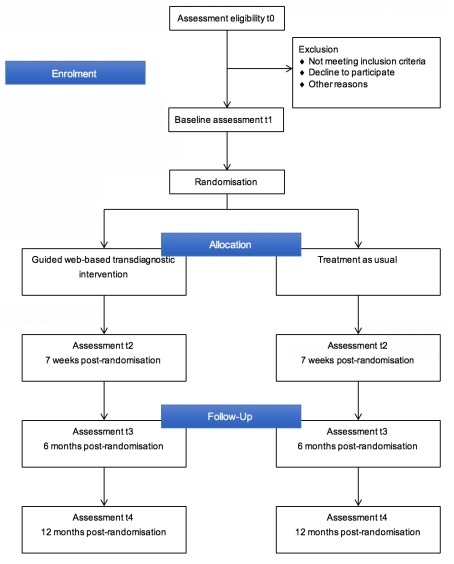
Introduction: The college years are a peak period for the onset of common mental disorders. Poor mental health is associated with low academic attainment, physical, interpersonal and cognitive impairments. Universities can use online approaches to screen students for mental disorders and treat those in need. The present study aims to assess the effectiveness of a guided web-based transdiagnostic individually tailored intervention to treat students with symptoms of depression and/or anxiety. Methods and analysis: The present study is a randomised controlled trial. Participants are Dutch college students (≥18 years) with mild to moderate depression and/or anxiety symptoms. The intervention is a guided web-based transdiagnostic individually tailored intervention that targets symptoms of depression and/or anxiety. The intervention consists of seven online sessions with a duration ranging from 4 to 7 weeks depending on individual progress. A booster session is administered 4 weeks after the completion of the seventh session. Primary outcome measures are the Patient Health Questionnaire for depression and the Generalised Anxiety Disorder 7-item scale for anxiety. These scales are administered at screening, post-treatment and follow-up assessments (6 and 12 months post-randomisation). E thics and dissemination: The Medical Ethics Committee of the Vrije Universiteit Medical Centre has approved the protocol (registration number 2016.583, A2017.362andA2018.421). Results of the trial will be published in a peer-reviewed journal. Trial registration number: NTR6797; Pre-results.
Overview
The claims and statistics of this paper haven’t been checked yet.
Free: it reads the open-access text and checks the first 5 claims that cite a source we can check. Create a free account to check every claim.
Integrity signals
Registry
Cites
Statistics
Figures
Verification
Claims the paper makes
The claims and statistics of this paper haven’t been checked yet.
Free: it reads the open-access text and checks the first 5 claims that cite a source we can check. Create a free account to check every claim.
Claims other papers make about this one
Each is checked against this paper’s own text: does it say what the citing paper says it does?
The cited source doesn’t support the claim as written.
In the citing paper
“and results have so far shown minor effects.”
From Transdiagnostic and tailored internet intervention to improve mental health among university students: Research protocol for a randomized controlled trial (2024) · cites this paper as [18]
Checked by a reasoning model — may be wrong.
Experimental — accuracy not yet measuredThe source backs part of the claim, not all of it — or backs it for a different population, condition or comparison.
In the citing paper
“Transdiagnostic interventions for mild to moderate depression and anxiety among university students have been developed and tested in Australia, Canada, Indonesia, the Netherlands, and the UK, [14–20]”
From Transdiagnostic and tailored internet intervention to improve mental health among university students: Research protocol for a randomized controlled trial (2024) · cites this paper as [18]
Experimental — accuracy not yet measured
Self-check
Percentages, sums and reported differences re-computed from the paper’s own numbers.
The self-check needs the paper’s full text.
Citations
Cites
The PHQ-9: Validity of a brief depression severity measure
Kroenke, K., Spitzer, R. L., & Williams, J. B. W. (2001) · Journal of General Internal Medicine · doi:10.1046/j.1525-1497.2001.016009606.x · Cited by 44,910
A Brief Measure for Assessing Generalized Anxiety Disorder: The GAD-7
Spitzer, R. L., Kroenke, K., Williams, J. B. W., & Löwe, B. (2006) · Archives of Internal Medicine · doi:10.1001/archinte.166.10.1092 · Cited by 31,765
Kessler, R. C., Berglund, P., Demler, O., Jin, R., Merikangas, K. R., & Walters, E. E. (2005) · Archives of General Psychiatry · doi:10.1001/archpsyc.62.6.593 · Cited by 20,391
Self-citation(1998) · The Journal of Clinical Psychiatry · Cited by 19,139
EuroQol: a new facility for the measurement of health-related quality of life
(1990) · Health Policy · doi:10.1016/0168-8510(90)90421-9 · Cited by 15,736
SAUNDERS, J. B., AASLAND, O. G., BABOR, T. F., DE LA FUENTE, J. R., & GRANT, M. (1993) · Addiction · doi:10.1111/j.1360-0443.1993.tb02093.x · Cited by 13,597
(1998) · PubMed · Cited by 10,216
Jacobson, N. S., & Truax, P. (1991) · Journal of Consulting and Clinical Psychology · doi:10.1037/0022-006x.59.1.12 · Cited by 7,770 · cited 2×
“To measure clinical significance, we will calculate response and symptom deterioration rates according to the Reliable Change Index.57 The reliable change will be calculated using the pretreatment SD, and the test–retest reliability coefficient of PHQ-9 (0.76)31 and GAD-7 (0.83).39 Analogously, Cohen’s d and clinicall…”
InfluentialThe PHQ-9: A New Depression Diagnostic and Severity Measure
Kroenke, K., & Spitzer, R. L. (2002) · Psychiatric Annals · doi:10.3928/0048-5713-20020901-06 · Cited by 5,898
Kessler, R. C., & Üstün, T. B. (2004) · International Journal of Methods in Psychiatric Research · doi:10.1002/mpr.168 · Cited by 4,771
Self-citationLecrubier, Y., Sheehan, D., Weiller, E., Amorim, P., Bonora, I., Sheehan, K. H., Janavs, J., & Dunbar, G. (1997) · European Psychiatry · doi:10.1016/s0924-9338(97)83296-8 · Cited by 3,513 · cited 1×
“The MINI shows good psychometric properties with good test–retest reliability and validity.(40) The MINI is administered at baseline (t1) and 12-month follow-up (t4).”
KESSLER, R. C., ADLER, L., AMES, M., DEMLER, O., FARAONE, S., HIRIPI, E., HOWES, M. J., JIN, R., SECNIK, K., SPENCER, T., et al. (2005) · Psychological Medicine · doi:10.1017/s0033291704002892 · Cited by 3,452
Self-citationAssessment of client/patient satisfaction: development of a general scale
Larsen, D. L., Attkisson, C. C., Hargreaves, W. A., & Nguyen, T. D. (1979) · Evaluation and Program Planning · doi:10.1016/0149-7189(79)90094-6 · Cited by 2,887
Auerbach, R. P., Collaborators, W. W.-I., Mortier, P., Bruffaerts, R., Alonso, J., Benjet, C., Cuijpers, P., Demyttenaere, K., Ebert, D. D., Green, J. G., et al. (2018) · Journal of Abnormal Psychology · doi:10.1037/abn0000362 · Cited by 2,522 · cited 2×
“Research has shown that depression and anxiety are highly prevalent among college students while the majority of lifetime cases begin before 24 years of age.(2) Not surprisingly, there is a positive association between mental health and academic attainment.”
Self-citationMental health problems and help-seeking behavior among college students
Hunt, J., & Eisenberg, D. (2010) · Journal of Adolescent Health · doi:10.1016/j.jadohealth.2009.08.008 · Cited by 1,949 · cited 1×
“As a result, depression and anxiety are considerably underdiagnosed and typically untreated during college years with an unnecessary chance of aggravation of problems.(11) The question arises as to how universities and colleges can provide treatment, which is effective, timely, available at low-cost, accessible and th…”
The client satisfaction questionnaire
Attkisson, C. C., & Zwick, R. (1982) · Evaluation and Program Planning · doi:10.1016/0149-7189(82)90074-x · Cited by 1,743
Mental disorders among college students in the World Health Organization World Mental Health Surveys
Auerbach, R. P., Alonso, J., Axinn, W. G., Cuijpers, P., Ebert, D. D., Green, J. G., Hwang, I., Kessler, R. C., Liu, H., Mortier, P., et al. (2016) · Psychological Medicine · doi:10.1017/s0033291716001665 · Cited by 1,587
Self-citationBlanco, C., Okuda, M., Wright, C., Hasin, D. S., Grant, B. F., Liu, S.-M., & Olfson, M. (2008) · Archives of General Psychiatry · doi:10.1001/archpsyc.65.12.1429 · Cited by 1,582 · cited 1×
“Less than 25% of college students with mental disorders use mental healthcare services.(8) The university can be an excellent environment for detecting students at high risk of mental disorders and for applying evidence-based treatment approaches to prevent and treat common mental disorders at an early stage.”
Computer-based psychological treatments for depression: A systematic review and meta-analysis
Richards, D., & Richardson, T. (2012) · Clinical Psychology Review · doi:10.1016/j.cpr.2012.02.004 · Cited by 1,442 · cited 1×
“Previous literature has shown that guided web-based interventions have a dropout rate of 28%.(55) Thus, considering the potential dropouts, the minimum sample for the RCT is 88 participants (44 participants per group).”
Social consequences of psychiatric disorders, I: Educational attainment
(1995) · American Journal of Psychiatry · doi:10.1176/ajp.152.7.1026 · Cited by 1,370
Self-citationNock, M. K., Holmberg, E. B., Photos, V. I., & Michel, B. D. (2007) · Psychological Assessment · doi:10.1037/1040-3590.19.3.309 · Cited by 1,352
Andersson, G., Cuijpers, P., Carlbring, P., Riper, H., & Hedman, E. (2014) · World Psychiatry · doi:10.1002/wps.20151 · Cited by 1,077 · cited 1×
“So far, the results have shown that web-based interventions with therapist support are superior to control groups with similar effect sizes to conventional faceto-face treatments.(18) Furthermore, several studies that examine the effects of web-based transdiagnostic and individually tailored interventions have emerged.”
Self-citationKaryotaki, E., Riper, H., Twisk, J., Hoogendoorn, A., Kleiboer, A., Mira, A., Mackinnon, A., Meyer, B., Botella, C., Littlewood, E., et al. (2017) · JAMA Psychiatry · doi:10.1001/jamapsychiatry.2017.0044 · Cited by 691
Self-citationHirschfeld, R. M. A. (2001) · The Primary Care Companion For CNS Disorders · doi:10.4088/pcc.v03n0609 · Cited by 661
(2005) · PubMed · Cited by 649
Davies, E. B., Morriss, R., & Glazebrook, C. (2014) · Journal of Medical Internet Research · doi:10.2196/jmir.3142 · Cited by 499 · cited 1×
“70 based on two recent meta-analyses on the effectiveness of psychotherapy in treating depressive symptoms in college students.(53) 54 If we set the statistical power at 0.”
Diagnostic accuracy of the mood module of the patient health questionnaire: a systematic review
Wittkampf, K. A., Naeije, L., Schene, A. H., Huyser, J., & van Weert, H. C. (2007) · General Hospital Psychiatry · doi:10.1016/j.genhosppsych.2007.06.004 · Cited by 493 · cited 1×
“97).(38) The PHQ-9 is administered at the screening (t0), post-treatment (t2) and follow-up (t3 and t4) assessments in the intervention group.”
Kessler, R. C., Birnbaum, H. G., Shahly, V., Bromet, E., Hwang, I., McLaughlin, K. A., Sampson, N., Andrade, L. H., de Girolamo, G., Demyttenaere, K., et al. (2010) · Depression and Anxiety · doi:10.1002/da.20634 · Cited by 477
Self-citationHarrer, M., Adam, S. H., Baumeister, H., Cuijpers, P., Karyotaki, E., Auerbach, R. P., Kessler, R. C., Bruffaerts, R., Berking, M., & Ebert, D. D. (2019) · International Journal of Methods in Psychiatric Research · doi:10.1002/mpr.1759 · Cited by 445
Self-citationEbert, D. D., Van Daele, T., Nordgreen, T., Karekla, M., Compare, A., Zarbo, C., Brugnera, A., Øverland, S., Trebbi, G., Jensen, K. L., et al. (2018) · European Psychologist · doi:10.1027/1016-9040/a000318 · Cited by 437 · cited 1×
“So far, the results have shown that web-based interventions with therapist support are superior to control groups 13–17 with similar effect sizes to conventional face-to-face treatments.”
Self-citationTest-retest reliability of health state valuations collected with the EuroQol questionnaire
van Agt, H. M. E., Essink-Bot, M.-L., Krabbe, P. F. M., & Bonsel, G. J. (1994) · Social Science & Medicine · doi:10.1016/0277-9536(94)90005-1 · Cited by 342 · cited 1×
“problems.(42) EQ-5D construct validity is adequate, and this type of measurement can detect meaningful changes for patients with anxiety disorders.”
Josephine, K., Josefine, L., Philipp, D., David, E., & Harald, B. (2017) · Journal of Affective Disorders · doi:10.1016/j.jad.2017.07.021 · Cited by 341 · cited 1×
“So far, the results have shown that web-based interventions with therapist support are superior to control groups 13–17 with similar effect sizes to conventional face-to-face treatments.”
Self-citationPăsărelu, C. R., Andersson, G., Bergman Nordgren, L., & Dobrean, A. (2017) · Cognitive Behaviour Therapy · doi:10.1080/16506073.2016.1231219 · Cited by 335
Karyotaki, E., Ebert, D. D., Donkin, L., Riper, H., Twisk, J., Burger, S., Rozental, A., Lange, A., Williams, A. D., Zarski, A. C., et al. (2018) · Clinical Psychology Review · doi:10.1016/j.cpr.2018.06.007 · Cited by 303
Self-citationTransdiagnostic internet treatment for anxiety and depression: a randomised controlled trial
Titov, N., Dear, B. F., Schwencke, G., Andrews, G., Johnston, L., Craske, M. G., & McEvoy, P. (2011) · Behaviour Research and Therapy · doi:10.1016/j.brat.2011.03.007 · Cited by 285
Dear, B. F., Titov, N., Sunderland, M., McMillan, D., Anderson, T., Lorian, C., & Robinson, E. (2011) · Cognitive Behaviour Therapy · doi:10.1080/16506073.2011.582138 · Cited by 282 · cited 1×
“83).(39) Analogously, Cohen’s d and clinically significant change will be calculated for follow-up assessments (6 and 12 months).”
Prevention and early intervention to improve mental health in higher education students: A review
Reavley, N., & Jorm, A. F. (2010) · Early Intervention in Psychiatry · doi:10.1111/j.1751-7893.2010.00167.x · Cited by 273
Reliability and Validity of Assessing User Satisfaction With Web-Based Health Interventions
Boß, L., Lehr, D., Reis, D., Vis, C., Riper, H., Berking, M., & Ebert, D. D. (2016) · Journal of Medical Internet Research · doi:10.2196/jmir.5952 · Cited by 251
Self-citationPrevention of Depression in the College Student Population: A Review of the Literature
Buchanan, J. L. (2012) · Archives of Psychiatric Nursing · doi:10.1016/j.apnu.2011.03.003 · Cited by 238
Individually-tailored, internet-based treatment for anxiety disorders: a randomized controlled trial
Carlbring, P., Maurin, L., Törngren, C., Linna, E., Eriksson, T., Sparthan, E., Strååt, M., Marquez von Hage, C., Bergman-Nordgren, L., & Andersson, G. (2011) · Behaviour Research and Therapy · doi:10.1016/j.brat.2010.10.002 · Cited by 227
Domhardt, M., Geßlein, H., von Rezori, R. E., & Baumeister, H. (2019) · Depression and Anxiety · doi:10.1002/da.22860 · Cited by 218
Cuijpers, P., Auerbach, R. P., Benjet, C., Bruffaerts, R., Ebert, D., Karyotaki, E., & Kessler, R. C. (2019) · International Journal of Methods in Psychiatric Research · doi:10.1002/mpr.1761 · Cited by 190 · cited 1×
“In many universities, psychologists offering services to students treat only study-related problems (eg, exam anxiety and procrastination) and not symptoms of mental disorders, such as depression and anxiety.(9) In addition, the fear of stigmatisation makes students reluctant to consult university counselling services.”
Self-citationTechnology-based interventions for mental health in tertiary students: Systematic review
Farrer, L., Gulliver, A., Chan, J. K., Batterham, P. J., Reynolds, J., Calear, A., Tait, R., Bennett, K., & Griffiths, K. M. (2013) · Journal of Medical Internet Research · doi:10.2196/jmir.2639 · Cited by 188 · cited 4×
“The outcomes of these trials were mixed and thus, inconclusive.(10) Moreover, to the best of our knowledge, previous studies on college students’ mental health have mostly focused on one disorder.”
InfluentialGroup prevention of depression and anxiety symptoms
Seligman, M. E. P., Schulman, P., & Tryon, A. M. (2007) · Behaviour Research and Therapy · doi:10.1016/j.brat.2006.09.010 · Cited by 187
Karyotaki, E., Kemmeren, L., Riper, H., Twisk, J., Hoogendoorn, A., Kleiboer, A., Mira, A., Mackinnon, A., Meyer, B., Botella, C., et al. (2018) · Psychological Medicine · doi:10.1017/s0033291718000648 · Cited by 167
Self-citationKessler, R. C., Santiago, P. N., Colpe, L. J., Dempsey, C. L., First, M. B., Heeringa, S. G., Stein, M. B., Fullerton, C. S., Gruber, M. J., Naifeh, J. A., et al. (2013) · International Journal of Methods in Psychiatric Research · doi:10.1002/mpr.1398 · Cited by 162
Self-citationBerger, T., Boettcher, J., & Caspar, F. (2014) · Psychotherapy · doi:10.1037/a0032527 · Cited by 158
Ebert, D. D., Donkin, L., Andersson, G., Andrews, G., Berger, T., Carlbring, P., Rozenthal, A., Choi, I., Laferton, J. A. C., Johansson, R., et al. (2016) · Psychological Medicine · doi:10.1017/s0033291716001562 · Cited by 154
Self-citationDay, V., McGrath, P. J., & Wojtowicz, M. (2013) · Behaviour Research and Therapy · doi:10.1016/j.brat.2013.03.003 · Cited by 145 · cited 1×
“66) compared with a waitlist control in college students.(29) Moreover, Mullin et al conducted an RCT examining the effects of iCBT in treating anxiety and depression of college students.”
the ESEMeD/MHEDEA 2000 investigators, König, H.-H., Heider, D., Lehnert, T., Riedel-Heller, S. G., Angermeyer, M. C., Matschinger, H., Vilagut, G., Bruffaerts, R., Haro, J. M., et al. (2010) · Health and Quality of Life Outcomes · doi:10.1186/1477-7525-8-143 · Cited by 143 · cited 1×
“EQ-5D is generally consistent with the measure of mood state: depression/anxiety.(43) The EQ-5D is administered at baseline (t1), post-treatment (t2) and follow-up (t3 and t4) assessments.”
Self-citationCuijpers, P., Cristea, I. A., Ebert, D. D., Koot, H. M., Auerbach, R. P., Bruffaerts, R., & Kessler, R. C. (2016) · Depression and Anxiety · doi:10.1002/da.22461 · Cited by 137
Self-citationInternet-Delivered Indicated Prevention For Anxiety Disorders: A Randomized Controlled Trial
Kenardy, J., McCafferty, K., & Rosa, V. (2003) · Behavioural and Cognitive Psychotherapy · doi:10.1017/s1352465803003047 · Cited by 121
ePREP: Computer Based Prevention of Relationship Dysfunction, Depression and Anxiety
Braithwaite, S. R., & Fincham, F. D. (2007) · Journal of Social and Clinical Psychology · doi:10.1521/jscp.2007.26.5.609 · Cited by 116
Alonso, J., Vilagut, G., Mortier, P., Auerbach, R. P., Bruffaerts, R., Cuijpers, P., Demyttenaere, K., Ebert, D. D., Ennis, E., Gutiérrez‐García, R. A., et al. (2019) · International Journal of Methods in Psychiatric Research · doi:10.1002/mpr.1750 · Cited by 79 · cited 1×
“IntroduCtIon Mental health problems, such as depression and anxiety, have a significant impact on college students’ functioning and are notably burdensome.(1) College years are a peak period for the first onset of common mental disorders.”
Self-citationSilfvernagel, K., Carlbring, P., Kabo, J., Edström, S., Eriksson, J., Månson, L., & Andersson, G. (2012) · Journal of Medical Internet Research · doi:10.2196/jmir.1853 · Cited by 69
Computer-Based Intervention for Anxious and Depressive Symptoms in a Non-Clinical Population
Cukrowicz, K. C., & Joiner, T. E. (2007) · Cognitive Therapy and Research · doi:10.1007/s10608-006-9094-x · Cited by 68
Mullin, A., Dear, B. F., Karin, E., Wootton, B. M., Staples, L. G., Johnston, L., Gandy, M., Fogliati, V., & Titov, N. (2015) · Internet Interventions · doi:10.1016/j.invent.2015.02.002 · Cited by 60 · cited 2×
“Moreover, Mullin et al conducted an RCT examining the effects of iCBT in treating anxiety and depression of college students.(30) The authors found significant results in favour of the transdiagnostic web-based intervention compared with a waiting list (anxiety: d=1.”
Weisel, K. K., Zarski, A.-C., Berger, T., Krieger, T., Schaub, M. P., Moser, C. T., Berking, M., Dey, M., Botella, C., Baños, R., et al. (2019) · Internet Interventions · doi:10.1016/j.invent.2018.04.002 · Cited by 57 · cited 1×
“This intervention has been initially developed in the German language for use in the general population and is based on adaptions of a range of evidence-based interventions.(34) 35 Thus, it has been translated into Dutch and English and adapted to college student needs after a series of focus group discussions with co…”
Self-citationPresenteeism in college students: reliability and validity of the Presenteeism Scale for Students
Matsushita, M., Adachi, H., Arakida, M., Namura, I., Takahashi, Y., Miyata, M., Kumano-go, T., Yamamura, S., Shigedo, Y., Suganuma, N., et al. (2011) · Quality of Life Research · doi:10.1007/s11136-010-9763-9 · Cited by 40 · cited 2×
“Regarding educational achievement, the Presenteeism Scale for Students (PSS) is used to assess presenteeism.(47) The PSS is a valid and reliable measure for the college student population.”
Bolinski, F., Kleiboer, A., Karyotaki, E., Bosmans, J. E., Zarski, A.-C., Weisel, K. K., Ebert, D. D., Jacobi, C., Cuijpers, P., & Riper, H. (2018) · Trials · doi:10.1186/s13063-018-2477-y · Cited by 31 · cited 1×
“35 Thus, it has been translated into Dutch and English and adapted to college student needs after a series of focus group discussions with college students.(36) The intervention strategies have been based mainly on cognitive behavioural techniques.”
Self-citationWeisel, K. K., Zarski, A.-C., Berger, T., Schaub, M. P., Krieger, T., Moser, C. T., Berking, M., & Ebert, D. D. (2018) · Frontiers in Psychiatry · doi:10.3389/fpsyt.2018.00274 · Cited by 21
Self-citationder Heijde, C. M. V., Vonk, P., & Meijman, F. J. (2015) · Health Psychology and Behavioral Medicine · doi:10.1080/21642850.2015.1049950 · Cited by 18 · cited 1×
“Universities can use electronic media to screen for students with mental disorders but also treat those in need.(12) Recently, web-based psychological interventions have been developed and examined in research and clinical settings.”
Self-citation
Cited by
Karyotaki, E., Cuijpers, P., Albor, Y., Alonso, J., Auerbach, R. P., Bantjes, J., Bruffaerts, R., Ebert, D. D., Hasking, P., Kiekens, G., et al. (2020) · Frontiers in Psychology · doi:10.3389/fpsyg.2020.01759 · Cited by 389
Self-citationPsychological Counseling among University Students Worldwide: A Systematic Review
Cerolini, S., Zagaria, A., Franchini, C., Maniaci, V. G., Fortunato, A., Petrocchi, C., Speranza, A. M., & Lombardo, C. (2023) · European Journal of Investigation in Health Psychology and Education · doi:10.3390/ejihpe13090133 · Cited by 136
“Among them, seven presented RCT protocols (e.g., [96,112,113], one introduced a new technology-based counseling environment (a virtual reality platform; [114]), and two presented psychological intervention program protocols.”
Forbes, A., Keleher, M. R., Venditto, M., & DiBiasi, F. (2023) · Journal of Medical Internet Research · doi:10.2196/43727 · Cited by 94
“Many studies provided coach feedback to participants after each lesson [72,75,77,99,106,108,111,122,124,130,135,141,144,145,154,155,157,158].”
Liu, X., Guo, Y.-X., & Xu, Y. (2023) · World Journal of Clinical Cases · doi:10.12998/wjcc.v11.i7.1442 · Cited by 115
Bourion-Bédès, S., Tarquinio, C., Batt, M., Tarquinio, P., Lebreuilly, R., Sorsana, C., Legrand, K., Rousseau, H., & Baumann, C. (2021) · Psychiatry Research · doi:10.1016/j.psychres.2020.113559 · Cited by 90
Metadata
- Authors
- Karyotaki, E., Klein, A. M., Riper, H., Wit, L. D., Krijnen, L., Bol, E., Bolinski, F., Burger, S., Ebert, D. D., Auerbach, R. P., Kessler, R. C., Bruffaerts, R., Batelaan, N., van der Heijde, C. M., Vonk, P., Kleiboer, A., Wiers, R. W., & Cuijpers, P.
- Affiliations
- Amsterdam Public Health (NL)
- University of Amsterdam (NL)
- Department of Clinical, Neuro, and Developmental Psychology, Vrije Universiteit Amsterdam, Amsterdam, The Netherlands
- Vrije Universiteit Amsterdam (NL)
- Friedrich-Alexander-Universität Erlangen-Nürnberg (DE)
- Columbia University (US)
- Harvard University (US)
- KU Leuven (BE)
- Department of Research, Development and Prevention, Student Health Service University of Amsterdam, Amsterdam, The Netherlands
- Corresponding author
- Karyotaki, Eirini
- ORCID
- Venue
- BMJ Open
- Publisher
- BMJ
- Published
- 2019-05
- Volume
- 9
- Issue
- 5
- Pages
- e028739
- ISSN
- 2044-6055 (ISSN-L)
- PMC
- PMC6530301
- OpenAlex
- W2944915918
- Cited by
- 28
- References
- 64
- Citations by year
- 2025: 2 · 2024: 4 · 2023: 8 · 2022: 3 · 2021: 7 · 2020: 4
- FWCI
- 3.96
- Type
- journal article
- Language
- en
- Open access
- gold
- doi.org
- Licence
- cc-by-nc
- Locations
- BMJ Open (publishedVersion, cc-by-nc)
- PubMed Central (publishedVersion, cc-by-nc)
- PubMed (publishedVersion)
- HighWire Press Open Archive (acceptedVersion)
- UvA-DARE (University of Amsterdam) (submittedVersion, cc-by-nc)
- Lirias (KU Leuven) (submittedVersion, cc-by-nc)
- Pure Amsterdam UMC (submittedVersion, cc-by)
- VU Research Portal (submittedVersion, cc-by-nc)
- Data Archiving and Networked Services (DANS) (submittedVersion, other-oa)
- Funders
- ZonMw
- Topics
- Social Sciences › Psychology › Applied Psychology › Digital Mental Health Interventions
- Social Sciences › Psychology › Experimental and Cognitive Psychology › Anxiety, Depression, Psychometrics, Treatment, Cognitive Processes
- Health Sciences › Medicine › Psychiatry and Mental health › Mental Health Treatment and Access
- Keywords
- depression, anxiety, university students, online intervention, transdiagnostic treatment, mental health screening, university mental health, booster sessions, PHQ-9, GAD-7
- MeSH terms
- Patient Health Questionnaire, Internet-Based Intervention, Adolescent, Anxiety, Depression, Female, Follow-Up Studies, Humans, Male, Students, Universities, Cognitive Behavioral Therapy, Randomized Controlled Trials as Topic, Treatment Outcome
About these checks
Registry, retraction, Cites and statistics results are computed, not judged, with one exception: a printed reference that no index lists is read once by a model before it counts as a citation error. Claims are extracted by a model and kept only when their quote appears verbatim in the text; each cited source is then checked, with a model’s help, for whether it says what the claim relies on. Those verdicts can be wrong — read the claim’s quote and the cited source before relying on one.
Statistics and arithmetic are recomputed, not judged.
Confidence bands are shown only for fields calibrated on our annotated test set. None is calibrated yet, so no band is shown.
What counts as a claim ›How we measure confidence ›How we check this ›
Are you an author, or do you see a problem with this page? Request a review
Data sources
Bibliographic data: Semantic Scholar, OpenAlex, Crossref.
Contains information from the Semantic Scholar Academic Graph Datasets, made available under the ODC Attribution License (ODC-BY 1.0).
Semantic Scholar’s data is described in: Kinney, R., et al. (2023). The Semantic Scholar Open Data Platform. arXiv:2301.10140.
