

Health care professionals’ views towards self-management and self-management education for people with type 2 diabetes
Open accessThe DOI matches its Crossref record; 42 of the 42 references it cites were found in a registry or an index; 4 of the 40 sources its claims cite were checked for support.
Abstract
Objectives: Significant problems with patients engaging with diabetes self-management education (DSME) exist. The role of healthcare professionals (HCPs) has been highlighted, with a lack of enthusiasm, inadequate information provision and poor promotion of available programmes all cited as affecting patients’ decisions to attend. However, little is known about HCPs’ views towards DSME. This study investigates the views of HCPs towards self-management generally and self-management in the context of DSME more specifically. Design: A qualitative study using semi-structured interviews to investigate HCPs views of type 2 diabetes self-management and DSME. Data were analysed thematically and emergent themes were mapped on to the constructs of Normalisation Process Theory (NPT). Setting: Two boroughs in London, UK. Participants: Sampling was purposive to recruit a diverse range of professional roles including GPs, practice nurses, diabetes specialist nurses, healthcare assistants (HCAs), receptionists and commissioners of care. Results: Interviews were conducted with 22 participants. The NPT analysis demonstrated that while a self-management approach to diabetes care was viewed by HCPs as necessary and, in principle, valuable, the reality is much more complex. HCPs expressed ambivalence about pushing certain patients into self-managing, preferring to retain responsibility. There was a lack of awareness among HCPs about the content of DSME and benefits to patients. Commitment to and engagement with DSME was tempered by concerns about suitability for some patients. There was little evidence of communication between providers of group-based DSME and HCPs or of HCPs engaging in work to follow-up non-attenders. Conclusions: HCPs have concerns about the appropriateness of DSME for all patients and discussed challenges to engaging with and performing the tasks required to embed the approach within practice. DSME, as a means of supporting self-management, was considered important in theory, but there was little evidence of HCPs seeing their role as extending beyond providing referrals.
Overview
CoChat Summary
TL;DR
In interviews with 22 healthcare professionals in two London boroughs, self-management for type 2 diabetes was seen as necessary and valuable in principle, but professionals were ambivalent about pushing it for all patients and had limited awareness of diabetes self-management education (DSME) content and benefits. Their role in DSME was largely limited to referral, with little follow-up of non-attenders or communication with DSME providers.
Key findings
- Twenty-two HCPs were interviewed (of 26 approached; 4 did not respond), including 4 GPs, 10 nurses, 3 healthcare assistants, 3 reception/admin staff, 1 practice manager and 1 commissioner; 15 (68.2%) had attended a DSME taster session and 13 (59.1%) had experience with online DSME.
- Normalisation Process Theory analysis showed that while a self-management approach was viewed as necessary and valuable in principle, HCPs expressed ambivalence about pushing certain patients to self-manage, preferring to retain responsibility for some, and raised concerns about suitability for patients with mental health problems, learning difficulties, low education/health literacy, or non-English-speaking backgrounds.
- Awareness of DSME content and benefits was polarised between those with personal experience of DSME and those without; commitment to DSME was tempered by concerns about suitability for some patients.
- There was little evidence of communication between group-based DSME providers and HCPs, or of HCPs following up non-attenders; HCPs generally saw their role as limited to providing referrals, though some with direct DSME experience described engaging patients more actively.
Methods
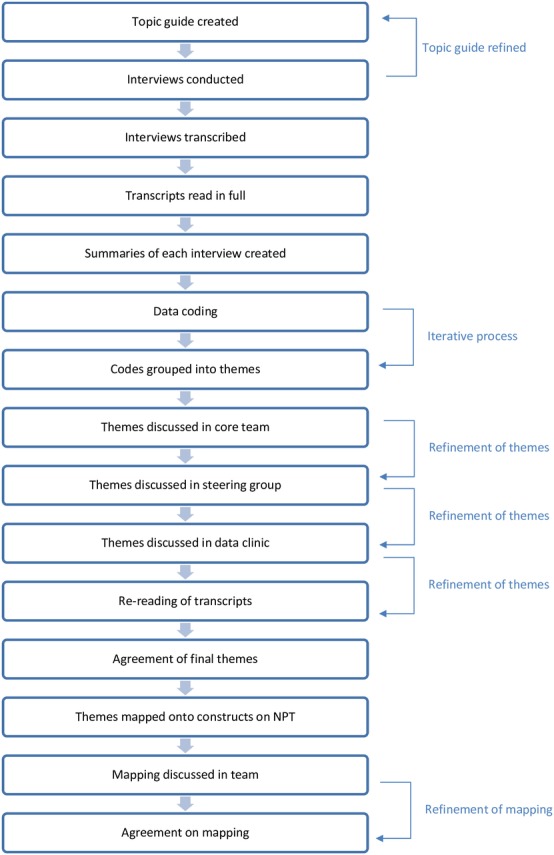
- Qualitative cross-sectional study using semi-structured interviews with HCPs working in primary, secondary and intermediate care services for patients with type 2 diabetes in two inner-city North London boroughs; purposive sampling recruited a diverse range of professional roles.
- Interviews were conducted between July 2013 and August 2015, lasted 30 min to an hour, and continued until data saturation; topic guides were informed by Normalisation Process Theory.
- Data were analysed thematically, initially inductively, then themes were mapped onto the four NPT constructs (Coherence, Cognitive Participation, Collective Action, Reflexive Monitoring); NVivo 10 was used, with patient and public involvement input.
Limitations
- The paper states the sample was limited to HCPs within two London boroughs, so views and available services may not generalise more widely, especially given the boroughs’ ethnic, cultural and socioeconomic diversity.
- The paper states interviews were conducted in the context of a wider HeLP-Diabetes implementation study; the interviewer had been involved in implementation and was known to many participants, and three steering group members worked in the boroughs, creating potential social desirability bias.
- Evident from the text: there were no formal systems for monitoring DSME attendance, monitoring appeared haphazard and varied by practice, and HCPs were often unaware of uptake figures, so accounts of promotion and follow-up rely on self-report.
Model-written summary. Check it against the paper before relying on it.
Integrity signals
Registry
Cites
Statistics
Figures
Verification
Claims the paper makes
1 Valid · 1 Not valid · 23 Not checked · 94 Own results and interpretations
The cited sources support only part of this claim — read each source’s verdict below.
In the paper
“Poor attendance rates are a major concern given that high quality DSME can have positive effects on quality of life and health outcomes17–20”
§ Health care professionals’ views towards self-management and self-management education for people with type 2 diabetes > Introduction
What the sources say
- Partly supportedcites [17] Murray E, Sweeting M, Dack C, et al Web-based self-management support for people with type 2 diabetes (HeLP-Diabetes): randomised controlled trial in English primary care. BMJ Open 2017; 7: e016009 10.1136/bmjopen-2017-016009 PMC5623569 28954789 sourceExperimental — accuracy not yet measured
The Introduction (p. 1) does state that 'Interventions which improve self-management skills for patients with diabetes can improve health outcomes and reduce healthcare costs' and that uptake of diabetes self-management education remains low (5.3% attendance in England 2014–2015), which supports the health-outcomes/low-attendance part of the citing sentence. However, our copy nowhere attributes positive effects on quality of life to DSME: quality of life appears only as background (distress 'severely impacts on quality of life', Discussion, crediting Chew et al. 2015; and a meta-ethnography on empowerment and QoL, crediting Frost et al. 2014). Moreover, this trial's own results run against the QoL element — no overall impact on the diabetes-related distress coprimary outcome (PAID mean difference −1.5, 95% CI −3.9 to 0.9, p=0.209; Table 2, Results) and no differences on secondary outcomes except systolic blood pressure (Results, Secondary outcomes). (LLM, conf=0.75)
- Partly supportedcites [18] Norris SL, Lau J, Smith SJ, et al Self-management education for adults with type 2 diabetes: a meta-analysis of the effect on glycemic control. Diabetes Care 2002; 25: 1159– 71. 10.2337/diacare.25.7.1159 12087014 sourceExperimental — accuracy not yet measured
Our copy of Norris et al. (2002) supports the 'health outcomes' half only in a narrower form: the Abstract/Conclusions and Meta-regression sections state that DSME improves glycemic control (GHb) in adults with type 2 diabetes, and the review deliberately restricted itself to GHb outcomes ('Of these studies, 40 examined GHb outcomes', RESULTS). The 'quality of life' half is not a finding of this paper: quality of life appears only in the Introduction as one of the stated goals of self-management education, credited to another reference (ref. 8), and the paper reports no quality-of-life results (psychosocial/quality-of-life effect sizes are attributed to Brown's earlier meta-analyses, refs. 11, 12, 69). The claim's 'high quality' framing is also looser than the source, whose only significant intervention predictor of benefit was total contact time, with the caveat that benefit declines 1-3 months after the intervention ends. (LLM, conf=0.78)
- Partly supportedcites [19] Davies MJ, Heller S, Skinner TC, et al Effectiveness of the diabetes education and self management for ongoing and newly diagnosed (DESMOND) programme for people with newly diagnosed type 2 diabetes: cluster randomised controlled trial. BMJ 2008; 336: 491– 5. 10.1136/bmj.39474.922025.BE 18276664 PMC2258400 sourceExperimental — accuracy not yet measured
The DESMOND trial (Davies et al. 2008) supports the 'health outcomes' half of the claim: Biomedical outcomes (Table 2) report significantly greater weight loss at 12 months (-1.01 kg, P=0.027) and a triglyceride reduction at 8 months, and Psychosocial measures/Implications report significantly better illness beliefs (P<0.001) and lower depression scores at 12 months (P=0.032), plus improvements in smoking and physical activity. However, the quality-of-life component is contrary to this source: the Quality of life section states 'The groups did not differ significantly in any of the scores for six dimensions of quality of life'. So attributing a positive effect on quality of life to this paper is not supported, and the Introduction even notes that at the time 'no evidence supports the belief that structured education provides added benefit for patients from the point of diagnosis'. (LLM, conf=0.78)
- Partly supportedcites [20] Loveman E, Frampton GK, Clegg AJ The clinical effectiveness of diabetes education models for Type 2 diabetes: a systematic review. Health Technol Assess 2008; 12: 1– 136. 10.3310/hta12090 18405469 sourceExperimental — accuracy not yet measured
Our copy supports the 'health outcomes' half: the Statement of principal findings reports statistically significant HbA1c effects 'in the region of a 1% change in many of the studies, which may reflect a clinically significant effect', plus significant effects on knowledge and some weight/BMI outcomes, and the Conclusions (Implications for service provision) tie this to 'high-quality patient-education programmes' delivered by a team with reinforcement, which 'may provide the best opportunity for improvements in patient outcomes'. The quality-of-life half is not supported as stated: the Interim summary and Outcomes sections say validated-instrument QoL was measured in only two published trials and 'the results were conflicting' (Trento showed significant DQOL improvement at 2 and 5 years; Deakin showed no significant ADDQoL difference at 14 months). The review's overall verdict is that effects are 'inconsistent' and that impact on patient-relevant outcomes (HbA1c, QoL, long-term complications) 'has been limited', so the unqualified positive framing of QoL effects overstates this source. (LLM, conf=0.72)
plainstates a cause- Asserted: passes — The authors put it forward as true.
- Checkable: passes — It can be checked against evidence.
- Load-bearing: passes — The paper’s conclusions depend on it.
- Based: passes — The paper gives a reason why it holds.
- Partly supported
A result the paper reports from its own data — it cites no other source for it, so there is none to check. The quote shows it is in the paper.
In the paper
“The value of group-based and online DSME were often presented in contrast to one another with the strength of one being the weakness of the other.”
§ Health care professionals’ views towards self-management and self-management education for people with type 2 diabetes > Results > Coherence
plainstates an association- Asserted: passes — The authors put it forward as true.
- Checkable: passes — It can be checked against evidence.
- Load-bearing: unclear — It is unclear whether the paper’s conclusions depend on it.
- Based: passes — The paper gives a reason why it holds.
A result the paper reports from its own data — it cites no other source for it, so there is none to check. The quote shows it is in the paper.
In the paper
“For those who had no personal experience with DSME many reported gaining their knowledge about what DSME consisted of and its value from patients who had attended.”
§ Health care professionals’ views towards self-management and self-management education for people with type 2 diabetes > Results > Coherence
plainstates a cause- Asserted: passes — The authors put it forward as true.
- Checkable: passes — It can be checked against evidence.
- Load-bearing: unclear — It is unclear whether the paper’s conclusions depend on it.
- Based: passes — The paper gives a reason why it holds.
A result the paper reports from its own data — it cites no other source for it, so there is none to check. The quote shows it is in the paper.
In the paper
“Other HCPs reported that they perceived resistance around putting a self-management approach into action within their practice because of the increased workload that this approach was perceived to create.”
§ Health care professionals’ views towards self-management and self-management education for people with type 2 diabetes > Results > Collective action
plainstates a cause- Asserted: passes — The authors put it forward as true.
- Checkable: passes — It can be checked against evidence.
- Load-bearing: passes — The paper’s conclusions depend on it.
- Based: passes — The paper gives a reason why it holds.
A result the paper reports from its own data — it cites no other source for it, so there is none to check. The quote shows it is in the paper.
In the paper
“HCPs did not report in engaging regularly in any activities which would allow them to reflect on DSME.”
§ Health care professionals’ views towards self-management and self-management education for people with type 2 diabetes > Results > Reflexive monitoring
plain- Asserted: passes — The authors put it forward as true.
- Checkable: passes — It can be checked against evidence.
- Load-bearing: unclear — It is unclear whether the paper’s conclusions depend on it.
- Based: passes — The paper gives a reason why it holds.
35 more claims
Create a free account to see all 119 claims and to verify the 35 references still open.
- Probably not a substantial claim. 58
- It may state two separate claims as one. 45
Claims other papers make about this one
Each is checked against this paper’s own text: does it say what the citing paper says it does?
In the citing paper
“Interestingly, however, several studies have found that physicians may feel unable to discuss the benefits, goals and expectations of DSME due to their own lack of knowledge of DSME [46, 47].”
From A qualitative study exploring the barriers to attending structured education programmes among adults with type 2 diabetes (2022) · cites this paper as [46]
Citations
Cites
Implementing, Embedding, and Integrating Practices: An Outline of Normalization Process Theory
May, C., & Finch, T. (2009) · Sociology · doi:10.1177/0038038509103208 · Cited by 2,115
Self-citationSelf-Management Education for Adults With Type 2 Diabetes
Norris, S. L., Lau, J., Smith, S. J., Schmid, C. H., & Engelgau, M. M. (2002) · Diabetes Care · doi:10.2337/diacare.25.7.1159 · Cited by 1,750
Development of a theory of implementation and integration: Normalization Process Theory
May, C. R., Mair, F., Finch, T., MacFarlane, A., Dowrick, C., Treweek, S., Rapley, T., Ballini, L., Ong, B. N., Rogers, A., et al. (2009) · Implementation Science · doi:10.1186/1748-5908-4-29 · Cited by 1,409
Self-citationGrounded Theory for Qualitative Research: A Practical Guide
Urquhart, C. (2013) · doi:10.4135/9781526402196 · Cited by 1,041
Davies, M. J., Heller, S., Skinner, T. C., Campbell, M. J., Carey, M. E., Cradock, S., Dallosso, H. M., Daly, H., Doherty, Y., Eaton, S., et al. (2008) · BMJ · doi:10.1136/bmj.39474.922025.be · Cited by 760
Nicolucci, A., Kovacs Burns, K., Holt, R. I. G., Comaschi, M., Hermanns, N., Ishii, H., Kokoszka, A., Pouwer, F., Skovlund, S. E., Stuckey, H., et al. (2013) · Diabetic Medicine · doi:10.1111/dme.12245 · Cited by 739
May, C. R., Cummings, A., Girling, M., Bracher, M., Mair, F. S., May, C. M., Murray, E., Myall, M., Rapley, T., & Finch, T. (2018) · Implementation Science · doi:10.1186/s13012-018-0758-1 · Cited by 683
Self-citationMcEvoy, R., Ballini, L., Maltoni, S., O’Donnell, C. A., Mair, F. S., & MacFarlane, A. (2014) · Implementation Science · doi:10.1186/1748-5908-9-2 · Cited by 413 · cited 1×
“36 NPT is widely used in process evaluations of innovations in healthcare organisation and delivery.(37) 38 It focuses on the ‘work’ of implementation.”
MethodStructured patient education: the Diabetes X‐PERT Programme makes a difference
Deakin, T. A., Cade, J. E., Williams, R., & Greenwood, D. C. (2006) · Diabetic Medicine · doi:10.1111/j.1464-5491.2006.01906.x · Cited by 374
100 Questions (and Answers) About Qualitative Research
Given, L. M. (2016) · doi:10.4135/9781483398655 · Cited by 309
Research works printed but not linked: 2
- Shaii S, Kumpatla S, Viswanathan V Bias and barriers influencing patients’ attendance towards diabetes education programme. TAPI Journal 2012; 4: 1– 7.
- National Institute for Health and Care Excellence. Type 2 diabetes in adults: management NICE guideline [NG28], 2015. 26741015
Cited by
Coningsby, I., Ainsworth, B., & Dack, C. (2022) · BMC Health Services Research · doi:10.1186/s12913-022-07980-w · Cited by 50
Self-citationHadjiconstantinou, M., Schreder, S., Brough, C., Northern, A., Stribling, B., Khunti, K., & Davies, M. J. (2020) · Journal of Medical Internet Research · doi:10.2196/17316 · Cited by 44
Ross, J., Cotterill, S., Bower, P., & Murray, E. (2023) · Journal of Medical Internet Research · doi:10.2196/40961 · Cited by 34
Self-citationKnowledge, attitude and practice of diabetes among secondary school-going children in Bangladesh
Akter, F., Rashid, S. M. M., Alam, N., Lipi, N., Qayum, M. O., Nurunnahar, M., & Mannan, A. (2022) · Frontiers in Public Health · doi:10.3389/fpubh.2022.1047617 · Cited by 34
Allory, E., Lucas, H., Maury, A., Garlantézec, R., Kendir, C., Chapron, A., & Fiquet, L. (2020) · BMC Health Services Research · doi:10.1186/s12913-020-05715-3 · Cited by 26
Educational Processes for Health and Disease Self-Management in Public Health: A Systematic Review
Ruiz-Ramírez, J. A., Olarte-Arias, Y. A., & Glasserman‐Morales, L. D. (2021) · International Journal of Environmental Research and Public Health · doi:10.3390/ijerph18126448 · Cited by 25
Barriers to Access to Care in Hispanics With Type 2 Diabetes: A Systematic Review
Titus, S. K., & Kataoka‐Yahiro, M. (2020) · Hispanic Health Care International · doi:10.1177/1540415320956389 · Cited by 18
Singh, H., Tahsin, F., Nie, J. X., McKinstry, B., Thavorn, K., Upshur, R. E. G., Harvey, S., Wodchis, W. P., & Gray, C. S. (2021) · BMC Medical Informatics and Decision Making · doi:10.1186/s12911-021-01734-0 · Cited by 15
Pasciak, W., Berg, D. N., Cherlin, E. J., Fried, T. R., & Lipska, K. J. (2021) · BMC Geriatrics · doi:10.1186/s12877-021-02268-w · Cited by 12
Diyabet Öz Yönetiminde Çok Disiplinli Ekip Yaklaşımı
Yıldırım, A., Hacıhasanoğlu, A., Bozdemir, N., & Aşılar, R. H. (2020) · Turkish Journal of Family Medicine & Primary Care · doi:10.21763/tjfmpc.698927 · Cited by 13
Hale, L. A., Higgs, C., Keen, D., & Smith, C. (2022) · Frontiers in Rehabilitation Sciences · doi:10.3389/fresc.2022.829542 · Cited by 11
Wongrith, P., Thirarattanasunthon, P., & Kaewsawat, S. (2021) · Journal of Diabetes & Metabolic Disorders · doi:10.1007/s40200-021-00851-x · Cited by 11
Bako, K. R., Reynolds, A. N., Sika‐Paotonu, D., Signal, L. N., & Mohammadnezhad, M. (2022) · Global Journal of Health Science · doi:10.5539/gjhs.v15n1p1 · Cited by 10
Wang, Q., Miao, G., Miao, S., Li, P., & Chen, J. (2025) · Scientific Reports · doi:10.1038/s41598-025-08537-7 · Cited by 10
Henderson, D., Salmons, H., Winston, P., & Koehn, D. A. (2022) · Current Diabetes Reviews · doi:10.2174/1573399819666220721113103 · Cited by 9
Penney-Amador, C., Salmerón, G. M., Muñoz-Torres, A. V., Roy-García, I. A., MACORRA, R. A.-D. L., LAM-CHAVEZ, A. E., Escobedo, J., & López, L. V. (2020) · Revista médica de Chile · doi:10.4067/s0034-98872020000400478 · Cited by 9
Pita, A. P. P., Bustos, B. C. V., & Bastidas, J. A. O. (2020) · Universidad y Salud · doi:10.22267/rus.202203.197 · Cited by 9
Timmermans, L., Decat, P., Foulon, V., Hecke, A. V., Vermandere, M., & Schoenmakers, B. (2024) · BMC Medical Education · doi:10.1186/s12909-024-05799-z · Cited by 8
Forde, R., Collin, J., Brackenridge, A., Chamley, M., Hunt, K. F., & Forbes, A. (2021) · Midwifery · doi:10.1016/j.midw.2021.103130 · Cited by 8
Lin, C., Guan, Q., Su, B., Lin, H., Xu, Y., Wu, Q., & Ge, L. (2025) · BMC Pregnancy and Childbirth · doi:10.1186/s12884-025-07932-2 · Cited by 5
Russell, S., Stocker, R., Cockshott, Z., Mason, S. M., Knight, J., Hanratty, B., & Preston, N. J. (2025) · BMC Geriatrics · doi:10.1186/s12877-025-06217-9 · Cited by 5
Self-management of long-term conditions: a district nursing perspective of patient engagement
Vaughan, K., & Lavery, J. P. (2024) · British Journal of Community Nursing · doi:10.12968/bjcn.2024.0035 · Cited by 5
Wyke, E., Baxter, E. R., Chew-Graham, C. A., Woodward, A., Walters, K. R., Davies, N., Taylor, S. J., Ross, J., Protheroe, J., Mitchell, C. A., et al. (2025) · British Journal of General Practice · doi:10.3399/bjgp.2025.0361 · Cited by 3
Self-citationHawkes, R. E., Ashpole, D., Baxter, M. S., Bickerton, A. S. T., Osei-Kwasi, H., Rutter, M. K., Taylor, D. R., Wake, D. J., Willis, T., & Brooks, J. M. (2025) · BMJ Open · doi:10.1136/bmjopen-2025-105869 · Cited by 3
Hale, L. A., McCulloch, M., Ruiter, S. D., Wihongia, E., Norlinga, E. M., Gorczynski, D., Kennedy, P., & Jones, F. (2023) · New Zealand Journal of Physiotherapy · doi:10.15619/nzjp/49.2.02 · Cited by 3
Lee, L. E., Kulnik, S. T., Curran, G. M., Boaz, A., & Ramdharry, G. M. (2023) · Pilot and Feasibility Studies · doi:10.1186/s40814-022-01231-9 · Cited by 2
Hawkes, R. E., Osei-Kwasi, H., Ashpole, D., Baxter, M. S., Bickerton, A. S. T., Cunningham, S. G., Taylor, D., Wake, D. J., Willis, T., Rutter, M. K., et al. (2026) · doi:10.2196/preprints.106931 · Cited by 2
Rodham, K. (2021) · Pain Management · doi:10.2217/pmt-2020-0022 · Cited by 2
Remote primary healthcare in the UK: How does marginalisation shape experiences of healthcare?
Humphrey, A. (2023) · LSHTM Research Online (London School of Hygiene and Tropical Medicine) · doi:10.17037/pubs.04671754 · Cited by 2
Saboo, B., Joshi, S., Maheshwari, A., Kesavadev, J., Jothydev, K., Krishnan, G., Basanth, A., & Anthuvan, T. (2025) · International Journal of Diabetes and Technology · doi:10.4103/ijdt.ijdt_38_25 · Cited by 1
Olorunfemi, O. (2023) · Indian Journal of Medical Specialities · doi:10.4103/injms.injms_15_23 · Cited by 1
Moubarak, N., & Douville, F. (2022) · Quality Advancement in Nursing Education - Avancées en formation infirmière · doi:10.17483/2368-6669.1332 · Cited by 1
Staff Education on Diabetes Self-Management for Patients
Okoye, G. E. (2021) · ScholarWorks (Walden University) · Cited by 1
Matthew, T. (2021) · UWE Research Repository (UWE Bristol) · Cited by 1
Physical activity in people with osteoarthritis and comorbidity: a multi-method study
McKevitt, S. (2021) · Keele Research Repository (Keele University) · Cited by 1
Self-care practice in young adults with type 2 diabetes mellitus
Gutiérrez-Valverde, J. M., Catalán-Gómez, C. A., Morales, M. D. L. Á. P., Rueda-Sánchez, C. B., Quintana-Lagunas, R., & Valtier, M. C. G. (2024) · Salud Ciencia y Tecnología · doi:10.56294/saludcyt2024957 · Cited by 1
Xu, Y., Yang, C., Zhi, J., Ma, Y., Zheng, H., Liu, Q., & Liao, J. (2026) · Frontiers in Public Health · doi:10.3389/fpubh.2026.1781781
Qebengu, N., & Mogale, M. (2026) · Frontiers in Health Services · doi:10.3389/frhs.2026.1917504
Lundstrøm, S. L., Burns, K., Hempler, N. F., Christensen, N. I., Toft, U., Snorgaard, O., & Jakobsen, L. M. (2026) · Chronic Illness · doi:10.1177/17423953261476052
Ross, J., Ng, C. M., Lee, S. W. H., & Gupta, S. (2026) · Springer eBooks · doi:10.1007/978-3-032-24854-1_12
Self-citationTimmermans, L., Decat, P., Foulon, V., Van Hecke, A., Vermandere, M., & Schoenmakers, B. (2024) · Figshare · doi:10.6084/m9.figshare.26756233
Timmermans, L., Decat, P., Foulon, V., Van Hecke, A., Vermandere, M., & Schoenmakers, B. (2024) · Figshare · doi:10.6084/m9.figshare.26756236
Coningsby, I., Ainsworth, B., & Dack, C. (2022) · Figshare · doi:10.6084/m9.figshare.19695609
Self-citationAllory, E., Lucas, H., Maury, A., Garlantézec, R., Kendir, C., Chapron, A., & Fiquet, L. (2020) · Figshare · doi:10.6084/m9.figshare.12947701
Allory, E., Lucas, H., Maury, A., Garlantézec, R., Kendir, C., Chapron, A., & Fiquet, L. (2020) · Figshare · doi:10.6084/m9.figshare.12947707
Assessing Health-related Quality of Life of Children
Wang, P., Li, S., Wu, J., & Luo, N. (2024) · Frontiers research topics · doi:10.3389/978-2-8325-4487-7
Lindkvist, A. M., & Nilsson, M. (2025) · Sophiahemmet University Library (Sophiahemmet University)
Morris, T. (2023) · UCL Discovery (University College London)
Hawkes, R. E., Bartlett, Y. K., & French, D. (2026) · Journal of Multidisciplinary Healthcare · doi:10.2147/jmdh.s571579
Sider, A. (2024) · DSpace repository (University of Tartu)
De ontwikkeling en implementatie van zelfmanagementondersteuning in de eerste lijn
Timmermans, L. (2024) · Lirias
Distriktssköterskors erfarenhet av e-hälsa för patienter med typ 2 diabetes
Milskog Torén, A., & Uttgren, B. (2023) · DiVA (Digitala Vetenskapliga Arkivet)
Bako, K. R. (2026) · Otago University Research Archive (University of Otago) · doi:10.82348/our-archive.00051
Ask, E., & Ekström, L. (2025) · DiVA at Umeå University (Umeå University)
Att främja egenvård - sjuksköterskans erfarenhet vid diabetes typ 2 : En allmän litteraturöversikt
Wikberg, D., & Roos, J. (2025) · DiVA (Blekinge Institute of Technology)
Rohilla, L., Kaur, G., & Dayal, D. (2026) · Nursing & Midwifery Research Journal · doi:10.1177/0974150x261432330
Acharekar, A. D., Jaiswal, V. C., & Burman, D. (2025) · Journal of Health Directories
Metadata
- Authors
- Ross, J., Stevenson, F. A., Dack, C., Pal, K., May, C. R., Michie, S., Yardley, L., & Murray, E.
- Affiliations
- University College London (GB)
- University of Bath (GB)
- London School of Hygiene & Tropical Medicine (GB)
- University of Oxford (GB)
- Corresponding author
- Murray, Elizabeth
- ORCID
- Venue
- BMJ Open
- Publisher
- BMJ
- Published
- 2019-07
- Volume
- 9
- Issue
- 7
- Pages
- e029961
- ISSN
- 2044-6055 (ISSN-L)
- PMC
- PMC6661639
- OpenAlex
- W2961504841
- Semantic Scholar
- fd1e0d999d4d224d7a5241feec7c4c93caa1529e
- Cited by
- 57
- References
- 40
- Citations by year
- 2026: 8 · 2025: 10 · 2024: 8 · 2023: 7 · 2022: 7 · 2021: 9 · 2020: 8
- FWCI
- 3.02
- Type
- journal article
- Language
- en
- Open access
- gold
- doi.org
- Licence
- cc-by
- Locations
- BMJ Open (publishedVersion, cc-by)
- Europe PMC (PubMed Central) (publishedVersion, cc-by)
- PubMed Central (publishedVersion, cc-by)
- PubMed (publishedVersion)
- Explore Bristol Research (publishedVersion, cc-by)
- Bristol Research (University of Bristol) (publishedVersion, cc-by)
- ePrints Soton (University of Southampton) (acceptedVersion)
- LSHTM Research Online (London School of Hygiene and Tropical Medicine) (acceptedVersion)
- DOAJ (DOAJ: Directory of Open Access Journals) (submittedVersion)
- UCL Discovery (University College London) (submittedVersion)
- HighWire Press Open Archive (submittedVersion)
- Funders
- Programme Grants for Applied Research
- National Institute of Health Research School for Primary Care Research
- Topics
- Health Sciences › Medicine › Endocrinology, Diabetes and Metabolism › Diabetes Management and Education
- Health Sciences › Medicine › Epidemiology › Chronic Disease Management Strategies
- Health Sciences › Medicine › Endocrinology, Diabetes and Metabolism › Diabetes Management and Research
- Keywords
- type 2 diabetes, diabetes self-management education, healthcare professionals' views, patient engagement, Normalisation Process Theory, primary care, health professionals' role
- MeSH terms
- Self-Management, Adolescent, Adult, Aged, Attitude of Health Personnel, Cross-Sectional Studies, Diabetes Mellitus, Type 2, Female, Humans, Interviews as Topic, London, Male, Middle Aged, Patient Education as Topic, Professional Role, Qualitative Research, Young Adult
About these checks
Registry, retraction, Cites and statistics results are computed, not judged, with one exception: a printed reference that no index lists is read once by a model before it counts as a citation error. Claims are extracted by a model and kept only when their quote appears verbatim in the text; each cited source is then checked, with a model’s help, for whether it says what the claim relies on. Those verdicts can be wrong — read the claim’s quote and the cited source before relying on one.
The claim verdicts this report counts are experimental: their accuracy is not yet measured.
A language model drew the claims from the paper on 2026-11-20, under version 3 of the claim definition (model deepseek-v4.1-flash, prompt extract-v3).
A second model labelled each claim on 2026-11-20 (model jev-1.13-20260917, definition revision gold-guideline-v0.2).
Cited sources are checked with a language model’s help (qwen3.8-omni-flash).
Statistics and arithmetic are recomputed, not judged.
Confidence bands are shown only for fields calibrated on our annotated test set. None is calibrated yet, so no band is shown.
What counts as a claim ›How we measure confidence ›How we check this ›
Are you an author, or do you see a problem with this page? Request a review
Data sources
Bibliographic data: Semantic Scholar, OpenAlex, Crossref.
Contains information from the Semantic Scholar Academic Graph Datasets, made available under the ODC Attribution License (ODC-BY 1.0).
Semantic Scholar’s data is described in: Kinney, R., et al. (2023). The Semantic Scholar Open Data Platform. arXiv:2301.10140.
