

Sociodemographic, clinical and pharmacological profiles of medication misuse and dependence in hospitalised older patients in Norway: a prospective cross-sectional study
Open accessThe DOI matches its Crossref record; 56 of the 57 references it cites were found in a registry or an index; none of the 12 sources its claims cite is checked for support yet.
Abstract
OBJECTIVES: Timely recognition of medication misuse and dependence is crucial to avoid both adverse drug events and increasing health expenditure. Yet the detection of these disorders in older people remains challenging due to the paucity of evidence on characteristics of patients at risk. This study investigates sociodemographic, pharmacological and clinical characteristics and factors associated with prolonged medication use, misuse and dependence in hospitalised older patients, focusing on three commonly prescribed central nervous system depressants (CNSDs): opioid analgesics, benzodiazepines and z-hypnotics. DESIGN: A prospective, cross-sectional study complying with the Strengthening the Reporting of Observational Studies in Epidemiology guidelines. SETTING: Somatic departments of the Akershus University Hospital, Norway. PARTICIPANTS: 246 patients aged 65-90 were included. OUTCOME MEASURES: Prolonged use was defined as using CNSDs for ≥4 weeks. Misuse and dependence were assessed with the Diagnostic and Statistical Manual of Mental Disorders, 4th Edition criteria for substance abuse and dependence. We used descriptive statistics to report patients' characteristics and logistic regression to demonstrate factors associated with prolonged use, and misuse or dependence. RESULTS: Forty per cent of participants reported using CNSDs for ≥4 weeks. The odds of prolonged use were higher for patients aged 75-84 (OR=2.32, 95% CI 1.16 to 4.65) and ≥85 (OR=3.33, 95% CI 1.25 to 8.87) vs <75 years, for pain intensity (OR=1.02, 95% CI 1.01 to 1.04), and polypharmacy versus no polypharmacy (OR=5.16, 95% CI 2.13 to 12.55). The odds were lower for patients who completed secondary education (OR=0.33, 95% CI 0.13 to 0.83) compared with those with only basic education. Factors associated with misuse or dependence were pain intensity (OR=1.02, 95% CI 1.01 to 1.04) and concurrent use of ≥2 CNSDs (OR=3.99, 95% CI 1.34 to 11.88). CONCLUSION: CNSD overuse is prevalent among hospitalised older patients, despite clear guidelines and recommendations. Our findings underline a need for stronger focus on responsible prescribing, timely detection and prevention of this issue, with special attention towards older patients, those with enhanced pain, polypharmacy and/or concurrent use of several CNSDs. TRIAL REGISTRATION NUMBER: NCT03162081.
Overview
CoChat Summary
## TL;DR
This prospective cross-sectional hospital study in Norway found that CNSD overuse was common among 246 patients aged 65–90, with 40% reporting use for ≥4 weeks and 39% of prolonged users meeting DSM-IV abuse/dependence criteria. Higher pain intensity, polypharmacy, older age, and concurrent use of multiple CNSDs were associated with worse outcomes.
## Key findings
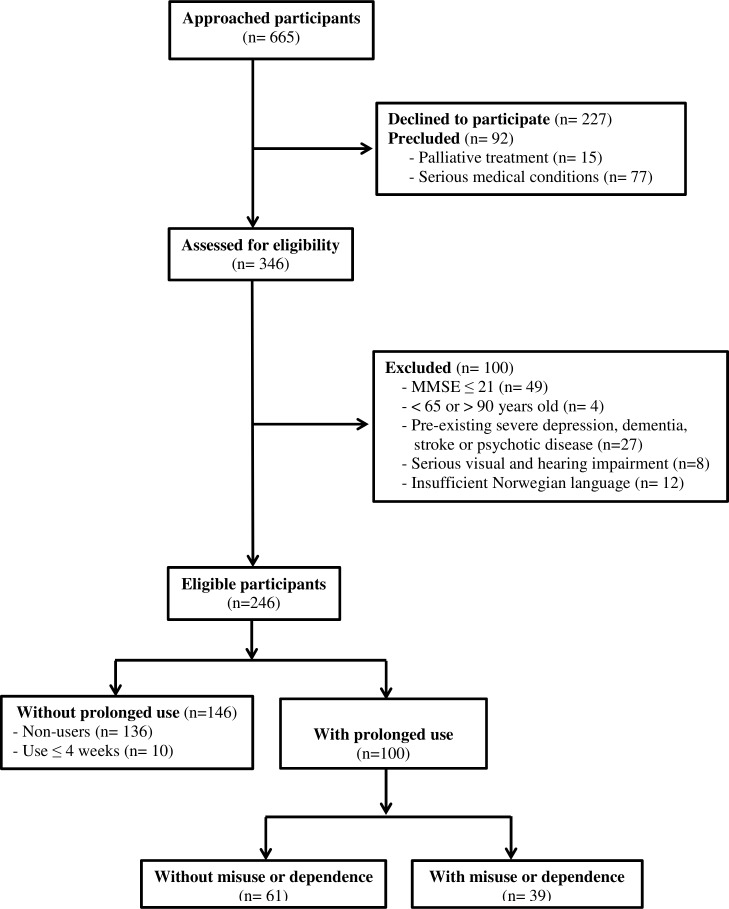
- Among 246 eligible older inpatients, 100 (40%) were prolonged users of opioid analgesics, benzodiazepines, and/or z-hypnotics; 39/100 prolonged users (39%) met DSM-IV criteria for substance abuse or dependence.
- The most common medication class was z-hypnotics: 42/100 used them exclusively and 26/100 used them concurrently with other CNSDs; opioid analgesics accounted for 21/100 exclusive use and 23/100 concurrent use, while benzodiazepines accounted for 7/100 exclusive use and 13/100 concurrent use.
- In multivariable analysis, prolonged CNSD use was associated with age 75–84 years (OR 2.32, 95% CI 1.16 to 4.65), age ≥85 years (OR 3.33, 95% CI 1.25 to 8.87), pain intensity (OR 1.02, 95% CI 1.01 to 1.04 per 1 mm on the VAS), and polypharmacy (OR 5.16, 95% CI 2.13 to 12.55); secondary education was protective (OR 0.33, 95% CI 0.13 to 0.83).
- Misuse/dependence was associated with pain intensity (OR 1.02, 95% CI 1.01 to 1.04 per 1 mm on the VAS) and concurrent use of ≥2 CNSDs (OR 3.99, 95% CI 1.34 to 11.88).
## Methods
- Prospective cross-sectional, in-hospital study conducted in the somatic departments of Akershus University Hospital, Norway, from May 2017 to September 2018.
- Included 246 hospitalised patients aged 65–90; exclusion criteria included MMSE ≤21, severe depression, stroke, dementia, psychotic disorders, serious sensory impairment, insufficient Norwegian language, and serious medical condition or palliative treatment.
- Data came from self-completed questionnaires, electronic patient records, and structured interviews; associations were tested using descriptive statistics plus bivariate and multiple logistic regression, with multiple imputation for missing data and complete-case sensitivity analyses.
## Limitations
- The paper states that the consecutive hospital-based sample limits generalisability to the general population.
- The paper states that cross-sectional data preclude causal inference.
- The paper states that the relatively high number of patients who declined participation may have biased the sample toward milder cases; additionally, evident from the design, the study cannot determine temporality between pain and CNSD overuse.
Model-written summary. Check it against the paper before relying on it.
Integrity signals
Registry
Cites
Statistics
Figures
Verification
Claims the paper makes
0 Valid · 0 Not valid · 10 Not checked · 49 Own results and interpretations
A result the paper reports from its own data — it cites no other source for it, so there is none to check. The quote shows it is in the paper.
In the paper
“and concurrent use of ≥2 CNSDs (OR=3.99, 95% CI 1.34 to 11.88)”
- Also stated in: § Factors associated with CNSD misuse or dependence · plain
“concurrent use of two or more CNSDs increased the odds for misuse or dependence by four times (OR=3.99, 95% CI 1.34 to 11.88)”
§ Sociodemographic, clinical and pharmacological profiles of medication misuse and dependence in hospitalised older patients in Norway: a prospective cross-sectional study > Abstract > Results
plainstates an association- Asserted: passes — The authors put it forward as true.
- Checkable: passes — It can be checked against evidence.
- Load-bearing: passes — The paper’s conclusions depend on it.
- Based: passes — The paper gives a reason why it holds.
- Also stated in: § Factors associated with CNSD misuse or dependence · plain
A result the paper reports from its own data — it cites no other source for it, so there is none to check. The quote shows it is in the paper.
In the paper
“The odds were lower for patients who completed secondary education (OR=0.33, 95% CI 0.13 to 0.83) compared with those with only basic education.”
- Also stated in: § Factors associated with prolonged use of CNSDs · plain
“the odds were lower among patients who had completed at least secondary education (OR=0.33, 95% CI 0.13 to 0.83) compared with only basic education”
§ Sociodemographic, clinical and pharmacological profiles of medication misuse and dependence in hospitalised older patients in Norway: a prospective cross-sectional study > Abstract > Results
plainstates an association- Asserted: passes — The authors put it forward as true.
- Checkable: passes — It can be checked against evidence.
- Load-bearing: passes — The paper’s conclusions depend on it.
- Based: passes — The paper gives a reason why it holds.
- Also stated in: § Factors associated with prolonged use of CNSDs · plain
A result the paper reports from its own data — it cites no other source for it, so there is none to check. The quote shows it is in the paper.
In the paper
“Forty per cent of participants reported using CNSDs for ≥4 weeks.”
- Also stated in: § Medication use patterns · plain
“Forty per cent (100 out of 246 participants) of the older patients enrolled in this study were identified as prolonged users (≥4 weeks) of opioid analgesics, benzodiazepines and/or z-hypnotics.”
§ Sociodemographic, clinical and pharmacological profiles of medication misuse and dependence in hospitalised older patients in Norway: a prospective cross-sectional study > Abstract > Results
plainn = 246- Asserted: passes — The authors put it forward as true.
- Checkable: passes — It can be checked against evidence.
- Load-bearing: passes — The paper’s conclusions depend on it.
- Based: passes — The paper gives a reason why it holds.
- Also stated in: § Medication use patterns · plain
A result the paper reports from its own data — it cites no other source for it, so there is none to check. The quote shows it is in the paper.
In the paper
“for pain intensity (OR=1.02, 95% CI 1.01 to 1.04)”
- Also stated in: § Factors associated with prolonged use of CNSDs · plain
“having more intense pain according to the VAS (OR=1.02, 95% CI 1.01 to 1.04)”
§ Sociodemographic, clinical and pharmacological profiles of medication misuse and dependence in hospitalised older patients in Norway: a prospective cross-sectional study > Abstract > Results
plainstates an association- Asserted: passes — The authors put it forward as true.
- Checkable: passes — It can be checked against evidence.
- Load-bearing: passes — The paper’s conclusions depend on it.
- Based: passes — The paper gives a reason why it holds.
- Also stated in: § Factors associated with prolonged use of CNSDs · plain
A result the paper reports from its own data — it cites no other source for it, so there is none to check. The quote shows it is in the paper.
In the paper
“The odds of prolonged use were higher for patients aged 75–84 (OR=2.32, 95% CI 1.16 to 4.65) and ≥85 (OR=3.33, 95% CI 1.25 to 8.87) vs <75 years”
- Also stated in: § Factors associated with prolonged use of CNSDs · plain
“being aged 75–84 (OR=2.32, 95% CI 1.16 to 4.65) and ≥85 years old (OR=3.33, 95% CI 1.25 to 8.87), compared with age <75”
§ Sociodemographic, clinical and pharmacological profiles of medication misuse and dependence in hospitalised older patients in Norway: a prospective cross-sectional study > Abstract > Results
plainstates an association- Asserted: passes — The authors put it forward as true.
- Checkable: passes — It can be checked against evidence.
- Load-bearing: passes — The paper’s conclusions depend on it.
- Based: passes — The paper gives a reason why it holds.
- Also stated in: § Factors associated with prolonged use of CNSDs · plain
26 more claims
Create a free account to see all 59 claims and to verify the 12 references still open.
- The quote only partly states this claim. 1
- It may state two separate claims as one. 16
- Probably not a substantial claim. 17
Claims other papers make about this one
Each is checked against this paper’s own text: does it say what the citing paper says it does?
The source backs part of the claim, not all of it — or backs it for a different population, condition or comparison.
In the citing paper
“Advancing age has been associated with an increased risk of developing Z-drug use disorder.”
From Z-drug abuse and dependence: Clinical guideline of the Brazilian Academy of Neurology for diagnosis and management (2025) · cites this paper as [50]
Experimental — accuracy not yet measuredThe source backs part of the claim, not all of it — or backs it for a different population, condition or comparison.
In the citing paper
“In elderly populations, extended hospital stays are linked to a higher risk of inappropriate use—including abuse and dependence—of hypnotics and opioids. This is especially true for patients over 75 years of age, those experiencing severe pain, and individuals undergoing polypharmacy.”
From Z-drug abuse and dependence: Clinical guideline of the Brazilian Academy of Neurology for diagnosis and management (2025) · cites this paper as [50]
Experimental — accuracy not yet measured
Citations
Cites
Diagnostic and Statistical Manual of Mental Disorders
Williams, J. B. W., & First, M. (2013) · Encyclopedia of Social Work · doi:10.1093/acrefore/9780199975839.013.104 · Cited by 109,519
Folstein, M. F., Folstein, S. E., & McHugh, P. R. (1975) · Journal of Psychiatric Research · doi:10.1016/0022-3956(75)90026-6 · Cited by 88,282
Hirono, N., Mori, E., Ikejiri, Y., Imamura, T., Shimomura, T., Hashimoto, M., Yamashita, H., & Ikeda, M. (1997) · Brain and nerve · Cited by 21,039
Hirono, N., Mori, E., Ikejiri, Y., et al. (1997) · PubMed · Cited by 20,849
Kok, J. S., Berg, I. J., & Scherder, E. J. A. (2013) · Dementia and Geriatric Cognitive Disorders Extra · doi:10.1159/000353441 · Cited by 20,589
Older Adults' Reasons for Using Technology while Aging in Place
Peek, S. T. M., Luijkx, K. G., Rijnaard, M. D., Nieboer, M. E., van der Voort, C. S., Aarts, S., van Hoof, J., Vrijhoef, H. J. M., & Wouters, E. J. M. (2016) · Gerontology · doi:10.1159/000430949 · Cited by 19,690
Sensitivity and False Alarm Rate of a Fall Sensor in Long-Term Fall Detection in the Elderly
Kangas, M., Korpelainen, R., Vikman, I., Nyberg, L., & Jämsä, T. (2015) · Gerontology · doi:10.1159/000362720 · Cited by 18,909
Principles and Practice of Sleep Medicine
(2011) · Elsevier eBooks · doi:10.1016/c2009-0-59875-3 · Cited by 5,088
By the American Geriatrics Society 2015 Beers Criteria Update Expert Panel (2015) · Journal of the American Geriatrics Society · doi:10.1111/jgs.13702 · Cited by 2,609
The Prescription Opioid and Heroin Crisis: A Public Health Approach to an Epidemic of Addiction
Kolodny, A., Courtwright, D. T., Hwang, C. S., Kreiner, P., Eadie, J. L., Clark, T. W., & Alexander, G. C. (2015) · Annual Review of Public Health · doi:10.1146/annurev-publhealth-031914-122957 · Cited by 1,388
Gnjidic, D., Hilmer, S. N., Blyth, F. M., Naganathan, V., Waite, L., Seibel, M. J., McLachlan, A. J., Cumming, R. G., Handelsman, D. J., & Le Couteur, D. G. (2012) · Journal of Clinical Epidemiology · doi:10.1016/j.jclinepi.2012.02.018 · Cited by 1,176
A Comprehensive Review of Opioid-Induced Hyperalgesia
Lee, M. O. (2011) · Pain Physician · doi:10.36076/ppj.2011/14/145 · Cited by 1,118
The Link between Depression and Chronic Pain: Neural Mechanisms in the Brain
Sheng, J., Liu, S., Wang, Y., Cui, R., & Zhang, X. (2017) · Neural Plasticity · doi:10.1155/2017/9724371 · Cited by 775
Guidelines for the Rational Use of Benzodiazepines: When and What to Use
Ashton, H. (1994) · Drugs · doi:10.2165/00003495-199448010-00004 · Cited by 593
Opioid-induced Hyperalgesia in Humans: Molecular Mechanisms and Clinical Considerations
Chu, L. F., Angst, M. S., & Clark, D. (2008) · The Clinical Journal of Pain · doi:10.1097/ajp.0b013e31816b2f43 · Cited by 575
Hamilton, H., Gallagher, P., Ryan, C., Byrne, S., & O’Mahony, D. (2011) · Archives of Internal Medicine · doi:10.1001/archinternmed.2011.215 · Cited by 566
Sun, E. C., Dixit, A., Humphreys, K., Darnall, B. D., Baker, L. C., & Mackey, S. (2017) · BMJ · doi:10.1136/bmj.j760 · Cited by 534
Djukanovic, I., Carlsson, J., & Årestedt, K. (2017) · Health and Quality of Life Outcomes · doi:10.1186/s12955-017-0759-9 · Cited by 326
Relationships among pain, anxiety, and depression in primary care
Means-Christensen, A. J., Roy-Byrne, P. P., Sherbourne, C. D., Craske, M. G., & Stein, M. B. (2008) · Depression and Anxiety · doi:10.1002/da.20342 · Cited by 247 · cited 1×
“50 The inter-relationship between pain, anxiety and depression is complex.(51) 52 Future prospective studies over time are therefore needed to explain the interplay between these entities and their influences on CNSD dependence.”
BackgroundCommunication Skills in Patient-Doctor Interactions: Learning from Patient Complaints
Kee, J. W. Y., Khoo, H. S., Lim, I., & Koh, M. Y. H. (2018) · Health Professions Education · doi:10.1016/j.hpe.2017.03.006 · Cited by 230
Handling missing items in the Hospital Anxiety and Depression Scale (HADS): a simulation study
Bell, M. L., Fairclough, D. L., Fiero, M. H., & Butow, P. N. (2016) · BMC Research Notes · doi:10.1186/s13104-016-2284-z · Cited by 182 · cited 1×
“Higher scores indicate higher levels of anxiety and depressive symptoms.(14) Data for all of these variables were collected through a self-completed questionnaire.”
BackgroundA survey on polypharmacy and use of inappropriate medications
Rambhade, S., Shrivastava, A., Rambhade, A., Chakarborty, A., & Patil, U. (2012) · Toxicology International · doi:10.4103/0971-6580.94506 · Cited by 170
Prospective associations of social isolation and loneliness with poor sleep quality in older adults
Yu, B., Steptoe, A., Niu, K., Ku, P., & Chen, L. (2017) · Quality of Life Research · doi:10.1007/s11136-017-1752-9 · Cited by 163
Hernandez, I., He, M., Brooks, M. M., & Zhang, Y. (2018) · JAMA Network Open · doi:10.1001/jamanetworkopen.2018.0919 · Cited by 161
Patterns of Opioid Use and Risk of Opioid Overdose Death Among Medicaid Patients
Garg, R. K., Fulton-Kehoe, D., & Franklin, G. M. (2017) · Medical Care · doi:10.1097/mlr.0000000000000738 · Cited by 158
Barriers and facilitators to medication adherence: a qualitative study with general practitioners
Kvarnström, K., Airaksinen, M., & Liira, H. (2018) · BMJ Open · doi:10.1136/bmjopen-2016-015332 · Cited by 154 · cited 1×
“tive impairment, low health literacy and lack of family/ social support.(35) 36 Furthermore, older patients may”
BackgroundSirdifield, C., Anthierens, S., Creupelandt, H., Chipchase, S. Y., Christiaens, T., & Siriwardena, A. N. (2013) · BMC Family Practice · doi:10.1186/1471-2296-14-191 · Cited by 131 · cited 1×
“Physicians may also experience other challenges in managing CNSD use.(37) Both the”
BackgroundZhang, Y., Shao, F., Wang, Q., Xie, X., & Wang, W. (2017) · Neural Plasticity · doi:10.1155/2017/9382797 · Cited by 124
Measuring Decision-Making Capacity in Cognitively Impaired Individuals
Karlawish, J. (2008) · Neurosignals · doi:10.1159/000109763 · Cited by 121
Mordal, J., Gundersen, Ø., & Bramness, J. G. (2010) · European Psychiatry · doi:10.1016/j.eurpsy.2009.02.004 · Cited by 111 · cited 2×
“Medication misuse and dependence were defined based on the Diagnostic and Statistical Manual of Mental Disorders, 4th Edition (DSM-IV) criteria for substance abuse and dependence, through structured interviews, using the Norwegian version of the Mini-International Neuropsychiatric Interview Guide.17 Dependence was def…”
MethodOpioid-induced hyperalgesia: Pathophysiology and clinical implications
Mitra, M. (2018) · Journal of Opioid Management · doi:10.5055/jom.2008.0017 · Cited by 109
Ros, T., Michela, A., Bellman, A., Vuadens, P., Saj, A., & Vuilleumier, P. (2017) · Neural Plasticity · doi:10.1155/2017/7407241 · Cited by 104
Greater incidence of depression with hypnotic use than with placebo
Kripke, D. F. (2007) · BMC Psychiatry · doi:10.1186/1471-244x-7-42 · Cited by 96
Nyborg, G. A., Straand, J., Klovning, A., & Brekke, M. (2015) · Scandinavian Journal of Primary Health Care · doi:10.3109/02813432.2015.1041833 · Cited by 95
Helvik, A.-S., Engedal, K., Skancke, R. H., & Selbæk, G. (2011) · Nordic Journal of Psychiatry · doi:10.3109/08039488.2011.560684 · Cited by 91 · cited 1×
“Optimal cut-off values for diagnosing anxiety and depression in older hospitalised patients using HADS remain to be established.(12) 13 To avoid underestimation and misclassification bias of”
MethodDeterminants of chronic benzodiazepine use in the elderly: A longitudinal study
Luijendijk, H. J., Tiemeier, H., Hofman, A., Heeringa, J., & Stricker, B. H. C. (2008) · British Journal of Clinical Pharmacology · doi:10.1111/j.1365-2125.2007.03060.x · Cited by 90
Heider, D., Matschinger, H., Meid, A. D., Quinzler, R., Adler, J., Günster, C., Haefeli, W. E., & König, H. (2017) · Drugs & Aging · doi:10.1007/s40266-017-0441-2 · Cited by 85 · cited 1×
“Given the vulnerability to serious adverse effects and interactions as a result of age-related changes in pharmacokinetics and pharmacodynamics, timely recognition and treatment of medication misuse and dependence in older patients are crucial to ensure medication safety and to avoid increasing health expenditure.(8)…”
BackgroundLong‐term Use of Z‐Hypnotics and Co‐medication with Benzodiazepines and Opioids
Sakshaug, S., Handal, M., Hjellvik, V., Berg, C., Ripel, Å., Gustavsen, I., Mørland, J. G., & Skurtveit, S. O. (2016) · Basic & Clinical Pharmacology & Toxicology · doi:10.1111/bcpt.12684 · Cited by 41
Mokhar, A., Tillenburg, N., Dirmaier, J., Kühn, S., Härter, M. C., & Verthein, U. (2018) · PeerJ · doi:10.7717/peerj.4614 · Cited by 36
Cheng, S., Siddiqui, T. G., Gossop, M., Kristoffersen, E. S., & Lundqvist, C. (2019) · BMC Geriatrics · doi:10.1186/s12877-019-1182-3 · Cited by 34 · cited 2×
“Yet the detection of these disorders in older people is challenging and requires both valid screening tools and evidence-based knowledge on long-term use of CNSDs, including patients’ characteristics related to misuse and dependence.(7) 9 Addressing these knowledge gaps forms the basis for developing evidence-based in…”
BackgroundSelf-citationWongpakaran, N., Wongpakaran, T., Sirirak, T., Jenraumjit, R., Jiraniramai, S., & Lerttrakarnnon, P. (2018) · BMC Geriatrics · doi:10.1186/s12877-018-1001-2 · Cited by 29
Affecting emergency department oxycodone discharge prescribing: An educational intervention
Kline, T. V., Savage, R. L., Greenslade, J. H., Lock, C., Pattullo, C., & Bell, A. (2019) · Emergency Medicine Australasia · doi:10.1111/1742-6723.13261 · Cited by 21
Mokhar, A., Kühn, S., Topp, J., Dirmaier, J., Härter, M. C., & Verthein, U. (2019) · BJGP Open · doi:10.3399/bjgpopen18x101626 · Cited by 20 · cited 2×
“Furthermore, it has recently been pointed out that long-term use of benzodiazepine/z-hypnotics often started in hospitals and the prescription is continued by GPs.21 Another issue, which suggests some care in the interpretation of our results, is the relatively high number of patients who declined participation.”
BackgroundSundseth, A. C., Gjelstad, S., Straand, J., & Rosvold, E. O. (2018) · Scandinavian Journal of Primary Health Care · doi:10.1080/02813432.2018.1459164 · Cited by 19 · cited 1×
“In line with this, another study found that CNSDs were frequently prescribed by GPs in large quantities and through indirect contacts without consultation.(6) Both inappropriate prescribing and the high consumption of such addictive medications may put older patients at risk of medication misuse and dependence—a condi…”
ResultSleep quality, use of hypnotics and sleeping habits in different age‐groups among older people
Hägg, M., Houston, B., Elmståhl, S., Ekström, H., & Wann‐Hansson, C. (2014) · Scandinavian Journal of Caring Sciences · doi:10.1111/scs.12119 · Cited by 17
Weiß, V., Nau, R., Glaeske, G., Hummers, E., & Himmel, W. (2018) · European Journal of Clinical Pharmacology · doi:10.1007/s00228-018-2555-9 · Cited by 15
Ten-year trend in sleeping pills use in Switzerland: the CoLaus study
Abolhassani, N., Haba‐Rubio, J., Heinzer, R. C., Vollenweider, P., & Marques-Vidal, P. M. (2019) · Sleep Medicine · doi:10.1016/j.sleep.2018.06.022 · Cited by 15
Ancoli‐Israel, S., & Shochat, T. (2011) · Elsevier eBooks · doi:10.1016/b978-1-4160-6645-3.00135-3 · Cited by 14
Prescription of Addictive and Non-Addictive Drugs to Home-Dwelling Elderly
Kann, I. C., Lundqvist, C., & Lurås, H. (2014) · Drugs & Aging · doi:10.1007/s40266-014-0169-1 · Cited by 8 · cited 1×
“A Norwegian study showed that patients’ regular general practitioners (GPs) prescribed the largest proportion of addictive drugs to their older patients (77%) compared with other groups of physicians.(5) In line with this, another study found that CNSDs were frequently prescribed by GPs in large quantities and through…”
ResultSelf-citationSocial support and sleep quality in older benzodiazepine users
Proulx-Tremblay, V., Allary, A., Payette, M., Benyebdri, F., Boudreau, M.-M., Bernard, C., Léveillé, V., Desrosiers, C., Cruz-Santiago, D., Gagné, M.-H., et al. (2019) · Aging & Mental Health · doi:10.1080/13607863.2019.1594167 · Cited by 6
Benzodiazepine and z-hypnotic use in Norwegian elderly, aged 65-79
Neutel, C. I., Skurtveit, S. O., & Berg, C. (2012) · Norsk Epidemiologi · doi:10.5324/nje.v22i2.1567 · Cited by 5
Psychotropic Medication Use in the Elderly
Panini, A. D. C., Teves, M. R., Giraudo, E., Garraza, M. H., & Calderón, C. P. (2017) · Springer eBooks · doi:10.1007/978-3-319-53126-7_22 · Cited by 3
Voepel‐Lewis, T., Tait, A. R., Becher, A., & Levine, R. L. (2019) · Pain Management · doi:10.2217/pmt-2019-0003 · Cited by 3
Recognizing Addiction in Older Patients
Levesque, A., & Nunes, E. V. (2016) · Oxford University Press eBooks · doi:10.1093/med/9780199392063.003.0002 · Cited by 3
Lam, Y. W. F. (2019) · The Brown University Psychopharmacology Update · doi:10.1002/pu.30504 · Cited by 1
Polypharmacy in elderly opioid users
Lam, Y. W. F. (2019) · The Brown University Psychopharmacology Update · doi:10.1002/pu.30422 · Cited by 1
Cited by
The use of islamic spiritual care practices among critically ill adult patients: A systematic review
Rababa, M., & Al-Sabbah, S. (2023) · Heliyon · doi:10.1016/j.heliyon.2023.e13862 · Cited by 50
Bjelkarøy, M. T., Benth, J. Š., Simonsen, T. B., Siddiqui, T. G., Cheng, S., Kristoffersen, E. S., & Lundqvist, C. (2023) · Progress in Neuro-Psychopharmacology and Biological Psychiatry · doi:10.1016/j.pnpbp.2023.110925 · Cited by 37
“Study design and results from the 2017 – 2018 study have otherwise been extensively reported elsewhere (Bjelkaroy et al., 2021; Cheng et al., 2019a; Cheng et al., 2019b; Cheng et al., 2020; Cheng et al., 2021; Siddiqui et al., 2022; Siddiqui et al., 2020).”
Self-citation‘Z-trip’? A Comprehensive Overview and a Case-series of Zolpidem Misuse
Orsolini, L., Chiappini, S., Grandinetti, P., Bruschi, A., Testa, R., Provenzano, A., Berardis, D. D., & Volpe, U. (2021) · Clinical Psychopharmacology and Neuroscience · doi:10.9758/cpn.2021.19.2.367 · Cited by 32
“A second subset of individuals abusing or depending on Z-drugs include female patients with psychiatric comorbidities and/or pain syndromes, who were originally started with these molecules for insomnia but who developed tolerance and withdrawal phenomena [17,18,22,24,26-28].”
BackgroundCheng, S., Siddiqui, T. G., Gossop, M., Wyller, T. B., Kristoffersen, E. S., & Lundqvist, C. (2021) · Aging Clinical and Experimental Research · doi:10.1007/s40520-021-01791-5 · Cited by 17
Self-citationSiddiqui, T. G., Cheng, S., Gossop, M., Kristoffersen, E. S., Grambaitė, R., & Lundqvist, C. (2020) · BMJ Open · doi:10.1136/bmjopen-2020-038432 · Cited by 19
Self-citation
Metadata
- Authors
- Cheng, S., Siddiqui, T. G., Gossop, M., Kristoffersen, E. S., & Lundqvist, C.
- Affiliations
- University of Oslo (NO)
- King's College London (GB)
- Corresponding author
- Cheng, Socheat
- ORCID
- Venue
- BMJ Open
- Publisher
- BMJ
- Published
- 2019-09
- Volume
- 9
- Issue
- 9
- Pages
- e031483
- ISSN
- 2044-6055 (ISSN-L)
- PMC
- PMC6731874
- OpenAlex
- W2971868073
- Cited by
- 24
- References
- 57
- Citations by year
- 2025: 4 · 2024: 4 · 2023: 4 · 2022: 2 · 2021: 7 · 2020: 3
- FWCI
- 1.58
- Type
- journal article
- Language
- en
- Open access
- gold
- doi.org
- Licence
- cc-by-nc
- Locations
- BMJ Open (publishedVersion, cc-by-nc)
- Europe PMC (PubMed Central) (publishedVersion, cc-by-nc)
- PubMed Central (publishedVersion, cc-by-nc)
- PubMed (publishedVersion)
- DOAJ (DOAJ: Directory of Open Access Journals) (submittedVersion)
- Research Portal (King's College London) (submittedVersion, other-oa)
- HighWire Press Open Archive (submittedVersion)
- NORA - Norwegian Open Research Archives (submittedVersion, other-oa)
- Funders
- Helse Sør-Øst RHF (Prosjektnummer 2011016)
- Norges Forskningsråd (NFR-nummer 256431)
- Topics
- Health Sciences › Medicine › Geriatrics and Gerontology › Pharmaceutical Practices and Patient Outcomes
- Health Sciences › Medicine › Public Health, Environmental and Occupational Health › Opioid Use Disorder Treatment
- Health Sciences › Medicine › Anesthesiology and Pain Medicine › Pain Management and Opioid Use
- Keywords
- medication misuse, medication dependence, central nervous system depressants, opioid analgesics, benzodiazepines, Z-drugs, elderly patients, hospitalized patients, polypharmacy, pain intensity, sociodemographic factors, risk factors, substance abuse, adverse drug reactions, educational attainment, age differences, Norway
- MeSH terms
- Aged, Aged, 80 and over, Analgesics, Opioid, Benzodiazepines, Central Nervous System Depressants, Cross-Sectional Studies, Female, Humans, Hypnotics and Sedatives, Male, Opioid-Related Disorders, Norway, Pain, Prospective Studies, Prevalence, Logistic Models, Polypharmacy, Diagnostic and Statistical Manual of Mental Disorders, Prescription Drug Misuse
About these checks
Registry, retraction, Cites and statistics results are computed, not judged, with one exception: a printed reference that no index lists is read once by a model before it counts as a citation error. Claims are extracted by a model and kept only when their quote appears verbatim in the text; each cited source is then checked, with a model’s help, for whether it says what the claim relies on. Those verdicts can be wrong — read the claim’s quote and the cited source before relying on one.
A language model drew the claims from the paper on 2026-10-11, under version 3 of the claim definition (model deepseek-v4.1-flash, prompt extract-v3).
A second model labelled each claim on 2026-10-11 (model jev-1.13-20260917, definition revision gold-guideline-v0.2).
Statistics and arithmetic are recomputed, not judged.
Confidence bands are shown only for fields calibrated on our annotated test set. None is calibrated yet, so no band is shown.
What counts as a claim ›How we measure confidence ›How we check this ›
Are you an author, or do you see a problem with this page? Request a review
Data sources
Bibliographic data: Semantic Scholar, OpenAlex, Crossref.
Contains information from the Semantic Scholar Academic Graph Datasets, made available under the ODC Attribution License (ODC-BY 1.0).
Semantic Scholar’s data is described in: Kinney, R., et al. (2023). The Semantic Scholar Open Data Platform. arXiv:2301.10140.
