

The DOI matches its Crossref record; 48 of the 52 references it cites were found in a registry or an index.
Factors associated with the mental health status of medical students during the COVID-19 pandemic: a cross-sectional study in Japan
Open accessAbstract
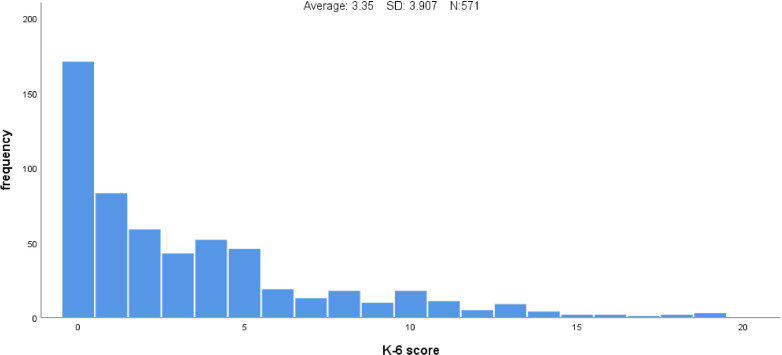
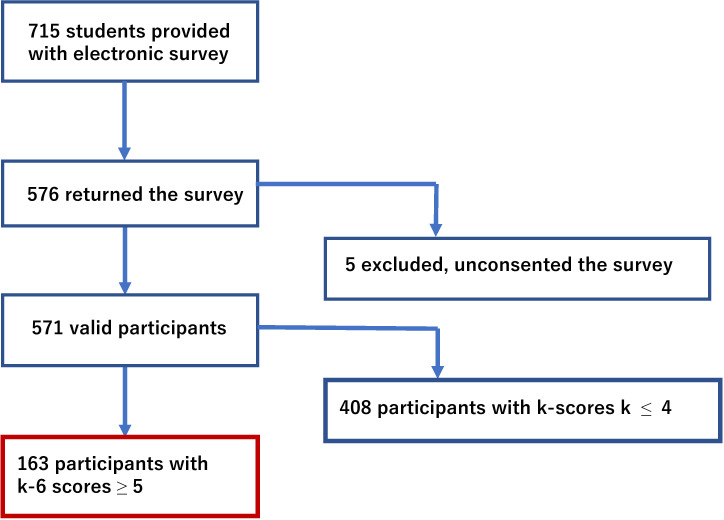
Objective: The COVID-19 pandemic had a substantial impact on university students, including those in medical schools, with disruption in routine education causing significant psychological distress. The objective of this study was to evaluate the factors associated with psychological distress among medical students during the period of enforced home quarantine from March through May 2020. Design: A cross-sectional study. Setting: One Japanese medical school. Participants: 571 medical students. Primary and secondary outcome measures: Self-administered electronic questionnaires including the K-6 scale for psychological distress, the Rosenberg Self-Esteem Scale (RSES) for self-esteem and the General Self-Efficacy Scale (GSES) for self-efficacy were distributed. To assess the determinant factor for psychological distress, variables such as sex, grade in school, living conditions, and RSES and GSES scores were evaluated in regression analysis. Results: 163 respondents (28.5%) scored ≥5 on the K-6 scale, indicating a significant degree of psychological distress. Logistic regression revealed that a higher score on RSES (p<0.001) and GSES (p<0.01) was an independent factor associated with lower levels of psychological distress. Multiple regression analysis focusing on students with a K-6 score ≥5 revealed that higher scores on RSES correlated with lower levels of psychological distress. By contrast, those with higher GSES scores also scored higher for indicators of psychological distress. Conclusions: This study identified that self-efficacy and self-esteem were both influential factors for predicting psychological distress during the current COVID-19 pandemic. Medical schools should provide support for mental health and educational initiatives directed at enhancing self-esteem and self-efficacy, with a focus on improving personal resilience. In emergency situations, such as that faced in response to the COVID-19 pandemic, initial programmes might target students with higher levels of self-efficacy. By contrast, under routine situations, these efforts should be directed towards students with lower self-esteem as primary means to prevent depression.
Overview
The claims and statistics of this paper haven’t been checked yet.
Run the check — free, no account needed. It reads the open-access text and checks the sources it cites.
Integrity signals
Registry
Cites
Statistics
Figures
Verification
Claims the paper makes
The claims and statistics of this paper haven’t been checked yet.
Run the check — free, no account needed. It reads the open-access text and checks the sources it cites.
Claims other papers make about this one
Each is checked against this paper’s own text: does it say what the citing paper says it does?
The cited source says what the claim attributes to it.
In the citing paper
“Moreover, Covid-19 has had a drastic impact on the population’s mental health [40–43], including medical students [44–48].”
From Effectiveness of online mindfulness interventions on medical students’ mental health: a systematic review (2021) · cites this paper as [44]
Self-check
Percentages, sums and reported differences re-computed from the paper’s own numbers.
The self-check needs the paper’s full text.
Citations
Cites
Self-efficacy: The exercise of control
Bandura, A., Freeman, W. H., & Lightsey, R. (1999) · Journal of Cognitive Psychotherapy · doi:10.1891/0889-8391.13.2.158 · Cited by 46,835
Society and the Adolescent Self-Image
Rosenberg, M. (1965) · doi:10.1515/9781400876136 · Cited by 30,126
KESSLER, R. C., ANDREWS, G., COLPE, L. J., HIRIPI, E., MROCZEK, D. K., NORMAND, S.-L. T., WALTERS, E. E., & ZASLAVSKY, A. M. (2002) · Psychological Medicine · doi:10.1017/s0033291702006074 · Cited by 10,327
Bonanno, G. A. (2004) · American Psychologist · doi:10.1037/0003-066x.59.1.20 · Cited by 6,851
The Oxford Handbook of Positive Psychology
(2009) · doi:10.1093/oxfordhb/9780195187243.001.0001 · Cited by 2,696
On the Functional Properties of Perceived Self-Efficacy Revisited
Bandura, A. (2012) · Journal of Management · doi:10.1177/0149206311410606 · Cited by 2,586
Rotenstein, L. S., Ramos, M. A., Torre, M., Segal, J. B., Peluso, M. J., Guille, C., Sen, S., & Mata, D. A. (2016) · JAMA · doi:10.1001/jama.2016.17324 · Cited by 2,479
Sahu, P. (2020) · Cureus · doi:10.7759/cureus.7541 · Cited by 2,353
Does low self-esteem predict depression and anxiety? A meta-analysis of longitudinal studies.
Sowislo, J. F., & Orth, U. (2013) · Psychological Bulletin · doi:10.1037/a0028931 · Cited by 2,123
Coronavirus disease (COVID-19) pandemic.
Rampal, L., & Liew, B. S. (2020) · PubMed · Cited by 2,115
Research works printed but not linked: 1
- Smith ER , Mackie DM . Social psychology. 3rd edn. Hove: Psychology Press, 2007.
Cited by
Sorted by citations
Baticulon, R. E., Sy, J. J., Alberto, N. R. I., Baron, M. B. C., Mabulay, R. E. C., Rizada, L. G. T., Tiu, C. J. S., Clarion, C. A., & Reyes, J. C. B. (2021) · Medical Science Educator · doi:10.1007/s40670-021-01231-z · Cited by 760
Impacts of the Covid‐19 pandemic on the health of university students
Ihm, L., Zhang, H., van Vijfeijken, A., & Waugh, M. G. (2021) · The International Journal of Health Planning and Management · doi:10.1002/hpm.3145 · Cited by 98
Chu, T., Liu, X., Takayanagi, S., Matsushita, T., & Kishimoto, H. (2023) · International Journal of Methods in Psychiatric Research · doi:10.1002/mpr.1938 · Cited by 93
Karing, C. (2021) · Journal of Affective Disorders Reports · doi:10.1016/j.jadr.2021.100174 · Cited by 98
Yogeswaran, V., & El Morr, C. (2021) · BMC Public Health · doi:10.1186/s12889-021-12341-z · Cited by 62
Metadata
- Authors
- Arima, M., Takamiya, Y., Furuta, A., Siriratsivawong, K., Tsuchiya, S., & Izumi, M.
- Affiliations
- SHOWA Medical University (JP)
- Corresponding author
- Arima, Makiko
- Venue
- BMJ Open
- Publisher
- BMJ
- Published
- 2020-12
- Volume
- 10
- Issue
- 12
- Pages
- e043728
- ISSN
- 2044-6055 (ISSN-L)
- PMC
- PMC7733210
- OpenAlex
- W3111932542
- Cited by
- 138
- References
- 52
- Citations by year
- 2026: 7 · 2025: 11 · 2024: 12 · 2023: 45 · 2022: 37 · 2021: 26
- FWCI
- 10.79
- Type
- journal article
- Language
- en
- Open access
- gold
- doi.org
- Licence
- Locations
- BMJ Open (publishedVersion, cc-by-nc)
- PubMed Central (publishedVersion, cc-by-nc)
- PubMed (publishedVersion)
- Institutional Repositories DataBase (IRDB) (submittedVersion, cc-by-nc-nd)
- DOAJ (DOAJ: Directory of Open Access Journals) (submittedVersion, cc-by-sa)
- HighWire Press Open Archive (submittedVersion)
- Topics
- Social Sciences › Psychology › Clinical Psychology › COVID-19 and Mental Health
- Health Sciences › Health Professions › General Health Professions › Healthcare professionals’ stress and burnout
- Social Sciences › Psychology › Developmental and Educational Psychology › Student Stress and Coping
- Keywords
- medical students, psychological distress, COVID-19 pandemic, self-esteem, self-efficacy, mental health, home quarantine, resilience, depression prevention, student mental health support
- MeSH terms
- COVID-19, Adolescent, Adult, Cross-Sectional Studies, Depression, Female, Humans, Japan, Male, Mental Health, Psychiatric Status Rating Scales, Surveys and Questionnaires, Stress, Psychological, Students, Medical, Logistic Models, Self Efficacy, Resilience, Psychological, Young Adult
About these checks
Registry, retraction, Cites and statistics results are computed, not judged, with one exception: a printed reference that no index lists is read once by a model before it counts as a citation error. Claims are extracted by a model and kept only when their quote appears verbatim in the text; each cited source is then checked, with a model’s help, for whether it says what the claim relies on. Those verdicts can be wrong — read the claim’s quote and the cited source before relying on one.
Statistics and arithmetic are recomputed, not judged.
Confidence bands are shown only for fields calibrated on our annotated test set. None is calibrated yet, so no band is shown.
What counts as a claim ›How we measure confidence ›How we check this ›
Are you an author, or do you see a problem with this page? Request a review
