

Emotional distress and well-being among people with motor neurone disease (MND) and their family caregivers: a qualitative interview study
Open accessThe DOI matches its Crossref record; 52 of the 54 references it cites were found in a registry or an index.
Abstract
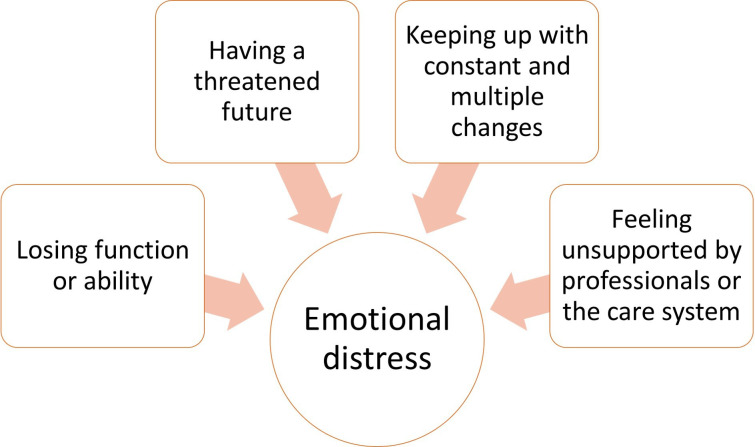
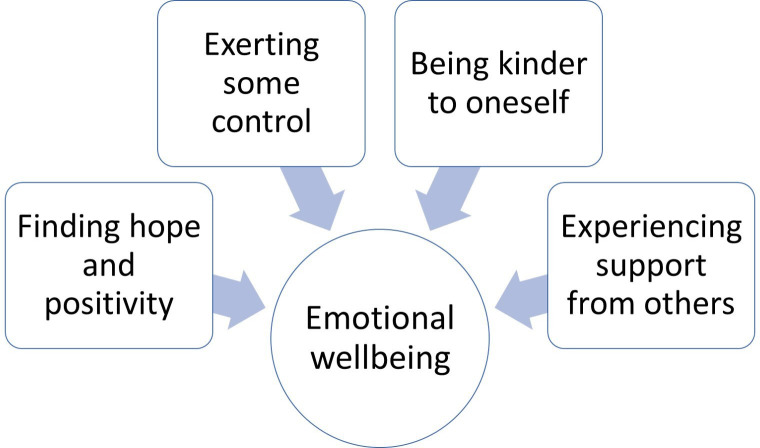
Objective: We aimed to get an in-depth understanding of the emotions experienced by people with motor neurone disease (MND) and their caregivers, and to explore what impacts emotional distress and well-being. Design: Qualitative study using semi-structured interviews with people with MND and caregivers. Setting: Participants were recruited from across the UK and took part in interviews conducted either face to face, by telephone or email to accommodate for varying levels of disability. Participants: 25 people with MND and 10 caregivers took part. Participants were purposively sampled based on their MND diagnosis, symptoms and time since diagnosis. Data analysis: Data were analysed using inductive reflexive thematic analysis. Results: Eight broad themes were generated (20 subthemes). Participants described the emotional distress of losing physical function and having a threatened future because of poor prognosis. Keeping up with constant changes in symptoms and feeling unsupported by the healthcare system added to emotional distress. Finding hope and positivity, exerting some control, being kinder to oneself and experiencing support from others were helpful strategies for emotional well-being. Conclusion: The study provides a broad understanding of what impacts emotional distress and well-being and discusses implications for psychological interventions for people with MND and caregivers. Any communication and support provided for people with MND and their caregivers, needs to pay attention to concepts of hope, control and compassion.
Overview
The claims and statistics of this paper haven’t been checked yet.
Free: it reads the open-access text and checks the first 5 claims that cite a source we can check. Create a free account to check every claim.
Integrity signals
Registry
Cites
Statistics
Figures
Verification
Claims the paper makes
The claims and statistics of this paper haven’t been checked yet.
Free: it reads the open-access text and checks the first 5 claims that cite a source we can check. Create a free account to check every claim.
Self-check
Percentages, sums and reported differences re-computed from the paper’s own numbers.
The self-check needs the paper’s full text.
Citations
Cites
Using thematic analysis in psychology
Braun, V., & Clarke, V. (2006) · Qualitative Research in Psychology · doi:10.1191/1478088706qp063oa · Cited by 194,414
Tong, A., Sainsbury, P., & Craig, J. (2007) · International Journal for Quality in Health Care · doi:10.1093/intqhc/mzm042 · Cited by 42,509
Reflecting on reflexive thematic analysis
Braun, V., & Clarke, V. (2019) · Qualitative Research in Sport, Exercise and Health · doi:10.1080/2159676x.2019.1628806 · Cited by 19,677 · cited 1×
“They also helped pilot the interview topic guide, refine interview questions and trial the data collection procedure to ensure that it was not burden-some.”
Self-compassion, stress, and coping in the context of chronic illness
Sirois, F. M., Molnar, D. S., & Hirsch, J. K. (2015) · Self and Identity · doi:10.1080/15298868.2014.996249 · Cited by 312 · cited 1×
“Despite these limitations, including the experiences of under-represented groups gives us confidence in the application of these findings for people with different symptoms and at different stages of MND.”
Pinto‐Gouveia, J., Duarte, C., Matos, M., & Fráguas, S. (2014) · Clinical Psychology & Psychotherapy · doi:10.1002/cpp.1838 · Cited by 192 · cited 1×
“Despite these limitations, including the experiences of under-represented groups gives us confidence in the application of these findings for people with different symptoms and at different stages of MND.”
Wren, A. A., Somers, T. J., Wright, M. A., Goetz, M. C., Leary, M. R., Fras, A. M., Huh, B. K., Rogers, L. L., & Keefe, F. J. (2012) · Journal of Pain and Symptom Management · doi:10.1016/j.jpainsymman.2011.04.014 · Cited by 173
Caregiver burden in amyotrophic lateral sclerosis: A systematic review
de Wit, J., Bakker, L. A., van Groenestijn, A. C., van den Berg, L. H., Schröder, C. D., Visser-Meily, J. M., & Beelen, A. (2018) · Palliative Medicine · doi:10.1177/0269216317709965 · Cited by 163
Aoun, S. M., Bentley, B., Funk, L., Toye, C., Grande, G., & Stajduhar, K. J. (2013) · Palliative Medicine · doi:10.1177/0269216312455729 · Cited by 152
A review of psychosocial aspects of motor neurone disease
McLeod, J. E., & Clarke, D. M. (2007) · Journal of the Neurological Sciences · doi:10.1016/j.jns.2007.03.001 · Cited by 135
Kangas, M., & McDonald, S. (2011) · Neuropsychological Rehabilitation · doi:10.1080/09602011.2010.540920 · Cited by 133
Cited by
Briscoe, S., Pintado, C. M., Sutcliffe, K., Meléndez‐Torres, G. J., Garside, R., Lawal, H., Orr, N., Shaw, L., & Coon, J. T. (2025) · Orphanet Journal of Rare Diseases · doi:10.1186/s13023-025-03818-w · Cited by 18
“…co-ordination within health care services, including with respect to primary, secondary and tertiary services [21, 23, 25, 31, 47, 48, 52, 56, 60, 67, 73, 75, 78, 91, 101, 108]; and four studies reported data relating to care co-ordination between health and social care settings [78, 97, 105, 110].”
Acceptance Theory of Family Caregiving
Feliciano, A. Z., Feliciano, E. E., Palompon, D. R., & Gonzales, F. (2022) · Belitung Nursing Journal · doi:10.33546/bnj.2004 · Cited by 18
“Moreover, increasing dependence on the caregiver emanates from the older adult’s functional decline over time (Ainamani et al., 2020; Pinto et al., 2021), and the caregiving role becomes more intense in the advanced and end-of-life phase (Robinson et al., 2020).”
BackgroundGenuis, S. K., Luth, W., Bubela, T. M., & Johnston, W. S. W. (2023) · Muscle & Nerve · doi:10.1002/mus.27935 · Cited by 16
“At the same time, a communication agreement will shape patient and caregiver expectations and foster a sense of control within the therapeutic relationship.(51,83,84) This sense of control may be achieved by prioritizing of patients' communication preferences and by developing trust in clinicians who will sensitively…”
BackgroundVelaga, V. C., Cook, A. G., Auret, K. A., Jenkins, T. M., Thomas, G., & Aoun, S. M. (2023) · Brain Sciences · doi:10.3390/brainsci13060920 · Cited by 15
“Despite the majority of respondents using specialist palliative care services, they stated that they did not receive appropriate levels of empathy from their health care providers, a finding which is also consistent with other published accounts by MND patients and carers [11,26,27].”
BackgroundResultWalls, M., Claffey, A., Mockler, D., & Galvin, M. (2024) · Palliative Medicine · doi:10.1177/02692163241291745 · Cited by 13
“8,9,15 As the disease progresses increasing dependency and the level of care required have also been associated with high levels of burden, 16 emotional distress 17 and reduced psychological well-being 18 for patients and informal caregivers.”
Economic crises and happiness: Empirical insights from 134 countries (2008–2019)
Ko, J., Leung, C. K., & Chen, X. (2025) · Development and sustainability in economics and finance. · doi:10.1016/j.dsef.2024.100040 · Cited by 14
Gould, R. L., Rawlinson, C., Thompson, B., Weeks, K., Gossage-Worrall, R., Cantrill, H., Serfaty, M. A., Graham, C. D., McCracken, L. M., White, D., et al. (2023) · Pilot and Feasibility Studies · doi:10.1186/s40814-023-01354-7 · Cited by 10
Ahmad, M., Genuis, S. K., Luth, W., Bubela, T. M., & Johnston, W. S. W. (2022) · Amyotrophic Lateral Sclerosis and Frontotemporal Degeneration · doi:10.1080/21678421.2022.2119869 · Cited by 11
Trucco, A. P., Khondoker, M. R., Kishita, N., Backhouse, T., Copsey, H., & Mioshi, E. (2024) · Amyotrophic Lateral Sclerosis and Frontotemporal Degeneration · doi:10.1080/21678421.2024.2359559 · Cited by 11
“Symptoms of AG may include sadness, anger, guilt, frustration, ambiguity, loneliness, sleep disturbances and disbelief (6) and encompass grief-related emotions which surface before death, causing emotional destabilization (7) and emotional distress (8).”
BackgroundGlennie, N., Harris, F., & France, E. F. (2022) · Disability and Rehabilitation · doi:10.1080/09638288.2022.2104942 · Cited by 9
“This could lead to plwMND questioning the need for the treatments recommended by health professionals or seeking alternative therapies [31,44].”
BackgroundResultInfluentialPinto, C., Geraghty, A. W. A., Pagnini, F., Yardley, L., & Dennison, L. (2023) · Frontiers in Psychiatry · doi:10.3389/fpsyt.2023.1083196 · Cited by 8
Self-citationPalazzo, L., Pizzolato, L., Rigo, M., & Bondì, G. (2023) · Behavioral Sciences · doi:10.3390/bs13100822 · Cited by 6
“The emotional distress triggered by the illness is primarily attributed to the loss of independence and the gradual decline in functions and abilities associated with it [6,7].”
BackgroundTrucco, A. P., Mioshi, E., Kishita, N., Barry, C., & Backhouse, T. (2023) · Palliative & Supportive Care · doi:10.1017/s147895152300158x · Cited by 5
“Another qualitative study found that strategies used were the gradual acceptance of MND, engaging in meaningful activities, focusing on positive and present aspects of life, spending time without thinking about MND, and receiving support from HCPs, friends, and family (Pinto et al. 2021).”
Lee, S. Y., Yoo, S. H., Cho, B., Kim, K. H., Jang, M., Shin, J., Hwang, I. Y., Choi, S., Sung, J., & Kim, M. S. (2024) · Muscle & Nerve · doi:10.1002/mus.28115 · Cited by 5
Mioshi, E., Heal, S., & Katangwe‐Chigamba, T. (2024) · BMC Neurology · doi:10.1186/s12883-024-03746-5 · Cited by 5
“Carers not only have to deal with known triggers of emotional distress in MND, such as a threatened future and keeping up with multiple changes [23], but they also experience behaviours from the PwMND which are not consistent with the person they know [24], as shown in theme one.”
BackgroundChan, Y., Creer, S., Mere, J., Griffiths, A. W., Wright, C. M., Hobson, E., McDermott, C. J., & Mayberry, E. J. (2026) · Muscle & Nerve · doi:10.1002/mus.70309 · Cited by 3
Befecadu, F. B. P., Perrenoud, B., Behaghel, G., Jaques, C., Pautex, S., Rodrigues, M. G. D. R., & Larkin, P. J. (2022) · JBI Evidence Synthesis · doi:10.11124/jbies-21-00364 · Cited by 5
Monteiro, A., Ali, A. M., & Laranjeira, C. (2025) · Behavioral Sciences · doi:10.3390/bs15040510 · Cited by 3
“…the importance of professionals in establishing shared goals for the rehabilitation process, as well as providing structured support that includes psychosocial and spiritual support and helping to manage concerns about an unpredictable future (Handberg & Werlauff, 2023; Pinto et al., 2021).”
InfluentialKeetharuth, A. D., Gould, R. L., McDermott, C. J., Thompson, B. J., Rawlinson, C., Bradburn, M., Bursnall, M., Kumar, P., Turton, E. J., Tappenden, P., et al. (2024) · European Journal of Neurology · doi:10.1111/ene.16317 · Cited by 2
“The rapid progression of the disease poses considerable psychological burden on people living with MND (plwMND) leading to significant changes to daily living and a shortened lifespan which can also result in psychological distress [2, 3].”
Okoh, C., Mayall, L. A., Makin, S. M., Chen, C., & Zarotti, N. (2025) · Brain Sciences · doi:10.3390/brainsci15020112 · Cited by 2
It’s not just “press record”: a viewpoint for providing ethical voice banking
Krikheli, L., El‐Wahsh, S., & Cave, R. (2026) · Evidence-Based Communication Assessment and Intervention · doi:10.1080/17489539.2025.2601983 · Cited by 2
“It’s taking away part of my person-ality” (Pinto et al., 2021, p. 4).”
Desgroseilliers, J., Hamel, C., Ogundokun, K., & Latulippe, K. (2026) · Medicine Advances · doi:10.1002/med4.70065 · Cited by 2
“Access to accurate, timely, and comprehensive information is essential for empowering individuals, alleviating anxiety, and supporting informed decision‐making regarding treatment and end‐of‐life care [4, 5].”
Making Video Games More Inclusive for People Living With Motor Neuron Disease: Scoping Review
O’Mara, B., Harrison, M., Harley, K., & Dwyer, N. (2024) · JMIR Rehabilitation and Assistive Technologies · doi:10.2196/58828 · Cited by 3
“As a result, quality of life can deteriorate [8-10].”
Trucco, A. P., Khondoker, M. R., Kishita, N., Backhouse, T., Meuser, T. M., & Mioshi, E. (2025) · Journal of Health Psychology · doi:10.1177/13591053251328490 · Cited by 1
“Research has revealed that providing care for someone living with MND can significantly impact the emotional wellbeing of the primary carer, usually a close relative or family member (Pinto et al., 2021; Trucco et al., 2024c).”
Zambetti, E., Belli, S., Mucci, C., & Greco, A. (2026) · Palliative Care and Social Practice · doi:10.1177/26323524261474107 · Cited by 2
Genuis, S. K., Luth, W., Adams, B., & Johnston, W. S. W. (2025) · Amyotrophic Lateral Sclerosis and Frontotemporal Degeneration · doi:10.1080/21678421.2025.2589782 · Cited by 1
“Interest in personalized prognosis focused on reducing the negative impacts of prognosis uncertainty (48,49) by improving PwALS’ and caregivers’ understanding of functional prognosis and informing critical decisions related to function and quality of life.”
Creer, S., Griffiths, A. W., Hobson, E., Davies, S. M., Massey, C., Stokes, L., Waters, B., Bamber, R. W., Hastings, S., Bedford, J., et al. (2026) · Neurodegenerative Disease Management · doi:10.1080/17582024.2026.2637420 · Cited by 2
Perception of Family Support in Married and Working Female Students
Soleha, T., & Nurhayati, S. R. (2025) · Journal of Psychology and Instructions · doi:10.23887/jpai.v9i2.92073 · Cited by 1
Dening, K. H. (2022) · British Journal of Neuroscience Nursing · doi:10.12968/bjnn.2022.18.1.52
Palliation and advance directives in end-stage disease
Simonds, A. K. (2023) · European Respiratory Society eBooks · doi:10.1183/9781849841641.011822
Treatment of hypoventilation syndromes
(2023) · European Respiratory Society eBooks · doi:10.1183/9781849841641.chapter13
Malloy, E., Corrie, S., & Cushen-Brewster, N. (2025) · Palliative & Supportive Care · doi:10.1017/s1478951524002141
“Couples often experienced identity issues due to this change in their relationships, with individuals with MND no longer able to take on roles they were once responsible for and their partners no longer seeing themselves as a spouse but as a carer (Pinto et al. 2021).”
Gould, R. L., Rawlinson, C. V., Thompson, B., Weeks, K., Gossage-Worrall, R., Cantrill, H., Serfaty, M. A., Graham, C. D., McCracken, L. M., White, D. A., et al. (2023) · Figshare · doi:10.6084/m9.figshare.23647495
Gould, R. L., Rawlinson, C. V., Thompson, B., Weeks, K., Gossage-Worrall, R., Cantrill, H., Serfaty, M. A., Graham, C. D., McCracken, L. M., White, D., et al. (2023) · Figshare · doi:10.6084/m9.figshare.23647486
Gould, R. L., Rawlinson, C. V., Thompson, B., Weeks, K., Gossage-Worrall, R., Cantrill, H., Serfaty, M. A., Graham, C. D., McCracken, L. M., White, D., et al. (2023) · Figshare · doi:10.6084/m9.figshare.23647492
Gould, R. L., Rawlinson, C. V., Thompson, B., Weeks, K., Gossage-Worrall, R., Cantrill, H., Serfaty, M. A., Graham, C. D., McCracken, L. M., White, D., et al. (2023) · Figshare · doi:10.6084/m9.figshare.23647489
Personers upplevelser av att leva med sjukdomen ALS : En deskriptiv litteraturstudie
Andersson, M., & Bengtsson, S. (2024) · DiVA (University of Gävle)
Trucco, A. P. (2024) · UEA Digital Repository (University of East Anglia)
Illes, A., & Rönnerling, S. (2023) · DiVA (Linnaeus University)
Thomasson Olsson, T., & Andersson, K. (2024) · KTH Publication Database DiVA (KTH Royal Institute of Technology)
Upplevelser av förändrad rörelseförmåga hos personer med ALS : En kvalitativ litteraturstudie
Karlsson, E., & Larsson, A. (2024) · DiVA (Linnaeus University)
Living with amyotrophic lateral sclerosis (ALS) : A non-systematic literature review
Lindestam, V., & Persson, V. (2025) · Sophiahemmet University Library (Sophiahemmet University)
Coldwell, S. J. (2025) · ePrints Soton (University of Southampton)
Personers upplevelse av att leva med Amyotrofisk lateralskleros (ALS)
Eriksson, T., & Hedblom, E. (2025) · DiVA (University of Gävle)
Living with amyotrophic lateral sclerosis (ALS) : A literature study
Månsson, G., & Grefve, K. (2024) · KTH Publication Database DiVA (KTH Royal Institute of Technology)
Trajectory of Mobility Function Decline for People With Motor Neuron Disease
Sia, T., Sheehy, T. P., Morgan, P. E., Wools, C. A., Zhao, Y., Gibbs, R., Mathieson, S., & Smith, A. A. (2026) · Archives of Physical Medicine and Rehabilitation · doi:10.1016/j.apmr.2026.01.028 · Cited by 1
Calix, K. K. (2026) · Palliative & Supportive Care · doi:10.1017/s1478951526101965
“Strategiesthat mediated the impact of the disease included maintaining a positive outlook, finding a sense of control, receiving support from others, and taking space from the disease (Pinto et al. 2021).”
InfluentialKhokhar, M. A., O'Malley, L. A., Glenny, A., & Chen, X. (2026) · Community Dentistry And Oral Epidemiology · doi:10.1111/cdoe.70061
Yu, K.-P., Tsoi, K.-M., Chan, K.-L., Chan, Y.-C., & Ma, W.-L. (2025) · International Convention on Rehabilitation Engineering & Assistive Technology · doi:10.1109/i-create67590.2025.11478177
“Additionally, patients of severe disability, such as MND and high-level spinal cord injury, lose their ability of finger movement, which makes it difficult to press buttons of electric bed according to their will and trigger emotional distress [7][8].”
RES-MND: Motor neuron disease detection using Res4Net–convolutional block attention module
Balusamy, S., Sivalingam, R., ROOBEN, S., & HELEN, S. (2026) · TURKISH JOURNAL OF MEDICAL SCIENCES · doi:10.55730/1300-0144.6177
“The progressive weakening of spinal muscles occurs gradually and is not immediately fatal; however, motor neuron diseases generally lack effective treatment [17,18].”
Weetman, K., Seckin, M., Guo, P., Tiwana, R., Wilson, E., & Bailey, C. (2026) · BMJ Open · doi:10.1136/bmjopen-2026-122001
“20 Where communications from healthcare professionals are poor, this may add to MND patient and carer emotional distress 21 and compromise co- ordination 22 and delivery of care.”
Wilson, E., Turner, N., Macdonald, G. M., & Faull, C. (2026) · Palliative Care and Social Practice · doi:10.1177/26323524261452739
“Pinto et al. 3 and Trucco et al. 52 report that family members experience ongoing emotional distress due to the progressive nature of MND and the transformation of the home into a clinical space.”
Barriers Inhibiting African American Male Nurses’ Promotion to Leadership Positions
Dominic, A. A. (2026) · ScholarWorks (Walden University)
Specialist psychology provision for ALS/MND: results from a survey of UK ALS/MND services
Mayberry, E. J., Creer, S., Griffiths, A. W., Hobson, E., Davies, S., Bedford, J., Gould, R. L., & McDermott, C. J. (2026) · Amyotrophic Lateral Sclerosis and Frontotemporal Degeneration · doi:10.1080/21678421.2026.2742816
Metadata
- Authors
- Pinto, C., Geraghty, A. W. A., Yardley, L., & Dennison, L.
- Affiliations
- University of Southampton (GB)
- University of Bristol (GB)
- Corresponding author
- Pinto, Cathryn
- Venue
- BMJ Open
- Publisher
- BMJ
- Published
- 2021-08
- Volume
- 11
- Issue
- 8
- Pages
- e044724
- ISSN
- 2044-6055 (ISSN-L)
- PMC
- PMC8372816
- OpenAlex
- W3195631618
- Semantic Scholar
- 6753752276b2e18fc478a369ec9ed3400377b6d1
- Cited by
- 40
- References
- 54
- Citations by year
- 2026: 9 · 2025: 8 · 2024: 6 · 2023: 12 · 2022: 5
- FWCI
- 8.97
- Type
- journal article
- Language
- en
- Open access
- gold
- doi.org
- Locations
- BMJ Open (publishedVersion, cc-by)
- PubMed Central (publishedVersion, cc-by)
- PubMed (publishedVersion)
- City Research Online (City University London) (acceptedVersion)
- Bristol Research (University of Bristol) (submittedVersion, cc-by)
- DOAJ (DOAJ: Directory of Open Access Journals) (submittedVersion, cc-by-sa)
- ePrints Soton (University of Southampton) (submittedVersion, cc-by)
- Explore Bristol Research (submittedVersion, cc-by)
- Funders
- Motor Neurone Disease Association (Yardley/May17/891-792)
- Topics
- Health Sciences › Nursing › Research and Theory › Nursing care and research
- Health Sciences › Medicine › Clinical Neurology › Amyotrophic Lateral Sclerosis Research
- Health Sciences › Medicine › Oncology › Cancer survivorship and care
- Keywords
- motor neuron disease, emotional distress, well-being, family caregivers, hope, perceived control, compassion, psychological intervention, prognosis, healthcare support, coping strategies
- MeSH terms
- Psychological Distress, Emotions, Humans, Motor Neuron Disease, Caregivers, Qualitative Research
About these checks
Registry, retraction, Cites and statistics results are computed, not judged, with one exception: a printed reference that no index lists is read once by a model before it counts as a citation error. Claims are extracted by a model and kept only when their quote appears verbatim in the text; each cited source is then checked, with a model’s help, for whether it says what the claim relies on. Those verdicts can be wrong — read the claim’s quote and the cited source before relying on one.
Statistics and arithmetic are recomputed, not judged.
Confidence bands are shown only for fields calibrated on our annotated test set. None is calibrated yet, so no band is shown.
What counts as a claim ›How we measure confidence ›How we check this ›
Are you an author, or do you see a problem with this page? Request a review
Data sources
Bibliographic data: Semantic Scholar, OpenAlex, Crossref.
Contains information from the Semantic Scholar Academic Graph Datasets, made available under the ODC Attribution License (ODC-BY 1.0).
Semantic Scholar’s data is described in: Kinney, R., et al. (2023). The Semantic Scholar Open Data Platform. arXiv:2301.10140.
