

Emotional distress and well-being among people with motor neurone disease (MND) and their family caregivers: a qualitative interview study
Open accessThe DOI matches its Crossref record; 52 of the 54 references it cites were found in a registry or an index.
Abstract
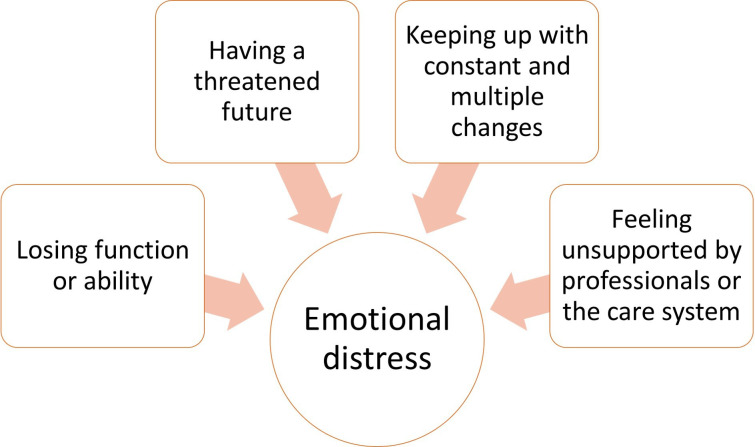
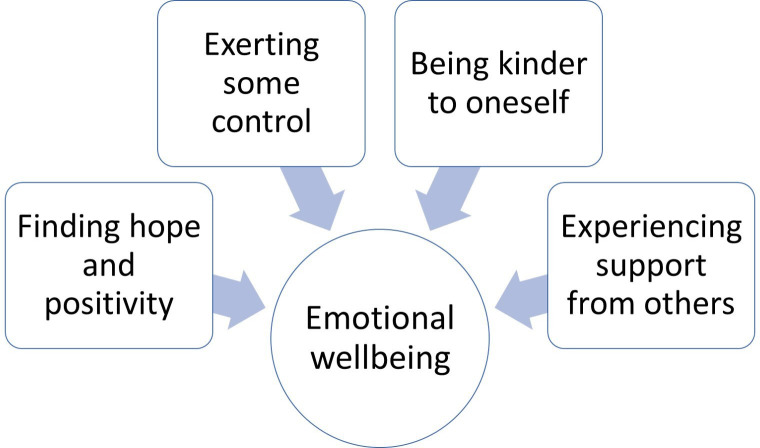
Objective: We aimed to get an in-depth understanding of the emotions experienced by people with motor neurone disease (MND) and their caregivers, and to explore what impacts emotional distress and well-being. Design: Qualitative study using semi-structured interviews with people with MND and caregivers. Setting: Participants were recruited from across the UK and took part in interviews conducted either face to face, by telephone or email to accommodate for varying levels of disability. Participants: 25 people with MND and 10 caregivers took part. Participants were purposively sampled based on their MND diagnosis, symptoms and time since diagnosis. Data analysis: Data were analysed using inductive reflexive thematic analysis. Results: Eight broad themes were generated (20 subthemes). Participants described the emotional distress of losing physical function and having a threatened future because of poor prognosis. Keeping up with constant changes in symptoms and feeling unsupported by the healthcare system added to emotional distress. Finding hope and positivity, exerting some control, being kinder to oneself and experiencing support from others were helpful strategies for emotional well-being. Conclusion: The study provides a broad understanding of what impacts emotional distress and well-being and discusses implications for psychological interventions for people with MND and caregivers. Any communication and support provided for people with MND and their caregivers, needs to pay attention to concepts of hope, control and compassion.
Overview
The claims and statistics of this paper haven’t been checked yet.
Free: it reads the open-access text and checks the first 5 claims that cite a source we can check. Create a free account to check every claim.
Integrity signals
Registry
Cites
Statistics
Figures
Verification
Claims the paper makes
The claims and statistics of this paper haven’t been checked yet.
Free: it reads the open-access text and checks the first 5 claims that cite a source we can check. Create a free account to check every claim.
Self-check
Percentages, sums and reported differences re-computed from the paper’s own numbers.
The self-check needs the paper’s full text.
Citations
Cites
Using thematic analysis in psychology
Braun, V., & Clarke, V. (2006) · Qualitative Research in Psychology · doi:10.1191/1478088706qp063oa · Cited by 194,414
Tong, A., Sainsbury, P., & Craig, J. (2007) · International Journal for Quality in Health Care · doi:10.1093/intqhc/mzm042 · Cited by 42,509
Reflecting on reflexive thematic analysis
Braun, V., & Clarke, V. (2019) · Qualitative Research in Sport, Exercise and Health · doi:10.1080/2159676x.2019.1628806 · Cited by 19,677 · cited 1×
“They also helped pilot the interview topic guide, refine interview questions and trial the data collection procedure to ensure that it was not burden-some.”
Self-compassion, stress, and coping in the context of chronic illness
Sirois, F. M., Molnar, D. S., & Hirsch, J. K. (2015) · Self and Identity · doi:10.1080/15298868.2014.996249 · Cited by 312 · cited 1×
“Despite these limitations, including the experiences of under-represented groups gives us confidence in the application of these findings for people with different symptoms and at different stages of MND.”
Pinto‐Gouveia, J., Duarte, C., Matos, M., & Fráguas, S. (2014) · Clinical Psychology & Psychotherapy · doi:10.1002/cpp.1838 · Cited by 192 · cited 1×
“Despite these limitations, including the experiences of under-represented groups gives us confidence in the application of these findings for people with different symptoms and at different stages of MND.”
Wren, A. A., Somers, T. J., Wright, M. A., Goetz, M. C., Leary, M. R., Fras, A. M., Huh, B. K., Rogers, L. L., & Keefe, F. J. (2012) · Journal of Pain and Symptom Management · doi:10.1016/j.jpainsymman.2011.04.014 · Cited by 173
Caregiver burden in amyotrophic lateral sclerosis: A systematic review
de Wit, J., Bakker, L. A., van Groenestijn, A. C., van den Berg, L. H., Schröder, C. D., Visser-Meily, J. M., & Beelen, A. (2018) · Palliative Medicine · doi:10.1177/0269216317709965 · Cited by 163
Aoun, S. M., Bentley, B., Funk, L., Toye, C., Grande, G., & Stajduhar, K. J. (2013) · Palliative Medicine · doi:10.1177/0269216312455729 · Cited by 152
A review of psychosocial aspects of motor neurone disease
McLeod, J. E., & Clarke, D. M. (2007) · Journal of the Neurological Sciences · doi:10.1016/j.jns.2007.03.001 · Cited by 135
Kangas, M., & McDonald, S. (2011) · Neuropsychological Rehabilitation · doi:10.1080/09602011.2010.540920 · Cited by 133
Correlates of Quality of Life in people with motor neuron disease (MND)
Goldstein, L., Atkins, L., & Leigh, P. (2002) · Amyotrophic Lateral Sclerosis and Other Motor Neuron Disorders · doi:10.1080/146608202760834120 · Cited by 126
Caregiving in ALS – a mixed methods approach to the study of Burden
Galvin, M., Corr, B., Madden, C., Mays, I., McQuillan, R., Timonen, V., Staines, A., & Hardiman, O. (2016) · BMC Palliative Care · doi:10.1186/s12904-016-0153-0 · Cited by 122
The psychological impact of motor neurone disease
Hogg, K. E., Goldstein, L. H., & Leigh, P. N. (1994) · Psychological Medicine · doi:10.1017/s003329170002777x · Cited by 116
Psychological wellbeing and quality of life in amyotrophic lateral sclerosis: A review
Pagnini, F. (2013) · International Journal of Psychology · doi:10.1080/00207594.2012.691977 · Cited by 116
Psychological health in patients with amyotrophic lateral sclerosis
Averill, A. J., Kasarskis, E. J., & Segerstrom, S. C. (2007) · Amyotrophic Lateral Sclerosis · doi:10.1080/17482960701374643 · Cited by 110
O'Brien, M. R., Whitehead, B., Jack, B. A., & Mitchell, J. D. (2011) · Amyotrophic Lateral Sclerosis · doi:10.3109/17482968.2010.546414 · Cited by 106
King, S. J., Duke, M. M., & O’Connor, B. A. (2009) · Journal of Clinical Nursing · doi:10.1111/j.1365-2702.2008.02671.x · Cited by 100
Experiences of dying, death and bereavement in motor neurone disease: A qualitative study
Whitehead, B. A., O'Brien, M. R., Jack, B., & Mitchell, D. J. (2011) · Palliative Medicine · doi:10.1177/0269216311410900 · Cited by 100
The psychological impact of MND on patients and carers
Goldstein, L. H., Adamson, M., Jeffrey, L., Down, K., Barby, T., Wilson, C., & Leigh, P. N. (1998) · Journal of the Neurological Sciences · doi:10.1016/s0022-510x(98)00209-3 · Cited by 98
Existential Issues in Palliative Care: Interviews of Patients with Amyotrophic Lateral Sclerosis
Bolmsjö, I. (2001) · Journal of Palliative Medicine · doi:10.1089/109662101753381647 · Cited by 96
Coping with amyotrophic lateral sclerosis: an integrative view
Matuz, T., Birbaumer, N., Hautzinger, M., & Kubler, A. (2010) · Journal of Neurology, Neurosurgery & Psychiatry · doi:10.1136/jnnp.2009.201285 · Cited by 87
O’Brien, M. R., Whitehead, B., Jack, B. A., & Mitchell, J. D. (2012) · Disability and Rehabilitation · doi:10.3109/09638288.2011.605511 · Cited by 81
Exerting control and adapting to loss in amyotrophic lateral sclerosis
Foley, G., Timonen, V., & Hardiman, O. (2014) · Social Science & Medicine · doi:10.1016/j.socscimed.2013.11.003 · Cited by 76
Longitudinal predictors of psychological distress and self-esteem in people with ALS
Goldstein, L. H., Atkins, L., Landau, S., Brown, R. G., & Leigh, P. N. (2006) · Neurology · doi:10.1212/01.wnl.0000242886.91786.47 · Cited by 75
User, carer and professional experiences of care in motor neurone disease
Brown, J. B. (2003) · Primary Health Care Research and Development · doi:10.1191/1463423603pc151oa · Cited by 72
Jenkinson, C. (2001) · Journal of Neurology, Neurosurgery & Psychiatry · doi:10.1136/jnnp.70.1.70 · Cited by 67
Clarke, D. M., McLeod, J. E., Smith, G. C., Trauer, T., & Kissane, D. W. (2005) · Journal of Palliative Care · doi:10.1177/082585970502100310 · Cited by 58
Hope in Palliative Care: From Narcissism to Self-Transcendence in Amyotrophic Lateral Sclerosis
Fanos, J. H., Gelinas, D. F., Foster, R. S., Postone, N., & Miller, R. G. (2008) · Journal of Palliative Medicine · doi:10.1089/jpm.2007.0098 · Cited by 57
Foley, G., Timonen, V., & Hardiman, O. (2014) · Palliative Medicine · doi:10.1177/0269216313512013 · Cited by 54
How common is depression among ALS caregivers? A longitudinal study
Rabkin, J., Albert, S., Rowland, L., & Mitsumoto, H. (2008) · Amyotrophic Lateral Sclerosis · doi:10.1080/17482960802459889 · Cited by 53
The personal experience of partners of individuals with motor neuron disease
Oyebode, J. R., Smith, H.-J., & Morrison, K. E. (2012) · Amyotrophic Lateral Sclerosis and Frontotemporal Degeneration · doi:10.3109/17482968.2012.719236 · Cited by 52
Quality of life, anxiety and depression in ALS patients and their next of kin
Olsson Ozanne, A. G., Strang, S., & Persson, L. I. (2011) · Journal of Clinical Nursing · doi:10.1111/j.1365-2702.2010.03509.x · Cited by 52
Psychosocial adjustment to ALS: a longitudinal study
Matuz, T., Birbaumer, N., Hautzinger, M., & Kübler, A. (2015) · Frontiers in Psychology · doi:10.3389/fpsyg.2015.01197 · Cited by 49
Perceptions of quality of life in people with ALS: Effects of coping and health care
Foley, G., O'Mahony, P., & Hardiman, O. (2007) · Amyotrophic Lateral Sclerosis · doi:10.1080/17482960601164532 · Cited by 48
Gould, R. L., Coulson, M. C., Brown, R. G., Goldstein, L. H., Al-Chalabi, A., & Howard, R. J. (2015) · Amyotrophic Lateral Sclerosis and Frontotemporal Degeneration · doi:10.3109/21678421.2015.1062515 · Cited by 47
Coping with amyotrophic lateral sclerosis; from diagnosis and during disease progression
Larsson, B. J., Nordin, K., & Nygren, I. (2015) · Journal of the Neurological Sciences · doi:10.1016/j.jns.2015.12.042 · Cited by 45
Graham, C. D., Simmons, Z., Stuart, S. R., & Rose, M. R. (2015) · Muscle & Nerve · doi:10.1002/mus.24487 · Cited by 43
Exploring the transitional process from receiving a diagnosis to living with motor neurone disease
Mistry, K., & Simpson, J. (2013) · Psychology and Health · doi:10.1080/08870446.2013.770513 · Cited by 40
Hugel, H., Grundy, N., Rigby, S., & Young, C. A. (2006) · Amyotrophic Lateral Sclerosis · doi:10.1080/14660820600601051 · Cited by 38
Experiences of living with motor neurone disease: a review of qualitative research
Sakellariou, D., Boniface, G., & Brown, P. (2013) · Disability and Rehabilitation · doi:10.3109/09638288.2012.753118 · Cited by 37
Goldstein, L. H., & Leigh, P. N. (1999) · British Journal of Health Psychology · doi:10.1348/135910799168579 · Cited by 37
Needs and preferences for psychological interventions of people with motor neuron disease
Weeks, K. R., Gould, R. L., Mcdermott, C., Lynch, J., Goldstein, L. H., Graham, C. D., McCracken, L., Serfaty, M., Howard, R., Al-Chalabi, A., et al. (2019) · Amyotrophic Lateral Sclerosis and Frontotemporal Degeneration · doi:10.1080/21678421.2019.1621344 · Cited by 36 · cited 1×
“Despite these limitations, including the experiences of under-represented groups gives us confidence in the application of these findings for people with different symptoms and at different stages of MND.”
Psychological interventions for people with motor neuron disease: a scoping review
Zarotti, N., Mayberry, E., Ovaska-Stafford, N., Eccles, F., & Simpson, J. (2021) · Amyotrophic Lateral Sclerosis and Frontotemporal Degeneration · doi:10.1080/21678421.2020.1788094 · Cited by 36
Soundy, A., & Condon, N. (2015) · Frontiers in Psychology · doi:10.3389/fpsyg.2015.00606 · Cited by 35
Clinical aspects of motor neurone disease
Hobson, E., Harwood, C. A., McDermott, C. J., & Shaw, P. J. (2016) · Medicine · doi:10.1016/j.mpmed.2016.06.004 · Cited by 29
Pavey, A., Allen‐Collinson, J., & Pavey, T. (2013) · Sociological Research Online · doi:10.5153/sro.2927 · Cited by 28
The experience of informal caregivers of patients with motor neurone disease: A thematic synthesis
Holkham, L., & Soundy, A. (2017) · Palliative & Supportive Care · doi:10.1017/s1478951517000852 · Cited by 27
Metaphoric language and the articulation of emotions by people affected by motor neurone disease
Locock, L., Mazanderani, F., & powell, J. A. (2012) · Chronic Illness · doi:10.1177/1742395312443390 · Cited by 25 · cited 1×
“One qualitative study examined the use of metaphors to express emotions, 30 and a small number have focused on emotions at specific time periods (eg, during diagnosis or the final stages).”
“It Gives Me My Freedom”: Technology and Responding to Bodily Limitations in Motor Neuron Disease
Pavey, A., Warren, N., & Allen‐Collinson, J. (2015) · Medical Anthropology · doi:10.1080/01459740.2015.1035782 · Cited by 14 · cited 1×
“Despite these limitations, including the experiences of under-represented groups gives us confidence in the application of these findings for people with different symptoms and at different stages of MND.”
Predictors of distress in amyotrophic lateral sclerosis: A systematic review
Fisher, P., Dodd, R., Barrow, E., Makin, S. M., & Cherry, M. G. (2019) · Cogent Psychology · doi:10.1080/23311908.2019.1608031 · Cited by 13
Perspectives of motor neurone disease
Cox, D. L. (1992) · Clinical Rehabilitation · doi:10.1177/026921559200600409 · Cited by 10
Clinical aspects of motor neurone disease
Moore, C., McDermott, C. J., & Shaw, P. J. (2008) · Medicine · doi:10.1016/j.mpmed.2008.09.001 · Cited by 5
Cited by
Briscoe, S., Pintado, C. M., Sutcliffe, K., Meléndez‐Torres, G. J., Garside, R., Lawal, H., Orr, N., Shaw, L., & Coon, J. T. (2025) · Orphanet Journal of Rare Diseases · doi:10.1186/s13023-025-03818-w · Cited by 18
“…co-ordination within health care services, including with respect to primary, secondary and tertiary services [21, 23, 25, 31, 47, 48, 52, 56, 60, 67, 73, 75, 78, 91, 101, 108]; and four studies reported data relating to care co-ordination between health and social care settings [78, 97, 105, 110].”
Acceptance Theory of Family Caregiving
Feliciano, A. Z., Feliciano, E. E., Palompon, D. R., & Gonzales, F. (2022) · Belitung Nursing Journal · doi:10.33546/bnj.2004 · Cited by 18
“Moreover, increasing dependence on the caregiver emanates from the older adult’s functional decline over time (Ainamani et al., 2020; Pinto et al., 2021), and the caregiving role becomes more intense in the advanced and end-of-life phase (Robinson et al., 2020).”
BackgroundGenuis, S. K., Luth, W., Bubela, T. M., & Johnston, W. S. W. (2023) · Muscle & Nerve · doi:10.1002/mus.27935 · Cited by 16
“At the same time, a communication agreement will shape patient and caregiver expectations and foster a sense of control within the therapeutic relationship.(51,83,84) This sense of control may be achieved by prioritizing of patients' communication preferences and by developing trust in clinicians who will sensitively…”
BackgroundVelaga, V. C., Cook, A. G., Auret, K. A., Jenkins, T. M., Thomas, G., & Aoun, S. M. (2023) · Brain Sciences · doi:10.3390/brainsci13060920 · Cited by 15
“Despite the majority of respondents using specialist palliative care services, they stated that they did not receive appropriate levels of empathy from their health care providers, a finding which is also consistent with other published accounts by MND patients and carers [11,26,27].”
BackgroundResultWalls, M., Claffey, A., Mockler, D., & Galvin, M. (2024) · Palliative Medicine · doi:10.1177/02692163241291745 · Cited by 13
“8,9,15 As the disease progresses increasing dependency and the level of care required have also been associated with high levels of burden, 16 emotional distress 17 and reduced psychological well-being 18 for patients and informal caregivers.”
Metadata
- Authors
- Pinto, C., Geraghty, A. W. A., Yardley, L., & Dennison, L.
- Affiliations
- University of Southampton (GB)
- University of Bristol (GB)
- Corresponding author
- Pinto, Cathryn
- Venue
- BMJ Open
- Publisher
- BMJ
- Published
- 2021-08
- Volume
- 11
- Issue
- 8
- Pages
- e044724
- ISSN
- 2044-6055 (ISSN-L)
- PMC
- PMC8372816
- OpenAlex
- W3195631618
- Semantic Scholar
- 6753752276b2e18fc478a369ec9ed3400377b6d1
- Cited by
- 40
- References
- 54
- Citations by year
- 2026: 9 · 2025: 8 · 2024: 6 · 2023: 12 · 2022: 5
- FWCI
- 8.97
- Type
- journal article
- Language
- en
- Open access
- gold
- doi.org
- Locations
- BMJ Open (publishedVersion, cc-by)
- PubMed Central (publishedVersion, cc-by)
- PubMed (publishedVersion)
- City Research Online (City University London) (acceptedVersion)
- Bristol Research (University of Bristol) (submittedVersion, cc-by)
- DOAJ (DOAJ: Directory of Open Access Journals) (submittedVersion, cc-by-sa)
- ePrints Soton (University of Southampton) (submittedVersion, cc-by)
- Explore Bristol Research (submittedVersion, cc-by)
- Funders
- Motor Neurone Disease Association (Yardley/May17/891-792)
- Topics
- Health Sciences › Nursing › Research and Theory › Nursing care and research
- Health Sciences › Medicine › Clinical Neurology › Amyotrophic Lateral Sclerosis Research
- Health Sciences › Medicine › Oncology › Cancer survivorship and care
- Keywords
- motor neuron disease, emotional distress, well-being, family caregivers, hope, perceived control, compassion, psychological intervention, prognosis, healthcare support, coping strategies
- MeSH terms
- Psychological Distress, Emotions, Humans, Motor Neuron Disease, Caregivers, Qualitative Research
About these checks
Registry, retraction, Cites and statistics results are computed, not judged, with one exception: a printed reference that no index lists is read once by a model before it counts as a citation error. Claims are extracted by a model and kept only when their quote appears verbatim in the text; each cited source is then checked, with a model’s help, for whether it says what the claim relies on. Those verdicts can be wrong — read the claim’s quote and the cited source before relying on one.
Statistics and arithmetic are recomputed, not judged.
Confidence bands are shown only for fields calibrated on our annotated test set. None is calibrated yet, so no band is shown.
What counts as a claim ›How we measure confidence ›How we check this ›
Are you an author, or do you see a problem with this page? Request a review
Data sources
Bibliographic data: Semantic Scholar, OpenAlex, Crossref.
Contains information from the Semantic Scholar Academic Graph Datasets, made available under the ODC Attribution License (ODC-BY 1.0).
Semantic Scholar’s data is described in: Kinney, R., et al. (2023). The Semantic Scholar Open Data Platform. arXiv:2301.10140.
