

Impact of COVID-19 pandemic on utilisation of healthcare services: a systematic review
Open accessPublished version of a preprint
The DOI matches its Crossref record; 40 of the 41 references it cites were found in a registry or an index.
Abstract
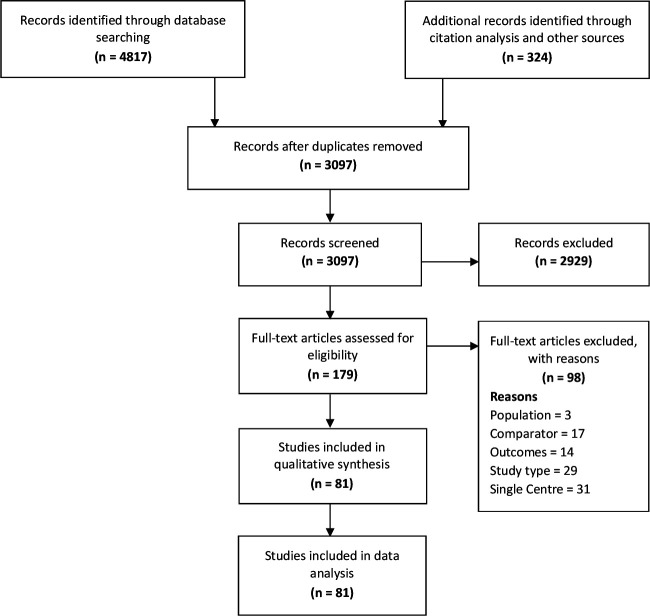
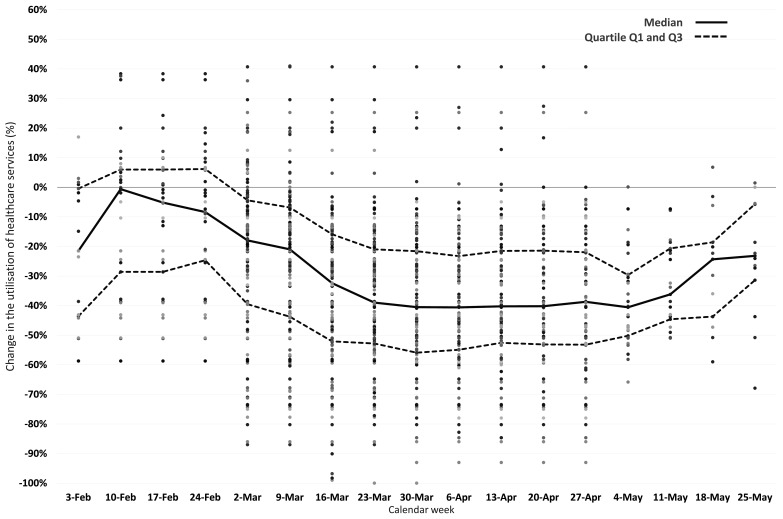
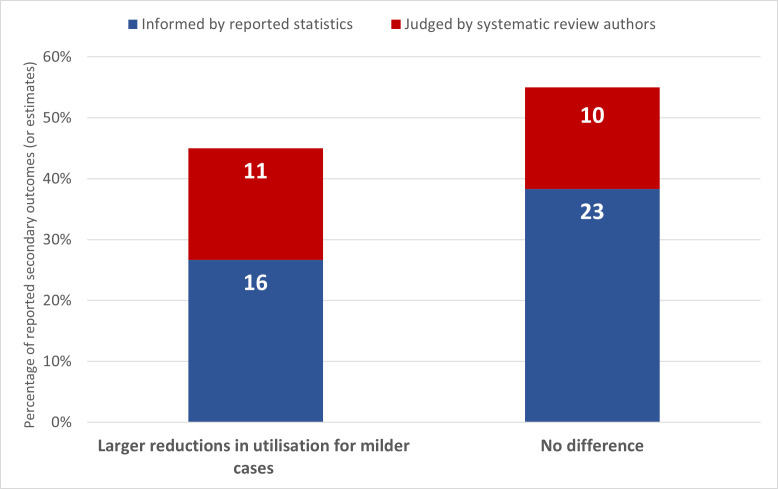
Objectives: To determine the extent and nature of changes in utilisation of healthcare services during COVID-19 pandemic. Design: Systematic review. Eligibility: Eligible studies compared utilisation of services during COVID-19 pandemic to at least one comparable period in prior years. Services included visits, admissions, diagnostics and therapeutics. Studies were excluded if from single centres or studied only patients with COVID-19. Data sources: PubMed, Embase, Cochrane COVID-19 Study Register and preprints were searched, without language restrictions, until 10 August, using detailed searches with key concepts including COVID-19, health services and impact. Data analysis: Risk of bias was assessed by adapting the Risk of Bias in Non-randomised Studies of Interventions tool, and a Cochrane Effective Practice and Organization of Care tool. Results were analysed using descriptive statistics, graphical figures and narrative synthesis. Outcome measures: Primary outcome was change in service utilisation between prepandemic and pandemic periods. Secondary outcome was the change in proportions of users of healthcare services with milder or more severe illness (eg, triage scores). Results: 3097 unique references were identified, and 81 studies across 20 countries included, reporting on >11 million services prepandemic and 6.9 million during pandemic. For the primary outcome, there were 143 estimates of changes, with a median 37% reduction in services overall (IQR −51% to −20%), comprising median reductions for visits of 42% (−53% to −32%), admissions 28% (−40% to −17%), diagnostics 31% (−53% to −24%) and for therapeutics 30% (−57% to −19%). Among 35 studies reporting secondary outcomes, there were 60 estimates, with 27 (45%) reporting larger reductions in utilisation among people with a milder spectrum of illness, and 33 (55%) reporting no difference. Conclusions: Healthcare utilisation decreased by about a third during the pandemic, with considerable variation, and with greater reductions among people with less severe illness. While addressing unmet need remains a priority, studies of health impacts of reductions may help health systems reduce unnecessary care in the postpandemic recovery. PROSPERO registration number: CRD42020203729.
Overview
The claims and statistics of this paper haven’t been checked yet.
Free: it reads the open-access text and checks the first 5 claims that cite a source we can check. Create a free account to check every claim.
Integrity signals
Registry
Cites
Statistics
Figures
Verification
Claims the paper makes
The claims and statistics of this paper haven’t been checked yet.
Free: it reads the open-access text and checks the first 5 claims that cite a source we can check. Create a free account to check every claim.
Claims other papers make about this one
Each is checked against this paper’s own text: does it say what the citing paper says it does?
The cited source says what the claim attributes to it.
In the citing paper
“Our data collection predated Covid-19 and the myriad effects that it has had on medicine, the community [28], and social media use [29].”
From Factors affecting how Australian doctors view and use social media: a follow-up national survey (2024) · cites this paper as [28]
Self-check
Percentages, sums and reported differences re-computed from the paper’s own numbers.
The self-check needs the paper’s full text.
Citations
Cites
Preferred Reporting Items for Systematic Reviews and Meta-Analyses: the PRISMA statement
Moher, D., Liberati, A., Tetzlaff, J., Altman, D. G., & for the PRISMA Group (2009) · BMJ · doi:10.1136/bmj.b2535 · Cited by 83,823
Preferred Reporting Items for Systematic Reviews and Meta-Analyses: The PRISMA Statement
Moher, D., Liberati, A., Tetzlaff, J., Altman, D. G., & The PRISMA Group (2009) · PLoS Medicine · doi:10.1371/journal.pmed.1000097 · Cited by 64,042
Preferred reporting items for systematic reviews and meta-analyses: the PRISMA Statement.
(2009) · PubMed Central · Cited by 44,859
ROBINS-I: a tool for assessing risk of bias in non-randomised studies of interventions
Sterne, J. A., Hernán, M. A., Reeves, B. C., Savović, J., Berkman, N. D., Viswanathan, M., Henry, D., Altman, D. G., Ansari, M. T., Boutron, I., et al. (2016) · BMJ · doi:10.1136/bmj.i4919 · Cited by 20,329
Wang, G., Ma, R., Qiao, G., Wada, K., Aizawa, Y., & Satoh, T. (2015) · Integrative Medicine International · doi:10.1159/000368408 · Cited by 18,657
Cochrane Handbook for Systematic Reviews of Interventions
(2019) · doi:10.1002/9781119536604 · Cited by 14,828
Cumpston, M., Li, T., Page, M. J., Chandler, J., Welch, V. A., Higgins, J. P., & Thomas, J. (2019) · Cochrane Database of Systematic Reviews · doi:10.1002/14651858.ed000142 · Cited by 7,218
Synthesis without meta-analysis (SWiM) in systematic reviews: reporting guideline
Campbell, M., McKenzie, J. E., Sowden, A., Katikireddi, S. V., Brennan, S. E., Ellis, S., Hartmann-Boyce, J., Ryan, R., Shepperd, S., Thomas, J., et al. (2020) · BMJ · doi:10.1136/bmj.l6890 · Cited by 4,628
Maringe, C., Spicer, J., Morris, M., Purushotham, A., Nolte, E., Sullivan, R., Rachet, B., & Aggarwal, A. (2020) · The Lancet Oncology · doi:10.1016/s1470-2045(20)30388-0 · Cited by 1,807
Eliminating Waste in US Health Care
Hackbarth, A. D. (2012) · JAMA · doi:10.1001/jama.2012.362 · Cited by 1,746
Research works printed but not linked: 2
- Armchair Medical TV. Laragh gollogly: official welcome. preventing overdiagnosis international scientific Conference, Sydney, 5-7 Dec 2019, 2019. Available: https://www.armchairmedical.tv/media/Official+Welcome+Fiona+Godlee+BMJ+%26+Laragh+Gollogy+WHO/0_lt786rva/146828052AccessedSeptember15,2020
- Cochrane Effective Practice and Organisation of Care (EPOC). Suggested risk of bias criteria for EPOC reviews. EPOC resources for review authors, 2017. Available: Epoc.cochrane.org/resources/epoc-resources-review-authors
Cited by
COVID-19 and resilience of healthcare systems in ten countries
Arsenault, C., Gage, A., Kim, M. K., Kapoor, N. R., Akweongo, P., Amponsah, F., Aryal, A., Asai, D., Awoonor-Williams, J. K., Ayele, W., et al. (2022) · Nature Medicine · doi:10.1038/s41591-022-01750-1 · Cited by 554
Materials-Driven Soft Wearable Bioelectronics for Connected Healthcare
Gong, S., Lu, Y., Yin, J., Levin, A., & Cheng, W. (2024) · Chemical Reviews · doi:10.1021/acs.chemrev.3c00502 · Cited by 411
Pandemi COVID-19: Dampak Kesehatan, Ekonomi, & Sosial
Aeni, N. (2021) · Jurnal Litbang Media Informasi Penelitian Pengembangan dan IPTEK · doi:10.33658/jl.v17i1.249 · Cited by 307
Tessema, G. A., Kinfu, Y., Dachew, B. A., Tesema, A. G., Assefa, Y., Alene, K. A., Aregay, A. F., Ayalew, M. B., Bezabhe, W. M., Bali, A. G., et al. (2021) · BMJ Global Health · doi:10.1136/bmjgh-2021-007179 · Cited by 271
Kwon, S., Park, J. K., & Koh, Y. H. (2023) · Journal of NeuroEngineering and Rehabilitation · doi:10.1186/s12984-023-01219-3 · Cited by 197
Metadata
- Authors
- Moynihan, R., Sanders, S., Michaleff, Z. A., Scott, A. M., Clark, J., To, E. J., Jones, M., Kitchener, E., Fox, M., Johansson, M., Lang, E., Duggan, A., Scott, I., & Albarqouni, L.
- Venue
- BMJ Open
- Publisher
- BMJ
- Published
- 2021-03
- Volume
- 11
- Issue
- 3
- Pages
- e045343
- ISSN
- 2044-6055 (ISSN-L)
- PMC
- PMC7969768
- OpenAlex
- W3136312839
- Cited by
- 1,422
- References
- 41
- FWCI
- 40.03
- Type
- journal article
- Language
- en
- Open access
- gold
About these checks
Registry, retraction, Cites and statistics results are computed, not judged, with one exception: a printed reference that no index lists is read once by a model before it counts as a citation error. Claims are extracted by a model and kept only when their quote appears verbatim in the text; each cited source is then checked, with a model’s help, for whether it says what the claim relies on. Those verdicts can be wrong — read the claim’s quote and the cited source before relying on one.
Statistics and arithmetic are recomputed, not judged.
Confidence bands are shown only for fields calibrated on our annotated test set. None is calibrated yet, so no band is shown.
What counts as a claim ›How we measure confidence ›How we check this ›
Are you an author, or do you see a problem with this page? Request a review
Data sources
Bibliographic data: Semantic Scholar, OpenAlex, Crossref.
Contains information from the Semantic Scholar Academic Graph Datasets, made available under the ODC Attribution License (ODC-BY 1.0).
Semantic Scholar’s data is described in: Kinney, R., et al. (2023). The Semantic Scholar Open Data Platform. arXiv:2301.10140.
