

Relationship between self-care activities, stress and well-being during COVID-19 lockdown: a cross-cultural mediation model
Open accessThe DOI matches its Crossref record; 54 of the 54 references it cites were found in a registry or an index.
Abstract
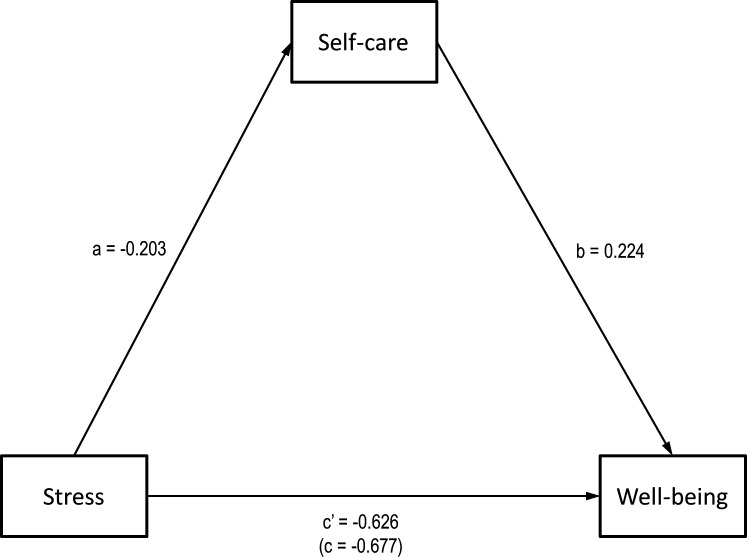
Objectives: To examine the mediation role of self-care between stress and psychological well-being in the general population of four countries and to assess the impact of sociodemographic variables on this relationship. Design: Cross-sectional, online survey. Participants: A stratified sample of confined general population (N=1082) from four Ibero-American countries—Chile (n=261), Colombia (n=268), Ecuador (n=282) and Spain (n=271)—balanced by age and gender. Primary outcomes measures: Sociodemographic information (age, gender, country, education and income level), information related to COVID-19 lockdown (number of days in quarantine, number of people with whom the individuals live, absence/presence of adults and minors in charge and attitude towards the search of information related to COVID-19), Perceived Stress Scale-10, Ryff’s Psychological Well-Being Scale-29 and Self-Care Activities Screening Scale-14. Results: Self-care partially mediates the relationship between stress and well-being during COVID-19 confinement in the general population in the total sample ( F (3,1078)=370.01, p<0.001, R 2 =0.507) and in each country. On the other hand, among the evaluated sociodemographic variables, only age affects this relationship. Conclusion: The results have broad implications for public health, highlighting the importance of promoting people’s active role in their own care and health behaviour to improve psychological well-being if stress management and social determinants of health are jointly addressed first. The present study provides the first transnational evidence from the earlier stages of the COVID-19 lockdown, showing that the higher perception of stress, the less self-care activities are adopted, and in turn the lower the beneficial effects on well-being.
Overview
The claims and statistics of this paper haven’t been checked yet.
Free: it reads the open-access text and checks the first 5 claims that cite a source we can check. Create a free account to check every claim.
Integrity signals
Registry
Cites
Statistics
Figures
Verification
Claims the paper makes
The claims and statistics of this paper haven’t been checked yet.
Free: it reads the open-access text and checks the first 5 claims that cite a source we can check. Create a free account to check every claim.
Claims other papers make about this one
Each is checked against this paper’s own text: does it say what the citing paper says it does?
The source backs part of the claim, not all of it — or backs it for a different population, condition or comparison.
In the citing paper
“The prevailing literature also suggests that self-care, positive psychological states, and resilience have protective effects on well-being, stress management, and mental health [16-23].”
From Psychological Interventions and Those With Elements of Positive Psychology for Child and Youth Mental Health During the COVID-19 Pandemic: Literature Review, Lessons Learned, and Areas for Future Knowledge Dissemination (2024) · cites this paper as [16]
Experimental — accuracy not yet measuredThe source backs part of the claim, not all of it — or backs it for a different population, condition or comparison.
In the citing paper
“Positive psychology can help youth by providing them with the necessary tools and resources to increase their resilience, well-being, and ability to cope during difficult times, which is especially relevant to the global youth mental health crisis during the pandemic [16-23].”
From Psychological Interventions and Those With Elements of Positive Psychology for Child and Youth Mental Health During the COVID-19 Pandemic: Literature Review, Lessons Learned, and Areas for Future Knowledge Dissemination (2024) · cites this paper as [16]
Experimental — accuracy not yet measured
Self-check
Percentages, sums and reported differences re-computed from the paper’s own numbers.
The self-check needs the paper’s full text.
Citations
Cites
Baron, R. M., & Kenny, D. A. (1986) · Journal of Personality and Social Psychology · doi:10.1037/0022-3514.51.6.1173 · Cited by 91,532
The psychological impact of quarantine and how to reduce it: Rapid review of the evidence
Brooks, S. K., Webster, R. K., Smith, L. E., Woodland, L., Wessely, S., Greenberg, N., & Rubin, G. J. (2020) · The Lancet · doi:10.1016/s0140-6736(20)30460-8 · Cited by 16,378
Happiness is everything, or is it? Explorations on the meaning of psychological well-being.
Ryff, C. D. (1989) · Journal of Personality and Social Psychology · doi:10.1037/0022-3514.57.6.1069 · Cited by 14,847
The structure of psychological well-being revisited.
Ryff, C. D., & Keyes, C. L. M. (1995) · Journal of Personality and Social Psychology · doi:10.1037//0022-3514.69.4.719 · Cited by 10,285
Using social and behavioural science to support COVID-19 pandemic response
Bavel, J. J. V., Baicker, K., Boggio, P. S., Capraro, V., Cichocka, A., Cikara, M., Crockett, M. J., Crum, A. J., Douglas, K. M., Druckman, J. N., et al. (2020) · Nature Human Behaviour · doi:10.1038/s41562-020-0884-z · Cited by 4,964
Pappa, S., Ntella, V., Giannakas, T., Giannakoulis, V. G., Papoutsi, E., & Katsaounou, P. (2020) · Brain Behavior and Immunity · doi:10.1016/j.bbi.2020.05.026 · Cited by 3,617
COVID-19 pandemic and mental health consequences: Systematic review of the current evidence
Vindegaard, N., & Benros, M. E. (2020) · Brain, Behavior, and Immunity · doi:10.1016/j.bbi.2020.05.048 · Cited by 3,221
The salutogenic model as a theory to guide health promotion
ANTONOVSKY, A. (1996) · Health Promotion International · doi:10.1093/heapro/11.1.11 · Cited by 2,647
Huber, M., Knottnerus, J. A., Green, L., Horst, H. V. D., Jadad, A. R., Kromhout, D., Leonard, B., Lorig, K., Loureiro, M. I., Meer, J. W. M. V. D., et al. (2011) · BMJ · doi:10.1136/bmj.d4163 · Cited by 2,637
Mediation Analysis in Social Psychology: Current Practices and New Recommendations
Rucker, D. D., Preacher, K. J., Tormala, Z. L., & Petty, R. E. (2011) · Social and Personality Psychology Compass · doi:10.1111/j.1751-9004.2011.00355.x · Cited by 2,430
Research works printed but not linked: 2
- Farberman HA. Mannheim, Cooley, and mead: toward a social theory of mentality. The sociological Quarterly. 11, 1970: 3– 13.
- Hayes AF. Mediation, moderation, and conditional process analysis: a regression-based approach. second ed. New York: Guilford Press, 2018.
Cited by
Studying Self-Care with Generative AI Tools: Lessons for Design
Capel, T., Ploderer, B., Birčanin, F., Hanmer, S., Yates, J. P., Wang, J., Khor, K. L., Leong, T. W., Wadley, G., & Newcomb, M. (2024) · Designing Interactive Systems Conference · doi:10.1145/3643834.3661614 · Cited by 44
Urtubia-Herrera, V., Sánchez, M. V. N., Santos, A. M. P., Marcos, A. P., García-Gómez, A., Luís, E. O., & Bermejo‐Martins, E. (2024) · Frontiers in Public Health · doi:10.3389/fpubh.2024.1304310 · Cited by 24
Self-citationDoes self-care improve coping or does coping improve self-care? A structural equation modeling study
Riegel, B. J., Barbaranelli, C., Stawnychy, M. A., MATUS, A. M., & Hirschman, K. B. (2024) · Applied Nursing Research · doi:10.1016/j.apnr.2024.151810 · Cited by 24
Badura-Brzoza, K., Dębski, P. G., Główczyński, P., Dębska, M., & Gorczyca, P. W. (2022) · International Journal of Environmental Research and Public Health · doi:10.3390/ijerph19116706 · Cited by 20
Grandieri, A., Trevisan, C., Gentili, S., Vetrano, D. L., Liotta, G., & Volpato, S. (2023) · Journal of Personalized Medicine · doi:10.3390/jpm13071090 · Cited by 19
Metadata
- Authors
- Luis, E., Bermejo-Martins, E., Martinez, M., Sarrionandia, A., Cortes, C., Oliveros, E. Y., Garces, M. S., Oron, J. V., & Fernández-Berrocal, P.
- Affiliations
- School of Education and Psychology, University of Navarra, Pamplona, Spain
- IdiSNA, Navarre Institute of Health Research, Pamplona, Spain
- University of the Basque Country (ES)
- Faculty of Psychology, Universidad del Desarrollo, Santiago de Chile, Chile
- Universidad de San Buenaventura, Bogota (CO)
- Neuroscience Institute, Universidad San Francisco de Quito, Quito, Ecuador
- UpToYou Fundation, Pamplona, Spain
- Faculty of Psychology, University of Malaga, Malaga, Spain
- ORCID
- Venue
- BMJ Open
- Publisher
- BMJ
- Published
- 2021-12
- Volume
- 11
- Issue
- 12
- Pages
- e048469
- ISSN
- 2044-6055 (ISSN-L)
- PMC
- PMC8678542
- OpenAlex
- W4200122692
- Cited by
- 45
- References
- 54
- Citations by year
- 2026: 3 · 2025: 3 · 2024: 12 · 2023: 14 · 2022: 13
- FWCI
- 6.65
- Type
- journal article
- Language
- en
- Open access
- gold
- doi.org
- Licence
- Locations
- BMJ Open (publishedVersion, cc-by-nc)
- PubMed Central (publishedVersion, cc-by-nc)
- PubMed (publishedVersion)
- DOAJ (DOAJ: Directory of Open Access Journals) (submittedVersion)
- Funders
- The Spanish Ministry of Economy, Industry and Competitiveness (PSI2017–84170–R)
- Junta Andalucia FEDERJA (UMA18– FEDERJA–114)
- Topics
- Social Sciences › Psychology › Clinical Psychology › COVID-19 and Mental Health
- Health Sciences › Health Professions › General Health Professions › Health, psychology, and well-being
- Social Sciences › Sociology and Political Science › COVID-19 Prevention and Impact
- Keywords
- self-care, perceived stress, psychological well-being, COVID-19 lockdown, quarantine, mediation, sociodemographic factors, age differences, Ibero-American countries, cross-cultural comparison, stress management, social determinants of health
- MeSH terms
- COVID-19, SARS-CoV-2, Communicable Disease Control, Cross-Sectional Studies, Cross-Cultural Comparison, Humans, Self Care
About these checks
Registry, retraction, Cites and statistics results are computed, not judged, with one exception: a printed reference that no index lists is read once by a model before it counts as a citation error. Claims are extracted by a model and kept only when their quote appears verbatim in the text; each cited source is then checked, with a model’s help, for whether it says what the claim relies on. Those verdicts can be wrong — read the claim’s quote and the cited source before relying on one.
Statistics and arithmetic are recomputed, not judged.
Confidence bands are shown only for fields calibrated on our annotated test set. None is calibrated yet, so no band is shown.
What counts as a claim ›How we measure confidence ›How we check this ›
Are you an author, or do you see a problem with this page? Request a review
How to cite
Cite CoChat for the checks on this page, and the paper for its own findings.
- This page
- CoChat. (2026). Citation check: Relationship between self-care activities, stress and well-being during COVID-19 lockdown: a cross-cultural mediation model. https://app.cochat.ai/papers/10.1136/bmjopen-2020-048469
- The paper
- Luis, E., Bermejo-Martins, E., Martinez, M., Sarrionandia, A., Cortes, C., Oliveros, E. Y., Garces, M. S., Oron, J. V., & Fernández-Berrocal, P. (2021). Relationship between self-care activities, stress and well-being during COVID-19 lockdown: a cross-cultural mediation model. BMJ Open. https://doi.org/10.1136/bmjopen-2020-048469
Data sources
Bibliographic data: Semantic Scholar, OpenAlex, Crossref.
Contains information from the Semantic Scholar Academic Graph Datasets, made available under the ODC Attribution License (ODC-BY 1.0).
Semantic Scholar’s data is described in: Kinney, R., et al. (2023). The Semantic Scholar Open Data Platform. arXiv:2301.10140.
