

Quality of clinical practice guidelines for inadequate response to first-line treatment for depression according to AGREE II checklist and comparison of recommendations: a systematic review
Open accessThe DOI matches its Crossref record; 58 of the 58 references it cites were found in a registry or an index.
Abstract
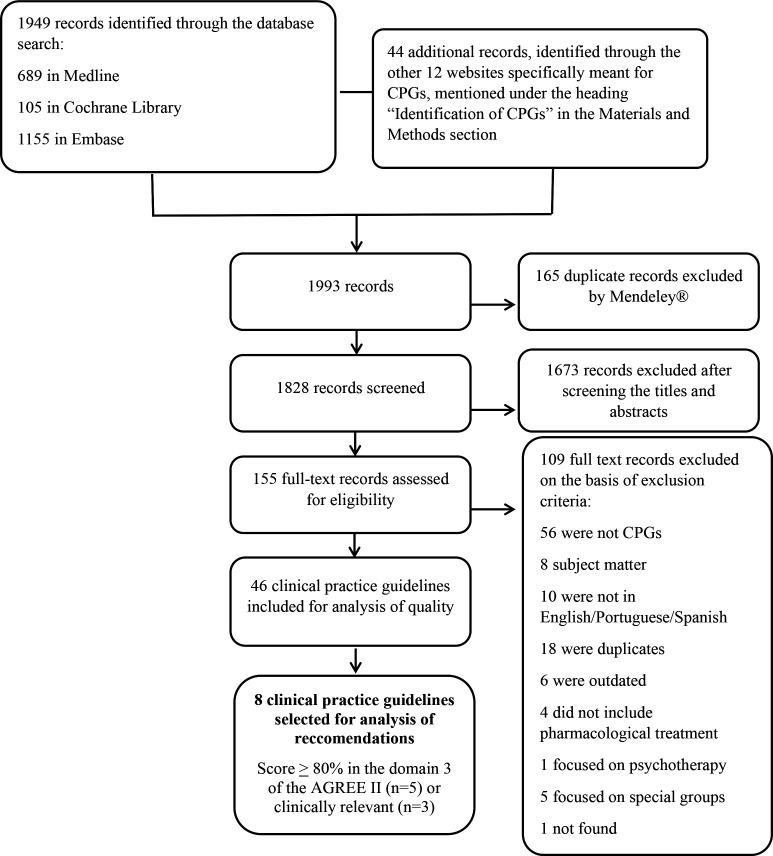
Objective: To assess similarities and differences in the recommended sequence of strategies among the most relevant clinical practice guidelines (CPGs) for the treatment of depression in adults with inadequate response to first-line treatment. Data sources: We performed a systematic review of the literature spanning January 2011 to August 2020 in Medline, Embase, Cochrane Library and 12 databases recognised as CPGs repositories. CPGs quality was assessed using the Appraisal of Guidelines for Research and Evaluation II (AGREE II). Study selection: The eligibility criteria were CPGs that described pharmacological recommendations for treating depression for individuals aged 18 years or older in outpatient care setting. We included CPGs considered of high-quality (≥80% in domain 3 of AGREE II) or recognised as clinically relevant. Data extraction: Two independent researchers extracted recommendations for patients who did not respond to first-line pharmacological treatment from the selected CPGs. Results: We included 46 CPGs and selected 8, of which 5 were considered high quality (≥80% in domain 3 of AGREE II) and 3 were recognised as clinically relevant. Three CPGs did not define inadequate response to treatment and 3 did not establish a clear sequence of strategies. The duration of treatment needed to determine that a patient had not responded was not explicit in 3 CPGs and was discordant in 5 CPGs. Most CPGs agree in reassessing the diagnosis, assessing the presence of comorbidities, adherence to treatment, and increase dosage as first steps. All CPGs recommend psychotherapy, switching antidepressants, and considering augmentation/combining antidepressants. Conclusion: Relevant CPGs present shortcomings in recommendations for non-responders to first-line antidepressant treatment including absence and divergencies in definition of inadequate response and sequence of recommended strategies. Overall, most relevant CPGs recommend reassessing the diagnosis, evaluate comorbidities, adherence to treatment, increase dosage of antidepressants, and psychotherapy as first steps. PROSPERO registration number: CRD42016043364.
Overview
The claims and statistics of this paper haven’t been checked yet.
Free: it reads the open-access text and checks the first 5 claims that cite a source we can check. Create a free account to check every claim.
Integrity signals
Registry
Cites
Statistics
Figures
Verification
Claims the paper makes
The claims and statistics of this paper haven’t been checked yet.
Free: it reads the open-access text and checks the first 5 claims that cite a source we can check. Create a free account to check every claim.
Claims other papers make about this one
Each is checked against this paper’s own text: does it say what the citing paper says it does?
The source backs part of the claim, not all of it — or backs it for a different population, condition or comparison.
In the citing paper
“None of the extant TRD definitions are universally accepted and/or implemented at point- of- care in clinical practice 11,32,64- 68 .”
From Treatment‐resistant depression: definition, prevalence, detection, management, and investigational interventions (2023) · cites this paper as [68]
Experimental — accuracy not yet measured
Self-check
Percentages, sums and reported differences re-computed from the paper’s own numbers.
The self-check needs the paper’s full text.
Citations
Cites
AGREE II: advancing guideline development, reporting and evaluation in health care
Brouwers, M. C., Kho, M. E., Browman, G. P., Burgers, J. S., Cluzeau, F., Feder, G., Fervers, B., Graham, I. D., Grimshaw, J., Hanna, S. E., et al. (2010) · Canadian Medical Association Journal · doi:10.1503/cmaj.090449 · Cited by 3,790
Cipriani, A., Furukawa, T. A., Salanti, G., Chaimani, A., Atkinson, L. Z., Ogawa, Y., Leucht, S., Ruhe, H. G., Turner, E. H., Higgins, J. P. T., et al. (2018) · The Lancet · doi:10.1016/s0140-6736(17)32802-7 · Cited by 3,541
Grand challenges in global mental health
Collins, P. Y., Patel, V., Joestl, S. S., March, D., Insel, T. R., Daar, A. S., Bordin, I. A., Costello, E. J., Durkin, M., Fairburn, C., et al. (2011) · Nature · doi:10.1038/475027a · Cited by 2,043
Murray, C. J. L., Barber, R. M., Foreman, K. J., Ozgoren, A. A., Abd-Allah, F., Abera, S. F., Aboyans, V., Abraham, J. P., Abubakar, I., Abu-Raddad, L. J., et al. (2015) · The Lancet · doi:10.1016/s0140-6736(15)61340-x · Cited by 1,964
(2012) · RePEc: Research Papers in Economics · Cited by 1,951
Self-citationPRACTICE GUIDELINE FOR THE Treatment of Patients With Major Depressive Disorder
Gelenberg, A. J., Freeman, P. B., Markowitz, J. C., Rosenbaum, J. F., Thase, M. E., Trivedi, M. H., & Rhoads, R. S. (2010) · Cited by 1,521
Alonso-Coello, P., Schünemann, H. J., Moberg, J., Brignardello-Petersen, R., Akl, E. A., Davoli, M., Treweek, S., Mustafa, R. A., Rada, G., Rosenbaum, S., et al. (2016) · BMJ · doi:10.1136/bmj.i2016 · Cited by 1,317
The consequences of the COVID-19 pandemic on mental health and implications for clinical practice
Fiorillo, A., & Gorwood, P. (2020) · European Psychiatry · doi:10.1192/j.eurpsy.2020.35 · Cited by 1,190
Kennedy, S. H., Lam, R. W., McIntyre, R. S., Tourjman, S. V., Bhat, V., Blier, P., Hasnain, M., Jollant, F., Levitt, A. J., MacQueen, G. M., et al. (2016) · The Canadian Journal of Psychiatry · doi:10.1177/0706743716659417 · Cited by 1,181
Malhi, G. S., Bassett, D., Boyce, P., Bryant, R., Fitzgerald, P. B., Fritz, K., Hopwood, M., Lyndon, B., Mulder, R., Murray, G., et al. (2015) · Australian & New Zealand Journal of Psychiatry · doi:10.1177/0004867415617657 · Cited by 842
Cleare, A., Pariante, C., Young, A., Anderson, I., Christmas, D., Cowen, P., Dickens, C., Ferrier, I., Geddes, J., Gilbody, S., et al. (2015) · Journal of Psychopharmacology · doi:10.1177/0269881115581093 · Cited by 759
Bauer, M., Pfennig, A., Severus, E., Whybrow, P. C., Angst, J., Möller, H.-J., & Šon behalf of the Task Force on Unipolar Depressive Disorders (2013) · The World Journal of Biological Psychiatry · doi:10.3109/15622975.2013.804195 · Cited by 632
Connolly, K. R., & Thase, M. E. (2011) · Drugs · doi:10.2165/11587620-000000000-00000 · Cited by 462
Depression in the Primary Care Setting
Park, L. T., & Zarate, C. A. (2019) · New England Journal of Medicine · doi:10.1056/nejmcp1712493 · Cited by 458
(2007) · PubMed · Cited by 453
Management of Treatment-Resistant Depression: Challenges and Strategies
Voineskos, D., Daskalakis, Z. J., & Blumberger, D. M. (2020) · Neuropsychiatric Disease and Treatment · doi:10.2147/ndt.s198774 · Cited by 446
Taylor, W. D. (2014) · New England Journal of Medicine · doi:10.1056/nejmcp1402180 · Cited by 394
Depression in adults: recognition and management
(2017) · Clinical Pharmacist · doi:10.1211/cp.2017.20202439 · Cited by 393
Dua, T., Barbui, C., Clark, N., Fleischmann, A., Poznyak, V., van Ommeren, M., Yasamy, M. T., Ayuso-Mateos, J. L., Birbeck, G. L., Drummond, C., et al. (2011) · PLoS Medicine · doi:10.1371/journal.pmed.1001122 · Cited by 384
Gartlehner, G., Hansen, R. A., Morgan, L. C., Thaler, K., Lux, L., Van Noord, M., Mager, U., Thieda, P., Gaynes, B. N., Wilkins, T., et al. (2011) · Annals of Internal Medicine · doi:10.7326/0003-4819-155-11-201112060-00009 · Cited by 355
Qaseem, A., Barry, M. J., Kansagara, D., & for the Clinical Guidelines Committee of the American College of Physicians (2016) · Annals of Internal Medicine · doi:10.7326/m15-2570 · Cited by 279
Systematic reviews of clinical practice guidelines: a methodological guide
Johnston, A., Kelly, S. E., Hsieh, S.-C., Skidmore, B., & Wells, G. A. (2019) · Journal of Clinical Epidemiology · doi:10.1016/j.jclinepi.2018.11.030 · Cited by 273
Clinical Practice Guidelines for the management of Depression
Grover, S., Gautam, S., Jain, A., Gautam, M., & Vahia, V. (2017) · Indian Journal of Psychiatry · doi:10.4103/0019-5545.196973 · Cited by 269
Cuijpers, P., Dekker, J., Hollon, S. D., & Andersson, G. (2009) · The Journal of Clinical Psychiatry · doi:10.4088/jcp.09r05021 · Cited by 261
Clinicians' attitudes to clinical practice guidelines: a systematic review
Farquhar, C. M., Kofa, E. W., & Slutsky, J. R. (2002) · Medical Journal of Australia · doi:10.5694/j.1326-5377.2002.tb04920.x · Cited by 257
Hochman, B., Nahas, F. X., Oliveira Filho, R. S. D., & Ferreira, L. M. (2005) · Acta Cirurgica Brasileira · doi:10.1590/s0102-86502005000800002 · Cited by 229
Bauer, M., Severus, E., Köhler, S., Whybrow, P. C., Angst, J., Möller, H.-J., & on behalf of the Wfsbp Task Force on Treatment Guidelines for Unipolar Depressive Disorders (2015) · The World Journal of Biological Psychiatry · doi:10.3109/15622975.2014.1001786 · Cited by 199
Pharmacological treatment of unipolar depressive disorders: summary of WFSBP guidelines
Bauer, M., Severus, E., Möller, H.-J., Young, A. H., & WFSBP Task Force on Unipolar Depressive Disorders (2017) · International Journal of Psychiatry in Clinical Practice · doi:10.1080/13651501.2017.1306082 · Cited by 175
Clinical Practice Guidelines: What’s Next?
Shekelle, P. (2018) · JAMA · doi:10.1001/jama.2018.9660 · Cited by 159
Pharmacological Treatments for Patients with Treatment-Resistant Depression
Ruberto, V. L., Jha, M. K., & Murrough, J. W. (2020) · Pharmaceuticals · doi:10.3390/ph13060116 · Cited by 147
Hoffmann-Eßer, W., Siering, U., Neugebauer, E. A. M., Brockhaus, A. C., McGauran, N., & Eikermann, M. (2018) · BMC Health Services Research · doi:10.1186/s12913-018-2954-8 · Cited by 146
MacQueen, G., Santaguida, P., Keshavarz, H., Jaworska, N., Levine, M., Beyene, J., & Raina, P. (2017) · The Canadian Journal of Psychiatry · doi:10.1177/0706743716664885 · Cited by 123
Gabriel, F. C., de Melo, D. O., Fráguas, R., Leite-Santos, N. C., Mantovani da Silva, R. A., & Ribeiro, E. (2020) · PLOS ONE · doi:10.1371/journal.pone.0231700 · Cited by 111
Self-citationCarvalho, A. F., Cavalcante, J. L., Castelo, M. S., & Lima, M. C. O. (2007) · Journal of Clinical Pharmacy and Therapeutics · doi:10.1111/j.1365-2710.2007.00846.x · Cited by 110
Bennabi, D., Charpeaud, T., Yrondi, A., Genty, J.-B., Destouches, S., Lancrenon, S., Alaïli, N., Bellivier, F., Bougerol, T., Camus, V., et al. (2019) · BMC Psychiatry · doi:10.1186/s12888-019-2237-x · Cited by 100
A Systematic Approach to Pharmacotherapy for Geriatric Major Depression
Mulsant, B. H., Blumberger, D. M., Ismail, Z., Rabheru, K., & Rapoport, M. J. (2014) · Clinics in Geriatric Medicine · doi:10.1016/j.cger.2014.05.002 · Cited by 99
Clinical practice guidelines for management of depression in elderly
Avasthi, A., & Grover, S. (2018) · Indian Journal of Psychiatry · doi:10.4103/0019-5545.224474 · Cited by 99
Bschor, T., Kern, H., Henssler, J., & Baethge, C. (2018) · The Journal of Clinical Psychiatry · doi:10.4088/jcp.16r10749 · Cited by 94
Molino, C. D. G. R. C., Leite-Santos, N. C., Gabriel, F. C., Wainberg, S. K., de Vasconcelos, L. P., Silva, R. A. M., Ribeiro, E., Romano-Lieber, N. S., Stein, A. T., de Melo, D. O., et al. (2019) · JAMA Internal Medicine · doi:10.1001/jamainternmed.2018.7529 · Cited by 83
Self-citationMcIntyre, R. S., Suppes, T., Tandon, R., & Ostacher, M. (2017) · The Journal of Clinical Psychiatry · doi:10.4088/jcp.16cs10885 · Cited by 61
Möller, H.-J., Bitter, I., Bobes, J., Fountoulakis, K., Höschl, C., & Kasper, S. (2012) · European Psychiatry · doi:10.1016/j.eurpsy.2011.08.002 · Cited by 53
Hamoda, H. M., & Osser, D. N. (2008) · Harvard Review of Psychiatry · doi:10.1080/10673220802277904 · Cited by 47
Zafra-Tanaka, J. H., Goicochea-Lugo, S., Villarreal-Zegarra, D., & Taype-Rondan, A. (2019) · BMC Psychiatry · doi:10.1186/s12888-019-2057-z · Cited by 44
Pharmacological management of unipolar depression
Malhi, G. S., Hitching, R., Berk, M., Boyce, P., Porter, R., & Fritz, K. (2013) · Acta Psychiatrica Scandinavica · doi:10.1111/acps.12122 · Cited by 42
Saddichha, S., & Chaturvedi, S. K. (2014) · ISRN Psychiatry · doi:10.1155/2014/828917 · Cited by 32
How to choose an antidepressant medication
Bayes, A. J., & Parker, G. B. (2019) · Acta Psychiatrica Scandinavica · doi:10.1111/acps.13001 · Cited by 32
Giakoumatos, C. I., & Osser, D. (2019) · Harvard Review of Psychiatry · doi:10.1097/hrp.0000000000000197 · Cited by 27
Driot, D., Bismuth, M., Maurel, A., Soulié-Albouy, J., Birebent, J., Oustric, S., & Dupouy, J. (2017) · La Presse Médicale · doi:10.1016/j.lpm.2017.10.010 · Cited by 26
Korean Medication Algorithm for Depressive Disorder: Comparisons with Other Treatment Guidelines
Wang, H. R., Bahk, W., Seo, J. S., Woo, Y. S., Park, Y., Jeong, J., Kim, W. K., Shim, S.-H., Lee, J. G., Jon, D., et al. (2017) · Clinical Psychopharmacology and Neuroscience · doi:10.9758/cpn.2017.15.3.199 · Cited by 24
Ministry of Health clinical practice guidelines: depression.
Chua, H. C., Chan, L., Chee, K. S., Chen, Y. H., Chin, S., Chua, P. L., Fones, S. L. C., Fung, D. S. S., Khoo, C. L., Kwek, S. K. D., et al. (2012) · PubMed · Cited by 22
Combined Treatment of Depression
Busch, F. N., & Sandberg, L. S. (2011) · Psychiatric Clinics of North America · doi:10.1016/j.psc.2011.10.002 · Cited by 19
Molino, C. D. G. R. C., Ribeiro, E., Romano-Lieber, N. S., Stein, A. T., & de Melo, D. O. (2017) · Systematic Reviews · doi:10.1186/s13643-017-0621-5 · Cited by 18
Self-citationPiotrowski, P., Gondek, T. M., Rymaszewska, J., Beszłej, J. A., Czachowski, S., Parmentier, H., & Kurpas, D. (2017) · Family Medicine & Primary Care Review · doi:10.5114/fmpcr.2017.69300 · Cited by 9
Protocolos clínicos e diretrizes terapêuticas no SUS: histórico, desafios e perspectivas
Mega, T. ́., Lopes, A. C. D. F., Santos, V. C. C., et al. (2015) · Dialnet (Universidad de la Rioja) · Cited by 7
Protocolos clínicos e diretrizes terapêuticas no SUS: histórico, desafios e perspectivas
Mega, T. ́., Lopes, A. C. D. F., Santos, V. C. C., & Petramale, C. A. (2015) · Revista Gestão & Saúde · doi:10.18673/gs.v6i4.22111 · Cited by 7
Grobler, G. P. (2013) · South African Medical Journal · Cited by 5
Combined Pharmacotherapy and Psychological Treatment for Depression: A Systematic Review
Pampallona, S., Bollini, P., Tibaldi, G., Kupelnick, B., & Munizza, C. (2004) · Archives of General Psychiatry · doi:10.1001/archpsyc.61.7.714 · Cited by 5
Voytenko, V. L., Nykamp, L. J., Achtyes, E. D., Stoyanov, R., Anderson, K., Pine Rest Christian Mental Health Services, G. R., Thomas, S., Pine Rest Christian Mental Health Services, G. R., Lee, S. H., Pine Rest Christian Mental Health Services, G. R., et al. (2018) · Psychiatria i Psychologia Kliniczna · doi:10.15557/pipk.2018.0029 · Cited by 5
Research works printed but not linked: 3
- Thompson C. Affective disorders. In: Thompson C, ed. The instruments of psychiatric research. London, UK: John Wiley & Sons, 1989: 87– 126.
- Institute of Medicine. US committee on standards for developing trustworthy clinical practice guidelines. In: Clinical practice guidelines we can trust. Washington, DC: The National Academies Press, 2011.
- Sánchez VP, Santos PM. Diagnostic and therapeutic protocol of depression. J Med 2019; 12: 5070– 4.
Cited by
McIntyre, R. S., Alsuwaidan, M., Baune, B. T., Berk, M., Demyttenaere, K., Goldberg, J. F., Gorwood, P., Ho, R., Kasper, S., Kennedy, S. H., et al. (2023) · World Psychiatry · doi:10.1002/wps.21120 · Cited by 836
Gabriel, F. C., Stein, A. T., de Melo, D. O., Fontes-Mota, G. C. H., dos Santos, I. B., Rodrigues, C. D. S., Dourado, A., Rodrigues, M. C., Fráguas, R., Flórez, I. D., et al. (2023) · PLoS ONE · doi:10.1371/journal.pone.0281501 · Cited by 34
“Both CPGs include drug switching as a treatment option after the first antidepressant failure, which is in line with the finding that most CPGs recommend drug switching before drug augmentation or a combination [38].”
ResultSelf-citationWang, X., Fan, X., Zhang, L., Liu, X., & Ji, Z. (2023) · Medicine · doi:10.1097/md.0000000000034841 · Cited by 19
“This not only causes significant harm to families, but also affects social stability and harmony.[2] At present, MDD is mainly treated with drugs in clinical practice.”
The management of depression: the evidence speaks for itself
Malhi, G. S., Bell, E., Bassett, D. L., Boyce, P. M., Bryant, R. A., Hopwood, M., Lyndon, B., Mulder, R., Porter, R., Singh, A., et al. (2022) · The British Journal of Psychiatry · doi:10.1192/bjp.2022.133 · Cited by 10
Guo, L., Li, J., White, H., Xu, Z., Ren, J., Huang, X., Chen, Y., & Yang, K. (2023) · Campbell Systematic Reviews · doi:10.1002/cl2.1308 · Cited by 5
Metadata
- Authors
- Gabriel, F. C., Stein, A. T., de Melo, D. O., Henrique Fontes-Mota, G. C., dos Santos, I. B., de Oliveira, A. F., Fráguas, R., & Ribeiro, E.
- Affiliations
- Universidade de São Paulo (BR)
- Departamento de Saúde Coletiva, Universidade Federal de Ciências da Saúde de Porto Alegre, Porto Alegre, Rio Grande do Sul, Brasil
- Departamento de Ciências Farmacêuticas, Instituto de Ciências Ambientais, Químicas e Farmacêuticas, Universidade Federal de São Paulo, Diadema, São Paulo, Brasil
- Departamento de Farmácia, Faculdade de Ciências Farmacêuticas, Universidade de São Paulo, São Paulo, São Paulo, Brasil
- Departamento de Desenho Industrial, Universidade Federal de Santa Maria, Santa Maria, Rio Grande do Sul, Brasil
- Corresponding author
- Gabriel, Franciele Cordeiro
- ORCID
- Venue
- BMJ Open
- Publisher
- BMJ
- Published
- 2022-04
- Volume
- 12
- Issue
- 4
- Pages
- e051918
- ISSN
- 2044-6055 (ISSN-L)
- PMC
- PMC8977814
- OpenAlex
- W4221092288
- Cited by
- 15
- References
- 57
- Citations by year
- 2026: 6 · 2025: 2 · 2023: 5 · 2022: 2
- FWCI
- 0.45
- Type
- journal article
- Language
- en
- Open access
- gold
- doi.org
- Licence
- Locations
- BMJ Open (publishedVersion, cc-by-nc)
- PubMed Central (publishedVersion, cc-by-nc)
- PubMed (publishedVersion)
- LA Referencia (Red Federada de Repositorios Institucionales de Publicaciones Científicas) (submittedVersion, other-oa)
- DOAJ (DOAJ: Directory of Open Access Journals) (submittedVersion)
- Funders
- Conselho Nacional de Desenvolvimento Científico e Tecnológico
- Programa Pesquisa para o SUS – Gestão Compartilhada Em Saúde
- Coordenação de Aperfeiçoamento de Pessoal de Nível Superior (Finance Code 001)
- Topics
- Health Sciences › Medicine › Public Health, Environmental and Occupational Health › Clinical practice guidelines implementation
- Health Sciences › Medicine › Pharmacology (medical) › Treatment of Major Depression
- Health Sciences › Medicine › Psychiatry and Mental health › Mental Health Treatment and Access
- Keywords
- depression, first-line antidepressants, guideline quality, AGREE II, antidepressant augmentation, antidepressant switching, psychotherapy, medication adherence, comorbidities
- MeSH terms
- Adolescent, Adult, Antidepressive Agents, Depression, Humans, Checklist
About these checks
Registry, retraction, Cites and statistics results are computed, not judged, with one exception: a printed reference that no index lists is read once by a model before it counts as a citation error. Claims are extracted by a model and kept only when their quote appears verbatim in the text; each cited source is then checked, with a model’s help, for whether it says what the claim relies on. Those verdicts can be wrong — read the claim’s quote and the cited source before relying on one.
Statistics and arithmetic are recomputed, not judged.
Confidence bands are shown only for fields calibrated on our annotated test set. None is calibrated yet, so no band is shown.
What counts as a claim ›How we measure confidence ›How we check this ›
Are you an author, or do you see a problem with this page? Request a review
Data sources
Bibliographic data: Semantic Scholar, OpenAlex, Crossref.
Contains information from the Semantic Scholar Academic Graph Datasets, made available under the ODC Attribution License (ODC-BY 1.0).
Semantic Scholar’s data is described in: Kinney, R., et al. (2023). The Semantic Scholar Open Data Platform. arXiv:2301.10140.
