

Problems with evidence assessment in COVID-19 health policy impact evaluation: a systematic review of study design and evidence strength
Open accessPublished version of a preprint
The DOI matches its Crossref record; 66 of the 68 references it cites were found in a registry or an index.
Abstract
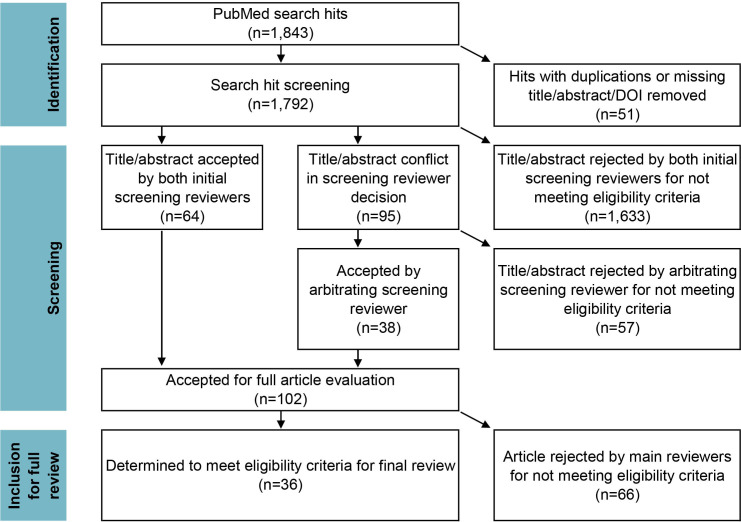
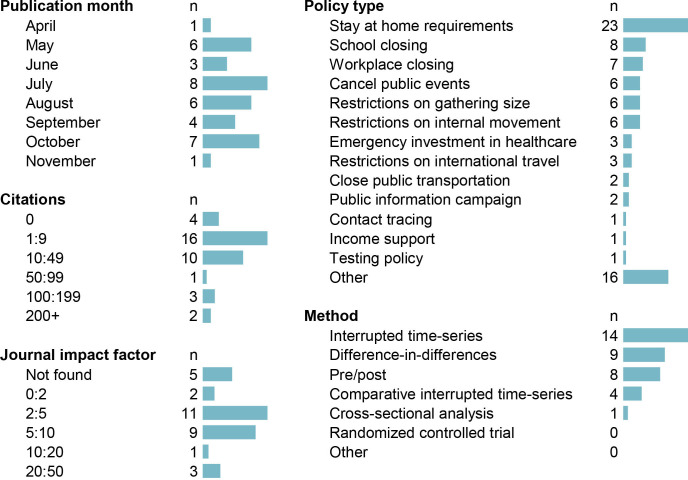
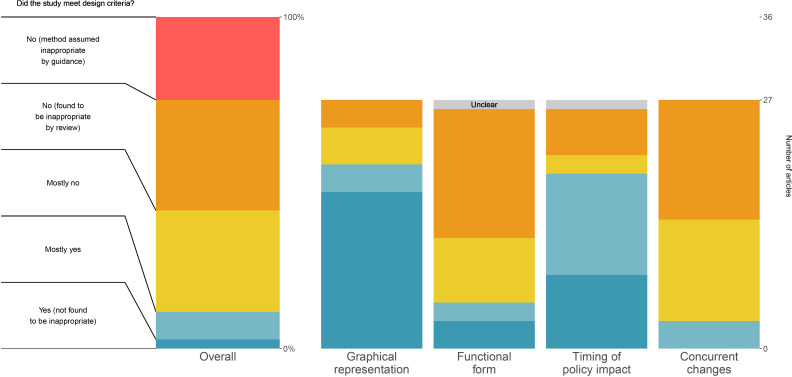
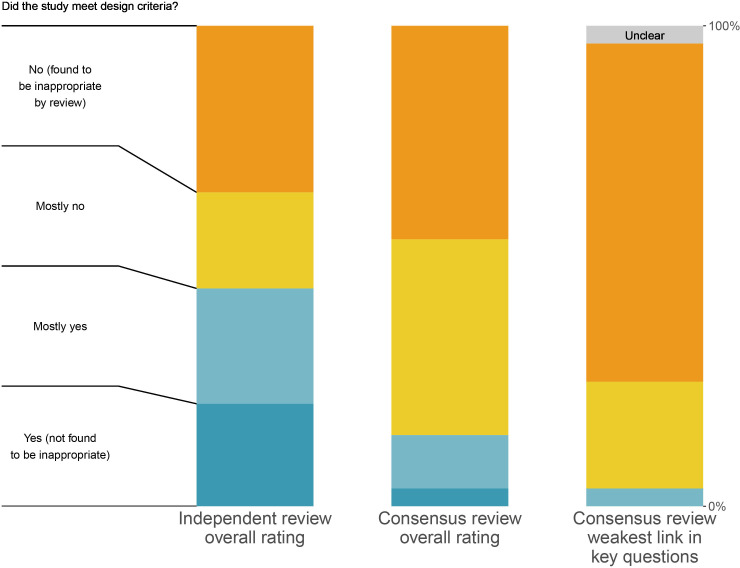
Introduction: Assessing the impact of COVID-19 policy is critical for informing future policies. However, there are concerns about the overall strength of COVID-19 impact evaluation studies given the circumstances for evaluation and concerns about the publication environment. Methods: We included studies that were primarily designed to estimate the quantitative impact of one or more implemented COVID-19 policies on direct SARS-CoV-2 and COVID-19 outcomes. After searching PubMed for peer-reviewed articles published on 26 November 2020 or earlier and screening, all studies were reviewed by three reviewers first independently and then to consensus. The review tool was based on previously developed and released review guidance for COVID-19 policy impact evaluation. Results: After 102 articles were identified as potentially meeting inclusion criteria, we identified 36 published articles that evaluated the quantitative impact of COVID-19 policies on direct COVID-19 outcomes. Nine studies were set aside because the study design was considered inappropriate for COVID-19 policy impact evaluation (n=8 pre/post; n=1 cross-sectional), and 27 articles were given a full consensus assessment. 20/27 met criteria for graphical display of data, 5/27 for functional form, 19/27 for timing between policy implementation and impact, and only 3/27 for concurrent changes to the outcomes. Only 4/27 were rated as overall appropriate. Including the 9 studies set aside, reviewers found that only four of the 36 identified published and peer-reviewed health policy impact evaluation studies passed a set of key design checks for identifying the causal impact of policies on COVID-19 outcomes. Discussion: The reviewed literature directly evaluating the impact of COVID-19 policies largely failed to meet key design criteria for inference of sufficient rigour to be actionable by policy-makers. More reliable evidence review is needed to both identify and produce policy-actionable evidence, alongside the recognition that actionable evidence is often unlikely to be feasible.
Overview
The claims and statistics of this paper haven’t been checked yet.
Free: it reads the open-access text and checks the first 5 claims that cite a source we can check. Create a free account to check every claim.
Integrity signals
Registry
Cites
Statistics
Figures
Verification
Claims the paper makes
The claims and statistics of this paper haven’t been checked yet.
Free: it reads the open-access text and checks the first 5 claims that cite a source we can check. Create a free account to check every claim.
Claims other papers make about this one
Each is checked against this paper’s own text: does it say what the citing paper says it does?
The source backs part of the claim, not all of it — or backs it for a different population, condition or comparison.
In the citing paper
“Where formal theory is well-developed, researchers may be able to translate the parallel trends assumption into domain-specific conditions and use context to help select functional form or scale of the outcome, to which the parallel trends assumption is usually sensitive [17, 32, 66].”
From Difference-in-Differences for Health Policy and Practice: A Review of Modern Methods (2025) · cites this paper as [66]
Experimental — accuracy not yet measured
Self-check
Percentages, sums and reported differences re-computed from the paper’s own numbers.
The self-check needs the paper’s full text.
Citations
Cites
Mostly Harmless Econometrics: An Empiricist's Companion
Angrist, J. D., & Pischke, J.-S. (2009) · doi:10.1515/9781400829828 · Cited by 9,467
Wynants, L., Van Calster, B., Bonten, M. M., Collins, G. S., Debray, T. P., De Vos, M., Haller, M. C., Heinze, G., Moons, K. G., Riley, R. D., et al. (2020) · doi:10.1101/2020.03.24.20041020 · Cited by 3,070 · cited 1×
“Similar to other areas in the COVID-19 literature, 22 we found the current literature directly evaluating the impact of COVID-19 policies largely fails to meet key design criteria for useful inference.”
The effect of large-scale anti-contagion policies on the COVID-19 pandemic
Hsiang, S., Allen, D., Annan-Phan, S., Bell, K., Bolliger, I., Chong, T., Druckenmiller, H., Huang, L. Y., Hultgren, A., Krasovich, E., et al. (2020) · Nature · doi:10.1038/s41586-020-2404-8 · Cited by 1,379
Identifying airborne transmission as the dominant route for the spread of COVID-19
Zhang, R., Li, Y., Zhang, A. L., Wang, Y., & Molina, M. J. (2020) · Proceedings of the National Academy of Sciences · doi:10.1073/pnas.2009637117 · Cited by 1,236
Courtemanche, C., Garuccio, J., Le, A., Pinkston, J., & Yelowitz, A. (2020) · Health Affairs · doi:10.1377/hlthaff.2020.00608 · Cited by 773
Lyu, W., & Wehby, G. L. (2020) · Health Affairs · doi:10.1377/hlthaff.2020.00818 · Cited by 721
Islam, N., Sharp, S. J., Chowell, G., Shabnam, S., Kawachi, I., Lacey, B., Massaro, J. M., D’Agostino, R. B., & White, M. (2020) · BMJ · doi:10.1136/bmj.m2743 · Cited by 601
irr: Various Coefficients of Interrater Reliability and Agreement
Matthias Gamer <m.gamer@uke.uni-hamburg.de>, J. L. <. C. A. (2005) · CRAN: Contributed Packages · doi:10.32614/cran.package.irr · Cited by 540
The Efficacy of Lockdown Against COVID-19: A Cross-Country Panel Analysis
Alfano, V., & Ercolano, S. (2020) · Applied Health Economics and Health Policy · doi:10.1007/s40258-020-00596-3 · Cited by 481
Association Between Statewide School Closure and COVID-19 Incidence and Mortality in the US
Auger, K. A., Shah, S. S., Richardson, T., Hartley, D., Hall, M., Warniment, A., Timmons, K., Bosse, D., Ferris, S. A., Brady, P. W., et al. (2020) · JAMA · doi:10.1001/jama.2020.14348 · Cited by 470
How a torrent of COVID science changed research publishing — in seven charts
Else, H. (2020) · Nature · doi:10.1038/d41586-020-03564-y · Cited by 385
Glasziou, P. P., Sanders, S., & Hoffmann, T. (2020) · BMJ · doi:10.1136/bmj.m1847 · Cited by 330
Dave, D., Friedson, A. I., Matsuzawa, K., & Sabia, J. J. (2021) · Economic Inquiry · doi:10.1111/ecin.12944 · Cited by 262
Pandemic publishing poses a new COVID-19 challenge
Palayew, A., Norgaard, O., Safreed-Harmon, K., Andersen, T. H., Rasmussen, L. N., & Lazarus, J. V. (2020) · Nature Human Behaviour · doi:10.1038/s41562-020-0911-0 · Cited by 258
Using Difference-in-Differences to Identify Causal Effects of COVID-19 Policies
Goodman-Bacon, A., & Marcus, J. (2020) · SSRN Electronic Journal · doi:10.2139/ssrn.3603970 · Cited by 201
COVID-19-related medical research: a meta-research and critical appraisal
Raynaud, M., Zhang, H., Louis, K., Goutaudier, V., Wang, J., Dubourg, Q., Wei, Y., Demir, Z., Debiais, C., Aubert, O., et al. (2021) · BMC Medical Research Methodology · doi:10.1186/s12874-020-01190-w · Cited by 172
Evaluating the impact of healthcare interventions using routine data
Clarke, G. M., Conti, S., Wolters, A. T., & Steventon, A. (2019) · BMJ · doi:10.1136/bmj.l2239 · Cited by 164
An alarming retraction rate for scientific publications on Coronavirus Disease 2019 (COVID-19)
Yeo-Teh, N. S. L., & Tang, B. L. (2021) · Accountability in Research · doi:10.1080/08989621.2020.1782203 · Cited by 157
Quasi-experimental study designs series—paper 7: assessing the assumptions
Bärnighausen, T., Oldenburg, C., Tugwell, P., Bommer, C., Ebert, C., Barreto, M., Djimeu, E., Haber, N., Waddington, H., Rockers, P., et al. (2017) · Journal of Clinical Epidemiology · doi:10.1016/j.jclinepi.2017.02.017 · Cited by 146
Self-citationWill COVID-19 be evidence-based medicine’s nemesis?
Greenhalgh, T. (2020) · PLOS Medicine · doi:10.1371/journal.pmed.1003266 · Cited by 146
COVID-19 spreading in Rio de Janeiro, Brazil: Do the policies of social isolation really work?
Crokidakis, N. (2020) · Chaos Solitons & Fractals · doi:10.1016/j.chaos.2020.109930 · Cited by 142
Which interventions work best in a pandemic?
Haushofer, J., & Metcalf, C. J. E. (2020) · Science · doi:10.1126/science.abb6144 · Cited by 140
Coevolution of policy and science during the pandemic
Yin, Y., Gao, J., Jones, B. F., & Wang, D. (2021) · Science · doi:10.1126/science.abe3084 · Cited by 127 · cited 1×
“Graphical representation of the outcome over time was relatively well-rated in our sample, with only 26% (n=7/27) studies being given a “no” or “mostly no” rating for appropriateness.”
Assumptions behind Intercoder Reliability Indices
Zhao, X., Liu, J. S., & Deng, K. (2013) · Annals of the International Communication Association · doi:10.1080/23808985.2013.11679142 · Cited by 113
All things equal? Heterogeneity in policy effectiveness against COVID-19 spread in chile
Bennett, M. (2021) · World Development · doi:10.1016/j.worlddev.2020.105208 · Cited by 106
Lyu, W., & Wehby, G. L. (2020) · JAMA Network Open · doi:10.1001/jamanetworkopen.2020.11102 · Cited by 98
Silva, L., Filho, D. B. F., & Fernandes, A. A. T. (2020) · Cadernos de Saúde Pública · doi:10.1590/0102-311x00213920 · Cited by 97
Measures implemented in the school setting to contain the COVID-19 pandemic: a rapid scoping review
Krishnaratne, S., Pfadenhauer, L. M., Coenen, M., Geffert, K., Jung-Sievers, C., Klinger, C., Kratzer, S., Littlecott, H., Movsisyan, A., Rabe, J. E., et al. (2020) · Cochrane Database of Systematic Reviews · doi:10.1002/14651858.cd013812 · Cited by 94
Rapid publications risk the integrity of science in the era of COVID-19.
Bagdasarian, N., Cross, G. B., & Fisher, D. (2020) · BMC Medicine · doi:10.1186/s12916-020-01650-6 · Cited by 93 · cited 1×
“7 There is some general concern that the volume and speed 8,9 at which this work has been produced may result in a literature that is overall low quality and unreliable, as partially indicated by retractions, though this is difficult to say, given the usual lag between publication and retraction.”
Zdravković, M., Berger‐Estilita, J., Zdravković, B., & Berger, D. (2020) · PLoS ONE · doi:10.1371/journal.pone.0241826 · Cited by 90
Gallaway, M. S., Rigler, J., Robinson, S. J., Herrick, K., Livar, E., Komatsu, K. K., Brady, S., Cunico, J., & Christ, C. M. (2020) · MMWR Morbidity and Mortality Weekly Report · doi:10.15585/mmwr.mm6940e3 · Cited by 81
Making Decisions in a COVID-19 World
Fischhoff, B. (2020) · JAMA · doi:10.1001/jama.2020.10178 · Cited by 77
Lyu, W., & Wehby, G. L. (2020) · Health Affairs · doi:10.1377/hlthaff.2020.00719 · Cited by 75
Cobb, J. S., & Seale, M. A. (2020) · Public Health · doi:10.1016/j.puhe.2020.04.016 · Cited by 68
Dave, D., Friedson, A., Matsuzawa, K., Sabia, J. J., & Safford, S. (2022) · Journal of Urban Economics · doi:10.1016/j.jue.2020.103294 · Cited by 67
The effect of state-level stay-at-home orders on COVID-19 infection rates
Castillo, R. C., Staguhn, E. D., & Weston-Farber, E. (2020) · American Journal of Infection Control · doi:10.1016/j.ajic.2020.05.017 · Cited by 66
COVID-19: The impact of social distancing policies, cross-country analysis
Castex, G., Dechter, E. K., & Lorca, M. (2020) · Economics of Disasters and Climate Change · doi:10.1007/s41885-020-00076-x · Cited by 66
Analysis of the impact of lockdown on the reproduction number of the SARS-Cov-2 in Spain
Hyafil, A., & Moriña, D. (2020) · Gaceta Sanitaria · doi:10.1016/j.gaceta.2020.05.003 · Cited by 63
Wong, L. P., & Alias, H. (2020) · Journal of Behavioral Medicine · doi:10.1007/s10865-020-00172-z · Cited by 63
An “alarming” and “exceptionally high” rate of COVID-19 retractions?
Abritis, A., Marcus, A., & Oransky, I. (2021) · Accountability in Research · doi:10.1080/08989621.2020.1793675 · Cited by 59
Impact Evaluation of Coronavirus Disease 2019 Policy: A Guide to Common Design Issues
Haber, N., Clarke‐Deelder, E., Salomon, J. A., Feller, A., & Stuart, E. A. (2021) · American Journal of Epidemiology · doi:10.1093/aje/kwab185 · Cited by 58
Self-citationWong, C. K. H., Wong, J. Y. H., Tang, E. H. M., Au, C. H., Lau, K. T. K., & Wai, A. K. C. (2020) · Journal of Medical Internet Research · doi:10.2196/19904 · Cited by 56
Empirical assessment of government policies and flattening of the COVID 19 curve
Arshed, N., Meo, M. S., & Farooq, F. (2020) · Journal of Public Affairs · doi:10.1002/pa.2333 · Cited by 43
Wang, K., Gao, J., Song, X., Huang, J., Wang, H., Wu, X., Yuan, Q.-F., Li, X., Cheng, F., & Cheng, Y. (2020) · One Health · doi:10.1016/j.onehlt.2020.100167 · Cited by 40
Xu, J., Hussain, S., Lu, G., Zheng, K., Wei, S., Bao, W., & Zhang, L. (2020) · Exploratory Research and Hypothesis in Medicine · doi:10.14218/erhm.2020.00045 · Cited by 39
Santamaría, L., & Hortal, J. (2020) · The Science of The Total Environment · doi:10.1016/j.scitotenv.2020.142257 · Cited by 39
Too much information, too little evidence: is waste in research fuelling the covid-19 infodemic?
Casigliani, V., De Nard, F., De Vita, E., Arzilli, G., Grosso, F. M., Quattrone, F., Tavoschi, L., & Lopalco, P. (2020) · BMJ · doi:10.1136/bmj.m2672 · Cited by 38 · cited 1×
“25,26 In the case of COVID-19 health policy, a frank appraisal of the strength of the studies on which policies are based is needed, alongside the understanding that we often must make decisions when strong evidence is not feasible.”
Tsai, A. C., Harling, G., Reynolds, Z., Gilbert, R. F., & Siedner, M. J. (2020) · Clinical Infectious Diseases · doi:10.1093/cid/ciaa1502 · Cited by 37
Social distancing merely stabilized COVID‐19 in the United States
Wagner, A. B., Hill, E., Ryan, S., Sun, Z., Deng, G., Bhadane, S., Martinez, V. H., Wu, P., Li, D., Anand, A., et al. (2020) · Stat · doi:10.1002/sta4.302 · Cited by 30
Padalabalanarayanan, S., Hanumanthu, V. S., & Sen, B. (2020) · JAMA Network Open · doi:10.1001/jamanetworkopen.2020.26010 · Cited by 28
Effect of mitigation measures on the spreading of COVID-19 in hard-hit states in the U.S.
Tam, K.-M., Walker, N., & Moreno, J. (2020) · PLoS ONE · doi:10.1371/journal.pone.0240877 · Cited by 27
Effects of policies and containment measures on control of COVID-19 epidemic in Chongqing
Liang, X., Tang, X., Luo, Y., Zhang, M., & Feng, Z.-P. (2020) · World Journal of Clinical Cases · doi:10.12998/wjcc.v8.i14.2959 · Cited by 27
U.S. county level analysis to determine If social distancing slowed the spread of COVID-19
Banerjee, T., & Nayak, A. (2020) · Revista Panamericana de Salud Pública · doi:10.26633/rpsp.2020.90 · Cited by 26
Extensive Testing May Reduce COVID-19 Mortality: A Lesson From Northern Italy
Bari, M. D., Balzi, D., Carreras, G., & Onder, G. (2020) · Frontiers in Medicine · doi:10.3389/fmed.2020.00402 · Cited by 23
Assumptions behind Intercoder Reliability Indices
Salmon, C. T. (2012) · Routledge eBooks · doi:10.4324/9780203113653-23 · Cited by 22
The Effects of Border Shutdowns on the Spread of COVID-19
Kang, N., & Kim, B. (2020) · Journal of Preventive Medicine and Public Health · doi:10.3961/jpmph.20.332 · Cited by 20
Dave, D., Friedson, A., Matsuzawa, K., Sabia, J. J., & Safford, S. (2020) · SSRN Electronic Journal · doi:10.2139/ssrn.3608511 · Cited by 20
Lim, J. T., Dickens, B. S. L., Choo, E. L. W., Chew, L. Z. X., Koo, J. R., Tam, C. C., Park, M., & Cook, A. R. (2020) · Proceedings of the Royal Society B Biological Sciences · doi:10.1098/rspb.2020.1173 · Cited by 19
Public health interventions slowed but did not halt the spread of COVID‐19 in India
Singh, B. B., Lowerison, M. W., Lewinson, R. T., Vallerand, I. A., Deardon, R., Gill, J. P., Gill, J. P. S., & Barkema, H. W. (2020) · Transboundary and Emerging Diseases · doi:10.1111/tbed.13868 · Cited by 16
Defining high-value information for COVID-19 decision-makingPreprint
COVID-19 Statistics, P. M. A. E. C. (.-S., Bilinski, A., Birger, R. B., Burn, S. L., Chitwood, M. H., Clarke‐Deelder, E., Copple, T., Eaton, J. W., Ehrlich, H. Y., Erlendsdottir, M., et al. (2020) · medRxiv · doi:10.1101/2020.04.06.20052506 · Cited by 15
Self-citationEdelstein, M. L., Obi, C., Chand, M. A., Hopkins, S., Brown, K. E., & Ramsay, M. E. (2020) · Journal of Epidemiology & Community Health · doi:10.1136/jech-2020-214730 · Cited by 15
COVID-19 Policy Impact Evaluation: A guide to common design issuesPreprint
Haber, N., Clarke‐Deelder, E., Salomon, J. A., Feller, A., & Stuart, E. A. (2020) · PubMed Central · doi:10.48550/arxiv.2009.01940 · Cited by 14
Self-citationTen Rules for Conducting Retrospective Pharmacoepidemiological Analyses: Example COVID-19 Study
Powell, M. A., Koenecke, A., Byrd, J. B., Nishimura, A., Konig, M. F., Xiong, R., Mahmood, S., Mucaj, V., Bettegowda, C., Rose, L., et al. (2021) · Frontiers in Pharmacology · doi:10.3389/fphar.2021.700776 · Cited by 10
Self-citationElgendy, I. Y., Nimri, N., Barakat, A. F., Ibrahim, J., Mandrola, J. M., & Foy, A. (2021) · European Journal of Internal Medicine · doi:10.1016/j.ejim.2021.01.018 · Cited by 9
Lessons Learnt from China: National Multidisciplinary Healthcare Assistance
Yang, T., Shi, H., Liu, J., & Deng, J. (2020) · Risk Management and Healthcare Policy · doi:10.2147/rmhp.s269523 · Cited by 4
Ten rules for conducting retrospective pharmacoepidemiological analyses: example COVID-19 studyPreprint
Powell, M. A., Koenecke, A., Byrd, J. B., et al. (2020) · doi:10.31219/osf.io/3drch · Cited by 3
Research works printed but not linked: 3
- Chapter 8: Assessing risk of bias in a randomized trial. Available: https://training.cochrane.org/handbook/current/chapter-08 [Accessed 8 Sep 2021].
- Krippendorff KH. Content analysis: an introduction to its methodology. SAGE Publications, 1980.
- About Google Scholar. Available: https://scholar.google.com/intl/en/scholar/about.html [Accessed 15 Jan 2021].
Cited by
Impact Evaluation of Coronavirus Disease 2019 Policy: A Guide to Common Design Issues
Haber, N., Clarke‐Deelder, E., Salomon, J. A., Feller, A., & Stuart, E. A. (2021) · American Journal of Epidemiology · doi:10.1093/aje/kwab185 · Cited by 58
Self-citationCOVID-19 data are messy: analytic methods for rigorous impact analyses with imperfect data
Stoto, M. A., Woolverton, A., Kraemer, J. D., Barlow, P., & Clarke, M. (2022) · Globalization and Health · doi:10.1186/s12992-021-00795-0 · Cited by 42
Policy evaluation during a pandemic
Callaway, B., & Li, T. (2023) · Journal of Econometrics · doi:10.1016/j.jeconom.2023.03.009 · Cited by 38
Griffin, B. A., Schuler, M. S., Stuart, E. A., Patrick, S. W., McNeer, E. A., Smart, R., Powell, D., Stein, B. D., Schell, T. L., & Pacula, R. L. (2021) · BMC Medical Research Methodology · doi:10.1186/s12874-021-01471-y · Cited by 36
Self-citationDing, W., Zhang, Y., Wang, M., & Wang, S. (2025) · World Journal of Psychiatry · doi:10.5498/wjp.v15.i10.109502 · Cited by 36
Metadata
- Authors
- Haber, N. A., Clarke-Deelder, E., Feller, A., Smith, E. R., Salomon, J. A., MacCormack-Gelles, B., Stone, E. M., Bolster-Foucault, C., Daw, J. R., Hatfield, L. A., Fry, C. E., Boyer, C. B., Ben-Michael, E., Joyce, C. M., Linas, B. S., Schmid, I., Au, E. H., Wieten, S. E., Jarrett, B., Axfors, C., Nguyen, V. T., Griffin, B. A., Bilinski, A., & Stuart, E. A.
- Affiliations
- Stanford University (US)
- Department of Global Health and Population, Harvard University T H Chan School of Public Health, Boston, Massachusetts, USA
- University of California, Berkeley (US)
- George Washington University (US)
- Harvard University (US)
- Johns Hopkins University (US)
- Department of Epidemiology, Biostatistics, and Occupational Health, McGill University, Montreal, Québec, Canada
- Columbia University (US)
- Vanderbilt University (US)
- Institute for Quantitative Social Science, Harvard University, Cambridge, MA, USA
- McGill University (CA)
- The University of Sydney (AU)
- RAND Corporation (US)
- Corresponding author
- Haber, Noah A
- ORCID
- Haber, Noah A
- Feller, Avi
- Smith, Emily R
- Salomon, Joshua A.
- Stone, Elizabeth M
- Daw, Jamie R
- Hatfield, Laura Anne
- Fry, Carrie E
- Boyer, Christopher B
- Joyce, Caroline M
- Linas, Beth S
- Schmid, Ian
- Au, Eric H
- Wieten, Sarah E
- Jarrett, Brooke
- Axfors, Cathrine
- Nguyen, Van Thu
- Griffin, Beth Ann
- Bilinski, Alyssa
- Stuart, Elizabeth A
- Venue
- BMJ Open
- Publisher
- BMJ
- Published
- 2022-01
- Volume
- 12
- Issue
- 1
- Pages
- e053820
- ISSN
- 2044-6055 (ISSN-L)
- PMC
- PMC8753111
- OpenAlex
- W4205346926
- Cited by
- 36
- References
- 68
- Citations by year
- 2026: 1 · 2025: 4 · 2024: 6 · 2023: 9 · 2022: 7
- FWCI
- 0.69
- Type
- journal article
- Language
- en
- Open access
- gold
- doi.org
- Licence
- Locations
- BMJ Open (publishedVersion, cc-by-nc)
- medRxiv (acceptedVersion, cc-by-nc-nd)
- PubMed Central (publishedVersion, cc-by-nc)
- PubMed (publishedVersion)
- Durham Research Online (Durham University) (acceptedVersion)
- PubMed Central (submittedVersion, cc-by-nc-nd)
- DOAJ (DOAJ: Directory of Open Access Journals) (submittedVersion, cc-by-sa)
- The Sydney eScholarship Repository (The University of Sydney) (submittedVersion)
- Funders
- Laura and John Arnold Foundation
- Knut och Alice Wallenbergs Stiftelse (2019.0561)
- National Institutes of Health
- National Heart, Lung, and Blood Institute (T32HL098048)
- National Institute of Mental Health (F31MH121128, T32MH122357, T32MH109436)
- National Institute on Drug Abuse (P50DA046351)
- Topics
- Physical Sciences › Mathematics › Modeling and Simulation › COVID-19 epidemiological studies
- Social Sciences › Public Administration › Evaluation and Performance Assessment
- Health Sciences › Health Professions › General Health Professions › Health Policy Implementation Science
- Keywords
- health policy evaluation, research design, causal inference, quality of evidence, COVID-19 outcomes
About these checks
Registry, retraction, Cites and statistics results are computed, not judged, with one exception: a printed reference that no index lists is read once by a model before it counts as a citation error. Claims are extracted by a model and kept only when their quote appears verbatim in the text; each cited source is then checked, with a model’s help, for whether it says what the claim relies on. Those verdicts can be wrong — read the claim’s quote and the cited source before relying on one.
Statistics and arithmetic are recomputed, not judged.
Confidence bands are shown only for fields calibrated on our annotated test set. None is calibrated yet, so no band is shown.
What counts as a claim ›How we measure confidence ›How we check this ›
Are you an author, or do you see a problem with this page? Request a review
Data sources
Bibliographic data: Semantic Scholar, OpenAlex, Crossref.
Contains information from the Semantic Scholar Academic Graph Datasets, made available under the ODC Attribution License (ODC-BY 1.0).
Semantic Scholar’s data is described in: Kinney, R., et al. (2023). The Semantic Scholar Open Data Platform. arXiv:2301.10140.
