

Enablers and barriers in upscaling telemonitoring across geographic boundaries: a scoping review
Open accessThe DOI matches its Crossref record; 46 of the 46 references it cites were found in a registry or an index.
Abstract
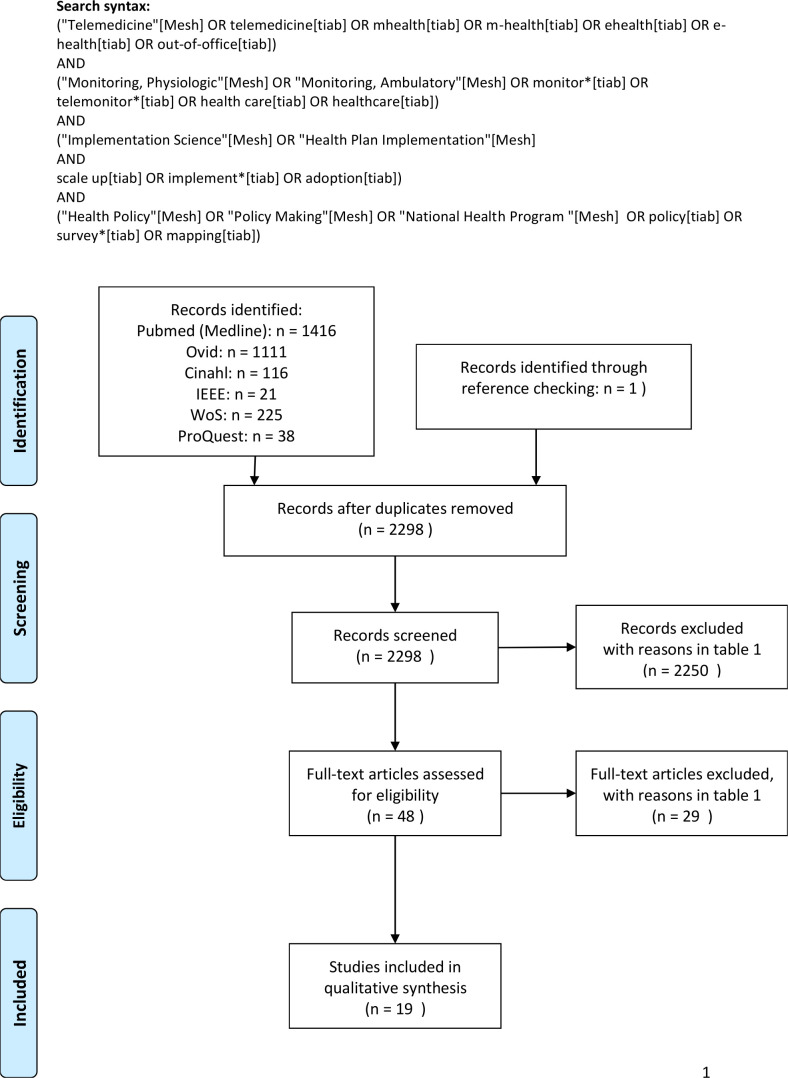
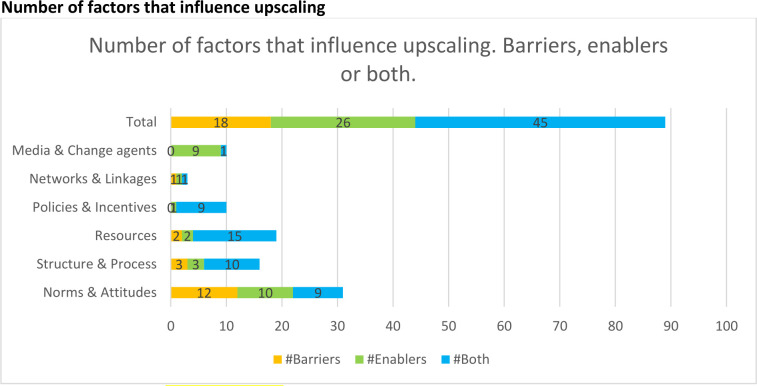
Introduction and objective: Telemonitoring is a method to monitor a person’s vital functions via their physiological data at distance, using technology. While pilot studies on the proposed benefits of telemonitoring show promising results, it appears challenging to implement telemonitoring on a larger scale. The aim of this scoping review is to identify the enablers and barriers for upscaling of telemonitoring across different settings and geographical boundaries in healthcare. Methods: PubMed, Embase, Cinahl, Web of Science, ProQuest and IEEE databases were searched. Resulting outcomes were assessed by two independent reviewers. Studies were considered eligible if they focused on remote monitoring of patients’ vital functions and data was transmitted digitally. Using scoping review methodology, selected studies were systematically assessed on their factors of influence on upscaling of telemonitoring. Results: A total of 2298 titles and abstracts were screened, and 19 articles were included for final analysis. This analysis revealed 89 relevant factors of influence: 26 were reported as enabler, 18 were reported as barrier and 45 factors were reported being both. The actual utilisation of telemonitoring varied widely across studies. The most frequently mentioned factors of influence are: resources such as costs or reimbursement, access or interface with electronic medical record and knowledge of frontline staff. Conclusion: Successful upscaling of telemonitoring requires insight into its critical success factors, especially at an overarching national level. To future-proof and facilitate upscaling of telemonitoring, it is recommended to use this type of technology in usual care and to find means for reimbursement early on. A wide programme on change management, nationally or regionally coordinated, is key. Clear regulatory conditions and professional guidelines may further facilitate widespread adoption and use of telemonitoring. Future research should focus on converting the ‘enablers and barriers’ as identified by this review into a guideline supporting further nationwide upscaling of telemonitoring.
Overview
The claims and statistics of this paper haven’t been checked yet.
Free: it reads the open-access text and checks the first 5 claims that cite a source we can check. Create a free account to check every claim.
Integrity signals
Registry
Cites
Statistics
Figures
Verification
Claims the paper makes
The claims and statistics of this paper haven’t been checked yet.
Free: it reads the open-access text and checks the first 5 claims that cite a source we can check. Create a free account to check every claim.
Claims other papers make about this one
Each is checked against this paper’s own text: does it say what the citing paper says it does?
The source backs part of the claim, not all of it — or backs it for a different population, condition or comparison.
In the citing paper
“Despite processing 3.9 million consultations, evidence on population-level impacts of scaled telemedicine services like Babyl in sub-Saharan Africa remains limited.”
From Telemedicine implementation and healthcare utilization in Rwanda: interrupted time series of Babyl digital health services from 2015 to 2024 (2026) · cites this paper as [7]
Experimental — accuracy not yet measured
Self-check
Percentages, sums and reported differences re-computed from the paper’s own numbers.
The self-check needs the paper’s full text.
Citations
Cites
Preferred Reporting Items for Systematic Reviews and Meta-Analyses: the PRISMA statement
Moher, D., Liberati, A., Tetzlaff, J., Altman, D. G., & for the PRISMA Group (2009) · BMJ · doi:10.1136/bmj.b2535 · Cited by 83,823
Preferred Reporting Items for Systematic Reviews and Meta-Analyses: The PRISMA Statement
Moher, D., Liberati, A., Tetzlaff, J., Altman, D. G., & The PRISMA Group (2009) · PLoS Medicine · doi:10.1371/journal.pmed.1000097 · Cited by 64,042 · cited 1×
“17 18 The scoping review protocol was registered on 29 March 2021, via the Open Science Framework (https://osf.io/mpq9g/).”
Scoping studies: towards a methodological framework
Arksey, H., & O'Malley, L. (2005) · International Journal of Social Research Methodology · doi:10.1080/1364557032000119616 · Cited by 36,742
Rayyan-a web and mobile app for systematic reviews.
Ouzzani, M., Hammady, H., Fedorowicz, Z., & Elmagarmid, A. (2016) · Systematic Reviews · doi:10.1186/s13643-016-0384-4 · Cited by 26,092
Wang, G., Ma, R., Qiao, G., Wada, K., Aizawa, Y., & Satoh, T. (2015) · Integrative Medicine International · doi:10.1159/000368408 · Cited by 18,657
Munn, Z., Peters, M. D. J., Stern, C., Tufanaru, C., McArthur, A., & Aromataris, E. (2018) · BMC Medical Research Methodology · doi:10.1186/s12874-018-0611-x · Cited by 11,385
From Triple to Quadruple Aim: Care of the Patient Requires Care of the Provider
Bodenheimer, T., & Sinsky, C. (2014) · The Annals of Family Medicine · doi:10.1370/afm.1713 · Cited by 3,462
Evaluating barriers to adopting telemedicine worldwide: A systematic review
Scott Kruse, C., Karem, P., Shifflett, K., Vegi, L., Ravi, K., & Brooks, M. (2018) · Journal of Telemedicine and Telecare · doi:10.1177/1357633x16674087 · Cited by 1,735
Updated methodological guidance for the conduct of scoping reviews
Peters, M. D. J., Marnie, C., Tricco, A. C., Pollock, D., Munn, Z., Alexander, L., McInerney, P., Godfrey, C. M., & Khalil, H. (2021) · JBI Evidence Implementation · doi:10.1097/xeb.0000000000000277 · Cited by 1,461
Ross, J., Stevenson, F., Lau, R., & Murray, E. (2016) · Implementation Science · doi:10.1186/s13012-016-0510-7 · Cited by 1,011
Cited by
Disparities in Digital Health Care Use in 2022
Wakeman, M., Buckman, D. W., & El‐Toukhy, S. (2025) · JAMA Network Open · doi:10.1001/jamanetworkopen.2025.5359 · Cited by 39
Enabling Telemedicine From the System-Level Perspective: Scoping Review
Li, X., Huang, L., Zhang, H., & Liang, Z. (2025) · Journal of Medical Internet Research · doi:10.2196/65932 · Cited by 40
“Telemonitoring involves using personal health technologies to collect, transmit, evaluate, and communicate patients’ personal health data from outside hospitals or clinical departments (eg, patients’ homes) and relay them to health care providers [12].”
Digital health technologies and innovation patterns in diabetes ecosystems
Giger, O.-F., Pfitzer, E., Mekniran, W., Gebhardt, H., Fleisch, E., Jovanova, M., & Kowatsch, T. (2025) · DIGITAL HEALTH · doi:10.1177/20552076241311740 · Cited by 19
Mihevc, M., Lukančič, M. M., Zavrnik, Č., Potočnik, T. V., Šter, M. P., Klemenc–Ketiš, Z., & Susič, A. P. (2024) · International Journal of Integrated Care · doi:10.5334/ijic.7621 · Cited by 14
A realist review of factors critical for the implementation of eHealth in chronic disease management
Shahid, N., Parker, G., BIELECKI, J. M., Rac, V. E., & Berta, W. B. (2025) · BMC Health Services Research · doi:10.1186/s12913-025-12361-0 · Cited by 13
“Similarly, a scoping review of healthcare professionals ( n = 19) identified factors crucial to upscaling ehealth across different geographic settings, with increased workload being a common perceived barrier [135].”
Upscaling telemonitoring in Dutch University Medical Centres: A baseline measurement
Gijsbers, H., Kleiss, J., Nurmohamed, A. S., van de Belt, T. H., Schijven, M. P., Bekker, M. N., Buijs, M. A., Buskens, E., Chavannes, N. H., van Dam, D., et al. (2023) · International Journal of Medical Informatics · doi:10.1016/j.ijmedinf.2023.105085 · Cited by 12
“[10,11] Although several government institutes are focusing on telemonitoring adoption to futureproof healthcare, the majority of projects are pilot-or scientific case studies.”
BackgroundMethodSelf-citationSurgical education in the post-COVID era: an EAES DELPHI-study
Feenstra, T. M., Tejedor, P., Popa, D. E., Francis, N. K., & Schijven, M. P. (2022) · Surgical Endoscopy · doi:10.1007/s00464-022-09762-1 · Cited by 9
“identified six themes affecting upscaling of telemonitoring; norms & attitudes, organizational structure & process, resources, policies and incentives, network & linkages, and media & change agents [27].”
BackgroundSelf-citationAuener, S. L., van Dulmen, S. A., Atsma, F., van der Galiën, O., Bellersen, L., van Kimmenade, R. R. J., Westert, G. P., & Jeurissen, P. (2023) · Journal of Medical Internet Research · doi:10.2196/43038 · Cited by 9
“While there have been studies on enablers and barriers, such as funding and national coordination, there is a need for converting those enablers and barriers into actionable guidelines that support nationwide upscaling [51].”
BackgroundMihevc, M., Podgoršek, D., Gajšek, J., Mikuletič, S., Homar, V., Kolšek, M., & Šter, M. P. (2023) · Family Medicine & Primary Care Review · doi:10.5114/fmpcr.2023.130091 · Cited by 7
Auener, S. L., van Dulmen, S. A., van Kimmenade, R. R. J., Westert, G. P., & Jeurissen, P. (2023) · Digital Health · doi:10.1177/20552076231196998 · Cited by 7
“Empirical research of telemonitoring projects beyond initial adoption phases is scarce.(11) The aim of this study is to draw on these empirical experiences and perspectives to create new insights into the factors and processes that support the sustainable adoption of telemonitoring for HF.”
BackgroundResultAlexandru, A., Ianculescu, M., & Paraschiv, E. A. (2024) · Studies in systems, decision and control · doi:10.1007/978-3-031-62158-1_10 · Cited by 9
Gijsbers, H., Nurmohamed, A. S., van de Belt, T. H., Schijven, M. P., & The Citrien 2 Project Leaders and Steering Group (2023) · JMIR Research Protocols · doi:10.2196/45201 · Cited by 6
Self-citationA Cross-Disciplinary Analysis of the Complexities of Scaling Up eHealth Innovation
Allers, S., Carboni, C., Eijkenaar, F., & Wehrens, R. (2024) · Journal of Medical Internet Research · doi:10.2196/58007 · Cited by 7
“Similarly, the scoping review by Gijsbers et al [29] concluded that “successful upscaling of telemonitoring requires insight into its critical success factors, especially at an overarching national level.”
Telemonitoring: ethical lessons from the COVID-19 pandemic
Bolt, I. L. L. E., Specker, J., & Schermer, M. (2023) · BMC Digital Health · doi:10.1186/s44247-023-00046-9 · Cited by 7
“In this section we discuss the results of the interview study in relation to the existing literature and draw some ethical lessons for telemonitoring in a non-pandemic situation and for a responsible upscaling of telemonitoring (see Table 2) [47].”
Backgroundvan Eijk, J., Trappenburg, J. C. A., Asselbergs, F. W., & Jaarsma, T. (2024) · Digital Health · doi:10.1177/20552076241272570 · Cited by 5
Olivelli, M., Donati, M., Vianello, A., Petrucci, I., Masi, S., Bechini, A., & Fanucci, L. (2024) · Electronics · doi:10.3390/electronics13081462 · Cited by 5
Mihevc, M., Podgoršek, D., Gajšek, J., Mikuletič, S., Homar, V., Kolšek, M., & Šter, M. P. (2023) · Croatian Medical Journal · doi:10.3325/cmj.2023.64.170 · Cited by 5
“It offers advantages such as low startup costs and compatibility with existing clinical pathways (12,16,17), which distinguish it from more complex and resource-intensive systems (10,13-15).”
Prerequisites for Cost-Effective Home Blood Pressure Telemonitoring: Early Health Economic Analysis
van Steenkiste, J., van Dorst, P. W. M., Dohmen, D., & Boersma, C. (2025) · JMIR Cardio · doi:10.2196/64386 · Cited by 2
“One of the perceived barriers to large-scale implementation is the lack of a clear reimbursement structure, which is related to a lack of evidence on the cost-effectiveness of this digital health intervention [9].”
Tan, N. C., Tyagi, S., Koh, Y. L. E., Gong, P. P., Koh, G. C., & Lee, C. S. (2024) · Journal of Telemedicine and Telecare · doi:10.1177/1357633x241286546 · Cited by 3
“30”
Rubuga, F. K., Absolomon, G., Uhawenimana, T. C., Nsaba-Uwera, Y. D., Muhire, J., Hagenimana, J. D., Nyabyenda, E. C., Irakiza, P., Semakula, M., Remera, E., et al. (2026) · BMC Primary Care · doi:10.1186/s12875-026-03179-8 · Cited by 1
Implementation and Scale-up of Telemonitoring in the Netherlands
Gijsbers, H., Peute, L., van de Belt, T. H., & Schijven, M. P. (2024) · Studies in health technology and informatics · doi:10.3233/shti240441 · Cited by 1
Self-citationLok-Visser, J., Leenen, J. P. L., den Hertog, H. M., van Vemde, G., Rekveldt, J., van den Berg, J. W., Patijn, G. A., Cornelisse-Vermaat, J. R., Leeftink, G., & Maring, J. G. (2024) · Health Policy and Technology · doi:10.1016/j.hlpt.2024.100926 · Cited by 1
Elferink, N., Roest, M. J., Weggelaar‐Jansen, A. M., & de Mul, M. (2025) · JMIR Medical Informatics · doi:10.2196/69349 · Cited by 1
“Thus, the attitudes and perceptions of health care professionals influence the implementation of telemonitoring, impacting not only local adoption but also broader upscaling [54].”
Moes, S. L., Depmann, M., Kvamme, I., Anker, E., Dirken, J., van Eerden, L., Franx, A., de Heus, R., Gordijn, S. J., Koenen, S. V., et al. (2025) · Digital Health · doi:10.1177/20552076251376518 · Cited by 1
“23 A qualitative study in Ghana also researched barriers and facilitators of home BP monitoring during pregnancy, showing the same perspective of the potential of telemonitoring to improve patient outcomes.”
Value of a Nationwide University Network in scaling up telemonitoring: a qualitative study
Gijsbers, H., Nurmohamed, A. S., Peute, L., Schijven, M. P., & van de Belt, T. H. (2025) · BMJ Health & Care Informatics · doi:10.1136/bmjhci-2024-101320 · Cited by 1
“36”
Self-citationTarikh Akmal Pangestu, S., & Setyonugroho, W. (2023) · World Journal of Advanced Research and Reviews · doi:10.30574/wjarr.2023.17.1.0062 · Cited by 1
“This will allow for immediate first aid to be given in the event of an emergency [34].”
Navigating the Complexities of Scaling Remote Patient Management: A Scoping Review (Preprint)Preprint
Houwen, J., Pannunzio, V., van Os, H. J. A., Janssen, V. R., Raijmakers, J., Rietjens, J. A. C., Atsma, D. E., & Kleinsmann, M. S. (2024) · doi:10.2196/preprints.59534
Novihantoro, C., Saryono, S., & Rejeki, D. S. S. (2024) · Journal of Holistic Nursing Science · doi:10.31603/nursing.v11i2.11118
Renting, N., Brands, M. R., Velthausz, E. A. B., & Gouw, S. C. (2025) · BMJ Open · doi:10.1136/bmjopen-2024-086600 · Cited by 1
Telemonitoring and Teleconsultation in Cancer Care
Mappouras, S., Gemenaris, M., & Kyriacou, E. C. (2025) · Springer eBooks · doi:10.1007/978-3-031-87158-0_4 · Cited by 1
Gijsbers, H., Nurmohamed, A. S., Peute, L., van de Belt, T. H., Schijven, M. P., Bekker, M. N., Buijs, M. A., Buskens, E., Chavannes, N. H., van Dam, D., et al. (2025) · Health Policy and Technology · doi:10.1016/j.hlpt.2025.101132
Self-citationUpscaling of telemonitoring across geographic boundariesPreprint
Gijsbers, H. (2021) · doi:10.17605/osf.io/mpq9g
Self-citationRezazadeh, M., Yazdani, A., Ghahremani, A., & Mahmoudzadeh‐Sagheb, Z. (2026) · Health Science Reports · doi:10.1002/hsr2.71663
“These factors must be addressed during system design to ensure that video‐based interactions are both usable and clinically safe [79–81].”
L’insuffisance cardiaque à l'ère du numérique : de grandes avancées, mais encore des défis
Marier-Tétrault, E. (2026) · doi:10.71781/34134
Oudbier, S. J., Peute, L., Bartelds, J., Nurmohamed, A. S., Smeulers, M., & Gijsbers, H. (2026) · Pregnancy Hypertension · doi:10.1016/j.preghy.2026.101489
Self-citationvan Oorschot, H. F. C., van Ravenswaaij, R. V., Bel, E. W., Ahaus, K., del Barco, E., van Hoorn, E. S., Porte, P. J., Franx, A., Posthumus, A. G., Depmann, M., et al. (2026) · doi:10.2196/preprints.105825
Meier, E., Bak, M., van Exel, J., Winter, M. M., van den Hoven, M., Rigter, T., & Schijven, M. P. (2026) · Digital Health · doi:10.1177/20552076261484036
Self-citationPerformance evaluation of telemedicine application: a stochastic modeling approach
Jain, D., & Gupta, V. K. N. (2026) · International Journal of Systems Assurance Engineering and Management · doi:10.1007/s13198-026-03431-5
Metadata
- Authors
- Gijsbers, H., Feenstra, T. M., Eminovic, N., van Dam, D., Nurmohamed, S. A., van de Belt, T., & Schijven, M. P.
- Affiliations
- Amsterdam UMC Location University of Amsterdam (NL)
- Corresponding author
- Schijven, Marlies P
- Venue
- BMJ Open
- Publisher
- BMJ
- Published
- 2022-04
- Volume
- 12
- Issue
- 4
- Pages
- e057494
- ISSN
- 2044-6055 (ISSN-L)
- PMC
- PMC9021767
- OpenAlex
- W4224293293
- Cited by
- 37
- References
- 46
- Citations by year
- 2026: 6 · 2025: 11 · 2024: 10 · 2023: 8 · 2022: 1
- FWCI
- 1.49
- Type
- journal article
- Language
- en
- Open access
- gold
- doi.org
- Licence
- Locations
- BMJ Open (publishedVersion, cc-by-nc)
- PubMed Central (publishedVersion, cc-by-nc)
- PubMed (publishedVersion)
- Pure Amsterdam UMC (submittedVersion, cc-by)
- Data Archiving and Networked Services (DANS) (submittedVersion, other-oa)
- DOAJ (DOAJ: Directory of Open Access Journals) (submittedVersion)
- Data Archiving and Networked Services (DANS) (submittedVersion, cc-by-nc)
- Funders
- Amsterdam University Medical Centers
- Topics
- Health Sciences › Medicine › Public Health, Environmental and Occupational Health › Telemedicine and Telehealth Implementation
- Health Sciences › Health Professions › General Health Professions › Mobile Health and mHealth Applications
- Health Sciences › Medicine › Geriatrics and Gerontology › Technology Use by Older Adults
- Keywords
- remote patient monitoring, vital signs monitoring, barriers and facilitators, health technology adoption, reimbursement, electronic health record integration, change management, regulatory conditions, professional guidelines, digital health
- MeSH terms
- Humans, Monitoring, Physiologic, Research Design, Telemedicine
About these checks
Registry, retraction, Cites and statistics results are computed, not judged, with one exception: a printed reference that no index lists is read once by a model before it counts as a citation error. Claims are extracted by a model and kept only when their quote appears verbatim in the text; each cited source is then checked, with a model’s help, for whether it says what the claim relies on. Those verdicts can be wrong — read the claim’s quote and the cited source before relying on one.
Statistics and arithmetic are recomputed, not judged.
Confidence bands are shown only for fields calibrated on our annotated test set. None is calibrated yet, so no band is shown.
What counts as a claim ›How we measure confidence ›How we check this ›
Are you an author, or do you see a problem with this page? Request a review
Data sources
Bibliographic data: Semantic Scholar, OpenAlex, Crossref.
Contains information from the Semantic Scholar Academic Graph Datasets, made available under the ODC Attribution License (ODC-BY 1.0).
Semantic Scholar’s data is described in: Kinney, R., et al. (2023). The Semantic Scholar Open Data Platform. arXiv:2301.10140.
