

Recruitment, consent and retention of participants in randomised controlled trials: a review of trials published in the National Institute for Health Research (NIHR) Journals Library (1997–2020)
Open accessThe DOI matches its Crossref record; 45 of the 47 references it cites were found in a registry or an index.
Abstract
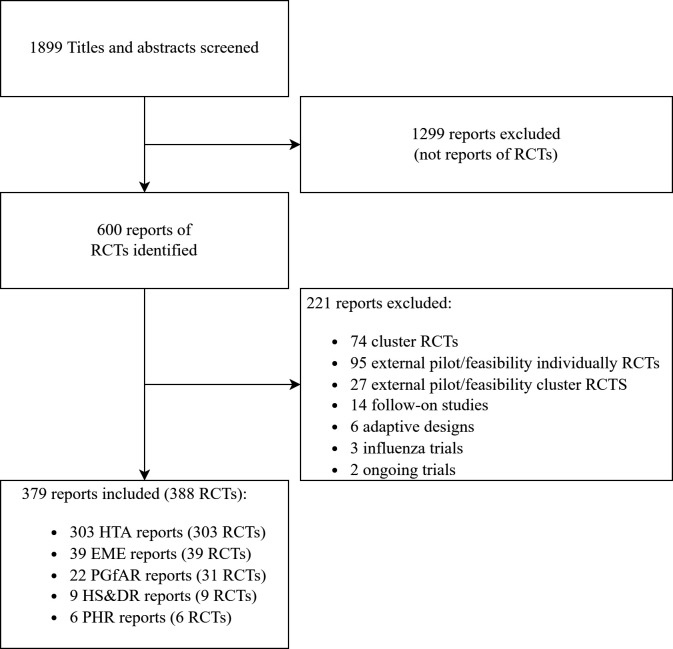
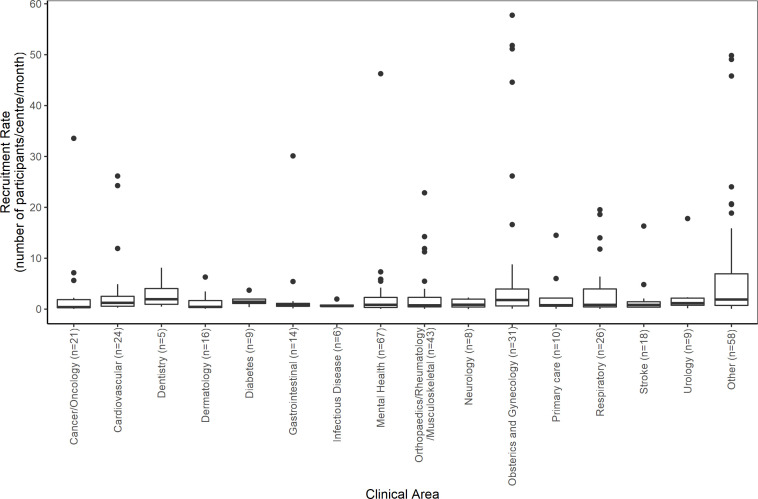
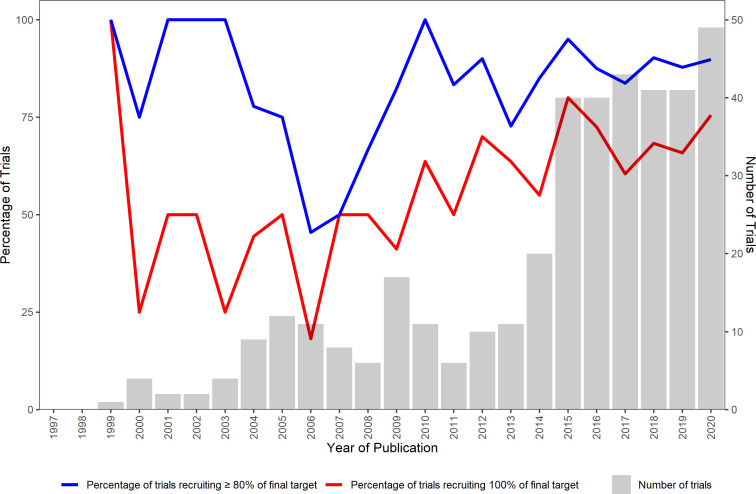
Objectives: To review the consent, recruitment and retention rates for randomised controlled trials (RCTs) funded by the UK’s National Institute for Health Research (NIHR) and published in the online NIHR Journals Library between January 1997 and December 2020. Design: Comprehensive review. Setting: RCTs funded by the NIHR and published in the NIHR Journals Library. Data extraction: Information relating to the trial characteristics, sample size, recruitment and retention. Primary and secondary outcome measures: The primary outcome was the recruitment rate (number of participants recruited per centre per month). Secondary outcomes were the target sample size and whether it was achieved; consent rates (percentage of eligible participants who consented and were randomised) and retention rates (percentage of randomised participants retained and assessed with valid primary outcome data). Results: This review identified 388 individual RCTs from 379 reports in the NIHR Journals Library. The final recruitment target sample size was achieved in 63% (245/388) of the RCTs. The original recruitment target was revised in 30% (118/388) of trials (downwards in 67% (79/118)). The median recruitment rate (participants per centre per month) was found to be 0.95 (IQR: 0.42–2.60); the median consent rate was 72% (IQR: 50%–88%) and the median retention rate was estimated at 88% (IQR: 80%–97%). Conclusions: There is considerable variation in the consent, recruitment and retention rates in publicly funded RCTs. Although the majority of (6 out of 10) trials in this review achieved their final target sample; 3 out of 10 trials revised their original target sample size (downwards in 7 out of 10 trials). Investigators should bear this in mind at the planning stage of their study and not be overly optimistic about their recruitment projections.
Overview
The claims and statistics of this paper haven’t been checked yet.
Free: it reads the open-access text and checks the first 5 claims that cite a source we can check. Create a free account to check every claim.
Integrity signals
Registry
Cites
Statistics
Figures
Verification
Claims the paper makes
The claims and statistics of this paper haven’t been checked yet.
Free: it reads the open-access text and checks the first 5 claims that cite a source we can check. Create a free account to check every claim.
Claims other papers make about this one
Each is checked against this paper’s own text: does it say what the citing paper says it does?
The source backs part of the claim, not all of it — or backs it for a different population, condition or comparison.
In the citing paper
“This is in keeping with RCTs generally, where from those published in the National Institute of Health and Care Research (NIHR) library, 27% did not meet target with 30% requiring a revised target [35].”
From Is it feasible to conduct a randomised controlled trial of silver diamine fluoride compared to usual care for the management of caries in children's primary teeth in UK primary dental care? A randomised feasibility study. (2026) · cites this paper as [35]
Experimental — accuracy not yet measured
Self-check
Percentages, sums and reported differences re-computed from the paper’s own numbers.
The self-check needs the paper’s full text.
Citations
Cites
Wickham, H. (2016) · Use R! · doi:10.1007/978-3-319-24277-4 · Cited by 33,115
CONSORT 2010 Statement: updated guidelines for reporting parallel group randomised trials
the CONSORT Group, Schulz, K. F., Altman, D. G., & Moher, D. (2010) · BMC Medicine · doi:10.1186/1741-7015-8-18 · Cited by 13,371
CONSORT 2010 Statement: updated guidelines for reporting parallel group randomised trials
Schulz, K. F., Altman, D. G., Moher, D., & for the CONSORT Group (2010) · BMJ · doi:10.1136/bmj.c332 · Cited by 9,329
Moher, D., Schulz, K. F., & Altman, D. G. (2001) · The Lancet · doi:10.1016/s0140-6736(00)04337-3 · Cited by 5,373
Improving the Quality of Reporting of Randomized Controlled Trials: The CONSORT Statement
Begg, C. (1996) · JAMA · doi:10.1001/jama.1996.03540080059030 · Cited by 3,127
Increasing value and reducing waste in research design, conduct, and analysis
Ioannidis, J. P. A., Greenland, S., Hlatky, M. A., Khoury, M. J., Macleod, M. R., Moher, D., Schulz, K. F., & Tibshirani, R. (2014) · The Lancet · doi:10.1016/s0140-6736(13)62227-8 · Cited by 1,597
What is a pilot or feasibility study? A review of current practice and editorial policy
Arain, M., Campbell, M. J., Cooper, C. L., & Lancaster, G. A. (2010) · BMC Medical Research Methodology · doi:10.1186/1471-2288-10-67 · Cited by 1,483
National Institute for Health Research
Evans, R. (2014) · Nursing Standard · doi:10.7748/ns.28.49.32.s37 · Cited by 1,350
Reducing waste from incomplete or unusable reports of biomedical research
Glasziou, P., Altman, D. G., Bossuyt, P., Boutron, I., Clarke, M., Julious, S., Michie, S., Moher, D., & Wager, E. (2014) · The Lancet · doi:10.1016/s0140-6736(13)62228-x · Cited by 1,319
McDonald, A. M., Knight, R. C., Campbell, M. K., Entwistle, V. A., Grant, A. M., Cook, J. A., Elbourne, D. R., Francis, D., Garcia, J., Roberts, I., et al. (2006) · Trials · doi:10.1186/1745-6215-7-9 · Cited by 946
Walters, S. J., Bonacho dos Anjos Henriques-Cadby, I., Bortolami, O., Flight, L., Hind, D., Jacques, R. M., Knox, C., Nadin, B., Rothwell, J., Surtees, M., et al. (2017) · BMJ Open · doi:10.1136/bmjopen-2016-015276 · Cited by 560
Self-citationStrategies to improve recruitment to randomised trials
Treweek, S., Pitkethly, M., Cook, J., Fraser, C., Mitchell, E., Sullivan, F., Jackson, C., Taskila, T. K., & Gardner, H. (2018) · Cochrane Database of Systematic Reviews · doi:10.1002/14651858.mr000013.pub6 · Cited by 521
Mant, J., Doust, J., Roalfe, A., Barton, P., Cowie, M., Glasziou, P., Mant, D., McManus, R., Holder, R., Deeks, J., et al. (2009) · Health Technology Assessment · doi:10.3310/hta13320 · Cited by 498
Price, M. J., Ades, A., Soldan, K., Welton, N. J., Macleod, J., Simms, I., DeAngelis, D., Turner, K. M., & Horner, P. J. (2016) · Health Technology Assessment · doi:10.3310/hta20220 · Cited by 494
Prevalence, Characteristics, and Publication of Discontinued Randomized Trials
Kasenda, B., von Elm, E., You, J., Blümle, A., Tomonaga, Y., Saccilotto, R., Amstutz, A., Bengough, T., Meerpohl, J. J., Stegert, M., et al. (2014) · JAMA · doi:10.1001/jama.2014.1361 · Cited by 415
Sully, B. G. O., Julious, S. A., & Nicholl, J. (2013) · Trials · doi:10.1186/1745-6215-14-166 · Cited by 410
Designing Randomised Trials in Health, Education and the Social Sciences
Torgerson, D. J., & Torgerson, C. J. (2008) · doi:10.1057/9780230583993 · Cited by 366
Rogozińska, E., Marlin, N., Jackson, L., Rayanagoudar, G., Ruifrok, A. E., Dodds, J., Molyneaux, E., van Poppel, M. N., Poston, L., Vinter, C. A., et al. (2017) · Health Technology Assessment · doi:10.3310/hta21410 · Cited by 298
Strategies to improve retention in randomised trials
Brueton, V. C., Tierney, J., Stenning, S., Harding, S., Meredith, S., Nazareth, I., & Rait, G. (2013) · Cochrane Database of Systematic Reviews · doi:10.1002/14651858.mr000032.pub2 · Cited by 279
The trials methodological research agenda: results from a priority setting exercise
Tudur Smith, C., Hickey, H., Clarke, M., Blazeby, J., & Williamson, P. (2014) · Trials · doi:10.1186/1745-6215-15-32 · Cited by 193
Costs and benefits of community postnatal support workers: a randomised controlled trial
Morrell, Spiby, Stewart, Walters, & Morgan (2000) · Health Technology Assessment · doi:10.3310/hta4060 · Cited by 166
Davis, S., Simpson, E., Hamilton, J., James, M. M.-S., Rawdin, A., Wong, R., Goka, E., Gittoes, N., & Selby, P. (2020) · Health Technology Assessment · doi:10.3310/hta24290 · Cited by 164
Westwood, M., Ramaekers, B., Lang, S., Grimm, S., Deshpande, S., de Kock, S., Armstrong, N., Joore, M., & Kleijnen, J. (2018) · Health Technology Assessment · doi:10.3310/hta22440 · Cited by 161
Strategies to improve retention in randomised trials
Gillies, K., Kearney, A., Keenan, C., Treweek, S., Hudson, J., Brueton, V. C., Conway, T., Hunter, A., Murphy, L., Carr, P. J., et al. (2021) · Cochrane Database of Systematic Reviews · doi:10.1002/14651858.mr000032.pub3 · Cited by 138
Kinley, H., Czoski-Murray, C., George, S., McCabe, C., Primrose, J., Reilly, C., Wood, R., Nicolson, P., Healy, C., Read, S., et al. (2001) · Health Technology Assessment · doi:10.3310/hta5200 · Cited by 129
Atkin, W., Cross, A. J., Kralj-Hans, I., MacRae, E., Piggott, C., Pearson, S., Wooldrage, K., Brown, J., Lucas, F., Prendergast, A., et al. (2019) · Health Technology Assessment · doi:10.3310/hta23010 · Cited by 129
Wyke, S., Hunt, K., Gray, C. M., Fenwick, E., Bunn, C., Donnan, P. T., Rauchhaus, P., Mutrie, N., Anderson, A. S., Boyer, N., et al. (2015) · Public Health Research · doi:10.3310/phr03020 · Cited by 99
Elliott, R. A., Payne, K., Moore, J. K., Davies, L. M., Harper, N. J. N., St. Leger, A. S., Moore, E. W., Thoms, G. M. M., Pollard, B. J., McHugh, G. A., et al. (2002) · Health Technology Assessment · doi:10.3310/hta6300 · Cited by 89
Robson, S., Kelly, T., Howel, Deverill, M., Hewison, J., Lie, M., Stamp, E., Armstrong, N., & May, C. (2009) · Health Technology Assessment · doi:10.3310/hta13530 · Cited by 62
Amstutz, A., Schandelmaier, S., Frei, R., Surina, J., Agarwal, A., Olu, K. K., Alturki, R., von Niederhäusern, B., von Elm, E. B., & Briel, M. (2017) · BMJ Open · doi:10.1136/bmjopen-2017-016216 · Cited by 61
Gkioni, E., Rius, R., Dodd, S. R., & Gamble, C. L. (2019) · Journal of Clinical Epidemiology · doi:10.1016/j.jclinepi.2019.07.002 · Cited by 54
Medical Statistics: A Textbook for the Health Sciences
คำแก่น, น. (n.d.) · Journal of Food Health and Bioenvironmental Science · doi:10.14456/sdu-sci.2012.12 · Cited by 52
Townsend, J., Wolke, D., Hayes, J., Davé, S., Rogers, C., Bloomfield, L., Quist-Therson, E., Tomlin, M., & Messer, D. (2004) · Health Technology Assessment · doi:10.3310/hta8140 · Cited by 50
McDermott, L. M., Wright, A. J., Cornelius, V. R., Burgess, C. C., Forster, A. S., Ashworth, M. J., Khoshaba, B., Clery, P., Fuller, F., Miller, J., et al. (2016) · Health Technology Assessment · doi:10.3310/hta20840 · Cited by 42
Davidson, B. R., Gurusamy, K. S., Corrigan, N., Croft, J., Ruddock, S., Pullan, A., Brown, J. M., Twiddy, M., Birtwistle, J. C., Stephen Morris, A., et al. (2020) · Health Technology Assessment · doi:10.3310/hta24210 · Cited by 31
Lobban, F. A., Akers, N., Appelbe, D., Capuccinello, R. I., Chapman, L. J., Collinge, L., Dodd, S. R., Flowers, S., Hollingsworth, B. P., Honary, M., et al. (2020) · Health Technology Assessment · doi:10.3310/hta24320 · Cited by 31
Brocklehurst, P., Field, D. J., Greene, K. R., Juszczak, E., Kenyon, S. L., Linsell, L., Mabey, C., Newburn, M., Plachcinski, R., QUIGLEY, M. A., et al. (2018) · Health Technology Assessment · doi:10.3310/hta22090 · Cited by 29
Absoud, M., Brex, P., Ciccarelli, O., Diribe, O., Giovannoni, G., Hellier, J. M., Howe, R., Holland, R., Kelly, J., McCrone, P., et al. (2017) · Health Technology Assessment · doi:10.3310/hta21310 · Cited by 28
Crombie, I. K., Irvine, L. A., Williams, B., Sniehotta, F. F., Petrie, D., Jones, C., Norrie, J. D., Evans, J. M. M., Emslie, C., Rice, P. M., et al. (2018) · Public Health Research · doi:10.3310/phr06060 · Cited by 18
Daley, A., Jolly, K. B., Madigan, C. D., Griffin, R. A., Roalfe, A. K., Lewis, A. L., Nickless, A., & Aveyard, P. N. (2019) · Public Health Research · doi:10.3310/phr07070 · Cited by 15
Williams, N. H., Jenkins, A., Goulden, N., Hoare, Z., Hughes, D. A., Wood, E. M., Foster, N. E., Walsh, D. A., Carnes, D., Sparkes, V., et al. (2017) · Health Technology Assessment · doi:10.3310/hta21600 · Cited by 13
Gkioni, E., Dodd, S. R., Rius, R., & Gamble, C. L. (2020) · Journal of Clinical Epidemiology · doi:10.1016/j.jclinepi.2020.03.012 · Cited by 13
Strang, J., Kelleher, M., Mayet, S., Day, E., Hellier, J. M., Byford, S., Murphy, C., McLennan, B. K., Shearer, J., Ryan, E., et al. (2019) · Health Technology Assessment · doi:10.3310/hta23030 · Cited by 10
Williams, C. L., Weller, S., Roberts, L. C., Reading, I., Cook, A., Little, L., Wood, W., Stanton, L., Roposch, A., & Clarke, N. M. P. (2017) · Health Technology Assessment · doi:10.3310/hta21630 · Cited by 8
Sample Size Estimation for Trials and Other Two Group Comparisons
Walters, S. J., Simpson, R. M., & Jacques, R. (2020) · SAGE Publications Ltd eBooks · doi:10.4135/9781529741636 · Cited by 1
Self-citation
Research works printed but not linked: 3
- 10.3310/hta21410 · DOI · Paper page
- 10.3310/hta24290 · DOI · Paper page
- 10.3310/hta21410 · DOI · Paper page
Cited by
Totton, N., Lin, J., Julious, S. A., Chowdhury, M., & Brand, A. (2023) · Pilot and Feasibility Studies · doi:10.1186/s40814-023-01416-w · Cited by 188
Lee, B. P., Witkiewitz, K. A., Mellinger, J. L., Anania, F. A., Bataller, R. A., Cotter, T. G., Curtis, B. L., Dasarathy, S., DeMartini, K. S., Diamond, I., et al. (2024) · Nature Reviews Gastroenterology & Hepatology · doi:10.1038/s41575-024-00936-x · Cited by 80
Anastasi, J. K., Capili, B., Norton, M., McMahon, D. J., & Marder, K. S. (2024) · Frontiers in Pain Research · doi:10.3389/fpain.2023.1330937 · Cited by 60
Bencheva, V., Mann, N., Rombey, T., Pieper, D., & Schmiedl, S. (2024) · Systematic Reviews · doi:10.1186/s13643-024-02698-8 · Cited by 52
Leenen, J. P. L., Ardesch, V., Kalkman, C. J., Schoonhoven, L., & Patijn, G. A. (2024) · BJS Open · doi:10.1093/bjsopen/zrad128 · Cited by 36
“In fact, the complex nature of the CMVS intervention and implementation also impedes randomization of two different vital signs monitoring protocols in parallel on the same ward but could also lower the consent rate 62,63 .”
Background
Metadata
- Authors
- Jacques, R. M., Ahmed, R., Harper, J., Ranjan, A., Saeed, I., Simpson, R. M., & Walters, S. J.
- Affiliations
- University of Sheffield (GB)
- Corresponding author
- Jacques, Richard M
- Venue
- BMJ Open
- Publisher
- BMJ
- Published
- 2022-02
- Volume
- 12
- Issue
- 2
- Pages
- e059230
- ISSN
- 2044-6055 (ISSN-L)
- PMC
- PMC8845327
- OpenAlex
- W4213326003
- Cited by
- 120
- References
- 47
- Citations by year
- 2026: 30 · 2025: 39 · 2024: 35 · 2023: 13 · 2022: 3
- FWCI
- 19.80
- Type
- journal article
- Language
- en
- Open access
- gold
- doi.org
- Locations
- BMJ Open (publishedVersion, cc-by)
- PubMed Central (publishedVersion, cc-by)
- PubMed (publishedVersion)
- White Rose Research Online (University of Leeds, The University of Sheffield, University of York) (acceptedVersion)
- DOAJ (DOAJ: Directory of Open Access Journals) (submittedVersion, cc-by-sa)
- Funders
- National Institute for Health Research (NF-SI-0617-10012)
- Topics
- Health Sciences › Medicine › Public Health, Environmental and Occupational Health › Ethics in Clinical Research
- Physical Sciences › Mathematics › Statistics and Probability › Statistical Methods in Clinical Trials
- Social Sciences › Decision Sciences › Statistics, Probability and Uncertainty › Meta-analysis and systematic reviews
- Keywords
- participant recruitment, informed consent, participant retention, randomized controlled trials, sample size, recruitment rate, trial planning, National Institute for Health Research
- MeSH terms
- Cost-Benefit Analysis, Humans, Informed Consent, Periodicals as Topic, Publications, Randomized Controlled Trials as Topic, Research Report
About these checks
Registry, retraction, Cites and statistics results are computed, not judged, with one exception: a printed reference that no index lists is read once by a model before it counts as a citation error. Claims are extracted by a model and kept only when their quote appears verbatim in the text; each cited source is then checked, with a model’s help, for whether it says what the claim relies on. Those verdicts can be wrong — read the claim’s quote and the cited source before relying on one.
Statistics and arithmetic are recomputed, not judged.
Confidence bands are shown only for fields calibrated on our annotated test set. None is calibrated yet, so no band is shown.
What counts as a claim ›How we measure confidence ›How we check this ›
Are you an author, or do you see a problem with this page? Request a review
Data sources
Bibliographic data: Semantic Scholar, OpenAlex, Crossref.
Contains information from the Semantic Scholar Academic Graph Datasets, made available under the ODC Attribution License (ODC-BY 1.0).
Semantic Scholar’s data is described in: Kinney, R., et al. (2023). The Semantic Scholar Open Data Platform. arXiv:2301.10140.
