

Healthcare professional perspective on barriers and facilitators of multidisciplinary team working in acute care setting: a systematic review and meta-synthesis
Open accessThe DOI matches its Crossref record; 61 of the 61 references it cites were found in a registry or an index.
Abstract
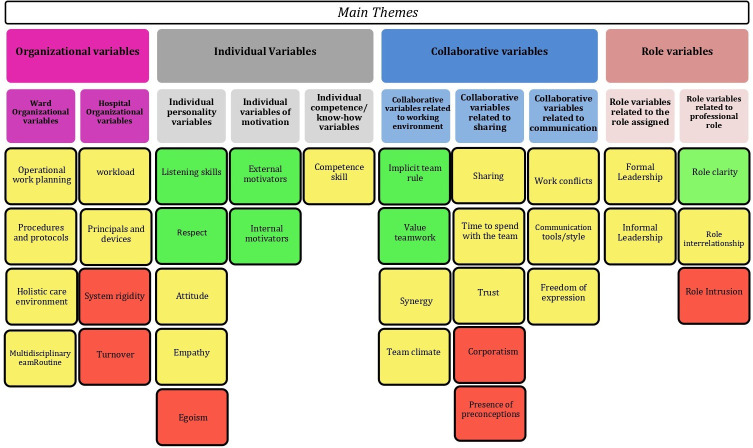
Objective: A multidisciplinary team is essential to providing high-quality, patient-centred care. However, its effectiveness can be either hindered or facilitated by various factors, such as the need for rapid decision-making, which may compromise patient outcomes despite individual efforts. The aim of this study is to synthesise the factors that may act as barriers and facilitators to the work of multidisciplinary teams in managing labour within acute care settings. Design: A systematic qualitative review and meta-synthesis was conducted following the five-step methodology proposed by Sandelowski et al . Data source: Three databases (Medline, Embase and Scopus) were systematically searched without time restrictions up to 25 May 2024. Eligibility criteria for selecting studies: Qualitative studies exploring perspectives, experiences and other similar factors were included. These studies were assessed for methodological quality using the Critical Appraisal Skills Programme. Data extraction and synthesis: The reviewers independently searched, screened and coded the results of the included studies. Data were synthesised using the method proposed by Thomas and Harden. Results: Seventeen studies were included in the meta-synthesis. Four key dimensions emerged, reflecting both the barriers and the facilitators of multidisciplinary team performances: (1) organisational variables, (2) individual variables, (3) collaborative variables and (4) role variables. A total of 36 variables were identified, which could function as barriers (n=6; eg, high staff turnover), facilitators (n=6; eg, strong listening skills) or both (n=24; eg, team climate), depending on the context. Conclusions: This meta-synthesis identifies specific barriers and facilitators and variables that can act as both. Understanding these factors enables targeted interventions to enhance the performance of multidisciplinary teams in clinical practice, particularly in acute care settings. PROSPERO registration number: CRD42022297395.
Overview
The claims and statistics of this paper haven’t been checked yet.
Free: it reads the open-access text and checks the first 5 claims that cite a source we can check. Create a free account to check every claim.
Integrity signals
Registry
Cites
Statistics
Figures
Verification
Claims the paper makes
The claims and statistics of this paper haven’t been checked yet.
Free: it reads the open-access text and checks the first 5 claims that cite a source we can check. Create a free account to check every claim.
Claims other papers make about this one
Each is checked against this paper’s own text: does it say what the citing paper says it does?
The source backs part of the claim, not all of it — or backs it for a different population, condition or comparison.
In the citing paper
“Hospital settings are a particularly unique context, characterised by complex organisational structures, multidisciplinary teams, and high-pressure, fast-paced work [17,18].”
From Explainable AI in hospital clinical decision support systems: A scoping review of healthcare professionals’ perspectives (2026) · cites this paper as [18]
Experimental — accuracy not yet measured
Self-check
Percentages, sums and reported differences re-computed from the paper’s own numbers.
The self-check needs the paper’s full text.
Citations
Cites
The PRISMA 2020 statement: An updated guideline for reporting systematic reviews
Page, M. J., McKenzie, J. E., Bossuyt, P. M., Boutron, I., Hoffmann, T. C., Mulrow, C. D., Shamseer, L., Tetzlaff, J. M., Akl, E. A., Brennan, S. E., et al. (2021) · BMJ · doi:10.1136/bmj.n71 · Cited by 108,283
Methods for the thematic synthesis of qualitative research in systematic reviews
Thomas, J., & Harden, A. (2008) · BMC Medical Research Methodology · doi:10.1186/1471-2288-8-45 · Cited by 9,312
Enhancing transparency in reporting the synthesis of qualitative research: ENTREQ
Tong, A., Flemming, K., McInnes, E., Oliver, S., & Craig, J. (2012) · BMC Medical Research Methodology · doi:10.1186/1471-2288-12-181 · Cited by 3,569 · cited 1×
“To ensure trans-parency in reporting, both the methods and the findings were documented in accordance with the Enhancing Transparency in Reporting the Synthesis of Qualitative Research (ENTREQ), 27 as detailed in online supplemental appendix S2.”
Methley, A. M., Campbell, S., Chew-Graham, C., McNally, R., & Cheraghi-Sohi, S. (2014) · BMC Health Services Research · doi:10.1186/s12913-014-0579-0 · Cited by 2,706 · cited 1×
“Due to the structure of the SPIDER tool, 30 31 the specific AC setting of interest was identified by the reviewers during the screening process.”
Beyond PICO: The SPIDER Tool for Qualitative Evidence Synthesis
Cooke, A., Smith, D., & Booth, A. (2012) · Qualitative Health Research · doi:10.1177/1049732312452938 · Cited by 2,608
Qualitative metasynthesis: Issues and techniques
Sandelowski, M., Docherty, S., & Emden, C. (1997) · Research in Nursing & Health · doi:10.1002/(sici)1098-240x(199708)20:4<365::aid-nur9>3.0.co;2-e · Cited by 1,046
Australasian College for Emergency Medicine
(1994) · Emergency Medicine · doi:10.1111/j.1442-2026.1994.tb00150.x · Cited by 725
Meta-Study of Qualitative Health Research
Paterson, B., Thorne, S., Canam, C., & Jillings, C. (2001) · doi:10.4135/9781412985017 · Cited by 664 · cited 1×
“…studies, ethnographies, grounded theory research and mixed-method or multimethod studies, provided that qualitative data could be clearly separated from quantitative data 28 29 ; and (5) studies focusing on the experiences of a single professional category in relation to multidisciplinary teamwork.”
Promoting a Culture of Safety as a Patient Safety Strategy: A Systematic Review
Weaver, S. J., Lubomksi, L. H., Wilson, R. F., Pfoh, E. R., Martinez, K. A., & Dy, S. M. (2013) · Annals of Internal Medicine · doi:10.7326/0003-4819-158-5-201303051-00002 · Cited by 602
Dixon-Woods, M., Sutton, A., Shaw, R., Miller, T., Smith, J., Young, B., Bonas, S., Booth, A., & Jones, D. (2007) · Journal of Health Services Research & Policy · doi:10.1258/135581907779497486 · Cited by 546 · cited 1×
“25 26 The meta-synthesis process comprised five distinct stages: (1) definition of key concepts, (2) systematic literature review, (3) quality assessment of the included studies, (4) data analysis and calculation of the effect dimension and (5) synthesis of the results.”
Cited by
Wang, X., Wang, Q., Ding, G., Wang, J., Tang, Y., & Feng, Y. (2025) · iScience · doi:10.1016/j.isci.2025.114082 · Cited by 28
Multiprofessional Interventions for Frailty in Patients with Heart Failure: A Comprehensive Review
Uchmanowicz, I., Jędrzejczyk, M., Lee, C. S., Hill, L., Vitale, C., Denfeld, Q. E., Vellone, E., Żółkowska, B., Janczak, S. D., Chamos, A. J., et al. (2025) · Current Heart Failure Reports · doi:10.1007/s11897-025-00727-8 · Cited by 13
“Such collaborative care can reduce complications and readmissions while improving function and quality of life [21–27].”
Van Dort, B. A., Engelsma, T., Sneekes, P., Peute, L., & Medlock, S. (2026) · PLOS Digital Health · doi:10.1371/journal.pdig.0001417 · Cited by 9
Kuipers, R., Reinke, L., Tulleken, J. E., & Reinders, J. J. (2025) · Journal of Multidisciplinary Healthcare · doi:10.2147/jmdh.s512952 · Cited by 3
Gonzalez, M., Chowdhury, F., Kee, M., MacLeod, B., Skidmore, B., & Woodgate, R. L. (2026) · Journal of Healthcare Leadership · doi:10.2147/jhl.s569934 · Cited by 5
Clement, E., & Brown, C. J. (2025) · Annals of Surgical Oncology · doi:10.1245/s10434-025-18301-w · Cited by 1
Frisardi, V., Sando, V. D., Conceining, G., & Schlögl, M. (2025) · European Geriatric Medicine · doi:10.1007/s41999-025-01292-y · Cited by 1
Prescription Support Practice for Pharmacy Students: Pre-Post Educational Intervention Study
Aizawa, F., Yagi, K., Higashionna, T., Hamano, H., Takahashi, S., Zamami, Y., Shinomiya, K., Niimura, T., Goda, M., Kawada, K., et al. (2026) · JMIR Medical Education · doi:10.2196/79545 · Cited by 1
“Collaborative care, provided by a team of medical professionals, can enhance therapeutic effects [1,2].”
Post-intensive care syndrome: why multidisciplinary care is not enough?
Rousseau, A., Berger‐Estilita, J., & Leaver, S. K. (2026) · Intensive Care Medicine · doi:10.1007/s00134-026-08422-5 · Cited by 1
“Addressing these challenges requires pragmatic and deliberate actions [5].”
Yamanaka, R., Ito, H., Takashima, Y., Soriano, K., Onishi, K., Betriana, F., Soriano, G. P., Blaquera, A. P., Akiyama, T., Tanioka, R., et al. (2026) · Healthcare · doi:10.3390/healthcare14101394 · Cited by 1
“In interprofessional team-based care, the absence of a common evaluative framework often leads to unclear role distribution, communication break-downs, and fragmented professional growth [28–30].”
Stone, R. A., Marwood, J., Davies, P., Nobles, J., Coulman, K. D., Ioannou, E., Martin, A., Swallow, V. M., Nield, L., Ells, L. J., et al. (2026) · BMC Health Services Research · doi:10.1186/s12913-026-14899-z · Cited by 1
“Importantly, our findings reiterate that effective MDT functioning depends on appropriate IT infrastructure, adequate workspace, and sufficient administrative support [38].”
Pearcy, P., Sussman, K.-L., & Friebel, R. (2026) · Health Economics Policy and Law · doi:10.1017/s1744133126100590 · Cited by 1
Kelly, D., Bankowski, L., Chaudhari, S., Pennington, J., Wakely, L., Kocanda, L., & Kersten, M. L. (2026) · International Wound Journal · doi:10.1111/iwj.70993 · Cited by 1
Chanida, K., Soontorn, T., & Sarathep, P. (2026) · International Emergency Nursing · doi:10.1016/j.ienj.2026.101906 · Cited by 1
Lapierre, A., Berube, M., Turcotte, V., Giroux, M., Severino, F., Boisvert, L., Williamson, D. R., Mercier, É., Richard‐Denis, A., & Moore, L. (2025) · Journal of Interprofessional Education & Practice · doi:10.1016/j.xjep.2025.100763
Alsubhi, N. H., Alshomrani, M. H., Ghazwani, N. A. Y., Sawadi, F. Y. O., Alshehri, R. F., & Sanawi, M. A. H. (2024) · Journal of Posthumanism · doi:10.63332/joph.v4i3.3368
Quintana-Lorenzo, M. L., la Torre, H. G., Rodríguez-Suárez, C.-A., Sánchez, J. J. S., Pinto-Plasencia, R. J., & Soriano, J. V. (2025) · Journal of Interprofessional Care · doi:10.1080/13561820.2025.2579535
“Healthcare delivery is widely acknowledged as a process involving the participation of teams composed of various healthcare professionals, often representing multiple disciplines (Gilbert et al., 2010; O’Donnell et al., 2025; Pradelli et al., 2025; Walters et al., 2016).”
ALHARBI, K. A., ALANAZI, M. N., SHAMMRI, A. S. A., ALJAMEELI, O. M., ALMUTAIRI, M. A., ALSHAMMARI, M. K., & ALAMRI, M. O. A. (2025) · TPM Testing, psychometrics, methodology in applied psychology · doi:10.5281/zenodo.17285180
The Role and Classification of CVICU‑Trained Cardiac Intensivists in Advancing Saudi Vision 2030
AlSamadani, S. K., alharthi, A. B., Albloushi, A. A., Alsawyan, T. H., Almaghrabi, A. A., Khan, A. H., Alsharif, M. H., & Mirza, A. S. (2025) · European Journal of Biology and Medical Science Research · doi:10.37745/ejbmsr.2013/vol14n1111
Rial, M. V. M., Santos, K. L. D. D., da Silva, M. G. R. M., de Souza, P. A., Cavalcanti, A. U. A., & Rodrigues, T. D. G. (2026) · Revista de Geopolítica · doi:10.56238/revgeov17n1-029
THE SAFETY HUDDLE AS A TOOL FOR COORDINATING NURSING CARE IN THE INTENSIVE CARE UNIT
Rial, M. V. M., Santos, K. L. D. D., da Silva, M. T., de Souza, P. A., Cavalcanti, A. U. A., & Rodrigues, T. D. G. (2026) · Seven Editora eBooks · doi:10.56238/sevened2026.009-008
Staglianò, A., Visconti, S., Lucifora, R., Rizzo, M. A., Page, E. H., Ferrara, M. C., Pinardi, E., Tonus, B., Sironi, A., Sandi, F., et al. (2026) · Frontiers in Dementia · doi:10.3389/frdem.2026.1740269
de Sousa, L. B., Melo, K. R. D. S., de Sales, M. E. L., Sestari, L. E., Lopes, J. M. C., Oliveira, J. R. B., Ribeiro, N. G., Gomes, A. D. M., Julião, S. D. M., Oliveira, T. N. S. D., et al. (2026) · Revista de Geopolítica · doi:10.56238/revgeov17n2-129 · Cited by 1
Bonanno, K., Bothwell, S. J., Glazer, S., Patronick, J., McNally, K. A., Scratch, S. E., Cirincione, L., & Wade, S. L. (2026) · Applied Neuropsychology Child · doi:10.1080/21622965.2026.2644531
Al-Judaibi, A. A. (2026) · Infectious diseases · doi:10.5772/intechopen.1014263
Mancini, D., Hilger, A., & Jetté, M. E. (2026) · Perspectives of the ASHA Special Interest Groups · doi:10.1044/2026_persp-25-00274
Pavliuk, V. O., Perepichka, M. P., Vlasova, O. V., & Koloskova, О. К. (2026) · Acta Balneologica · doi:10.36740/abal202601109
Du, X., Zhao, M., & Fu, Z. (2026) · Cureus · doi:10.7759/cureus.107764
“This The nexus between KM and patient safety is of paramount importance concerning systemic clinical risks [15,18,43,80-82,86].”
InfluentialMishra, A., & Nayak, S. C. (2026) · IP Journal of Otorhinolaryngology and Allied Science · doi:10.18231/j.ijoas.15854.1773995177
Naidoo, N., Martin, L. I., Conradie, W., Heunis, M., Smit, C. P., & Edge, J. (2026) · World Journal of Surgery · doi:10.1002/wjs.70405
Souza, M. R. C., & Ribeiro, A. C. (2026) · Revista gaúcha de enfermagem · doi:10.1590/1983-1447.2026.20250261.pt
Souza, M. R. C., & Ribeiro, A. C. (2026) · Revista gaúcha de enfermagem · doi:10.1590/1983-1447.2026.20250261.en
Pippi, R., Prete, D., Pagano, S., Valenti, C., Simonetti, S., Prati, S., Alabiso, M., Settembrini, G., Fruttini, D., & Sarchielli, P. (2026) · Nutrients · doi:10.3390/nu18121893
“The requirement for specialized personnel adds complexity to the implementation of the protocol, highlighting both its challenges and benefits, as noted by Pradelli et al. [128].”
Rodríguez-Blanco, N., Sánchez‐Más, J., Ayuso-Murillo, D., Fontán-Vinagre, G., Angulo-Perea, M., Díaz-Gautier, A., & Guerrero-Menéndez, R. (2026) · BMC Pregnancy and Childbirth · doi:10.1186/s12884-026-09484-5
Mo, D., Wang, Y., Xu, Y., Guan, Y., Gao, Y.-N., & Wang, D. (2026) · Frontiers in Public Health · doi:10.3389/fpubh.2026.1831732 · Cited by 1
“Open communication and collaborative decision-making are fostered by effective leaders (69).”
Höök, E., & Keen, A. (2026) · DiVA (Luleå University of Technology)
DOĞAN, H. D., & Mat, S. T. B. (2026) · BMC Nursing · doi:10.1186/s12912-026-04971-8
“Similarly, evidence suggests that in ICUs characterized by strong teamwork and support structures, the quality of nurse-patient interactions remains resilient despite high workloads, effectively mitigating the stress induced by temporal pressures [42].”
MedSurg: A Reciprocal Resident-Led Lecture Series for Medicine and Surgery Residents
Radulovacki, K., Barter, S. M., Hirshman, N. A., Leraas, H. J., Rhodin, K. E., Shaw, B., Cui, C., Vatsaas, C., Hill, S. S., Greenberg, J., et al. (2026) · Journal of Surgical Research · doi:10.1016/j.jss.2026.07.022
Supervisão clínica em equipas multidisciplinares: o papel na gestão de conflitos
Roque, A., Carriço, A., Quaresma, C., Goes, M., & Marques, F. (2026) · Portuguese National Funding Agency for Science, Research and Technology (RCAAP Project by FCT)
Supervisão clínica em enfermagem: dos modelos à qualidade dos cuidados
Dias, A. M. G. D. S., Goes, M., & Zangão, M. O. B. (2026) · Portuguese National Funding Agency for Science, Research and Technology (RCAAP Project by FCT)
Factors Influencing the Success of Change Management: A Systematic Literature Review
Febriana, D. D., Dewi, R. H. A., Intan Permatasari, H., Daffa, N. R., Rahayu, N. A., Khoiriyah, B. N., Maufiroh, S., Syafi'i, A., Abigail, H. N., Yulianingtyas, K. Y., et al. (2026) · Journal of Nursing Management Innovations · doi:10.58723/jnmi.v2i2.148
“Recent evidence also suggests that healthcare organizations require adaptive leadership and resilient organizational systems to sustain improvements and respond effectively to emerging healthcare challenges (Pradelli et al., 2025; Patel, 2026).”
Hong, Y., Hu, W., Tang, J., & Xiong, F. (2026) · Frontiers in Neurology · doi:10.3389/fneur.2026.1837085
“…on coordinated input from multiple disciplines, including neurology, critical care medicine, nursing, physiotherapy, and respiratory therapy (260), each contributing distinct and complementary information regarding neurological function, hemodynamic stability, respiratory status, and…”
Ali, S., Afzal, S., Mahboob, F., & Shaikh, A. (2026) · Archives of Management and Social Sciences · doi:10.63516/amss/02.04/003
Alkhaldi, M. J. O. (2024) · Review of Contemporary Philosophy
Aldhafeeri, W. A. S. (2025) · Review of Contemporary Philosophy
Albariqi, M. Z. A. (2025) · Review of Contemporary Philosophy
Almutiri, L. H. (2025) · Review of Contemporary Philosophy
Aljameeli, A. B. A. (2024) · Review of Contemporary Philosophy
Alsaif, S. H. M. (2024) · Review of Contemporary Philosophy
Alsubaie, S. M. F. (2024) · Review of Contemporary Philosophy
Alanazi, F. M. J. (2024) · Review of Contemporary Philosophy
Alanzi, A. K. (2024) · Review of Contemporary Philosophy
Elna, N. P., Yusnaini, Y., Novita, M., & Rukiani, S. (2026) · Jurnal Kesehatan Rekam Medis dan Farmasi (JUK-Medifa)
Multidisciplinary research teams within hospital and health service settings: A concept analysis
Bowden, A., Hearn, J., Croaker, K., & Middleton, R. (2026) · Journal of Interprofessional Education & Practice · doi:10.1016/j.xjep.2026.100859
Grapa, C. M., Mocan, T., Leucuta, D., Mocan, L. P., Crăciun, R., Ştefănescu, H., Procopeț, B., Kornek, M., Krawczyk, M. J., Hajjar, N. A., et al. (2026) · Livers · doi:10.3390/livers6050104
Kumar, H. H., Rathi, C., Manohar, T., & Yoosaf, N. (2026) · Cureus · doi:10.7759/cureus.117678
Pereira, N. A. P. G., Durval, S. D. F., de Souza, A. S., Teston, É. F., Marcon, S. S., de Souza, M. D. L., & Giacon-Arruda, B. C. C. (2026) · Revista Latino-Americana de Enfermagem · doi:10.1590/1518-8345.7898.4947
Pereira, N. A. P. G., Durval, S. D. F., de Souza, A. S., Teston, É. F., Marcon, S. S., de Souza, M. D. L., & Giacon-Arruda, B. C. C. (2026) · Revista Latino-Americana de Enfermagem · doi:10.1590/1518-8345.7898.4950
Maternal death surveillance and Primary Health Care nurses’ performance in a Brazilian capital city
Pereira, N. A. P. G., Durval, S. D. F., de Souza, A. S., Teston, É. F., Marcon, S. S., de Souza, M. D. L., & Giacon-Arruda, B. C. C. (2026) · Revista Latino-Americana de Enfermagem · doi:10.1590/1518-8345.7898.4948
Healthcare professionals’ experiences and expectations about medicines safety
Hussain, R., & Alshorman, K. (2026) · Elsevier eBooks · doi:10.1016/b978-0-443-26588-4.00016-4
Γιαννακάκου, Α. Χ. (2026) · University of Thessaly Institutional Repository (University of Thessaly)
Edwards, L. M., Montgomery, A., Mudge, A., Moussa, R., Campbell, K., Yenson, V. M., Hepworth, A., & Agar, M. R. (2026) · Delirium · doi:10.56392/001c.172179
Smith, S. J., Maxwell‐Smith, C., & Ha, N. T. (2026) · Health & Social Care in the Community · doi:10.1155/hsc/3123244
Tragantzopoulou, P., & Giannouli, V. (2026) · Healthcare · doi:10.3390/healthcare14203552
“These relationships may be particularly consequential in healthcare because clinical work combines high emotional demands with professional hierarchies, multidisciplinary interdependence, clinical uncertainty, and substantial responsibility for patient safety [29,30].”
InfluentialMaatouk, L., & Ndupu, L. B. (2026) · Journal of Public Health Issues and Practices · doi:10.33790/jphip1100264
Metadata
- Authors
- Pradelli, L., Risoli, C., Summer, E., Bellini, G., Mozzarelli, F., Anderson, G., Guasconi, M., Artioli, G., Bonacaro, A., & Sarli, L.
- Affiliations
- Azienda USL di Piacenza, Piacenza, Italy
- Fondazione Madonna della Bomba Scalabrini ETS, Piacenza, Italy
- University of Parma (IT)
- Agostino Gemelli University Polyclinic (IT)
- Corresponding author
- Guasconi, Massimo
- ORCID
- Venue
- BMJ Open
- Publisher
- BMJ
- Published
- 2025-03
- Volume
- 15
- Issue
- 3
- Pages
- e087268
- ISSN
- 2044-6055 (ISSN-L)
- PMC
- PMC11931918
- OpenAlex
- W4408745436
- Cited by
- 42
- References
- 60
- Citations by year
- 2026: 35 · 2025: 7
- FWCI
- 8.33
- Type
- journal article
- Language
- en
- Open access
- gold
- doi.org
- Licence
- Locations
- BMJ Open (publishedVersion, cc-by-nc)
- Europe PMC (PubMed Central) (publishedVersion, cc-by-nc)
- PubMed Central (publishedVersion, cc-by-nc)
- PubMed (publishedVersion)
- DOAJ (DOAJ: Directory of Open Access Journals) (submittedVersion, cc-by-sa)
- Topics
- Health Sciences › Health Professions › General Health Professions › Interprofessional Education and Collaboration
- Social Sciences › Psychology › Social Psychology › Team Dynamics and Performance
- Social Sciences › Arts and Humanities › History and Philosophy of Science › Interdisciplinary Research and Collaboration
- Keywords
- multidisciplinary team, barriers and facilitators, acute care, labor management, healthcare professionals' perspectives, team climate, employee turnover, listening skills, organizational factors, collaboration, role clarity, patient-centered care
- MeSH terms
- Attitude of Health Personnel, Health Personnel, Humans, Patient Care Team, Patient-Centered Care, Qualitative Research
About these checks
Registry, retraction, Cites and statistics results are computed, not judged, with one exception: a printed reference that no index lists is read once by a model before it counts as a citation error. Claims are extracted by a model and kept only when their quote appears verbatim in the text; each cited source is then checked, with a model’s help, for whether it says what the claim relies on. Those verdicts can be wrong — read the claim’s quote and the cited source before relying on one.
Statistics and arithmetic are recomputed, not judged.
Confidence bands are shown only for fields calibrated on our annotated test set. None is calibrated yet, so no band is shown.
What counts as a claim ›How we measure confidence ›How we check this ›
Are you an author, or do you see a problem with this page? Request a review
Data sources
Bibliographic data: Semantic Scholar, OpenAlex, Crossref.
Contains information from the Semantic Scholar Academic Graph Datasets, made available under the ODC Attribution License (ODC-BY 1.0).
Semantic Scholar’s data is described in: Kinney, R., et al. (2023). The Semantic Scholar Open Data Platform. arXiv:2301.10140.
