

Interventions to reduce repetitive ordering of low-value inpatient laboratory tests: a systematic review
Open accessThe DOI matches its Crossref record; 49 of the 49 references it cites were found in a registry or an index.
Abstract
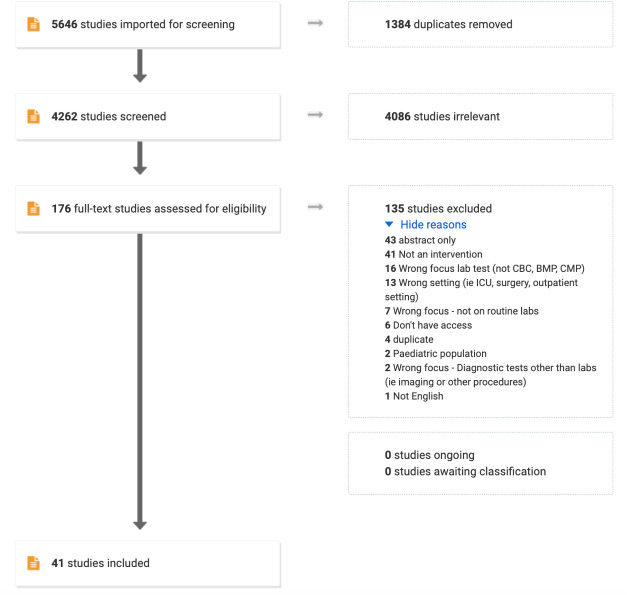
Background: Over-ordering of daily laboratory tests adversely affects patient care through hospital-acquired anaemia, patient discomfort, burden on front-line staff and unnecessary downstream testing. This remains a prevalent issue despite the 2013 Choosing Wisely recommendation to minimise unnecessary daily labs. We conducted a systematic review of the literature to identify interventions targeting unnecessary laboratory testing. Methods: We systematically searched MEDLINE, EMBASE, Cochrane Central and SCOPUS databases to identify interventions focused on reducing daily complete blood count, complete metabolic panel and basic metabolic panel labs. We defined interventions as ‘effective’ if a statistically significant reduction was attained and ‘highly effective’ if a reduction of ≥25% was attained. Results: The search yielded 5646 studies with 41 articles that met inclusion criteria. We grouped interventions into one or more categories: audit and feedback, cost display, education, electronic medical record (EMR) change, and policy change. Most interventions lasted less than a year and used a multipronged approach. All five strategies were effective in most studies with EMR change being the most commonly used independent strategy. EMR change and policy change were the strategies most frequently reported as effective. EMR change was the strategy most frequently reported as highly effective. Conclusion: Our analysis identified five categories of interventions targeting daily laboratory testing. All categories were effective in most studies, with EMR change being most frequently highly effective. PROSPERO registration number: CRD42021254076.
Overview
The claims and statistics of this paper haven’t been checked yet.
Free: it reads the open-access text and checks the first 5 claims that cite a source we can check. Create a free account to check every claim.
Integrity signals
Registry
Cites
Statistics
Figures
Verification
Claims the paper makes
The claims and statistics of this paper haven’t been checked yet.
Free: it reads the open-access text and checks the first 5 claims that cite a source we can check. Create a free account to check every claim.
Claims other papers make about this one
Each is checked against this paper’s own text: does it say what the citing paper says it does?
The cited source doesn’t support the claim as written.
In the citing paper
“Existing mitigation strategies, including clinician education, audit and feedback, financial incentives, and broad ordering restrictions, have limited precision and efficacy.11,12”
From SmartAlert - Implementing Machine Learning-Driven Clinical Decision Support for Inpatient Laboratory Utilization Reduction (2026) · cites this paper as [11]
Checked by a reasoning model — may be wrong.
Experimental — accuracy not yet measured
Self-check
Percentages, sums and reported differences re-computed from the paper’s own numbers.
The self-check needs the paper’s full text.
Citations
Cites
Interrater reliability: The kappa statistic
McHugh, M. L. (2012) · Biochemia Medica · doi:10.11613/bm.2012.031 · Cited by 19,877
The Landscape of Inappropriate Laboratory Testing: A 15-Year Meta-Analysis
Zhi, M., Ding, E. L., Theisen-Toupal, J., Whelan, J., & Arnaout, R. (2013) · PLoS ONE · doi:10.1371/journal.pone.0078962 · Cited by 535
Bates, D. W., Kuperman, G. J., Rittenberg, E., Teich, J. M., Fiskio, J., Ma’luf, N., Onderdonk, A., Wybenga, D., Winkelman, J., Brennan, T. A., et al. (1999) · The American Journal of Medicine · doi:10.1016/s0002-9343(98)00410-0 · Cited by 292
Miyakis, S., Karamanof, G., Liontos, M., & Mountokalakis, T. D. (2006) · Postgraduate Medical Journal · doi:10.1136/pgmj.2006.049551 · Cited by 257
Evidence-Based Guidelines to Eliminate Repetitive Laboratory Testing
Eaton, K. P., Levy, K., Soong, C., Pahwa, A. K., Petrilli, C., Ziemba, J. B., Cho, H. J., Alban, R., Blanck, J. F., & Parsons, A. S. (2017) · JAMA Internal Medicine · doi:10.1001/jamainternmed.2017.5152 · Cited by 178
The Impact of Peer Management on Test-Ordering Behavior
Neilson, E. G., Johnson, K. B., Rosenbloom, S. T., Dupont, W. D., Talbert, D., Giuse, D. A., Kaiser, A., Miller, R. A., & and the Resource Utilization Committee* (2004) · Annals of Internal Medicine · doi:10.7326/0003-4819-141-3-200408030-00008 · Cited by 147
Reducing Unnecessary Inpatient Laboratory Testing in a Teaching Hospital
May, T. A., Clancy, M., Critchfield, J., Ebeling, F., Enriquez, A., Gallagher, C., Genevro, J., Kloo, J., Lewis, P., Smith, R., et al. (2006) · American Journal of Clinical Pathology · doi:10.1309/wp59-ym73-l6ce-gx2f · Cited by 111
How to save costs by reducing unnecessary testing: Lean thinking in clinical practice
Vegting, I. L., van Beneden, M., Kramer, M. H. H., Thijs, A., Kostense, P. J., & Nanayakkara, P. W. B. (2011) · European Journal of Internal Medicine · doi:10.1016/j.ejim.2011.07.003 · Cited by 109
Calderon-Margalit, R., Mor-Yosef, S., Mayer, M., Adler, B., & Shapira, S. C. (2005) · International Journal for Quality in Health Care · doi:10.1093/intqhc/mzi025 · Cited by 102
Vidyarthi, A. R., Hamill, T., Green, A. L., Rosenbluth, G., & Baron, R. B. (2014) · American Journal of Medical Quality · doi:10.1177/1062860613517502 · Cited by 91
Cited by
Kien, C., Daxenbichler, J., Titscher, V., Baenziger, J., Klingenstein, P., Naef, R., Klerings, I., Clack, L., Fila, J., & Sommer, I. (2024) · Implementation Science · doi:10.1186/s13012-024-01384-6 · Cited by 41
“Only eight SRs [37, 45, 49, 53, 56, 58, 60, 61] reported results on comparisons between discrete and multifaceted strategies usable for analysis (Figs.”
BackgroundResultInfluentialLab testing overload: a comprehensive analysis of overutilization in hospital-based settings
Shaik, T., Mahmood, R., Kanagala, S. G., Kaur, H., Mendpara, V., Gupta, V., Aggarwal, P., Anamika, F., Garg, N., & Jain, R. (2024) · Baylor University Medical Center Proceedings · doi:10.1080/08998280.2023.2288788 · Cited by 22
“21 However, EMR changes were less used among physicians who had strict limitations and pop up alerts, while strategies like cost display and education were more effective in combination with other methods, making it unclear how well they work on an individual basis.”
BackgroundWhat Is Diagnostic Stewardship?
Claeys, K. C., Coffey, K., & Morgan, D. J. (2025) · The Journal of Applied Laboratory Medicine · doi:10.1093/jalm/jfae130 · Cited by 20
Guidance-Based Appropriateness of Hemostasis Testing in the Acute Setting
Devis, L., Arachchillage, D. J., Hardy, M. J., Mansour, A., Catry, É., Closset, M., Gouin‐Thibault, I., Frère, C., Lecompte, T., Alberio, L., et al. (2025) · Hämostaseologie · doi:10.1055/a-2491-3631 · Cited by 12
Gaudreau-Simard, M., Shetty, N., Silverstein, W. K., Luo, O. D., & Stoynova, V. (2025) · Journal of General Internal Medicine · doi:10.1007/s11606-025-09441-6 · Cited by 11
How can we finally reduce repetitive routine laboratory tests for hospitalised patients?
Moriates, C. P. (2023) · BMJ Quality & Safety · doi:10.1136/bmjqs-2023-016315 · Cited by 9
Reducing Erythrocyte Sedimentation Rate Ordering: De-implementation and Diagnostic Stewardship
Fatemi, Y., Golembe, T. J., Burns, J. E., L’Etoile, N., Obstfeld, A. E., Zorc, J. J., Nord, E., Coffin, S. E., & Shaw, K. N. (2024) · Hospital Pediatrics · doi:10.1542/hpeds.2023-007642 · Cited by 8
“4 E’s” Ways That Clinicians Can Reduce Low-Value Care on Medical Wards
Silverstein, W. K., Leis, J. A., & Moriates, C. P. (2024) · JAMA Internal Medicine · doi:10.1001/jamainternmed.2023.7632 · Cited by 7
Vaughn, V. M., & Morgan, D. J. (2024) · Journal of Hospital Medicine · doi:10.1002/jhm.13321 · Cited by 6
Ambasta, A., Holroyd-Leduc, J. M., Pokharel, S., Mathura, P. V., Shih, A. W. Y., Stelfox, H. T., Ma, I. W. Y., Harrison, M. J., Manns, B., Faris, P., et al. (2024) · Implementation Science · doi:10.1186/s13012-024-01376-6 · Cited by 6
“A recent systematic review on interventions to reduce repetitive ordering of low-value inpatient laboratory tests identified EMR and policy changes as the most effective and sustainable [28].”
BackgroundInfluentialReducing pathology testing in emergency departments: A scoping review
Kazda, L., Pickles, K. M., Colagiuri, P., Bell, K., O’Connell, B. J., & Mathieu, E. (2025) · Australasian Emergency Care · doi:10.1016/j.auec.2025.05.006 · Cited by 4
Simple signage and targeted education can lead to process improvement in acute appendicitis care
Atwood, R. E., Benoit, P., Hennrikus, W. P., Kraemer, L. S., Gunasingha, R. M. K. D., Kindvall, A. T., Jessie, E., Gosztyla, C. E., & Bradley, M. J. (2023) · BMJ Open Quality · doi:10.1136/bmjoq-2023-002327 · Cited by 4
Direct-to-Consumer Testing: Benefits and Concerns of Commercially Accessed Laboratory Tests
Orth, M., Sandberg, S., & Shih, P. (2025) · Clinical Chemistry · doi:10.1093/clinchem/hvaf004 · Cited by 3
Zaitoon, H., Shefer, G., Segev‐Becker, A., Eyal, O., Lebenthal, Y., & Brener, A. (2023) · Endocrine · doi:10.1007/s12020-023-03575-5 · Cited by 3
“Nonetheless, failures to act upon the results of appropriately requested tests and repeating tests even after a diagnosis has been established are still major factors contributing to unnecessary laboratory testing [42].”
How to decrease routine and repetitive blood tests in hospitalized patients
Silverstein, W. K., Weinerman, A. S., & Moriates, C. P. (2024) · Canadian Family Physician · doi:10.46747/cfp.701112701 · Cited by 2
Reducing Daily Laboratory Tests in a Rural-Serving Health System: Insights and Challenges
Sheri, G., Pakala, P., Tumin, D., Manning, J. R., & Zhou, Y. (2025) · Journal for Healthcare Quality · doi:10.1097/jhq.0000000000000487 · Cited by 2
Eliminating Routine Maternal Blood Work After Cesarean Birth: A Quality Improvement Project
Khaikin, Y., Benipal, H., Thomas, J. A., Shapiro, J. L., Page, A., & Jones, C. A. (2025) · Journal for Healthcare Quality · doi:10.1097/jhq.0000000000000491 · Cited by 2
“27 All five strategies were effective in most studies.”
Hughes, C., Myers, M. A., Tickell‐Painter, M., Aitchison, M., Roberts, L., & Shorten, R. J. (2025) · Clinical Biochemistry · doi:10.1016/j.clinbiochem.2025.111060 · Cited by 3
From ordering to interpretation: a comprehensive framework for laboratory test indications
Weninger, J., Streichert, T., Coşkun, A., Pohl, M., Canbay, A. E., & Özcürümez, M. K. (2026) · Clinical Chemistry and Laboratory Medicine (CCLM) · doi:10.1515/cclm-2025-1531 · Cited by 2
“This metadata supports selection of the minimum e ff ective test set, tailoring turnaround time and alerting to clinical urgency, and discouraging low-yield or duplicative panels [7, 40, 41].”
Woodhouse, D., Duncan, D., Ferrie, L., Omodon, O., Mehta, A., Pokharel, S., & Ambasta, A. (2024) · Implementation Science Communications · doi:10.1186/s43058-024-00679-5 · Cited by 2
“Target behaviours for inpatient laboratory testing are poorly defined due to the heterogeneity of the tests and lack of a ‘gold standard’ solution [6].”
Shimoni, Z., Gazi, M., & Froom, P. (2024) · Diagnostics · doi:10.3390/diagnostics14030302 · Cited by 4
“Peer comparisons are particularly effective [19], and nearly all feedback studies have reported some effect [25].”
BackgroundInpatient Test Utilization and Test Volume Benchmarking: A Q-Probes Study
Perrotta, P. L., Coulter, S., Blond, B. J., Long, T. H., & Schifman, R. B. (2024) · Archives of Pathology & Laboratory Medicine · doi:10.5858/arpa.2024-0104-cp · Cited by 1
Mathura, P. V., Grasdal, M. C., Marini, S., Podder, M., & Kassam, N. (2025) · Journal of General Internal Medicine · doi:10.1007/s11606-025-09513-7 · Cited by 1
Res, A., Kibret, G. D., & Georgiou, A. (2025) · IJQHC Communications · doi:10.1093/ijcoms/lyaf008 · Cited by 1
Evidence-Based Laboratory Testing Algorithms: A Strategic Approach to Improving Diagnostic Accuracy
Okonkwo, K. N. (2026) · Cureus · doi:10.7759/cureus.101862 · Cited by 2
Turning knowledge into action: The vital role of science in nursing
Barcellos, R. D. A. (2024) · Nursing in Critical Care · doi:10.1111/nicc.13140 · Cited by 1
Liang, A. S., Amrollahi, F., Jiang, Y., Corbin, C. K., Kim, G. Y. E., Mui, D., Crowell, T., Acharya, A., Mony, S., Punnathanam, S., et al. (2026) · NEJM AI · doi:10.1056/aics2501086
Jääskeläinen, A., & Heikkinen, E. V. (2023) · Research Square · doi:10.21203/rs.3.rs-3303064/v1
Schattner, A. (2024) · The American Journal of Medicine · doi:10.1016/j.amjmed.2024.07.035
Gibas, K. M., & Mermel, L. A. (2024) · Antimicrobial Stewardship & Healthcare Epidemiology · doi:10.1017/ash.2024.451
“22 To ensure the success and sustainability of these programs, it will be essential for healthcare institutions to invest in the infrastructure, resources, and staffing to implement and monitor diagnostic stewardship interventions and to develop standardized measures to track excessive and…”
Harris, J. G., Holland, M. J., Fox, E., Favier, L. A., Hoffart, C. M., Ibarra, M. F., Jones, J. T., Harris, L. A., & Cooper, A. M. (2025) · Clinical Rheumatology · doi:10.1007/s10067-025-07342-x
Dreyfuss, E., Yahalom, V., Barer, Y., Ambar, I., Pardo, A., Shmueli, A., Houri, O., Hadar, E., & Barbash‐Hazan, S. (2025) · Transfusion · doi:10.1111/trf.18356
Criteria for Routine Laboratory Blood Tests in Patients Hospitalized in Cardiology Departments
Shimoni, Z., Hin, F., & Froom, P. (2025) · Diagnostics · doi:10.3390/diagnostics15182307
“Furthermore, excessive testing may even prolong hospital stays and result in clinical disutility if the results are misinterpreted [1–4].”
Biggin, F., White, L. M., Ashcroft, Q., Howcroft, T., Chandrabalan, V., Emsley, H. C. A., & Knight, J. (2025) · BMJ Neurology Open · doi:10.1136/bmjno-2025-001202
“21 22 These previous studies highlighted the need to consider carefully the way in which records are made, the underlying activity that they represent and the potential to save resources and improve patient care by eliminating unnecessary testing and data capture.”
Kannan, P., Mathew, S., & Griffith, B. (2025) · Cureus · doi:10.7759/cureus.97681
“Evidence supports this approach; a systematic review of 41 studies found that EMR-based interventions were most effective in reducing inappropriate blood test requests [11].”
Ambasta, A., Holroyd-Leduc, J. M., Pokharel, S., Mathura, P., Shih, A. W.-Y., Stelfox, H. T., Ma, I., Harrison, M. J., Manns, B., Faris, P., et al. (2024) · Figshare · doi:10.6084/m9.figshare.26742122
Ambasta, A., Holroyd-Leduc, J. M., Pokharel, S., Mathura, P., Shih, A. W.-Y., Stelfox, H. T., Ma, I., Harrison, M. J., Manns, B., Faris, P., et al. (2024) · Figshare · doi:10.6084/m9.figshare.26742128
Ambasta, A., Holroyd-Leduc, J. M., Pokharel, S., Mathura, P., Shih, A. W.-Y., Stelfox, H. T., Ma, I., Harrison, M. J., Manns, B., Faris, P., et al. (2024) · Figshare · doi:10.6084/m9.figshare.26742125
Laboratoriotutkimusprosessi tutuksi : verkkokurssi terveydenhuollon henkilöstölle
Hautala, J. (2025) · Theseus (Ammattikorkeakoulujen)
Maciel, V. V. D. S. (2023) · LA Referencia (Red Federada de Repositorios Institucionales de Publicaciones Científicas)
Less testing, more yield: a multicomponent intervention halves inpatient biochemistry
Jacobsen, M. S., Albertsen, A. E., & Trolle, C. (2026) · Scandinavian Journal of Clinical and Laboratory Investigation · doi:10.1080/00365513.2026.2659590
“Overuse also burdens staff, clutters decision-making with low-value results, and generates avoidable environmental waste [1].”
Ghais, A., Sakan, M. M. A., Alkhateb, O., Diab, Y., Itani, H., Daher, R. T., & Zaatari, G. S. (2026) · Cureus · doi:10.7759/cureus.109928
“This framing has helped shift the focus from individual test knowledge to ordering patterns and has motivated hospital-based diagnostic stewardship efforts aimed at reducing repetitive routine testing [3].”
Novel approach to the codesign of a tailored intervention bundle: applying theory with pragmatism
Pokharel, S., Omodon, O., Woodhouse, D., Ferrie, L., Duncan, D., Mehta, A., & Ambasta, A. (2026) · BMJ Open Quality · doi:10.1136/bmjoq-2025-003861
Pinto, J. A., & Dourado, A. (2026) · Cureus · doi:10.7759/cureus.111275
Sustainability and waste reduction in clinical laboratories
Ejilemele, A. A., & Singh, I. R. (2026) · Critical Reviews in Clinical Laboratory Sciences · doi:10.1080/10408363.2026.2687509
Varkey, A., Parmar, S., Yeat, N. C., & Ornstein, V. (2026) · American Journal of Medical Quality · doi:10.1097/jmq.0000000000000336
Arciero, V. S., Skorupski, C., Goro, T., Cheung, C. M., Fu, L., Podesky, J., Lem-Ragosnig, B., Lafreniere, M., Yip, P. S. F., & Silverstein, W. K. (2026) · The American Journal of Medicine · doi:10.1016/j.amjmed.2026.08.033
Lawrence, H., McCammon, K., Griffiths, L., Mitton, C., Muniak, A., & Tseng, O. L.-I. (2026) · SSM - Health Systems · doi:10.1016/j.ssmhs.2026.100315
Using Labs Wisely: A collaboration between Choosing Wisely Canada and over 150 Canadian hospitals
Bodley, T. F., Shakir, M. B., Hurwitz, G., Weinerman, A. S., Lo, L., Arnoldo, S., Chow, C., Simons, J. E., & Levinson, W. S. (2026) · Journal of Hospital Medicine · doi:10.1002/jhm.70477
ECG for laboratory values:A comprehensive physiological and technical analysisPreprint
Palanchuk, W. (2026) · arXiv (Cornell University) · doi:10.48550/arxiv.2610.28507
Li, J., Scowen, C., Loten, C., Franco, G., Eigenstetter, A., Thomas, J., Baysari, M. T., Georgiou, A., & Prgomet, M. (2026) · JMIR Formative Research · doi:10.2196/92744
Metadata
- Authors
- Yeshoua, B., Bowman, C., Dullea, J., Ditkowsky, J., Shyu, M., Lam, H., Zhao, W., Shin, J. Y., Dunn, A., Tsega, S., S. Linker, A., & Shah, M.
- Affiliations
- Icahn School of Medicine at Mount Sinai (US)
- Hackensack University Medical Center (US)
- Department of Medicine, Mount Sinai, New York, New York, USA
- Corresponding author
- Yeshoua, Brandon
- ORCID
- Venue
- BMJ Open Quality
- Publisher
- BMJ
- Published
- 2023-03
- Volume
- 12
- Issue
- 1
- Pages
- e002128
- ISSN
- 2399-6641 (ISSN-L)
- PMC
- PMC10040017
- OpenAlex
- W4360613269
- Semantic Scholar
- f8232b19f7b040af24462ccf7a861ad89f52bb58
- Cited by
- 46
- References
- 49
- Citations by year
- 2026: 12 · 2025: 15 · 2024: 14 · 2023: 5
- FWCI
- 2.33
- Type
- journal article
- Language
- en
- Open access
- gold
- doi.org
- Licence
- Locations
- BMJ Open Quality (publishedVersion, cc-by-nc)
- PubMed Central (publishedVersion, cc-by-nc)
- PubMed (publishedVersion)
- DOAJ (DOAJ: Directory of Open Access Journals) (submittedVersion, cc-by-sa)
- HighWire Press Open Archive (submittedVersion)
- Topics
- Health Sciences › Health Professions › General Health Professions › Healthcare cost, quality, practices
- Health Sciences › Health Professions › Medical Laboratory Technology › Clinical Laboratory Practices and Quality Control
- Health Sciences › Health Professions › Health Information Management › Electronic Health Records Systems
- Keywords
- unnecessary laboratory testing, Choosing Wisely, complete blood count, basic metabolic panel, audit and feedback, hospital policy change, low-value care
- MeSH terms
- Humans, Inpatients, Clinical Laboratory Techniques, Unnecessary Procedures
About these checks
Registry, retraction, Cites and statistics results are computed, not judged, with one exception: a printed reference that no index lists is read once by a model before it counts as a citation error. Claims are extracted by a model and kept only when their quote appears verbatim in the text; each cited source is then checked, with a model’s help, for whether it says what the claim relies on. Those verdicts can be wrong — read the claim’s quote and the cited source before relying on one.
Statistics and arithmetic are recomputed, not judged.
Confidence bands are shown only for fields calibrated on our annotated test set. None is calibrated yet, so no band is shown.
What counts as a claim ›How we measure confidence ›How we check this ›
Are you an author, or do you see a problem with this page? Request a review
Data sources
Bibliographic data: Semantic Scholar, OpenAlex, Crossref.
Contains information from the Semantic Scholar Academic Graph Datasets, made available under the ODC Attribution License (ODC-BY 1.0).
Semantic Scholar’s data is described in: Kinney, R., et al. (2023). The Semantic Scholar Open Data Platform. arXiv:2301.10140.
