

Interventions to reduce repetitive ordering of low-value inpatient laboratory tests: a systematic review
Open accessThe DOI matches its Crossref record; 49 of the 49 references it cites were found in a registry or an index.
Abstract
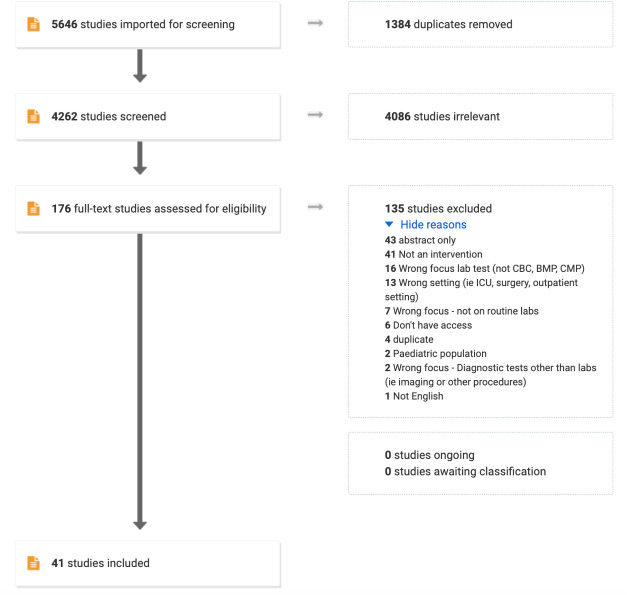
Background: Over-ordering of daily laboratory tests adversely affects patient care through hospital-acquired anaemia, patient discomfort, burden on front-line staff and unnecessary downstream testing. This remains a prevalent issue despite the 2013 Choosing Wisely recommendation to minimise unnecessary daily labs. We conducted a systematic review of the literature to identify interventions targeting unnecessary laboratory testing. Methods: We systematically searched MEDLINE, EMBASE, Cochrane Central and SCOPUS databases to identify interventions focused on reducing daily complete blood count, complete metabolic panel and basic metabolic panel labs. We defined interventions as ‘effective’ if a statistically significant reduction was attained and ‘highly effective’ if a reduction of ≥25% was attained. Results: The search yielded 5646 studies with 41 articles that met inclusion criteria. We grouped interventions into one or more categories: audit and feedback, cost display, education, electronic medical record (EMR) change, and policy change. Most interventions lasted less than a year and used a multipronged approach. All five strategies were effective in most studies with EMR change being the most commonly used independent strategy. EMR change and policy change were the strategies most frequently reported as effective. EMR change was the strategy most frequently reported as highly effective. Conclusion: Our analysis identified five categories of interventions targeting daily laboratory testing. All categories were effective in most studies, with EMR change being most frequently highly effective. PROSPERO registration number: CRD42021254076.
Overview
The claims and statistics of this paper haven’t been checked yet.
Free: it reads the open-access text and checks the first 5 claims that cite a source we can check. Create a free account to check every claim.
Integrity signals
Registry
Cites
Statistics
Figures
Verification
Claims the paper makes
The claims and statistics of this paper haven’t been checked yet.
Free: it reads the open-access text and checks the first 5 claims that cite a source we can check. Create a free account to check every claim.
Claims other papers make about this one
Each is checked against this paper’s own text: does it say what the citing paper says it does?
The cited source doesn’t support the claim as written.
In the citing paper
“Existing mitigation strategies, including clinician education, audit and feedback, financial incentives, and broad ordering restrictions, have limited precision and efficacy.11,12”
From SmartAlert - Implementing Machine Learning-Driven Clinical Decision Support for Inpatient Laboratory Utilization Reduction (2026) · cites this paper as [11]
Checked by a reasoning model — may be wrong.
Experimental — accuracy not yet measured
Self-check
Percentages, sums and reported differences re-computed from the paper’s own numbers.
The self-check needs the paper’s full text.
Citations
Cites
Interrater reliability: The kappa statistic
McHugh, M. L. (2012) · Biochemia Medica · doi:10.11613/bm.2012.031 · Cited by 19,877
The Landscape of Inappropriate Laboratory Testing: A 15-Year Meta-Analysis
Zhi, M., Ding, E. L., Theisen-Toupal, J., Whelan, J., & Arnaout, R. (2013) · PLoS ONE · doi:10.1371/journal.pone.0078962 · Cited by 535
Bates, D. W., Kuperman, G. J., Rittenberg, E., Teich, J. M., Fiskio, J., Ma’luf, N., Onderdonk, A., Wybenga, D., Winkelman, J., Brennan, T. A., et al. (1999) · The American Journal of Medicine · doi:10.1016/s0002-9343(98)00410-0 · Cited by 292
Miyakis, S., Karamanof, G., Liontos, M., & Mountokalakis, T. D. (2006) · Postgraduate Medical Journal · doi:10.1136/pgmj.2006.049551 · Cited by 257
Evidence-Based Guidelines to Eliminate Repetitive Laboratory Testing
Eaton, K. P., Levy, K., Soong, C., Pahwa, A. K., Petrilli, C., Ziemba, J. B., Cho, H. J., Alban, R., Blanck, J. F., & Parsons, A. S. (2017) · JAMA Internal Medicine · doi:10.1001/jamainternmed.2017.5152 · Cited by 178
The Impact of Peer Management on Test-Ordering Behavior
Neilson, E. G., Johnson, K. B., Rosenbloom, S. T., Dupont, W. D., Talbert, D., Giuse, D. A., Kaiser, A., Miller, R. A., & and the Resource Utilization Committee* (2004) · Annals of Internal Medicine · doi:10.7326/0003-4819-141-3-200408030-00008 · Cited by 147
Reducing Unnecessary Inpatient Laboratory Testing in a Teaching Hospital
May, T. A., Clancy, M., Critchfield, J., Ebeling, F., Enriquez, A., Gallagher, C., Genevro, J., Kloo, J., Lewis, P., Smith, R., et al. (2006) · American Journal of Clinical Pathology · doi:10.1309/wp59-ym73-l6ce-gx2f · Cited by 111
How to save costs by reducing unnecessary testing: Lean thinking in clinical practice
Vegting, I. L., van Beneden, M., Kramer, M. H. H., Thijs, A., Kostense, P. J., & Nanayakkara, P. W. B. (2011) · European Journal of Internal Medicine · doi:10.1016/j.ejim.2011.07.003 · Cited by 109
Calderon-Margalit, R., Mor-Yosef, S., Mayer, M., Adler, B., & Shapira, S. C. (2005) · International Journal for Quality in Health Care · doi:10.1093/intqhc/mzi025 · Cited by 102
Vidyarthi, A. R., Hamill, T., Green, A. L., Rosenbluth, G., & Baron, R. B. (2014) · American Journal of Medical Quality · doi:10.1177/1062860613517502 · Cited by 91
A multifaceted hospitalist quality improvement intervention: Decreased frequency of common labs
Corson, A. H., Fan, V. S., White, T., Sullivan, S. D., Asakura, K., Myint, M., & Dale, C. R. (2015) · Journal of Hospital Medicine · doi:10.1002/jhm.2354 · Cited by 83
Procop, G. W., Keating, C., Stagno, P., Kottke‐Marchant, K., Partin, M. H., Tuttle, R. H., & Wyllie, R. (2015) · American Journal of Clinical Pathology · doi:10.1309/ajcpjoj3hkebd3tu · Cited by 71
A Multidisciplinary Housestaff-Led Initiative to Safely Reduce Daily Laboratory Testing
Iams, W. T., Heck, J. M., Kapp, M., Leverenz, D. L., Vella, M. A., Szentirmai, E., Valerio-Navarrete, I., Theobald, C. N., Goggins, K. M., Flemmons, K., et al. (2016) · Academic Medicine · doi:10.1097/acm.0000000000001149 · Cited by 62
Sadowski, B. W., Lane, A. B., Wood, S. M., Robinson, S. L., & Kim, C. H. (2017) · The American Journal of Medicine · doi:10.1016/j.amjmed.2017.02.029 · Cited by 59
Konger, R. L., Ndekwe, P., Jones, G., Schmidt, R. P., Trey, M., Baty, E. J., Wilhite, D., Munshi, I. A., Sutter, B. M., Rao, M., et al. (2016) · American Journal of Clinical Pathology · doi:10.1093/ajcp/aqv092 · Cited by 53
The Frequency of Unnecessary Testing in Hospitalized Patients
Koch, C., Roberts, K., Petruccelli, C., & Morgan, D. J. (2018) · The American Journal of Medicine · doi:10.1016/j.amjmed.2017.11.025 · Cited by 50
The role of a best practice alert in the electronic medical record in reducing repetitive lab tests
Bejjanki, H., Mramba, L. K., Beal, S. G., Radhakrishnan, N. S., Bishnoi, R., Shah, C., Agrawal, N., Harris, N., Leverence, R. R., & Rand, K. H. (2018) · ClinicoEconomics and Outcomes Research · doi:10.2147/ceor.s167499 · Cited by 49
Incidence, Predictors, and Outcomes of Hospital‐Acquired Anemia
Makam, A. N., Nguyen, O. K., Clark, C., & Halm, E. A. (2017) · Journal of Hospital Medicine · doi:10.12788/jhm.2723 · Cited by 46
Kurniali, P. C., Curry, S., Brennan, K. W., Velletri, K., Shaik, M. S., Schwartz, K. A., & McCormack, E. M. (2014) · Anemia · doi:10.1155/2014/634582 · Cited by 44
Effect of feedback to clinical staff of information on clinical biochemistry requesting patterns.
Grivell, A. R., Forgie, H. J., Fraser, C. G., & Berry, M. N. (1981) · Clinical Chemistry · doi:10.1093/clinchem/27.10.1717 · Cited by 42
A Successful Experiment to Reduce Unnecessary Laboratory Use in a Community Hospital
GORTMAKER, S. L., BICKFORD, A. F., MATHEWSON, H. O., DUMBAUGH, K., & TIRRELL, P. C. (1988) · Medical Care · doi:10.1097/00005650-198806000-00011 · Cited by 42
Sommers, B. D., Desai, N. R., Fiskio, J. M., Licurse, A. M., Thorndike, M., Katz, J. T., & Bates, D. W. (2012) · Academic Medicine · doi:10.1097/acm.0b013e31825373b3 · Cited by 41
Optimize Your Electronic Medical Record to Increase Value: Reducing Laboratory Overutilization
Iturrate, E., Jubelt, L. E., Volpicelli, F., & Hochman, K. A. (2015) · The American Journal of Medicine · doi:10.1016/j.amjmed.2015.09.009 · Cited by 40
Faisal, A., Andres, K., Rind, J. A. K., Das, A., Alter, D. N., Subramanian, J., Koehler, T. J., Parker, J., & Bernicchi, N. (2018) · Postgraduate Medical Journal · doi:10.1136/postgradmedj-2018-135784 · Cited by 40
Bindraban, R. S., van Beneden, M., Kramer, M. H. H., van Solinge, W. W., van de Ven, P. M., Naaktgeboren, C. A., Al‐Dulaimy, M., van der Wekken‐Pas, L., Bandt, Y. C., Stam, F., et al. (2019) · JAMA Network Open · doi:10.1001/jamanetworkopen.2019.7577 · Cited by 39
Wertheim, B. M., Aguirre, A. J., Bhattacharyya, R. P., Chorba, J. S., Jadhav, A. P., Kerry, V. B., Macklin, E. A., Motyckova, G., Raju, S. S., Lewandrowski, K. B., et al. (2016) · The American Journal of Medicine · doi:10.1016/j.amjmed.2016.08.021 · Cited by 37
Reducing unnecessary testing: an intervention to improve resident ordering practices
Melendez-Rosado, J., Thompson, K. M., Cowdell, J. C., Sánchez-Álvarez, C., Ung, R. L., Villanueva, A., Jeffers, K. B., Imam, J. S., Mitkov, M. V., Kaleem, T. A., et al. (2017) · Postgraduate Medical Journal · doi:10.1136/postgradmedj-2016-134513 · Cited by 29
Evaluating Automated Rules for Rapid Response System Alarm Triggers in Medical and Surgical Patients
Brufau, S. R., Morlan, B. W., Johnson, M. G., Hickman, J. A., Kirkland, L. L., Naessens, J. M., & Huddleston, J. M. (2017) · Journal of Hospital Medicine · doi:10.12788/jhm.2712 · Cited by 27
Impact of weekly feedback on test ordering patterns.
Minerowicz, C., Abel, N., Hunter, K. M., Behling, K. C., Cerceo, E. A., & Bierl, C. (2015) · PubMed · Cited by 24
Economic and organizational impact of a clinical decision support system on laboratory test ordering
Bellodi, E., Vagnoni, E., Bonvento, B., & Lamma, E. (2017) · BMC Medical Informatics and Decision Making · doi:10.1186/s12911-017-0574-6 · Cited by 24
Mindfulness-Based Laboratory Reduction: Reducing Utilization Through Trainee-Led Daily ‘Time Outs’
McDonald, E. G., Saleh, R., & Lee, T. C. (2017) · The American Journal of Medicine · doi:10.1016/j.amjmed.2017.01.011 · Cited by 21
Erard, Y., Giorno, R. D., Zasa, A., Gottardi, S. D., Bruna, R. D., Keller, F., Clivio, L., Greco, A., Giannini, O., & Gabutti, L. (2018) · International Journal of Clinical Practice · doi:10.1111/ijcp.13286 · Cited by 19
A quality improvement project to reduce overutilization of blood tests in a teaching hospital
Almeqdadi, M., Nair, H. K., Hill, J., Sanchez-Cruz, J., Nader, C. M., & Jaber, B. L. (2019) · Journal of Community Hospital Internal Medicine Perspectives · doi:10.1080/20009666.2019.1601979 · Cited by 17
Ambasta, A., Ma, I. W. Y., Woo, S., Lonergan, K., Mackay, E., & Williamson, T. S. (2020) · BMJ Quality & Safety · doi:10.1136/bmjqs-2019-010118 · Cited by 16
Gupta, S. S., Voleti, R., Nyemba, V., Demir, S., Lamikanra, O., Musemwa, N., Saverimuthu, A., Agoro, K., Kalter, R., Homel, P., et al. (2017) · Journal of Clinical Medicine Research · doi:10.14740/jocmr3210w · Cited by 13
Lapić, I., Rogić, D., Fuček, M., & Galović, R. (2019) · Biochemia Medica · doi:10.11613/bm.2019.030705 · Cited by 13
Thurm, M., Craggs, H., Watts, M., & Brooks, A. (2021) · Annals of Clinical Biochemistry International Journal of Laboratory Medicine · doi:10.1177/00045632211040670 · Cited by 13
House Officer–Driven Reduction in Laboratory Utilization
Tawfik, B., Collins, J., Fino, N. F., & MILLER, D. P. (2016) · Southern Medical Journal · doi:10.14423/smj.0000000000000390 · Cited by 10
Hirota, Y., Suzuki, S., Ohira, Y., Shikino, K., & Ikusaka, M. (2018) · Internal Medicine · doi:10.2169/internalmedicine.0738-17 · Cited by 10
Bedside Assessment of the Necessity of Daily Lab Testing for Patients Nearing Discharge
Tsega, S., O’Connor, M., Poeran, J., Iberti, C. T., & Cho, H. J. (2017) · Journal of Hospital Medicine · doi:10.12788/jhm.2869 · Cited by 9
Self-citation“THINK” Before You Order: Multidisciplinary Initiative to Reduce Unnecessary Lab Testing
Shinwa, M., Bossert, A., Chen, I., Cushing, A. M., Dunn, A. S., Poeran, J., Weinstein, S., & Cho, H. J. (2018) · Journal for Healthcare Quality · doi:10.1097/jhq.0000000000000157 · Cited by 7
Self-citationObserving Effectiveness of Pathology Ordering Controls in Emergency Departments
Wagholikar, A. S., John, O., Hansen, D. T., & Chu, K. (2011) · Studies in health technology and informatics · doi:10.3233/978-1-60750-791-8-172 · Cited by 6
A minimalist electronic health record-based intervention to reduce standing lab utilisation
Chin, K., Krishnamurthy, A., Zubair, T., Ramaswamy, T., Hom, J., Maggio, P. M., & Shieh, L. Y. (2020) · Postgraduate Medical Journal · doi:10.1136/postgradmedj-2019-136992 · Cited by 6
Fisher, A., Katumba, A. M., Musa, K., Wijethilleke, S., Khan, Z. N., Chung, Y., & Akhtar, W. (2021) · Clinical Medicine · doi:10.7861/clinmed.2020-0250 · Cited by 6
Minimum retesting intervals – application through electronic order forms on common laboratory tests
Galović, R., Fuček, M., & Rogić, D. (2016) · Signa Vitae · doi:10.22514/sv112.062016.17 · Cited by 5
Reducing Inappropriate Laboratory Testing in the Hospital Setting: How Low Can We Go?
Basuita (2020) · Journal of clinical outcomes management · doi:10.12788/jcom.0027 · Cited by 5
Signage as an intervention on a general medicine ward to reduce unnecessary testing
Wiens, E. J., Supel, I., Gallardo, J., & Seifer, C. M. (2020) · Internal Medicine Journal · doi:10.1111/imj.14784 · Cited by 2
Coberly, J., Coberly, E. A., Dettenwanger, K., Ross, B., & Pierce, R. P. (2019) · American Journal of Clinical Pathology · doi:10.1093/ajcp/aqz130.018 · Cited by 1
Reducing Unnecessary Inpatient Laboratory Testing in a Teaching Hospital
May, T. A., Clancy, M. K., Critchfield, J., Ebeling, F., Enriquez, A., Gallagher, C., Genevro, J., Kloo, J., Lewis, P. A. J., Smith, R., et al. (2006) · American Journal of Clinical Pathology · doi:10.1309/wp59ym73l6cegx2f
Cited by
Kien, C., Daxenbichler, J., Titscher, V., Baenziger, J., Klingenstein, P., Naef, R., Klerings, I., Clack, L., Fila, J., & Sommer, I. (2024) · Implementation Science · doi:10.1186/s13012-024-01384-6 · Cited by 41
“Only eight SRs [37, 45, 49, 53, 56, 58, 60, 61] reported results on comparisons between discrete and multifaceted strategies usable for analysis (Figs.”
BackgroundResultInfluentialLab testing overload: a comprehensive analysis of overutilization in hospital-based settings
Shaik, T., Mahmood, R., Kanagala, S. G., Kaur, H., Mendpara, V., Gupta, V., Aggarwal, P., Anamika, F., Garg, N., & Jain, R. (2024) · Baylor University Medical Center Proceedings · doi:10.1080/08998280.2023.2288788 · Cited by 22
“21 However, EMR changes were less used among physicians who had strict limitations and pop up alerts, while strategies like cost display and education were more effective in combination with other methods, making it unclear how well they work on an individual basis.”
BackgroundWhat Is Diagnostic Stewardship?
Claeys, K. C., Coffey, K., & Morgan, D. J. (2025) · The Journal of Applied Laboratory Medicine · doi:10.1093/jalm/jfae130 · Cited by 20
Guidance-Based Appropriateness of Hemostasis Testing in the Acute Setting
Devis, L., Arachchillage, D. J., Hardy, M. J., Mansour, A., Catry, É., Closset, M., Gouin‐Thibault, I., Frère, C., Lecompte, T., Alberio, L., et al. (2025) · Hämostaseologie · doi:10.1055/a-2491-3631 · Cited by 12
Gaudreau-Simard, M., Shetty, N., Silverstein, W. K., Luo, O. D., & Stoynova, V. (2025) · Journal of General Internal Medicine · doi:10.1007/s11606-025-09441-6 · Cited by 11
Metadata
- Authors
- Yeshoua, B., Bowman, C., Dullea, J., Ditkowsky, J., Shyu, M., Lam, H., Zhao, W., Shin, J. Y., Dunn, A., Tsega, S., S. Linker, A., & Shah, M.
- Affiliations
- Icahn School of Medicine at Mount Sinai (US)
- Hackensack University Medical Center (US)
- Department of Medicine, Mount Sinai, New York, New York, USA
- Corresponding author
- Yeshoua, Brandon
- ORCID
- Venue
- BMJ Open Quality
- Publisher
- BMJ
- Published
- 2023-03
- Volume
- 12
- Issue
- 1
- Pages
- e002128
- ISSN
- 2399-6641 (ISSN-L)
- PMC
- PMC10040017
- OpenAlex
- W4360613269
- Cited by
- 46
- References
- 49
- Citations by year
- 2026: 12 · 2025: 15 · 2024: 14 · 2023: 5
- FWCI
- 2.33
- Type
- journal article
- Language
- en
- Open access
- gold
- doi.org
- Licence
- Locations
- BMJ Open Quality (publishedVersion, cc-by-nc)
- PubMed Central (publishedVersion, cc-by-nc)
- PubMed (publishedVersion)
- DOAJ (DOAJ: Directory of Open Access Journals) (submittedVersion, cc-by-sa)
- HighWire Press Open Archive (submittedVersion)
- Topics
- Health Sciences › Health Professions › General Health Professions › Healthcare cost, quality, practices
- Health Sciences › Health Professions › Medical Laboratory Technology › Clinical Laboratory Practices and Quality Control
- Health Sciences › Health Professions › Health Information Management › Electronic Health Records Systems
- Keywords
- unnecessary laboratory testing, Choosing Wisely, complete blood count, basic metabolic panel, audit and feedback, hospital policy change, low-value care
- MeSH terms
- Humans, Inpatients, Clinical Laboratory Techniques, Unnecessary Procedures
About these checks
Registry, retraction, Cites and statistics results are computed, not judged, with one exception: a printed reference that no index lists is read once by a model before it counts as a citation error. Claims are extracted by a model and kept only when their quote appears verbatim in the text; each cited source is then checked, with a model’s help, for whether it says what the claim relies on. Those verdicts can be wrong — read the claim’s quote and the cited source before relying on one.
Statistics and arithmetic are recomputed, not judged.
Confidence bands are shown only for fields calibrated on our annotated test set. None is calibrated yet, so no band is shown.
What counts as a claim ›How we measure confidence ›How we check this ›
Are you an author, or do you see a problem with this page? Request a review
Data sources
Bibliographic data: Semantic Scholar, OpenAlex, Crossref.
Contains information from the Semantic Scholar Academic Graph Datasets, made available under the ODC Attribution License (ODC-BY 1.0).
Semantic Scholar’s data is described in: Kinney, R., et al. (2023). The Semantic Scholar Open Data Platform. arXiv:2301.10140.
