

Challenges and enablers for scaling up interventions targeting non-communicable diseases: a qualitative study applying the Consolidated Framework for Implementation Research to 19 research projects worldwide
Open accessThe DOI matches its Crossref record; 49 of the 49 references it cites were found in a registry or an index.
Abstract
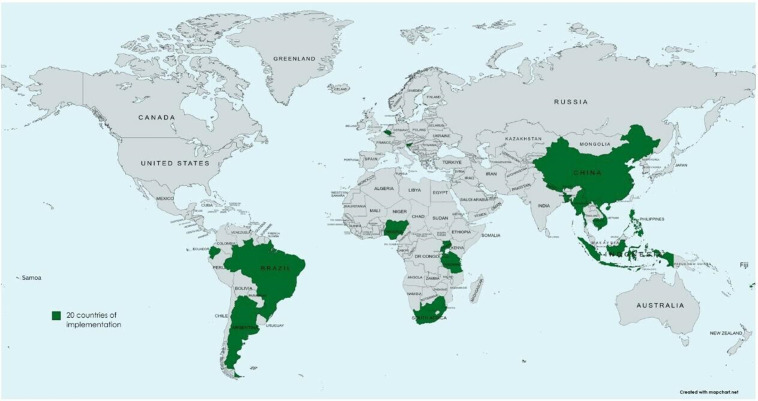
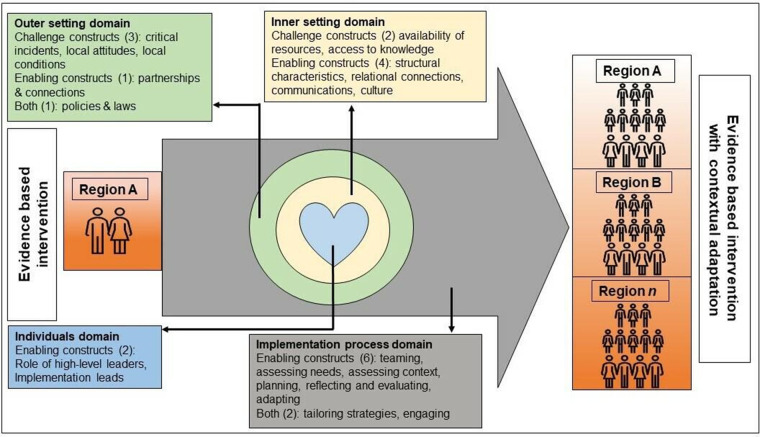
Introduction: Scaling up interventions targeting non-communicable diseases (NCDs) is a global health priority, and implementation research can contribute to that effort. In 2019, the Global Alliance for Chronic Diseases funded 27 implementation research studies to improve evidence for scaling up interventions targeting prevention and/or control of hypertension and/or diabetes in low-resource settings. We examined these studies to improve the understanding of the implementation factors, including challenges and facilitators, that influence the early implementation phase of scale-up research projects targeting NCDs. Methods: This qualitative study was undertaken between August 2020 and July 2021. 43 semi-structured interviews were conducted with project investigators, implementers and policymakers, across 19 diverse scale-up projects, being implemented in 20 countries. The transcripts were inductively, open-coded using thematic analysis. Generated themes were mapped systematically to four out of five domain categorisations of the Consolidated Framework for Implementation Research (CFIR); the innovation domain fell outside the scope of this study. Results: Highlighted findings using CFIR are: (i) outer setting: influence of politics, lack of coordination between government departments and differing agendas towards NCDs hindered implementation while reliable and trustworthy government connections proved useful; (ii) inner setting: commitment of resources for implementation was a challenge while research capacity, work culture and trustworthy networks facilitated implementation; (iii) individuals: high-level stakeholder support and leadership was essential; (iv) process: extensive time and efforts required for stakeholder engagement towards local contextualisation was challenging, while collaborating, joint reflection, effective communication and adaptation facilitated. COVID-19 provided both challenges and opportunities and these varied depending on the intervention characteristics and study objectives. Conclusion: Researchers supporting the scale-up of complex interventions targeting NCDs need to leverage on existing trusting relationships and foster equitable stakeholder partnerships through research. Interpersonal skills and good communication are essential complements to research expertise and must be considered during capacity building.
Overview
The claims and statistics of this paper haven’t been checked yet.
Free: it reads the open-access text and checks the first 5 claims that cite a source we can check. Create a free account to check every claim.
Integrity signals
Registry
Cites
Statistics
Figures
Verification
Claims the paper makes
The claims and statistics of this paper haven’t been checked yet.
Free: it reads the open-access text and checks the first 5 claims that cite a source we can check. Create a free account to check every claim.
Claims other papers make about this one
Each is checked against this paper’s own text: does it say what the citing paper says it does?
The source backs part of the claim, not all of it — or backs it for a different population, condition or comparison.
In the citing paper
“These findings are highly consistent with a qualitative study by Ramani-Chander et al. (122), which evaluated 19 noncommunicable disease (NCD) scale-up projects funded by the Global Alliance for Chronic Diseases (GACD) across 20 low-resource countries.”
From Implementation and translation of evidence-based dietary strategies for type 2 diabetes in resource-limited settings: a scoping review based on the CFIR framework (2026) · cites this paper as [122]
Experimental — accuracy not yet measuredThe cited source says what the claim attributes to it.
In the citing paper
“This aligns closely with the “local contextualization” mechanism highlighted as central to successful scale-up in Ramani-Chander et al. (122).”
The cited source says what the claim attributes to it.
In the citing paper
“Key facilitators included trusted networks, consistent communication, and contextually responsive adaptation.”
The cited source says what the claim attributes to it.
In the citing paper
“Using the CFIR framework, that study identified major barriers including outer setting factors (political influences, poor intersectoral coordination), inner setting constraints (insufficient resource investment, high staff turnover), individual-level challenges (need for sustained senior leadership support), and process-related burdens (extensive time demands for stakeholder engagement).”
Self-check
Percentages, sums and reported differences re-computed from the paper’s own numbers.
The self-check needs the paper’s full text.
Citations
Cites
Using thematic analysis in psychology
Braun, V., & Clarke, V. (2006) · Qualitative Research in Psychology · doi:10.1191/1478088706qp063oa · Cited by 194,414
The updated consolidated framework for implementation research based on user feedback
Damschroder, L. J., Reardon, C. M., Widerquist, M. A. O., & Lowery, J. (2022) · Implementation Science · doi:10.1186/s13012-022-01245-0 · Cited by 4,452
Intercoder Reliability in Qualitative Research: Debates and Practical Guidelines
O’Connor, C., & Joffe, H. (2020) · International Journal of Qualitative Methods · doi:10.1177/1609406919899220 · Cited by 3,871
Bennett, J. E., Stevens, G. A., Mathers, C. D., Bonita, R., Rehm, J., Kruk, M. E., Riley, L. M., Dain, K., Kengne, A. P., Chalkidou, K., et al. (2018) · The Lancet · doi:10.1016/s0140-6736(18)31992-5 · Cited by 1,336
Global health 2035: a world converging within a generation
Jamison, D. T., Summers, L. H., Alleyne, G., Arrow, K. J., Berkley, S., Binagwaho, A., Bustreo, F., Evans, D., Feachem, R. G. A., Frenk, J., et al. (2013) · The Lancet · doi:10.1016/s0140-6736(13)62105-4 · Cited by 1,220
Peters, D. H., Adam, T., Alonge, O., Agyepong, I. A., & Tran, N. (2014) · British Journal of Sports Medicine · doi:10.1136/bmj.f6753 · Cited by 1,109 · cited 1×
“45–47 However, this study highlighted the importance of building stakeholder networks that connect local organ-isations, communities, non-governmental organisations, private sector, health industries, food and drug industries, and different government bodies to support scale-up of interventions…”
Methods to Improve the Selection and Tailoring of Implementation Strategies
Powell, B. J., Beidas, R. S., Lewis, C. C., Aarons, G. A., McMillen, J. C., Proctor, E. K., & Mandell, D. S. (2017) · The Journal of Behavioral Health Services & Research · doi:10.1007/s11414-015-9475-6 · Cited by 967
What Makes Clinical Research in Developing Countries Ethical? The Benchmarks of Ethical Research
Emanuel, E. J., Wendler, D., Killen, J., & Grady, C. (2004) · The Journal of Infectious Diseases · doi:10.1086/381709 · Cited by 966 · cited 1×
“36 37–39 Similarly, trust between implementers and community members is essential for successful implementation.”
Allen, C., Metternicht, G., & Wiedmann, T. (2018) · Sustainability Science · doi:10.1007/s11625-018-0572-3 · Cited by 649
Understanding pathways for scaling up health services through the lens of complex adaptive systems
Paina, L., & Peters, D. H. (2012) · Health Policy and Planning · doi:10.1093/heapol/czr054 · Cited by 534
Means, A. R., Kemp, C. G., Gwayi-Chore, M.-C., Gimbel, S., Soi, C., Sherr, K., Wagenaar, B. H., Wasserheit, J. N., & Weiner, B. J. (2020) · Implementation Science · doi:10.1186/s13012-020-0977-0 · Cited by 418 · cited 1×
“33 The framework provided us with a comprehensive structure to systematically map the inductively identified challenges and facilitators faced during the early implementation phase of scaling up.”
Scaling up in international health: what are the key issues?
Mangham, L. J., & Hanson, K. (2010) · Health Policy and Planning · doi:10.1093/heapol/czp066 · Cited by 303
Improving responsiveness of health systems to non-communicable diseases
Atun, R., Jaffar, S., Nishtar, S., Knaul, F. M., Barreto, M. L., Nyirenda, M., Banatvala, N., & Piot, P. (2013) · The Lancet · doi:10.1016/s0140-6736(13)60063-x · Cited by 283
McMahon, S. A., & Winch, P. J. (2018) · BMJ Global Health · doi:10.1136/bmjgh-2018-000837 · Cited by 249
Handbook on Implementation Science
(2020) · Edward Elgar Publishing eBooks · doi:10.4337/9781788975995 · Cited by 237
Yamey, G. (2012) · Globalization and Health · doi:10.1186/1744-8603-8-11 · Cited by 218
Watkins, D. A., Msemburi, W. T., Pickersgill, S. J., Kawakatsu, Y., Gheorghe, A., Dain, K., Johansson, K. A., Said, S., Renshaw, N., Tolla, M. T., et al. (2022) · The Lancet · doi:10.1016/s0140-6736(21)02347-3 · Cited by 213
Co-production of knowledge: the future
Redman, S., Greenhalgh, T., Adedokun, L., Staniszewska, S., & Denegri, S. (2021) · BMJ · doi:10.1136/bmj.n434 · Cited by 180 · cited 1×
“34 Respectful relationships set a ‘climate of trust’ 35 and serve as a foundation for collaborative BMJ Public Health scale-up activities.”
Milat, A. J., King, L., Newson, R., Wolfenden, L., Rissel, C., Bauman, A., & Redman, S. (2014) · Health Research Policy and Systems · doi:10.1186/1478-4505-12-18 · Cited by 174
Gibson, O., Lisy, K., Davy, C., Aromataris, E., Kite, E., Lockwood, C., Riitano, D., McBride, K., & Brown, A. (2015) · Implementation Science · doi:10.1186/s13012-015-0261-x · Cited by 152
Time to deliver: report of the WHO Independent High-Level Commission on NCDs
Nishtar, S., Niinistö, S., Sirisena, M., Vázquez, T. R., Skvortsova, V. I., Rubinstein, A., Mogae, F. G., Mattila, P., Hashemi, S. H. G., Kariuki, S. K., et al. (2018) · The Lancet · doi:10.1016/s0140-6736(18)31258-3 · Cited by 134
Edwards, A., Zweigenthal, V., & Olivier, J. (2019) · Health Research Policy and Systems · doi:10.1186/s12961-019-0419-0 · Cited by 118 · cited 1×
“43 44 Our findings support the notion that networks between team members and stakeholders enhances the research team’s ability to navigate implementation challenges in the field.”
The Global Alliance for Chronic Diseases, P. E. W. G., Limbani, F., Goudge, J., Joshi, R., Maar, M. A., Miranda, J. J., Oldenburg, B. F., Parker, G., Pesantes, M. A., Riddell, M. A., et al. (2019) · BMC Public Health · doi:10.1186/s12889-019-7261-8 · Cited by 91
Self-citationChanging Mindsets: Research Capacity strengthening in low and middle-income countries
Ghaffar, A., IJsselmuiden, C., & Zicker, F. (2008) · Cited by 80
Transforming Global Health by Improving the Science of Scale-Up
Kruk, M. E., Yamey, G., Angell, S. Y., Beith, A., Cotlear, D., Guanais, F., Jacobs, L., Saxenian, H., Victora, C., & Goosby, E. (2016) · PLOS Biology · doi:10.1371/journal.pbio.1002360 · Cited by 80
Abraham, T. H., Stewart, G. L., & Solimeo, S. L. (2021) · BMC Medical Education · doi:10.1186/s12909-021-02567-1 · Cited by 80
Shared learning in an interconnected world: innovations to advance global health equity
Binagwaho, A., Nutt, C. T., Mutabazi, V., Karema, C., Nsanzimana, S., Gasana, M., Drobac, P. C., Rich, M. L., Uwaliraye, P., Nyemazi, J., et al. (2013) · Globalization and Health · doi:10.1186/1744-8603-9-37 · Cited by 65 · cited 1×
“36 57 58 The head- heart-hands model, based on the three domains of knowledge found in classical education theory, and referring to cognitive, psycho-social and psycho-motor skills can also be applied to understand the skills required by researchers for supporting meaningful engagement during…”
Rethinking research processes to strengthen co-production in low and middle income countries
Beran, D., Pesantes, M. A., Berghusen, M. C., Hennig, B. J., Jacobi, J., Lazo-Porras, M., Llanque, A., Placella, E., Robledo‐Abad, C., Tufet, M., et al. (2021) · BMJ · doi:10.1136/bmj.m4785 · Cited by 58
Self-citationNdejjo, R., Wanyenze, R. K., Nuwaha, F., Bastiaens, H., & Musinguzi, G. (2020) · Implementation Science · doi:10.1186/s13012-020-01065-0 · Cited by 54 · cited 1×
“26 40–42 These strong, trusting relationships were leveraged by researchers and operational team members, to gain access to decision-makers, secure commitments and facilitate ongoing engagement between the inner setting and the outer setting stake-holders.”
van Olmen, J., Erwin, E., García-Ulloa, A. C., Meessen, B., Miranda, J. J., Bobrow, K., Iwelunmore, J., Nwaozuru, U., Obiezu Umeh, C., Smith, C., et al. (2020) · Wellcome Open Research · doi:10.12688/wellcomeopenres.15581.2 · Cited by 51
Self-citationNigeria Implementation Science Alliance, Ezeanolue, E. E., Menson, W. N. A., Patel, D. V., Aarons, G. A., Olutola, A., Obiefune, M. C., Dakum, P., Okonkwo, P., Gobir, I. B., et al. (2018) · Health Research Policy and Systems · doi:10.1186/s12961-018-0289-x · Cited by 46 · cited 1×
“36 57 58 The head- heart-hands model, based on the three domains of knowledge found in classical education theory, and referring to cognitive, psycho-social and psycho-motor skills can also be applied to understand the skills required by researchers for supporting meaningful engagement during…”
Vanyoro, K. P., Hawkins, K., Greenall, M., Parry, H., & Keeru, L. (2019) · BMJ Global Health · doi:10.1136/bmjgh-2019-001523 · Cited by 44 · cited 1×
“49 Our findings underscore the role of interpersonal communication, negotiation and leadership skills to secure commitments and encourage policy and practice changes.”
Marten, R., Mikkelsen, B., Shao, R., Zennaro, L. D., Berdzuli, N., Fernando, T., Hammerich, A., Hennis, A. J. M., Shin, H., Shongwe, S., et al. (2020) · The Lancet Global Health · doi:10.1016/s2214-109x(20)30485-x · Cited by 37
Agyepong, I. A., Godt, S., Sombié, I., Binka, C., Okine, V., & Ingabire, M. (2021) · BMJ · doi:10.1136/bmj.n166 · Cited by 37 · cited 1×
“52–56 These critical skills are not routine in research training, so are not common among researchers.”
Conceptualization of head-heart-hands model for developing an effective 21st century teacher
Islam, M. A., Said, S. M., Umarlebbe, J. H., Sobhani, F. A., & Afrin, S. (2022) · Frontiers in Psychology · doi:10.3389/fpsyg.2022.968723 · Cited by 34
Jessani, N., Rohwer, A. C., Schmidt, B., & Delobelle, P. (2021) · Health Research Policy and Systems · doi:10.1186/s12961-021-00733-x · Cited by 32
Self-citationVerbal autopsy coding: are multiple coders better than one?
Joshi, R. (2009) · Bulletin of the World Health Organization · doi:10.2471/blt.08.051250 · Cited by 31
Self-citationSchleiff, M., Hansoti, B., Akridge, A., Dolive, C., Hausner, D., Kalbarczyk, A., Pariyo, G. W., Quinn, T. C., Rudy, S., & Bennett, S. (2020) · PLoS ONE · doi:10.1371/journal.pone.0239917 · Cited by 30
National action plans to tackle NCDs: role of stakeholder network analysis
Hunter, R. F., Wickramasinghe, K. K., Ergüder, T., Bolat, A., Arı, H. O., Yıldırım, H. H., Ursu, P., Robinson, G., Breda, J., Mikkelsen, B., et al. (2019) · BMJ · doi:10.1136/bmj.l1871 · Cited by 23 · cited 3×
“45–47 However, this study highlighted the importance of building stakeholder networks that connect local organ-isations, communities, non-governmental organisations, private sector, health industries, food and drug industries, and different government bodies to support scale-up of interventions targeted at NCDs. 48 Th…”
InfluentialDong, R., Leung, C. L., Naert, M. N., Yebei, V. N., Kiptoo, P., Matelong, W., Matini, E., Orango, V., Bloomfield, G. S., Edelman, D. E., et al. (2021) · PLoS ONE · doi:10.1371/journal.pone.0248496 · Cited by 18
Self-citationJackson-Morris, A. M., Mutungi, G. N., Maree, E., Waqanivalu, T., Marten, R., & Nugent, R. A. (2022) · BMJ Global Health · doi:10.1136/bmjgh-2021-008275 · Cited by 17
Almas, A., Awan, S., Bloomfield, G. S., Nisar, M. I., Siddiqi, S., Ahmed, A., Ali, A., Shafqat, S., Bhutta, Z. A., Mark, D. B., et al. (2022) · BMJ Open · doi:10.1136/bmjopen-2022-066460 · Cited by 17
Onwujekwe, O. E., Etiaba, E., Mbachu, C. O., Arize, I., Nwankwor, C. A., Ezenwaka, U., Okeke, C. C., Ezumah, N., & Uzochukwu, B. S. C. (2020) · PLoS ONE · doi:10.1371/journal.pone.0238365 · Cited by 16
Ramani-Chander, A., Thrift, A. G., van Olmen, J., Wouters, E., Delobelle, P., Vedanthan, R., Miranda, J. J., Sherwood, S. G., Teede, H. J., & Joshi, R. (2023) · BMJ Global Health · doi:10.1136/bmjgh-2023-012804 · Cited by 15
Self-citationFazelipour, M., & Cunningham, F. C. (2019) · International Journal for Equity in Health · doi:10.1186/s12939-019-1059-2 · Cited by 14 · cited 1×
“26 40–42 These strong, trusting relationships were leveraged by researchers and operational team members, to gain access to decision-makers, secure commitments and facilitate ongoing engagement between the inner setting and the outer setting stake-holders.”
Considerations for supporting meaningful stakeholder engagement in global mental health research
Murphy, J. (2022) · Epidemiology and Psychiatric Sciences · doi:10.1017/s204579602200035x · Cited by 14 · cited 1×
“52–56 These critical skills are not routine in research training, so are not common among researchers.”
Oni, T., Mogo, E., Ahmed, A., & Davies, J. I. (2019) · BMJ Global Health · doi:10.1136/bmjgh-2019-001717 · Cited by 13 · cited 2×
“36 57 58 The head- heart-hands model, based on the three domains of knowledge found in classical education theory, and referring to cognitive, psycho-social and psycho-motor skills can also be applied to understand the skills required by researchers for supporting meaningful engagement during…”
Firth, S., Hart, J., Reeve, M., Li, H., Mikkelsen, L., Sarmiento, C., Bo, K. S., Kwa, V., Qi, J., Yin, P., et al. (2021) · BMJ Global Health · doi:10.1136/bmjgh-2021-006760 · Cited by 12 · cited 1×
“43 44 Our findings support the notion that networks between team members and stakeholders enhances the research team’s ability to navigate implementation challenges in the field.”
Self-citationRamani-Chander, A., Joshi, R., van Olmen, J., Wouters, E., Delobelle, P., Vedanthan, R., Miranda, J. J., Oldenburg, B. F., Sherwood, S. G., Rawal, L. B., et al. (2022) · BMJ Open · doi:10.1136/bmjopen-2021-053122 · Cited by 11 · cited 1×
“This study was undertaken by members of the GACD upscaling working group 23 (see online supplemental file 1).”
Self-citation
Cited by
Ramani-Chander, A., Thrift, A. G., van Olmen, J., Wouters, E., Delobelle, P., Vedanthan, R., Miranda, J. J., Neve, J. D., Esandi, M. E., Koot, J. A. R., et al. (2024) · Health Policy and Planning · doi:10.1093/heapol/czae043 · Cited by 10
Self-citationAdaptive management in disaster crisis: Role analysis in cross-sector collaboration
Meutia, I. F., Zainal, A. G., Sujadmiko, B., Assalam, M. S., & Putri, R. A. (2025) · Jàmbá Journal of Disaster Risk Studies · doi:10.4102/jamba.v17i1.1830 · Cited by 7
Pardoel, Z., Folkertsma, I., Ramani-Chander, A., Thrift, A. G., Joshi, R., Bandurek, I., van Olmen, J., Shrestha, A., Rawal, L. B., Wouters, E., et al. (2025) · BMJ Open · doi:10.1136/bmjopen-2025-101292 · Cited by 4
“Never-theless, by focusing on projects nearing or completing scale-up, integrating our extraction tool with CFIR V.2.0 and mapping results to the WHO building blocks, we were still able to generate novel insights into systemic enablers and barriers influencing scalability and sustainability.”
InfluentialSelf-citationShrestha, A., Yang, L., Demissie, G. D., Dhital, R., Jeemon, P., Ganeshkumar, P., Gupta, S., Karmacharya, B. M., Thankappan, K. R., Oldenburg, B. F., et al. (2025) · BMJ Public Health · doi:10.1136/bmjph-2024-001371 · Cited by 3
“This might have caused overestimation or underestimation of the results.”
Shahzeb, Khan, M. A., Tariq, M., & Khan, F. (2026) · Journal for social science archives · doi:10.59075/jssa.v4i1.525 · Cited by 2
Metadata
- Authors
- Ramani-Chander, A., Thrift, A. G., van Olmen, J., Wouters, E., Delobelle, P., Vedanthan, R., Miranda, J. J., Sherwood, S., Teede, H., & Joshi, R.
- Affiliations
- Monash Health (AU)
- Department of Family Health and Population Medicine, University of Antwerp, Antwerpen, Belgium
- University of Antwerp (BE)
- Vrije Universiteit Brussel (BE)
- New York University (US)
- The University of Sydney (AU)
- Wageningen University & Research (NL)
- UNSW Sydney (AU)
- Corresponding author
- Joshi, Rohina
- ORCID
- Venue
- BMJ Public Health
- Publisher
- BMJ
- Published
- 2024-04
- Volume
- 2
- Issue
- 1
- Pages
- e000710
- ISSN
- 2753-4294 (ISSN-L)
- PMC
- PMC11812842
- OpenAlex
- W4395703795
- Cited by
- 9
- References
- 48
- Citations by year
- 2026: 3 · 2025: 5 · 2024: 1
- FWCI
- 5.29
- Type
- journal article
- Language
- en
- Open access
- diamond
- doi.org
- Licence
- Locations
- BMJ Public Health (publishedVersion, cc-by-nc)
- PubMed Central (publishedVersion, cc-by-nc)
- PubMed (publishedVersion)
- White Rose Research Online (University of Leeds, The University of Sheffield, University of York) (acceptedVersion, other-oa)
- Socio-Environmental Systems Modeling (submittedVersion, cc-by-nc)
- DOAJ (DOAJ: Directory of Open Access Journals) (submittedVersion)
- Funders
- Japan Society for the Promotion of Science (23K27814)
- Topics
- Health Sciences › Health Professions › General Health Professions › Health Policy Implementation Science
- Health Sciences › Medicine › Public Health, Environmental and Occupational Health › Global Public Health Policies and Epidemiology
- Health Sciences › Health Professions › General Health Professions › Health Sciences Research and Education
- Keywords
- scaling up interventions, non-communicable diseases, hypertension, diabetes mellitus, Consolidated Framework for Implementation Research, stakeholder engagement, research capacity building, resource-limited settings, government coordination, trust and relationships
About these checks
Registry, retraction, Cites and statistics results are computed, not judged, with one exception: a printed reference that no index lists is read once by a model before it counts as a citation error. Claims are extracted by a model and kept only when their quote appears verbatim in the text; each cited source is then checked, with a model’s help, for whether it says what the claim relies on. Those verdicts can be wrong — read the claim’s quote and the cited source before relying on one.
Statistics and arithmetic are recomputed, not judged.
Confidence bands are shown only for fields calibrated on our annotated test set. None is calibrated yet, so no band is shown.
What counts as a claim ›How we measure confidence ›How we check this ›
Are you an author, or do you see a problem with this page? Request a review
Data sources
Bibliographic data: Semantic Scholar, OpenAlex, Crossref.
Contains information from the Semantic Scholar Academic Graph Datasets, made available under the ODC Attribution License (ODC-BY 1.0).
Semantic Scholar’s data is described in: Kinney, R., et al. (2023). The Semantic Scholar Open Data Platform. arXiv:2301.10140.
