

The DOI matches its Crossref record; 126 of the 129 references it cites were found in a registry or an index.
Development of an evidence-based framework of factors contributing to patient safety incidents in hospital settings: a systematic review
Open accessAbstract
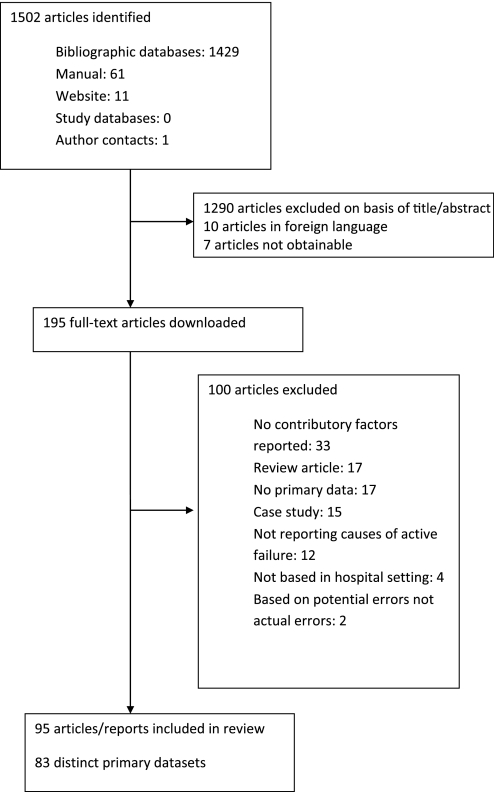
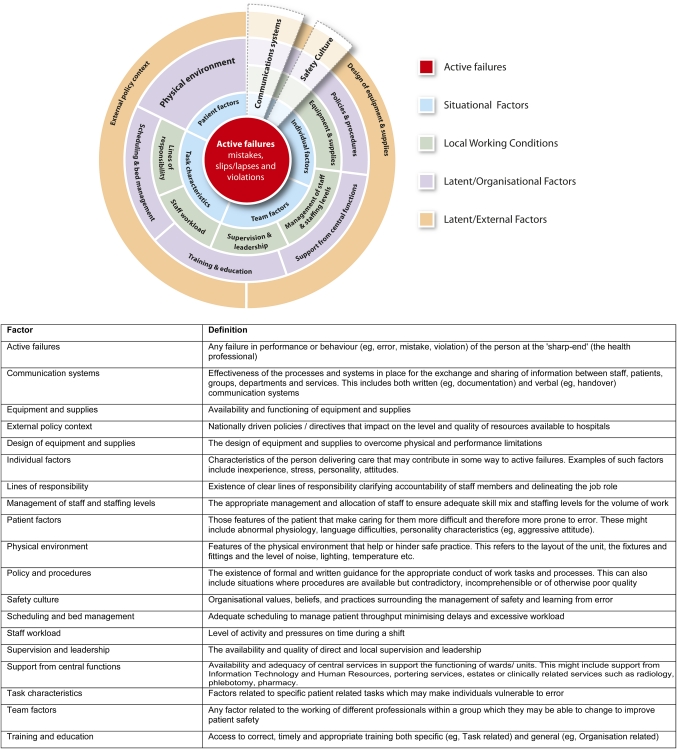
OBJECTIVE: The aim of this systematic review was to develop a 'contributory factors framework' from a synthesis of empirical work which summarises factors contributing to patient safety incidents in hospital settings. DESIGN: A mixed-methods systematic review of the literature was conducted. DATA SOURCES: Electronic databases (Medline, PsycInfo, ISI Web of knowledge, CINAHL and EMBASE), article reference lists, patient safety websites, registered study databases and author contacts. ELIGIBILITY CRITERIA: Studies were included that reported data from primary research in secondary care aiming to identify the contributory factors to error or threats to patient safety. RESULTS: 1502 potential articles were identified. 95 papers (representing 83 studies) which met the inclusion criteria were included, and 1676 contributory factors extracted. Initial coding of contributory factors by two independent reviewers resulted in 20 domains (eg, team factors, supervision and leadership). Each contributory factor was then coded by two reviewers to one of these 20 domains. The majority of studies identified active failures (errors and violations) as factors contributing to patient safety incidents. Individual factors, communication, and equipment and supplies were the other most frequently reported factors within the existing evidence base. CONCLUSIONS: This review has culminated in an empirically based framework of the factors contributing to patient safety incidents. This framework has the potential to be applied across hospital settings to improve the identification and prevention of factors that cause harm to patients.
Overview
The claims and statistics of this paper haven’t been checked yet.
Run the check — free, no account needed. It reads the open-access text and checks the sources it cites.
Integrity signals
Registry
Cites
Statistics
Figures
Verification
Claims the paper makes
The claims and statistics of this paper haven’t been checked yet.
Run the check — free, no account needed. It reads the open-access text and checks the sources it cites.
Claims other papers make about this one
Each is checked against this paper’s own text: does it say what the citing paper says it does?
The cited source says what the claim attributes to it.
In the citing paper
“For example, the social influences and environmental context and resource domains point to organisational and systems context for change and can be further elaborated, e.g. by Normalisation Process Theory [66], the Consolidated Framework For Implementation Research [67] and the Yorkshire Contributory Factors Framework [68].”
From A guide to using the Theoretical Domains Framework of behaviour change to investigate implementation problems (2017) · cites this paper as [68]
Self-check
Percentages, sums and reported differences re-computed from the paper’s own numbers.
The self-check needs the paper’s full text.
Citations
Cites
Institute of Medicine (2000) · National Academies Press eBooks · doi:10.17226/9728 · Cited by 14,390
Wall, A. (2000) · British Journal of Healthcare Management · doi:10.12968/bjhc.2000.6.9.19311 · Cited by 5,912
Human error: models and management
Reason, J. (2000) · BMJ · doi:10.1136/bmj.320.7237.768 · Cited by 5,665
Reason, J. (1990) · doi:10.1017/cbo9781139062367 · Cited by 5,108
Diagnostic error in internal medicine
Graber, M. L., Franklin, N., & Gordon, R. (2005) · Archives of Internal Medicine · doi:10.1001/archinte.165.13.1493 · Cited by 1,549
COMMITTEE ON QUALITY OF HEALTH CARE IN AMERICA
Kohn, L. T., Corrigan, J. M., & Donaldson, M. S. (2000) · Cited by 1,540
Systems Analysis of Adverse Drug Events
Leape, L. L. (1995) · JAMA: The Journal of the American Medical Association · doi:10.1001/jama.1995.03530010049034 · Cited by 1,404
Analysis of errors reported by surgeons at three teaching hospitals
Gawande, A. A., Zinner, M. J., Studdert, D. M., & Brennan, T. A. (2003) · Surgery · doi:10.1067/msy.2003.169 · Cited by 1,115
Communication Failures: An Insidious Contributor to Medical Mishaps
Sutcliffe, K. M., Lewton, E., & Rosenthal, M. M. (2004) · Academic Medicine · doi:10.1097/00001888-200402000-00019 · Cited by 1,069
Understanding adverse events: human factors.
REASON, J. T. (1995) · BMJ Quality & Safety · doi:10.1136/qshc.4.2.80 · Cited by 975
Framework for analysing risk and safety in clinical medicine
Vincent, C. A., Taylor‐Adams, S. E., & Stanhope, N. (1998) · BMJ · doi:10.1136/bmj.316.7138.1154 · Cited by 942
Rothschild, J. M., Landrigan, C. P., CRONIN, J. W., Kaushal, R., Lockley, S. W., Burdick, E., Stone, P. H., Lilly, C. M., Katz, J. T., Czeisler, C. A., et al. (2005) · Critical Care Medicine · doi:10.1097/01.ccm.0000171609.91035.bd · Cited by 925
An Analysis of Major Errors and Equipment Failures in Anesthesia Management
Cooper, J. B., Newbower, R. S., & Kitz, R. J. (1984) · Anesthesiology · doi:10.1097/00000542-198401000-00008 · Cited by 868
Factors Related to Errors in Medication Prescribing
Lesar, T. S. (1997) · JAMA · doi:10.1001/jama.1997.03540280050033 · Cited by 734
Reviewing studies with diverse designs: the development and evaluation of a new tool
Sirriyeh, R., Lawton, R., Gardner, P., & Armitage, G. (2012) · Journal of Evaluation in Clinical Practice · doi:10.1111/j.1365-2753.2011.01662.x · Cited by 715
Self-citationCauses of prescribing errors in hospital inpatients: a prospective study
Franklin, B. D., Schachter, M., Vincent, C. A., & Barber, N. (2002) · The Lancet · doi:10.1016/s0140-6736(02)08350-2 · Cited by 674
Preventable adverse drug events in hospitalized patients
Cullen, D. J., Sweitzer, B. J., Bates, D. W., Burdick, E., Edmondson, A. C., & Leape, L. L. (1997) · Critical Care Medicine · doi:10.1097/00003246-199708000-00014 · Cited by 611
Disruptions in surgical flow and their relationship to surgical errors: An exploratory investigation
Wiegmann, D. A., ElBardissi, A. W., Dearani, J. A., Daly, R. C., & Sundt, T. M. (2007) · Surgery · doi:10.1016/j.surg.2007.07.034 · Cited by 594
Adverse Sedation Events in Pediatrics: A Critical Incident Analysis of Contributing Factors
Coté, C. J., Notterman, D. A., Karl, H. W., Weinberg, J. A., & McCloskey, C. A. (2000) · PEDIATRICS · doi:10.1542/peds.105.4.805 · Cited by 582
Donaldson, L. (2002) · Clinical Medicine · doi:10.7861/clinmedicine.2-5-452 · Cited by 578
A prospective study of patient safety in the operating room
Christian, C. K., Gustafson, M. L., Roth, E. M., Sheridan, T. B., Gandhi, T. K., Dwyer, K., Zinner, M. J., & Dierks, M. (2006) · Surgery · doi:10.1016/j.surg.2005.07.037 · Cited by 514
Human factors and cardiac surgery: A multicenter study
de Leval, M. R., Carthey, J., Wright, D. J., Farewell, V. T., & REASON, J. T. (2000) · Journal of Thoracic and Cardiovascular Surgery · doi:10.1016/s0022-5223(00)70006-7 · Cited by 506
Operational Failures and Interruptions in Hospital Nursing
Tucker, A. L., & Spear, S. J. (2006) · Health Services Research · doi:10.1111/j.1475-6773.2006.00502.x · Cited by 382
Kopp, B. J., Erstad, B. L., Allen, M. E., Theodorou, A. A., & Priestley, G. (2006) · Critical Care Medicine · doi:10.1097/01.ccm.0000198106.54306.d7 · Cited by 363
Voluntary Anonymous Reporting of Medical Errors for Neonatal Intensive Care
Suresh, G., Horbar, J. D., Plsek, P. E., Gray, J., Edwards, W. H., Shiono, P. H., Ursprung, R., Nickerson, J., Lucey, J. F., Goldmann, D. A., et al. (2004) · PEDIATRICS · doi:10.1542/peds.113.6.1609 · Cited by 333
Nurses relate the contributing factors involved in medication errors
Tang, F., Sheu, S., Yu, S., Wei, I., & Chen, C. (2007) · Journal of Clinical Nursing · doi:10.1111/j.1365-2702.2005.01540.x · Cited by 331
Valentin, A., Capuzzo, M., Guidet, B., Moreno, R. P., Metnitz, B., Bauer, P., & Metnitz, P. (2009) · BMJ · doi:10.1136/bmj.b814 · Cited by 321
Errors, Incidents and Accidents in Anaesthetic Practice
Runciman, W. B., Sellen, A. J., Webb, R. K., Williamson, J., Currie, M., Morgan, C., & Russell, W. J. (1993) · Anaesthesia and Intensive Care · doi:10.1177/0310057x9302100506 · Cited by 320
Horwitz, L. I., Meredith, T., Schuur, J. D., Shah, N., Kulkarni, R. G., & Jenq, G. Y. (2008) · Annals of Emergency Medicine · doi:10.1016/j.annemergmed.2008.05.007 · Cited by 306
Exploring the Causes of Adverse Events in NHS Hospital Practice
Neale, G., Woloshynowych, M., & Vincent, C. A. (2001) · Journal of the Royal Society of Medicine · doi:10.1177/014107680109400702 · Cited by 276
Improving patient safety by identifying latent failures in successful operations
Catchpole, K. C., Giddings, A. E. B., Wilkinson, M., Hirst, G., Dale, T., & de Leval, M. R. (2007) · Surgery · doi:10.1016/j.surg.2007.01.033 · Cited by 269
Systems analysis of clinical incidents: the London protocol
Taylor‐Adams, S. E., & Vincent, C. A. (2004) · Clinical Risk · doi:10.1258/1356262042368255 · Cited by 267
Iatrogenic complications in adult intensive care units
Giraud, T., Dhainaut, J.-F., Vaxelaire, J. F., Joseph, T., Journois, D., Bleichner, G., Sollet, J.-P., Chevret, S., & Monsallier, J.-F. (1993) · Critical Care Medicine · doi:10.1097/00003246-199301000-00011 · Cited by 250
Chassin, M. R., & Becher, E. C. (2002) · Annals of Internal Medicine · doi:10.7326/0003-4819-136-11-200206040-00012 · Cited by 249
Gaba, D. M. (2000) · California Management Review · doi:10.2307/41166067 · Cited by 246
Vincent, C. A. (2010) · Wiley eBooks · doi:10.1002/9781444323856 · Cited by 244
Leading organisational learning in health care
Carroll, J. S. (2002) · BMJ Quality & Safety · doi:10.1136/qhc.11.1.51 · Cited by 240
Analysis of demographic characteristics.
Jorm, C., & Strunin, L. (1994) · PubMed · Cited by 235
Taylor, D. (2007) · Cited by 234
Human Failure: An Analysis of 2000 Incident Reports
Williamson, J., Webb, R. K., Sellen, A. J., Runciman, W. B., & WALT, J. H. V. D. (1993) · Anaesthesia and Intensive Care · doi:10.1177/0310057x9302100534 · Cited by 232
The Veterans Affairs Root Cause Analysis System in Action
Bagian, J. P., Gosbee, J. W., Lee, C. Z., Williams, L. C., McKnight, S. D., & Mannos, D. M. (2002) · The Joint Commission Journal on Quality Improvement · doi:10.1016/s1070-3241(02)28057-8 · Cited by 231
The human factor in cardiac surgery: errors and near misses in a high technology medical domain
Carthey, J., de Leval, M. R., & REASON, J. T. (2001) · The Annals of Thoracic Surgery · doi:10.1016/s0003-4975(00)02592-3 · Cited by 224
ElBardissi, A. W., Wiegmann, D. A., Dearani, J. A., Daly, R. C., & Sundt, T. M. (2007) · The Annals of Thoracic Surgery · doi:10.1016/j.athoracsur.2006.11.002 · Cited by 200
ICU incident reporting systems
Wu, A. W., Pronovost, P. J., & Morlock, L. (2002) · Journal of Critical Care · doi:10.1053/jcrc.2002.35100 · Cited by 186
The Frequency and Potential Causes of Dispensing Errors in a Hospital Pharmacy
Beso, A., Franklin, B. D., & Barber, N. (2005) · Pharmacy World & Science · doi:10.1007/s11096-004-2270-8 · Cited by 184
Identification of systems failures in successful paediatric cardiac surgery
Catchpole, K. C., Giddings, A. E. B., de Leval, M. R., Peek, G. J., Godden, P., Utley, M., Gallivan, S., Hirst, G., & Dale, T. (2006) · Ergonomics · doi:10.1080/00140130600568865 · Cited by 183
Nursing and patient safety in the operating room
Alfredsdottir, H., & Björnsdóttir, K. (2007) · Journal of Advanced Nursing · doi:10.1111/j.1365-2648.2007.04462.x · Cited by 171
Beckmann, U., Bohringer, C. H., Carless, R., Gillies, D. M., Runciman, W. B., Wu, A. W., & Pronovost, P. J. (2003) · Critical Care Medicine · doi:10.1097/01.ccm.0000060016.21525.3c · Cited by 168
Identification and classification of the causes of events in transfusion medicine
Kaplan, H., Battles, J. B., van der Schaaf, T. W., Shea, C., & Mercer, S. Q. (1998) · Transfusion · doi:10.1046/j.1537-2995.1998.38111299056319.x · Cited by 166
Sanghera, I., Franklin, B. D., & Dhillon, S. (2006) · Anaesthesia · doi:10.1111/j.1365-2044.2006.04858.x · Cited by 162
Incident Reporting and Patient Safety
Vincent, C. (2007) · BMJ · doi:10.1136/bmj.39071.441609.80 · Cited by 161
Wolf, Z. R., Hicks, R. W., & Serembus, J. F. (2006) · Journal of Professional Nursing · doi:10.1016/j.profnurs.2005.12.008 · Cited by 159
Dornan, T., Ashcroft, D. M., Heathfield, H., Lewis, P., Miles, J. D., Taylor, D. R., Tully, M. P., & Wass, V. (2009) · Research Explorer (The University of Manchester) · Cited by 153
Why do interns make prescribing errors? A qualitative study
Coombes, I., Stowasser, D. A., Coombes, J. A., & Mitchell, C. (2008) · The Medical Journal of Australia · doi:10.5694/j.1326-5377.2008.tb01529.x · Cited by 152
Adverse Events in New Zealand Public Hospitals: Principal Findings from a National Survey
Davis, P. B., Lay‐Yee, R., Briant, R., Schug, S. A., Scott, A., Johson, S., & Bingley, W. (2003) · UWA Profiles and Research Repository (UWA) · Cited by 149
Barach, P. R., Johnson, J. K., Ahmad, A., Galvan, C., Bognár, A., DUNCAN, R. C., Starr, J. P., & BACHA, E. A. (2008) · Journal of Thoracic and Cardiovascular Surgery · doi:10.1016/j.jtcvs.2008.03.071 · Cited by 147
Human error, not communication and systems, underlies surgical complications
Fabri, P. J., & Zayas‐Castro, J. L. (2008) · Surgery · doi:10.1016/j.surg.2008.06.011 · Cited by 146
The frustrating case of incident-reporting systems
Shojania, K. G. (2008) · BMJ Quality & Safety · doi:10.1136/qshc.2008.029496 · Cited by 145
Observational study of potential risk factors of medication administration errors
Tissot, E., Cornette, C., Limat, S., Jl, M., Becker, M., Etievent, J.-P., Dupond, J. L., Jacquet, M., & Woronoff-Lemsi, M.-C. (2003) · Pharmacy World & Science · doi:10.1023/b:phar.0000006519.44483.a0 · Cited by 144
Learning from errors in nursing practice
Meurier, C., Vincent, C. A., & Parmar, D. G. (1997) · Journal of Advanced Nursing · doi:10.1046/j.1365-2648.1997.1997026111.x · Cited by 138
Errors of Diagnosis in Pediatric Practice: A Multisite Survey
Singh, H., Thomas, E. J., Wilson, L., Kelly, P. A., Pietz, K., Elkeeb, D., & Singhal, G. (2010) · PEDIATRICS · doi:10.1542/peds.2009-3218 · Cited by 137
Adverse occurrences in intensive care units
Abramson, N. S. (1980) · JAMA · doi:10.1001/jama.244.14.1582 · Cited by 134
Tucker, A. L., Singer, S. J., Hayes, J. E., & Falwell, A. (2008) · Health Services Research · doi:10.1111/j.1475-6773.2008.00868.x · Cited by 129
Critical incident reporting in the intensive care unit
Buckley, T., Short, T. G., Rowbottom, Y. M., & Oh, T. E. (1997) · Anaesthesia · doi:10.1111/j.1365-2044.1997.094-az0085.x · Cited by 128
Critical incidents in the intensive therapy unit
Wright, D., Mackenzie, S. J., Buchan, I. E., Cairns, C., & Price, L. (1991) · The Lancet · doi:10.1016/0140-6736(91)91243-n · Cited by 126
Beckmann, U., Baldwin, I., Hart, G. K., Runciman, W. B., & Intensive Care Units participating in the AIMS-ICU project (1996) · Anaesthesia and Intensive Care · doi:10.1177/0310057x9602400304 · Cited by 126
Adverse Occurrences in Intensive Care Units
Abramson, N. S. (1980) · JAMA · doi:10.1001/jama.1980.03310140040027 · Cited by 125
Reporting of near‐miss events for transfusion medicine: improving transfusion safety
Callum, J. L., Kaplan, H. S., Merkley, L. L., Pinkerton, P. H., Fastman, B. R., Romans, R. A., Coovadia, A. S., & Reis, M. D. (2001) · Transfusion · doi:10.1046/j.1537-2995.2001.41101204.x · Cited by 121
Beckmann, U., West, L. F., Groombridge, G. J., Baldwin, I., Hart, G., Clayton, D. G., Webb, R. K., Runciman, W. B., & Intensive Care Units participating in the AIMS-ICU project (1996) · Anaesthesia and Intensive Care · doi:10.1177/0310057x9602400303 · Cited by 115
Team Training and Resource Management in Health Care: Current Issues and Future Directions
Musson, D. M., & Helmreich, R. L. (2004) · Cited by 111
Adverse Events Detected by Clinical Surveillance on an Obstetric Service
Forster, A. J., Fung, I. N., Caughey, S., Oppenheimer, L. W., Beach, C., Shojania, K. G., & van Walraven, C. (2006) · Obstetrics and Gynecology · doi:10.1097/01.aog.0000242565.28432.7c · Cited by 105
Nursing Student Medication Errors: A Retrospective Review
Harding, L., & Petrick, T. (2008) · Journal of Nursing Education · doi:10.3928/01484834-20080101-05 · Cited by 105
Electronic reporting to improve patient safety
Tuttle, D. J. (2004) · BMJ Quality & Safety · doi:10.1136/qhc.13.4.281 · Cited by 102
EDITORIAL: Why should we report adverse incidents?
Leape, L. L. (1999) · Journal of Evaluation in Clinical Practice · doi:10.1046/j.1365-2753.1999.00162.x · Cited by 97
Frey, B., Kehrer, B. H., Losa, M., Braun, H., Berweger, L., Micallef, J., & Ebenberger, M. (2000) · Intensive Care Medicine · doi:10.1007/s001340050014 · Cited by 96
Equipment Failure: An Analysis of 2000 Incident Reports
Webb, R. K., Russell, W. J., Klepper, I. D., & Runciman, W. B. (1993) · Anaesthesia and Intensive Care · doi:10.1177/0310057x9302100533 · Cited by 94
Silén‐Lipponen, M., Tossavainen, K., Turunen, H. E., & Smith, A. (2004) · International Journal of Nursing Practice · doi:10.1111/j.1440-172x.2005.00494.x · Cited by 91
Parker, S., Laviana, A. A., Wadhera, R. K., Wiegmann, D. A., & Sundt, T. M. (2009) · World Journal of Surgery · doi:10.1007/s00268-009-0312-z · Cited by 88
The development of an incident analysis tool for the medical field
Vuuren, V. W. W., Shea, C., & Schaaf, V. D. T. T. (1997) · TU/e Research Portal · Cited by 83
Exploring the causes of adverse events in hospitals and potential prevention strategies
Smits, M., Zegers, M., Groenewegen, P., Timmermans, D. R. M., Zwaan, L., van der Wal, G., & Wagner, C. (2010) · BMJ Quality & Safety · doi:10.1136/qshc.2008.030726 · Cited by 80
A Method for Measuring System Safety and Latent Errors Associated with Pediatric Procedural Sedation
Blike, G. T., Christoffersen, K., Cravero, J. P., Andeweg, S. K., & Jensen, J. S. (2005) · Anesthesia & Analgesia · doi:10.1213/01.ane.0000152614.57997.6c · Cited by 77
Identification and characterization of errors and incidents in a medical intensive care unit
Graf, J., Driesch, A. V. D., Koch, K. ‐., & Janssens, U. (2005) · Acta Anaesthesiologica Scandinavica · doi:10.1111/j.1399-6576.2005.00731.x · Cited by 74
Needham, D. M., Thompson, D. A., Holzmueller, C. G., Dorman, T., Lubomski, L. H., Wu, A. W., Morlock, L., & Pronovost, P. J. (2004) · Critical Care Medicine · doi:10.1097/01.ccm.0000145230.52725.6c · Cited by 72
Creating the Web-based Intensive Care Unit Safety Reporting System
Holzmueller, C. G. (2004) · Journal of the American Medical Informatics Association · doi:10.1197/jamia.m1408 · Cited by 71
Preventable in-hospital medical injury under the "no fault" system in New Zealand
Davis, P. B. (2003) · BMJ Quality & Safety · doi:10.1136/qhc.12.4.251 · Cited by 71
The nature and causes of unintended events reported at ten emergency departments
Smits, M., Groenewegen, P. P., Timmermans, D. R., van der Wal, G., & Wagner, C. (2009) · BMC Emergency Medicine · doi:10.1186/1471-227x-9-16 · Cited by 66
Improvements in anaesthetic care resulting from a critical incident reporting programme
Short, T. G., O'REGAN, A., JAYASURIYA, J. P., ROWBOTTOM, M., Buckley, T., & Oh, T. E. (1996) · Anaesthesia · doi:10.1111/j.1365-2044.1996.tb04641.x · Cited by 60
A Prospective Survey of Anaesthetic Critical Events in a Teaching Hospital
Currie, M. (1989) · Anaesthesia and Intensive Care · doi:10.1177/0310057x8901700402 · Cited by 57
A human factors approach to understanding patient safety during pediatric cardiac surgery
Galvan, C., BACHA, E. A., Mohr, J. J., & Barach, P. R. (2005) · Progress in Pediatric Cardiology · doi:10.1016/j.ppedcard.2004.12.001 · Cited by 55
A system factors analysis of “line, tube, and drain” incidents in the intensive care unit*
Needham, D. M., Sinopoli, D. J., Thompson, D. A., Holzmueller, C. G., Dorman, T., Lubomski, L. H., Wu, A. W., Morlock, L., Makary, M. A., & Pronovost, P. J. (2005) · Critical Care Medicine · doi:10.1097/01.ccm.0000171205.73728.81 · Cited by 54
Khan, F. A., & Hoda, M. Q. (2001) · Anaesthesia · doi:10.1046/j.1365-2044.2001.01528-3.x · Cited by 54
Factors Associated With Reintubation in Intensive Care
Beckmann, U., & Gillies, D. M. (2001) · CHEST Journal · doi:10.1378/chest.120.2.538 · Cited by 48
Incidence of medical error and adverse outcomes on a pediatric general surgery service
Proctor, M. L., Pastore, J., Gerstle, J. T., & Langer, J. C. (2003) · Journal of Pediatric Surgery · doi:10.1016/s0022-3468(03)00396-8 · Cited by 47
Causes and management of nursing practice errors: a questionnaire survey of hospital nurses in Iran
Anoosheh, M., Ahmadi, F., Faghihzadeh, S., & Vaismoradi, M. (2008) · International Nursing Review · doi:10.1111/j.1466-7657.2008.00623.x · Cited by 47
Effects of technological interventions on the safety of a medication-use system
Skibinski, K. A., White, B. A., Lin, L. I., Dong, Y., & Wu, W. (2006) · American Journal of Health-System Pharmacy · doi:10.2146/ajhp060060 · Cited by 46
Assessing system failures in operating rooms and intensive care units
van Beuzekom, M., Akerboom, S., & Boer, F. (2007) · BMJ Quality & Safety · doi:10.1136/qshc.2005.015446 · Cited by 44
Lundy, D., Laspina, S., Kaplan, H., Fastman, B. R., & Lawlor, E. (2007) · Vox Sanguinis · doi:10.1111/j.1423-0410.2006.00885.x · Cited by 44
Smits, M., Janssen, J. C. J. A., de Vet, R., Zwaan, L., Timmermans, D. R. M., Groenewegen, P., & Wagner, C. (2009) · International Journal for Quality in Health Care · doi:10.1093/intqhc/mzp023 · Cited by 43
Improving the quality of drug error reporting
Armitage, G., Newell, R., & Wright, J. (2010) · Journal of Evaluation in Clinical Practice · doi:10.1111/j.1365-2753.2009.01293.x · Cited by 42
Self-citationCharuluxananan, S., Suraseranivongse, S., Jantorn, P., Sriraj, W., Chanchayanon, T., Tanudsintum, S., Kusumaphanyo, C., Suratsunya, T., Poajanasupawun, S., Klanarong, S., et al. (2007) · PubMed · Cited by 41
Pediatric Safety Incidents From an Intensive Care Reporting System
Skapik, J. L., Pronovost, P. J., Miller, M. R., Thompson, D. A., & Wu, A. W. (2009) · Journal of Patient Safety · doi:10.1097/pts.0b013e3181a70c68 · Cited by 40
Classification and analysis of incidents in complex medical environments.
Dk, B., & Dj, W. (2000) · PubMed · Cited by 38
Nast, P. A., Avidan, M. S., Harris, C. B., Krauss, M. J., Jacobsohn, E., Petlin, A., Dunagan, W. C., & Fraser, V. J. (2005) · Journal of Thoracic and Cardiovascular Surgery · doi:10.1016/j.jtcvs.2005.06.003 · Cited by 37
Galletly, D. C., & Mushet, N. (1991) · Anaesthesia and Intensive Care · doi:10.1177/0310057x9101900112 · Cited by 37
Prospective assessment of intraoperative precursor events during cardiac surgery☆
Wong, D., Salm, T. J. V., Ali, I. S., Agnihotri, A. K., Bohmer, R. M. J., & Torchiana, D. F. (2006) · European Journal of Cardio-Thoracic Surgery · doi:10.1016/j.ejcts.2006.01.001 · Cited by 35
Contributing factors identified by hospital incident report narratives
Nuckols, T. K., Bell, D. S., Paddock, S. M., & Hilborne, L. H. (2008) · BMJ Quality & Safety · doi:10.1136/qshc.2007.023721 · Cited by 34
Using In Situ Simulation to Identify and Resolve Latent Environmental Threats to Patient Safety
Hamman, W. R., Beaudin-Seiler, B. M., Beaubien, J. M., Gullickson, A. M., Gross, A. C., Orizondo-Korotko, K., Fuqua, W., & Lammers, R. L. (2009) · Journal of Patient Safety · doi:10.1097/pts.0b013e3181b35e6c · Cited by 33
Application of Human Reliability Analysis to Nursing Errors in Hospitals
Inoue, K., & Koizumi, A. (2004) · Risk Analysis · doi:10.1111/j.0272-4332.2004.00542.x · Cited by 33
Organisational failures in urgent and emergency surgeryA potential peri‐operative risk factor
Pearse, R. M., Dana, E. C., Lanigan, C., & Pook, J. A. R. (2001) · Anaesthesia · doi:10.1046/j.1365-2044.2001.01374-4.x · Cited by 32
The epistemology of patient safety research
Runciman, W. B., Baker, G. R., Michel, P., Larizgoitia, I., Lilford, R. J., Andermann, A. A. J., Flin, R. H., & Weeks, W. B. (2008) · International Journal of Evidence-Based Healthcare · doi:10.1097/01258363-200812000-00008 · Cited by 31
Ohsaka, A., Kobayashi, M., & Abe, K. (2008) · Transfusion Medicine · doi:10.1111/j.1365-3148.2008.00868.x · Cited by 30
Sinopoli, D. J., Needham, D. M., Thompson, D. A., Holzmueller, C. G., Dorman, T., Lubomski, L. H., Wu, A. W., Morlock, L., Makary, M. A., & Pronovost, P. J. (2007) · Journal of Critical Care · doi:10.1016/j.jcrc.2006.11.002 · Cited by 28
Systems Factors in the Reporting of Serious Medication Errors in Hospitals
Crawford, S. Y., Cohen, M. R., & Tafesse, E. (2003) · Journal of Medical Systems · doi:10.1023/a:1025985832133 · Cited by 27
A Prospective Survey of Anaesthetic Critical Events a Report on a Pilot Study of 88 Cases
Currie, M., Pybus, D. A., & Torda, T. A. (1988) · Anaesthesia and Intensive Care · doi:10.1177/0310057x8801600136 · Cited by 21
Comparing Process- and Outcome-Oriented Approaches to Voluntary Incident Reporting in Two Hospitals
Nuckols, T. K., Bell, D. S., Paddock, S. M., & Hilborne, L. H. (2009) · The Joint Commission Journal on Quality and Patient Safety · doi:10.1016/s1553-7250(09)35018-7 · Cited by 16
Contribution of patient and hospital characteristics to adverse patient incidents.
Elnicki, R. A., & Schmitt, J. P. (1980) · PubMed Central · Cited by 15
Ahmad, I., Thompson, A., Frawley, M., Hu, P., Heffernan, A. M., & Power, C. K. (2010) · Irish Journal of Medical Science (1971 -) · doi:10.1007/s11845-010-0482-6 · Cited by 13
Kusumaphanyo, C., Charuluxananan, S., Sriramatr, D., Pulnitiporn, A., & Sriraj, W. (2009) · PubMed · Cited by 13
Cronin, C. M. G. (2006) · Healthcare Quarterly · doi:10.12927/hcq.2006.18449 · Cited by 11
An engineered solution to the maladministration of spinal injections
Lawton, R., Gardner, P. H., Green, B., Davey, C., Chamberlain, P., Phillips, P., & Hughes, G. (2009) · BMJ Quality & Safety · doi:10.1136/qshc.2007.025767 · Cited by 11
Self-citationKlanarong, S., Chau-In, W., Pulnitiporn, A., & Pengpol, W. (2005) · PubMed · Cited by 11
Preventable Mix-ups of Tuberculin and Vaccines
Chang, S., Pool, V., O’Connell, K., Polder, J. A., Iskander, J., Sweeney, C., Ball, R., & Braun, M. M. (2008) · Drug Safety · doi:10.2165/00002018-200831110-00007 · Cited by 9
Nursing faults in the recovery period of surgical patients
Chianca, T. C. M. (2006) · Revista Latino-Americana de Enfermagem · doi:10.1590/s0104-11692006000600008 · Cited by 7
HALOTHANE CONCENTRATION DOES NOT ALTER THE THRESHOLD FOR EPINEPHRINE-INDUCED ARRHYTHMIAS IN DOGS
Metz, S., & Maze, M. (1984) · Anesthesiology · doi:10.1097/00000542-198409001-00034 · Cited by 5
Sintavanuruk, K., Rodanant, O., Kositanurit, I., Akavipat, P., Pulnitiporn, A., & Sriraj, W. (2008) · PubMed · Cited by 4
Morita, K. (2004) · The Kurume Medical Journal · doi:10.2739/kurumemedj.51.151 · Cited by 2
Research works printed but not linked: 5
- 10.1111/j.1744-1609.2008.00117.x · DOI
- Itoh K Andersen HB . Causes of medical errors as perceived by patients and healthcare staff. In: Aven T Vinnem JE , eds. Risk, Reliability and Societal Safety. Oxford: Taylor & Francis, 2007:179–85.
- 10.1111/j.1365-2044.1996.tb07841.x · DOI
- 10.1136/qshc.2003.009100 · DOI
- Watt I Birks Y Entwistle V . A Review of Strategies to Promote Patient Involvement, a Study to Explore Patient's Views and Attitudes and a Pilot Study to Evaluate the Acceptability of Selected Patient Involvement Strategies. York: University of York, 2009.
Cited by
Sorted by citations
Atkins, L., Francis, J., Islam, R., O’Connor, D., Patey, A., Ivers, N., Foy, R., Duncan, E. M., Colquhoun, H., Grimshaw, J. M., et al. (2017) · Implementation Science · doi:10.1186/s13012-017-0605-9 · Cited by 3,819
“by Normalisation Process Theory [66], the Consolidated Framework For Implementation Research [67] and the Yorkshire Contributory Factors Framework [68].”
Self-citationHolden, R. J., Carayon, P., Gurses, A. P., Hoonakker, P., Hundt, A. S., Ozok, A. A., & Rivera-Rodriguez, A. J. (2013) · Ergonomics · doi:10.1080/00140139.2013.838643 · Cited by 1,221
Patient complaints in healthcare systems: a systematic review and coding taxonomy
Reader, T. W., Gillespie, A., & Roberts, J. (2014) · BMJ Quality & Safety · doi:10.1136/bmjqs-2013-002437 · Cited by 446
Quantifying drivers of antibiotic resistance in humans: a systematic review
Chatterjee, A., Modarai, M., Naylor, N. R., Boyd, S. E., Atun, R. A., Barlow, J. G., Holmes, A. H., Johnson, A. P., & Robotham, J. V. (2018) · The Lancet Infectious Diseases · doi:10.1016/s1473-3099(18)30296-2 · Cited by 388
Torrens, C., Campbell, P., Hoskins, G., Strachan, H., Wells, M., Cunningham, M., Bottone, H., Polson, R., & Maxwell, M. (2019) · International Journal of Nursing Studies · doi:10.1016/j.ijnurstu.2019.103443 · Cited by 317
Metadata
- Authors
- Lawton, R., McEachan, R. R. C., Giles, S. J., Sirriyeh, R., Watt, I. S., & Wright, J.
- Affiliations
- University of Leeds (GB)
- Bradford Royal Infirmary (GB)
- University of York (GB)
- Corresponding author
- Lawton, Rebecca
- Venue
- BMJ Quality & Safety
- Publisher
- BMJ
- Published
- 2012-03-15
- Volume
- 21
- Issue
- 5
- Pages
- 369-380
- ISSN
- 1475-3898 (ISSN-L)
- 2044-5415
- 2044-5423
- PMC
- PMC3332004
- OpenAlex
- W2164086521
- Cited by
- 311
- References
- 129
- Citations by year
- 2026: 13 · 2025: 14 · 2024: 16 · 2023: 21 · 2022: 21 · 2021: 34 · 2020: 24 · 2019: 31 · 2018: 28 · 2017: 19 · 2016: 24 · 2015: 27 · 2014: 23 · 2013: 15
- FWCI
- 5.26
- Type
- journal article
- Language
- en
- Open access
- hybrid
- doi.org
- Licence
- cc-by-nc
- Locations
- BMJ Quality & Safety (publishedVersion, cc-by-nc)
- Europe PMC (PubMed Central) (publishedVersion, cc-by-nc)
- PubMed Central (publishedVersion, cc-by-nc)
- PubMed (publishedVersion)
- White Rose Research Online (University of Leeds, The University of Sheffield, University of York) (acceptedVersion)
- Research Explorer (The University of Manchester) (submittedVersion, cc-by-nc)
- Funders
- National Institute for Health and Care Research (RP-PG-0108-10049)
- Programme Grants for Applied Research (RP-PG-0108-10049)
- Topics
- Health Sciences › Medicine › Public Health, Environmental and Occupational Health › Patient Safety and Medication Errors
- Health Sciences › Nursing › Leadership and Management › Hospital Admissions and Outcomes
- Health Sciences › Medicine › Public Health, Environmental and Occupational Health › Healthcare Quality and Management
- Keywords
- patient safety incidents, hospital errors, active failures, team factors, communication, patient harm prevention, secondary care
- MeSH terms
- Data Interpretation, Statistical, Hospitals, Humans, Quality Assurance, Health Care, Databases, Bibliographic, Adverse Drug Reaction Reporting Systems, Medical Errors, Empirical Research, Evidence-Based Practice, Root Cause Analysis, Patient Safety
About these checks
Registry, retraction, Cites and statistics results are computed, not judged, with one exception: a printed reference that no index lists is read once by a model before it counts as a citation error. Claims are extracted by a model and kept only when their quote appears verbatim in the text; each cited source is then checked, with a model’s help, for whether it says what the claim relies on. Those verdicts can be wrong — read the claim’s quote and the cited source before relying on one.
Statistics and arithmetic are recomputed, not judged.
Confidence bands are shown only for fields calibrated on our annotated test set. None is calibrated yet, so no band is shown.
What counts as a claim ›How we measure confidence ›How we check this ›
Are you an author, or do you see a problem with this page? Request a review
