

The DOI matches its Crossref record; 126 of the 129 references it cites were found in a registry or an index.
Development of an evidence-based framework of factors contributing to patient safety incidents in hospital settings: a systematic review
Open accessAbstract
OBJECTIVE: The aim of this systematic review was to develop a 'contributory factors framework' from a synthesis of empirical work which summarises factors contributing to patient safety incidents in hospital settings. DESIGN: A mixed-methods systematic review of the literature was conducted. DATA SOURCES: Electronic databases (Medline, PsycInfo, ISI Web of knowledge, CINAHL and EMBASE), article reference lists, patient safety websites, registered study databases and author contacts. ELIGIBILITY CRITERIA: Studies were included that reported data from primary research in secondary care aiming to identify the contributory factors to error or threats to patient safety. RESULTS: 1502 potential articles were identified. 95 papers (representing 83 studies) which met the inclusion criteria were included, and 1676 contributory factors extracted. Initial coding of contributory factors by two independent reviewers resulted in 20 domains (eg, team factors, supervision and leadership). Each contributory factor was then coded by two reviewers to one of these 20 domains. The majority of studies identified active failures (errors and violations) as factors contributing to patient safety incidents. Individual factors, communication, and equipment and supplies were the other most frequently reported factors within the existing evidence base. CONCLUSIONS: This review has culminated in an empirically based framework of the factors contributing to patient safety incidents. This framework has the potential to be applied across hospital settings to improve the identification and prevention of factors that cause harm to patients.
Overview
The claims and statistics of this paper haven’t been checked yet.
Run the check — free, no account needed. It reads the open-access text and checks the sources it cites.
Integrity signals
Registry
Cites
Statistics
Figures
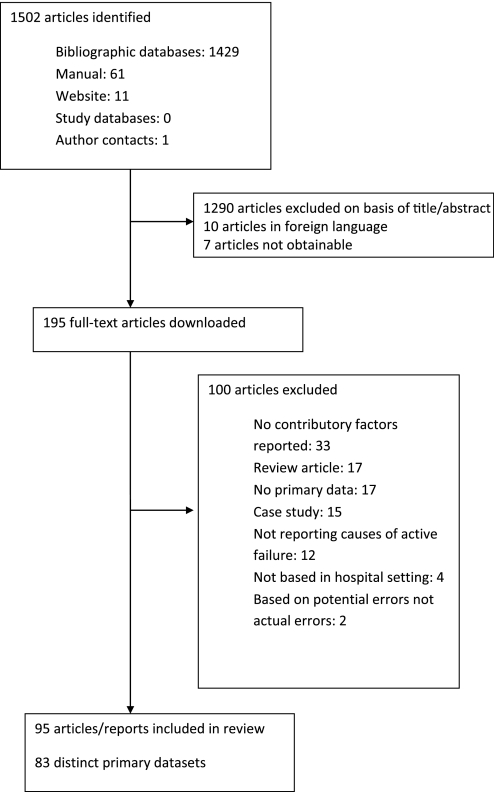
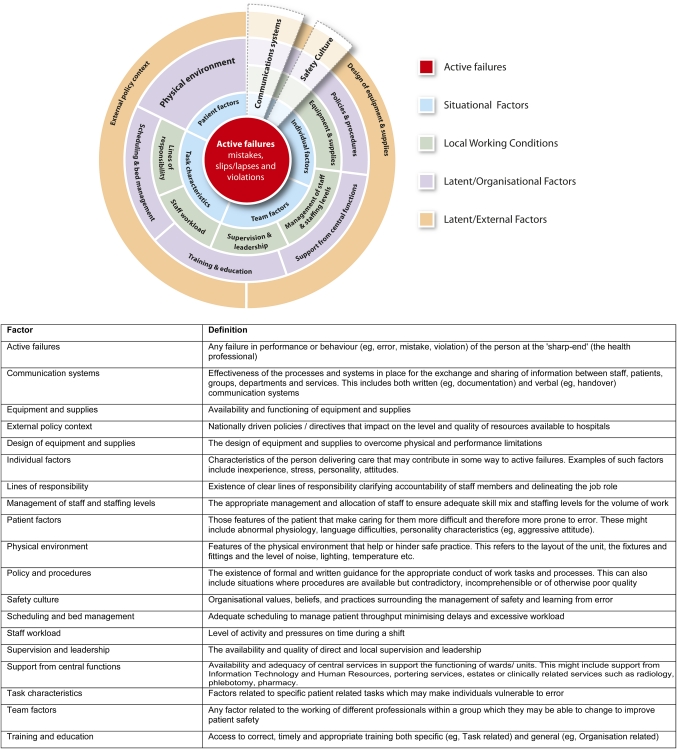
Verification
Claims the paper makes
The claims and statistics of this paper haven’t been checked yet.
Run the check — free, no account needed. It reads the open-access text and checks the sources it cites.
Claims other papers make about this one
Each is checked against this paper’s own text: does it say what the citing paper says it does?
The cited source says what the claim attributes to it.
In the citing paper
“For example, the social influences and environmental context and resource domains point to organisational and systems context for change and can be further elaborated, e.g. by Normalisation Process Theory [66], the Consolidated Framework For Implementation Research [67] and the Yorkshire Contributory Factors Framework [68].”
From A guide to using the Theoretical Domains Framework of behaviour change to investigate implementation problems (2017) · cites this paper as [68]
Self-check
Percentages, sums and reported differences re-computed from the paper’s own numbers.
The self-check needs the paper’s full text.
Citations
Cites
Institute of Medicine (2000) · National Academies Press eBooks · doi:10.17226/9728 · Cited by 14,390
Wall, A. (2000) · British Journal of Healthcare Management · doi:10.12968/bjhc.2000.6.9.19311 · Cited by 5,912
Human error: models and management
Reason, J. (2000) · BMJ · doi:10.1136/bmj.320.7237.768 · Cited by 5,665
Reason, J. (1990) · doi:10.1017/cbo9781139062367 · Cited by 5,108
Diagnostic error in internal medicine
Graber, M. L., Franklin, N., & Gordon, R. (2005) · Archives of Internal Medicine · doi:10.1001/archinte.165.13.1493 · Cited by 1,549
COMMITTEE ON QUALITY OF HEALTH CARE IN AMERICA
Kohn, L. T., Corrigan, J. M., & Donaldson, M. S. (2000) · Cited by 1,540
Systems Analysis of Adverse Drug Events
Leape, L. L. (1995) · JAMA: The Journal of the American Medical Association · doi:10.1001/jama.1995.03530010049034 · Cited by 1,404
Analysis of errors reported by surgeons at three teaching hospitals
Gawande, A. A., Zinner, M. J., Studdert, D. M., & Brennan, T. A. (2003) · Surgery · doi:10.1067/msy.2003.169 · Cited by 1,115
Communication Failures: An Insidious Contributor to Medical Mishaps
Sutcliffe, K. M., Lewton, E., & Rosenthal, M. M. (2004) · Academic Medicine · doi:10.1097/00001888-200402000-00019 · Cited by 1,069
Understanding adverse events: human factors.
REASON, J. T. (1995) · BMJ Quality & Safety · doi:10.1136/qshc.4.2.80 · Cited by 975
Research works printed but not linked: 5
- 10.1111/j.1744-1609.2008.00117.x · DOI
- Itoh K Andersen HB . Causes of medical errors as perceived by patients and healthcare staff. In: Aven T Vinnem JE , eds. Risk, Reliability and Societal Safety. Oxford: Taylor & Francis, 2007:179–85.
- 10.1111/j.1365-2044.1996.tb07841.x · DOI
- 10.1136/qshc.2003.009100 · DOI
- Watt I Birks Y Entwistle V . A Review of Strategies to Promote Patient Involvement, a Study to Explore Patient's Views and Attitudes and a Pilot Study to Evaluate the Acceptability of Selected Patient Involvement Strategies. York: University of York, 2009.
Cited by
Sorted by citations
Atkins, L., Francis, J., Islam, R., O’Connor, D., Patey, A., Ivers, N., Foy, R., Duncan, E. M., Colquhoun, H., Grimshaw, J. M., et al. (2017) · Implementation Science · doi:10.1186/s13012-017-0605-9 · Cited by 3,819
“by Normalisation Process Theory [66], the Consolidated Framework For Implementation Research [67] and the Yorkshire Contributory Factors Framework [68].”
Self-citationHolden, R. J., Carayon, P., Gurses, A. P., Hoonakker, P., Hundt, A. S., Ozok, A. A., & Rivera-Rodriguez, A. J. (2013) · Ergonomics · doi:10.1080/00140139.2013.838643 · Cited by 1,221
Patient complaints in healthcare systems: a systematic review and coding taxonomy
Reader, T. W., Gillespie, A., & Roberts, J. (2014) · BMJ Quality & Safety · doi:10.1136/bmjqs-2013-002437 · Cited by 446
Quantifying drivers of antibiotic resistance in humans: a systematic review
Chatterjee, A., Modarai, M., Naylor, N. R., Boyd, S. E., Atun, R. A., Barlow, J. G., Holmes, A. H., Johnson, A. P., & Robotham, J. V. (2018) · The Lancet Infectious Diseases · doi:10.1016/s1473-3099(18)30296-2 · Cited by 388
Torrens, C., Campbell, P., Hoskins, G., Strachan, H., Wells, M., Cunningham, M., Bottone, H., Polson, R., & Maxwell, M. (2019) · International Journal of Nursing Studies · doi:10.1016/j.ijnurstu.2019.103443 · Cited by 317
Metadata
- Authors
- Lawton, R., McEachan, R. R. C., Giles, S. J., Sirriyeh, R., Watt, I. S., & Wright, J.
- Affiliations
- University of Leeds (GB)
- Bradford Royal Infirmary (GB)
- University of York (GB)
- Corresponding author
- Lawton, Rebecca
- Venue
- BMJ Quality & Safety
- Publisher
- BMJ
- Published
- 2012-03-15
- Volume
- 21
- Issue
- 5
- Pages
- 369-380
- ISSN
- 1475-3898 (ISSN-L)
- 2044-5415
- 2044-5423
- PMC
- PMC3332004
- OpenAlex
- W2164086521
- Cited by
- 311
- References
- 129
- Citations by year
- 2026: 13 · 2025: 14 · 2024: 16 · 2023: 21 · 2022: 21 · 2021: 34 · 2020: 24 · 2019: 31 · 2018: 28 · 2017: 19 · 2016: 24 · 2015: 27 · 2014: 23 · 2013: 15
- FWCI
- 5.26
- Type
- journal article
- Language
- en
- Open access
- hybrid
- doi.org
- Licence
- cc-by-nc
- Locations
- BMJ Quality & Safety (publishedVersion, cc-by-nc)
- Europe PMC (PubMed Central) (publishedVersion, cc-by-nc)
- PubMed Central (publishedVersion, cc-by-nc)
- PubMed (publishedVersion)
- White Rose Research Online (University of Leeds, The University of Sheffield, University of York) (acceptedVersion)
- Research Explorer (The University of Manchester) (submittedVersion, cc-by-nc)
- Funders
- National Institute for Health and Care Research (RP-PG-0108-10049)
- Programme Grants for Applied Research (RP-PG-0108-10049)
- Topics
- Health Sciences › Medicine › Public Health, Environmental and Occupational Health › Patient Safety and Medication Errors
- Health Sciences › Nursing › Leadership and Management › Hospital Admissions and Outcomes
- Health Sciences › Medicine › Public Health, Environmental and Occupational Health › Healthcare Quality and Management
- Keywords
- patient safety incidents, hospital errors, active failures, team factors, communication, patient harm prevention, secondary care
- MeSH terms
- Data Interpretation, Statistical, Hospitals, Humans, Quality Assurance, Health Care, Databases, Bibliographic, Adverse Drug Reaction Reporting Systems, Medical Errors, Empirical Research, Evidence-Based Practice, Root Cause Analysis, Patient Safety
About these checks
Registry, retraction, Cites and statistics results are computed, not judged, with one exception: a printed reference that no index lists is read once by a model before it counts as a citation error. Claims are extracted by a model and kept only when their quote appears verbatim in the text; each cited source is then checked, with a model’s help, for whether it says what the claim relies on. Those verdicts can be wrong — read the claim’s quote and the cited source before relying on one.
Statistics and arithmetic are recomputed, not judged.
Confidence bands are shown only for fields calibrated on our annotated test set. None is calibrated yet, so no band is shown.
What counts as a claim ›How we measure confidence ›How we check this ›
Are you an author, or do you see a problem with this page? Request a review
