

Electronic health record-based clinical decision support alert for severe sepsis: A randomised evaluation.
Open accessThe DOI matches its Crossref record; 23 of the 23 references it cites were found in a registry or an index.
Abstract
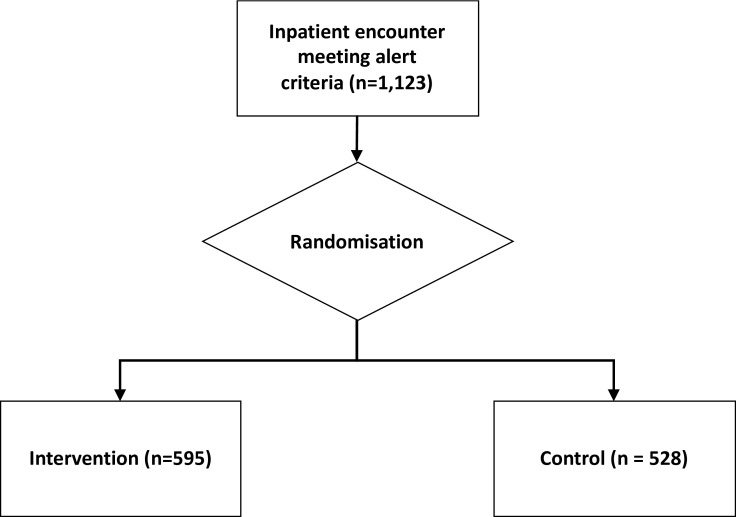
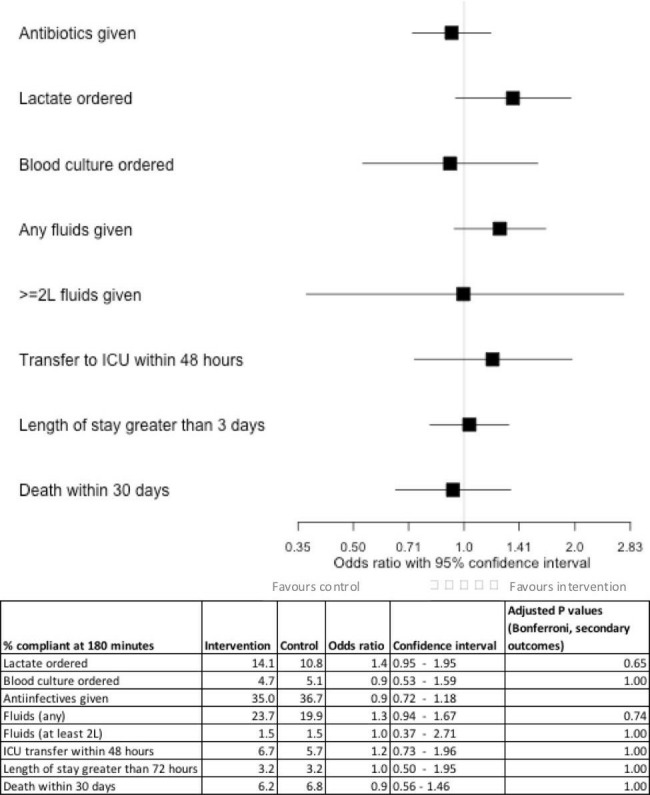
Background: Sepsis remains the top cause of morbidity and mortality of hospitalised patients despite concerted efforts. Clinical decision support for sepsis has shown mixed results reflecting heterogeneous populations, methodologies and interventions. Objectives: To determine whether the addition of a real-time electronic health record (EHR)-based clinical decision support alert improves adherence to treatment guidelines and clinical outcomes in hospitalised patients with suspected severe sepsis. Design: Patient-level randomisation, single blinded. Setting: Medical and surgical inpatient units of an academic, tertiary care medical centre. Patients: 1123 adults over the age of 18 admitted to inpatient wards (intensive care units (ICU) excluded) at an academic teaching hospital between November 2014 and March 2015. Interventions: Patients were randomised to either usual care or the addition of an EHR-generated alert in response to a set of modified severe sepsis criteria that included vital signs, laboratory values and physician orders. Measurements and main results: There was no significant difference between the intervention and control groups in primary outcome of the percentage of patients with new antibiotic orders at 3 hours after the alert (35% vs 37%, p=0.53). There was no difference in secondary outcomes of in-hospital mortality at 30 days, length of stay greater than 72 hours, rate of transfer to ICU within 48 hours of alert, or proportion of patients receiving at least 30 mL/kg of intravenous fluids. Conclusions: An EHR-based severe sepsis alert did not result in a statistically significant improvement in several sepsis treatment performance measures.
Overview
The claims and statistics of this paper haven’t been checked yet.
Free: it reads the open-access text and checks the first 5 claims that cite a source we can check. Create a free account to check every claim.
Integrity signals
Registry
Cites
Statistics
Figures
Verification
Claims the paper makes
The claims and statistics of this paper haven’t been checked yet.
Free: it reads the open-access text and checks the first 5 claims that cite a source we can check. Create a free account to check every claim.
Claims other papers make about this one
Each is checked against this paper’s own text: does it say what the citing paper says it does?
The source backs part of the claim, not all of it — or backs it for a different population, condition or comparison.
In the citing paper
“A pooled analysis of three RCTs did not demonstrate a mortality benefit of active screening (RR, 0.90; 95% CI, 0.51-1.58)(33-35).”
From Surviving Sepsis Campaign: International Guidelines for Management of Sepsis and Septic Shock 2021. (2021) · cites this paper as [33]
Experimental — accuracy not yet measuredThe source backs part of the claim, not all of it — or backs it for a different population, condition or comparison.
In the citing paper
“Unfortunately, many sepsis CDS systems fail to improve outcomes because of poor diagnostic accuracy and program implementation [23-25].”
From Integrating a Machine Learning System Into Clinical Workflows: Qualitative Study (2020) · cites this paper as [25]
Experimental — accuracy not yet measuredThe source backs part of the claim, not all of it — or backs it for a different population, condition or comparison.
In the citing paper
“Past deployed systems have reported significantly lower predictive performance on similar hospital populations 20,42,45 .”
From Factors driving provider adoption of the TREWS machine learning-based early warning system and its effects on sepsis treatment timing (2022) · cites this paper as [20]
Experimental — accuracy not yet measuredThe cited source says what the claim attributes to it.
In the citing paper
“A pooled analysis of three RCTs did not demonstrate a mortality benefit of active screening (RR 0.90; 95% CI 0.51–1.58) [33–35].”
From Surviving sepsis campaign: international guidelines for management of sepsis and septic shock 2021 (2021) · cites this paper as [33]
The cited source says what the claim attributes to it.
In the citing paper
“To date, sepsis early warning systems have not been shown to reliably improve patient outcomes,1”
From Quantification of Sepsis Model Alerts in 24 US Hospitals Before and During the COVID-19 Pandemic (2021) · cites this paper as [1]
Self-check
Percentages, sums and reported differences re-computed from the paper’s own numbers.
The self-check needs the paper’s full text.
Citations
Cites
Angus, D. C., Linde-Zwirble, W. T., Lidicker, J., Clermont, G., Carcillo, J., & Pinsky, M. R. (2001) · Critical Care Medicine · doi:10.1097/00003246-200107000-00002 · Cited by 8,503
Garg, A. X., Adhikari, N. K. J., McDonald, H., Rosas-Arellano, M. P., Devereaux, P. J., Beyene, J., Sam, J., & Haynes, R. B. (2005) · JAMA · doi:10.1001/jama.293.10.1223 · Cited by 2,936
Kawamoto, K., Houlihan, C. A., Balas, E. A., & Lobach, D. F. (2005) · BMJ · doi:10.1136/bmj.38398.500764.8f · Cited by 2,703
Shankar-Hari, M., Phillips, G. S., Levy, M. L., Seymour, C. W., Liu, V. X., Deutschman, C. S., Angus, D. C., Rubenfeld, G. D., Singer, M., & for the Sepsis Definitions Task Force (2016) · JAMA · doi:10.1001/jama.2016.0289 · Cited by 2,424
Benchmarking the Incidence and Mortality of Severe Sepsis in the United States*
Gaieski, D. F., Edwards, J. M., Kallan, M. J., & Carr, B. G. (2013) · Critical Care Medicine · doi:10.1097/ccm.0b013e31827c09f8 · Cited by 1,326
Dombrovskiy, V. Y., Martin, A. A., Sunderram, J., & Paz, H. L. (2007) · Critical Care Medicine · doi:10.1097/01.ccm.0000261890.41311.e9 · Cited by 1,249
Effect of Clinical Decision-Support Systems: A Systematic Review
Bright, T. J., Wong, A., Dhurjati, R., Bristow, E., Bastian, L., Coeytaux, R. R., Samsa, G., Hasselblad, V., Williams, J. W., Musty, M. D., et al. (2012) · Annals of Internal Medicine · doi:10.7326/0003-4819-157-1-201207030-00450 · Cited by 1,200
Roshanov, P. S., Fernandes, N., Wilczynski, J. M., Hemens, B. J., You, J. J., Handler, S. M., Nieuwlaat, R., Souza, N. M., Beyene, J., Spall, H. G. C. V., et al. (2013) · BMJ · doi:10.1136/bmj.f657 · Cited by 456
STRIDE--An integrated standards-based translational research informatics platform.
Lowe, H., Ferris, T., Hernandez, P. M., & Weber, S. (2009) · PubMed Central · Cited by 443
Sterling, S. A., Miller, W. R., Pryor, J., Puskarich, M. A., & Jones, A. E. (2015) · Critical Care Medicine · doi:10.1097/ccm.0000000000001142 · Cited by 434
Cited by
Surviving sepsis campaign: international guidelines for management of sepsis and septic shock 2021
Evans, L., Rhodes, A., Alhazzani, W., Antonelli, M., Coopersmith, C. M., French, C., Machado, F. R., Mcintyre, L., Ostermann, M., Prescott, H. C., et al. (2021) · Intensive Care Medicine · doi:10.1007/s00134-021-06506-y · Cited by 5,082
Surviving Sepsis Campaign: International Guidelines for Management of Sepsis and Septic Shock 2021.
Evans, L., Rhodes, A., Alhazzani, W., Antonelli, M., Coopersmith, C. M., French, C., Machado, F. R., Mcintyre, L., Ostermann, M., Prescott, H. C., et al. (2021) · Critical Care Medicine · doi:10.1097/ccm.0000000000005337 · Cited by 2,935
Wong, A., Otles, E., Donnelly, J. P., Krumm, A., McCullough, J., DeTroyer-Cooley, O., Pestrue, J., Phillips, M., Konye, J., Penoza, C., et al. (2021) · JAMA Internal Medicine · doi:10.1001/jamainternmed.2021.2626 · Cited by 995
“This threshold is within the recommended score range (5-8) suggested by its developer.”
Background"The human body is a black box": supporting clinical decision-making with deep learning
Sendak, M., Elish, M. C., Gao, M., Futoma, J., Ratliff, W., Nichols, M., Bedoya, A., Balu, S., & O'Brien, C. (2020) · Proceedings of the 2020 Conference on Fairness, Accountability, and Transparency · doi:10.1145/3351095.3372827 · Cited by 196
Integrating a Machine Learning System Into Clinical Workflows: Qualitative Study
Sandhu, S., Lin, A. L., Brajer, N., Sperling, J., Ratliff, W., Bedoya, A. D., Balu, S., O'Brien, C., & Sendak, M. P. (2020) · Journal of Medical Internet Research · doi:10.2196/22421 · Cited by 168
Henry, K. E., Adams, R., Parent, C., Soleimani, H., Sridharan, A., Johnson, L., Hager, D. N., Cosgrove, S. E., Markowski, A., Klein, E. Y., et al. (2022) · Nature Medicine · doi:10.1038/s41591-022-01895-z · Cited by 144
Zhang, S., Yu, J., Xu, X., Yin, C., Lu, Y., Yao, B., Tory, M., Padilla, L. M., Caterino, J., Zhang, P., et al. (2024) · Proceedings of the CHI Conference on Human Factors in Computing Systems · doi:10.1145/3613904.3642343 · Cited by 99
“Different workflows that arise from different clinical roles are often overlooked in contemporary AI-CDSS designs.”
BackgroundInfluentialHong, J. C., Eclov, N. C. W., Dalal, N. H., Thomas, S. M., Stephens, S. J., Malicki, M., Shields, S., Cobb, A., Mowery, Y. M., Niedzwiecki, D., et al. (2020) · Journal of Clinical Oncology · doi:10.1200/jco.20.01688 · Cited by 93
Clinical Decision Support Systems and Their Role in Antibiotic Stewardship: a Systematic Review
Rittmann, B., & Stevens, M. (2019) · Current Infectious Disease Reports · doi:10.1007/s11908-019-0683-8 · Cited by 87
On classifying sepsis heterogeneity in the ICU: insight using machine learning
Ibrahim, Z. M., Wu, H., Hamoud, A., Stappen, L., Dobson, R., & Agarossi, A. (2020) · Journal of the American Medical Informatics Association · doi:10.1093/jamia/ocz211 · Cited by 81
Evolving Applications of Artificial Intelligence and Machine Learning in Infectious Diseases Testing
Tran, N. K., Albahra, S., May, L., Waldman, S., Crabtree, S., Bainbridge, S., & Rashidi, H. (2021) · Clinical Chemistry · doi:10.1093/clinchem/hvab239 · Cited by 77
Tarabichi, Y., Cheng, A., Bar-Shain, D., McCrate, B. M., Reese, L. H., Emerman, C., Siff, J., Wang, C., Kaelber, D. C., Watts, B., et al. (2022) · Critical Care Medicine · doi:10.1097/ccm.0000000000005267 · Cited by 76
Evaluation of sepsis prediction models before onset of treatment
Kamran, F., Tjandra, D., Heiler, A., Virzi, J., Singh, K., King, J. E., Valley, T. S., & Wiens, J. (2024) · NEJM AI · doi:10.1056/aioa2300032 · Cited by 74
Effectiveness of automated alerting system compared to usual care for the management of sepsis
Zhang, Z., Chen, L., Xu, P., Wang, Q., Zhang, J., Chen, K., Clements, C. M., Celi, L. A., Herasevich, V., & Hong, Y. (2022) · npj Digital Medicine · doi:10.1038/s41746-022-00650-5 · Cited by 69
Syed, M., Syed, S., Sexton, K., Syeda, H. B., Garza, M., Zozus, M., Syed, F., Begum, S., Syed, A. U., Sanford, J., et al. (2021) · Informatics · doi:10.3390/informatics8010016 · Cited by 68
The Impact of Cytokines on Neutrophils’ Phagocytosis and NET Formation during Sepsis—A Review
Gierlikowska, B., Stachura, A., Gierlikowski, W., & Demkow, U. A. (2022) · International Journal of Molecular Sciences · doi:10.3390/ijms23095076 · Cited by 67
Valik, J. K., Ward, L., Tanushi, H., Johansson, A. F., Färnert, A., Mogensen, M. L., Pickering, B. W., Herasevich, V., Dalianis, H., Henriksson, A., et al. (2023) · Scientific Reports · doi:10.1038/s41598-023-38858-4 · Cited by 68
Digital Alerting and Outcomes in Patients With Sepsis: Systematic Review and Meta-Analysis
Joshi, M., Ashrafian, H., Arora, S., Khan, S. N., Cooke, G., & Darzi, A. W. (2019) · Journal of Medical Internet Research · doi:10.2196/15166 · Cited by 64
The number needed to benefit: estimating the value of predictive analytics in healthcare
Liu, V. X., Bates, D. W., Wiens, J., & Shah, N. H. (2019) · Journal of the American Medical Informatics Association · doi:10.1093/jamia/ocz088 · Cited by 59
Quantification of Sepsis Model Alerts in 24 US Hospitals Before and During the COVID-19 Pandemic
Wong, A., Cao, J., Lyons, P. G., Dutta, S., Major, V. J., Ötleş, E., & Singh, K. (2021) · JAMA Network Open · doi:10.1001/jamanetworkopen.2021.35286 · Cited by 57
Sepsis Performance Improvement Programs: From Evidence Toward Clinical Implementation
Schinkel, M., Nanayakkara, P. W. B., & Wiersinga, W. J. (2022) · Critical Care · doi:10.1186/s13054-022-03917-1 · Cited by 51
The Clinical Information Systems Response to the COVID-19 Pandemic
Reeves, J. J., Pageler, N. M., Wick, E. C., Melton, G. B., Tan, Y.-H. G., Clay, B. J., & Longhurst, C. (2021) · Yearbook of Medical Informatics · doi:10.1055/s-0041-1726513 · Cited by 48
Joshi, M., Mecklai, K., Rozenblum, R., & Samal, L. (2022) · JAMIA Open · doi:10.1093/jamiaopen/ooac022 · Cited by 46
“Some randomized studies support reduction in length of stay and in hospital mortality,(21,29) while others have shown no significant change in clinical outcomes.(2,8) There is however prospective data to suggest that these alerts may lead to faster interventions such as time to blood culture or antibiotics.”
ResultThe clinical artificial intelligence department: a prerequisite for success
Cosgriff, C. V., Stone, D. J., Weissman, G., Pirracchio, R., & Celi, L. A. (2020) · BMJ Health & Care Informatics · doi:10.1136/bmjhci-2020-100183 · Cited by 43
Rhee, C., Strich, J. R., Chiotos, K., Classen, D. C., Cosgrove, S. E., Greeno, R., Heil, E. L., Kadri, S. S., Kalil, A. C., Gilbert, D. N., et al. (2024) · Clinical Infectious Diseases · doi:10.1093/cid/ciad447 · Cited by 40
Ackermann, K., Baker, J., Green, M., Fullick, M., Varinli, H., Westbrook, J. I., & Li, L. (2022) · Journal of Medical Internet Research · doi:10.2196/31083 · Cited by 42
Autopilots in the Operating Room: Safe Use of Automated Medical Technology
Ruskin, K. J., Corvin, C., Rice, S. C., & Winter, S. R. (2020) · Anesthesiology · doi:10.1097/aln.0000000000003385 · Cited by 38
Epic Sepsis Model Inpatient Predictive Analytic Tool: A Validation Study
Cull, J., Brevetta, R., Gerac, J., Kothari, S., & Blackhurst, D. (2023) · Critical Care Explorations · doi:10.1097/cce.0000000000000941 · Cited by 37
“The study by Downing et al (17) was a randomized controlled trial of 1,123 patients using a sepsis alert based on the definition of systemic inflammatory response syndrome (SIRS) plus a source of infection.”
BackgroundMethodResultInfluentialEvaluation and Regulation of Artificial Intelligence Medical Devices for Clinical Decision Support
Weissman, G. E. (2025) · Annual Review of Biomedical Data Science · doi:10.1146/annurev-biodatasci-103123-095824 · Cited by 38
Early Diagnosis of Sepsis: The Role of Biomarkers and Rapid Microbiological Tests
Plata-Menchaca, E. P., Ruiz‐Rodríguez, J. C., & Ferrer, R. (2024) · Seminars in Respiratory and Critical Care Medicine · doi:10.1055/s-0044-1787270 · Cited by 36
Honeyford, K., Cooke, G. S., Kinderlerer, A., Williamson, E., Gilchrist, M., Holmes, A., Room, T. S. B., Glampson, B., Mulla, A., & Costelloe, C. (2020) · Journal of the American Medical Informatics Association · doi:10.1093/jamia/ocz186 · Cited by 34
Tell me something interesting: Clinical utility of machine learning prediction models in the ICU
Eini-Porat, B., Amir, O., Eytan, D., & Shalit, U. (2022) · Journal of Biomedical Informatics · doi:10.1016/j.jbi.2022.104107 · Cited by 33
The Potential of Artificial Intelligence for Achieving Healthy and Sustainable Societies
Sırmaçek, B., Gupta, S., Mallor, F., Azizpour, H., Ban, Y., Eivazi, H., Fang, H., Golzar, F., Leite, I., Melsión, G. I., et al. (2023) · Philosophical studies series · doi:10.1007/978-3-031-21147-8_5 · Cited by 29
Talianu, A., Fraser-Krauss, O., Bolton, W., Ming, D. K. Y., Zhu, N., Hernandez, B., Gilchrist, M. J., Holmes, A. H., Georgiou, P., & Rawson, T. M. (2025) · Journal of Antimicrobial Chemotherapy · doi:10.1093/jac/dkaf470 · Cited by 24
Wong, H. S., & Wong, T. K. (2026) · JMIR Medical Informatics · doi:10.2196/82026 · Cited by 23
What can a learning healthcare system teach us about improving outcomes?
Casey, J. D., Courtright, K. R., Rice, T. W., & Semler, M. W. (2021) · Current Opinion in Critical Care · doi:10.1097/mcc.0000000000000857 · Cited by 22
Tran, N. K., Kretsch, C. M., LaValley, C., & Rashidi, H. H. (2023) · Current Opinion in Infectious Diseases · doi:10.1097/qco.0000000000000935 · Cited by 22
Dutta, S., McEvoy, D. S., Rubins, D. M., Dighe, A. S., Filbin, M. R., & Rhee, C. (2022) · Journal of the American Medical Informatics Association · doi:10.1093/jamia/ocac115 · Cited by 20
To catch a killer: electronic sepsis alert tools reaching a fever pitch?
Ruppel, H., & Liu, V. (2019) · BMJ Quality & Safety · doi:10.1136/bmjqs-2019-009463 · Cited by 19
Sendak, M., Liu, V. X., Beecy, A., Vidal, D. E., Shaw, K., Lifson, M. A., Tobey, D., Valladares, A., Loufek, B. T., Mogri, M., et al. (2024) · Journal of the American Medical Informatics Association · doi:10.1093/jamia/ocae119 · Cited by 19
Designing Interactive Alerts to Improve Recognition of Critical Events in Medical Emergencies
Mastrianni, A., Sarcevic, A., Chung, L., Zakeri, I., Alberto, E. C., Milestone, Z. P., Marsic, I., & Burd, R. S. (2021) · Designing Interactive Systems Conference · doi:10.1145/3461778.3462051 · Cited by 18
Integration of Machine Learning in Clinical Decision Support Systems
Siddiq, M. (2021) · Eduvest - Journal Of Universal Studies · doi:10.59188/eduvest.v1i12.809 · Cited by 18
Evaluation of the effectiveness of an automated sepsis predictive tool on patient outcomes
Schootman, M., Wiskow, C., Loux, T., Meyer, L., Powell, S., Gandhi, A., & Lacasse, A. (2022) · Journal of Critical Care · doi:10.1016/j.jcrc.2022.154061 · Cited by 17
What is needed to mainstream artificial intelligence in health care?
Scott, I. A., Abdel‐Hafez, A., Barras, M. A., & Canaris, S. (2021) · Australian Health Review · doi:10.1071/ah21034 · Cited by 17
Lazzarino, R., Borek, A., Honeyford, K., Welch, J., Brent, A., Kinderlerer, A. R., Cooke, G., Patil, S., Gordon, A. C., Glampson, B., et al. (2024) · JMIR Human Factors · doi:10.2196/56949 · Cited by 17
The Effect of Early Warning Systems for Sepsis on Mortality: A Systematic Review and Meta-analysis
Alshaeba, S. E., Marhoffer, E. A., Holleck, J. L., Theisen-Toupal, J. C., Grimshaw, A. A., & Gunderson, C. G. (2025) · Journal of General Internal Medicine · doi:10.1007/s11606-025-09569-5 · Cited by 16
Evaluation of a Sepsis Alert in the Pediatric Acute Care Setting
Gibbs, K. D., Shi, Y. P., Sanders, N., Bodnar, A., Brown, T. L., Shah, M. D., & Hess, L. M. (2021) · Applied Clinical Informatics · doi:10.1055/s-0041-1730027 · Cited by 16
Physicians’ Perceptions of Clinical Decision Support to Treat Patients With Heart Failure in the ED
Casey, S. D., Reed, M., LeMaster, C., Mark, D. G., Gaskin, J., Norris, R. P., & Sax, D. R. (2023) · JAMA Network Open · doi:10.1001/jamanetworkopen.2023.44393 · Cited by 16
Clinical Decision Support for Septic Shock in the Emergency Department: A Cluster Randomized Trial
Scott, H. F., Sevick, C. J., Colborn, K. L., Davies, S. J. D., Greer, C. H., Dafoe, A., Holliman, B. D., Bajaj, L., Schmidt, S. K., & Kempe, A. (2025) · PEDIATRICS · doi:10.1542/peds.2024-069478 · Cited by 16
Wayne, M. T., Molling, D. J., Wang, X. Q., Hogan, C. K., Seelye, S. M., Liu, V. X., & Prescott, H. C. (2021) · Annals of the American Thoracic Society · doi:10.1513/annalsats.202009-1130oc · Cited by 15
Eliminating the AI digital divide by building local capacity
Gulamali, F., Kim, J. Y., Pejavara, K., Thomas, C., Mathur, V., Eigen, Z. J., Lifson, M. A., Patel, M. R., Shaw, K., Tobey, D., et al. (2025) · PLOS Digital Health · doi:10.1371/journal.pdig.0001026 · Cited by 14
External validation of the Epic sepsis predictive model in 2 county emergency departments.
Ostermayer, D. G., Braunheim, B., Mehta, A. M., Ward, J., Andrabi, S., & Sirajuddin, A. M. (2024) · JAMIA Open · doi:10.1093/jamiaopen/ooae133 · Cited by 13
Xie, C. X., Sun, L., Ingram, E., Simoni, A. D., Eldridge, S. M., Pinnock, H., & Relton, C. (2023) · Implementation Science · doi:10.1186/s13012-023-01300-4 · Cited by 13
Silvestri, J. A., Kmiec, T. E., Bishop, N. S., Regli, S. H., & Weissman, G. E. (2022) · JMIR Human Factors · doi:10.2196/36976 · Cited by 12
Generalizability of SuperAlarm via Cross-Institutional Performance Evaluation
Xiao, R., Do, D. H., Ding, C., Meisel, K. M., Lee, R. J., & Hu, X. (2020) · IEEE Access · doi:10.1109/access.2020.3009667 · Cited by 12
Lipatov, K., Daniels, C. E., Park, J. G., Elmer, J., Hanson, A. C., Madsen, B. E., Clements, C. M., Gajic, O., Pickering, B. W., & Herasevich, V. (2022) · The American Journal of Emergency Medicine · doi:10.1016/j.ajem.2021.09.086 · Cited by 11
Wan, Y.-K. J., Wright, M. C., McFarland, M. M., Dishman, D., Nies, M. A., Rush, A., Madaras-Kelly, K., Jeppesen, A., & Del Fiol, G. (2023) · Journal of the American Medical Informatics Association · doi:10.1093/jamia/ocad203 · Cited by 11
Fixler, A., Oliaro, B., Frieden, M., Girardo, C., Winterbottom, F. A., Fort, L. B., & Hill, J. (2023) · Ochsner Journal · doi:10.31486/toj.22.0098 · Cited by 11
Schertz, A. R., Smith, S. A., Lenoir, K. M., & Thomas, K. W. (2023) · Journal of Emergency Medicine · doi:10.1016/j.jemermed.2023.02.025 · Cited by 11
Nigatu, T., Gezie, L. D., Abraham, L., Willems, H., Metzger, J., Abere, B., Tilaye, M., Hailegeberel, T., & Alemu, T. (2024) · Frontiers in Digital Health · doi:10.3389/fdgth.2024.1377826 · Cited by 11
Adult Code Sepsis: A Narrative Review of its Implementation and Impact
Giglio, A., Aranda, M., Ferre, A., & Borges-Sa, M. (2024) · Journal of Intensive Care Medicine · doi:10.1177/08850666241293034 · Cited by 10
Lopez, K. D., Yao, Y., Cho, H., Santos, F. C. D., Madandola, O. O., Bjarnadóttir, R. I., Macieira, T. G. R., Garcia, A. L., Priola, K., Wolf, J. S., et al. (2022) · Contemporary Clinical Trials · doi:10.1016/j.cct.2022.106712 · Cited by 10
Harutyunyan, R., Jeffries, S. D., Ramírez-GarcíaLuna, J. L., & Hemmerling, T. M. (2023) · Anesthesia & Analgesia · doi:10.1213/ane.0000000000006500 · Cited by 9
Hyun, D., Lee, S., Choi, S., Son, J., Park, S.-H., Hong, S., & Lim, C. (2025) · Acute and Critical Care · doi:10.4266/acc.000625 · Cited by 9
Artificial Intelligence: The New Alexander Fleming
Almallah, Z., El-Lababidi, R. M., Shamout, F. E., & Doyle, D. J. (2021) · Healthcare Informatics Research · doi:10.4258/hir.2021.27.2.168 · Cited by 9
Morley, J. (2023) · Oxford University Research Archive (ORA) (University of Oxford) · doi:10.5287/ora-jxprn9ry5 · Cited by 9
Nurses' Knowledge on Sepsis Related to Mechanical Ventilation: An Intervention Study
HLUNGWANE, E. Z., ten Ham‐Baloyi, W., Jordan, P. J., & Oamen, B. R. (2021) · Journal of Nursing Research · doi:10.1097/jnr.0000000000000434 · Cited by 9
Chopra, S., Carroll, J., & Pater, J. A. (2024) · Proceedings of the ACM on Human-Computer Interaction · doi:10.1145/3686988 · Cited by 8
Pereira, M. A., Concheiro-Moscoso, P., López-Álvarez, A., Baños, G., Pazos, A., & Pereira, J. (2021) · Applied Sciences · doi:10.3390/app11062880 · Cited by 8
Lee, A. H.-Y., Aaronson, E. L., Hibbert, K. A., Flynn, M. H., Rutkey, H., Mort, E. A., Sonis, J. D., & Safavi, K. C. (2021) · Journal of Medical Internet Research · doi:10.2196/26946 · Cited by 7
Rincon, T., Raffa, J. D., Celi, L. A., Badawi, O., Johnson, A. E. W., Pollard, T., Deliberato, R. O., & Pierce, J. D. (2023) · International Journal of Nursing Studies · doi:10.1016/j.ijnurstu.2023.104529 · Cited by 7
Bhuyain, M. M., & Fatema, M. K. (2023) · doi:10.63125/ac09sa31 · Cited by 7
Cucchi, E. W., Burzynski, J., Marshall, N., & Greenberg, B. (2024) · JAMIA Open · doi:10.1093/jamiaopen/ooae143 · Cited by 6
Mastrianni, A., Cui, H., & Sarcevic, A. (2022) · CHI Conference Extended Abstracts on Human Factors in Computing Systems (CHI EA) · doi:10.1145/3491101.3519669 · Cited by 6
Clinical decision support tools useful for identifying sepsis risk
Heineman, T., Orrick, C., Phan, T. K., Denke, L., Atem, F., & Draganic, K. (2024) · Nursing · doi:10.1097/01.nurse.0001007628.31606.ee · Cited by 6
Connor, J. P., Medow, J. E., Ehlenfeldt, B. D., Rose, A. E., & Raife, T. J. (2020) · Transfusion · doi:10.1111/trf.15962 · Cited by 6
Bucheeri, M. A., Elligsen, M., Lam, P. W., Daneman, N., & MacFadden, D. R. (2023) · PLoS ONE · doi:10.1371/journal.pone.0295908 · Cited by 6
Repairing Innovation: A Study of Integrating AI in Clinical Care
Elish, M. C., & Watkins, E. A. (2020) · doi:10.69985/vcvu5761 · Cited by 5
Recognizing Coagulation Disorders in Sepsis in the Emergency Room: A Narrative Review
Iba, T., Tanigawa, T., Wada, H., Kondo, K., Ferrer, R., & Levy, J. H. (2026) · Journal of Clinical Medicine · doi:10.3390/jcm15020488 · Cited by 5
Physicians’ Perspectives on Prescription Alerts: A Journey Towards Reducing Fatigue
Takizawa, M., Nakayama, N., Ohishi, Y., Tanaka, K., Noguchi, R., Saito, Y., Hirano, K., & Komatsu, Y. (2025) · Cureus · doi:10.7759/cureus.86996 · Cited by 4
Use of Sepsis Clinical Prediction Models to Improve Patient Care
Mogri, M., Grant, R. W., & Liu, V. X. (2023) · JAMA Internal Medicine · doi:10.1001/jamainternmed.2022.7164 · Cited by 4
Weissman, G. E. (2024) · Critical Care Medicine · doi:10.1097/ccm.0000000000006277 · Cited by 4
Pradhan, A., Wright, E. A., Hayduk, V. A., Berhane, J., Sponenberg, M., Webster, L., Anderson, H., Park, S., Graham, J., & Friedenberg, S. M. (2024) · JMIR Medical Informatics · doi:10.2196/58456 · Cited by 4
What's new in critical illness and injury science? Antibiotics in critical care: Therapeutic toolbox
Mathur, A. (2019) · International Journal of Critical Illness and Injury Science · doi:10.4103/ijciis.ijciis_81_19 · Cited by 3
Sepsis Performance Improvement Programs: From Evidence Toward Clinical Implementation
Schinkel, M., Nanayakkara, P. W. B., & Wiersinga, W. J. (2022) · Annual update in intensive care and emergency medicine · doi:10.1007/978-3-030-93433-0_30 · Cited by 3
Pseudorandomized Testing of a Discharge Medication Alert to Reduce Free-Text Prescribing
Rabbani, N., Ho, M., Dash, D., Calway, T., Morse, K., & Chadwick, W. A. (2023) · Applied Clinical Informatics · doi:10.1055/a-2068-6940 · Cited by 3
Exploiting temporal relationships in the prediction of mortality
Cosgriff, C. V., & Celi, L. A. (2020) · The Lancet Digital Health · doi:10.1016/s2589-7500(20)30056-x · Cited by 3
Ibrahim, Z. M., Wu, H., & Dobson, R. (2020) · Frontiers in artificial intelligence and applications · doi:10.3233/faia200298 · Cited by 3
Artificial intelligence in diagnostics and medical decision making
Levi, M. M. (2026) · European Journal of Internal Medicine · doi:10.1016/j.ejim.2026.107056 · Cited by 2
HEALTH INFORMATICS TOOL TOWARD SEPSIS SCREENING.
Liengsawangwong, R., Kumar, S., Ortiz, R. A., & Hill, J. (2021) · Perspectives in health information management / AHIMA, American Health Information Management Association · Cited by 2
Alrefaie, K., Madlol, B., & Atallah, O. (2026) · Education and human development · doi:10.5772/intechopen.1014649 · Cited by 1
Paez, R., Khalil, T. A., Forero, Y., Woodhouse, P., Antic, S., Holmes, H. M., Fremont, R. D., Brandt, W. S., Chen, H., Chen, S., et al. (2026) · Trials · doi:10.1186/s13063-026-09727-y · Cited by 1
McIlmurray, L., Blackwood, B., Dempster, M., Kee, F., Gillan, C. J., Hagan, R., Lohfeld, L. H., & Shyamsundar, M. (2022) · BMJ Open · doi:10.1136/bmjopen-2021-057026 · Cited by 1
Ranard, B. L., Qian, M., Cummings, M. J., Zhang, D. Y., Lee, S. M., Beitler, J. R., Applebaum, J. R., Schenck, E. J., Mohamed, H., Trepp, R., et al. (2025) · BMJ Open · doi:10.1136/bmjopen-2024-088792 · Cited by 1
AI/ML-enabled sepsis prediction systems: laboratory considerations from development to deployment
Durant, T. J. S., Aldewereld, Z., Peaper, D. R., & Wheeler, S. (2026) · Journal of Clinical Microbiology · doi:10.1128/jcm.01461-25 · Cited by 1
Meyer, S. (2021) · Deep Blue (University of Michigan) · doi:10.7302/3097 · Cited by 1
Ostermayer, D. G., Braunheim, B., Mehta, A., Ward, J., Andrabi, S., & Sirajuddin, A. M. (2025) · Journal of the American Medical Informatics Association · doi:10.1093/jamia/ocaf207 · Cited by 1
Blom, M. J. (2019) · Pure Amsterdam UMC · Cited by 1
Usability of Clinical Decision Support for Adult Sepsis Detection
Ackermann, K., Westbrook, J. I., & Li, L. (2024) · Studies in health technology and informatics · doi:10.3233/shti231204 · Cited by 1
Zhang, J. C., Javaherian, K., Zapata, J., Duffy, R., Lu, C. M., Price, E., Snowden, H., Agarwal, A., & Mihara, K. (2026) · American Journal of Medical Quality · doi:10.1097/jmq.0000000000000357
Metadata
- Authors
- Downing, N. L., Rolnick, J., Poole, S. F., Hall, E., Wessels, A. J., Heidenreich, P., & Shieh, L.
- Affiliations
- Stanford Medicine (US)
- Philadelphia VA Medical Center (US)
- Stanford University (US)
- Corresponding author
- Downing, Norman Lance
- Venue
- BMJ Quality & Safety
- Publisher
- BMJ
- Published
- 2019-03-14
- Volume
- 28
- Issue
- 9
- Pages
- 762-768
- ISSN
- 1475-3898 (ISSN-L)
- 2044-5415
- 2044-5423
- PMC
- PMC6860967
- OpenAlex
- W2921640653
- Semantic Scholar
- c0c4ab33ac0d90746a26f9338b8626c107121826
- Cited by
- 112
- References
- 23
- Citations by year
- 2026: 17 · 2025: 9 · 2024: 17 · 2023: 16 · 2022: 14 · 2021: 21 · 2020: 8 · 2019: 10
- FWCI
- 10.09
- Type
- journal article
- Language
- en
- Open access
- hybrid
- doi.org
- Licence
- cc-by-nc
- Locations
- BMJ Quality & Safety (publishedVersion, cc-by-nc)
- Europe PMC (PubMed Central) (publishedVersion, cc-by-nc)
- PubMed Central (publishedVersion, cc-by-nc)
- PubMed (publishedVersion)
- HighWire Press Open Archive (submittedVersion)
- Topics
- Health Sciences › Medicine › Critical Care and Intensive Care Medicine › Sepsis Diagnosis and Treatment
- Health Sciences › Health Professions › Health Information Management › Electronic Health Records Systems
- Health Sciences › Nursing › Research and Theory › Nursing Diagnosis and Documentation
- Keywords
- severe sepsis, clinical decision support, electronic health records, sepsis alerts, timing of antibiotic administration, guideline adherence, in-hospital mortality, length of hospital stay, ICU transfer, intravenous fluid therapy
- MeSH terms
- Aged, Aged, 80 and over, Female, Humans, Intensive Care Units, Health Knowledge, Attitudes, Practice, Male, Middle Aged, Hospital Mortality, Sepsis, Health Care Surveys, Guideline Adherence, Decision Support Systems, Clinical, Electronic Health Records
About these checks
Registry, retraction, Cites and statistics results are computed, not judged, with one exception: a printed reference that no index lists is read once by a model before it counts as a citation error. Claims are extracted by a model and kept only when their quote appears verbatim in the text; each cited source is then checked, with a model’s help, for whether it says what the claim relies on. Those verdicts can be wrong — read the claim’s quote and the cited source before relying on one.
Statistics and arithmetic are recomputed, not judged.
Confidence bands are shown only for fields calibrated on our annotated test set. None is calibrated yet, so no band is shown.
What counts as a claim ›How we measure confidence ›How we check this ›
Are you an author, or do you see a problem with this page? Request a review
Data sources
Bibliographic data: Semantic Scholar, OpenAlex, Crossref.
Contains information from the Semantic Scholar Academic Graph Datasets, made available under the ODC Attribution License (ODC-BY 1.0).
Semantic Scholar’s data is described in: Kinney, R., et al. (2023). The Semantic Scholar Open Data Platform. arXiv:2301.10140.
