

Electronic health record-based clinical decision support alert for severe sepsis: A randomised evaluation.
Open accessThe DOI matches its Crossref record; 23 of the 23 references it cites were found in a registry or an index.
Abstract
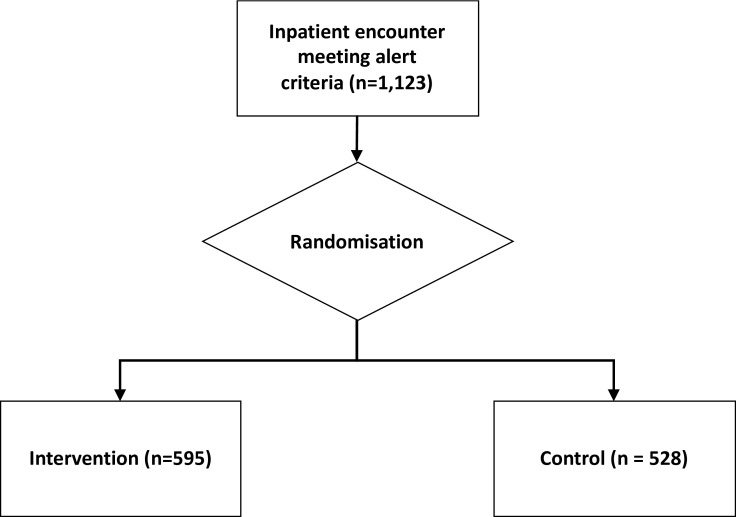
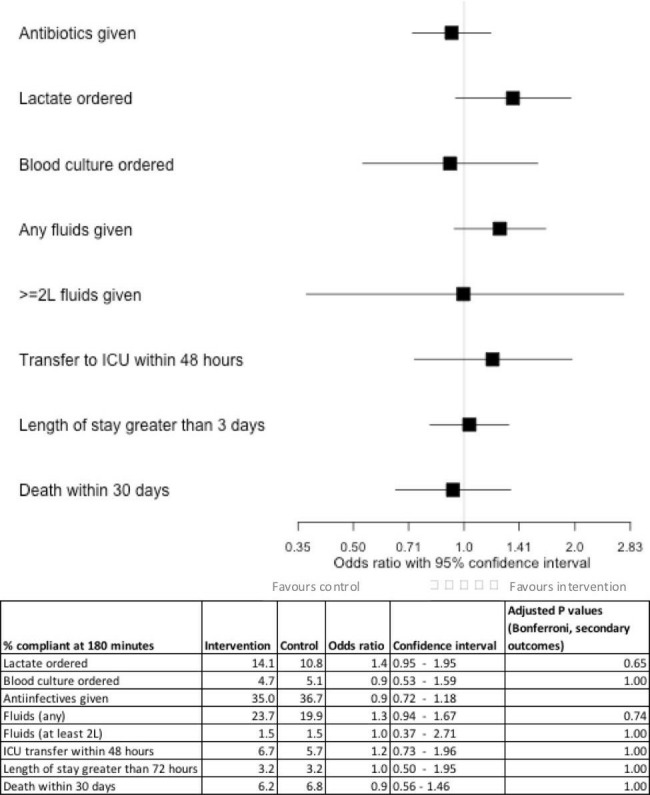
Background: Sepsis remains the top cause of morbidity and mortality of hospitalised patients despite concerted efforts. Clinical decision support for sepsis has shown mixed results reflecting heterogeneous populations, methodologies and interventions. Objectives: To determine whether the addition of a real-time electronic health record (EHR)-based clinical decision support alert improves adherence to treatment guidelines and clinical outcomes in hospitalised patients with suspected severe sepsis. Design: Patient-level randomisation, single blinded. Setting: Medical and surgical inpatient units of an academic, tertiary care medical centre. Patients: 1123 adults over the age of 18 admitted to inpatient wards (intensive care units (ICU) excluded) at an academic teaching hospital between November 2014 and March 2015. Interventions: Patients were randomised to either usual care or the addition of an EHR-generated alert in response to a set of modified severe sepsis criteria that included vital signs, laboratory values and physician orders. Measurements and main results: There was no significant difference between the intervention and control groups in primary outcome of the percentage of patients with new antibiotic orders at 3 hours after the alert (35% vs 37%, p=0.53). There was no difference in secondary outcomes of in-hospital mortality at 30 days, length of stay greater than 72 hours, rate of transfer to ICU within 48 hours of alert, or proportion of patients receiving at least 30 mL/kg of intravenous fluids. Conclusions: An EHR-based severe sepsis alert did not result in a statistically significant improvement in several sepsis treatment performance measures.
Overview
The claims and statistics of this paper haven’t been checked yet.
Free: it reads the open-access text and checks the first 5 claims that cite a source we can check. Create a free account to check every claim.
Integrity signals
Registry
Cites
Statistics
Figures
Verification
Claims the paper makes
The claims and statistics of this paper haven’t been checked yet.
Free: it reads the open-access text and checks the first 5 claims that cite a source we can check. Create a free account to check every claim.
Claims other papers make about this one
Each is checked against this paper’s own text: does it say what the citing paper says it does?
The source backs part of the claim, not all of it — or backs it for a different population, condition or comparison.
In the citing paper
“A pooled analysis of three RCTs did not demonstrate a mortality benefit of active screening (RR, 0.90; 95% CI, 0.51-1.58)(33-35).”
From Surviving Sepsis Campaign: International Guidelines for Management of Sepsis and Septic Shock 2021. (2021) · cites this paper as [33]
Experimental — accuracy not yet measuredThe source backs part of the claim, not all of it — or backs it for a different population, condition or comparison.
In the citing paper
“Unfortunately, many sepsis CDS systems fail to improve outcomes because of poor diagnostic accuracy and program implementation [23-25].”
From Integrating a Machine Learning System Into Clinical Workflows: Qualitative Study (2020) · cites this paper as [25]
Experimental — accuracy not yet measuredThe source backs part of the claim, not all of it — or backs it for a different population, condition or comparison.
In the citing paper
“Past deployed systems have reported significantly lower predictive performance on similar hospital populations 20,42,45 .”
From Factors driving provider adoption of the TREWS machine learning-based early warning system and its effects on sepsis treatment timing (2022) · cites this paper as [20]
Experimental — accuracy not yet measuredThe cited source says what the claim attributes to it.
In the citing paper
“A pooled analysis of three RCTs did not demonstrate a mortality benefit of active screening (RR 0.90; 95% CI 0.51–1.58) [33–35].”
From Surviving sepsis campaign: international guidelines for management of sepsis and septic shock 2021 (2021) · cites this paper as [33]
The cited source says what the claim attributes to it.
In the citing paper
“To date, sepsis early warning systems have not been shown to reliably improve patient outcomes,1”
From Quantification of Sepsis Model Alerts in 24 US Hospitals Before and During the COVID-19 Pandemic (2021) · cites this paper as [1]
Self-check
Percentages, sums and reported differences re-computed from the paper’s own numbers.
The self-check needs the paper’s full text.
Citations
Cites
Angus, D. C., Linde-Zwirble, W. T., Lidicker, J., Clermont, G., Carcillo, J., & Pinsky, M. R. (2001) · Critical Care Medicine · doi:10.1097/00003246-200107000-00002 · Cited by 8,503
Garg, A. X., Adhikari, N. K. J., McDonald, H., Rosas-Arellano, M. P., Devereaux, P. J., Beyene, J., Sam, J., & Haynes, R. B. (2005) · JAMA · doi:10.1001/jama.293.10.1223 · Cited by 2,936
Kawamoto, K., Houlihan, C. A., Balas, E. A., & Lobach, D. F. (2005) · BMJ · doi:10.1136/bmj.38398.500764.8f · Cited by 2,703
Shankar-Hari, M., Phillips, G. S., Levy, M. L., Seymour, C. W., Liu, V. X., Deutschman, C. S., Angus, D. C., Rubenfeld, G. D., Singer, M., & for the Sepsis Definitions Task Force (2016) · JAMA · doi:10.1001/jama.2016.0289 · Cited by 2,424
Benchmarking the Incidence and Mortality of Severe Sepsis in the United States*
Gaieski, D. F., Edwards, J. M., Kallan, M. J., & Carr, B. G. (2013) · Critical Care Medicine · doi:10.1097/ccm.0b013e31827c09f8 · Cited by 1,326
Dombrovskiy, V. Y., Martin, A. A., Sunderram, J., & Paz, H. L. (2007) · Critical Care Medicine · doi:10.1097/01.ccm.0000261890.41311.e9 · Cited by 1,249
Effect of Clinical Decision-Support Systems: A Systematic Review
Bright, T. J., Wong, A., Dhurjati, R., Bristow, E., Bastian, L., Coeytaux, R. R., Samsa, G., Hasselblad, V., Williams, J. W., Musty, M. D., et al. (2012) · Annals of Internal Medicine · doi:10.7326/0003-4819-157-1-201207030-00450 · Cited by 1,200
Roshanov, P. S., Fernandes, N., Wilczynski, J. M., Hemens, B. J., You, J. J., Handler, S. M., Nieuwlaat, R., Souza, N. M., Beyene, J., Spall, H. G. C. V., et al. (2013) · BMJ · doi:10.1136/bmj.f657 · Cited by 456
STRIDE--An integrated standards-based translational research informatics platform.
Lowe, H., Ferris, T., Hernandez, P. M., & Weber, S. (2009) · PubMed Central · Cited by 443
Sterling, S. A., Miller, W. R., Pryor, J., Puskarich, M. A., & Jones, A. E. (2015) · Critical Care Medicine · doi:10.1097/ccm.0000000000001142 · Cited by 434
Cited by
Items 101–127 of 127
The Use of Clinical Decision Support to Improve Nursing Practice
Klimpel, K. (2019) · Digital USD (University of San Diego) · doi:10.22371/07.2019.038
Yin, X., Li, X., Huang, G., & Wang, X. (2026) · Journal of Medical Internet Research · doi:10.2196/98205
Georgy, K., Metsker, O., Stanislav, Y., Dmitry, K., Shelukhanov, N. K., Evgeny, K., Yury, M., & Alexey, Y. (2025) · Research Square · doi:10.21203/rs.3.rs-8105230/v1
Sepsis prediction and recognition systems: A Making Healthcare Safer IV rapid review
Cherian, J. P., Segal, J. B., Sharma, R., Zhang, A., Bass, E. B., & Rosen, M. A. (2026) · Journal of Patient Safety and Risk Management · doi:10.1177/25160435261479069
Vishnevsky, G., & Ablin, J. N. (2026) · Applied Clinical Informatics · doi:10.1055/a-2945-3280
Chaturvedi, A., Tiwari, R. V., Agrawal, S., & Kamble, S. (2024) · Advances in finance, accounting, and economics book series · doi:10.4018/979-8-3693-7580-8.ch019
Challenges and opportunities in ECMO monitoring: A mixed-methods appraisal
Yin, W., Permessur, A., Pittas, G., Sukhlal, S., Chow, N., Pinheiro, S., Cobos, A., Sabetta, G., Cahill, J., Zaidi, S., et al. (2026) · Journal of ExtraCorporeal Technology · doi:10.1051/ject/2026022
Quadriceps muscle behavior assessed by ultrasound in septic patients: A systematic review
Cordeiro, V., Andrade, F., LIMA, S. P. D. O., Ribeiro, A., Teles, B., Gómez, C., Generoso, S., & Junior, V. A. N. (2026) · Clinical Nutrition ESPEN · doi:10.1016/j.clnesp.2026.103630
Die aktuelle Sepsisleitlinie – was müssen Sie wissen?
Kochanek, M., & David, S. (2023) · Die Innere Medizin · doi:10.1007/s00108-023-01585-z
Kochanek, M., & David, S. (2024) · Wiener klinisches Magazin · doi:10.1007/s00740-024-00527-1
Koca, H., & Ayvat, P. U. (2026) · Infection · doi:10.1007/s15010-026-03019-y
Data transforming: A concept analysis
Luo, S., & Wang, H. (2022) · Nursing Forum · doi:10.1111/nuf.12801
Sepsis Screening Tool Increased the Usage of Sepsis Order Set
Liengsawangwong, R. (2019) · doi:10.21007/chp.hiim.0066
Lowney, E. L., Hirth, S., Fanning, L., Duke, G. J., & Roodenburg, O. S. (2026) · Research Square · doi:10.21203/rs.3.rs-8188665/v1
Bamgboje‐Ayodele, A., Boscolo, A., Dao, M., Burger, M., Newton, N., McPhail, S., & Baysari, M. T. (2025) · SSRN Electronic Journal · doi:10.2139/ssrn.5150513
Quality and safety in the literature: October 2022
Childers, S., Houchens, N., & Gupta, A. B. (2022) · BMJ Quality & Safety · doi:10.1136/bmjqs-2022-015316
Shevchenko, Y. L., Fedyk, O. V., & Щепарев, И. С. (2026) · Bulletin of Pirogov National Medical & Surgical Center · doi:10.25881/20728255_2026_21_2_104
Viantoro, Y., & Yuniarmi, F. (2026) · The International Journal of Medical Science and Health Research · doi:10.70070/sehv7w52
Sepsis Screening in General Hospitalised Patients in a Developing Nation Health Setting
Alberto, L. (2019) · Griffith Research Online · doi:10.25904/1912/1449
et al., A. M. (2024) · Letters in High Energy Physics
Mansi, G., Kim, J., Dombrowski, L., Riedl, M. O., & Karusala, N. (2026) · arXiv (Cornell University) · doi:10.48550/arxiv.2611.14989
Sauthier, N. (2022) · Papyrus : Institutional Repository (Université de Montréal) · doi:10.71781/30300
Rahmadani, F., Simsekler, M. C. E., Omar, M., Anwar, S., & Shidi, A. M. A. (2025) · doi:10.2196/preprints.74093
Nogueira, A. C. D. L. E. (2019) · Portuguese National Funding Agency for Science, Research and Technology (RCAAP Project by FCT) · doi:10.34626/jzgr-zb17
The Impact of Clinical Decision Support Tool (SupraVista) in Identifying Sepsis Cases
Manigo, B. N. (2021) · Digital Commons (Liberty University)
The Digital Chain of Survival: A Review of Informatics-Enabled Resuscitation from Field to ICU
Alqahtani, A. A. A., Hakami, A. M. A., Alotaibi, D. A., Sharahili, A. N. Y., Alwahidi, S. A., Almotiri, B. S., Almutairy, B. S., Aldosari, M. N., Alqassemi, R. I., Almuqati, K. H., et al. (2024) · Saudi Journal of Medicine and Public Health · doi:10.64483/202412629
MacFadden, D. R., Elligsen, M., Graham, C., Garg, A., Nott, C., Chan, K., Zvonar, R. K., Chou, L., Suh, K. N., Taljaard, M., et al. (2026) · medRxiv · doi:10.64898/2026.02.04.26343404
Metadata
- Authors
- Downing, N. L., Rolnick, J., Poole, S. F., Hall, E., Wessels, A. J., Heidenreich, P., & Shieh, L.
- Affiliations
- Stanford Medicine (US)
- Philadelphia VA Medical Center (US)
- Stanford University (US)
- Corresponding author
- Downing, Norman Lance
- Venue
- BMJ Quality & Safety
- Publisher
- BMJ
- Published
- 2019-03-14
- Volume
- 28
- Issue
- 9
- Pages
- 762-768
- ISSN
- 1475-3898 (ISSN-L)
- 2044-5415
- 2044-5423
- PMC
- PMC6860967
- OpenAlex
- W2921640653
- Semantic Scholar
- c0c4ab33ac0d90746a26f9338b8626c107121826
- Cited by
- 112
- References
- 23
- Citations by year
- 2026: 17 · 2025: 9 · 2024: 17 · 2023: 16 · 2022: 14 · 2021: 21 · 2020: 8 · 2019: 10
- FWCI
- 10.09
- Type
- journal article
- Language
- en
- Open access
- hybrid
- doi.org
- Licence
- cc-by-nc
- Locations
- BMJ Quality & Safety (publishedVersion, cc-by-nc)
- Europe PMC (PubMed Central) (publishedVersion, cc-by-nc)
- PubMed Central (publishedVersion, cc-by-nc)
- PubMed (publishedVersion)
- HighWire Press Open Archive (submittedVersion)
- Topics
- Health Sciences › Medicine › Critical Care and Intensive Care Medicine › Sepsis Diagnosis and Treatment
- Health Sciences › Health Professions › Health Information Management › Electronic Health Records Systems
- Health Sciences › Nursing › Research and Theory › Nursing Diagnosis and Documentation
- Keywords
- severe sepsis, clinical decision support, electronic health records, sepsis alerts, timing of antibiotic administration, guideline adherence, in-hospital mortality, length of hospital stay, ICU transfer, intravenous fluid therapy
- MeSH terms
- Aged, Aged, 80 and over, Female, Humans, Intensive Care Units, Health Knowledge, Attitudes, Practice, Male, Middle Aged, Hospital Mortality, Sepsis, Health Care Surveys, Guideline Adherence, Decision Support Systems, Clinical, Electronic Health Records
About these checks
Registry, retraction, Cites and statistics results are computed, not judged, with one exception: a printed reference that no index lists is read once by a model before it counts as a citation error. Claims are extracted by a model and kept only when their quote appears verbatim in the text; each cited source is then checked, with a model’s help, for whether it says what the claim relies on. Those verdicts can be wrong — read the claim’s quote and the cited source before relying on one.
Statistics and arithmetic are recomputed, not judged.
Confidence bands are shown only for fields calibrated on our annotated test set. None is calibrated yet, so no band is shown.
What counts as a claim ›How we measure confidence ›How we check this ›
Are you an author, or do you see a problem with this page? Request a review
Data sources
Bibliographic data: Semantic Scholar, OpenAlex, Crossref.
Contains information from the Semantic Scholar Academic Graph Datasets, made available under the ODC Attribution License (ODC-BY 1.0).
Semantic Scholar’s data is described in: Kinney, R., et al. (2023). The Semantic Scholar Open Data Platform. arXiv:2301.10140.
