

Prevalence of depression and anxiety in people with inflammatory bowel disease and associated healthcare use: population-based cohort study
Open accessThe DOI matches its Crossref record; 30 of the 30 references it cites were found in a registry or an index.
Abstract
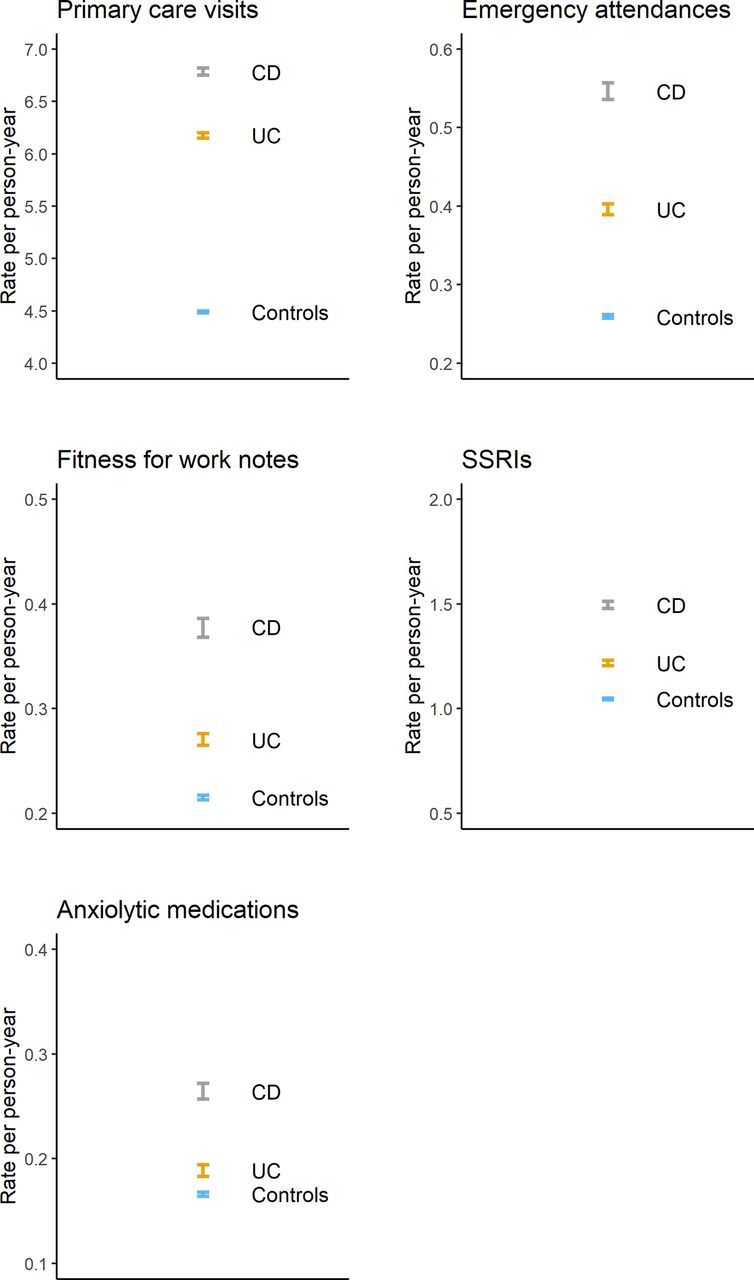
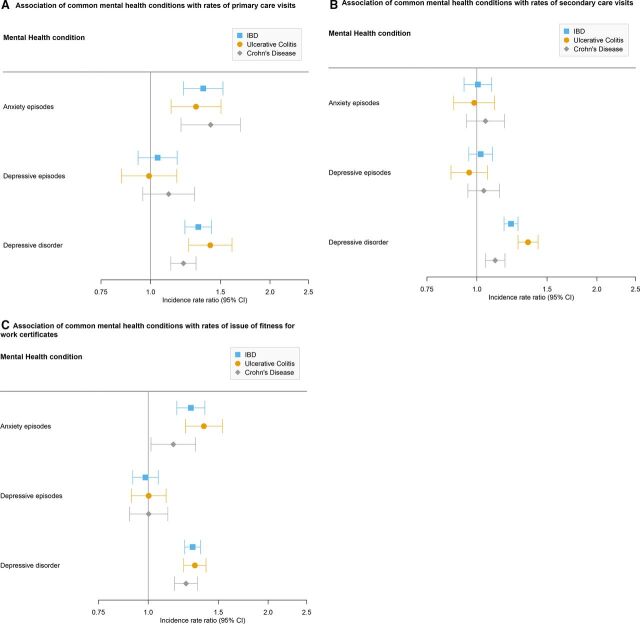
BACKGROUND: Inflammatory bowel disease (IBD) has a significant impact on quality of life for many people. OBJECTIVE: To assess the prevalence of common mental health conditions in IBD and the combined impact of IBD and mental health conditions on healthcare use and time off work. METHODS: A UK population-based primary care database (Royal College of General Practitioners Research and Surveillance Centre) was used to identify adults with IBD (n=19 011) (Crohn's disease (CD) or ulcerative colitis (UC)), and matched controls (n=76 044). Prevalences of anxiety, depressive episodes and depressive disorder recorded in primary care were assessed between 2016 and 2018. Outcomes comprised of rates of primary care visits, emergency secondary care visits, certificates for time off work, antidepressant and anxiolytic prescriptions. FINDINGS: Mental health conditions were more common in people with CD than controls: anxiety episodes (3.5% vs 3.0%; p=0.02), depressive episodes (5.7% vs 4.1%; p<0.001) and depressive disorder (17.5% vs 12.9%; p<0.001), and people with UC versus controls: depressive episodes (4.4% vs 3.6%; p<0.001) and depressive disorder (14.2% vs 12.4%; p<0.001). Healthcare utilisation rates were higher in people with IBD than controls (primary care visits incidence rate ratio 1.47 (95% CI 1.43 to 1.51); emergency secondary care visits 1.87 (1.79 to 1.95); fitness for work certificates 1.53 (1.44 to 1.62); antidepressant use 1.22 (1.13 to 1.32); anxiolytic use 1.20 (1.01 to 1.41)). In people with IBD, mental health conditions were associated with additional increases in healthcare use and time off work. CONCLUSION: Depression and anxiety are more common in people with IBD than matched controls. Healthcare utilisation and prescribing of psychotropic medications are also higher in people with IBD. Mental health conditions in people with IBD are associated with additional healthcare use and time off work. CLINICAL IMPLICATIONS: Evidence-based mental health support programmes, including psychological treatments, are needed for people with IBD.
Overview
The claims and statistics of this paper haven’t been checked yet.
Free: it reads the open-access text and checks the first 5 claims that cite a source we can check. Create a free account to check every claim.
Integrity signals
Registry
Cites
Statistics
Figures
Verification
Claims the paper makes
The claims and statistics of this paper haven’t been checked yet.
Free: it reads the open-access text and checks the first 5 claims that cite a source we can check. Create a free account to check every claim.
Claims other papers make about this one
Each is checked against this paper’s own text: does it say what the citing paper says it does?
The source backs part of the claim, not all of it — or backs it for a different population, condition or comparison.
In the citing paper
“Psychiatric disorders are 1.5 to 2 times more prevalent in persons with inflammatory bowel disease (IBD) than in the general population, with pooled prevalence estimates of 21% for clinical anxiety and 15% for depression.”
From The 2023 Impact of Inflammatory Bowel Disease in Canada: Mental Health and Inflammatory Bowel Disease (2023) · cites this paper as [3]
Experimental — accuracy not yet measured
Self-check
Percentages, sums and reported differences re-computed from the paper’s own numbers.
The self-check needs the paper’s full text.
Citations
Cites
Kessler, R. C., Chiu, W. T., Demler, O., & Walters, E. E. (2005) · Archives of General Psychiatry · doi:10.1001/archpsyc.62.6.617 · Cited by 12,052
International Statistical Classification of Diseases and Related Health Problems
Eisfeld, J. (2014) · TSQ: Transgender Studies Quarterly · doi:10.1215/23289252-2399740 · Cited by 3,570
Inflammatory bowel disease: clinical aspects and established and evolving therapies
Baumgart, D. C., & Sandborn, W. J. (2007) · The Lancet · doi:10.1016/s0140-6736(07)60751-x · Cited by 1,920
Mikocka-Walus, A., Knowles, S. R., Keefer, L., & Graff, L. (2016) · Inflammatory Bowel Diseases · doi:10.1097/mib.0000000000000620 · Cited by 567
Depression and anxiety in patients with Inflammatory Bowel Disease: a systematic review
Neuendorf, R., Harding, A., Stello, N., Hanes, D., & Wahbeh, H. (2016) · Journal of Psychosomatic Research · doi:10.1016/j.jpsychores.2016.06.001 · Cited by 561
Woodmansey, C., McGovern, A. P., McCullough, K. A., Whyte, M. B., Munro, N. M., Correa, A. C., Gatenby, P. A. C., Jones, S. A., & de Lusignan, S. (2017) · Diabetes Care · doi:10.2337/dc17-0542 · Cited by 280
Romberg-Camps, M. J. L., Bol, Y., Dagnelie, P. C., Hesselink-van de Kruijs, M. A. M., Kester, A. D. M., Engels, L. G. J. B., van Deursen, C., Hameeteman, W. H. A., Pierik, M., Wolters, F., et al. (2010) · Inflammatory Bowel Diseases · doi:10.1002/ibd.21285 · Cited by 240
Frolkis, A. D., Vallerand, I. A., Shaheen, A.-A., Lowerison, M. W., Swain, M. G., Barnabe, C., Patten, S. B., & Kaplan, G. G. (2019) · Gut · doi:10.1136/gutjnl-2018-317182 · Cited by 228
Lewis, J. D., Brensinger, C., Bilker, W. B., & Strom, B. L. (2002) · Pharmacoepidemiology and Drug Safety · doi:10.1002/pds.698 · Cited by 189 · cited 6×
“The use of diagnostic codes to identify IBD from UK primary care records has been validated and shown to be accurate and to correctly differentiate between UC and CD. 19 Read code lists used to identify UC and CD are reported in online supplemental table 1, and were based on validated UK code lists 11 19 and mapped to…”
InfluentialCorrea, A., Hinton, W., McGovern, A., van Vlymen, J., Yonova, I., Jones, S., & de Lusignan, S. (2016) · BMJ Open · doi:10.1136/bmjopen-2016-011092 · Cited by 185
Cited by
Lamb, C. A., Saifuddin, A., Powell, N., & Rieder, F. (2022) · Gastroenterology · doi:10.1053/j.gastro.2021.09.077 · Cited by 73
Yoo, J.-W., Shin, Y.-J., Ma, X., Son, Y.-H., Jang, H., Lee, C. K., & Kim, D. (2022) · Nutrients · doi:10.3390/nu14102080 · Cited by 64
“Inflammatory bowel disease (IBD) is closely connected with the outbreak of psychiatric disorders including anxiety/depression [3,4].”
BackgroundMassironi, S., Pigoni, A., Vegni, E. A. M., Keefer, L., Dubinsky, M. C., Brambilla, P., Delvecchio, G., & Danese, S. (2024) · Inflammatory Bowel Diseases · doi:10.1093/ibd/izae206 · Cited by 62
Bisgaard, T. H., Poulsen, G., Allin, K. H., Keefer, L., Ananthakrishnan, A. N., & Jess, T. (2023) · EClinicalMedicine · doi:10.1016/j.eclinm.2023.101986 · Cited by 61
Zhao, L., Wu, J., Quan, W., Zhou, Y., Hong, H., Niu, G.-Y., Li, T., Huang, S.-B., Qiao, C.-M., Zhao, W.-J., et al. (2023) · Frontiers in Immunology · doi:10.3389/fimmu.2022.1089200 · Cited by 54
Metadata
- Authors
- Irving, P., Barrett, K., Nijher, M., & de Lusignan, S.
- Affiliations
- Guy's Hospital (GB)
- New Road Surgery, Croxley Green, Hertfordshire, UK
- Pfizer (United Kingdom) (GB)
- Nuffield Department of Primary Care Health Sciences, University of Oxford, Oxford, UK
- Corresponding author
- Irving, Peter
- Venue
- Evidence-Based Mental Health
- Publisher
- BMJ
- Published
- 2021-03-30
- Volume
- 24
- Issue
- 3
- Pages
- 102-109
- ISSN
- 1362-0347 (ISSN-L)
- 1468-960X
- PMC
- PMC8311072
- OpenAlex
- W3148514631
- Cited by
- 63
- References
- 30
- Citations by year
- 2026: 9 · 2025: 13 · 2024: 13 · 2023: 15 · 2022: 13
- FWCI
- 5.80
- Type
- journal article
- Language
- en
- Open access
- hybrid
- doi.org
- Licence
- Locations
- Evidence-Based Mental Health (publishedVersion, cc-by-nc)
- PubMed Central (publishedVersion, cc-by-nc)
- PubMed (publishedVersion)
- Funders
- Pfizer (NA)
- Topics
- Health Sciences › Medicine › Gastroenterology › Inflammatory Bowel Disease
- Health Sciences › Medicine › Psychiatry and Mental health › Mental Health Treatment and Access
- Life Sciences › Neuroscience › Biological Psychiatry › Tryptophan and brain disorders
- Keywords
- inflammatory bowel disease, depression, anxiety, Crohn's disease, ulcerative colitis, health care utilization, time off work, antidepressant prescribing, anxiolytic prescribing, depressive disorders, primary care visits, psychotropic drugs, quality of life, comorbidities, work disability, matched controls, psychosocial impact
About these checks
Registry, retraction, Cites and statistics results are computed, not judged, with one exception: a printed reference that no index lists is read once by a model before it counts as a citation error. Claims are extracted by a model and kept only when their quote appears verbatim in the text; each cited source is then checked, with a model’s help, for whether it says what the claim relies on. Those verdicts can be wrong — read the claim’s quote and the cited source before relying on one.
Statistics and arithmetic are recomputed, not judged.
Confidence bands are shown only for fields calibrated on our annotated test set. None is calibrated yet, so no band is shown.
What counts as a claim ›How we measure confidence ›How we check this ›
Are you an author, or do you see a problem with this page? Request a review
How to cite
Cite CoChat for the checks on this page, and the paper for its own findings.
- This page
- CoChat. (2026). Citation check: Prevalence of depression and anxiety in people with inflammatory bowel disease and associated healthcare use: population-based cohort study. https://app.cochat.ai/papers/10.1136/ebmental-2020-300223
- The paper
- Irving, P., Barrett, K., Nijher, M., & de Lusignan, S. (2021). Prevalence of depression and anxiety in people with inflammatory bowel disease and associated healthcare use: population-based cohort study. Evidence-Based Mental Health. https://doi.org/10.1136/ebmental-2020-300223
Data sources
Bibliographic data: Semantic Scholar, OpenAlex, Crossref.
Contains information from the Semantic Scholar Academic Graph Datasets, made available under the ODC Attribution License (ODC-BY 1.0).
Semantic Scholar’s data is described in: Kinney, R., et al. (2023). The Semantic Scholar Open Data Platform. arXiv:2301.10140.
