

Prevalence of depression and anxiety in people with inflammatory bowel disease and associated healthcare use: population-based cohort study
Open accessThe DOI matches its Crossref record; 30 of the 30 references it cites were found in a registry or an index.
Abstract
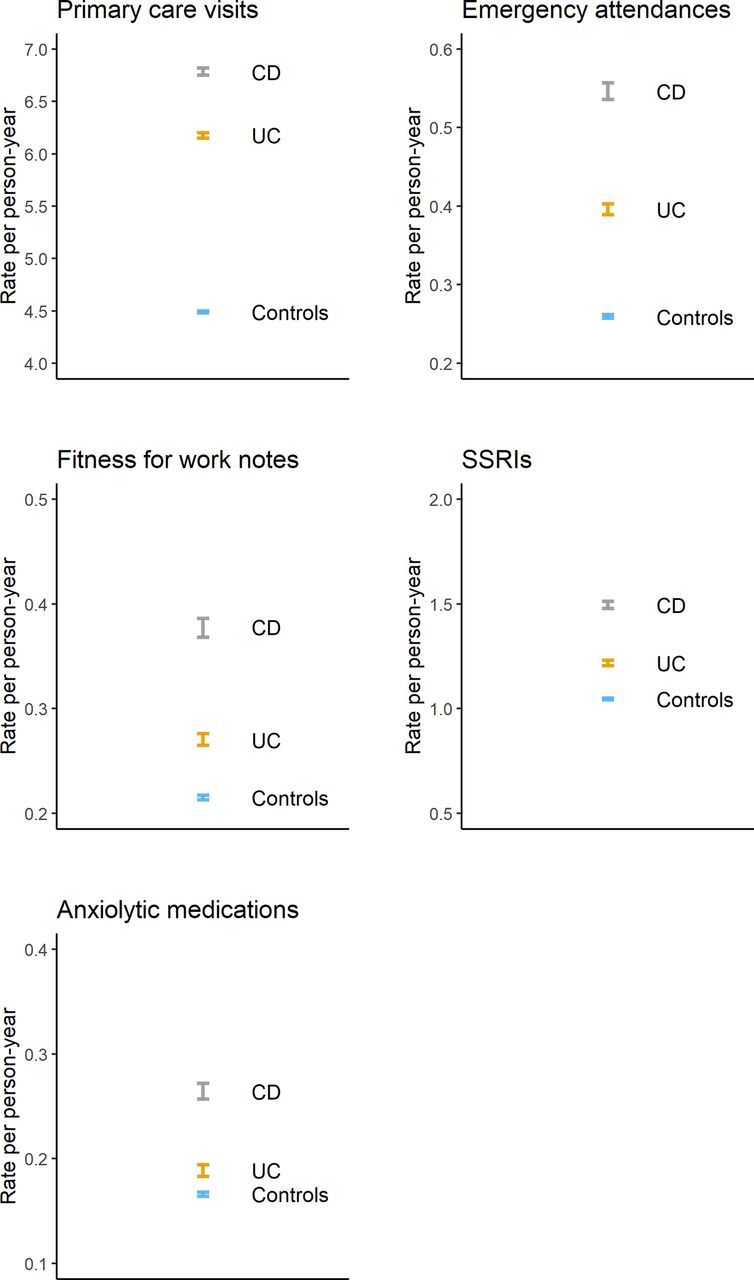
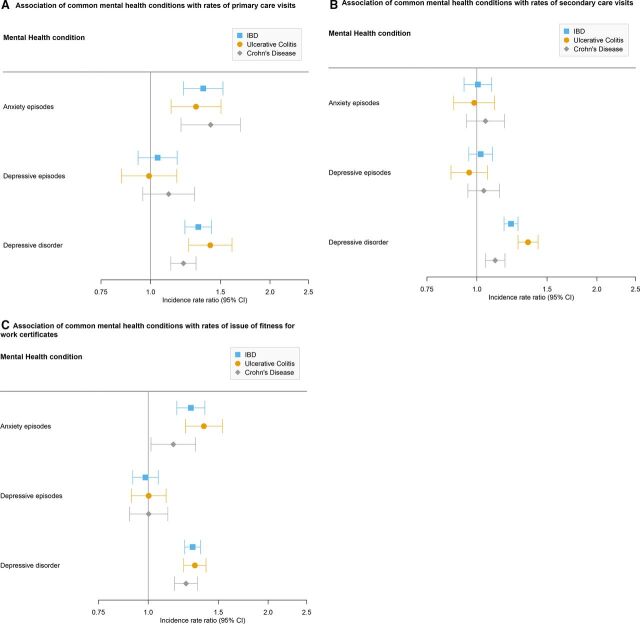
BACKGROUND: Inflammatory bowel disease (IBD) has a significant impact on quality of life for many people. OBJECTIVE: To assess the prevalence of common mental health conditions in IBD and the combined impact of IBD and mental health conditions on healthcare use and time off work. METHODS: A UK population-based primary care database (Royal College of General Practitioners Research and Surveillance Centre) was used to identify adults with IBD (n=19 011) (Crohn's disease (CD) or ulcerative colitis (UC)), and matched controls (n=76 044). Prevalences of anxiety, depressive episodes and depressive disorder recorded in primary care were assessed between 2016 and 2018. Outcomes comprised of rates of primary care visits, emergency secondary care visits, certificates for time off work, antidepressant and anxiolytic prescriptions. FINDINGS: Mental health conditions were more common in people with CD than controls: anxiety episodes (3.5% vs 3.0%; p=0.02), depressive episodes (5.7% vs 4.1%; p<0.001) and depressive disorder (17.5% vs 12.9%; p<0.001), and people with UC versus controls: depressive episodes (4.4% vs 3.6%; p<0.001) and depressive disorder (14.2% vs 12.4%; p<0.001). Healthcare utilisation rates were higher in people with IBD than controls (primary care visits incidence rate ratio 1.47 (95% CI 1.43 to 1.51); emergency secondary care visits 1.87 (1.79 to 1.95); fitness for work certificates 1.53 (1.44 to 1.62); antidepressant use 1.22 (1.13 to 1.32); anxiolytic use 1.20 (1.01 to 1.41)). In people with IBD, mental health conditions were associated with additional increases in healthcare use and time off work. CONCLUSION: Depression and anxiety are more common in people with IBD than matched controls. Healthcare utilisation and prescribing of psychotropic medications are also higher in people with IBD. Mental health conditions in people with IBD are associated with additional healthcare use and time off work. CLINICAL IMPLICATIONS: Evidence-based mental health support programmes, including psychological treatments, are needed for people with IBD.
Overview
The claims and statistics of this paper haven’t been checked yet.
Free: it reads the open-access text and checks the first 5 claims that cite a source we can check. Create a free account to check every claim.
Integrity signals
Registry
Cites
Statistics
Figures
Verification
Claims the paper makes
The claims and statistics of this paper haven’t been checked yet.
Free: it reads the open-access text and checks the first 5 claims that cite a source we can check. Create a free account to check every claim.
Claims other papers make about this one
Each is checked against this paper’s own text: does it say what the citing paper says it does?
The source backs part of the claim, not all of it — or backs it for a different population, condition or comparison.
In the citing paper
“Psychiatric disorders are 1.5 to 2 times more prevalent in persons with inflammatory bowel disease (IBD) than in the general population, with pooled prevalence estimates of 21% for clinical anxiety and 15% for depression.”
From The 2023 Impact of Inflammatory Bowel Disease in Canada: Mental Health and Inflammatory Bowel Disease (2023) · cites this paper as [3]
Experimental — accuracy not yet measured
Self-check
Percentages, sums and reported differences re-computed from the paper’s own numbers.
The self-check needs the paper’s full text.
Citations
Cites
Kessler, R. C., Chiu, W. T., Demler, O., & Walters, E. E. (2005) · Archives of General Psychiatry · doi:10.1001/archpsyc.62.6.617 · Cited by 12,052
International Statistical Classification of Diseases and Related Health Problems
Eisfeld, J. (2014) · TSQ: Transgender Studies Quarterly · doi:10.1215/23289252-2399740 · Cited by 3,570
Inflammatory bowel disease: clinical aspects and established and evolving therapies
Baumgart, D. C., & Sandborn, W. J. (2007) · The Lancet · doi:10.1016/s0140-6736(07)60751-x · Cited by 1,920
Mikocka-Walus, A., Knowles, S. R., Keefer, L., & Graff, L. (2016) · Inflammatory Bowel Diseases · doi:10.1097/mib.0000000000000620 · Cited by 567
Depression and anxiety in patients with Inflammatory Bowel Disease: a systematic review
Neuendorf, R., Harding, A., Stello, N., Hanes, D., & Wahbeh, H. (2016) · Journal of Psychosomatic Research · doi:10.1016/j.jpsychores.2016.06.001 · Cited by 561
Woodmansey, C., McGovern, A. P., McCullough, K. A., Whyte, M. B., Munro, N. M., Correa, A. C., Gatenby, P. A. C., Jones, S. A., & de Lusignan, S. (2017) · Diabetes Care · doi:10.2337/dc17-0542 · Cited by 280
Romberg-Camps, M. J. L., Bol, Y., Dagnelie, P. C., Hesselink-van de Kruijs, M. A. M., Kester, A. D. M., Engels, L. G. J. B., van Deursen, C., Hameeteman, W. H. A., Pierik, M., Wolters, F., et al. (2010) · Inflammatory Bowel Diseases · doi:10.1002/ibd.21285 · Cited by 240
Frolkis, A. D., Vallerand, I. A., Shaheen, A.-A., Lowerison, M. W., Swain, M. G., Barnabe, C., Patten, S. B., & Kaplan, G. G. (2019) · Gut · doi:10.1136/gutjnl-2018-317182 · Cited by 228
Lewis, J. D., Brensinger, C., Bilker, W. B., & Strom, B. L. (2002) · Pharmacoepidemiology and Drug Safety · doi:10.1002/pds.698 · Cited by 189 · cited 6×
“The use of diagnostic codes to identify IBD from UK primary care records has been validated and shown to be accurate and to correctly differentiate between UC and CD. 19 Read code lists used to identify UC and CD are reported in online supplemental table 1, and were based on validated UK code lists 11 19 and mapped to…”
InfluentialCorrea, A., Hinton, W., McGovern, A., van Vlymen, J., Yonova, I., Jones, S., & de Lusignan, S. (2016) · BMJ Open · doi:10.1136/bmjopen-2016-011092 · Cited by 185
Cited by
Lamb, C. A., Saifuddin, A., Powell, N., & Rieder, F. (2022) · Gastroenterology · doi:10.1053/j.gastro.2021.09.077 · Cited by 73
Yoo, J.-W., Shin, Y.-J., Ma, X., Son, Y.-H., Jang, H., Lee, C. K., & Kim, D. (2022) · Nutrients · doi:10.3390/nu14102080 · Cited by 64
“Inflammatory bowel disease (IBD) is closely connected with the outbreak of psychiatric disorders including anxiety/depression [3,4].”
BackgroundMassironi, S., Pigoni, A., Vegni, E. A. M., Keefer, L., Dubinsky, M. C., Brambilla, P., Delvecchio, G., & Danese, S. (2024) · Inflammatory Bowel Diseases · doi:10.1093/ibd/izae206 · Cited by 62
Bisgaard, T. H., Poulsen, G., Allin, K. H., Keefer, L., Ananthakrishnan, A. N., & Jess, T. (2023) · EClinicalMedicine · doi:10.1016/j.eclinm.2023.101986 · Cited by 61
Zhao, L., Wu, J., Quan, W., Zhou, Y., Hong, H., Niu, G.-Y., Li, T., Huang, S.-B., Qiao, C.-M., Zhao, W.-J., et al. (2023) · Frontiers in Immunology · doi:10.3389/fimmu.2022.1089200 · Cited by 54
Umar, N., King, D. S., Chandan, J. S., Bhala, N. B., Nirantharakumar, K., Adderley, N. J., Zemedikun, D. T., Harvey, P., & Trudgill, N. J. (2022) · Alimentary Pharmacology & Therapeutics · doi:10.1111/apt.17110 · Cited by 51
Constipation preceding depression: a population-based cohort study
Yun, Q., Wang, S., Chen, S., Luo, H., Li, B., YIP, P. S. F., Yu, X., Yang, Z., Sha, F., & Tang, J.-L. (2024) · EClinicalMedicine · doi:10.1016/j.eclinm.2023.102371 · Cited by 54
Arp, L., Jansson, S., Wewer, V., & Burisch, J. (2022) · Journal of Crohn's and Colitis · doi:10.1093/ecco-jcc/jjac095 · Cited by 38
Psychological burden and quality of life in newly diagnosed inflammatory bowel disease patients
Bernabeu, P., Belén-Galipienso, O., Hofstadt, C. V.-D., Gutiérrez, A., Madero-Velázquez, L., del Castillo, G. G., Garcia-Sepulcre, M. F., Aguas, M., Zapater, P., Marín, J. R., et al. (2024) · Frontiers in Psychology · doi:10.3389/fpsyg.2024.1334308 · Cited by 47
Hinnant, L., Rios Villacorta, N., Chen, E., Bacchus, D., Dotson, J., Greywoode, R., Keefer, L., Lupe, S., Maggs, L., Meek, G., et al. (2025) · Inflammatory Bowel Diseases · doi:10.1093/ibd/izae151 · Cited by 31
“The literature is clear that many patients with IBD have a higher risk of experiencing symptoms of anxiety and depression 3,4 and will need support to normalize and manage those symptoms.”
Ma, X., Park, H.-S., Shin, Y.-J., Kim, J.-K., Hong, J. K., Han, S.-W., Yoon, I., & Kim, D. (2024) · Journal of Neuroinflammation · doi:10.1186/s12974-024-03211-7 · Cited by 32
“Depression and anxiety (DA) are the most common mental disorders [1].”
BackgroundGraff, L. A., Geist, R., Kuenzig, M. E., Benchimol, E. I., Kaplan, G. G., Windsor, J. W., Bitton, A., Coward, S., Jones, J. L., Lee, K., et al. (2023) · Journal of the Canadian Association of Gastroenterology · doi:10.1093/jcag/gwad012 · Cited by 30
“92), as well as higher prevalence of these mental health conditions overall (2,3).”
BackgroundClark, C., Richiardi, J., Maréchal, B., Bowman, G. L., Dayon, L., & Popp, J. (2022) · Journal of Neuroinflammation · doi:10.1186/s12974-022-02473-3 · Cited by 34
Zhang, J., Liu, C., An, P., Chen, M., Wei, Y., Li, J., Zeng, S., Xiang, D., Cai, Y., Li, J., et al. (2024) · United European Gastroenterology Journal · doi:10.1002/ueg2.12532 · Cited by 39
“However, among Western countries, a UK study 40 showed a higher prevalence of anxiety ‐ depression in CD than in UC, and a systematic review in Spain 41 showed a higher prevalence of anxiety ‐ depression in CD than in UC among adults.”
BackgroundZhao, L., Wu, J., Quan, W., Zhou, Y., Hong, H., Niu, G.-Y., Ting-Li, Huang, S.-B., Qiao, C.-M., Zhao, W.-J., et al. (2023) · The Journal of Nutritional Biochemistry · doi:10.1016/j.jnutbio.2023.109282 · Cited by 29
Prebiotics for depression: how does the gut microbiota play a role?
Yang, Y., Bi, Z., Zhang, S., Si, L., Liu, X., & Li, F. (2023) · Frontiers in Nutrition · doi:10.3389/fnut.2023.1206468 · Cited by 39
Liu, C., Zhang, J., Chen, M., An, P., Xiang, J., Yu, R., Zeng, S., Wei, S., Deng, B., Liu, Z., et al. (2023) · Journal of Clinical Medicine · doi:10.3390/jcm12051791 · Cited by 24
“Studies have shown that IBD patients are more likely than the general population to suffer from psychological problems, such as anxiety and depression [23].”
BackgroundLiu, C., Zhu, S., Zhang, J., Ren, K., Li, K., & Yu, J. (2023) · Frontiers in Immunology · doi:10.3389/fimmu.2023.1154746 · Cited by 22
Qin, X., Pan, C., Cai, Q., Zhao, Y., He, D., Wei, W., Zhang, N., Shi, S., Chu, X., & Zhang, F. (2022) · Brain Behavior & Immunity - Health · doi:10.1016/j.bbih.2022.100557 · Cited by 22
Benefits and Challenges of Treat-to-Target in Inflammatory Bowel Disease
West, J., Tan, K., Devi, J., Macrae, F., Christensen, B., & Segal, J. P. (2023) · Journal of Clinical Medicine · doi:10.3390/jcm12196292 · Cited by 28
“Patients with IBD are disproportionately affected by psychological co-morbidity, especially in the form of anxiety and depressive disorders [51,52].”
BackgroundLee, D.-Y., Baek, J.-S., Shin, Y.-J., & Kim, D. H. (2024) · Nutrients · doi:10.3390/nu16213711 · Cited by 23
“Systemic inflammation including gut inflammation induces DA [27,28].”
Bommena, S., Goldberg, A., Amini, M., & Alishahi, Y. (2022) · Inflammatory Bowel Diseases · doi:10.1093/ibd/izac245 · Cited by 19
Transition Readiness in Youth with Inflammatory Bowel Disease
Foster, A., Chan, J. M., Wine, E., El‐Matary, W., Carroll, M. W., Kroeker, K. I., deBruyn, J. C. C., Seow, C. H., Lawrence, S. J., Evans, K., et al. (2023) · The Journal of Pediatrics · doi:10.1016/j.jpeds.2023.113403 · Cited by 15
Lund, K., Zegers, F. D., Nielsen, J., Brodersen, J. B., Knudsen, T., Kjeldsen, J., Larsen, M. D., & Nørgård, B. M. (2023) · Inflammatory Bowel Diseases · doi:10.1093/ibd/izad244 · Cited by 14
Wang, S., Tan, C., Liu, C., Liu, Z., Jiang, C., Shi, J., Wu, K., Dong, W., & Psychology Club of Inflammatory Bowel Disease Group, C. S. O. G. (2023) · Gastroenterology report · doi:10.1093/gastro/goae019 · Cited by 13
“The presence of these negative emotional states, along with sleep disturbance, has emerged as a significant risk factor that profoundly impacts the quality of life and long-term prognosis of IBD patients [25].”
BackgroundMercuri, C., Giordano, V., Bosco, V., Serra, N., Spagnuolo, R., Nocerino, R., Rea, T., Colaci, C., Guillari, A., Doldo, P., et al. (2024) · Healthcare · doi:10.3390/healthcare12242538 · Cited by 16
IBD-related mental health disorders: where do we go from here?
Gomez, D. A., Ahmad-waqar, M., Brookes, M., & Kumar, A. (2023) · Frontline Gastroenterology · doi:10.1136/flgastro-2023-102403 · Cited by 17
Cooney, R. M., Barrett, K. J., & Russell, R. K. (2024) · BMJ Open · doi:10.1136/bmjopen-2023-080408 · Cited by 11
Self-citationEnns, M. W., Bernstein, C. N., Graff, L. A., Lix, L. M., Hitchon, C. A., Fisk, J. D., Dufault, B., & Marrie, R. A. (2023) · Journal of Psychosomatic Research · doi:10.1016/j.jpsychores.2023.111473 · Cited by 10
Cai, A., Shen, D., Xiong, Q., Li, S., Qiu, C., Li, L., Chen, Z., Lin, X., Yao, Q., Zhang, Y., et al. (2025) · Behavioral and Brain Functions · doi:10.1186/s12993-025-00283-0 · Cited by 8
Horovitz, O. (2025) · Frontiers in Nutrition · doi:10.3389/fnut.2025.1592528 · Cited by 12
Spagnuolo, R., Basile, A., Corea, A., Iaquinta, F. S., Milić, N., Doldo, P., Luzza, F., & Abenavoli, L. (2022) · Reviews on Recent Clinical Trials · doi:10.2174/1574887117666220628151256 · Cited by 8
Dysbiosis: A Potential Precursor to the Development of a Depressive Disorder
Chung, S.-Y., Kostev, K., & Tanislav, C. (2022) · Healthcare · doi:10.3390/healthcare10081503 · Cited by 12
“In patients with irritable bowel syndrome, the prevalence of depression was found to be around 25% [22].”
BackgroundPsychobiotics and Dietary Supplementation in the Clinical Practice: A Mini Review
Jurek, J. M., & Owczarek, M. (2022) · Journal of Biomedical Research & Environmental Sciences · doi:10.37871/jbres1560 · Cited by 4
Zeng, C., Zhu, Q., Peng, W., Huang, C., Chen, H., Huang, H., Zhou, Y., & Zhao, C. (2024) · Journal of Pharmacology and Experimental Therapeutics · doi:10.1124/jpet.124.002207 · Cited by 6
Kim, J. K., & Cheon, J. H. (2022) · Journal of Yeungnam Medical Science · doi:10.12701/jyms.2022.00031 · Cited by 4
“showed contrasting results, anxiety episodes were more prevalent [13], and the proportion of complementary and alternative medicine users was higher among patients with CD than among those with UC [14].”
ResultHolistic care in inflammatory bowel disease: is it in REACH?
Said, H., Moulton, C. D., Hart, A. L., & Keefer, L. (2026) · Journal of Crohn s and Colitis · doi:10.1093/ecco-jcc/jjaf227 · Cited by 3
Prevalence and risk factors of depression among patients with perianal fistulizing Crohn’s disease
Li, J., Ng, W., Qiao, L., Yuan, F., Lan, X., Zhu, L.-B., Yang, B., & Wang, Z.-Q. (2024) · World Journal of Psychiatry · doi:10.5498/wjp.v14.i5.715 · Cited by 3
Outcomes Associated With Anti‐Depressant Use in Patients With Inflammatory Bowel Disease
Kochar, B. D., Chaaban, L., Kobeissi, L., Fuss, A., Challa, P. K., Melia, J., & Ananthakrishnan, A. N. (2025) · Alimentary Pharmacology & Therapeutics · doi:10.1111/apt.70229 · Cited by 3
Goodwin, E., do Valle, H. A., Nitschke, A. S., Puyat, J. H., Yong, P. J., & Hanley, G. E. (2023) · Women s Health Reports · doi:10.1089/whr.2023.0068 · Cited by 3
MacDonald, M., Heisler, C., Willett, N., Rohatinsky, N., Farina, S., Stewart, M., Vallis, M., Shepherd, T., Currie, B., Robar, J., et al. (2025) · Journal of the Canadian Association of Gastroenterology · doi:10.1093/jcag/gwaf024 · Cited by 2
Goodwin, E., do Valle, H. A., Nitschke, A. S., Puyat, J. H., Yong, P. J., & Hanley, G. E. (2025) · BMC Women s Health · doi:10.1186/s12905-025-04022-5 · Cited by 4
“Research has shown that individuals with similar chronic and inflammatory conditions (such as inflammatory bowel disease), report higher prevalence of depression and anxiety [31–33].”
Mulders, L. G. M., Beek, K. J., Tielbeek, J. A. W., Zwart, M., Rietdijk, S. T., Jansen, J. M., Wildenberg, M. E., van Hulst, R. A., Stoker, J., Bemelman, W. A., et al. (2025) · Clinical Gastroenterology and Hepatology · doi:10.1016/j.cgh.2025.12.016 · Cited by 2
Jaksic, D., Vuksanovic, S., Topličanin, A., Spiric-Milovancevic, J., Maric, G. D., & Sokić-Milutinović, A. (2025) · Life · doi:10.3390/life15040612 · Cited by 2
“In patients with an IBD, the prevalence of anxiety is 20.5% and the prevalence of depression is 21.2%, which are higher than those of healthy controls [12,13].”
InfluentialTang, H., Jiang, P., & Chen, J. (2025) · Dementia and Geriatric Cognitive Disorders Extra · doi:10.1159/000548720 · Cited by 1
“These experimental findings are corroborated by clinical observations that NPSs and cognitive impairment frequently co-occur and progress together in neurodegenerative diseases, especially in chronic inflammatory conditions [7, 8].”
Lu, K., Tang, A., Liu, Y., Li, L., Fang, R., Zhang, S., Chen, Y., & Cao, F. (2026) · Neuropsychiatric Disease and Treatment · doi:10.2147/ndt.s584034 · Cited by 2
“160 The fundamental mechanism underlying this association is intricately linked to the regulation of the gut-brain axis.”
Influence of the Gut-Brain Axis on Psychiatric Comorbidity in Inflammatory Bowel Disease
Borrego-Ruiz, A., & Borrego, J. J. (2026) · Psychiatry International · doi:10.3390/psychiatryint7020052 · Cited by 3
Tadić, V., Batrićević, A., & Zaric, D. (2026) · Health Psychology Report · doi:10.5114/hpr/218405 · Cited by 2
“Despite major therapeutic advances, individuals with IBD continue to experience marked reductions in psychological well-being and social functioning (By-ron et al., 2020; Gomez et al., 2023; Irving et al., 2021).”
Du, H., Du, G., Zhang, Q., Zhao, Y., Fan, J., Zhou, Y., Sun, Z., Li, C., & Li, W. (2026) · Depression and Anxiety · doi:10.1155/da/7688691 · Cited by 2
Cai, Q., Zhang, H., Qin, X., He, D., Zhao, Y., Wei, W., Chu, X., Shi, S., Zhang, N., Li, C., et al. (2022) · Research Square · doi:10.21203/rs.3.rs-1695595/v1
CO-OCCURRENCE OF INFLAMMATORY BOWEL DISEASE AND PSYCHIATRIC DISEASES
Bisgaard, T. H. (2023) · VBN Forskningsportal (Aalborg Universitet) · doi:10.54337/aau614553280 · Cited by 2
The frequency of anxiety-depressive syndrome in children with inflammatory bowel diseases
Sorokman, Т. V., Chernei, N. Y., Makarova, O. V., & Kolіesnik, D. І. (2024) · Modern pediatrics Ukraine · doi:10.15574/sp.2024.137.101
Noise is a Risk Factor for Patients with Ulcerative Colitis and Anxiety
Zhu, J., Ren, X., He, S., Mi, C., Zhang, L., Zhou, D., & Luo, M. (2024) · Noise and Health · doi:10.4103/nah.nah_51_24
Chauhan, U., Stretton, J., & Watson, M. (2025) · Springer eBooks · doi:10.1007/978-3-031-87503-8_54
Rimmer, P. J., Stoica, V., Ibrahim, M., Javed, A., Hazel, K., Owusu, M., Regan-Komito, D., Cooney, R. M., Iqbal, A. J., Chapple, I., et al. (2025) · Frontiers in Gastroenterology · doi:10.3389/fgstr.2025.1642061 · Cited by 2
Adolescent Crohn’s disease: A nursing case report
Wang, X., Zhang, N., & Ma, H. (2025) · Medicine · doi:10.1097/md.0000000000046251
“[17] In adolescents with CD, unpredictable disease onset, intestinal symptoms, complex treatment protocols, and therapeutic side effects cause significant distress to adolescents and parents.”
Clark, C., Richiardi, J., Maréchal, B., Bowman, G. L., Dayon, L., & Popp, J. (2022) · Figshare · doi:10.6084/m9.figshare.19921025
Psychological factors of quality of life in patients with inflammatory bowel diseases
Gorbenkova, O. A., & Ilich, M. (2025) · Journal of Modern Foreign Psychology · doi:10.17759/jmfp.2025140411
Experiences and perceptions of IBD-related psychological distress in persons living with IBD
Willett, N., Heisler, C., Rohatinsky, N., Farina, S., Stewart, M., Shepherd, T., Currie, B., Phalen-Kelly, K., Robar, J., Huard, T., et al. (2026) · Journal of the Canadian Association of Gastroenterology · doi:10.1093/jcag/gwag009
Riggott, C., Fairbrass, K. M., Guthrie, E., Black, C. J., Selinger, C. P., Ford, A. C., & Gracie, D. J. (2026) · Alimentary Pharmacology & Therapeutics · doi:10.1111/apt.70673
Short-term psychiatric outcomes after ostomy vs nonostomy surgery in biologic-treated IBD patients
Clarke, K., Orbe, V., Dalessio, S., Kulaylat, A. S., & Coates, M. D. (2026) · Inflammatory Bowel Diseases · doi:10.1093/ibd/izag164
Napolitano, D., Bozzetti, M., Cascio, A. L., Orgiana, N., Parello, S., D’Onofrio, A. M., Autullo, G., Camardese, G., Mazza, M., Marano, G., et al. (2026) · Psychiatric Quarterly · doi:10.1007/s11126-026-10306-2
Pathan, R. M., Ghanta, S., Bade, P. G. T., Kommu, M. R. K., Kondepati, V. K., Gangavarapu, N. K., Navuluri, L. T., Munipally, S. T., & Lakkakula, P. (2026) · The Egyptian Journal of Internal Medicine · doi:10.1186/s43162-026-00718-8
Metadata
- Authors
- Irving, P., Barrett, K., Nijher, M., & de Lusignan, S.
- Affiliations
- Guy's Hospital (GB)
- New Road Surgery, Croxley Green, Hertfordshire, UK
- Pfizer (United Kingdom) (GB)
- Nuffield Department of Primary Care Health Sciences, University of Oxford, Oxford, UK
- Corresponding author
- Irving, Peter
- Venue
- Evidence-Based Mental Health
- Publisher
- BMJ
- Published
- 2021-03-30
- Volume
- 24
- Issue
- 3
- Pages
- 102-109
- ISSN
- 1362-0347 (ISSN-L)
- 1468-960X
- PMC
- PMC8311072
- OpenAlex
- W3148514631
- Cited by
- 63
- References
- 30
- Citations by year
- 2026: 9 · 2025: 13 · 2024: 13 · 2023: 15 · 2022: 13
- FWCI
- 5.80
- Type
- journal article
- Language
- en
- Open access
- hybrid
- doi.org
- Licence
- Locations
- Evidence-Based Mental Health (publishedVersion, cc-by-nc)
- PubMed Central (publishedVersion, cc-by-nc)
- PubMed (publishedVersion)
- Funders
- Pfizer (NA)
- Topics
- Health Sciences › Medicine › Gastroenterology › Inflammatory Bowel Disease
- Health Sciences › Medicine › Psychiatry and Mental health › Mental Health Treatment and Access
- Life Sciences › Neuroscience › Biological Psychiatry › Tryptophan and brain disorders
- Keywords
- inflammatory bowel disease, depression, anxiety, Crohn's disease, ulcerative colitis, health care utilization, time off work, antidepressant prescribing, anxiolytic prescribing, depressive disorders, primary care visits, psychotropic drugs, quality of life, comorbidities, work disability, matched controls, psychosocial impact
About these checks
Registry, retraction, Cites and statistics results are computed, not judged, with one exception: a printed reference that no index lists is read once by a model before it counts as a citation error. Claims are extracted by a model and kept only when their quote appears verbatim in the text; each cited source is then checked, with a model’s help, for whether it says what the claim relies on. Those verdicts can be wrong — read the claim’s quote and the cited source before relying on one.
Statistics and arithmetic are recomputed, not judged.
Confidence bands are shown only for fields calibrated on our annotated test set. None is calibrated yet, so no band is shown.
What counts as a claim ›How we measure confidence ›How we check this ›
Are you an author, or do you see a problem with this page? Request a review
Data sources
Bibliographic data: Semantic Scholar, OpenAlex, Crossref.
Contains information from the Semantic Scholar Academic Graph Datasets, made available under the ODC Attribution License (ODC-BY 1.0).
Semantic Scholar’s data is described in: Kinney, R., et al. (2023). The Semantic Scholar Open Data Platform. arXiv:2301.10140.
