

The DOI matches its Crossref record; 30 of the 30 references it cites were found in a registry or an index.
Semistructured interviewing in primary care research: a balance of relationship and rigour
Open accessAbstract
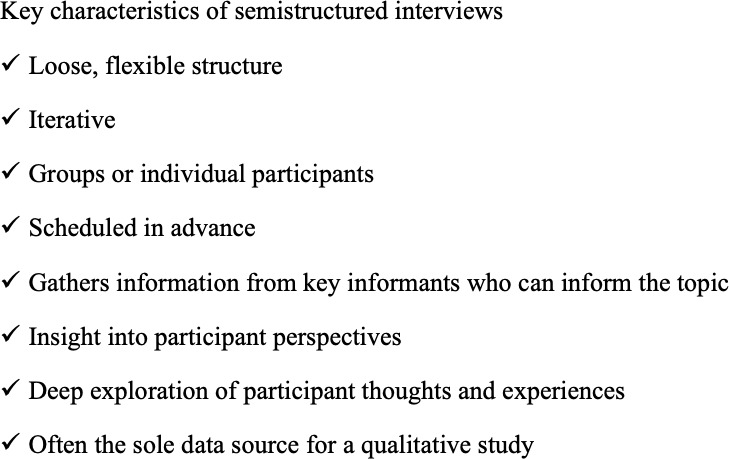
Semistructured in-depth interviews are commonly used in qualitative research and are the most frequent qualitative data source in health services research. This method typically consists of a dialogue between researcher and participant, guided by a flexible interview protocol and supplemented by follow-up questions, probes and comments. The method allows the researcher to collect open-ended data, to explore participant thoughts, feelings and beliefs about a particular topic and to delve deeply into personal and sometimes sensitive issues. The purpose of this article was to identify and describe the essential skills to designing and conducting semistructured interviews in family medicine and primary care research settings. We reviewed the literature on semistructured interviewing to identify key skills and components for using this method in family medicine and primary care research settings. Overall, semistructured interviewing requires both a relational focus and practice in the skills of facilitation. Skills include: (1) determining the purpose and scope of the study; (2) identifying participants; (3) considering ethical issues; (4) planning logistical aspects; (5) developing the interview guide; (6) establishing trust and rapport; (7) conducting the interview; (8) memoing and reflection; (9) analysing the data; (10) demonstrating the trustworthiness of the research; and (11) presenting findings in a paper or report. Semistructured interviews provide an effective and feasible research method for family physicians to conduct in primary care research settings. Researchers using semistructured interviews for data collection should take on a relational focus and consider the skills of interviewing to ensure quality. Semistructured interviewing can be a powerful tool for family physicians, primary care providers and other health services researchers to use to understand the thoughts, beliefs and experiences of individuals. Despite the utility, semistructured interviews can be intimidating and challenging for researchers not familiar with qualitative approaches. In order to elucidate this method, we provide practical guidance for researchers, including novice researchers and those with few resources, to use semistructured interviewing as a data collection strategy. We provide recommendations for the essential steps to follow in order to best implement semistructured interviews in family medicine and primary care research settings.
Overview
The claims and statistics of this paper haven’t been checked yet.
Run the check — free, no account needed. It reads the open-access text and checks the sources it cites.
Integrity signals
Registry
Cites
Statistics
Figures
Verification
Claims the paper makes
The claims and statistics of this paper haven’t been checked yet.
Run the check — free, no account needed. It reads the open-access text and checks the sources it cites.
Claims other papers make about this one
Each is checked against this paper’s own text: does it say what the citing paper says it does?
The cited source says what the claim attributes to it.
In the citing paper
“Individual semi-structured interviews enabled consistent exploration of common topics while allowing follow-up questions when participants introduced unexpected examples or distinctions (DeJonckheere & Vaughn, 2019).”
From Between Co-Intelligence and Cognitive Offloading: Educators’ Perspectives from Dutch Academic Medical Settings on Generative AI, Critical Thinking, and Adult Professional Learning (2026) · cites this paper as DeJonckheere & Vaughn, 2019
Self-check
Percentages, sums and reported differences re-computed from the paper’s own numbers.
The self-check needs the paper’s full text.
Citations
Cites
Qualitative Data Analysis: An Expanded Sourcebook
(1994) · Journal of Environmental Psychology · doi:10.1016/s0272-4944(05)80231-2 · Cited by 48,420
Lincoln, Y. S., Guba, E. G., & Pilotta, J. J. (1985) · International Journal of Intercultural Relations · doi:10.1016/0147-1767(85)90062-8 · Cited by 45,787
How Many Interviews Are Enough?: An Experiment with Data Saturation and Variability
Guest, G., Bunce, A., & Johnson, L. (2006) · Field Methods · doi:10.1177/1525822x05279903 · Cited by 20,808
(2008) · Springer eBooks · doi:10.1007/978-0-387-77282-0_6 · Cited by 17,411
(2017) · Cited by 16,036
Sample Size in Qualitative Interview Studies: Guided by Information Power
Malterud, K., Siersma, V. D., & Guassora, A. D. (2016) · Qualitative Health Research · doi:10.1177/1049732315617444 · Cited by 12,703
Strategies for ensuring trustworthiness in qualitative research projects
Shenton, A. K. (2004) · Education for Information · doi:10.3233/efi-2004-22201 · Cited by 9,748
(2017) · Sage eBooks · doi:10.4135/9781483381411.n168 · Cited by 8,268
The qualitative research interview
DiCicco‐Bloom, B., & Crabtree, B. F. (2006) · Medical Education · doi:10.1111/j.1365-2929.2006.02418.x · Cited by 4,995
Kallio, H., Pietilä, A., Johnson, M., & Kangasniemi, M. (2016) · Journal of Advanced Nursing · doi:10.1111/jan.13031 · Cited by 4,295
Doing Qualitative Research in Education Settings
(2002) · doi:10.1353/book4583 · Cited by 3,502
Advantages and disadvantages of four interview techniques in qualitative research
Opdenakker, R. R. (2006) · Forum qualitative Sozialforschung · doi:10.17169/fqs-7.4.175 · Cited by 1,543
What is Qualitative Interviewing?
Edwards, R., & Holland, J. (2013) · Bloomsbury Publishing Plc eBooks · doi:10.5040/9781472545244 · Cited by 899
Qualitative Research: A Personal Skills Approach
Shank, G. D. (2001) · Cited by 841
Forman, J., & Damschroder, L. (2007) · Advances in Bioethics · doi:10.1016/s1479-3709(07)11003-7 · Cited by 808
Semi-structured interviews: guidance for novice researchers
Whiting, L. S. (2008) · Nursing Standard · doi:10.7748/ns2008.02.22.23.35.c6420 · Cited by 615
Interviewing for Qualitative Inquiry: A Relational Approach
Josselson, R. (2013) · Cited by 403
Anderson, K., & Jack, D. C. (2002) · Routledge eBooks · doi:10.4324/9780203435960-18 · Cited by 310
LEARNING TO LISTEN: INTERVIEW TECHNIQUES AND ANALYSES
Wilton, J. (2015) · Routledge eBooks · doi:10.4324/9781315671833-20 · Cited by 194
Watkins, D. C. (2012) · Health Promotion Practice · doi:10.1177/1524839912437370 · Cited by 171
Saigal, P., Takemura, Y. C., Nishiue, T., & Fetters, M. D. (2007) · BMC Medical Education · doi:10.1186/1472-6920-7-31 · Cited by 170
GPs’ perceptions of workload in England: a qualitative interview study
Croxson, C. H. D., Ashdown, H. F., & Hobbs, R. F. (2017) · British Journal of General Practice · doi:10.3399/bjgp17x688849 · Cited by 114
Britten, N. (2006) · doi:10.1002/9780470750841.ch2 · Cited by 98
Fundamentals of qualitative analysis in family medicine
Babchuk, W. A. (2019) · Family Medicine and Community Health · doi:10.1136/fmch-2018-000040 · Cited by 91
Interventions for Risk for Suicide and Risk for Violence
Smochek, M. R., Oblaczynski, C., Lauck, D. L., Green, P. T., Early, J. A., & Smith, J. E. (2000) · International Journal of Nursing Terminologies and Classifications · doi:10.1111/j.1744-618x.2000.tb00391.x · Cited by 65
Chang, T., Llanes, M., Gold, K. J., & Fetters, M. D. (2013) · BMC Pregnancy and Childbirth · doi:10.1186/1471-2393-13-47 · Cited by 62
Becoming pregnant: exploring the perspectives of women living with diabetes
Griffiths, F. E., Lowe, P., Boardman, F., Ayre, C., & Gadsby, R. (2008) · British Journal of General Practice · doi:10.3399/bjgp08x277294 · Cited by 43
Older Adults’ Preferences for When and How to Discuss Life Expectancy in Primary Care
Schoenborn, N. L., Lee, K. T., Pollack, C. E., Armacost, K. A., Dy, S. M., Xue, Q., Wolff, A. C., & Boyd, C. M. (2017) · The Journal of the American Board of Family Medicine · doi:10.3122/jabfm.2017.06.170067 · Cited by 18
Nurse prescribing in mental health: a person-centred approach
Jones, M., Oddoye, M., Whitfield, S., Surrey, & Gray, R. J. (2008) · Nursing Standard · doi:10.7748/ns2008.09.22.52.35.c6648 · Cited by 16
DeJonckheere, M. J., Robinson, C., Evans, L., Lowery, J. C., Youles, B., Tremblay, A. S., Kelley, C., & Sussman, J. B. (2018) · JMIR Human Factors · doi:10.2196/humanfactors.9030 · Cited by 13
Self-citation
Research works printed but not linked: 3
- Kvale S . Interviews. Thousand Oaks: SAGE Publications, 1996.
- Spradley JP . The ethnographic interview. 1979. Waveland Press, 2016.
- Bernard HR . Social research methods: quantitative and qualitative approaches. SAGE, 2000.
Cited by
Sorted by citations
The impact of childhood trauma on children's wellbeing and adult behavior
Downey, C., & Crummy, A. (2021) · European Journal of Trauma & Dissociation · doi:10.1016/j.ejtd.2021.100237 · Cited by 227
Probing in qualitative research interviews: Theory and practice
Robinson, O. C. (2023) · Qualitative Research in Psychology · doi:10.1080/14780887.2023.2238625 · Cited by 160
What do hotel employees think about service robots? A qualitative study in Turkey
Vatan, A., & Doğan, S. (2020) · Tourism Management Perspectives · doi:10.1016/j.tmp.2020.100775 · Cited by 152
Neri, A., Negri, M., Cagno, E., Franzò, S., Kumar, V., Lampertico, T., & Bassani, C. A. (2023) · Business Strategy and the Environment · doi:10.1002/bse.3388 · Cited by 137
Construction Industry 4.0 and Sustainability: An Enabling Framework
Balasubramanian, S., Shukla, V., Islam, N., & Manghat, S. (2021) · IEEE Transactions on Engineering Management · doi:10.1109/tem.2021.3110427 · Cited by 129
Metadata
- Authors
- DeJonckheere, M., & Vaughn, L. M.
- Affiliations
- University of Michigan (US)
- Cincinnati Children's Hospital Medical Center (US)
- Corresponding author
- DeJonckheere, Melissa
- Venue
- Family Medicine and Community Health
- Publisher
- BMJ
- Published
- 2019-03
- Volume
- 7
- Issue
- 2
- Pages
- e000057
- ISSN
- 2009-8774 (ISSN-L)
- 2305-6983
- PMC
- PMC6910737
- OpenAlex
- W2942286908
- Cited by
- 1,898
- References
- 30
- Citations by year
- 2026: 304 · 2025: 356 · 2024: 378 · 2023: 341 · 2022: 267 · 2021: 171 · 2020: 62 · 2019: 14
- FWCI
- 258.58
- Type
- journal article
- Language
- en
- Open access
- diamond
- doi.org
- Licence
- cc-by-nc
- Locations
- Family Medicine and Community Health (publishedVersion, cc-by-nc)
- PubMed Central (publishedVersion, cc-by-nc)
- PubMed (publishedVersion)
- Topics
- Social Sciences › Sociology and Political Science › Focus Groups and Qualitative Methods
- Social Sciences › Sociology and Political Science › Qualitative Research Methods and Ethics
- Social Sciences › Education › Qualitative Research Methods and Applications
- Keywords
- in-depth interviews, primary care research, family medicine research, interview skills, rapport building, trustworthiness, interview guide development, qualitative data collection, researcher-participant relationship, research ethics
About these checks
Registry, retraction, Cites and statistics results are computed, not judged, with one exception: a printed reference that no index lists is read once by a model before it counts as a citation error. Claims are extracted by a model and kept only when their quote appears verbatim in the text; each cited source is then checked, with a model’s help, for whether it says what the claim relies on. Those verdicts can be wrong — read the claim’s quote and the cited source before relying on one.
Statistics and arithmetic are recomputed, not judged.
Confidence bands are shown only for fields calibrated on our annotated test set. None is calibrated yet, so no band is shown.
What counts as a claim ›How we measure confidence ›How we check this ›
Are you an author, or do you see a problem with this page? Request a review
