

A randomised trial of ondansetron for the treatment of irritable bowel syndrome with diarrhoea
Open accessThe DOI matches its Crossref record; 39 of the 39 references it cites were found in a registry or an index.
Abstract
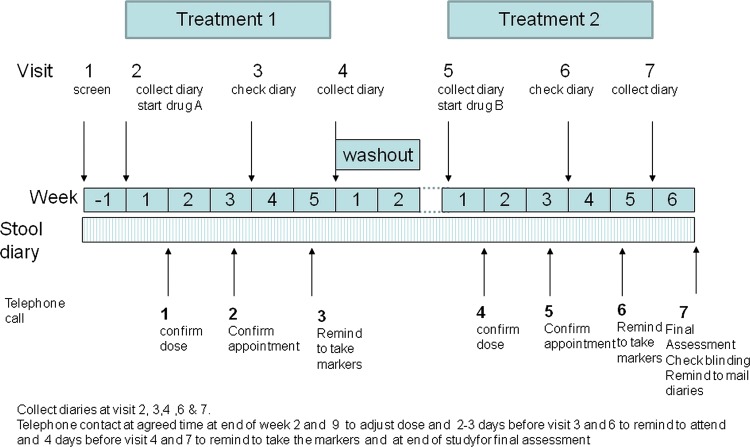
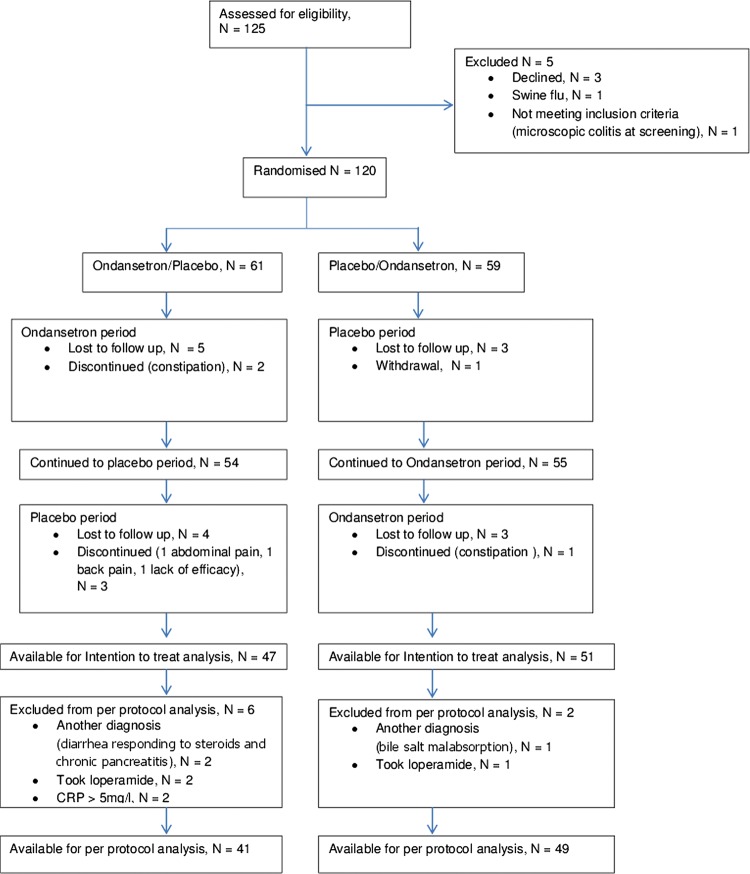
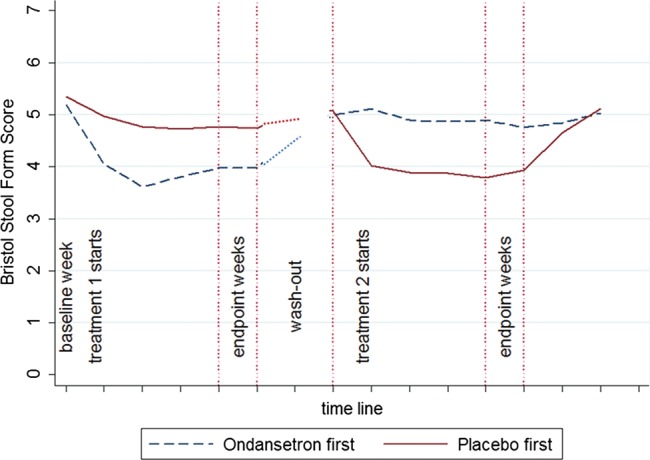
Background: Irritable bowel syndrome with diarrhoea (IBS-D) is particularly debilitating due to urgency and episodic incontinence. Some 5-hydroxytryptamine 3 (5-HT3) receptor antagonists (5-HT3RAs) have proven effective but have serious side effects. Ondansetron, also a 5-HT3RA, has been widely used as an antiemetic with an excellent safety record for over two decades. Our aim was to assess its effectiveness in IBS-D. Methods: 120 patients meeting Rome III criteria for IBS-D entered a randomised, double-blind, placebo-controlled crossover study of 5 weeks of ondansetron 4 mg versus placebo with dose titration allowed, up to two tablets three times daily in the first 3 weeks. Patients completed daily diaries documenting stool consistency using the Bristol Stool Form score. Gut transit was measured in the last week of each treatment. The primary endpoint was average stool consistency in the last 2 weeks of treatment. Results: Ondansetron significantly improved stool consistency (mean difference in stool form between ondansetron and placebo −0.9, 95% CI −1.1 to −0.6, p<0.001). Compared with placebo, patients on ondansetron experienced fewer days with urgency (p<0.001), lower urgency scores (p<0.001), reduced frequency of defaecation (p=0.002) and less bloating (p=0.002), although pain scores did not change significantly. IBS symptom severity score fell more with ondansetron than placebo (83±9.8 vs 37±9.7, p=0.001). 65% reported adequate relief with ondansetron but not placebo compared with 14% reporting relief with placebo but not ondansetron, relative risk 4.7, 95% CI 2.6 to 8.5, p<0.001. Conclusions: Ondansetron relieves some of the most intrusive symptoms of IBS-D, namely loose stools, frequency and urgency.
Overview
The claims and statistics of this paper haven’t been checked yet.
Free: it reads the open-access text and checks the first 5 claims that cite a source we can check. Create a free account to check every claim.
Integrity signals
Registry
Cites
Statistics
Figures
Verification
Claims the paper makes
The claims and statistics of this paper haven’t been checked yet.
Free: it reads the open-access text and checks the first 5 claims that cite a source we can check. Create a free account to check every claim.
Claims other papers make about this one
Each is checked against this paper’s own text: does it say what the citing paper says it does?
The cited source says what the claim attributes to it.
In the citing paper
“A small crossover trial of ondansetron titrated from 4 mg once a day to a maximum of 8 mg three times a day demonstrated significantly higher rates of improvement in urgency, bloating and stool consistency, but not abdominal pain.236”
From British Society of Gastroenterology guidelines on the management of irritable bowel syndrome (2021) · cites this paper as [236]
The cited source says what the claim attributes to it.
In the citing paper
“A crossover placebo-controlled trial of ondansetron, another 5-HT3 antagonist, in 120 patients with IBS-D demonstrated significant improvements in stool consistency and urgency, but not pain”
From Irritable bowel syndrome (2020) · cites this paper as [126]
Self-check
Percentages, sums and reported differences re-computed from the paper’s own numbers.
The self-check needs the paper’s full text.
Citations
Cites
1 retracted
Zhu, J. X., Wu, X. Y., Owyang, C., & Li, Y. (2001) · The Journal of Physiology · doi:10.1111/j.1469-7793.2001.0431k.x · Cited by 226
RetractedLongstreth, G. F., Thompson, W. G., Chey, W. D., Houghton, L. A., Mearin, F., & Spiller, R. C. (2006) · Gastroenterology · doi:10.1053/j.gastro.2005.11.061 · Cited by 4,856
Self-citationThe PHQ-15: Validity of a New Measure for Evaluating the Severity of Somatic Symptoms
Kroenke, K., Spitzer, R. L., & Williams, J. B. W. (2002) · Psychosomatic Medicine · doi:10.1097/00006842-200203000-00008 · Cited by 3,298
FRANCIS, C. Y., MORRIS, J., & WHORWELL, P. J. (1997) · Alimentary Pharmacology & Therapeutics · doi:10.1046/j.1365-2036.1997.142318000.x · Cited by 1,708
Self-citationSpiller, R. C., Jenkins, D., Thornley, J. P., Hebden, J. M., Wright, T., Skinner, M., & Neal, K. R. (2000) · Gut · doi:10.1136/gut.47.6.804 · Cited by 1,155
Self-citationPostinfectious Irritable Bowel Syndrome
Spiller, R., & Garsed, K. (2009) · Gastroenterology · doi:10.1053/j.gastro.2009.02.074 · Cited by 1,024
Self-citationDevelopment of the perceived stress questionnaire: A new tool for psychosomatic research
Levenstein, S., Prantera, C., Varvo, V., Scribano, M. L., Berto, E., Luzi, C., & Andreoli, A. (1993) · Journal of Psychosomatic Research · doi:10.1016/0022-3999(93)90120-5 · Cited by 985
Simplified assessment of segmental colonic transit
Metcalf, A. M., Phillips, S. F., Zinsmeister, A. R., MacCarty, R. L., Beart, R. W., & Wolff, B. G. (1987) · Gastroenterology · doi:10.1016/0016-5085(87)90837-7 · Cited by 928
Dunlop, S. P., Jenkins, D., Neal, K. R., & Spiller, R. C. (2003) · Gastroenterology · doi:10.1053/j.gastro.2003.09.028 · Cited by 583
Self-citationGershon, M. D. (2004) · Alimentary Pharmacology & Therapeutics · doi:10.1111/j.1365-2036.2004.02180.x · Cited by 521
Abnormalities of 5-hydroxytryptamine metabolism in irritable bowel syndrome
Dunlop, S. P., Coleman, N. S., Blackshaw, E., Perkins, A. C., Singh, G., Marsden, C. A., & Spiller, R. C. (2005) · Clinical Gastroenterology and Hepatology · doi:10.1016/s1542-3565(04)00726-8 · Cited by 356
Self-citationAn irritable bowel syndrome-specific symptom questionnaire: development and validation
K., W. I., S., F., J., H. C., H., J. R., F., L. G., A., M. E., A., P. R., K., W. I., & J., N. (2003) · Scandinavian Journal of Gastroenterology · doi:10.1080/00365520310004209 · Cited by 324
Serotonin-transporter polymorphism pharmacogenetics in diarrhea-predominant irritable bowel syndrome
Camilleri, M., Atanasova, E., Carlson, P. J., Ahmad, U., Kim, H. J., Viramontes, B. E., Mckinzie, S., & Urrutia, R. (2002) · Gastroenterology · doi:10.1053/gast.2002.34780 · Cited by 285
Efficacy of alosetron in irritable bowel syndrome: a meta‐analysis of randomized controlled trials
Cremonini, F., Delgado‐Aros, S., & Camilleri, M. (2003) · Neurogastroenterology & Motility · doi:10.1046/j.1365-2982.2003.00389.x · Cited by 219
Marciani, L., Cox, E. F., Hoad, C. L., Pritchard, S., Totman, J. J., Foley, S., Mistry, A., Evans, S., Gowland, P. A., & Spiller, R. C. (2010) · Gastroenterology · doi:10.1053/j.gastro.2009.10.055 · Cited by 218
Self-citationAndresen, V., Montori, V. M., Keller, J., West, C. P., Layer, P., & Camilleri, M. (2008) · Clinical Gastroenterology and Hepatology · doi:10.1016/j.cgh.2007.12.015 · Cited by 208
Clinical Determinants of Health-Related Quality of Life in Patients With Irritable Bowel Syndrome
Spiegel, B. M. R., Gralnek, I. M., Bolus, R., Chang, L., Dulai, G. S., Mayer, E. A., & Naliboff, B. (2004) · Archives of Internal Medicine · doi:10.1001/archinte.164.16.1773 · Cited by 200
Evaluation of a new quality of life questionnaire for patients with irritable bowel syndrome
Hahn, B. A., Kirchdoerfer, L. J., Fullerton, S., & Mayer, E. (1997) · Alimentary Pharmacology & Therapeutics · doi:10.1046/j.1365-2036.1997.00168.x · Cited by 185
Chang, L., Chey, W. D., Harris, L., Olden, K., Surawicz, C., & Schoenfeld, P. (2006) · The American Journal of Gastroenterology · doi:10.1111/j.1572-0241.2006.00459.x · Cited by 181
GR 38032F (Ondansetron), a selective 5HT3 receptor antagonist, slows colonic transit in healthy man
Talley, N. J., Phillips, S. F., Haddad, A., Miller, L. J., Twomey, C., Zinsmeister, A. R., MacCarty, R. L., & Ciociola, A. (1990) · Digestive Diseases and Sciences · doi:10.1007/bf01536922 · Cited by 170
An Office Guide to Whole-Gut Transit Time: Patients??? Recollection of their Stool Form
Heaton, K. W., & O???Donnell, L. J. D. (1994) · Journal of Clinical Gastroenterology · doi:10.1097/00004836-199407000-00008 · Cited by 167
Kozlowski, C. M., Green, A., Grundy, D., Boissonade, F. M., & Bountra, C. (2000) · Gut · doi:10.1136/gut.46.4.474 · Cited by 159
Foley, S., Garsed, K. C., Singh, G., Duroudier, N. P., Swan, C., Hall, I. P., Zaitoun, A. M., Bennett, A. J., Marsden, C. A., Holmes, G. K. T., et al. (2011) · Gastroenterology · doi:10.1053/j.gastro.2011.01.052 · Cited by 158
Self-citationFaure, C., Patey, N., Gauthier, C., Brooks, E. M., & Mawe, G. M. (2010) · Gastroenterology · doi:10.1053/j.gastro.2010.03.032 · Cited by 154
Preclinical and clinical pharmacology of the 5-HT3 receptor antagonists
Wolf, H. (2000) · Scandinavian Journal of Rheumatology · doi:10.1080/030097400446625 · Cited by 127
Characterization of the Alternating Bowel Habit Subtype in Patients with Irritable Bowel Syndrome
Tillisch, K., Labus, J. S., Naliboff, B. D., Bolus, R., Shetzline, M., Mayer, E. A., & Chang, L. (2005) · The American Journal of Gastroenterology · doi:10.1111/j.1572-0241.2005.41211.x · Cited by 126
Matsueda, K., Harasawa, S., Hongo, M., Hiwatashi, N., & Sasaki, D. (2008) · Scandinavian Journal of Gastroenterology · doi:10.1080/00365520802240255 · Cited by 124
Predictors of Patient-Assessed Illness Severity in Irritable Bowel Syndrome
Spiegel, B., Strickland, A., Naliboff, B. D., Mayer, E. A., & Chang, L. (2008) · The American Journal of Gastroenterology · doi:10.1111/j.1572-0241.2008.01997.x · Cited by 123
Krause, R., Ameen, V., Gordon, S. H., West, M., Heath, A. T., Perschy, T., & Carter, E. G. (2007) · The American Journal of Gastroenterology · doi:10.1111/j.1572-0241.2007.01282.x · Cited by 119
Brown, P. M., Drossman, D. A., Wood, A. J. J., Cline, G. A., Frazier, K. S., Jackson, J. I., Bronner, J., Freiman, J., Zambrowicz, B., Sands, A., et al. (2011) · Gastroenterology · doi:10.1053/j.gastro.2011.05.005 · Cited by 103
MAXTON, D. G., MORRIS, J., & WHORWELL, P. J. (1996) · Alimentary Pharmacology & Therapeutics · doi:10.1046/j.1365-2036.1996.30172000.x · Cited by 96
Self-citationKeating, C., Beyak, M., Foley, S., Singh, G., Marsden, C., Spiller, R., & Grundy, D. (2008) · The Journal of Physiology · doi:10.1113/jphysiol.2008.156984 · Cited by 88
Self-citationMatsueda, K., Harasawa, S., Hongo, M., Hiwatashi, N., & Sasaki, D. (2008) · Digestion · doi:10.1159/000150632 · Cited by 87
Chang, L., Tong, K., & Ameen, V. (2010) · American Journal of Gastroenterology · doi:10.1038/ajg.2010.25 · Cited by 83
A 5HT3 antagonist corrects the postprandial colonic hypertonie response in carcinoid diarrhea
von der Ohe, M. R., Camilleri, M., & Kvols, L. K. (1994) · Gastroenterology · doi:10.1016/0016-5085(94)90008-6 · Cited by 67
Cremonini, F., Nicandro, J. P., Atkinson, V., Shringarpure, R., Chuang, E., & Lembo, A. (2012) · Alimentary Pharmacology & Therapeutics · doi:10.1111/j.1365-2036.2012.05208.x · Cited by 64
Hirata, T., Keto, Y., Funatsu, T., Akuzawa, S., & Sasamata, M. (2007) · Journal of Pharmacological Sciences · doi:10.1254/jphs.fp0070620 · Cited by 47
CLAYTON, SARGENT, BUTLER, GALE, MAXWELL, HUNT, BARRETT, CAMBRIDGE, BOUNTRA, & HUMPHREY (1999) · Neurogastroenterology & Motility · doi:10.1046/j.1365-2982.1999.00148.x · Cited by 40
Olden, K. (2002) · The American Journal of Gastroenterology · doi:10.1016/s0002-9270(02)05528-4 · Cited by 40
Cited by
Lacy, B. E., Mearin, F., Chang, L., Chey, W. D., Lembo, A. J., Simren, M., & Spiller, R. (2016) · Gastroenterology · doi:10.1053/j.gastro.2016.02.031 · Cited by 2,866
Self-citationIrritable Bowel Syndrome: A Clinical Review
Chey, W. D., Kurlander, J., & Eswaran, S. (2015) · JAMA · doi:10.1001/jama.2015.0954 · Cited by 1,081
Enck, P., Aziz, Q., Barbara, G., Farmer, A. D., Fukudo, S., Mayer, E. A., Niesler, B., Quigley, E. M. M., Rajilić-Stojanović, M., Schemann, M., et al. (2016) · Nature Reviews Disease Primers · doi:10.1038/nrdp.2016.14 · Cited by 997
Self-citationACG Clinical Guideline: Management of Irritable Bowel Syndrome
Lacy, B. E., Pimentel, M., Brenner, D. M., Chey, W. D., Keefer, L. A., Long, M. D., & Moshiree, B. (2021) · American Journal of Gastroenterology · doi:10.14309/ajg.0000000000001036 · Cited by 893
Ford, A. C., Sperber, A. D., Corsetti, M., & Camilleri, M. (2020) · The Lancet · doi:10.1016/s0140-6736(20)31548-8 · Cited by 818
Metadata
- Authors
- Garsed, K., Chernova, J., Hastings, M., Lam, C., Marciani, L., Singh, G., Henry, A., Hall, I., Whorwell, P., & Spiller, R.
- Affiliations
- NIHR Nottingham Digestive Diseases Biomedical Research Unit (GB)
- Nottingham Digestive Diseases Biomedical Research Unit, Queens Medical Centre, Nottingham, UK
- Wythenshawe Hospital (GB)
- University of Nottingham (GB)
- Venue
- Gut
- Publisher
- BMJ
- Published
- 2013-12-12
- Volume
- 63
- Issue
- 10
- Pages
- 1617-1625
- ISSN
- 0017-5749 (ISSN-L)
- 1468-3288
- PMC
- PMC4173656
- OpenAlex
- W2129997920
- Cited by
- 246
- References
- 39
- Citations by year
- 2026: 10 · 2025: 24 · 2024: 16 · 2023: 18 · 2022: 19 · 2021: 24 · 2020: 22 · 2019: 17 · 2018: 20 · 2017: 22 · 2016: 26 · 2015: 16 · 2014: 11
- FWCI
- 16.66
- Type
- journal article
- Language
- en
- Open access
- hybrid
- doi.org
- Licence
- cc-by
- Locations
- Gut (publishedVersion, cc-by)
- PubMed Central (publishedVersion, cc-by)
- PubMed (publishedVersion)
- Repository@Nottingham (University of Nottingham) (publishedVersion, other-oa)
- Nottingham ePrints (University of Nottingham) (submittedVersion, cc-by)
- Repository@Nottingham (University of Nottingham) (submittedVersion, cc-by)
- HighWire Press Open Archive (submittedVersion)
- Funders
- National Institute for Health and Care Research (PB-PG-0107-12127)
- Topics
- Health Sciences › Medicine › Gastroenterology › Gastrointestinal motility and disorders
- Health Sciences › Medicine › Gastroenterology › Inflammatory Bowel Disease
- Health Sciences › Medicine › Pediatrics, Perinatology and Child Health › Infant Health and Development
- Keywords
- ondansetron, irritable bowel syndrome with diarrhea, 5-HT3 receptor antagonists, stool consistency, bowel urgency, bloating, symptom severity
- MeSH terms
- Adult, Diarrhea, Double-Blind Method, Feces, Female, Humans, Male, Middle Aged, Serotonin Antagonists, Treatment Outcome, Ondansetron, Cross-Over Studies, Irritable Bowel Syndrome
About these checks
Registry, retraction, Cites and statistics results are computed, not judged, with one exception: a printed reference that no index lists is read once by a model before it counts as a citation error. Claims are extracted by a model and kept only when their quote appears verbatim in the text; each cited source is then checked, with a model’s help, for whether it says what the claim relies on. Those verdicts can be wrong — read the claim’s quote and the cited source before relying on one.
Statistics and arithmetic are recomputed, not judged.
Confidence bands are shown only for fields calibrated on our annotated test set. None is calibrated yet, so no band is shown.
What counts as a claim ›How we measure confidence ›How we check this ›
Are you an author, or do you see a problem with this page? Request a review
Data sources
Bibliographic data: Semantic Scholar, OpenAlex, Crossref.
Contains information from the Semantic Scholar Academic Graph Datasets, made available under the ODC Attribution License (ODC-BY 1.0).
Semantic Scholar’s data is described in: Kinney, R., et al. (2023). The Semantic Scholar Open Data Platform. arXiv:2301.10140.
