

Helicobacter pylori infection has a detrimental impact on the efficacy of cancer immunotherapies
Open accessThe DOI matches its Crossref record; 52 of the 52 references it cites were found in a registry or an index.
Abstract
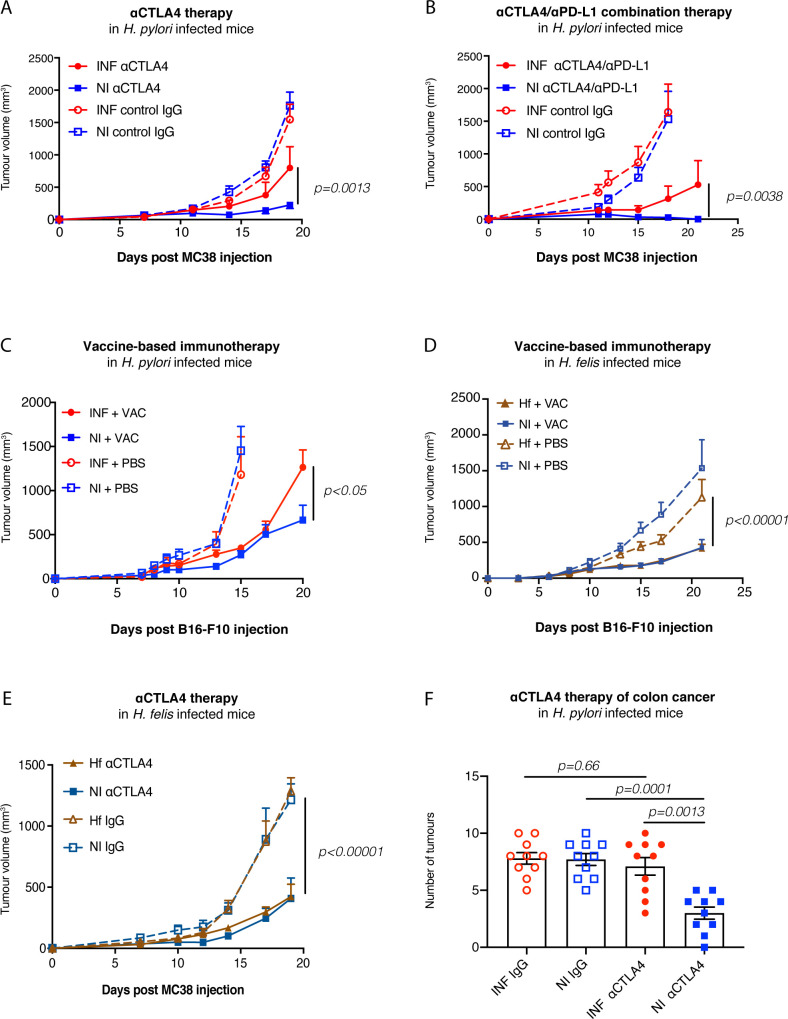
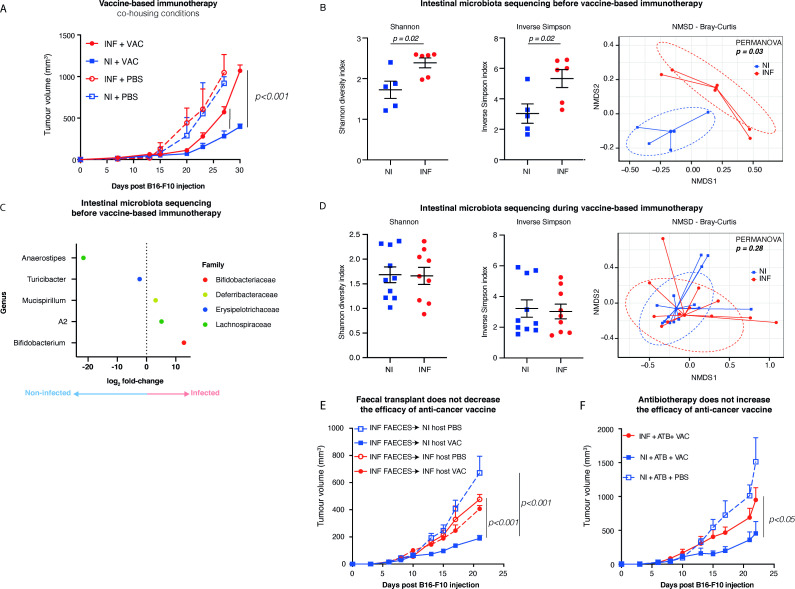
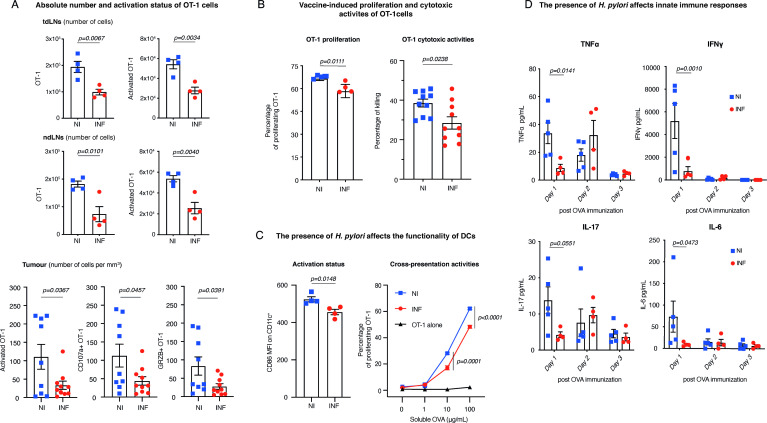
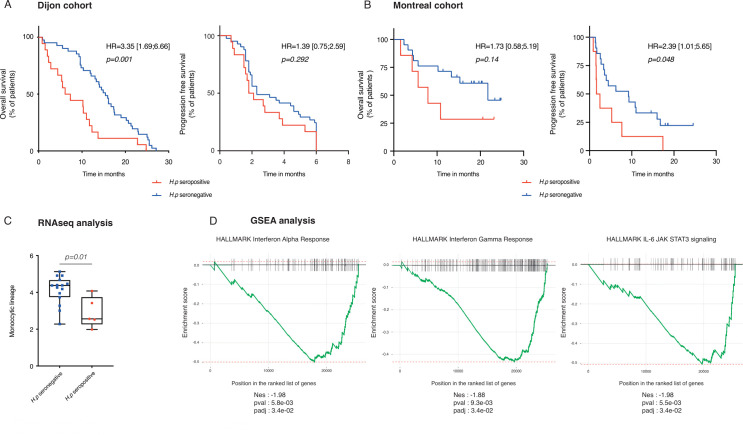
Objective: In this study, we determined whether Helicobacter pylori ( H. pylori ) infection dampens the efficacy of cancer immunotherapies. Design: Using mouse models, we evaluated whether immune checkpoint inhibitors or vaccine-based immunotherapies are effective in reducing tumour volumes of H. pylori -infected mice. In humans, we evaluated the correlation between H. pylori seropositivity and the efficacy of the programmed cell death protein 1 (PD-1) blockade therapy in patients with non-small-cell lung cancer (NSCLC). Results: In mice engrafted with MC38 colon adenocarcinoma or B16-OVA melanoma cells, the tumour volumes of non-infected mice undergoing anticytotoxic T-lymphocyte-associated protein 4 and/or programmed death ligand 1 or anti-cancer vaccine treatments were significantly smaller than those of infected mice. We observed a decreased number and activation status of tumour-specific CD8 + T cells in the tumours of infected mice treated with cancer immunotherapies independent of the gut microbiome composition. Additionally, by performing an in vitro co-culture assay, we observed that dendritic cells of infected mice promote lower tumour-specific CD8 + T cell proliferation. We performed retrospective human clinical studies in two independent cohorts. In the Dijon cohort, H. pylori seropositivity was found to be associated with a decreased NSCLC patient survival on anti-PD-1 therapy. The survival median for H. pylori seropositive patients was 6.7 months compared with 15.4 months for seronegative patients (p=0.001). Additionally, in the Montreal cohort, H. pylori seropositivity was found to be associated with an apparent decrease of NSCLC patient progression-free survival on anti-PD-1 therapy. Conclusion: Our study unveils for the first time that the stomach microbiota affects the response to cancer immunotherapies and that H. pylori serology would be a powerful tool to personalize cancer immunotherapy treatment.
Overview
The claims and statistics of this paper haven’t been checked yet.
Free: it reads the open-access text and checks the first 5 claims that cite a source we can check. Create a free account to check every claim.
Integrity signals
Registry
Cites
Statistics
Figures
Verification
Claims the paper makes
The claims and statistics of this paper haven’t been checked yet.
Free: it reads the open-access text and checks the first 5 claims that cite a source we can check. Create a free account to check every claim.
Claims other papers make about this one
Each is checked against this paper’s own text: does it say what the citing paper says it does?
The source backs part of the claim, not all of it — or backs it for a different population, condition or comparison.
In the citing paper
“In the context of ICIs, three retrospective studies demonstrated that the presence of circulating anti-H. pylori antibodies is associated with resistance to immunotherapy in patients with non-small cell lung cancer (NSCLC), melanoma, and gastric cancer.”
From Melanoma and microbiota: Current understanding and future directions (2024) · cites this paper as [65]
Experimental — accuracy not yet measured
Self-check
Percentages, sums and reported differences re-computed from the paper’s own numbers.
The self-check needs the paper’s full text.
Citations
Cites
Gut microbiome influences efficacy of PD-1-based immunotherapy against epithelial tumors
Routy, B., Le Chatelier, E., Derosa, L., Duong, C. P. M., Alou, M. T., Daillère, R., Fluckiger, A., Messaoudene, M., Rauber, C., Roberti, M. P., et al. (2018) · Science · doi:10.1126/science.aan3706 · Cited by 5,671
Self-citationGut microbiome modulates response to anti-PD-1 immunotherapy in melanoma patients
Gopalakrishnan, V., Spencer, C. N., Nezi, L., Reuben, A., Andrews, M. C., Karpinets, T. V., Prieto, P. A., Vicente, D., Hoffman, K., Wei, S. C., et al. (2018) · Science · doi:10.1126/science.aan4236 · Cited by 4,812 · cited 1×
“…importantly, human data clearly demonstrated that the composition of the intestinal microbiome had a considerable influence on the effectiveness of anti-cancer immunotherapies 3–5 and that the use of anti-biotics compromised the efficacy of programmed cell death protein 1 (PD-1) blockade therapy.”
Induction of Intestinal Th17 Cells by Segmented Filamentous Bacteria
Ivanov, I. I., Atarashi, K., Manel, N., Brodie, E. L., Shima, T., Karaoz, U., Wei, D., Goldfarb, K. C., Santee, C. A., Lynch, S. V., et al. (2009) · Cell · doi:10.1016/j.cell.2009.09.033 · Cited by 4,554 · cited 1×
“38 39 Thus, the eradication of H. pylori using a strategy that spares the microbiota, such as vaccination, would likely prove to be unsuccessful, as the immune system would have been previously imprinted.”
Commensal Bifidobacterium promotes antitumor immunity and facilitates anti–PD-L1 efficacy
Sivan, A., Corrales, L., Hubert, N., Williams, J. B., Aquino-Michaels, K., Earley, Z. M., Benyamin, F. W., Man Lei, Y., Jabri, B., Alegre, M.-L., et al. (2015) · Science · doi:10.1126/science.aac4255 · Cited by 3,888
Anticancer immunotherapy by CTLA-4 blockade relies on the gut microbiota
Vétizou, M., Pitt, J. M., Daillère, R., Lepage, P., Waldschmitt, N., Flament, C., Rusakiewicz, S., Routy, B., Roberti, M. P., Duong, C. P. M., et al. (2015) · Science · doi:10.1126/science.aad1329 · Cited by 3,488 · cited 1×
“1 Vétizou et al 2 demonstrated that the antitumour effects elicited by anticytotoxic T- lymphocyte-associated protein 4 (CTLA4) blockade in mice were dependent on the presence of Bacteroides fragilis , Bacteroides thetaiotaomicron and Burkholderiales in the gut microbiota.”
Self-citationCommensal Bacteria Control Cancer Response to Therapy by Modulating the Tumor Microenvironment
Iida, N., Dzutsev, A., Stewart, C. A., Smith, L., Bouladoux, N., Weingarten, R. A., Molina, D. A., Salcedo, R., Back, T., Cramer, S., et al. (2013) · Science · doi:10.1126/science.1240527 · Cited by 2,251 · cited 2×
“30”
Fecal microbiota transplant overcomes resistance to anti–PD-1 therapy in melanoma patients
Davar, D., Dzutsev, A. K., McCulloch, J. A., Rodrigues, R. R., Chauvin, J.-M., Morrison, R. M., Deblasio, R. N., Menna, C., Ding, Q., Pagliano, O., et al. (2021) · Science · doi:10.1126/science.abf3363 · Cited by 1,781 · cited 1×
“42 In summary, our study is in alignment with the recognised major role played by the microbiome on the efficacy of cancer immunotherapies.”
Fecal microbiota transplant promotes response in immunotherapy-refractory melanoma patients
Baruch, E. N., Youngster, I., Ben-Betzalel, G., Ortenberg, R., Lahat, A., Katz, L., Adler, K., Dick-Necula, D., Raskin, S., Bloch, N., et al. (2021) · Science · doi:10.1126/science.abb5920 · Cited by 1,757
Microbiome-derived inosine modulates response to checkpoint inhibitor immunotherapy
Mager, L. F., Burkhard, R., Pett, N., Cooke, N. C. A., Brown, K., Ramay, H., Paik, S., Stagg, J., Groves, R. A., Gallo, M., et al. (2020) · Science · doi:10.1126/science.abc3421 · Cited by 1,407 · cited 1×
“25 Remarkably, the number of colon tumours in non-infected mice undergoing anti-CTLA4 treatment was significantly lower than those of H. pylori - infected mice (figure 1F).”
The Influence of the Gut Microbiome on Cancer, Immunity, and Cancer Immunotherapy
Gopalakrishnan, V., Helmink, B. A., Spencer, C. N., Reuben, A., & Wargo, J. A. (2018) · Cancer Cell · doi:10.1016/j.ccell.2018.03.015 · Cited by 1,392
Research works printed but not linked: 1
- Oertli M, Noben M, Engler DB, et al. Helicobacter pylori γ-glutamyl transpeptidase and vacuolating cytotoxin promote gastric persistence and immune tolerance. Proc Natl Acad Sci U S A 2013; 110: 3047– 52. 10.1073/pnas.1211248110 23382221 PMC3581963 · DOI · Paper page
Cited by
Items 101–176 of 176
Harnessing Microbiota to Improve Immunotherapy for Gastrointestinal Cancers
Goc, J., & Sonnenberg, G. F. (2022) · Cancer Immunology Research · doi:10.1158/2326-6066.cir-22-0164 · Cited by 8
Tissue Pathogens and Cancers: A Review of Commonly Seen Manifestations in Histo- and Cytopathology
Chua, T. H., Punjabi, L. S., & Khor, L. Y. (2021) · Pathogens · doi:10.3390/pathogens10111410 · Cited by 8
Schmitt, C. R., Hoefsmit, E. P., Fangmeier, T., Kramer, N., Kabakci, C., González, J. V., Versluis, J. M., Compter, A., Harrer, T., Mijočević, H., et al. (2023) · Cancer Immunology Immunotherapy · doi:10.1007/s00262-023-03498-0 · Cited by 8
Interaction of microbiota, mucosal malignancies, and immunotherapy—Mechanistic insights
Mager, L. F., Krause, T., & McCoy, K. D. (2024) · Mucosal Immunology · doi:10.1016/j.mucimm.2024.03.007 · Cited by 8
Tertiary Lymphoid Structures in Microorganism-Related Cancer
Deng, S., Yang, X., He, L., Hou, Y., & Meng, H. (2024) · Cancers · doi:10.3390/cancers16203464 · Cited by 8
“In addition to carcinogenicity, it also affects the results of anti-PD-1 and anti-cytotoxic T lymphocyte-associated antigen-4 (CTLA4), possibly by inhibiting antitumor CD8 + T cells due to abnormal DC activation [66].”
Helicobacter pylori and Colorectal Cancer: Meeting Sir Austin Bradford Hill's Causality Criteria
Ordoñez, J. S. F., Riquelme, A. J., Fernández, H. M., Parra, L. O., Urrego, J. A., Ramos, E. O., Portillo‐Miño, J. D., & Regino, W. O. (2025) · Helicobacter · doi:10.1111/hel.70024 · Cited by 7
“The possible mechanism of action is to decrease cancer's sensibility and reactivity to ICIs, which is the result of the low anti- CTLA-4 and anti- PDL-1 therapy [49, 63].”
Impact of helicobacter pylori infection on the efficacy of ICIs in gastric cancer
Huang, Y., & Hu, Y. (2025) · BMC Cancer · doi:10.1186/s12885-025-14436-x · Cited by 9
Adugna, A., Muche, Y., Jemal, M., Habtegiorgis, S. D., Belew, H., & Amare, G. A. (2024) · Aging Medicine · doi:10.1002/agm2.12292 · Cited by 6
“37 FIGURE 1 Immune checkpoint blockades (ICBs) therapy for NSCLC patients.”
Wang, D., Chan, B. C.-L., Zhang, B., Wong, K. C., Kan, L. L., & Wong, C. K. (2024) · International Journal of Molecular Sciences · doi:10.3390/ijms25063081 · Cited by 10
Zhang, X., Zhang, G., Sang, S., Fei, Y., Cao, X., Song, W., Liu, F., Che, J., Tao, H., Wang, H., et al. (2025) · eLife · doi:10.7554/elife.99337 · Cited by 12
de Moraes, F. C. A., Sobreira, L. E. R., Kelly, F. A., & Burbano, R. M. R. (2025) · Microbial Pathogenesis · doi:10.1016/j.micpath.2025.107407 · Cited by 6
Noori, M., Fayyaz, F., & Rezaei, N. (2023) · Immunotherapy · doi:10.2217/imt-2022-0250 · Cited by 7
De- “bug”-ing the microbiome in lung cancer
Birla, P., & Shaikh, F. Y. (2022) · Cancer and Metastasis Reviews · doi:10.1007/s10555-022-10036-4 · Cited by 7
“which found that Helicobacter pylori seropositivity was found to be associated with a worse progression free survival (PFS) or overall survival (OS) in two retrospective, but independent, cohorts of patients with NSCLC on anti-program death ligand 1 (PD-1) therapy (n = 47 NSCLC total) [46].”
Khaled, N. B., Schulz, C., Alunni‐Fabbroni, M., Bronny, K., Jochheim, L. S., Kalali, B. N., Öcal, O., Seidensticker, M., Piseddu, I., Enßle, S., et al. (2025) · Digestion · doi:10.1159/000542847 · Cited by 6
Helicobacter pylori and Cancer: What’s the Link?
Merola, E., Pes, G. M., Graham, D. Y., & Dore, M. P. (2026) · Clinical and Experimental Gastroenterology · doi:10.2147/ceg.s495588 · Cited by 6
Gut microbiota drives cancer evolution and therapy resistance
Min, S., Zhang, Y., Zhang, H., & Liu, Q. (2026) · Molecular Cancer · doi:10.1186/s12943-025-02564-8 · Cited by 10
Zhao, J., Feng, D., Zhang, F., Cai, S., Xiong, Y., Pan, G., Ma, J., Tan, J., Zhong, M., Lin, Z., et al. (2026) · Cell Reports · doi:10.1016/j.celrep.2025.116863 · Cited by 6
A comprehensive analysis of molecular characteristics of hot and cold tumor of gastric cancer
Lv, C., Chen, T., Li, J., Shan, Y., & Zhou, H. (2025) · Cancer Immunology Immunotherapy · doi:10.1007/s00262-025-03954-z · Cited by 5
Castañeda, C. A., Castillo, M., Bernabe, L. A., Suárez, N., Fassan, M., Sanchez, J., Tello, K., Alatrista, R., Chavéz, I., Ruíz, E., et al. (2022) · ecancermedicalscience · doi:10.3332/ecancer.2022.1362 · Cited by 5
“Recent publications suggest that the tumour response to immunotherapy could be reduced in patients with HP infection [8].”
How Can We Better Understand the Gastric Carcinogenesis of Helicobacter pylori?
Duan, Y., Dou, Y., & Xu, D. (2022) · Gastroenterology · doi:10.1053/j.gastro.2022.04.018 · Cited by 5
The role of the microbiota in cancer drug resistance and emerging therapeutic strategies
Che, C., Zhou, Y., Chen, L., Li, S., fan, D., Lu, Y., & Zhao, X. (2026) · Cancer Letters · doi:10.1016/j.canlet.2026.218305 · Cited by 6
Ziogou, A., Giannakodimos, A., Giannakodimos, I., Schizas, D., & Charalampakis, N. (2025) · Immunotherapy · doi:10.1080/1750743x.2025.2479410 · Cited by 6
Tan, J., Wu, Z., Liu, Y., Wang, W., Qin, W., Pan, G., Xiong, Y., Ma, J., Zhao, J., Zhou, H., et al. (2025) · Frontiers in Immunology · doi:10.3389/fimmu.2025.1592558 · Cited by 5
Global status and trends of gastric cancer and gastric microbiota research: a bibliometric analysis
Ke, Y., Tan, C., Zhen, J., & Dong, W. (2024) · Frontiers in Microbiology · doi:10.3389/fmicb.2024.1341012 · Cited by 6
Application of immune checkpoint inhibitors for resectable gastric/gastroesophageal cancer
Lin, F., Chen, Y., Huang, B., Ruan, S., Lin, J., Chen, Z., Huang, C., & Zhao, B. (2024) · Frontiers in Pharmacology · doi:10.3389/fphar.2024.1391562 · Cited by 4
The oncobiome; what, so what, now what?
Abbas, M., & Tangney, M. (2025) · Microbiome Research Reports · doi:10.20517/mrr.2024.89 · Cited by 7
Immunogenomic precision medicine: a personalized approach based on immunogenomic cancer evolution
Momoi, Y., Kumagai, S., & Nishikawa, H. (2025) · International Immunology · doi:10.1093/intimm/dxaf020 · Cited by 5
Yang, K., Wei, H., Zhu, W., Xu, Y., Wang, S. L., Fan, F., Zhang, K., Yuan, Q., & Wang, H. (2025) · Frontiers in Immunology · doi:10.3389/fimmu.2025.1559211 · Cited by 4
Wu, B., Sun, C. M., Sun, X., & Li, X. (2022) · Medicine · doi:10.1097/md.0000000000030532 · Cited by 5
“[25] Furthermore, Helicobacter pylori infection weakens the efficacy of cancer immunotherapies in preclinical animal models and NSCLC patients.[26] PPIs can inhibit the growth and reduce the viability of HP directly or indirectly by urase[27] or changing pH.”
The Regulation of Nucleic Acid Vaccine Responses by the Microbiome
Johnson, A. M. F., Hager, K., Alameh, M., Van, P., Potchen, N. B., Mayer-Blackwell, K., Fiore-Gartland, A. J., Minot, S. S., Lin, P. J. C., Tam, Y. K., et al. (2023) · The Journal of Immunology · doi:10.4049/jimmunol.2300196 · Cited by 6
Xu, D., Chen, X., Wu, M., Bi, J., Xue, H., & Chen, H. (2024) · Heliyon · doi:10.1016/j.heliyon.2024.e28278 · Cited by 6
“However, the efficacy of immunotherapy is affected by tumor mutation load (PD-L1 expression) [7], infection [8], drugs [9 – 13], gender [14], diet [15] and other factors.”
Chen, L., Ruan, G., Zhao, X., Yi, A., Xiao, Z., Tian, Y., Cheng, Y., Chen, D., & Wei, Y. (2025) · Frontiers in Immunology · doi:10.3389/fimmu.2025.1553757 · Cited by 5
Yang, H.-C., Fu, C.-F., Qiao, L.-J., Long, G.-H., Yang, L., & Yao, B. (2025) · World Journal of Clinical Oncology · doi:10.5306/wjco.v16.i4.102397 · Cited by 3
Targeting Intratumoral Bacteria for Cancer Nanotherapeutics
Wang, Y., Yu, J. S., & Gao, L. (2025) · ACS Applied Materials & Interfaces · doi:10.1021/acsami.5c16720 · Cited by 4
Zhang, R., Li, Z., Liu, X., Qiu, Z., Li, Y., Gao, C., & Guo, C. (2026) · Frontiers in Immunology · doi:10.3389/fimmu.2025.1653727 · Cited by 4
Gut microbiota and metabolic control of immune checkpoint blockade in cancer
Gladstone, J. L., & Sonnenberg, G. F. (2026) · Cell Metabolism · doi:10.1016/j.cmet.2026.04.018 · Cited by 4
Zhou, Y., Liu, S., Zheng, Y., Wang, Y., & Zhou, Y. (2024) · Arab Journal of Gastroenterology · doi:10.1016/j.ajg.2024.02.001 · Cited by 3
Helicobacter pylori, gastrointestinal microbiota, and immunotherapy
Han, Z., Li, Y., & Li, Y. (2022) · Helicobacter · doi:10.1111/hel.12942 · Cited by 3
The Potential Anticancer Mechanisms of Probiotics: A Comprehensive Review
Tang, C., Qian, Y., Jia, S., Zhang, J., Zhang, Y., Ren, Y., Yong, H., Xu, J., Kan, J., & Liu, J. (2025) · Probiotics and Antimicrobial Proteins · doi:10.1007/s12602-025-10753-6 · Cited by 2
Gut microbiota and metabolites: emerging prospects in the treatment of non-small cell lung cancer
Jiao, J.-M., Liu, C., Zang, D., & Chen, J. (2025) · Frontiers in Immunology · doi:10.3389/fimmu.2025.1638942 · Cited by 3
The role of microbiome in immunotherapy: Insights and perspectives
Ye, M., Ju, H., Ren, G., & Hu, J. (2025) · Seminars in Cancer Biology · doi:10.1016/j.semcancer.2025.11.001 · Cited by 4
Role of oral microbiome in cancer immunotherapy
Khalil, W., Song, H., Li, Z., He, Y., Xu, C., & Ye, Q. (2026) · Seminars in Cancer Biology · doi:10.1016/j.semcancer.2026.06.006 · Cited by 4
Zhou, M., Wang, Y., Xuan, Y., Zou, W., Wang, Y., Zhang, Z., Zhang, J., Mo, M., Zhou, C., Liu, Y., et al. (2022) · BMC Cancer · doi:10.1186/s12885-022-09786-9 · Cited by 2
“Some studies have also shown that the gut microbiota [36] and HP infection [37] will have an impact on the efficacy of immunotherapy.”
[Advances of Immunotherapy Resistance and Coping Strategies in Non-small Cell Lung Cancer].
Jing, Y., Zeng, H., Cheng, R., Tian, P., & Li, Y. (2023) · PubMed Central · doi:10.3779/j.issn.1009-3419.2023.102.03 · Cited by 4
Wu, C., & Tseng, C. (2023) · Springer eBooks · doi:10.1007/978-981-19-4492-5_5 · Cited by 2
Burgermeister, E., & Ebert, M. P. A. (2023) · Springer eBooks · doi:10.1007/978-981-19-4492-5_4 · Cited by 3
Zhou, J., Zhang, M., Wang, H., Zhong, X., & Yang, X. (2024) · Archives of Microbiology · doi:10.1007/s00203-024-03908-6 · Cited by 4
Schooten, T. S. G.-V., Cabeza-Segura, M., Ferreira, R. M., Martínez‐Ciarpaglini, C., Barros, R., Santos‐Antunes, J., Costa, A., Fernández-Figueroa, E. A., Lino-Silva, L. S., Hernández-Guerrero, A., et al. (2025) · British Journal of Cancer · doi:10.1038/s41416-025-02979-6 · Cited by 3
Wang, X., Ma, X., Baheti, L., Dong, J., & Xu, J. (2025) · Critical Reviews in Eukaryotic Gene Expression · doi:10.1615/critreveukaryotgeneexpr.2025060632 · Cited by 1
Biomarker-guided immunotherapy in gastric cancer: current insights and future perspectives
Mulet, M. T., Rodríguez, J. V., Terán, E., Piñol, M., Vilardell, F., Iglesias, M., Hierro, C., Calvo, M., Matías‐Guiu, X., Salud, A., et al. (2026) · Cancer Treatment Reviews · doi:10.1016/j.ctrv.2026.103124 · Cited by 2
Microbiota as a modulator of drug response: targeting microbial–drug crosstalk in cancer therapy
Zhao, T., Liu, M., Qiu, L. X., Zhang, H., Zhang, N., Liu, Z., Xia, Z., Luo, P., Huang, J., & Cheng, Q. (2026) · Gut Microbes · doi:10.1080/19490976.2026.2651930 · Cited by 1
Unlocking the potential: current landscape and future directions of immunotherapy in gastric cancer
Zhou, Y., Wei, L., Wang, L., Zhang, B., & Liang, J. (2026) · Frontiers in Immunology · doi:10.3389/fimmu.2026.1742723 · Cited by 4
Zhang, N., Jiang, Q., Ma, Q., Huang, H., Ma, L., & Zhou, S. (2026) · Frontiers in Immunology · doi:10.3389/fimmu.2026.1908868 · Cited by 3
H. pylori mindert Effektivität von Krebsimmuntherapien
Lichert, F. (2022) · Zeitschrift für Gastroenterologie · doi:10.1055/a-1795-5459
H. pylori mindert Effektivität von Krebsimmuntherapien
Lichert, F. (2022) · TumorDiagnostik & Therapie · doi:10.1055/a-1887-7840
H. pylori mindert Effektivität von Krebsimmuntherapien
(2022) · Deutsche Zeitschrift für Onkologie · doi:10.1055/a-1963-3096
Can Helicobacter pylori Infection Reduce the Efficacy of Cancer Immunotherapy?
Lee, J. Y. (2023) · The Korean Journal of Helicobacter and Upper Gastrointestinal Research · doi:10.7704/kjhugr.2023.0061
逄, 淑. (2024) · Advances in Clinical Medicine · doi:10.12677/acm.2024.143678
Future Perspectives of Cancer Immunotherapy for the Treatment of Lung Cancer
Gupta, D., & Shetty, S. R. (2024) · Springer eBooks · doi:10.1007/978-981-99-7141-1_19
Association between Helicobacter Infection and the Efficacy of Cancer Immunotherapy
Kang, S. H. (2024) · Korean Journal of Gastroenterology · doi:10.4166/kjg.2024.009
Zhang, X., Zhang, G., Sang, S., Fei, Y., Cao, X., Song, W., Liu, F., Che, J., Tao, H., Wang, H., et al. (2024) · eLife · doi:10.7554/elife.99337.1
Liu, Y., Shang, X., Du, W., Shen, W., & Zhu, Y. (2024) · International Journal of General Medicine · doi:10.2147/ijgm.s485347
“27,28 Similar to previous investigations, the current study demonstrates a correlation between the depth of tumor infiltration into the tissue, lymphatic metastasis, and an increased risk of gastric cancer recurrence postsurgery.”
[Effect of CMTM6 on PD-L1 in Helicobacter pylori infected gastric epithelial cells].
Fu, W., Ning, J., Fu, W., Zhang, J., & Ding, S. (2025) · PubMed Central · doi:10.19723/j.issn.1671-167x.2025.02.004 · Cited by 2
Zhang, X., Zhang, G., Sang, S., Fei, Y., Cao, X., Song, W., Liu, F., Che, J., Tao, H., Wang, H., et al. (2025) · eLife · doi:10.7554/elife.99337.2
Sharma, A. B., Mahur, P., John, J., Sanjeevi, T., Ravikumar, S., Singh, A. K., Muthukumaran, J., & Jain, M. (2025) · 3 Biotech · doi:10.1007/s13205-025-04583-0
Thurman, M., Chokkavelu, V., Johnson, S. D., Olwenyi, O. A., Kathamuthu, G. R., Yu, J., Adeniji, S., Hong, K. Y., Johnston, M., Bose, D., et al. (2026) · bioRxiv (Cold Spring Harbor Laboratory) · doi:10.64898/2026.02.04.703720
PALOUNKOVÁ, A., Frejlachova, A., Kovaříková, A., Chrdle, A., & Langhansová, H. (2026) · Journal of Applied Biomedicine · doi:10.32725/jab.2026.001
Marcos-Kovandzic, L. (2024) · theses.fr (ABES) · doi:10.70675/3bde4b45z23ecz4b69zb90dzabccd7cd7fca
Makarova, M., Shumskaya, I. S., Kolesnikova, Е. А., Михайлович, К. Н., Radovsky, V. V., & Gamayunov, S. V. (2026) · Siberian Journal of Oncology · doi:10.21294/1814-4861-2026-25-2-145-154
Liang, F., Li, J., Yue, Y., Pan, J., Liu, C., Cheng, D., Zhang, N., Li, K., Chu, F., & Wu, H. (2026) · Polish Journal of Microbiology · doi:10.33073/pjm-2026-016
Clinical Research and Challenges of Immunotherapy
Friedrich, V., Pfeiffer, D., Palma, P., Damme, P. V., & Gerhard, M. (2026) · Springer eBooks · doi:10.1007/978-981-95-9598-3_15
Figueroa-Protti, L., Mainieri-Breedy, G., Ramírez, V., Mora, J., Molina‐Castro, S., & Alpízar‐Alpízar, W. (2026) · ImmunoHorizons · doi:10.1093/immhor/vlag048
“30,31 Importantly, the abundance of Tregs in GC microenvironments 70 and their major contribution to the expression of ICs, as shown in our study, highlight the fact that exhausted CD8 + T cells are not the only feasible target of ICIs in cancer; this may change our view of how ICIs therapies…”
InfluentialWestphal, J. R., Macke, L., Graf, C., & Schulz, C. (2026) · Best Practice & Research Clinical Gastroenterology · doi:10.1016/j.bpg.2026.102154
Peter, B., Ongaro, M., Mager, L. F., Rochat, K., Gaillard, C., Breuillard, N., Poms, M., Serex, C., Godat, S., Braissant, O., et al. (2026) · Gut Science · doi:10.1136/gutsci-2026-000039
Self-citationWen, D., Mi, L., Zhang, Y., Ji, Y., Yang, B., & Yin, F. (2026) · Frontiers in Oncology · doi:10.3389/fonc.2026.1930319
Xu, J. (2026) · Frontiers in Cellular and Infection Microbiology · doi:10.3389/fcimb.2026.1996461
Metadata
- Authors
- Oster, P., Vaillant, L., Riva, E., McMillan, B., Begka, C., Truntzer, C., Richard, C., Leblond, M. M., Messaoudene, M., Machremi, E., Limagne, E., Ghiringhelli, F., Routy, B., Verdeil, G., & Velin, D.
- Affiliations
- Centre Hospitalier Universitaire Vaudois (CH)
- Centre Georges François Leclerc (FR)
- Centre Hospitalier de l’Université de Montréal (CA)
- Department of Medical Oncology, Centre Georges François Leclerc, Dijon, France
- Department of Oncology, Centre Hospitalier Universitaire Vaudois, University of Lausanne, Lausanne, Switzerland
- Corresponding author
- Velin, Dominique
- ORCID
- Venue
- Gut
- Publisher
- BMJ
- Published
- 2021-07-12
- Volume
- 71
- Issue
- 3
- Pages
- 457-466
- ISSN
- 0017-5749 (ISSN-L)
- 1468-3288
- PMC
- PMC8862014
- OpenAlex
- W3179559990
- Semantic Scholar
- 17143ef247aeb3422ac777637d18995b0ff563c0
- Cited by
- 176
- References
- 52
- Citations by year
- 2026: 22 · 2025: 38 · 2024: 40 · 2023: 33 · 2022: 41 · 2021: 2
- FWCI
- 10.55
- Type
- journal article
- Language
- en
- Open access
- hybrid
- doi.org
- Licence
- Locations
- Gut (publishedVersion, cc-by-nc)
- PubMed Central (publishedVersion, cc-by-nc)
- PubMed (publishedVersion)
- IRIS (submittedVersion, cc-by-nc)
- SERVAL (Université de Lausanne) (submittedVersion, cc-by-nc)
- Funders
- Foundation Emma Muschamp (NA)
- Faculté de Biologie et de Médecine de Lausanne (NA)
- Foundation Max Cloëtta (NA)
- Swiss Cancer Research Foundation (KFS-4452-02-2018; KFS-4840-08-2019)
- Foundation Porphyrogenis (NA)
- Topics
- Health Sciences › Medicine › Oncology › Cancer Immunotherapy and Biomarkers
- Health Sciences › Medicine › Gastroenterology › Helicobacter pylori-related gastroenterology studies
- Life Sciences › Immunology and Microbiology › Immunology › Immunotherapy and Immune Responses
- Keywords
- Helicobacter pylori infection, cancer immunotherapy, immune checkpoint inhibitors, anti-PD-1 therapy, non-small cell lung cancer, gastric microbiota, CD8+ T cells, dendritic cells, cancer vaccines, CTLA-4, PD-L1, H. pylori seropositivity, treatment response prediction
- MeSH terms
- Immune Checkpoint Inhibitors, Adenocarcinoma, Animals, Carcinoma, Non-Small-Cell Lung, Colonic Neoplasms, Disease Models, Animal, Female, Humans, Lung Neoplasms, Male, Mice, Inbred C57BL, Retrospective Studies, Helicobacter pylori, Helicobacter Infections, Cancer Vaccines, Mice
About these checks
Registry, retraction, Cites and statistics results are computed, not judged, with one exception: a printed reference that no index lists is read once by a model before it counts as a citation error. Claims are extracted by a model and kept only when their quote appears verbatim in the text; each cited source is then checked, with a model’s help, for whether it says what the claim relies on. Those verdicts can be wrong — read the claim’s quote and the cited source before relying on one.
Statistics and arithmetic are recomputed, not judged.
Confidence bands are shown only for fields calibrated on our annotated test set. None is calibrated yet, so no band is shown.
What counts as a claim ›How we measure confidence ›How we check this ›
Are you an author, or do you see a problem with this page? Request a review
Data sources
Bibliographic data: Semantic Scholar, OpenAlex, Crossref.
Contains information from the Semantic Scholar Academic Graph Datasets, made available under the ODC Attribution License (ODC-BY 1.0).
Semantic Scholar’s data is described in: Kinney, R., et al. (2023). The Semantic Scholar Open Data Platform. arXiv:2301.10140.
