

Novel therapeutic targets for cholestatic and fatty liver disease
Open accessThe DOI matches its Crossref record; 244 of the 254 references it cites were found in a registry or an index; 39 of the 166 sources its claims cite were checked for support.
Abstract
Cholestatic and non-alcoholic fatty liver disease (NAFLD) share several key pathophysiological mechanisms which can be targeted by novel therapeutic concepts that are currently developed for both areas. Nuclear receptors (NRs) are ligand-activated transcriptional regulators of key metabolic processes including hepatic lipid and glucose metabolism, energy expenditure and bile acid (BA) homoeostasis, as well as inflammation, fibrosis and cellular proliferation. Dysregulation of these processes contributes to the pathogenesis and progression of cholestatic as well as fatty liver disease, placing NRs at the forefront of novel therapeutic approaches. This includes BA and fatty acid activated NRs such as farnesoid-X receptor (FXR) and peroxisome proliferator-activated receptors, respectively, for which high affinity therapeutic ligands targeting specific or multiple isoforms have been developed. Moreover, novel liver-specific ligands for thyroid hormone receptor beta 1 complete the spectrum of currently available NR-targeted drugs. Apart from FXR ligands, BA signalling can be targeted by mimetics of FXR-activated fibroblast growth factor 19, modulation of their enterohepatic circulation through uptake inhibitors in hepatocytes and enterocytes, as well as novel BA derivatives undergoing cholehepatic shunting (instead of enterohepatic circulation). Other therapeutic approaches more directly target inflammation and/or fibrosis as critical events of disease progression. Combination strategies synergistically targeting metabolic disturbances, inflammation and fibrosis may be ultimately necessary for successful treatment of these complex and multifactorial disorders.
Overview
CoChat Summary
TL;DR
This review argues that cholestatic and non-alcoholic fatty liver disease share key pathophysiological mechanisms and that nuclear receptors and bile acid signalling are leading therapeutic targets. It summarizes phase 2/3 trial data for FXR, PPAR, FGF19/21, THR-β1, norUDCA, CCR2/5, and LOXL2-directed agents, concluding that combination strategies may ultimately be necessary.
Key findings
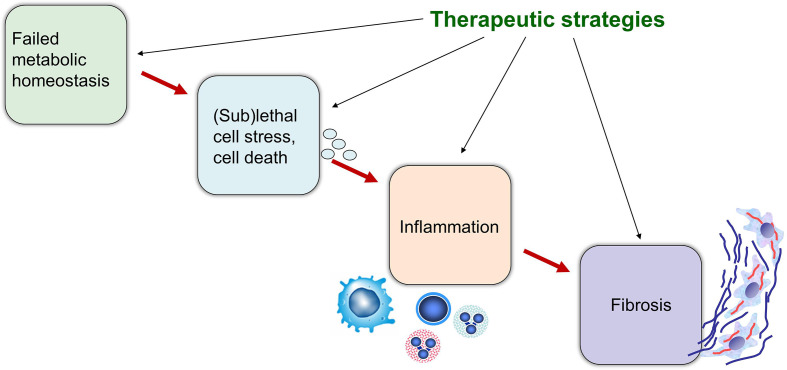
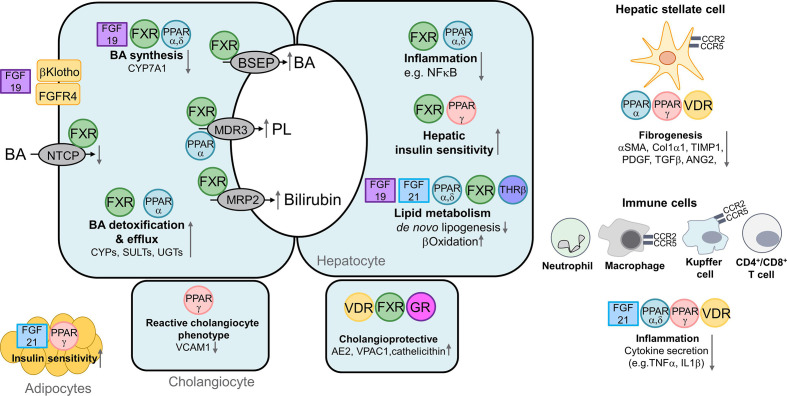
- Cholestasis and NAFLD/NASH converge on substrate overload, cell stress, inflammation, and fibrosis; nuclear receptors are broadly expressed in hepatocytes, cholangiocytes, hepatic stellate cells, and immune cells, making them attractive targets.
- FXR/BA-directed therapies show mixed results: in PBC, obeticholic acid improved biochemical markers and was conditionally approved as second-line therapy; in NASH, FLINT reported improved NAFLD activity score but NASH resolution of 22% vs 13% with placebo, while fibrosis improved in 35% vs 19%; REGENERATE interim analysis showed fibrosis improvement >1 stage in 23% vs 12% with placebo but no significant NASH improvement (12% vs 8%).
- PPAR and THR-β1 ligands also show signals: bezafibrate produced complete biochemical response in 31% of PBC patients with incomplete UDCA response vs 0% on placebo, with ALP normalisation in 67%; pioglitazone improved transaminases, steatosis, and inflammation but not fibrosis or NASH in PIVENS; resmetirom reduced hepatic fat and improved histological NAS in phase 2 NASH.
- Other approaches include norUDCA, which improved ALP in phase 2 PSC and reduced ALT in phase 2a NAFLD, while cenicriviroc showed no significant antifibrotic effect at 2 years and the AURORA phase 3 trial was terminated early for lack of efficacy; simtuzumab failed to improve fibrosis in NASH or PSC.
Methods
- Narrative review synthesizing mechanistic literature and clinical trial data across cholestatic liver diseases and NAFLD/NASH.
- Table 1 compiles key clinical trials of steroidal and non-steroidal FXR agonists, FGF19 mimetics, PPAR agonists, FGF21 mimetics, THR-β1 agonists, norUDCA, CCR2/CCR5 antagonists, and LOXL2 inhibitors.
- No systematic search, meta-analysis, or primary data collection is reported.
Limitations
- The paper states that long-term efficacy, tolerability, and safety of novel therapies still need evaluation, and that benefit on “hard” clinical endpoints remains to be demonstrated for OCA in PBC.
- The paper notes challenges such as high malignancy risk in PSC and the need for innovative trial designs such as basket trials.
- Evident from the text: this is a narrative review with selected trial coverage, including interim and ongoing study results, and no quantitative synthesis; later trials published after 2022 are not included.
Model-written summary. Check it against the paper before relying on it.
Integrity signals
Registry
Cites
Statistics
Figures
Verification
Claims the paper makes
24 Valid · 7 Not valid · 83 Not checked · 13 Own results and interpretations
At least one cited source doesn’t support this claim or points to a different paper, and none confirmed it — see the verdicts below.
In the paper
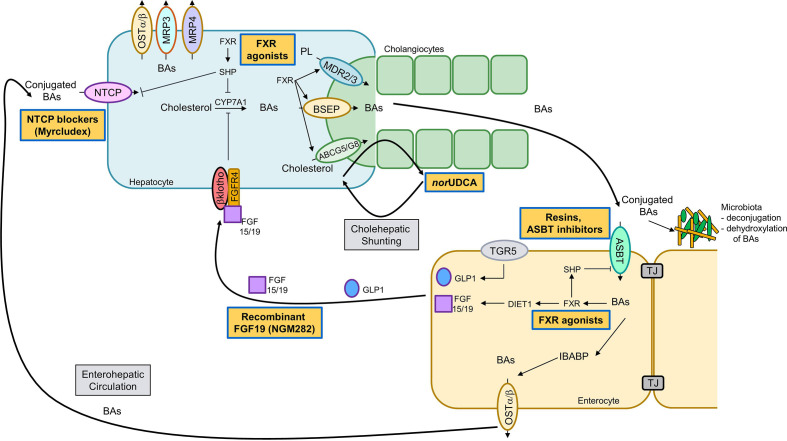
“However, small molecule inhibitors of NTCP can also prevent HBV infection without interrupting BA uptake.204”
§ Novel therapeutic targets for cholestatic and fatty liver disease > Enterohepatic bile acid circulation as therapeutic target
What the sources say
- Disputedcites [204] Kaneko M, Futamura Y, Tsukuda S, et al. Chemical array system, a platform to identify novel hepatitis B virus entry inhibitors targeting sodium taurocholate cotransporting polypeptide. Sci Rep 2018; 8: 2769. 10.1038/s41598-018-20987-w 29426822 PMC5807303 sourceExperimental — accuracy not yet measured
The Results section (“NPD8716 impaired the NTCP-dependent bile acid uptake”; page not available) says NPD8716 reduced NTCP-mediated bile acid uptake in a dose-dependent manner. The derivative analysis also reports that inhibition of HBV entry correlated with impairment of bile acid uptake. Thus, the inhibitors studied here do not support the claim that HBV infection was prevented without interrupting bile acid uptake. (LLM, conf=0.88)
Checked by a reasoning model — may be wrong.
plainstates a cause- Asserted: passes — The authors put it forward as true.
- Checkable: passes — It can be checked against evidence.
- Load-bearing: unclear — It is unclear whether the paper’s conclusions depend on it.
- Based: passes — The paper gives a reason why it holds.
- Disputed
The cited sources support only part of this claim — read each source’s verdict below.
In the paper
“Interestingly, BA toxicity as result of impaired hepatobiliary excretory function18 19 and functional (micro)cholestasis20 may also be involved in the pathogenesis of NASH.12”
§ Novel therapeutic targets for cholestatic and fatty liver disease > Shared pathogenetic principles as targets for therapeutic interventions
What the sources say
- Partly supportedcites [18] Pizarro M, Balasubramaniyan N, Solís N, et al. Bile secretory function in the obese Zucker rat: evidence of cholestasis and altered canalicular transport function. Gut 2004; 53: 1837– 43. 10.1136/gut.2003.037689 15542525 PMC1774316 sourceExperimental — accuracy not yet measured
Our copy supports the excretory/cholestatic half of the claim: the Abstract and Introduction report that obese Zucker rats exhibit impaired bile secretory function with functional and molecular alterations 'consistent with mild cholestasis' and decreased expression/function of critical canalicular transporters producing 'impaired excretory function of the liver', and that 'a defective hepatobiliary transport capacity may be a contributory factor in rendering the obese ZR more susceptible to liver injury'. However, the Introduction frames the injury mechanism generically — 'substances normally secreted into bile accumulate inside the cell promoting liver injury and leading to both necrosis and apoptosis' — without attributing it specifically to bile acid toxicity, and the term 'microcholestasis' does not appear. The claim's extension to the pathogenesis of NASH also goes beyond what this source states, which concerns susceptibility of a rodent NAFLD model to added insults (endotoxin, ischaemia/reperfusion) rather than steatohepatitis pathogenesis. (LLM, conf=0.72)
- Not checked yetcites [19] Geier A, Dietrich CG, Grote T, et al. Characterization of organic anion transporter regulation, glutathione metabolism and bile formation in the obese Zucker rat. J Hepatol 2005; 43: 1021– 30. 10.1016/j.jhep.2005.05.031 16139386 source
- Supportedcites [20] Segovia-Miranda F, Morales-Navarrete H, Kücken M, et al. Three-Dimensional spatially resolved geometrical and functional models of human liver tissue reveal new aspects of NAFLD progression. Nat Med 2019; 25: 1885– 93. 10.1038/s41591-019-0660-7 31792455 PMC6899159 source
The Discussion states exactly this chain: altered bile-canalicular microanatomy and the consequent pericentral micro-cholestasis 'may hamper BAs secretion into BC' (impaired hepatobiliary excretory function), bile accumulation 'due to its detergent-like properties, can cause liver damage', and BA accumulation 'could induce oxidative stress and trigger apoptosis', consistent with loss of pericentral hepatocytes in STEA and eNASH. The same Discussion section (and continuation) frames pericentral micro-cholestasis as 'a new piece in the NAFLD pathophysiology puzzle', while Results (Personalised model of bile flow...) and its Discussion supply the supporting prediction of elevated pericentral bile pressure with raised serum GGT and primary BAs in eNASH. The hedged wording of the claim ('may also be involved') matches the source's own hedging ('may hamper', 'could induce', 'suggests'). (LLM, conf=0.85)
hedgedstates a possible cause- Asserted: passes — The authors put it forward as true.
- Checkable: passes — It can be checked against evidence.
- Load-bearing: passes — The paper’s conclusions depend on it.
- Based: passes — The paper gives a reason why it holds.
- Partly supported
The sources with a verdict support this claim; the rest weren’t checked yet, have no full text we could read, or their verdicts aren’t rated yet.
In the paper
“while cholestasis may be considered an efflux problem resulting in accumulation of potentially cytotoxic and proinflammatory BAs and other cholephiles.13 14”
§ Novel therapeutic targets for cholestatic and fatty liver disease > Shared pathogenetic principles as targets for therapeutic interventions
What the sources say
- Not checked yetcites [13] Trauner M, Fuchs CD, Halilbasic E, et al. New therapeutic concepts in bile acid transport and signaling for management of cholestasis. Hepatology 2017; 65: 1393– 404. 10.1002/hep.28991 27997980 source
- Supportedcites [14] Jansen PLM, Ghallab A, Vartak N, et al. The ascending pathophysiology of cholestatic liver disease. Hepatology 2017; 65: 722– 38. 10.1002/hep.28965 27981592 source
Our copy treats cholestasis in exactly these terms: the TOXICITY OF BS section states that bile salts at accumulating concentrations 'may cause apoptosis, at 200 [µM] they activate proinflammatory genes, at 200-2,000 [µM] they induce necrosis' and refers to 'the inherent cytotoxicity of BS', and describes hepatocytes/cholangiocytes being 'exposed to toxic BS concentrations'. The ADAPTATION OF HEPATOCYTES section supplies the efflux framing, noting that canalicular Bsep/BSEP and Mrp2/MRP2 'helps to remove bile acids and other toxic agents from hepatocytes' (i.e. bile acids plus other transported substrates, the 'cholephiles' of the claim) and that cells which 'fail to exclude BS' accumulate them (Fig. 3C, 'accumulation in individual sporadic hepatocytes'). The wording 'efflux problem' and 'cholephiles' is the citing authors' shorthand, but the content — impaired biliary export with build-up of cytotoxic and proinflammatory bile acids and other transported agents — is what our copy states, with the same hedging level. (LLM, conf=0.82)
hedgedstates a possible cause- Asserted: passes — The authors put it forward as true.
- Checkable: passes — It can be checked against evidence.
- Load-bearing: passes — The paper’s conclusions depend on it.
- Based: passes — The paper gives a reason why it holds.
The cited sources support only part of this claim — read each source’s verdict below.
In the paper
“NASH may therefore be grossly viewed as an influx problem due to increased fatty acid load with consecutive lipotoxicity,11 12”
§ Novel therapeutic targets for cholestatic and fatty liver disease > Shared pathogenetic principles as targets for therapeutic interventions
What the sources say
- Supportedcites [11] Neuschwander-Tetri BA. Hepatic lipotoxicity and the pathogenesis of nonalcoholic steatohepatitis: the central role of nontriglyceride fatty acid metabolites. Hepatology 2010; 52: 774– 88. 10.1002/hep.23719 20683968 source
The “Factors Predisposing to Production of Lipotoxic Intermediates and NASH” section says that excessive fatty-acid delivery or synthesis contributes to NASH. It also explains that increased supply may be harmless if disposal pathways are robust, consistent with the claim’s qualified, broad framing. Page numbers are unavailable in our copy. (LLM, conf=0.90)
- Partly supportedcites [12] Arab JP, Karpen SJ, Dawson PA, et al. Bile acids and nonalcoholic fatty liver disease: molecular insights and therapeutic perspectives. Hepatology 2017; 65: 350– 62. 10.1002/hep.28709 27358174 PMC5191969 sourceExperimental — accuracy not yet measured
The section “Bile Acids and FXR: Regulation of Glucose and Lipid Metabolism” links fatty-acid metabolism to hepatic lipid accumulation, and “TGR5 Agonism and TGR5/FXR Dual Agonists” discusses reduced lipotoxicity in connection with NASH treatment. Neither passage characterizes NASH as primarily an influx problem caused by an increased fatty-acid load, so that part of the paraphrase is unsupported. (LLM, conf=0.78)
hedgedstates a possible cause- Asserted: passes — The authors put it forward as true.
- Checkable: passes — It can be checked against evidence.
- Load-bearing: passes — The paper’s conclusions depend on it.
- Based: passes — The paper gives a reason why it holds.
- Supported
Every source the paper cites for this claim was checked and supports it.
In the paper
“BA-induced cell stress may occur both at the level of hepatocytes (eg, via BA retention) and cholangiocytes (eg, via toxic bile composition and/or biliary stasis).5 14”
§ Novel therapeutic targets for cholestatic and fatty liver disease > Shared pathogenetic principles as targets for therapeutic interventions
What the sources say
- Supportedcites [5] Hirschfield GM, Heathcote EJ, Gershwin ME. Pathogenesis of cholestatic liver disease and therapeutic approaches. Gastroenterology 2010; 139: 1481– 96. 10.1053/j.gastro.2010.09.004 20849855 source
The source states bile-acid injury at both cell types: the Inherited Cholestatic Syndromes section describes 'decreased biliary bile salt secretion, decreased bile flow, and hepatic accumulation of bile acids' (i.e. hepatocyte retention) with bile 'especially toxic to the canalicular membrane', and loss of phosphatidylcholine protection exposing 'the bile duct epithelium from the detergent properties of bile acids' (i.e. cholangiocyte stress from toxic bile composition/stasis). The Abstract and Figure 1 legend frame cholestatic pathogenesis as 'the responses of cholangiocytes and hepatocytes to injury' with 'accumulation of bile and liver tissue damage'. The citing sentence is hedged ('may occur') and adds no mechanism beyond what the review reports, so no qualifier is overstated. (LLM, conf=0.85)
- Supportedcites [14] Jansen PLM, Ghallab A, Vartak N, et al. The ascending pathophysiology of cholestatic liver disease. Hepatology 2017; 65: 722– 38. 10.1002/hep.28965 27981592 source
The TOXICITY OF BS section states that after a breach of the bile-blood barrier 'the periductular stroma and the basolateral plasma membrane domains of hepatocytes and cholangiocytes are exposed to toxic BS concentrations,' adding toxic damage to immune-mediated injury — i.e. BA/BS-induced stress at both cell levels. The ADAPTATION OF HEPATOCYTES section supports the hepatocyte side with retention ('a small number of individual cells that fail to exclude BS... enrichment seems to occur through the apical membrane... associated with subsequent cell death... a bile infarct of the size of a single hepatocyte'), and the biliary-tree/intraluminal-pressure passages support cholangiocyte-level stress from stasis/pressure and BS reabsorption by cholangiocytes. The claim's hedge ('may') matches the paper's own tentative framing, so nothing attributed here exceeds the source. (LLM, conf=0.82)
hedgedstates a possible cause- Asserted: passes — The authors put it forward as true.
- Checkable: passes — It can be checked against evidence.
- Load-bearing: passes — The paper’s conclusions depend on it.
- Based: passes — The paper gives a reason why it holds.
- Supported
60 more claims · 11 with their cited sources checked
Create a free account to see all 127 claims and to verify the 127 references still open.
- It may state two separate claims as one. 56
- Probably not a substantial claim. 7
Claims other papers make about this one
Each is checked against this paper’s own text: does it say what the citing paper says it does?
In the citing paper
“Similarly, several drugs known to affect bile homeostasis also improve liver blood tests, 13,14 suggesting an involvement of these systems in PSC development.”
From EASL Clinical Practice Guidelines on sclerosing cholangitis (2022) · cites this paper as [14]
Self-check
Percentages, sums and reported differences re-computed from the paper’s own numbers.
Each contradiction between two passages listed here was confirmed by an independent check.
Rated minor: it would not touch a result — a value no result rests on, a p-value that stays on the same side of the significance level, or a conflict that is clerical, resolved elsewhere in the paper, or outside its own findings.
In the paper
§ Novel therapeutic targets for cholestatic and fatty liver disease > Nuclear receptor pathways as a new therapeutic frontier > Farnesoid X receptor
“In line with the beneficial effects of OCA in PBC, encouraging results were also observed in patients with PSC97 (table 1).”
§ Novel therapeutic targets for cholestatic and fatty liver disease > References
“97. Bowlus CL, Pockros PJ, Kremer AE, et al. Long-Term obeticholic acid therapy improves histological endpoints in patients with primary biliary cholangitis.”
Rated minor: it would not touch a result — a value no result rests on, a p-value that stays on the same side of the significance level, or a conflict that is clerical, resolved elsewhere in the paper, or outside its own findings.
In the paper
§ Novel therapeutic targets for cholestatic and fatty liver disease > Nuclear receptor pathways as a new therapeutic frontier
“ALP, alkaline phosphatase; ALT, alkaline phosphatase”
§ Novel therapeutic targets for cholestatic and fatty liver disease > Nuclear receptor pathways as a new therapeutic frontier > Farnesoid X receptor
“alanine amino transferase (ALT)”
Rated minor: it would not touch a result — a value no result rests on, a p-value that stays on the same side of the significance level, or a conflict that is clerical, resolved elsewhere in the paper, or outside its own findings.
In the paper
§ Novel therapeutic targets for cholestatic and fatty liver disease > Enterohepatic bile acid circulation as therapeutic target
“genetic absence of NTCP in mice and men results in increased serum levels of unconjugated BAs”
§ Novel therapeutic targets for cholestatic and fatty liver disease > References
“Sodium taurocholate cotransporting polypeptide (SLC10A1) deficiency: conjugated hypercholanemia without a clear clinical phenotype.”
Citations
Cites
Chalasani, N., Younossi, Z., Lavine, J. E., Charlton, M., Cusi, K., Rinella, M., Harrison, S. A., Brunt, E. M., & Sanyal, A. J. (2018) · Hepatology · doi:10.1002/hep.29367 · Cited by 7,239
EASL–EASD–EASO Clinical Practice Guidelines for the management of non-alcoholic fatty liver disease
(2016) · Journal of Hepatology · doi:10.1016/j.jhep.2015.11.004 · Cited by 4,836
Eslam, M., Newsome, P. N., Sarin, S. K., Anstee, Q. M., Targher, G., Romero-Gomez, M., Zelber-Sagi, S., Wai-Sun Wong, V., Dufour, J.-F., Schattenberg, J. M., et al. (2020) · Journal of Hepatology · doi:10.1016/j.jhep.2020.03.039 · Cited by 4,472
Mechanisms of NAFLD development and therapeutic strategies
Friedman, S. L., Neuschwander-Tetri, B. A., Rinella, M., & Sanyal, A. J. (2018) · Nature Medicine · doi:10.1038/s41591-018-0104-9 · Cited by 4,354
Genetic variation in PNPLA3 confers susceptibility to nonalcoholic fatty liver disease
Romeo, S., Kozlitina, J., Xing, C., Pertsemlidis, A., Cox, D., Pennacchio, L. A., Boerwinkle, E., Cohen, J. C., & Hobbs, H. H. (2008) · Nature Genetics · doi:10.1038/ng.257 · Cited by 3,416
Pioglitazone, Vitamin E, or Placebo for Nonalcoholic Steatohepatitis
Sanyal, A. J., Chalasani, N., Kowdley, K. V., McCullough, A., Diehl, A. M., Bass, N. M., Neuschwander-Tetri, B. A., Lavine, J. E., Tonascia, J., Unalp, A., et al. (2010) · New England Journal of Medicine · doi:10.1056/nejmoa0907929 · Cited by 3,327
Vrieze, A., Van Nood, E., Holleman, F., Salojärvi, J., Kootte, R. S., Bartelsman, J. F. W. M., Dallinga–Thie, G. M., Ackermans, M. T., Serlie, M. J., Oozeer, R., et al. (2012) · Gastroenterology · doi:10.1053/j.gastro.2012.06.031 · Cited by 2,913
Mechanisms of hepatic stellate cell activation
Tsuchida, T., & Friedman, S. L. (2017) · Nature Reviews Gastroenterology & Hepatology · doi:10.1038/nrgastro.2017.38 · Cited by 2,909
Bile salt biotransformations by human intestinal bacteria
Ridlon, J. M., Kang, D.-J., & Hylemon, P. B. (2006) · Journal of Lipid Research · doi:10.1194/jlr.r500013-jlr200 · Cited by 2,829
Identification of a nuclear receptor for bile acids
Makishima, M., Okamoto, A. Y., Repa, J. J., Tu, H., Learned, R. M., Luk, A., Hull, M. V., Lustig, K. D., Mangelsdorf, D. J., & Shan, B. (1999) · Science · doi:10.1126/science.284.5418.1362 · Cited by 2,714
Research works printed but not linked: 6
- Kowdley KV, Minuk GY, Pagadala MR. The nonsteroidal farnesoid X receptor (FXR) agonist Cilofexor improves liver biochemistry in patients with primary biliary cholangitis (pBC): a phase 2, randomized, placebo-controlled trial. Hepatology 2019; 70: 31a– 2.
- Alkhouri N, Herring R, Kabler H. Safety and efficacy of combination therapies including Semaglutide, Cilofexor, and Firsocostat in patients with NASH. Hepatology 2020; 72: 131A.
- Lucas KJ, Lopez P, Lawitz EJ. Safety and efficacy of tropifexor in patients with fibrotic nonalcoholic steatohepatitis: 48‐week results from part C of the phase 2 flight‐fxr study. Hepatology 2020; 72: 101A– 2.
- Harrison SA, Gunn NT, Khazanchi A. A 52-week multi-center double-blind randomized phase 2 study of Seladelpar, a potent and selective peroxisome proliferator-activated receptor delta (PPAR-delta) agonist, in patients with nonalcoholic steatohepatitis (NASH). Hepatology 2020; 72: 1043A– 4.31849085
- Harrison SA, Ratziu V, Bedossa P. RESOLVE-IT phase 3 of Elafibranor in NASH: final results of the week 72 interim surrogate efficacy analysis. Hepatology 2020; 72: LP23.
- Harrison SA, Ruane P, Freilich B. Efruxifermin (EFX) improved markers of fibrosis, liver injury andmetabolism in F4 NASH patients with compensated cirrhosis. J Hepatol 2021; 75: S204.
Cited by
Peiseler, M., Schwabe, R., Hampe, J., Kubes, P., Heikenwälder, M., & Tacke, F. (2022) · Journal of Hepatology · doi:10.1016/j.jhep.2022.06.012 · Cited by 564
EASL Clinical Practice Guidelines on sclerosing cholangitis
Chazouilleres, O., Beuers, U., Bergquist, A., Karlsen, T. H., Levy, C., Samyn, M., Schramm, C., & Trauner, M. (2022) · Journal of Hepatology · doi:10.1016/j.jhep.2022.05.011 · Cited by 419
Self-citationWhat defines a healthy gut microbiome?
Van Hul, M., Cani, P. D., Petitfils, C., De Vos, W. M., Tilg, H., & El-Omar, E. M. (2024) · Gut · doi:10.1136/gutjnl-2024-333378 · Cited by 369
“73 74 Besides BAs many other liver-derived factors such as antimicrobial peptides, gall- bladder-derived”
BackgroundCurrent treatment of non‐alcoholic fatty liver disease
Paternostro, R., & Trauner, M. (2022) · Journal of Internal Medicine · doi:10.1111/joim.13531 · Cited by 305
Self-citationBile acid metabolism and signalling in liver disease
Fuchs, C. D., Simbrunner, B., Baumgartner, M., Campbell, C., Reiberger, T., & Trauner, M. (2025) · Journal of Hepatology · doi:10.1016/j.jhep.2024.09.032 · Cited by 231
Self-citationTong, J., Lan, X.-T., Zhang, Z., Liu, Y., Sun, D.-Y., Wang, X.-J., Ou-Yang, S.-X., Zhuang, C.-L., Shen, F.-M., Wang, P., et al. (2023) · Acta Pharmacologica Sinica · doi:10.1038/s41401-022-01010-5 · Cited by 220
“However, although a number of therapeutic strategies for MAFLD have been proposed and developed [5, 6], the molecular mechanisms underlying the pathophysiology of MAFLD are not fully understood [7].”
BackgroundTNF in the liver: targeting a central player in inflammation
Tiegs, G., & Horst, A. K. (2022) · Seminars in Immunopathology · doi:10.1007/s00281-022-00910-2 · Cited by 224
Nuclear receptors linking metabolism, inflammation, and fibrosis in nonalcoholic fatty liver disease
Puengel, T., Liu, H., Guillot, A., Heymann, F., Tacke, F., & Peiseler, M. (2022) · International Journal of Molecular Sciences · doi:10.3390/ijms23052668 · Cited by 95
“Novel strategies that have been proposed include either combination therapy of agents targeting multiple components, such as inflammation and metabolism, or single drugs with multiple targets [13].”
BackgroundInfluentialAdvances in the Diagnosis and Treatment of Non-Alcoholic Fatty Liver Disease
Yin, X., Guo, X., Liu, Z., & Wang, J. (2023) · International Journal of Molecular Sciences · doi:10.3390/ijms24032844 · Cited by 103
Bile acid-mediated signaling in cholestatic liver diseases
Zeng, J., Fan, J., & Zhou, H. (2023) · Cell & Bioscience · doi:10.1186/s13578-023-01035-1 · Cited by 84
“attractive therapeutic targets for cholestatic liver diseases [23, 26, 28].”
BackgroundLi, N., Yin, L., Shang, J., Liang, M., Liu, Z., Yang, H., Qiang, G., Du, G., & Yang, X. (2023) · Biomedicine & Pharmacotherapy · doi:10.1016/j.biopha.2023.115113 · Cited by 78
Primary sclerosing cholangitis
Manns, M. P., Bergquist, A. M., Karlsen, T. H., Levy, C., Muir, A. J., Ponsioen, C. Y., Trauner, M., Wong, G. L., & Younossi, Z. M. (2025) · Nature Reviews Disease Primers · doi:10.1038/s41572-025-00600-x · Cited by 82
“The recently developed PPARδ (seladelpar) and dual PPARα/δ agonists (elafibranor) have already shown beneficial effects in PBC 257–261 and may also have potential for treatment of PSC 257,261,262 .”
Self-citationAnstee, Q. M., Lucas, K. J., Francque, S., Abdelmalek, M. F., Sanyal, A. J., Ratziu, V., Gadano, A. C., Rinella, M. E., Charlton, M., Loomba, R. S., et al. (2023) · Hepatology · doi:10.1097/hep.0000000000000439 · Cited by 74
“[3,8,9] There are no approved therapies globally for NASH, with many of the investigational agents studied to date either failing to meet histological end points or demonstrating limited efficacy.”
Zhou, S., You, H., Qiu, S., Yu, D., Bai, Y., He, J., Cao, H., Che, Q., Guo, J., & Su, Z. (2022) · Biomedicine & Pharmacotherapy · doi:10.1016/j.biopha.2022.113577 · Cited by 81
Yu, L., Liu, Y., Wang, S., Zhang, Q., Zhao, J., Zhang, H., Narbad, A., Tian, F., Zhai, Q., & Chen, W. (2023) · Gut Microbes · doi:10.1080/19490976.2023.2181930 · Cited by 76
“metabolic balance of BA, but also regulates the intestinal microbiota, which is mediated by the antibacterial peptide regulated by FXR.(15) However, the relationship between intestinal microbiota and cholestasis is not simply one-way, but highly intertwined, which will be introduced in more detail in the following con…”
BackgroundInfluentialHan, B., Li, J., Li, S., Liú, Y., & Zhang, Z. (2022) · Journal of Hazardous Materials · doi:10.1016/j.jhazmat.2022.130082 · Cited by 71
Dysregulated bile acid homeostasis: unveiling its role in metabolic diseases
Wang, Y., Xu, H., Zhou, X., Chen, W., & Zhou, H. (2024) · Medical Review · doi:10.1515/mr-2024-0020 · Cited by 74
“In the last decade, extensive e ff ort has been put into developing therapeutic strategies targeting bile acid pathways for metabolic diseases, focusing on modulating bile acid receptors, such as FXR and TGR5, and bile acid synthesis and transport [167].”
BackgroundLai, J., Luo, L., Zhou, T., Feng, X., Ye, J., & Zhong, B. (2023) · Biomolecules · doi:10.3390/biom13091356 · Cited by 76
“Specifically, the gut microbiota could modulate the BA pool size and composition through enzymatic activities [4,36].”
BackgroundThe Impact of Estrogen Deficiency on Liver Metabolism: Implications for Hormone Replacement Therapy
Dong, J., Dennis, K. M. J. H., Venkatakrishnan, R., Hodson, L., & Tomlinson, J. (2025) · Endocrine Reviews · doi:10.1210/endrev/bnaf018 · Cited by 72
The Role of Nuclear Receptors in the Pathogenesis and Treatment of Non-alcoholic Fatty Liver Disease
Yang, Z., Danzeng, A., Liu, Q., Zeng, C., Xu, L., Mo, J., Ciren, P., Wang, X., Wang, C., Zhang, B., et al. (2023) · International Journal of Biological Sciences · doi:10.7150/ijbs.87305 · Cited by 67
“NRs transcriptionally control critical metabolic processes, including liver lipid and glucose metabolism, energy consumption, bile acid (BA) homeostasis, inflammation, fibrosis, and cell proliferation[44, 45].”
BackgroundThe gut microbiota-bile acid axis in cholestatic liver disease
Sun, D., Xie, C., Zhao, Y. M., Liao, J., Li, S., Zhang, Y., Wang, D., Hua, K., Gu, Y., Du, J., et al. (2024) · Molecular Medicine · doi:10.1186/s10020-024-00830-x · Cited by 61
Yu, C., Sun, R., Yang, W., Gu, T., Ying, X., Ye, L., Zheng, Y., Fan, S., Zeng, X., & Yao, S. (2025) · Theranostics · doi:10.7150/thno.104186 · Cited by 57
Nevens, F., Trauner, M., & Manns, M. P. (2022) · Journal of Hepatology · doi:10.1016/j.jhep.2022.10.007 · Cited by 55
Self-citationThe Impact of an SGLT2 Inhibitor versus Ursodeoxycholic Acid on Liver Steatosis in Diabetic Patients
El-Hini, S. H., Wahsh, E. A., Elberry, A. A., Ameen, N. F. E., Saedii, A. A. F., Refaie, S. M., Elsayed, A. A., & Rabea, H. (2022) · Pharmaceuticals · doi:10.3390/ph15121516 · Cited by 50
“Ursodeoxycholic acid (UDCA) is a bile acid derivative with anti-inflammatory, antioxidative, and anti-apoptotic properties [13].”
BackgroundLeung, H., Xiong, L., Ni, Y., Busch, A., Bauer, M. W., Press, A. T., & Panagiotou, G. (2023) · npj Biofilms and Microbiomes · doi:10.1038/s41522-023-00398-0 · Cited by 49
Nonalcoholic Steatohepatitis Drug Development Pipeline: An Update
Chew, N., Ng, C. H., Truong, E., Noureddin, M., & Kowdley, K. V. (2022) · Seminars in Liver Disease · doi:10.1055/a-1877-9656 · Cited by 52
Bile Acids in Intrahepatic Cholestasis of Pregnancy
Majsterek, M., Wierzchowska-Opoka, M., Makosz, I., Kreczyńska, L. M., Kimber-Trojnar, Ż., & Leszczyńska‐Gorzelak, B. (2022) · Diagnostics · doi:10.3390/diagnostics12112746 · Cited by 46
“The latest discoveries have confirmed that BAs are involved in regulating their own metabolisms, transport through enterohepatic circulation, in glucose, lipid and overall energy expenditure metabolism, and in controlling signaling events in liver regeneration [71,72].”
BackgroundThe Farnesoid X Receptor as a Master Regulator of Hepatotoxicity
Rausch, M., Samodelov, S. L., Visentin, M., & Kullak-Ublick, G. A. (2022) · International Journal of Molecular Sciences · doi:10.3390/ijms232213967 · Cited by 47
“Many high-affinity ligands for FXR are in development for the treatment of liver diseases [6], with a handful advancing into clinical trials [149–154].”
The history and future of bile acid therapies
Beuers, U. H., Bañales, J. M., Karpen, S. J., Keitel, V., Williamson, C., & Trauner, M. (2025) · Journal of Hepatology · doi:10.1016/j.jhep.2025.06.010 · Cited by 46
Self-citationWang, H., Guo, Y. Z., Han, W., Liang, M., Xiao, X., Jiang, X., & Yu, W. (2024) · Journal of Agricultural and Food Chemistry · doi:10.1021/acs.jafc.4c04630 · Cited by 45
PTBP1 as a potential regulator of disease
Yu, Q., Wu, T., Xu, W., Wei, J., Zhao, A., Wang, M., Li, M., & Chi, G. (2023) · Molecular and Cellular Biochemistry · doi:10.1007/s11010-023-04905-x · Cited by 42
Crosstalk between Gut Microbiota and Bile Acids in Cholestatic Liver Disease
Shi, Q., Yuan, X., Zeng, Y., Wang, J., Zhang, Y., Chen, X., & Li, L. (2023) · Nutrients · doi:10.3390/nu15102411 · Cited by 43
Pediatric Cholestatic Diseases: Common and Unique Pathogenic Mechanisms
Sutton, H., Karpen, S. J., & Kamath, B. M. (2024) · Annual Review of Pathology Mechanisms of Disease · doi:10.1146/annurev-pathmechdis-031521-025623 · Cited by 39
Farnesoid X receptor: From Structure to Function and Its Pharmacology in Liver Fibrosis
Ding, C., Wang, Z., Dou, X., Yang, Q., Ning, Y., Kao, S., Sang, X., Hao, M., Wang, K., Peng, M., et al. (2023) · Aging and Disease · doi:10.14336/ad.2023.0830 · Cited by 44
“…with a typical nuclear receptor structure, could regulate key metabolic and immune-related processes, such as BA homoeostasis, glucose lipid metabolism and energy consumption, as well as the inflammatory response, cellular proliferation and fibrosis [26], which are explained in detail as follows.”
BackgroundZhang, L., Shi, J., Shen, Q., Fu, Y., Qi, S., Wu, J., Chen, J., Zhang, H., Mu, Y., Chen, G., et al. (2023) · Journal of Ethnopharmacology · doi:10.1016/j.jep.2023.116833 · Cited by 37
Yao, Q., Chen, W., Yu, Y., Gao, F., Zhou, J., Wu, J., Pan, Q., Yang, J., Zhou, L., Yu, J., et al. (2023) · Research · doi:10.34133/research.0207 · Cited by 42
“0207 14 During disease progression, PSC shows abnormal bile secretion, chronic inflammation, liver fibrosis, and other manifestations [16].”
BackgroundPuengel, T., & Tacke, F. (2024) · Expert Opinion on Pharmacotherapy · doi:10.1080/14656566.2024.2374463 · Cited by 34
“Nonetheless, future studies need to elucidate mechanistic insights in the development and progression of MASH as current evidence of FXR signaling is rather inconsistent [41].”
The role of bile acid metabolism in the occurrence and development of NAFLD
Bing, H., & Li, Y. (2022) · Frontiers in Molecular Biosciences · doi:10.3389/fmolb.2022.1089359 · Cited by 34
“Recently, approaches interfering with BA synthesis and metabolism have become a new research direction for the treatment of NAFLD (Trauner and Fuchs, 2021) (Table 1).”
BackgroundTargeting bile acid signaling for the treatment of liver diseases: From bench to bed
Duan, S., Li, X., Fan, G., & Liu, R. (2022) · Biomedicine & Pharmacotherapy · doi:10.1016/j.biopha.2022.113154 · Cited by 33
Therapeutic modulation of the liver immune microenvironment
Tilg, H., Adolph, T. E., & Tacke, F. (2023) · Hepatology · doi:10.1097/hep.0000000000000386 · Cited by 31
“Note: Drugs currently being tested in NAFLD which are commonly pleiotropic but exert anti-inflammatory activity, such as nor-ursodeoxycholic acid or farnesoid-X receptor or peroxisome proliferator–activated receptor ligands, are not mentioned in this table and have been reviewed previously.[130]”
BackgroundGao, Y., Lin, J., Ye, C., Guo, S., & Jiang, C. (2023) · Liver Research · doi:10.1016/j.livres.2023.09.002 · Cited by 36
“56,57 It was fi rst reported in 2002 by Maruyama et al .”
Lü, L., Xiong, Y., Lin, Z., Chu, X., Panayi, A. C., Hu, Y., Zhou, J., Mi, B., & Liu, G. (2022) · Frontiers in Pharmacology · doi:10.3389/fphar.2022.1009550 · Cited by 33
“Among the enzymes governing the metabolism of Bas, farnesoid X receptor (FXR) is a key element that controls biliary gathering by up-regulating proteins involved in scavenging and export and downregulating proteins involved in generation and import of BA (Bertolini et al., 2022; Jiao et al., 2022; Trauner and Fuchs, 2…”
BackgroundZhao, Z. Z., Du, J., Wang, Q.-L., Qiu, F.-N., Chen, X., Liu, F.-J., Li, P., Jiang, Y., & Li, H. (2023) · Food and Chemical Toxicology · doi:10.1016/j.fct.2023.113785 · Cited by 31
Lee, P., Wu, C.-J., Hung, Y., Lee, C.-J., Mon, H.-C., Chi, C., Lee, I., Kuo, Y.-L., Chou, S.-H., Luo, J., et al. (2025) · Hepatology · doi:10.1097/hep.0000000000001446 · Cited by 32
Bile acid signaling in MASLD: From pathogenesis to therapeutic applications
Simbrunner, B., Paternostro, R., Reiberger, T., & Trauner, M. (2025) · Hepatology · doi:10.1097/hep.0000000000001539 · Cited by 33
Self-citationLiu, Y., Hao, Y., Boeckmans, J., Rodrigues, R. M., & He, Y. (2023) · Pharmacology & Therapeutics · doi:10.1016/j.pharmthera.2023.108353 · Cited by 31
Trauner, M., Karpen, S. J., & Dawson, P. A. (2025) · Hepatology · doi:10.1097/hep.0000000000001438 · Cited by 32
“[90, 207]”
Self-citationGillard, J., & Leclercq, I. A. (2023) · Clinical Science · doi:10.1042/cs20220697 · Cited by 30
Advancement of Nanoengineered Flavonoids for Chronic Metabolic Diseases
Sharma, H., Anand, A. K., Halagali, P., Inamdar, A., Pathak, R., Taghizadeh‐Hesary, F., & Ashique, S. (2024) · Wiley eBooks · doi:10.1002/9781394238071.ch13 · Cited by 31
Role of PNPLA3 in Hepatic Stellate Cells and Hepatic Cellular Crosstalk
Martins, M. C., Dixon, E. D., Lupo, G., Claudel, T., Trauner, M., & Rombouts, K. (2024) · Liver International · doi:10.1111/liv.16117 · Cited by 28
“This opens important novel therapeutic opportunities with the nuclear receptor ligands which are now available for the treatment of MASLD [64].”
Self-citationYan, M., Hou, L., Cai, Y., Wang, H., Ma, Y., Geng, Q., Jiang, W., & Tang, W. (2022) · Frontiers in Pharmacology · doi:10.3389/fphar.2022.906452 · Cited by 30
Pathogenesis and Therapeutic Strategies Related to Non-Alcoholic Fatty Liver Disease
Teng, T., Qiu, S., Zhao, Y., Zhao, S., Sun, D., Hou, L., Li, Y., Zhou, K., Yu, X., Yang, C., et al. (2022) · International Journal of Molecular Sciences · doi:10.3390/ijms23147841 · Cited by 28
“In recent years, the available evidence has also shown that the other SGLT-2 inhibitors, consisting of ipragliflozin, tofogliflozin and luseogliflozin, can attenuate endoplasmic reticulum (ER) stress, oxidative stress, low-grade inflammation, autophagy, and apoptosis in NAFLD patients [31].”
BackgroundFuchs, C. D., Claudel, T., Mlitz, V., Riva, A., Menz, M., Brusilovskaya, K., Haller, F., Baumgartner, M., Königshofer, P., Unger, L. W., et al. (2023) · Cellular and Molecular Gastroenterology and Hepatology · doi:10.1016/j.jcmgh.2023.08.003 · Cited by 26
“In line with this, a Sma and Abbreviations used in this paper: BA, bile acid; Cyp7a1, cholesterol 7 alpha-hydroxylase; Cyp8b1, cytochrome P-450, family 8, subfamily b, polypeptide 1; Cyp27, sterol 27-hydroxylase; Cyp2b10, cytochrome P-450, family 2, subfamily b, polypeptide 10; Cyp2c70, cytochrome P-450, family 2, sub…”
BackgroundInfluentialSelf-citationBile salt signaling and bile salt-based therapies in cardiometabolic disease
Groenen, C., Nguyen, T.-A., Paulusma, C. C., & van de Graaf, S. F. J. (2024) · Clinical Science · doi:10.1042/cs20230934 · Cited by 26
Inhibition of CBP/β‐catenin signaling ameliorated fibrosis in cholestatic liver disease
Kimura, M., Nishikawa, K., Osawa, Y., Imamura, J., Yamaji, K., Harada, K., Yatsuhashi, H., Murata, K., Miura, K., Tanaka, A., et al. (2022) · Hepatology Communications · doi:10.1002/hep4.2043 · Cited by 25
“[2,4] BA receptors such as farnesoid X receptor (FXR) and its transporter system, and fibroblast growth factor 19, are attracting attention as therapeutic targets for cholestatic liver diseases and liver fibrosis.[5,6] However, there is currently no therapeutic drug that lowers BAs.”
BackgroundA Comprehensive Review on Non-Alcoholic Fatty Liver Disease
Sahu, P., Chhabra, P., & Mehendale, A. M. (2023) · Cureus · doi:10.7759/cureus.50159 · Cited by 32
“Sodium-glucose cotransporter-2 (SGLT2) inhibitors, farnesoid X receptor (FXR) agonists, dipeptidyl peptidase IV (DPP-IV) inhibitors, and glucagon-like peptide-1 (GLP1) agonists are a few of them [45].”
BackgroundInfluentialROS-responsive nanoparticle delivery of obeticholic acid mitigate primary sclerosing cholangitis
Yao, Q., Wang, B., Yu, J., Pan, Q., Yu, Y., Feng, X., Chen, W., Yang, J., Gao, C., & Cao, H. (2024) · Journal of Controlled Release · doi:10.1016/j.jconrel.2024.08.006 · Cited by 24
Moreau, F., Brandão, B. B., Liu, X., Tremblay, F., Fitzgerald, K. J., Ávila-Pacheco, J., Clish, C. B., Kahn, R., & Softic, S. (2022) · Journal of Lipid Research · doi:10.1016/j.jlr.2022.100324 · Cited by 26
Saponara, E., Penno, C., Orsini, V., Wang, Z.-Y., Fischer, A., Aebi, A., Matadamas-Guzman, M. L., Brun, V., Fischer, B., Brousseau, M., et al. (2023) · The American Journal of Pathology · doi:10.1016/j.ajpath.2022.10.008 · Cited by 22
Zhao, Z., Tong, Y., Jiang, W., Zang, Y., Xiong, J., Li, J. X., & Hu, J. (2023) · Journal of Natural Products · doi:10.1021/acs.jnatprod.3c00181 · Cited by 21
Zhang, J., Yang, Y., Wang, Z., Zhang, X., Zhang, Y., Lin, J., Du, Y., Wang, S., Si, D., Bao, J., et al. (2023) · Journal of Proteome Research · doi:10.1021/acs.jproteome.3c00009 · Cited by 23
Jasim, A. J., Albukhaty, S., Sulaiman, G. M., Al-Karagoly, H., Jabir, M. S., Abomughayedh, A. M., Mohammed, H. A., & Abomughaid, M. M. (2024) · ACS Omega · doi:10.1021/acsomega.3c07339 · Cited by 21
Yan, M., Zhao, Y., Man, S., Dai, Y., Ma, L., & Gao, W. (2024) · Phytomedicine · doi:10.1016/j.phymed.2023.155299 · Cited by 20
Therapeutic Targets and Approaches to Manage Inflammation of NAFLD
Geng, W., Liao, W., Cao, X., & Yang, Y. (2025) · Biomedicines · doi:10.3390/biomedicines13020393 · Cited by 20
“A long-term phase III AURORA study (NCT03028740) was terminated early due to insufficient efficacy; however, CVC continues to be explored in combination therapy approaches [201].”
Mantovani, A., Tilg, H., & Targher, G. (2023) · Gut · doi:10.1136/gutjnl-2023-331115 · Cited by 20
Han, L., Zhang, M., Hu, Y., Sun, X., Zhang, R., Zhang, X., Zhang, M., Tang, C., Cui, Q., Zhang, Z., et al. (2025) · International Immunopharmacology · doi:10.1016/j.intimp.2025.114564 · Cited by 19
Hu, S., Ai, Y., Hu, C., Bawa, F. N. C., & Xu, Y. (2024) · Genes & Diseases · doi:10.1016/j.gendis.2024.101372 · Cited by 23
“11 For example, the farnesoid X receptor (FXR) has emerged as one of the most promising drug targets for both hepatic steatosis and fibrosis.”
Zhou, H., Huang, Y., Chen, C., Song, M., & Hylemon, P. B. (2026) · Pharmacological Reviews · doi:10.1016/j.pharmr.2026.100120 · Cited by 19
Gruzdev, S., Podoprigora, I. V., & Gizinger, O. A. (2024) · Archives of Microbiology · doi:10.1007/s00203-023-03752-0 · Cited by 17
Li, J., Liu, H., Hu, X., Zhang, S., Yu, Q., Kuang, G., Liu, L., Yu, D., Huang, J., Xia, Y. F., et al. (2024) · International Immunopharmacology · doi:10.1016/j.intimp.2024.113087 · Cited by 17
Zhang, B., Li, J., Zong, X., Wang, J., Xin, L., Song, H., Zhang, W., Koda, S., Hua, H. M., Zhang, B., et al. (2022) · PLoS neglected tropical diseases · doi:10.1371/journal.pntd.0010651 · Cited by 25
“However, higher concentrations of bile acids are cytotoxic and pro-inflammatory in liver diseases like cholestatic and metabolic diseases [26].”
BackgroundAzizsoltani, A., Niknam, B., Taghizadeh-Teymorloei, M., Ghoodjani, E., Dianat-Moghadam, H., & Alizadeh, E. (2025) · Biomedicine & Pharmacotherapy · doi:10.1016/j.biopha.2025.118249 · Cited by 15
Wang, H., Ma, Q., Chen, Y., Luo, L., Ye, J., & Zhong, B. (2024) · Obesity Reviews · doi:10.1111/obr.13727 · Cited by 16
“8,9 However, it needs to be emphasized that metabolic-associated extrahepatic mortality far exceeds liver-related mortality in NAFLD.”
BackgroundGóméz, E., Montero, J. L., Molina, E., García-Buey, L., Casado, M., Fuentes, J., Simón, M. Á., Díaz‐González, Á., Jorquera, F., Morillas, R. M., et al. (2024) · Alimentary Pharmacology & Therapeutics · doi:10.1111/apt.18004 · Cited by 15
“42 Pruritus was the main reason for the discontinuation of our study.”
BackgroundYao, M., Zhou, P., Qin, Y.-Y., Wang, L., & Yao, D. (2023) · World Journal of Gastroenterology · doi:10.3748/wjg.v29.i12.1765 · Cited by 17
Stan, S. I., Biciuşcă, V., Clenciu, D., Mitrea, A., Boldeanu, M. V., Durand, P., & Dănoiu, S. (2023) · Medicine and Pharmacy Reports · doi:10.15386/mpr-2629 · Cited by 18
“…with hypoglycemic effect [128,129], which improves any aspects of the MS and from antioxidant, anti-inflammatory, and anti-apoptotic properties [130] of UDCA aimed to evaluate the differences between EMPA and UDCA in terms regarding safety and efficacy as adjunctive therapy in LFC regression…”
BackgroundPredicting and managing liver fibrosis in biliary atresia
Nyholm, I., Hukkinen, M., & Pakarinen, M. P. (2024) · Seminars in Pediatric Surgery · doi:10.1016/j.sempedsurg.2025.151473 · Cited by 15
Kimura, M., Ogawa, E., Harada, K., Imamura, J., Saio, M., Ikura, Y., Yatsuhashi, H., Murata, K., Miura, K., Ieiri, I., et al. (2022) · BMJ Open Gastroenterology · doi:10.1136/bmjgast-2022-001001 · Cited by 15
“14 15 Although numerous clinical trials are underway, there is currently no therapeutic drug that can improve fibrosis in cirrhosis due to cholestasis.”
Lin, S.-W., Huang, S., Deng, Z., Zhang, Y., Huang, L., Wu, Y., Lv, S., Wang, Z., Huang, N., Wang, L., et al. (2023) · Frontiers in Endocrinology · doi:10.3389/fendo.2023.1109615 · Cited by 17
“The average NAS score for the DIO model was approximately 5, which meets the criteria for mild NASH.”
BackgroundInfluentialBarrio, M. D., Díaz‐González, Á., & Alonso‐Peña, M. (2025) · International Journal of Molecular Sciences · doi:10.3390/ijms26167905 · Cited by 14
“As mentioned above, BA transport and metabolism can be altered, which has implications for the solubilization and excretion of cholesterol, due to their role in dietary lipid absorption but also because of their hormone-like signalling properties [42].”
Liu, X., Wang, J., Li, M., Qiu, J., Li, X., Qi, L., Liu, J., Liu, P., Xie, G., & Wang, X. (2023) · Journal of Gastroenterology and Hepatology · doi:10.1111/jgh.16279 · Cited by 13
Tang, X., Liao, Q., Li, Q., Jiang, L., Li, W., Xu, J., Xiong, A., Wang, R., Zhao, J., Wang, Z., et al. (2023) · European Journal of Pharmacology · doi:10.1016/j.ejphar.2023.176196 · Cited by 13
Cui, Y., Guo, Y., Kong, Y., & Zhang, G. (2024) · Frontiers in Microbiology · doi:10.3389/fmicb.2024.1348027 · Cited by 13
“…to be an important cause of the development and progression of NAFLD, which has some overlap with the mechanism of ACLD triggered by gut microbiota, and thus it has been pointed out that cholestasis and NAFLD can share some of the therapeutic targets in their treatments (Trauner and Fuchs, 2022).”
BackgroundTu, D., Cheng, L., Guo, J., Chen, Q., Li, X., Wang, Y., Cheng, L. L., Jiang, H., Jian, J., Ge, Y., et al. (2025) · Clinical and Molecular Hepatology · doi:10.3350/cmh.2025.0577 · Cited by 15
Wang, J., Yuan, Z., Zhang, H., Wu, Q., Miao, Y., Xu, Y., Yu, Q., Huang, X., Zhang, Z., Huang, X., et al. (2022) · Life Sciences · doi:10.1016/j.lfs.2022.120882 · Cited by 13
Inhibiting Wnt Signaling Reduces Cholestatic Injury by Disrupting the Inflammatory Axis
Ayers, M., Kosar, K., Xue, Y., Goel, C., Carson, M., Lee, E. H., Liu, S., Brooks, E., Cornuet, P. K., Oertel, M., et al. (2023) · Cellular and Molecular Gastroenterology and Hepatology · doi:10.1016/j.jcmgh.2023.08.004 · Cited by 14
“50 Although there was no evidence of ductular reaction after Trop treatment alone, our subsequent studies using Trop should be interpreted with caution because the mild biliary injury could confound interpretation of the results.”
ResultZou, Y., Wang, D., Sun, W., Wu, Q., Liu, S., Ren, Z., Li, Y., Zhao, T., Li, Z., Li, X., et al. (2024) · International Immunopharmacology · doi:10.1016/j.intimp.2024.111875 · Cited by 14
Matsumoto, K., Hirohara, J., Takeuchi, A., Miura, R., Asaoka, Y., Nakano, T., & Tanaka, A. (2023) · Hepatology Research · doi:10.1111/hepr.13931 · Cited by 12
“In cholestatic diseases such as PBC, bile acid synthesis via classical and alternative pathways is suppressed through FXR signaling.(25) Our recent findings suggest that the alternative pathway is less suppressed in treatment‐resistant PBC than in the classical pathway, while BZF treatment inhibits the classical pathw…”
BackgroundShi, J., Cui, J., Zheng, T., Han, X., Wang, B., Wang, W., Zhu, C., Fang, C., Zhou, X., Cong, N., et al. (2025) · BMC Gastroenterology · doi:10.1186/s12876-025-03826-x · Cited by 14
“Additionally, synthetic bile acid analogs, such as the FXR agonist obeticholic acid and FGF19 mimetics, have shown potential in the treatment of NAFLD and cholestatic liver diseases, further highlighting the importance of bile acid signaling in liver disease management [31].”
Tang, X., Zhou, Y., Xia, L., Lin, X., Zhu, Y., Chen, M., Wang, J., & Li, Y. (2025) · Molecules · doi:10.3390/molecules30153066 · Cited by 13
Li, X., Liu, J., Wang, L., Zhou, Y., Wen, Y., Ding, K., Zou, L., Liu, X., Li, A., Wang, Y., et al. (2022) · International Journal of Biological Sciences · doi:10.7150/ijbs.72751 · Cited by 14
“PPARs, consist of three subtypes (α, δ/β, and γ), are nuclear hormone receptors activated by fatty acids and endogenous ligands, and responsible for lipid and glucose metabolism homeostasis [30, 31].”
BackgroundAquaporin-8 ameliorates hepatic steatosis through farnesoid X receptor in obese mice
Xiang, M., Xu, Q., Han, L., Wang, H., Wang, J., Liu, W., Gu, Y., Yao, S., Yang, J., Zhang, Y., et al. (2023) · iScience · doi:10.1016/j.isci.2023.106561 · Cited by 13
Therapeutic approaches for cholestatic liver diseases: the role of nitric oxide pathway
Lashgari, N., Khayatan, D., Roudsari, N. M., Momtaz, S., Dehpour, A. R., & Abdolghaffari, A. H. (2023) · Naunyn-Schmiedeberg s Archives of Pharmacology · doi:10.1007/s00210-023-02684-2 · Cited by 12
Khaznadar, F., Petrovic, A., Khaznadar, O., Roguljić, H., Bojanić, K., Kuna, L., Siber, S., Smolić, R., Bilić-Čurčić, I., Wu, G. Y., et al. (2023) · Journal of Clinical Medicine · doi:10.3390/jcm12206561 · Cited by 13
“…PPAR γ ) are family of nuclear receptors acting as transcription factors [76 Endogenous ligands that activate PPARs are lipids and therefore the dysregulation of PPARs is associated with metabolic disorders, which makes them especially suitable diagnostic and treatment targets (Figure 1) [76,77].”
BackgroundGuo, Y., Zhou, A., Zhang, Y., Chen, Y., Chen, Y., Gao, Y., & Miao, X. (2023) · Life Sciences · doi:10.1016/j.lfs.2023.121824 · Cited by 11
Unmet needs in autoimmune liver diseases
Kolev, M., Kremer, A. E., Sokollik, C., Gershwin, M. E., Beretta‐Piccoli, B. T., Andrade, R. J., Bobzin, C., de Boer, Y. S., de Martin, E., Deganello, A., et al. (2025) · Current Opinion in Immunology · doi:10.1016/j.coi.2025.102565 · Cited by 12
Self-citationPetito‐da‐Silva, T. I., Villardi, F. M., Penna‐de‐Carvalho, A., Mandarim‐de‐Lacerda, C. A., Souza‐Mello, V., & Barbosa‐da‐Silva, S. (2023) · Molecular Nutrition & Food Research · doi:10.1002/mnfr.202300148 · Cited by 11
Priscilla, L., Yoo, C., Jang, S., Park, S., Lim, G., Kim, T., & Lee, D. Y. (2024) · Bioactive Materials · doi:10.1016/j.bioactmat.2024.01.027 · Cited by 13
“Additionally, bile acid regulation drugs such as obeticholic acid (OCA) and farnesoid X receptor (FXR) agonists have been investigated together with glucagon-like peptide-1 (GLP-1) receptor agonists [172].”
BackgroundYang, D., Zhao, M., Zhang, Y., Wang, M., & Zhao, C. (2024) · Journal of Functional Foods · doi:10.1016/j.jff.2024.106138 · Cited by 11
Miyata, M., Takeda, K., Nagira, S., & Sugiura, Y. (2024) · International Journal of Food Sciences and Nutrition · doi:10.1080/09637486.2024.2346765 · Cited by 11
Metadata
- Authors
- Trauner, M., & Fuchs, C. D.
- Affiliations
- Medical University of Vienna (AT)
- Corresponding author
- Trauner, Michael
- Venue
- Gut
- Publisher
- BMJ
- Published
- 2021-10-06
- Volume
- 71
- Issue
- 1
- Pages
- 194-209
- ISSN
- 0017-5749 (ISSN-L)
- 1468-3288
- PMC
- PMC8666813
- OpenAlex
- W3204219369
- Semantic Scholar
- 723d6138f1c7b5ffcc18a2543800a3d17760c3ba
- Cited by
- 204
- References
- 254
- Citations by year
- 2026: 38 · 2025: 42 · 2024: 44 · 2023: 48 · 2022: 32
- FWCI
- 4.74
- Type
- journal article
- Language
- en
- Open access
- hybrid
- doi.org
- Licence
- Locations
- Gut (publishedVersion, cc-by-nc)
- PubMed Central (publishedVersion, cc-by-nc)
- PubMed (publishedVersion)
- Funders
- Austrian Science Fund (F7310‐B21, I2755-B30)
- Topics
- Health Sciences › Medicine › Hepatology › Liver Disease Diagnosis and Treatment
- Health Sciences › Medicine › Oncology › Drug Transport and Resistance Mechanisms
- Health Sciences › Medicine › Hepatology › Liver Diseases and Immunity
- Keywords
- cholestatic liver disease, non-alcoholic fatty liver disease, nuclear receptors, farnesoid X receptor, peroxisome proliferator-activated receptors, thyroid hormone receptor beta 1, bile acid signaling, FGF19, enterohepatic circulation, liver fibrosis, liver inflammation, hepatic lipid metabolism
- MeSH terms
- Cholestasis, Gastrointestinal Agents, Humans, Receptors, Cytoplasmic and Nuclear, Molecular Targeted Therapy, Non-alcoholic Fatty Liver Disease
About these checks
Registry, retraction, Cites and statistics results are computed, not judged, with one exception: a printed reference that no index lists is read once by a model before it counts as a citation error. Claims are extracted by a model and kept only when their quote appears verbatim in the text; each cited source is then checked, with a model’s help, for whether it says what the claim relies on. Those verdicts can be wrong — read the claim’s quote and the cited source before relying on one.
The claim verdicts this report counts are experimental: their accuracy is not yet measured.
A language model drew the claims from the paper on 2026-10-06, under version 3 of the claim definition (model deepseek-v4.1-flash, prompt extract-v3).
A second model labelled each claim on 2026-10-06 (model jev-1.13-20260917, definition revision gold-guideline-v0.2).
Cited sources are checked with a language model’s help (gpt-6-sol and qwen3.8-omni-flash).
Statistics and arithmetic are recomputed, not judged.
Confidence bands are shown only for fields calibrated on our annotated test set. None is calibrated yet, so no band is shown.
What counts as a claim ›How we measure confidence ›How we check this ›
Are you an author, or do you see a problem with this page? Request a review
Data sources
Bibliographic data: Semantic Scholar, OpenAlex, Crossref.
Contains information from the Semantic Scholar Academic Graph Datasets, made available under the ODC Attribution License (ODC-BY 1.0).
Semantic Scholar’s data is described in: Kinney, R., et al. (2023). The Semantic Scholar Open Data Platform. arXiv:2301.10140.
