

Survival outcomes and independent response assessment with nivolumab plus ipilimumab versus sunitinib in patients with advanced renal cell carcinoma: 42-month follow-up of a randomized phase 3 clinical trial
Open accessThe DOI matches its Crossref record; 18 of the 18 references it cites were found in a registry or an index.
Abstract
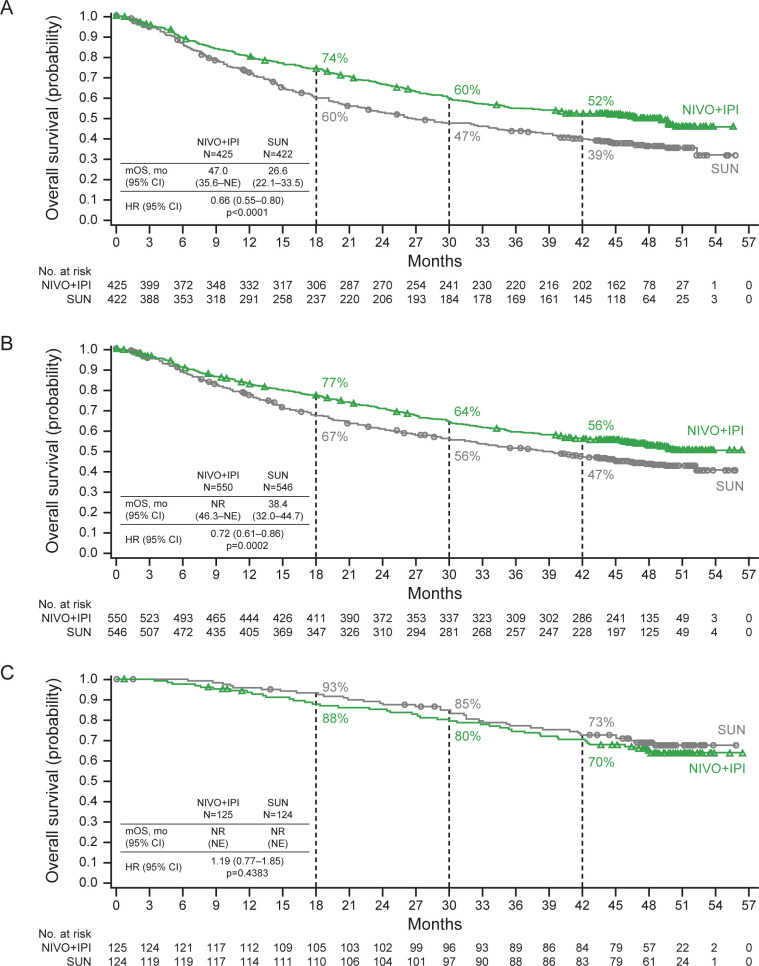
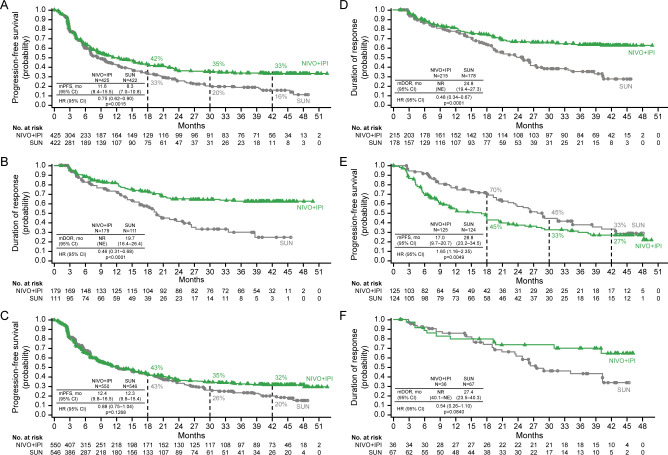
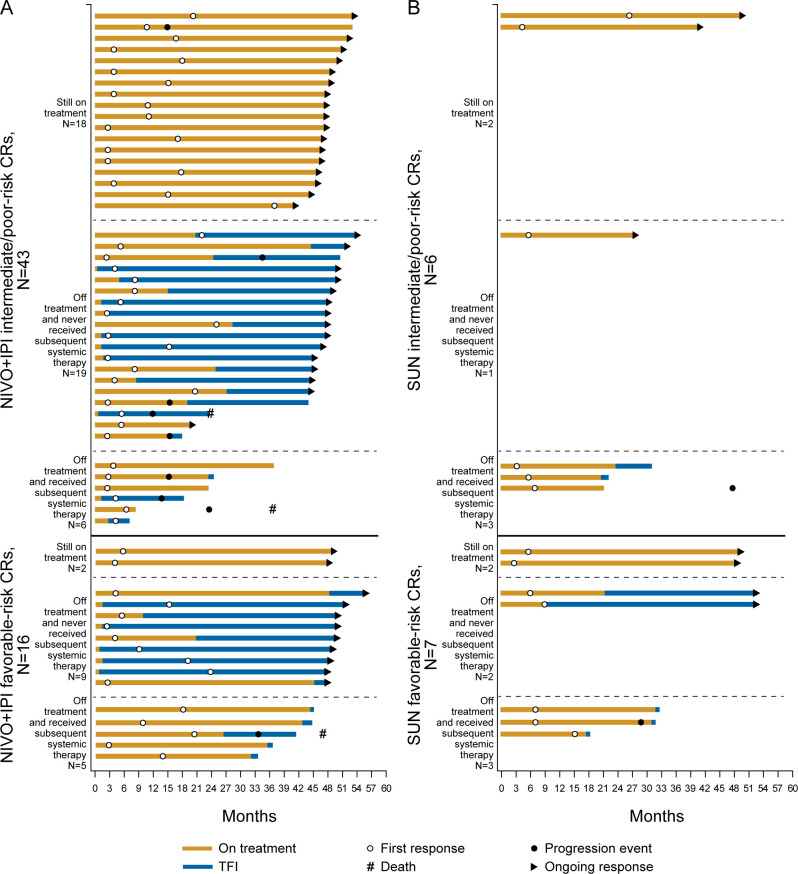
BACKGROUND: The extent to which response and survival benefits with immunotherapy-based regimens persist informs optimal first-line treatment options. We provide long-term follow-up in patients with advanced renal cell carcinoma (aRCC) receiving first-line nivolumab plus ipilimumab (NIVO+IPI) versus sunitinib (SUN) in the phase 3 CheckMate 214 trial. Survival, response, and safety outcomes with NIVO+IPI versus SUN were assessed after a minimum of 42 months of follow-up. METHODS: Patients with aRCC were enrolled from October 16, 2014, through February 23, 2016. Patients stratified by International Metastatic Renal Cell Carcinoma Database Consortium (IMDC) risk and region were randomized to nivolumab (3 mg/kg) plus ipilimumab (1 mg/kg) every 3 weeks for four doses, followed by nivolumab (3 mg/kg) every 2 weeks; or SUN (50 mg) once per day for 4 weeks (6-week cycle). Primary endpoints: overall survival (OS), progression-free survival (PFS), and objective response rate (ORR) per independent radiology review committee in IMDC intermediate-risk/poor-risk patients. Secondary endpoints: OS, PFS, and ORR in the intention-to-treat (ITT) population and safety. Favorable-risk patient outcomes were exploratory. RESULTS: Among ITT patients, 550 were randomized to NIVO+IPI (425 intermediate/poor risk; 125 favorable risk) and 546 to SUN (422 intermediate/poor risk; 124 favorable risk). Among intermediate-risk/poor-risk patients, OS (HR, 0.66; 95% CI, 0.55-0.80) and PFS (HR, 0.75; 95% CI, 0.62-0.90) benefits were observed, and ORR was higher (42.1% vs 26.3%) with NIVO+IPI versus SUN. In ITT patients, both OS benefits (HR, 0.72; 95% CI, 0.61-0.86) and higher ORR (39.1% vs 32.6%) were observed with NIVO+IPI versus SUN. In favorable-risk patients, HR for death was 1.19 (95% CI, 0.77-1.85) and ORR was 28.8% with NIVO+IPI versus 54.0% with SUN. Duration of response was longer (HR, 0.46-0.54), and more patients achieved complete response (10.1%-12.8% vs 1.4%-5.6%) with NIVO+IPI versus SUN regardless of risk group. The incidence of treatment-related adverse events was consistent with previous reports. CONCLUSIONS: NIVO+IPI led to improved efficacy outcomes versus SUN in both intermediate-risk/poor-risk and ITT patients that were maintained through 42 months' minimum follow-up. A complete response rate >10% was achieved with NIVO+IPI regardless of risk category, with no new safety signals detected in either arm. These results support NIVO+IPI as a first-line treatment option with the potential for durable response. TRIAL REGISTRATION NUMBER: NCT02231749.
Overview
The claims and statistics of this paper haven’t been checked yet.
Free: it reads the open-access text and checks the first 5 claims that cite a source we can check. Create a free account to check every claim.
Integrity signals
Registry
Cites
Statistics
Figures
Verification
Claims the paper makes
The claims and statistics of this paper haven’t been checked yet.
Free: it reads the open-access text and checks the first 5 claims that cite a source we can check. Create a free account to check every claim.
Claims other papers make about this one
Each is checked against this paper’s own text: does it say what the citing paper says it does?
In the citing paper
“Long-term follow-up has demonstrated durable survival benefi t for a subset of patients with melanoma and RCC, and combination therapy with ICT is under active investigation for a number of tumor types ( 55,58 ).”
From The Next Decade of Immune Checkpoint Therapy (2021) · cites this paper as [58]
Self-check
Percentages, sums and reported differences re-computed from the paper’s own numbers.
The self-check needs the paper’s full text.
Citations
Cites
Nonparametric Estimation from Incomplete Observations
Kaplan, E. L., & Meier, P. (1992) · Springer Series in Statistics · doi:10.1007/978-1-4612-4380-9_25 · Cited by 45,181
Meta-analysis in clinical trials
DerSimonian, R., & Laird, N. (1986) · Controlled Clinical Trials · doi:10.1016/0197-2456(86)90046-2 · Cited by 39,552
Nonparametric Estimation from Incomplete Observations
Kaplan, E. L., & Meier, P. (1958) · Journal of the American Statistical Association · doi:10.1080/01621459.1958.10501452 · Cited by 39,158
THE USE OF CONFIDENCE OR FIDUCIAL LIMITS ILLUSTRATED IN THE CASE OF THE BINOMIAL
CLOPPER, C. J., & PEARSON, E. S. (1934) · Biometrika · doi:10.1093/biomet/26.4.404 · Cited by 5,003
Nivolumab plus Ipilimumab versus Sunitinib in Advanced Renal-Cell Carcinoma
Motzer, R. J., Tannir, N. M., McDermott, D. F., Arén Frontera, O., Melichar, B., Choueiri, T. K., Plimack, E. R., Barthélémy, P., Porta, C., George, S., et al. (2018) · New England Journal of Medicine · doi:10.1056/nejmoa1712126 · Cited by 4,656
Self-citationPembrolizumab plus axitinib versus sunitinib for advanced renal-cell carcinoma
Rini, B. I., Plimack, E. R., Stus, V., Gafanov, R., Hawkins, R., Nosov, D., Pouliot, F., Alekseev, B., Soulières, D., Melichar, B., et al. (2019) · New England Journal of Medicine · doi:10.1056/nejmoa1816714 · Cited by 3,403
Self-citationAssociation of Immune-Related Adverse Events With Nivolumab Efficacy in Non–Small-Cell Lung Cancer
Haratani, K., Hayashi, H., Chiba, Y., Kudo, K., Yonesaka, K., Kato, R., Kaneda, H., Hasegawa, Y., Tanaka, K., Takeda, M., et al. (2018) · JAMA Oncology · doi:10.1001/jamaoncol.2017.2925 · Cited by 1,003
Motzer, R. J., Rini, B. I., McDermott, D. F., Arén Frontera, O., Hammers, H. J., Carducci, M. A., Salman, P., Escudier, B., Beuselinck, B., Amin, A., et al. (2019) · The Lancet Oncology · doi:10.1016/s1470-2045(19)30413-9 · Cited by 775
Self-citationPembrolizumab Cutaneous Adverse Events and Their Association With Disease Progression
Sanlorenzo, M., Vujic, I., Daud, A., Algazi, A., Gubens, M., Luna, S. A., Lin, K., Quaglino, P., Rappersberger, K., & Ortiz-Urda, S. (2015) · JAMA Dermatology · doi:10.1001/jamadermatol.2015.1916 · Cited by 449
Atkins, M. B., & Tannir, N. M. (2018) · Cancer Treatment Reviews · doi:10.1016/j.ctrv.2018.07.009 · Cited by 392
Self-citation
Cited by
Nivolumab plus Cabozantinib versus Sunitinib for Advanced Renal-Cell Carcinoma
Choueiri, T. K., Powles, T., Burotto, M., Escudier, B., Bourlon, M. T., Zurawski, B., Oyervides Juárez, V. M., Hsieh, J. J., Basso, U., Shah, A. Y., et al. (2021) · New England Journal of Medicine · doi:10.1056/nejmoa2026982 · Cited by 1,791
Self-citationThe Next Decade of Immune Checkpoint Therapy
Sharma, P., Siddiqui, B. A., Anandhan, S., Yadav, S. S., Subudhi, S. K., Gao, J., Goswami, S., & Allison, J. P. (2021) · Cancer Discovery · doi:10.1158/2159-8290.cd-20-1680 · Cited by 750
Albiges, L., Tannir, N. M., Burotto, M., McDermott, D., Plimack, E. R., Barthélémy, P., Porta, C., Powles, T., Donskov, F., George, S., et al. (2020) · ESMO Open · doi:10.1136/esmoopen-2020-001079 · Cited by 519
Self-citationBeyond conventional immune-checkpoint inhibition — novel immunotherapies for renal cell carcinoma
Braun, D. A., Bakouny, Z., Hirsch, L., Flippot, R., Van Allen, E. M., Wu, C. J., & Choueiri, T. K. (2021) · Nature Reviews Clinical Oncology · doi:10.1038/s41571-020-00455-z · Cited by 356
Self-citationManagement of Metastatic Clear Cell Renal Cell Carcinoma: ASCO Guideline
Rathmell, W. K., Rumble, R. B., Van Veldhuizen, P. J., Al-Ahmadie, H., Emamekhoo, H., Hauke, R. J., Louie, A. V., Milowsky, M. I., Molina, A. M., Rose, T. L., et al. (2022) · Journal of Clinical Oncology · doi:10.1200/jco.22.00868 · Cited by 336
“At a minimum study follow-up of 42 months in the primary efficacy population of intermediate-risk/poor-risk patients, Nivo plus Ipi improved OS probability (52% v 39%) and PFS probability (33% v 16%) when compared with sunitinib.(13) In addition, higher ORR (42% v 26%) and CR rates (10.”
BackgroundResultPaz-Ares, L. G., Ramalingam, S. S., Ciuleanu, T.-E., Lee, J.-S., Urban, L., Caro, R. B., Park, K., Sakai, H., Ohe, Y., Nishio, M., et al. (2022) · Journal of Thoracic Oncology · doi:10.1016/j.jtho.2021.09.010 · Cited by 315
Peters, S., Scherpereel, A., Cornelissen, R., Oulkhouir, Y., Greillier, L., Kaplan, M. A., Talbot, T., Monnet, I., Hiret, S., Baas, P., et al. (2022) · Annals of Oncology · doi:10.1016/j.annonc.2022.01.074 · Cited by 264
Motzer, R. J., McDermott, D. F., Escudier, B., Burotto, M., Choueiri, T. K., Hammers, H. J., Barthélémy, P., Plimack, E. R., Porta, C., George, S., et al. (2022) · Cancer · doi:10.1002/cncr.34180 · Cited by 261
Self-citationTrpkov, K., Hes, O., Williamson, S. R., Adeniran, A. J., Agaimy, A., Alaghehbandan, R., Amin, M. B., Argani, P., Chen, Y.-B., Cheng, L., et al. (2021) · Modern Pathology · doi:10.1038/s41379-021-00779-w · Cited by 258
“sion, gene expression signatures, tumor mutation burden, PBRM1 status, and CD8+ T-cell density [318, 319].”
BackgroundTannir, N. M., Signoretti, S., Choueiri, T. K., McDermott, D. F., Motzer, R. J., Flaifel, A., Pignon, J.-C., Ficial, M., Frontera, O. A., George, S., et al. (2021) · Clinical Cancer Research · doi:10.1158/1078-0432.ccr-20-2063 · Cited by 249
“Efficacy and safety analyses for the entire CheckMate 214 patient population has been reported previously (29).”
BackgroundSelf-citationBoyer, M., Şendur, M. A. N., Rodríguez-Abreu, D., Park, K., Lee, D. H., Çiçin, I., Yumuk, P. F., Orlandi, F. J., Leal, T. A., Molinier, O., et al. (2021) · Journal of Clinical Oncology · doi:10.1200/jco.20.03579 · Cited by 247
“The median (range) number of treatment cycles was 10 (1-35) in the pembrolizumabipilimumab group and 15 (1-35) in the pembrolizumabplacebo group (Appendix Table A2, online only).”
BackgroundTannir, N. M., Albigès, L., McDermott, D. F., Burotto, M., Choueiri, T. K., Hammers, H. J., Barthélémy, P., Plimack, E. R., Porta, C., George, S., et al. (2024) · Annals of Oncology · doi:10.1016/j.annonc.2024.07.727 · Cited by 231
Self-citationPowles, T., Albiges, L., Bex, A., Grünwald, V., Porta, C., Procopio, G., Schmidinger, M., Suárez, C., & de Velasco, G. (2021) · Annals of Oncology · doi:10.1016/j.annonc.2021.09.014 · Cited by 193
Self-citationPlimack, E. R., Powles, T. B., Stus, V. P., Gafanov, R. A., Nosov, D., Waddell, T., Alekseev, B. Y., Pouliot, F., Melichar, B., Soulières, D., et al. (2023) · European Urology · doi:10.1016/j.eururo.2023.06.006 · Cited by 180
Self-citationA comprehensive review of immune checkpoint inhibitors for cancer treatment
Arafat Hossain, M. (2024) · International Immunopharmacology · doi:10.1016/j.intimp.2024.113365 · Cited by 178
Choueiri, T. K., Eto, M., Motzer, R., De Giorgi, U., Buchler, T., Basappa, N. S., Méndez-Vidal, M. J., Tjulandin, S., Hoon Park, S., Melichar, B., et al. (2023) · The Lancet Oncology · doi:10.1016/s1470-2045(23)00049-9 · Cited by 172
Self-citationQuhal, F., Mori, K., Bruchbacher, A., Resch, I., Mostafaei, H., Pradère, B., Schuettfort, V. M., Laukhtina, E., Egawa, S., Fajković, H., et al. (2021) · European Urology Oncology · doi:10.1016/j.euo.2021.03.001 · Cited by 147
Motzer, R. J., Choueiri, T. K., McDermott, D. F., Powles, T. B., Vano, Y. A., Gupta, S. K., Yao, J., Han, G. C., Ammar, R., Papillon‐Cavanagh, S., et al. (2022) · Journal for ImmunoTherapy of Cancer · doi:10.1136/jitc-2021-004316 · Cited by 124
Self-citationPharmacogenomics: A Genetic Approach to Drug Development and Therapy
Qahwaji, R. M., Ashankyty, I., Sannan, N., Hazzazi, M. S., Basabrain, A. A., & Mobashir, M. (2024) · Pharmaceuticals · doi:10.3390/ph17070940 · Cited by 118
“…investigation of their ADME characteristics are essential to assist drug research and development procedures for the creation of safer and more potent biotherapeutics This suggests a potential tactic to reduce the probability of unfavorable outcomes when utilizing genetic data [4,10,24,52].”
Lisi, L., Lacal, P. M., Martire, M., Navarra, P., & Graziani, G. (2021) · Pharmacological Research · doi:10.1016/j.phrs.2021.105997 · Cited by 115
Iranzo, P., Callejo, A., Assaf, J. D., Molina, G., López-Valbuena, D., García-Illescas, D., Pardo, N., Navarro, A., Martínez‐Martí, A., Cedrés, S., et al. (2022) · Frontiers in Medicine · doi:10.3389/fmed.2022.875974 · Cited by 113
Updates on Immunotherapy and Immune Landscape in Renal Clear Cell Carcinoma
Kim, M., Jin, Z., Kolb, R. H., Borcherding, N. C., Chatzkel, J. A., Falzarano, S. M., & Zhang, W. (2021) · Cancers · doi:10.3390/cancers13225856 · Cited by 88
“In the phase III CheckMate 214 trial, the combination of nivolumab with ipilimumab was tested against sunitinib alone [21,27,92].”
BackgroundThe evolutionary legacy of immune checkpoint inhibitors
Kaushik, I., Ramachandran, S., Zabel, C., Gaikwad, S., & Srivastava, S. K. (2022) · Seminars in Cancer Biology · doi:10.1016/j.semcancer.2022.03.020 · Cited by 79
Regan, M. M., Jegede, O. A., Mantia, C. M., Powles, T. B., Werner, L. L., Motzer, R. J., Tannir, N. M., Lee, C., Tomita, Y., Voss, M. H., et al. (2021) · Clinical Cancer Research · doi:10.1158/1078-0432.ccr-21-2283 · Cited by 67
“TRAEs leading to treatment discontinuation were more frequent with nivolumab plus ipilimumab versus sunitinib, occurring in 22%and 13%of patients, respectively (10); however, nivolumab plus ipilimumab was associated with better health-related quality of life (HRQoL) throughout treatment (12, 13).”
BackgroundResultInfluentialSelf-citationDefining unique clinical hallmarks for immune checkpoint inhibitor-based therapies
Michielin, O. A., Lalani, A. A., Robert, C., Sharma, P., & Peters, S. (2022) · Journal for ImmunoTherapy of Cancer · doi:10.1136/jitc-2021-003024 · Cited by 64
Aldin, A., Besiroglu, B., Adams, A., Monsef, I., Piechotta, V., Tomlinson, E., Hornbach, C., Dressen, N., Goldkuhle, M., Maisch, P., et al. (2023) · Cochrane Database of Systematic Reviews · doi:10.1002/14651858.cd013798.pub2 · Cited by 51
Silva, P. D., Aiello, M. M., Gu‐Trantien, C., Migliori, E., Willard-Gallo, K. E., & Solinas, C. (2020) · International Journal of Cancer · doi:10.1002/ijc.33415 · Cited by 51
Zhang, Z., Pan, Q., Lu, M., & Zhao, B. (2023) · EClinicalMedicine · doi:10.1016/j.eclinm.2023.102156 · Cited by 49
Möller, K., Fraune, C., Blessin, N. C., Lennartz, M., Kluth, M., Hube‐Magg, C., Lindhorst, L., Dahlem, R., Fisch, M., Eichenauer, T., et al. (2021) · International Urology and Nephrology · doi:10.1007/s11255-021-02841-7 · Cited by 48
“For patients in need for a systemic therapy, several new drugs have recently gained approval and improved the prognosis of metastatic RCC [2, 3].”
BackgroundWiele, A. J., Bathala, T. K., Hahn, A. W., Xiao, L., Duran, M., Ross, J. A., Jonasch, E. W., Shah, A. Y., Campbell, M. T., Msaouel, P., et al. (2021) · The Oncologist · doi:10.1002/onco.13770 · Cited by 46
Self-citationLatest Advances in the Use of Therapeutic Focused Ultrasound in the Treatment of Pancreatic Cancer
Mouratidis, P., & ter Haar, G. (2022) · Cancers · doi:10.3390/cancers14030638 · Cited by 46
Serzan, M. T., & Atkins, M. B. (2021) · Journal of Cancer Metastasis and Treatment · doi:10.20517/2394-4722.2021.76 · Cited by 45
“3%, and landmark 42 months PFS 28% and 35%[43].”
BackgroundGrünwald, V., Powles, T. B., Kopyltsov, E., Kozlov, V. V., Alonso‐Gordoa, T., Eto, M., Hutson, T. E., Motzer, R. J., Winquist, E., Maroto, P., et al. (2023) · European Urology Oncology · doi:10.1016/j.euo.2023.01.010 · Cited by 43
“A similar association for RECIST-defined responses and OS with a 6-mo landmark analysis was reported in the CM214 trial of ipilimumab plus nivolumab [24].”
MethodSelf-citationAdjuvant therapy options in renal cell carcinoma — targeting the metastatic cascade
Fitzgerald, K. N., Motzer, R. J., & Lee, C. (2022) · Nature Reviews Urology · doi:10.1038/s41585-022-00666-2 · Cited by 42
Self-citationIinuma, K., Enomoto, T., Kawada, K., Fujimoto, S., Ishida, T., Takagi, K., Nagai, S., Ito, H., Kawase, M., Nakai, C., et al. (2021) · Journal of Clinical Medicine · doi:10.3390/jcm10225325 · Cited by 41
“However, in effective cases, it has been established that NIVO + IPI has a longer durable response and achieves therapeutic effects in a comparatively short period [11,42].”
Evolving landscape of first-line combination therapy in advanced renal cancer: a systematic review
Lalani, A. A., Heng, D. Y. C., Basappa, N. S., Wood, L. A., Iqbal, N., McLeod, D., Soulières, D., & Kollmannsberger, C. (2022) · Therapeutic Advances in Medical Oncology · doi:10.1177/17588359221108685 · Cited by 41
Self-citationA FAK Inhibitor Boosts Anti-PD1 Immunotherapy in a Hepatocellular Carcinoma Mouse Model
Wei, Y., Wang, Y., Liu, N., Qi, R., Xu, Y., Li, K., Feng, Y., & Shi, B. (2022) · Frontiers in Pharmacology · doi:10.3389/fphar.2021.820446 · Cited by 38
“In recent years, attention has been given to the effectiveness of immunotherapy which targets immune checkpoints, such as anti-programmed cell death 1(PD1) targeted immunotherapy, which has resulted in encouraging effects in the treatment of some solid tumors (Motzer et al., 2020).”
BackgroundAlhalabi, O., Thouvenin, J., Négrier, S., Vano, Y. A., Campedel, L., Hasanov, E., Bakouny, Z., Hahn, A. W., Bilen, M. A., Msaouel, P., et al. (2023) · The Oncologist · doi:10.1093/oncolo/oyac262 · Cited by 38
Self-citationHermansen, C. K., & Donskov, F. N. (2020) · Journal of Geriatric Oncology · doi:10.1016/j.jgo.2020.12.008 · Cited by 37
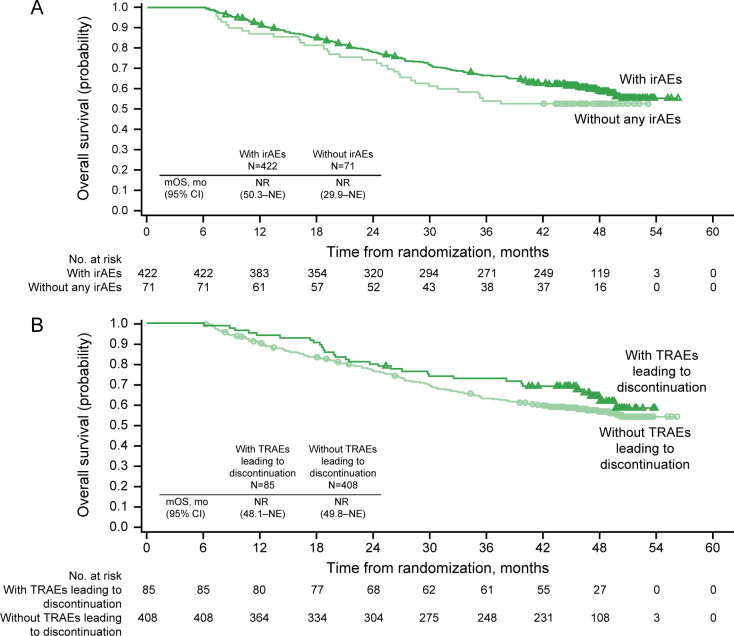
“On investigating the effect of nivolumab and ipilimumab in patients with mRCC, neither discontinuation due to immune-related AEs nor the overall incidences of AEs negatively affected OS[31].”
BackgroundSelf-citationPaz-Ares, L. G., Ciuleanu, T., Płużański, A., Lee, J., Gainor, J. F., Otterson, G. A., Audigier-Valette, C., Ready, N., Schenker, M., Linardou, H., et al. (2022) · Journal of Thoracic Oncology · doi:10.1016/j.jtho.2022.08.014 · Cited by 37
Tzeng, A., Tzeng, T. H., & Ornstein, M. C. (2021) · Journal for ImmunoTherapy of Cancer · doi:10.1136/jitc-2021-003473 · Cited by 35
Liu, Y., Zhang, Z., Wang, S., Fu, S., Cheng, X., Chen, R., & Sun, T. (2022) · International Immunopharmacology · doi:10.1016/j.intimp.2022.108900 · Cited by 35
Ikeda, T., Ishihara, H., Nemoto, Y., Tachibana, H., Fukuda, H., Yoshida, K., Takagi, T., Iizuka, J., Hashimoto, Y., Ishida, H., et al. (2021) · Urologic Oncology Seminars and Original Investigations · doi:10.1016/j.urolonc.2021.05.012 · Cited by 34
Shapiro, D. D., Karam, J. A., Zemp, L. W., Master, V. A., Sexton, W. J., Ghasemzadeh, A., Schmeusser, B. N., Davaro, F., Peak, T. C., Patil, D. H., et al. (2023) · European Urology Open Science · doi:10.1016/j.euros.2023.01.016 · Cited by 34
Adverse events induced by nivolumab and ipilimumab combination regimens
Somekawa, K., Horita, N., Kaneko, A., Tagami, Y., Fukuda, N., Matsumoto, H., Namkoong, H., Fujiwara, Y., Minegishi, K., Fukumoto, T., et al. (2022) · Therapeutic Advances in Medical Oncology · doi:10.1177/17588359211058393 · Cited by 33
Actualizaci ón en la fisiopatolo gía de la preeclampsia
Carbajal, L. M. G. (2015) · Revista Peruana de Ginecología y Obstetricia · doi:10.31403/rpgo.v60i156 · Cited by 34
Pancreatic injury following immune checkpoint inhibitors: A systematic review and meta-analysis
Zhang, T., Wang, Y., Shi, C., Liu, X., Lv, S., Wang, X., & Li, W. (2022) · Frontiers in Pharmacology · doi:10.3389/fphar.2022.955701 · Cited by 32
“After screening and eligibility assessment, 50 clinical trials, including 35,223 patients with malignant tumors, were selected for inclusion in this meta-analysis (Figure 1) (Baas et al., 2021; Choueiri et al., 2021; Fennell et al., 2021; Gadgeel et al., 2020; Herbst et al., 2021; Janjigian et al., 2021; Monk et al.,…”
Metastatic renal cell carcinoma to the pancreas and other sites—a multicenter retrospective study
Duarte, C., Hu, J., Beuselinck, B., Panian, J. A., Weise, N., Dizman, N., Collier, K. A., Rathi, N., Li, H., Elias, R. M., et al. (2023) · EClinicalMedicine · doi:10.1016/j.eclinm.2023.102018 · Cited by 32
Self-citationHendriksen, J. D., Locallo, A., Maarup, S. B., Debnath, O., Ishaque, N., Hasselbalch, B., Skjøth‐Rasmussen, J., Yde, C. W., Poulsen, H. S., Lassen, U., et al. (2024) · Neuro-Oncology · doi:10.1093/neuonc/noae085 · Cited by 31
Creemers, J. H. A., Lesterhuis, W. J., Mehra, N., Gerritsen, W. R., Figdor, C. G., de Vries, I. J. M., & Textor, J. C. (2021) · Journal for ImmunoTherapy of Cancer · doi:10.1136/jitc-2020-002032 · Cited by 30
“melanoma (1), lung cancer (2), and renal cell carcinoma (3).”
BackgroundKanesvaran, R., Porta, C., Wong, A. S. C., Powles, T. B., Ng, Q. S., Schmidinger, M., Ye, D., Malhotra, H., Miura, Y., Lee, J. L., et al. (2021) · ESMO Open · doi:10.1016/j.esmoop.2021.100304 · Cited by 30
Self-citationThe Genetic Evolution of Metastasis
Rogiers, A., Lobón, I., Spain, L. A., & Turajlic, S. (2022) · Cancer Research · doi:10.1158/0008-5472.can-21-3863 · Cited by 30
Frontier knowledge and future directions of programmed cell death in clear cell renal cell carcinoma
Cao, F., Xu, Z., Zhang, S., & Pang, J. (2024) · Cell Death Discovery · doi:10.1038/s41420-024-01880-0 · Cited by 30
“The combination of nivolumab plus ipilimumab showed longer duration of response and higher response rate in patients with advanced ccRCC [61].”
BackgroundEmerging Ocular Side Effects of Immune Checkpoint Inhibitors: A Comprehensive Review
Wu, K. Y., Yakobi, Y., Gueorguieva, D. D., & Mazerolle, É. (2024) · Biomedicines · doi:10.3390/biomedicines12112547 · Cited by 29
“All three classes have demonstrated significant efficacy in cancer treatment, improving patient outcomes in terms of Progression Free Survival and Overall Survival [11–14].”
Mantia, C. M., Jegede, O. A., Plimack, E. R., Powles, T. B., Motzer, R. J., Tannir, N. M., Lee, C., Tomita, Y., Voss, M. H., Choueiri, T. K., et al. (2024) · Journal for ImmunoTherapy of Cancer · doi:10.1136/jitc-2024-009495 · Cited by 28
Self-citationAtkins, M. B., Plimack, E. R., Puzanov, I. J., Fishman, M., McDermott, D. F., Cho, D. C., Vaishampayan, U. N., George, S., Tarazi, J., Duggan, W. T., et al. (2021) · European Journal of Cancer · doi:10.1016/j.ejca.2020.12.009 · Cited by 27
“…updated analysis of the phase III CheckMate 214 trial of nivolumab plus ipilimumab versus sunitinib, with a median follow-up of 43.6 months for the nivolumab plus ipilimumab arm, median OS was not reached and the probability of survival at 42 months was 56% in the intent-to-treat population [16].”
InfluentialSelf-citationKearney, M., Zhang, L., Hubscher, E. M., Musat, M. G., Harricharan, S., & Wilke, T. (2023) · Future Oncology · doi:10.2217/fon-2023-0298 · Cited by 26
Schoenfeld, D. A., Moutafi, M. K., Martinez, S., Djureinovic, D., Merkin, R. D., Adeniran, A., Braun, D. A., Signoretti, S., Choueiri, T. K., Parisi, F., et al. (2023) · Journal for ImmunoTherapy of Cancer · doi:10.1136/jitc-2023-007240 · Cited by 26
“9 For patients otherwise responding to ICI-based therapies, the brain is a common site of progression.”
Self-citationNovel Therapeutic Approaches and the Evolution of Drug Development in Advanced Kidney Cancer
Ravi, P. K., Bakouny, Z., Schmidt, A. L., & Choueiri, T. K. (2020) · The Cancer Journal · doi:10.1097/ppo.0000000000000477 · Cited by 25
Self-citationSiddiqui, B. A., Gheeya, J., Goswamy, R. V., Bathala, T. K., Surasi, D. S., Gao, J., Shah, A. Y., Campbell, M. T., Msaouel, P., Goswami, S., et al. (2021) · Journal for ImmunoTherapy of Cancer · doi:10.1136/jitc-2021-002850 · Cited by 25
Self-citationNajafi, M., Jahanbakhshi, A., Gomar, M., Iotti, C., Giaccherini, L., Rezaie, O., Cavallieri, F., Deantonio, L., Bardoscia, L., Botti, A., et al. (2022) · Current Oncology · doi:10.3390/curroncol29050244 · Cited by 25
Cella, E., Zullo, L., Marconi, S., Rossi, G., Coco, S., Dellepiane, C., Alama, A., Rozeboom, L. M., Bennicelli, E., Parisi, F., et al. (2022) · Expert Opinion on Biological Therapy · doi:10.1080/14712598.2022.2116273 · Cited by 25
Xiong, L., Zhang, Y., Wang, J., Yu, M., Huang, L., Hou, Y., Li, G., Wang, L., & Li, Y. (2024) · European Journal of Medicinal Chemistry · doi:10.1016/j.ejmech.2024.116158 · Cited by 25
Geynisman, D. M., Maranchie, J. K., Ball, M. W., Bratslavsky, G., & Singer, E. A. (2021) · Urologic Oncology Seminars and Original Investigations · doi:10.1016/j.urolonc.2021.04.038 · Cited by 25
“Even more compelling was that in contrast to 25 years ago when the median overall survival of advanced renal-cell carcinoma patients was approximately 1 year, in the 42-month updated analysis of the nivolumab with ipilimumab trial published in 2020, 56% of the intent-to-treat (favorable/intermediate/poor risk) patient…”
ResultVon Hippel-Lindau tumor suppressor pathways & corresponding therapeutics in kidney cancer
Shulman, M., Shi, R., & Zhang, Q. H. (2021) · Journal of genetics and genomics/Journal of Genetics and Genomics · doi:10.1016/j.jgg.2021.05.016 · Cited by 25
Ding, L., Dong, H., Zhou, T. R., Wang, Y. H., Yan, T., Li, J. C., Wang, Z. Y., Liang, C., & Liang, C. (2021) · Cancer Medicine · doi:10.1002/cam4.4190 · Cited by 25
Guida, A., Sabbatini, R., Gibellini, L., Biasi, S. D., Cossarizza, A., & Porta, C. (2021) · Cancer Treatment Reviews · doi:10.1016/j.ctrv.2021.102157 · Cited by 24
Self-citationXiang, Z., Li, J., Zhang, Z., Cen, C., Chen, W., Jiang, B., Meng, Y., Wang, Y., Berglund, B., Zhai, G., et al. (2022) · Frontiers in Pharmacology · doi:10.3389/fphar.2022.883655 · Cited by 24
Stühler, V., Herrmann, L. M., Rausch, S., Stenzl, A., & Bedke, J. (2022) · Cancers · doi:10.3390/cancers14122972 · Cited by 24
“However, the PFS rates shown in this analysis fit better with the data from the Checkmate 214 study, which showed an eighteen-month PFS rate of 43% [48].”
ResultNext Wave of Targets in the Treatment of Advanced Renal Cell Carcinoma
Cardenas, L. M., Deluce, J. E., Khan, S., Gulam, O., Vareki, S. M., Fernandes, R., & Lalani, A. A. (2022) · Current Oncology · doi:10.3390/curroncol29080429 · Cited by 24
“A plateau in progression-free survival (PFS) of 33% was seen after 36 months, suggesting that a proportion of patients are long-term responders [12].”
BackgroundMerrick, S., Nankivell, M. G., Quartagno, M., Clarke, C. S., Joharatnam‐Hogan, N., Waddell, T., O’Carrigan, B., Seckl, M. J., Ghorani, E., Banks, E., et al. (2022) · Contemporary Clinical Trials · doi:10.1016/j.cct.2022.107030 · Cited by 24
“9-month PFS rates are estimated to be 70% in the renal cohort(1,18).”
BackgroundThe role of immunotherapy in non-clear cell renal cell carcinoma
Climent, C., Soriano, S., Bonfill, T., López, N. V., Rodríguez-Castells, M., Sierra, M., Cobo, P. A., Gil, M. F., Busquets, M., Carrasco, A., et al. (2023) · Frontiers in Oncology · doi:10.3389/fonc.2023.941835 · Cited by 24
Overcoming Resistance to Immunotherapy in Advanced Cutaneous Squamous Cell Carcinoma
García‐Sancha, N., Corchado‐Cobos, R., Bellido-Hernández, L., Román‐Curto, C., Álvarez, E. C., Pérez‐Losada, J., Órfão, A., & Cañueto, J. (2021) · Cancers · doi:10.3390/cancers13205134 · Cited by 23
Greene, C., Attwood, K. M., Sharma, N. J., Balderman, B., Deng, R., Muhitch, J. B., Smith, G. J., Gross, K. W., Xu, B., & KAUFFMAN, E. C. (2022) · Frontiers in Oncology · doi:10.3389/fonc.2022.923043 · Cited by 23
Killer instincts: natural killer cells as multifactorial cancer immunotherapy
Nersesian, S., Carter, E. B., Lee, S. N., Westhaver, L. P., & Boudreau, J. E. (2023) · Frontiers in Immunology · doi:10.3389/fimmu.2023.1269614 · Cited by 23
Beyond PD‐1/PD‐L1: New Immune Checkpoints and Therapeutic Combinations in Cancer Immunotherapy
Li, Y., Kang, Z., & Du, Y. (2026) · Medicine Bulletin · doi:10.1002/mdb2.70018 · Cited by 22
de la Bruyère, C. L., Souquet, P.-J., Dalle, S., Corbaux, P., Boespflug, A. M., Duruisseaux, M., Kiakouama-Maleka, L., Reverdy, T., Maugeais, M., Şahin, G., et al. (2021) · Cancers · doi:10.3390/cancers13102365 · Cited by 22
“In contrast, an update of the phase 3 study evaluating nivolumab + ipilimumab versus sunitinib in clear cell renal carcinoma showed no negative impact on OS of irAEs incidence but also of therapy discontinuation due to treatment-related irAEs [39].”
ResultNolla, K. M., Benjamin, D. J., & Cella, D. F. (2023) · Nature Reviews Urology · doi:10.1038/s41585-023-00747-w · Cited by 22
Numakura, K., Sekine, Y., Hatakeyama, S., Muto, Y., Sobu, R., Kobayashi, M., Sasagawa, H., Kashima, S., Yamamto, R., Nara, T., et al. (2023) · Cancer Medicine · doi:10.1002/cam4.6306 · Cited by 22
Motzer, R. J., Rane, P. P., Saretsky, T. L., Pawar, D., Nguyen, A. M., Sundaram, M., Burgents, J. E., Pandey, R., & Rüdell, K. (2023) · European Urology · doi:10.1016/j.eururo.2023.07.006 · Cited by 22
Self-citationThe treatment of metastatic renal cell carcinoma
Ivanyi, P., Fröhlich, T. C., Grünwald, V., Zschäbitz, S., Bedke, J., & Doehn, C. (2024) · Deutsches Ärzteblatt international · doi:10.3238/arztebl.m2024.0147 · Cited by 22
Self-citationSchoenfeld, D. A., Djureinovic, D., Su, D. G., Zhang, L., Lu, B. Y., Kamga, L., Mann, J. E., Huck, J. D., Hurwitz, M. E., Braun, D. A., et al. (2024) · JCI Insight · doi:10.1172/jci.insight.184545 · Cited by 22
“Still, many patients do not respond to front-line therapy, and among initial responders, responses are usually transient (5).”
Choueiri, T. K., Albiges, L. K., Atkins, M. B., Bakouny, Z., Bratslavsky, G., Braun, D. A., Haas, N. B., Haanen, J. B. A. G., Hakimi, A. A., Jewett, M. A. S., et al. (2022) · Clinical Cancer Research · doi:10.1158/1078-0432.ccr-21-3238 · Cited by 22
Self-citationSingh, S., Zhang, X. H.-F., & Rosen, J. M. (2020) · Cells · doi:10.3390/cells10010011 · Cited by 21
“Combination therapy can also lead to an improvement of overall survival in patients with renal cell carcinoma as compared to the standard-of-care monotherapy sunitinib [15].”
BackgroundComplete response and renal cell carcinoma in the immunotherapy era: The paradox of good news
Zambrana, F. R., Carril-Ajuria, L., de Liaño, A. G., Chanzá, N. M., Kopp, R. M., Castellano, D., & de Velasco, G. (2021) · Cancer Treatment Reviews · doi:10.1016/j.ctrv.2021.102239 · Cited by 21
Monoclonal Antibodies to CTLA-4 with Focus on Ipilimumab
Graziani, G., Lisi, L., Tentori, L., & Navarra, P. (2022) · Experientia supplementum · doi:10.1007/978-3-030-91311-3_10 · Cited by 21
Ishihara, H., Nemoto, Y., Nakamura, K., Tachibana, H., Ikeda, T., Fukuda, H., Yoshida, K., Kobayashi, H., Iizuka, J., Shimmura, H., et al. (2023) · Targeted Oncology · doi:10.1007/s11523-023-00956-8 · Cited by 20
Pala, L., Pagan, E., Sala, I., Oriecuia, C., Oliari, M., Pas, T. M. D., Specchia, C., Cocorocchio, E., Zattarin, E., Rossi, G., et al. (2024) · EClinicalMedicine · doi:10.1016/j.eclinm.2024.102681 · Cited by 20
Iinuma, K., Kameyama, K., Kawada, K., Fujimoto, S., Takagi, K., Nagai, S., Ito, H., Ishida, T., Kawase, M., Kawase, K., et al. (2021) · Current Oncology · doi:10.3390/curroncol28020133 · Cited by 20
“In addition, almost half the complete responders experienced a treatment-free interval [9].”
BackgroundInfluentialChen, Z., Zhang, M., Lu, Y., Ding, T., Liu, Z., Liu, Y., Zhou, Z., & Wang, L. (2022) · Oncology Reports · doi:10.3892/or.2022.8378 · Cited by 19
“inhibits mTOR and nivolumab (27) used in immune therapies have been used for the treatment of metastatic RCC.”
MethodNumakura, K., Muto, Y., Naito, S., Hatakeyama, S., Kato, R., Koguchi, T., Kojima, T., Kawasaki, Y., Kandori, S., Kawamura, S., et al. (2021) · Cancer Medicine · doi:10.1002/cam4.4130 · Cited by 19
Schoenfeld, D. A., Merkin, R. D., Moutafi, M. K., Martinez, S., Adeniran, A., Kumar, D., Jilaveanu, L. B., Hurwitz, M. E., Rimm, D. L., & Kluger, H. M. (2022) · Frontiers in Oncology · doi:10.3389/fonc.2022.990367 · Cited by 19
Next Steps: Sequencing Therapies in Metastatic Kidney Cancer in the Contemporary Era
Schmidt, A. L., Tabakin, A. L., Singer, E. A., Choueiri, T. K., & McKay, R. R. (2021) · American Society of Clinical Oncology Educational Book · doi:10.1200/edbk_320785 · Cited by 18
Self-citationStühler, V., Rausch, S., Maas, J. M., Stenzl, A., & Bedke, J. (2021) · Expert Opinion on Biological Therapy · doi:10.1080/14712598.2021.1890713 · Cited by 18
Hoeh, B., Flammia, R. S., Hohenhorst, L., Sorce, G., Panunzio, A., Tappero, S., Tian, Z., Fred Saad, C., Gallucci, M., Briganti, A., et al. (2022) · Seminars in Oncology · doi:10.1053/j.seminoncol.2022.10.001 · Cited by 18
Chahoud, J., Msaouel, P., Ross, J. A., McCormick, B. Z., Bathala, T. K., Gao, J., Horn, R. G., Xiao, L., Sircar, K., Campbell, M. T., et al. (2020) · Urologic Oncology Seminars and Original Investigations · doi:10.1016/j.urolonc.2020.10.019 · Cited by 17
Self-citationRCC Real-World Data: Prognostic Factors and Risk Stratification in the Immunotherapy Era
Sagie, S., Sarfaty, M., Levartovsky, M., Sorotsky, H. G., Berger, R., Percik, R., & Gadot, M. (2022) · Cancers · doi:10.3390/cancers14133127 · Cited by 17
Vasudev, N. S., Ainsworth, G., Brown, S., Pickering, L. M., Waddell, T., Fife, K. M., Griffiths, R., Sharma, A., Katona, E., Howard, H., et al. (2023) · Journal of Clinical Oncology · doi:10.1200/jco.23.00236 · Cited by 16
Self-citationHemminki, O., Perlis, N., Björklund, J., Finelli, A., Zlotta, A. R., & Hemminki, A. (2020) · European Urology Open Science · doi:10.1016/j.euros.2020.11.003 · Cited by 16
“In particular, treatment-associated deaths were reported in early trials [45,46,53].”
BackgroundInfluentialComplete Pathologic Responses With Immunotherapy in Metastatic Renal Cell Carcinoma: Case Reports
Tucker, M. D., Beckermann, K. E., Gordetsky, J., Giannico, G. A., Davis, N. B., & Rini, B. I. (2020) · Frontiers in Oncology · doi:10.3389/fonc.2020.609235 · Cited by 16
Self-citation
Metadata
- Authors
- Motzer, R. J., Escudier, B., McDermott, D. F., Arén Frontera, O., Melichar, B., Powles, T., Donskov, F., Plimack, E. R., Barthélémy, P., Hammers, H. J., George, S., Grünwald, V., Porta, C., Neiman, V., Ravaud, A., Choueiri, T. K., Rini, B. I., Salman, P., Kollmannsberger, C. K., Tykodi, S. S., Grimm, M.-O., Gurney, H., Leibowitz-Amit, R., Geertsen, P. F., Amin, A., Tomita, Y., McHenry, M. B., Saggi, S. S., & Tannir, N. M.
- Affiliations
- Memorial Sloan Kettering Cancer Center (US)
- Institut Gustave Roussy (FR)
- Beth Israel Deaconess Medical Center (US)
- Centro de Investigación Clínica Bradford Hill, Santiago, Chile
- University Hospital Olomouc (CZ)
- National Health Service (GB)
- Aarhus University Hospital (DK)
- Fox Chase Cancer Center (US)
- Institut de Cancérologie Strasbourg (FR)
- The University of Texas Southwestern Medical Center (US)
- Roswell Park Comprehensive Cancer Center (US)
- Essen University Hospital (DE)
- University of Pavia (IT)
- Tel Aviv University (IL)
- Centre Hospitalier Universitaire de Bordeaux (FR)
- Dana-Farber Cancer Institute (US)
- Cleveland Clinic (US)
- Fundación Arturo López Pérez (CL)
- BC Cancer Agency (CA)
- University of Washington (US)
- Jena University Hospital (DE)
- Westmead Hospital (AU)
- Oncology Institute, Shamir Medical Center, Be'er Yaakov, Israel
- Herlev Hospital (DK)
- Levine Cancer Institute (US)
- Niigata University (JP)
- Bristol-Myers Squibb (United States) (US)
- The University of Texas MD Anderson Cancer Center (US)
- Corresponding author
- Motzer, Robert J
- ORCID
- Motzer, Robert J
- Escudier, Bernard
- McDermott, David F
- Melichar, Bohuslav
- Powles, Thomas
- Donskov, Frede
- Plimack, Elizabeth R
- Barthélémy, Philippe
- Hammers, Hans J
- George, Saby
- Grünwald, Viktor
- Porta, Camillo
- Ravaud, Alain
- Choueiri, Toni K
- Rini, Brian I
- Salman, Pamela
- Kollmannsberger, Christian K
- Tykodi, Scott S
- Grimm, Marc-Oliver
- Gurney, Howard
- Geertsen, Poul F
- Amin, Asim
- Tomita, Yoshihiko
- McHenry, M Brent
- Tannir, Nizar M
- Venue
- Journal for ImmunoTherapy of Cancer
- Publisher
- BMJ
- Published
- 2020-07
- Volume
- 8
- Issue
- 2
- Pages
- e000891
- ISSN
- 2051-1426 (ISSN-L)
- PMC
- PMC7359377
- OpenAlex
- W3042095160
- Cited by
- 224
- References
- 18
- Citations by year
- 2026: 6 · 2025: 15 · 2024: 27 · 2023: 43 · 2022: 57 · 2021: 58 · 2020: 18
- FWCI
- 24.77
- Type
- journal article
- Language
- en
- Update notices
- correction (2021-05-03)
- Open access
- gold
- doi.org
- Licence
- Locations
- Journal for ImmunoTherapy of Cancer (publishedVersion, cc-by-nc)
- PubMed Central (publishedVersion, cc-by-nc)
- PubMed (publishedVersion)
- DOAJ (DOAJ: Directory of Open Access Journals) (submittedVersion, cc-by-sa)
- CINECA IRIS Institutional Research Information System (University of Bari Aldo Moro) (submittedVersion, other-oa)
- Funders
- Bristol Myers Squibb and ONO Pharmaceutical Company Limited
- Topics
- Health Sciences › Medicine › Oncology › Renal cell carcinoma treatment
- Health Sciences › Medicine › Oncology › Cancer Immunotherapy and Biomarkers
- Life Sciences › Biochemistry, Genetics and Molecular Biology › Cancer Research › Ferroptosis and cancer prognosis
- Keywords
- advanced renal cell carcinoma, nivolumab, ipilimumab, sunitinib, immune checkpoint inhibitors, first-line therapy, overall survival, progression-free survival, objective response rate, long-term follow-up, IMDC risk stratification, treatment safety, immune-related adverse events, CheckMate 214, combination immunotherapy, tyrosine kinase inhibitors
- MeSH terms
- Ipilimumab, Sunitinib, Nivolumab, Antineoplastic Combined Chemotherapy Protocols, Carcinoma, Renal Cell, Female, Follow-Up Studies, Humans, Kidney Neoplasms, Male, Survival Analysis
About these checks
Registry, retraction, Cites and statistics results are computed, not judged, with one exception: a printed reference that no index lists is read once by a model before it counts as a citation error. Claims are extracted by a model and kept only when their quote appears verbatim in the text; each cited source is then checked, with a model’s help, for whether it says what the claim relies on. Those verdicts can be wrong — read the claim’s quote and the cited source before relying on one.
Statistics and arithmetic are recomputed, not judged.
Confidence bands are shown only for fields calibrated on our annotated test set. None is calibrated yet, so no band is shown.
What counts as a claim ›How we measure confidence ›How we check this ›
Are you an author, or do you see a problem with this page? Request a review
Data sources
Bibliographic data: Semantic Scholar, OpenAlex, Crossref.
Contains information from the Semantic Scholar Academic Graph Datasets, made available under the ODC Attribution License (ODC-BY 1.0).
Semantic Scholar’s data is described in: Kinney, R., et al. (2023). The Semantic Scholar Open Data Platform. arXiv:2301.10140.
