

Survival outcomes and independent response assessment with nivolumab plus ipilimumab versus sunitinib in patients with advanced renal cell carcinoma: 42-month follow-up of a randomized phase 3 clinical trial
Open accessThe DOI matches its Crossref record; 18 of the 18 references it cites were found in a registry or an index.
Abstract
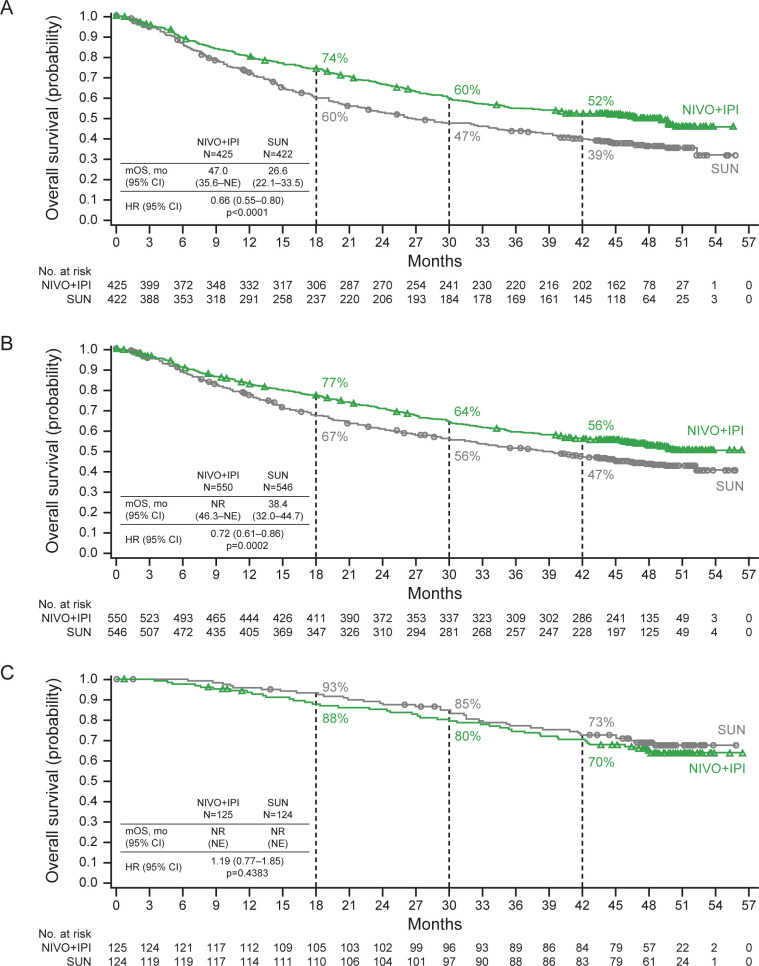
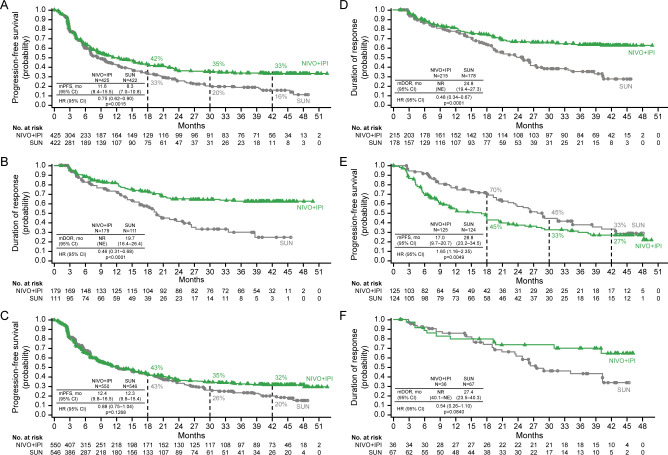
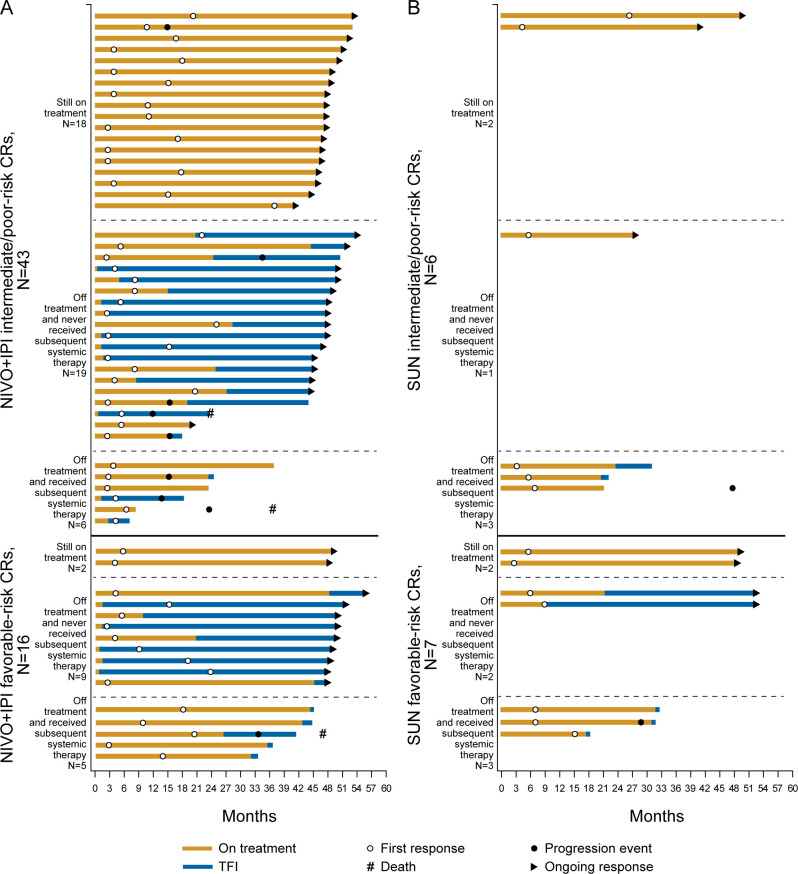
BACKGROUND: The extent to which response and survival benefits with immunotherapy-based regimens persist informs optimal first-line treatment options. We provide long-term follow-up in patients with advanced renal cell carcinoma (aRCC) receiving first-line nivolumab plus ipilimumab (NIVO+IPI) versus sunitinib (SUN) in the phase 3 CheckMate 214 trial. Survival, response, and safety outcomes with NIVO+IPI versus SUN were assessed after a minimum of 42 months of follow-up. METHODS: Patients with aRCC were enrolled from October 16, 2014, through February 23, 2016. Patients stratified by International Metastatic Renal Cell Carcinoma Database Consortium (IMDC) risk and region were randomized to nivolumab (3 mg/kg) plus ipilimumab (1 mg/kg) every 3 weeks for four doses, followed by nivolumab (3 mg/kg) every 2 weeks; or SUN (50 mg) once per day for 4 weeks (6-week cycle). Primary endpoints: overall survival (OS), progression-free survival (PFS), and objective response rate (ORR) per independent radiology review committee in IMDC intermediate-risk/poor-risk patients. Secondary endpoints: OS, PFS, and ORR in the intention-to-treat (ITT) population and safety. Favorable-risk patient outcomes were exploratory. RESULTS: Among ITT patients, 550 were randomized to NIVO+IPI (425 intermediate/poor risk; 125 favorable risk) and 546 to SUN (422 intermediate/poor risk; 124 favorable risk). Among intermediate-risk/poor-risk patients, OS (HR, 0.66; 95% CI, 0.55-0.80) and PFS (HR, 0.75; 95% CI, 0.62-0.90) benefits were observed, and ORR was higher (42.1% vs 26.3%) with NIVO+IPI versus SUN. In ITT patients, both OS benefits (HR, 0.72; 95% CI, 0.61-0.86) and higher ORR (39.1% vs 32.6%) were observed with NIVO+IPI versus SUN. In favorable-risk patients, HR for death was 1.19 (95% CI, 0.77-1.85) and ORR was 28.8% with NIVO+IPI versus 54.0% with SUN. Duration of response was longer (HR, 0.46-0.54), and more patients achieved complete response (10.1%-12.8% vs 1.4%-5.6%) with NIVO+IPI versus SUN regardless of risk group. The incidence of treatment-related adverse events was consistent with previous reports. CONCLUSIONS: NIVO+IPI led to improved efficacy outcomes versus SUN in both intermediate-risk/poor-risk and ITT patients that were maintained through 42 months' minimum follow-up. A complete response rate >10% was achieved with NIVO+IPI regardless of risk category, with no new safety signals detected in either arm. These results support NIVO+IPI as a first-line treatment option with the potential for durable response. TRIAL REGISTRATION NUMBER: NCT02231749.
Overview
The claims and statistics of this paper haven’t been checked yet.
Free: it reads the open-access text and checks the first 5 claims that cite a source we can check. Create a free account to check every claim.
Integrity signals
Registry
Cites
Statistics
Figures
Verification
Claims the paper makes
The claims and statistics of this paper haven’t been checked yet.
Free: it reads the open-access text and checks the first 5 claims that cite a source we can check. Create a free account to check every claim.
Claims other papers make about this one
Each is checked against this paper’s own text: does it say what the citing paper says it does?
In the citing paper
“Long-term follow-up has demonstrated durable survival benefi t for a subset of patients with melanoma and RCC, and combination therapy with ICT is under active investigation for a number of tumor types ( 55,58 ).”
From The Next Decade of Immune Checkpoint Therapy (2021) · cites this paper as [58]
Self-check
Percentages, sums and reported differences re-computed from the paper’s own numbers.
The self-check needs the paper’s full text.
Citations
Cites
Nonparametric Estimation from Incomplete Observations
Kaplan, E. L., & Meier, P. (1992) · Springer Series in Statistics · doi:10.1007/978-1-4612-4380-9_25 · Cited by 45,181
Meta-analysis in clinical trials
DerSimonian, R., & Laird, N. (1986) · Controlled Clinical Trials · doi:10.1016/0197-2456(86)90046-2 · Cited by 39,552
Nonparametric Estimation from Incomplete Observations
Kaplan, E. L., & Meier, P. (1958) · Journal of the American Statistical Association · doi:10.1080/01621459.1958.10501452 · Cited by 39,158
THE USE OF CONFIDENCE OR FIDUCIAL LIMITS ILLUSTRATED IN THE CASE OF THE BINOMIAL
CLOPPER, C. J., & PEARSON, E. S. (1934) · Biometrika · doi:10.1093/biomet/26.4.404 · Cited by 5,003
Nivolumab plus Ipilimumab versus Sunitinib in Advanced Renal-Cell Carcinoma
Motzer, R. J., Tannir, N. M., McDermott, D. F., Arén Frontera, O., Melichar, B., Choueiri, T. K., Plimack, E. R., Barthélémy, P., Porta, C., George, S., et al. (2018) · New England Journal of Medicine · doi:10.1056/nejmoa1712126 · Cited by 4,656
Self-citationPembrolizumab plus axitinib versus sunitinib for advanced renal-cell carcinoma
Rini, B. I., Plimack, E. R., Stus, V., Gafanov, R., Hawkins, R., Nosov, D., Pouliot, F., Alekseev, B., Soulières, D., Melichar, B., et al. (2019) · New England Journal of Medicine · doi:10.1056/nejmoa1816714 · Cited by 3,403
Self-citationAssociation of Immune-Related Adverse Events With Nivolumab Efficacy in Non–Small-Cell Lung Cancer
Haratani, K., Hayashi, H., Chiba, Y., Kudo, K., Yonesaka, K., Kato, R., Kaneda, H., Hasegawa, Y., Tanaka, K., Takeda, M., et al. (2018) · JAMA Oncology · doi:10.1001/jamaoncol.2017.2925 · Cited by 1,003
Motzer, R. J., Rini, B. I., McDermott, D. F., Arén Frontera, O., Hammers, H. J., Carducci, M. A., Salman, P., Escudier, B., Beuselinck, B., Amin, A., et al. (2019) · The Lancet Oncology · doi:10.1016/s1470-2045(19)30413-9 · Cited by 775
Self-citationPembrolizumab Cutaneous Adverse Events and Their Association With Disease Progression
Sanlorenzo, M., Vujic, I., Daud, A., Algazi, A., Gubens, M., Luna, S. A., Lin, K., Quaglino, P., Rappersberger, K., & Ortiz-Urda, S. (2015) · JAMA Dermatology · doi:10.1001/jamadermatol.2015.1916 · Cited by 449
Atkins, M. B., & Tannir, N. M. (2018) · Cancer Treatment Reviews · doi:10.1016/j.ctrv.2018.07.009 · Cited by 392
Self-citation
Cited by
Items 101–200 of 238
Rambhia, A., Patel, R. D., Okhawere, K. E., Korn, T. G., & Badani, K. K. (2021) · Urologic Oncology Seminars and Original Investigations · doi:10.1016/j.urolonc.2021.06.013 · Cited by 16
The Evolving Landscape of Cytoreductive Nephrectomy in Metastatic Renal Cell Carcinoma
Študentová, H., Spisarová, M., Kopová, A., Zemánková, A., Melichar, B., & Študent, V. (2023) · Cancers · doi:10.3390/cancers15153855 · Cited by 17
“Looking at the data in more detail, the progression-free survival (PFS) benefit was observed in patients undergoing prior nephrectomy in the ipilimumab plus nivolumab combination and nivolumab plus cabozantinib, with no benefit noticed in patients treated with pembrolizumab plus axitinib [26,30,33].”
BackgroundSelf-citationPacholczak‐Madej, R., Drobniak, A., Stokłosa, Ł., Bidas, A., Dobrzańska, J., Grela-Wojewoda, A., Roman, A., Tusień-Małecka, D., Walocha, J. A., Blecharz, P., et al. (2024) · BMC Cancer · doi:10.1186/s12885-024-13192-8 · Cited by 15
Thana, M., Basappa, N. S., Ghosh, S., Kollmannsberger, C., Heng, D. Y. C., Hansen, A. R., Graham, J., Soulières, D., Reaume, M. N., Lalani, A. A., et al. (2021) · Clinical Genitourinary Cancer · doi:10.1016/j.clgc.2021.12.003 · Cited by 15
Self-citationBasso, U., Paolieri, F., Rizzo, M., Giorgi, U. D., Sergio Bracarda, A., Antonuzzo, L., Atzori, F., Cartenì, G., Procopio, G., Fratino, L., et al. (2022) · Cancers · doi:10.3390/cancers14092293 · Cited by 15
“1% achieved by the IPI-NIVO combination in the Checkmate 214 trial [27], with fewer complete responses (2.”
BackgroundKankkunen, E., Penttilä, P., Peltola, K. J., & Bono, P. (2022) · Acta Oncologica · doi:10.1080/0284186x.2022.2104132 · Cited by 15
“Furthermore, in a prospective follow-up study of nivolumab plus ipilimumab versus sunitinib, a positive trend was seen between irAEs and OS in nivolumab plus ipilimumabtreated patients [26].”
BackgroundKopp, R. M., Lema, M., Carril-Ajuria, L., Ibatá, L., Martínez, S., Castellano, D., & de Velasco, G. (2022) · Biomedicines · doi:10.3390/biomedicines10030577 · Cited by 14
“Efficacy Overall survival was the primary endpoint in two studies [20,22], and secondary outcome in the other three [19,21,23].”
BackgroundResultMonti, M., Lunardini, S., Magli, I. A., Campi, R., Primiceri, G., Berardinelli, F., Amparore, D., Terracciano, D., Lucarelli, G. T., Schips, L., et al. (2022) · Biomedicines · doi:10.3390/biomedicines10061287 · Cited by 14
“In this subgroup of patients, which might account for one-fifth of patients [41], upfront cytoreductive nephrectomy could be a better approach, avoiding treatment delay and the development of symptoms.”
BackgroundCope, S. F., Chan, K., Campbell, H., Chen, J., Borrill, J., May, J. R., Malcolm, W., Branchoux, S., Kupas, K., & Jansen, J. P. (2022) · Value in Health · doi:10.1016/j.jval.2022.11.017 · Cited by 14
Locoregional therapies combined with immune checkpoint inhibitors for liver metastases
Zhang, X., Zhou, Y., Wei, G.-X., Luo, Y., & Qiu, M. (2024) · Cancer Cell International · doi:10.1186/s12935-024-03484-1 · Cited by 13
“In several cancer types including melanoma [121, 122], NSCLC [123], malignant pleural mesothelioma [124], renal cell carcinoma [125, 126], and colorectal cancer (MSI-H/dMMR) [127], combination therapy with anti-CTLA-4 and anti–PD-(L)1 antibodies showed higher response rates than monotherapy.”
BackgroundThe need for new algorithms of treatment sequencing in clear-cell metastatic renal cell carcinoma
Bersanelli, M., Buti, S., & Rizzo, M. (2020) · Expert Review of Anticancer Therapy · doi:10.1080/14737140.2021.1861941 · Cited by 13
“6%) were observed with nivolumab plus ipilimumab versus sunitinib [6,18].”
BackgroundVogelzang, N. J., Monnette, A. M., Wang, Y., Wan, Y., Xie, Y., Robert, N. J., & Tannir, N. M. (2021) · Clinical Genitourinary Cancer · doi:10.1016/j.clgc.2021.05.002 · Cited by 13
“Endpoints included were (1) real-world best overall response (BOR) and objective response rate (ORR), (2) duration of response (DOR), (3) PFS, (4) time to treatment discontinuation (TTD), and (5) overall survival (OS).”
MethodSelf-citationSchuppe, K., Burke, S. E., Cohoe, B. H., Chang, K., Lance, R. S., & Mroch, H. (2023) · Cureus · doi:10.7759/cureus.36042 · Cited by 12
“The patient described here underwent pembrolizumab therapy, but these therapies are not without adverse effects, such as cytokine release syndrome, which this patient experienced [19].”
BackgroundIshihara, H., Yuki, N., Ishiyama, R., Ikeda, T., Kobari, Y., Fukuda, H., Yoshida, K., Shimmura, H., Hashimoto, Y., Iizuka, J., et al. (2024) · Japanese Journal of Clinical Oncology · doi:10.1093/jjco/hyae001 · Cited by 12
Dostarlimab: A promising new PD-1 inhibitor for cancer immunotherapy
Farzeen, Z., Khan, R. R. M., Choudhry, A. R., Pervaiz, M. A., Saeed, Z., Rasheed, S., Shehzad, B., Adnan, A., & Summer, M. (2024) · Journal of Oncology Pharmacy Practice · doi:10.1177/10781552241265058 · Cited by 11
The multi-faceted roles of cancer-associated fibroblasts in pancreatic cancer
Kwon, J. Y., Vera, R. E., & Fernández-Zapico, M. E. (2025) · Cellular Signalling · doi:10.1016/j.cellsig.2024.111584 · Cited by 11
Emerging Therapies for Advanced Clear Cell Renal Cell Carcinoma
Toth, A. T., & Cho, D. C. (2020) · Journal of Kidney Cancer and VHL · doi:10.15586/jkcvhl.2020.156 · Cited by 11
Ishihara, H., Nemoto, Y., Nakamura, K., Ikeda, T., Tachibana, H., Fukuda, H., Yoshida, K., Kobayashi, H., Iizuka, J., Shimmura, H., et al. (2021) · Targeted Oncology · doi:10.1007/s11523-021-00825-2 · Cited by 11
Kato, R., Kojima, T., Sazuka, T., Yamamoto, H., Fukuda, S., Yamana, K., Sugino, Y., Hamamoto, S., Nakaigawa, N., Kabu, K., et al. (2021) · Anticancer Research · doi:10.21873/anticanres.15439 · Cited by 11
Ishihara, H., Nemoto, Y., Nakamura, K., Tachibana, H., Fukuda, H., Yoshida, K., Kobayashi, H., Iizuka, J., Shimmura, H., Hashimoto, Y., et al. (2022) · Targeted Oncology · doi:10.1007/s11523-022-00940-8 · Cited by 11
Nishimoto, K., Kimura, G., Sazuka, T., Hamamoto, S., Nozawa, M., Numakura, K., Mizokami, A., Kondo, T., Naito, S., Abe, T., et al. (2025) · International Journal of Urology · doi:10.1111/iju.70076 · Cited by 10
Ikoma, H., Hamamoto, S., Tasaki, Y., Tomita, M., Sakata, T., Suzuki, H., Noda, Y., Usami, M., Tsubouchi, Y., Mimura, Y., et al. (2025) · Frontiers in Immunology · doi:10.3389/fimmu.2025.1668406 · Cited by 10
Samuelly, A., Stefano, R. F. D., Turco, F., Delcuratolo, M. D., Pisano, C., Saporita, I., Calabrese, M., Carfì, F. M., Tucci, M., & Buttigliero, C. (2024) · Journal of Clinical Medicine · doi:10.3390/jcm13020307 · Cited by 10
Checking the Hippo in Sarcomatoid Renal Cell Carcinoma with Immunotherapy
Hwang, J. K., Agarwal, N., Brugarolas, J., & Zhang, T. (2020) · Clinical Cancer Research · doi:10.1158/1078-0432.ccr-20-3506 · Cited by 10
“The safety profile of ipilimumab-nivolumab in patients with sRCCwas consistent with prior safety reports in the overall population (3).”
BackgroundResultWu, S., & Li, X. (2021) · Bioengineered · doi:10.1080/21655979.2021.1922330 · Cited by 11
“And arecent large-scale cohort study on ICB therapy for advanced RCC also proved that low-risk patients have less advantage from ICB therapy compared to high- or intermediate-risk patients who significantly yielded from ICB therapy (nivolumab plus ipilimumab) [58].”
ResultRole of Gut Microbiome in Immune Regulation and Immune Checkpoint Therapy of Colorectal Cancer
Shi, L., Xu, Y., & Feng, M. (2022) · Digestive Diseases and Sciences · doi:10.1007/s10620-022-07689-0 · Cited by 9
Alhalabi, O., Hasanov, E., Wilson, N. R., Araujo, J. C., Wang, J., Campbell, M. T., Goswami, S., Shah, A. Y., Gao, J., Msaouel, P., et al. (2021) · International Journal of Cancer · doi:10.1002/ijc.33560 · Cited by 9
“Additionally, landmark analysis at 42 months demonstrated a 35% PFS probability for patients treated with nivo/ipi.(9) From a safety standpoint, the combination of nivo/ipi is well-tolerated, with toxicities that tend to ameliorate over time.”
BackgroundSelf-citationYu, X., Yang, J., Yang, M., Len, J.-J., & Yu, Y. (2022) · Frontiers in Genetics · doi:10.3389/fgene.2022.866819 · Cited by 9
“Clinical trials have confirmed that PD-1 blockade can prolong the overall survival time of ccRCC patients, and ccRCC patients treated with nivolumab (anti-PD-1) are more effective than those treated with everolimus (Motzer et al., 2020a).”
BackgroundFahey, C. C., Shevach, J. W., Flippot, R., Albiges, L. K., Haas, N. B., & Beckermann, K. E. (2023) · American Society of Clinical Oncology Educational Book · doi:10.1200/edbk_389650 · Cited by 9
Nukaya, T., Takahara, K., Yoshizawa, A., Saruta, M., Yano, Y., Ohno, T., Uchimoto, T., Fukuokaya, W., Adachi, T., Yamazaki, S., et al. (2023) · Clinical Genitourinary Cancer · doi:10.1016/j.clgc.2023.09.007 · Cited by 9
Interdisziplinäre Empfehlungen zur Behandlung des fortgeschrittenen Nierenzellkarzinoms
Miller, K., Bergmann, L., Doehn, C., Grünwald, V., Gschwend, J. E., Ivanyi, P., Keilholz, U., & Kuczyk, M. A. (2020) · Aktuelle Urologie · doi:10.1055/a-1252-1780 · Cited by 8
Self-citationInce, W., & Eisen, T. G. (2021) · Expert Opinion on Investigational Drugs · doi:10.1080/13543784.2021.2014814 · Cited by 8
Rini, B. I., Brugarolas, J., & Atkins, M. B. (2023) · Journal for ImmunoTherapy of Cancer · doi:10.1136/jitc-2022-006361 · Cited by 8
Self-citationZhang, Y., Lu, L., & Zheng, R. (2023) · Frontiers in Pharmacology · doi:10.3389/fphar.2023.1140771 · Cited by 8
“…ipilimumab, as a combination immunotherapy, increases long-term survival in patients with advanced malignancies, including melanoma, renal cell carcinoma, malignant pleural mesothelioma, and NSCLC (NCT01844505, NCT02231749, NCT02899299) (Larkin et al., 2019; Motzer et al., 2020; Baas et al., 2021).”
BackgroundŠtudentová, H., Zemánková, A., Spisarová, M., Škanderová, D., Tüdös, Z., Melichar, B., & Študent, V. (2022) · Medicina · doi:10.3390/medicina58030336 · Cited by 8
“Moreover, combination immunotherapy with PD-1 and CTLA-4 inhibitors has shown high complete and overall response rates in metastatic setting, and the therapy is now being evaluated in multiple clinical trials to investigate the benefit in the preoperative setting [7,8].”
BackgroundResultSelf-citationGrumberg, V., Roze, S., Chevalier, J., Borrill, J., Gaudin, A.-F., & Branchoux, S. (2022) · International Journal of Technology Assessment in Health Care · doi:10.1017/s0266462322000125 · Cited by 8
“2 33% HR over lognormal 42 (41) 42 (41) 50.”
Fukushima, H., Yajima, S., Chen, W., Hirakawa, A., Tanabe, K., Fujiwara, M., Arita, Y., Tanaka, H., Masuda, H., Fujii, Y., et al. (2026) · Targeted Oncology · doi:10.1007/s11523-025-01194-w · Cited by 7
Kartolo, A., Holstead, R. G., Durán, I., Robinson, A. G., & Vera-Badillo, F. (2021) · Urology · doi:10.1016/j.urology.2021.08.023 · Cited by 7
George, D. J., Spigel, D. R., Gordan, L., Kochuparambil, S. T., Molina, A. M., Yorio, J. T., Kalebasty, A. R., McKean, H. A., Tchekmedyian, N., Tykodi, S. S., et al. (2022) · BMJ Open · doi:10.1136/bmjopen-2021-058396 · Cited by 7
Self-citationAvelumab as First-Line Maintenance Treatment in Locally Advanced or Metastatic Urothelial Carcinoma
Mansinho, A., Cruz, A., Marconi, L. S., Pinto, C. M. S., & Augusto, I. (2023) · Advances in Therapy · doi:10.1007/s12325-023-02624-9 · Cited by 7
Cárdenas, A., Bocchieri-Oyarce, P. A., Méndez-Laport, C. R., Zolezzi, J. M., & Ríos, J. A. (2022) · Revista médica de Chile · doi:10.4067/s0034-98872022000100093 · Cited by 7
Takemura, K. N., Navani, V., Ernst, M. S., Wells, J. C., Meza, L., Pal, S. K., Lee, J., Li, H., Agarwal, N., Alva, A. S., et al. (2022) · The Journal of Urology · doi:10.1097/ju.0000000000003132 · Cited by 7
Self-citationImmune Checkpoint Inhibitor-Induced Autoimmune Encephalitis in Metastatic Squamous Cell Lung Cancer
Wang, J., Zheng, Q., & Chen, J. (2023) · Immunotherapy · doi:10.2217/imt-2022-0265 · Cited by 7
de Joode, K., van de Geer, W. S., van Leenders, G. J. L. H., Hamberg, P., Westgeest, H. M., Beeker, A., Oosting, S. F., van Rooijen, J. M., Beerepoot, L. V., Labots, M., et al. (2023) · Scientific Reports · doi:10.1038/s41598-023-37764-z · Cited by 7
“The introduction of ICIs has significantly changed the therapeutic landscape for patients with advanced ccRCC 76,77 , resulting in a clinical need to select patients who will benefit from angiogenic or immunogenic treatment 17 .”
Chadha, J. S., Adashek, J. J., Jim, H., Kim, Y., Semaan, A., Chakiryan, N. H., Safa, H., Hajiran, A. J., Sexton, W. J., Gilbert, S. M., et al. (2021) · Clinical Genitourinary Cancer · doi:10.1016/j.clgc.2021.12.002 · Cited by 7
Borchiellini, D., & Maillet, D. (2022) · Bulletin du Cancer · doi:10.1016/s0007-4551(22)00234-x · Cited by 8
Han, B. R., Liu, W., Wang, W., Li, Z., You, B., Liu, D., Nan, Y., Ding, T., Dai, Z., Zhang, Y., et al. (2025) · Frontiers in Immunology · doi:10.3389/fimmu.2025.1619361 · Cited by 6
Khandwala, Y. S., Reese, S. W., Üçpınar, B. A., Knežević, A., Eismann, L., Wu, C., Mittal, R., Doshi, S. D., Barbakoff, D., Sanmiguel, A. L., et al. (2025) · European Urology Oncology · doi:10.1016/j.euo.2025.11.003 · Cited by 6
Self-citationIvanyi, P., Grüllich, C., Kroeger, N., Gauler, T. C., Johannsen, M., Bedke, J., Grünwald, V., & On behalf of the Interdisciplinary working group on renal tumors (IAG-N) of the German Cancer Socity (DKG) (2020) · Journal of Cancer Research and Clinical Oncology · doi:10.1007/s00432-020-03341-4 · Cited by 6
Self-citationBasso, U., Procopio, G., Fornarini, G., Massari, F., Bearz, A., Fratino, L., Milella, M., Bassanelli, M., Ermacora, P., Bimbatti, D., et al. (2021) · Oncology · doi:10.1159/000515951 · Cited by 6
Self-citationMechanism and Management of Checkpoint Inhibitor-Related Toxicities in Genitourinary Cancers
Li, H., Sahu, K. K., & Maughan, B. L. (2022) · Cancers · doi:10.3390/cancers14102460 · Cited by 6
“A meta-analysis showed pneumonitis and dyspnea are more likely to occur in mRCC, while arthralgia, hypothyroidism, rash, pruritus, and diarrhea are more likely to occur in melanoma when treated with anti-PD-1 inhibitors [57].”
InfluentialKartolo, A., Yeung, C., Hopman, W. M., Fung, A. S., Baetz, T. D., & Badillo, F. E. V. (2022) · Immunotherapy · doi:10.2217/imt-2021-0220 · Cited by 6
Eggers, H., Schünemann, C., Grünwald, V., Rudolph, L., Tiemann, M.-L., Reuter, C., Anders-Meyn, M., Ganser, A., & Ivanyi, P. (2022) · World Journal of Urology · doi:10.1007/s00345-022-04110-3 · Cited by 6
“Medical treatment options for mRCC have changed dramatically in recent years, offering a variety of different effective treatments, enabling impressive improvements in OS [13].”
BackgroundSelf-citationLu, H., Ye, Q., Zheng, C., Fan, L., & Xia, X. (2023) · BMC Cancer · doi:10.1186/s12885-023-10754-0 · Cited by 6
“In the phase 3 CheckMate 214 trial [14], nivolumab plus ipilimumab led to improved efficacy outcomes versus sunitinib in both intermediate-risk/poorrisk patients that were maintained through 42 months’ minimum follow-up, with manageable safety.”
BackgroundEll, J., Balz, P., Manava, P., & Hüttenbrink, C. (2023) · Case Reports in Oncology · doi:10.1159/000534000 · Cited by 6
Donskov, F. N. (2021) · Annals of Translational Medicine · doi:10.21037/atm-20-7009 · Cited by 6
“CheckMate 214 was a randomized phase III study evaluating the efficacy and safety of nivolumab plus ipilimumab versus sunitinib (24).”
BackgroundSelf-citationRessler, H. W., Cramer, C. K., Isom, S. P., McCormack, M., Ruiz, J., Xing, F., Li, W., Whitlow, C. T., White, J. J., Laxton, A. W., et al. (2024) · Clinical Neurology and Neurosurgery · doi:10.1016/j.clineuro.2024.108191 · Cited by 5
Successful Targeting of Somatic VHL Alterations With Belzutifan in Two Cases
Thapa, B., Shreenivas, A. V., Bylow, K. A., Chen, H., George, B., & Kurzrock, R. (2024) · Journal of Immunotherapy and Precision Oncology · doi:10.36401/jipo-24-13 · Cited by 5
Ishihara, H., Nishimura, K., Nemoto, Y., Mizoguchi, S., Nakayama, T., Fukuda, H., Shimmura, H., Hashimoto, Y., Yoshida, K., Iizuka, J., et al. (2025) · Japanese Journal of Clinical Oncology · doi:10.1093/jjco/hyaf093 · Cited by 5
Repáraz, D., Ruiz, M., Silva, L., Aparicio, B., Egea, J., Guruceaga, E., Ajona, D., Senent, Y., Conde, E., Navarro, F. C., et al. (2022) · Frontiers in Immunology · doi:10.3389/fimmu.2022.991311 · Cited by 5
Moinard‐Butot, F., Oriel, M., Tricard, T., Cazzato, R. L., Pierard, L., Gaillard, V., Werle, P., Lindner, V., Martin, S., Schuster, C., et al. (2024) · Clinical Genitourinary Cancer · doi:10.1016/j.clgc.2024.102134 · Cited by 5
Self-citationKaddissi, A. E., Ducleon, G. G., Lefort, F., Mezepo, G., Frontczak, A., Goujon, M., Mouillet, G., Almotlak, H., Gross‐Goupil, M., & Thiery-Vuillemin, A. (2022) · Bulletin du Cancer · doi:10.1016/s0007-4551(22)00235-1 · Cited by 5
Spisarová, M., Melichar, B., Juráňová, J., Zemánková, A., Adam, T., Matoušová, K., Javorská, L., Krčmová, L. K., Turoňová, D., & Študentová, H. (2023) · In Vivo · doi:10.21873/invivo.13091 · Cited by 5
Self-citationAdverse Events of Cabozantinib Plus Nivolumab Versus Ipilimumab Plus Nivolumab
Blas, L., Shiota, M., Tsukahara, S., Nagakawa, S., Matsumoto, T., & Eto, M. (2023) · Clinical Genitourinary Cancer · doi:10.1016/j.clgc.2023.09.003 · Cited by 5
Hamamoto, S., Nozawa, M., Shirotake, S., Sazuka, T., Numakura, K., Mizokami, A., Kondo, T., Naito, S., Abe, T., Ohba, K., et al. (2026) · International Journal of Urology · doi:10.1111/iju.70400 · Cited by 4
Študentová, H., Holá, K., Melichar, B., & Spisarová, M. (2024) · Expert Review of Anticancer Therapy · doi:10.1080/14737140.2024.2341734 · Cited by 4
Self-citationGeynisman, D. M., Du, E. X., Yang, X., Sendhil, S. R., Tejo, V. D., Betts, K. A., & Huo, S. (2021) · Future Oncology · doi:10.2217/fon-2021-1109 · Cited by 4
Xie, R., Wu, J., Shang, B., Cao, C., Bi, X., Shi, H., Shou, J., & Guan, Y. (2022) · Journal of Oncology · doi:10.1155/2022/3204189 · Cited by 4
“To date, molecular biomarkers for prognosis such as carbonic anhydrase IX (CaIX), vascular endothelial growth factor (VEGF), hypoxia-inducible factor (HIF), Ki-67, p53, p21 [26], PTEN, CXCR4 [27], and PD-L1 0 0.”
BackgroundÇakar, E., Oniangue-Ndza, C., Schneider, R. P., Klijn, S. L., Vogl, U. M., Rothermundt, C. A., & May, J. R. (2023) · PharmacoEconomics - Open · doi:10.1007/s41669-023-00395-1 · Cited by 4
“Efficacy measures for NIVO + IPI versus SUN were based on the progression-free survival (PFS) and OS outcomes reported from CheckMate 214 at the August 2019 database lock (42-month minimum follow-up) [13].”
BackgroundMethodResultInfluentialBibliometric analysis on the progress of immunotherapy in renal cell carcinoma from 2003-2022
Zhu, H., Wang, X., Lu, S., Wu, J., Ou, K., & Li, N. (2023) · Human Vaccines & Immunotherapeutics · doi:10.1080/21645515.2023.2243669 · Cited by 4
Catalano, M., Venturi, G., Salfi, A., Bloise, F., Paolieri, F., Galli, L., Sisani, M., Doni, L., & Roviello, G. (2025) · Immunotherapy · doi:10.1080/1750743x.2025.2482510 · Cited by 4
Rolley, C., Barthélémy, P., Bensalah, K., Nouhaud, F., Villers, A. A., Bruyère, F., Lebdai, S., Ricard, S., Goupil, M. G., Morgan Rouprêt, A., et al. (2022) · Clinical Genitourinary Cancer · doi:10.1016/j.clgc.2022.07.002 · Cited by 4
Self-citationDrljevic‐Nielsen, A., Rasmussen, F., Nielsen, P. S., Stilling, C., Thorup, K. S., Mains, J. R., Madsen, H. H. T., & Donskov, F. N. (2021) · European Radiology Experimental · doi:10.1186/s41747-021-00232-2 · Cited by 4
“The disease can also be treated with immunotherapy: interferon-alpha (INF-α2b, IntronA: Merck & Co., Whitehouse Station, NJ) and interleukin-2 (aldesleukin, Proleukin: Novartis Vaccines and Diagnostics, East Hanover, NJ) were first shown to be effective [6] followed by the checkpoint inhibitors nivolumab (Opdivo: Bris…”
BackgroundSelf-citationFlippot, R., Gorgeu, V., Pujalte, M., Colomba, É., Alves, C., Cerbone, L., Carril, L., Derosa, L., Escudier, B. J., & Albiges, L. K. (2022) · Bulletin du Cancer · doi:10.1016/s0007-4551(22)00236-3 · Cited by 4
Self-citationChen, J., Ye, W., Jiang, W., Li, X., Liu, R., Lin, B., Xiang, J., Tian, W., Bai, J., Zuo, T., et al. (2021) · Translational Andrology and Urology · doi:10.21037/tau-21-111 · Cited by 3
Recent advances in the frontline treatment of metastatic renal cell carcinoma
Porta, C., & Rizzo, M. (2021) · Journal of Cancer Metastasis and Treatment · doi:10.20517/2394-4722.2021.86 · Cited by 3
Self-citationFleeman, N., Houten, R., Nevitt, S. J., Mahon, J., Beale, S., Boland, A., Greenhalgh, J., Edwards, K., Maden, M., Bhattacharyya, D., et al. (2024) · Health Technology Assessment · doi:10.3310/trrm4238 · Cited by 3
Evolving Treatment Options for Metastatic Renal Cell Carcinoma (mRCC)
Yu, E.-M., Mudireddy, M., Patel, I., & Aragon‐Ching, J. B. (2023) · Uro · doi:10.3390/uro3020014 · Cited by 3
“As a result, a multicenter, international, open-label phase III RCT, KEYNOTE-426, was conducted to compare the efficacy of pembrolizumab plus axitinib in 432 patients versus sunitinib in 429 patients [8].”
MethodInterdisziplinäre Empfehlungen zur Behandlung des fortgeschrittenen Nierenzellkarzinoms
Miller, K., Bergmann, L., Doehn, C., Grünwald, V., Gschwend, J. E., Ivanyi, P., & Kuczyk, M. A. (2021) · Aktuelle Urologie · doi:10.1055/a-1579-0562 · Cited by 3
Self-citationTowards inmunotherapeutic exploitation strategies of rotumor and antitumor cytokines
Olivera, I. (2023) · Depósito Académico Digital Universidad de Navarra (University of Navarra) · doi:10.15581/10171/69099 · Cited by 3
Cardiac Biventricular Metastasis From Renal Cell Carcinoma
Latifi, A. N., Ibe, U., Arbune, A., Kluger, H. M., & Baldassarre, L. A. (2020) · Cureus · doi:10.7759/cureus.10870 · Cited by 2
“In a recent report of a randomized trial involving ipilimumab and nivolumab in the frontline setting, at 42 months just over half the patients remained alive [16].”
BackgroundGeynisman, D. M., Hill, N. R., Rosenblatt, L. C., Yin, X., Haley, V. B., Barron, J. J., Nguyen, C., Vilanova, D., & George, S. (2025) · JCO Oncology Practice · doi:10.1200/op-24-00564 · Cited by 2
Self-citationOing, C., & Bokemeyer, C. (2021) · Der Onkologe · doi:10.1007/s00761-020-00891-7 · Cited by 2
“In der randomisierten Studie CheckMate-9ER wurden 651 Patienten mit fortgeschrittenem, metastasiertem Nierenzellkarzinom jeglicher IMDC-Risikogruppe und mindestens einer klarzelligen Komponente entweder mit Sunitinib (Kontrollarm, 50mg täglich p.o., 4+ 2-Schema) oder derKombination aus Nivolumab (240mg alle 2 Wochen i…”
BackgroundInfluentialPoon, D. M. C., Chan, C., Chan, K., Chu, W., Kwong, P. W., Lam, W., Law, K., Lee, E. K., Liu, P., Sze, H. C., et al. (2022) · Hong Kong Medical Journal · doi:10.12809/hkmj219727 · Cited by 2
“…with sunitinib as first-line treatment for metastatic RCC in the respective primary study populations: for intermediate/ poor-risk patients, ipilimumab/nivolumab 10 ; and for intention-to-treat patients, pembrolizumab/ axitinib, 11 nivolumab/cabozantinib, 4 and pembrolizumab/lenvatinib 5 (Table 2).”
Bartol, A., Dreßler, K., Isbary, G., Lechner, C., Niemann, I., & Petschulies, M. (2023) · Forum · doi:10.1007/s12312-023-01253-1 · Cited by 2
Dobrzańska, J., Potocki, P. M., & Wysocki, P. J. (2023) · Oncology in Clinical Practice · doi:10.5603/ocp.96762 · Cited by 2
“Due to the availability of new generations of antiangiogenic agents and immune checkpoint inhibitors, median overall survival (OS) approaches 47 months [2].”
BackgroundKumada, N., Iinuma, K., Kubota, Y., Takagi, K., Nakano, M., Ishida, T., Yokoi, S., Sugino, F., Kawase, M., Takeuchi, S., et al. (2024) · Diseases · doi:10.3390/diseases12060122 · Cited by 2
Pacholczak‐Madej, R., Drobniak, A., Stokłosa, Ł., Grela-Wojewoda, A., Calik, J., Viegas, N. V., Tusień-Małecka, D., Szwiec, M., Dobrzańska, J., Roman, A., et al. (2025) · Future Oncology · doi:10.1080/14796694.2025.2508138 · Cited by 2
Re: Nivolumab plus Cabozantinib Versus Sunitinib for Advanced Renal-cell Carcinoma
Grünwald, V., & Hadaschik, B. A. (2021) · European Urology · doi:10.1016/j.eururo.2021.04.039 · Cited by 2
Self-citationManagement of Favorable-risk Advanced Renal Cell Carcinoma: Is Dual Therapy the Answer?
Kartolo, A., Procopio, G., & Vera-Badillo, F. (2021) · European Urology Open Science · doi:10.1016/j.euros.2021.06.006 · Cited by 2
“However, it is important to balance this potential benefit against patient age and comorbidities, especially given that the potential survival benefit with dual therapy may not be apparent until at least 54 mo, when the Kaplan-Meier curve had started to cross over to favoring dual therapy over sunitinib in Checkmate-2…”
BackgroundInfluentialNieder, C., Stanisavljević, L., & Haukland, E. C. (2024) · Cancer Diagnosis & Prognosis · doi:10.21873/cdp.10316 · Cited by 1
Takahashi, M., Matsushita, Y., Kojima, T., Osawa, T., Sazuka, T., Hatakeyama, S., Goto, K., Numakura, K., Yamana, K., Kandori, S., et al. (2025) · Clinical Genitourinary Cancer · doi:10.1016/j.clgc.2025.102322 · Cited by 1
Peres, T., & Larkin, J. (2025) · Clinical Genitourinary Cancer · doi:10.1016/j.clgc.2025.102470 · Cited by 1
Ito, F., Kobayashi, K., Hayashi, G., Kamijo, S., & Fujita, T. (2026) · Clinical Case Reports · doi:10.1002/ccr3.71852 · Cited by 1
Rothausen, C. S., Andersen, N., Tolstrup, L. K., Ruhlmann, C. H. B., Pappot, H., Laidsaar‐Powell, R., & Dieperink, K. B. (2026) · Seminars in Oncology Nursing · doi:10.1016/j.soncn.2026.152207 · Cited by 1
Alekseev, B. Y., & Шевчук, И. М. (2020) · Cancer Urology · doi:10.17650/1726-9776-2020-16-3-38-52 · Cited by 1
Aktuelles zur medikamentösen Therapie des rezidivierten/metastasierten Nierenzellkarzinom (mNCC)
Virchow, I., & Grünwald, V. (2021) · Aktuelle Urologie · doi:10.1055/a-1480-3653 · Cited by 1
Self-citationQu, H., Mu, Z., Wang, K., & Hu, B. (2022) · Journal of Oncology · doi:10.1155/2022/5805289 · Cited by 1
“Motzer [16] 2020 III NCT01835158 Nivolumab+ ipilimumab Sunitinib 425 422 PFS, OS, RR, AEs”
BackgroundA Podcast Discussion on the Current Treatment Landscape for Renal Cell Carcinoma
Ivanyi, P., Wiegmann, J. P., Eggers, H., & Grünwald, V. (2023) · Advances in Therapy · doi:10.1007/s12325-023-02569-z · Cited by 1
“And there the median overall survive was about 70 months [19, 21, 22].”
BackgroundSelf-citationThe emerging genetic landscape of renal cell carcinoma
Lee, G., Shinder, B. M., Sadimin, E. T., Stephenson, R. D., & Singer, E. A. (2023) · Elsevier eBooks · doi:10.1016/b978-0-12-822824-1.00035-3 · Cited by 1
Metadata
- Authors
- Motzer, R. J., Escudier, B., McDermott, D. F., Arén Frontera, O., Melichar, B., Powles, T., Donskov, F., Plimack, E. R., Barthélémy, P., Hammers, H. J., George, S., Grünwald, V., Porta, C., Neiman, V., Ravaud, A., Choueiri, T. K., Rini, B. I., Salman, P., Kollmannsberger, C. K., Tykodi, S. S., Grimm, M.-O., Gurney, H., Leibowitz-Amit, R., Geertsen, P. F., Amin, A., Tomita, Y., McHenry, M. B., Saggi, S. S., & Tannir, N. M.
- Affiliations
- Memorial Sloan Kettering Cancer Center (US)
- Institut Gustave Roussy (FR)
- Beth Israel Deaconess Medical Center (US)
- Centro de Investigación Clínica Bradford Hill, Santiago, Chile
- University Hospital Olomouc (CZ)
- National Health Service (GB)
- Aarhus University Hospital (DK)
- Fox Chase Cancer Center (US)
- Institut de Cancérologie Strasbourg (FR)
- The University of Texas Southwestern Medical Center (US)
- Roswell Park Comprehensive Cancer Center (US)
- Essen University Hospital (DE)
- University of Pavia (IT)
- Tel Aviv University (IL)
- Centre Hospitalier Universitaire de Bordeaux (FR)
- Dana-Farber Cancer Institute (US)
- Cleveland Clinic (US)
- Fundación Arturo López Pérez (CL)
- BC Cancer Agency (CA)
- University of Washington (US)
- Jena University Hospital (DE)
- Westmead Hospital (AU)
- Oncology Institute, Shamir Medical Center, Be'er Yaakov, Israel
- Herlev Hospital (DK)
- Levine Cancer Institute (US)
- Niigata University (JP)
- Bristol-Myers Squibb (United States) (US)
- The University of Texas MD Anderson Cancer Center (US)
- Corresponding author
- Motzer, Robert J
- ORCID
- Motzer, Robert J
- Escudier, Bernard
- McDermott, David F
- Melichar, Bohuslav
- Powles, Thomas
- Donskov, Frede
- Plimack, Elizabeth R
- Barthélémy, Philippe
- Hammers, Hans J
- George, Saby
- Grünwald, Viktor
- Porta, Camillo
- Ravaud, Alain
- Choueiri, Toni K
- Rini, Brian I
- Salman, Pamela
- Kollmannsberger, Christian K
- Tykodi, Scott S
- Grimm, Marc-Oliver
- Gurney, Howard
- Geertsen, Poul F
- Amin, Asim
- Tomita, Yoshihiko
- McHenry, M Brent
- Tannir, Nizar M
- Venue
- Journal for ImmunoTherapy of Cancer
- Publisher
- BMJ
- Published
- 2020-07
- Volume
- 8
- Issue
- 2
- Pages
- e000891
- ISSN
- 2051-1426 (ISSN-L)
- PMC
- PMC7359377
- OpenAlex
- W3042095160
- Cited by
- 224
- References
- 18
- Citations by year
- 2026: 6 · 2025: 15 · 2024: 27 · 2023: 43 · 2022: 57 · 2021: 58 · 2020: 18
- FWCI
- 24.77
- Type
- journal article
- Language
- en
- Update notices
- correction (2021-05-03)
- Open access
- gold
- doi.org
- Licence
- Locations
- Journal for ImmunoTherapy of Cancer (publishedVersion, cc-by-nc)
- PubMed Central (publishedVersion, cc-by-nc)
- PubMed (publishedVersion)
- DOAJ (DOAJ: Directory of Open Access Journals) (submittedVersion, cc-by-sa)
- CINECA IRIS Institutional Research Information System (University of Bari Aldo Moro) (submittedVersion, other-oa)
- Funders
- Bristol Myers Squibb and ONO Pharmaceutical Company Limited
- Topics
- Health Sciences › Medicine › Oncology › Renal cell carcinoma treatment
- Health Sciences › Medicine › Oncology › Cancer Immunotherapy and Biomarkers
- Life Sciences › Biochemistry, Genetics and Molecular Biology › Cancer Research › Ferroptosis and cancer prognosis
- Keywords
- advanced renal cell carcinoma, nivolumab, ipilimumab, sunitinib, immune checkpoint inhibitors, first-line therapy, overall survival, progression-free survival, objective response rate, long-term follow-up, IMDC risk stratification, treatment safety, immune-related adverse events, CheckMate 214, combination immunotherapy, tyrosine kinase inhibitors
- MeSH terms
- Ipilimumab, Sunitinib, Nivolumab, Antineoplastic Combined Chemotherapy Protocols, Carcinoma, Renal Cell, Female, Follow-Up Studies, Humans, Kidney Neoplasms, Male, Survival Analysis
About these checks
Registry, retraction, Cites and statistics results are computed, not judged, with one exception: a printed reference that no index lists is read once by a model before it counts as a citation error. Claims are extracted by a model and kept only when their quote appears verbatim in the text; each cited source is then checked, with a model’s help, for whether it says what the claim relies on. Those verdicts can be wrong — read the claim’s quote and the cited source before relying on one.
Statistics and arithmetic are recomputed, not judged.
Confidence bands are shown only for fields calibrated on our annotated test set. None is calibrated yet, so no band is shown.
What counts as a claim ›How we measure confidence ›How we check this ›
Are you an author, or do you see a problem with this page? Request a review
Data sources
Bibliographic data: Semantic Scholar, OpenAlex, Crossref.
Contains information from the Semantic Scholar Academic Graph Datasets, made available under the ODC Attribution License (ODC-BY 1.0).
Semantic Scholar’s data is described in: Kinney, R., et al. (2023). The Semantic Scholar Open Data Platform. arXiv:2301.10140.
