

Practical, epistemic and normative implications of algorithmic bias in healthcare artificial intelligence: a qualitative study of multidisciplinary expert perspectives
Open accessThe DOI matches its Crossref record; 46 of the 46 references it cites were found in a registry or an index.
Abstract
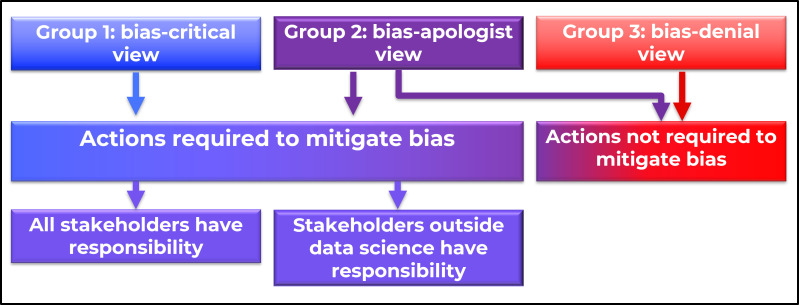
Background: There is a growing concern about artificial intelligence (AI) applications in healthcare that can disadvantage already under-represented and marginalised groups (eg, based on gender or race). Objectives: Our objectives are to canvas the range of strategies stakeholders endorse in attempting to mitigate algorithmic bias, and to consider the ethical question of responsibility for algorithmic bias. Methodology: The study involves in-depth, semistructured interviews with healthcare workers, screening programme managers, consumer health representatives, regulators, data scientists and developers. Results: Findings reveal considerable divergent views on three key issues. First, views on whether bias is a problem in healthcare AI varied, with most participants agreeing bias is a problem (which we call the bias-critical view), a small number believing the opposite (the bias-denial view), and some arguing that the benefits of AI outweigh any harms or wrongs arising from the bias problem (the bias-apologist view). Second, there was a disagreement on the strategies to mitigate bias, and who is responsible for such strategies. Finally, there were divergent views on whether to include or exclude sociocultural identifiers (eg, race, ethnicity or gender-diverse identities) in the development of AI as a way to mitigate bias. Conclusion/significance: Based on the views of participants, we set out responses that stakeholders might pursue, including greater interdisciplinary collaboration, tailored stakeholder engagement activities, empirical studies to understand algorithmic bias and strategies to modify dominant approaches in AI development such as the use of participatory methods, and increased diversity and inclusion in research teams and research participant recruitment and selection.
Overview
The claims and statistics of this paper haven’t been checked yet.
Free: it reads the open-access text and checks the first 5 claims that cite a source we can check. Create a free account to check every claim.
Integrity signals
Registry
Cites
Statistics
Figures
Verification
Claims the paper makes
The claims and statistics of this paper haven’t been checked yet.
Free: it reads the open-access text and checks the first 5 claims that cite a source we can check. Create a free account to check every claim.
Claims other papers make about this one
Each is checked against this paper’s own text: does it say what the citing paper says it does?
The cited source says what the claim attributes to it.
In the citing paper
“Issues such as amplification of biases present in the training data, failure to generalize effectively beyond specific populations, or errors in classification can affect reliability [ 2 - 7 ].”
In the citing paper
“The generative AI models, that naturally have elevated data bias risks due to their pre-training on massive datasets, should not exacerbate this inequity for marginalized, under-represented, socioeconomically disadvantaged, low education, or low health literacy groups98, but rather incorporate their unique social situations into future AI models to insure equity.”
From Adopting and expanding ethical principles for generative artificial intelligence from military to healthcare (2023) · cites this paper as [98]
Self-check
Percentages, sums and reported differences re-computed from the paper’s own numbers.
The self-check needs the paper’s full text.
Citations
Cites
Gale, N. K., Heath, G., Cameron, E., Rashid, S., & Redwood, S. (2013) · BMC Medical Research Methodology · doi:10.1186/1471-2288-13-117 · Cited by 10,865
Dissecting racial bias in an algorithm used to manage the health of populations
Obermeyer, Z., Powers, B., Vogeli, C., & Mullainathan, S. (2019) · Science · doi:10.1126/science.aax2342 · Cited by 7,137 · cited 3×
“16 For other participants who denied the existence of algorithmic bias, the denial concerned the relevance of the issue rather than the absence of bias itself, holding that these knowledge systems are biased, but this is normatively acceptable.”
BackgroundMethodPROBAST: A Tool to Assess the Risk of Bias and Applicability of Prediction Model Studies
Wolff, R. F., Moons, K. G. M., Riley, R. D., Whiting, P. F., Westwood, M., Collins, G. S., Reitsma, J. B., Kleijnen, J., Mallett, S., & for the PROBAST Group† (2019) · Annals of Internal Medicine · doi:10.7326/m18-1376 · Cited by 2,984 · cited 1×
“18 These solutions are yet to be widely implemented.”
Algorithms of Oppression: How Search Engines Reinforce Racism
Noble, S. U. (2020) · doi:10.2307/j.ctt1pwt9w5 · Cited by 2,709
Atlas of AI: Power, Politics, and the Planetary Costs of Artificial Intelligence
Crawford, K. (2021) · doi:10.12987/9780300252392 · Cited by 1,361
Reducing and meta-analysing estimates from distributed lag non-linear models
Gasparrini, A., & Armstrong, B. (2013) · BMC Medical Research Methodology · doi:10.1186/1471-2288-13-1 · Cited by 1,081
Seyyed-Kalantari, L., Zhang, H., McDermott, M. B. A., Chen, I. Y., & Ghassemi, M. (2021) · Nature Medicine · doi:10.1038/s41591-021-01595-0 · Cited by 928 · cited 1×
“14 15 Similar problems of biased results have been demonstrated in AI systems used for radiography-based disease diagnosis 15 and health resource allocations.”
Decolonial AI: Decolonial Theory as Sociotechnical Foresight in Artificial Intelligence
Mohamed, S., Png, M.-T., & Isaac, W. (2020) · Philosophy & Technology · doi:10.1007/s13347-020-00405-8 · Cited by 912
Addressing bias in big data and AI for health care: A call for open science
Norori, N., Hu, Q., Aellen, F. M., Faraci, F. D., & Tzovara, A. (2021) · Patterns · doi:10.1016/j.patter.2021.100347 · Cited by 903
Algorithmic bias: review, synthesis, and future research directions
Kordzadeh, N., & Ghasemaghaei, M. (2022) · European Journal of Information Systems · doi:10.1080/0960085x.2021.1927212 · Cited by 770 · cited 1×
“12 For example, a US-based classification algorithm for skin cancer diagnosis, 13 which was trained using mainly images of skin lesions in light-skinned patients, has been found to have approximately half the diagnostic accuracy when used on images of lesions among African-American patients.”
Method
Research works printed but not linked: 2
- Noble SU Algorithms of oppression New York University Press 2018
- Institute of Medicine (US) Committee on Understanding and Eliminating Racial and Ethnic Disparities in Health Care Unequal treatment Smedley BD Stith AY Nelson AR Confronting racial and ethnic disparities in health care Washington DC National Academics of Sciences, Engineering and Medicine 2003 25032386
Cited by
Nouis, S. C., Uren, V. S., & Jariwala, S. (2025) · BMC Medical Ethics · doi:10.1186/s12910-025-01243-z · Cited by 187
Algorithmic bias in public health AI: a silent threat to equity in low-resource settings
Joseph, J. (2025) · Frontiers in Public Health · doi:10.3389/fpubh.2025.1643180 · Cited by 146
Oniani, D., Hilsman, J., Peng, Y., Poropatich, R. K., Pamplin, J. C., Legault, G. L., & Wang, Y. (2023) · npj Digital Medicine · doi:10.1038/s41746-023-00965-x · Cited by 143
Ratti, E., Morrison, M. C., & Jakab, I. (2025) · BMC Medical Ethics · doi:10.1186/s12910-025-01198-1 · Cited by 139
Li, F., Wang, S., Gao, Z., Qing, M., Pan, S. L., Liu, Y., & Hu, C. (2025) · Frontiers in Medicine · doi:10.3389/fmed.2024.1510792 · Cited by 122
Metadata
- Authors
- Aquino, Y. S. J., Carter, S. M., Houssami, N., Braunack-Mayer, A., Win, K. T., Degeling, C., Wang, L., & Rogers, W. A.
- Affiliations
- University of Wollongong (AU)
- The University of Sydney (AU)
- Macquarie University (AU)
- Corresponding author
- Aquino, Yves Saint James
- ORCID
- Venue
- Journal of Medical Ethics
- Publisher
- BMJ
- Published
- 2023-02-23
- Volume
- 51
- Issue
- 6
- Pages
- 420-428
- ISSN
- 0306-6800 (ISSN-L)
- 1473-4257
- PMC
- PMC12171461
- OpenAlex
- W4321610264
- Cited by
- 62
- References
- 44
- Citations by year
- 2026: 16 · 2025: 28 · 2024: 11 · 2023: 7
- FWCI
- 15.47
- Type
- journal article
- Language
- en
- Open access
- hybrid
- doi.org
- Locations
- Journal of Medical Ethics (publishedVersion, cc-by)
- PubMed Central (publishedVersion, cc-by)
- PubMed (publishedVersion)
- Research Online (University of Wollongong) (submittedVersion)
- Figshare (submittedVersion)
- The Sydney eScholarship Repository (The University of Sydney) (submittedVersion, cc-by)
- Funders
- National Health and Medical Research Council (1181960)
- Topics
- Physical Sciences › Computer Science › Artificial Intelligence › Ethics and Social Impacts of AI
- Health Sciences › Medicine › Health Informatics › Artificial Intelligence in Healthcare and Education
- Physical Sciences › Computer Science › Artificial Intelligence › Explainable Artificial Intelligence (XAI)
- Keywords
- algorithmic bias, artificial intelligence in healthcare, bias mitigation strategies, stakeholder perspectives, underrepresented groups, screening programs, ethical implications of AI
- MeSH terms
- Algorithms, Artificial Intelligence, Attitude of Health Personnel, Delivery of Health Care, Female, Health Personnel, Humans, Interviews as Topic, Male, Bias, Qualitative Research
About these checks
Registry, retraction, Cites and statistics results are computed, not judged, with one exception: a printed reference that no index lists is read once by a model before it counts as a citation error. Claims are extracted by a model and kept only when their quote appears verbatim in the text; each cited source is then checked, with a model’s help, for whether it says what the claim relies on. Those verdicts can be wrong — read the claim’s quote and the cited source before relying on one.
Statistics and arithmetic are recomputed, not judged.
Confidence bands are shown only for fields calibrated on our annotated test set. None is calibrated yet, so no band is shown.
What counts as a claim ›How we measure confidence ›How we check this ›
Are you an author, or do you see a problem with this page? Request a review
How to cite
Cite CoChat for the checks on this page, and the paper for its own findings.
- This page
- CoChat. (2026). Citation check: Practical, epistemic and normative implications of algorithmic bias in healthcare artificial intelligence: a qualitative study of multidisciplinary expert perspectives. https://app.cochat.ai/papers/10.1136/jme-2022-108850
- The paper
- Aquino, Y. S. J., Carter, S. M., Houssami, N., Braunack-Mayer, A., Win, K. T., Degeling, C., Wang, L., & Rogers, W. A. (2025). Practical, epistemic and normative implications of algorithmic bias in healthcare artificial intelligence: a qualitative study of multidisciplinary expert perspectives. Journal of Medical Ethics. https://doi.org/10.1136/jme-2022-108850
Data sources
Bibliographic data: Semantic Scholar, OpenAlex, Crossref.
Contains information from the Semantic Scholar Academic Graph Datasets, made available under the ODC Attribution License (ODC-BY 1.0).
Semantic Scholar’s data is described in: Kinney, R., et al. (2023). The Semantic Scholar Open Data Platform. arXiv:2301.10140.
