

Whole exome sequencing in family trios reveals de novo mutations in PURA as a cause of severe neurodevelopmental delay and learning disability
Open accessThe DOI matches its Crossref record; 42 of the 42 references it cites were found in a registry or an index.
Abstract
Background: De novo mutations are emerging as an important cause of neurocognitive impairment, and whole exome sequencing of case-parent trios is a powerful way of detecting them. Here, we report the findings in four such trios. Methods: The Deciphering Developmental Disorders study is using whole exome sequencing in family trios to investigate children with severe, sporadic, undiagnosed developmental delay. Three of our patients were ascertained from the first 1133 children to have been investigated through this large-scale study. Case 4 was a phenotypically isolated case recruited into an undiagnosed rare disorders sequencing study. Results: Protein-altering de novo mutations in PURA were identified in four subjects. They include two different frameshifts, one inframe deletion and one missense mutation. PURA encodes Pur-α, a highly conserved multifunctional protein that has an important role in normal postnatal brain development in animal models. The associated human phenotype of de novo heterozygous mutations in this gene is variable, but moderate to severe neurodevelopmental delay and learning disability are common to all. Neonatal hypotonia, early feeding difficulties and seizures, or ‘seizure-like’ movements, were also common. Additionally, it is suspected that anterior pituitary dysregulation may be within the spectrum of this disorder. Psychomotor developmental outcomes appear variable between patients, and we propose a possible genotype–phenotype correlation, with disruption of Pur repeat III resulting in a more severe phenotype. Conclusions: These findings provide definitive evidence for the role of PURA in causing a variable syndrome of neurodevelopmental delay, learning disability, neonatal hypotonia, feeding difficulties, abnormal movements and epilepsy in humans, and help clarify the role of PURA in the previously described 5q31.3 microdeletion phenotype.
Overview
The claims and statistics of this paper haven’t been checked yet.
Free: it reads the open-access text and checks the first 5 claims that cite a source we can check. Create a free account to check every claim.
Integrity signals
Registry
Cites
Statistics
Figures
Verification
Claims the paper makes
The claims and statistics of this paper haven’t been checked yet.
Free: it reads the open-access text and checks the first 5 claims that cite a source we can check. Create a free account to check every claim.
Claims other papers make about this one
Each is checked against this paper’s own text: does it say what the citing paper says it does?
The source backs part of the claim, not all of it — or backs it for a different population, condition or comparison.
In the citing paper
“PURA, is involved in transcriptional regulation 139 , and pathogenic variants cause severe myoclonic DEE with respiratory insufficiency and hypotonia 140 .”
From Developmental and epileptic encephalopathies (2024) · cites this paper as [139]
Experimental — accuracy not yet measured
Self-check
Percentages, sums and reported differences re-computed from the paper’s own numbers.
The self-check needs the paper’s full text.
Citations
Cites
Cingolani, P., Platts, A., Wang, L. L., Coon, M., Nguyen, T., Wang, L., Land, S. J., Lu, X., & Ruden, D. M. (2012) · Fly · doi:10.4161/fly.19695 · Cited by 11,816
A map of human genome variation from population-scale sequencing.
The 1000 Genomes Project Consortium (2010) · Nature · doi:10.1038/nature09534 · Cited by 7,877
Deriving the consequences of genomic variants with the Ensembl API and SNP Effect Predictor
McLaren, W., Pritchard, B., Rios, D., Chen, Y., Flicek, P., & Cunningham, F. (2010) · Bioinformatics · doi:10.1093/bioinformatics/btq330 · Cited by 1,586
Exome sequencing identifies MLL2 mutations as a cause of Kabuki syndrome
Ng, S. B., Bigham, A. W., Buckingham, K. J., Hannibal, M. C., McMillin, M. J., Gildersleeve, H. I., Beck, A. E., Tabor, H. K., Cooper, G. M., Mefford, H. C., et al. (2010) · Nature Genetics · doi:10.1038/ng.646 · Cited by 1,347
A de novo paradigm for mental retardation.
Vissers, L. E. L. M., de Ligt, J., Gilissen, C., Janssen, I., Steehouwer, M., de Vries, P., van Lier, B., Arts, P., Wieskamp, N., del Rosario, M., et al. (2010) · Nature Genetics · doi:10.1038/ng.712 · Cited by 852
dbNSFP: A lightweight database of human nonsynonymous SNPs and their functional predictions
Liu, X., Jian, X., & Boerwinkle, E. (2011) · Human Mutation · doi:10.1002/humu.21517 · Cited by 823
dbSNP—database for single nucleotide polymorphisms and other classes of minor genetic variation
Sherry, S. T., Ward, M., & Sirotkin, K. (1999) · Genome Research · doi:10.1101/gr.9.8.677 · Cited by 789
De novo mutations of SETBP1 cause Schinzel-Giedion syndrome
Hoischen, A., van Bon, B. W. M., Gilissen, C., Arts, P., van Lier, B., Steehouwer, M., de Vries, P., de Reuver, R., Wieskamp, N., Mortier, G., et al. (2010) · Nature Genetics · doi:10.1038/ng.581 · Cited by 489
Genetic and Epigenetic Networks in Intellectual Disabilities
van Bokhoven, H. (2011) · Annual Review of Genetics · doi:10.1146/annurev-genet-110410-132512 · Cited by 382
Robinson, P., & Mundlos, S. (2010) · Clinical Genetics · doi:10.1111/j.1399-0004.2010.01436.x · Cited by 354
Jin, P., Duan, R., Qurashi, A., Qin, Y., Tian, D., Rosser, T. C., Liu, H., Feng, Y., & Warren, S. T. (2007) · Neuron · doi:10.1016/j.neuron.2007.07.020 · Cited by 312
De novo mutations in the actin genes ACTB and ACTG1 cause Baraitser-Winter syndrome
Rivière, J.-B., van Bon, B. W. M., Hoischen, A., Kholmanskikh, S. S., O'Roak, B. J., Gilissen, C., Gijsen, S., Sullivan, C. T., Christian, S. L., Abdul-Rahman, O. A., et al. (2012) · Nature Genetics · doi:10.1038/ng.1091 · Cited by 304
Bragin, E., Chatzimichali, E. A., Wright, C. F., Hurles, M. E., Firth, H. V., Bevan, A. P., & Swaminathan, G. J. (2014) · Nucleic Acids Research · doi:10.1093/nar/gkt937 · Cited by 233
Khalili, K., Del Valle, L., Muralidharan, V., Gault, W. J., Darbinian, N., Otte, J., Meier, E., Johnson, E. M., Daniel, D. C., Kinoshita, Y., et al. (2003) · Molecular and Cellular Biology · doi:10.1128/mcb.23.19.6857-6875.2003 · Cited by 190 · cited 3×
“30 There are two independently generated Pura − / − mice which have helped our understanding of Pur α ’ s role in normal 31 32 Both knockout mice are reported to appear normal at birth and develop neurological features at approximately 2 weeks of age, which include continuous and increasingly…”
BackgroundBergemann, A. D., & Johnson, E. M. (1992) · Molecular and Cellular Biology · doi:10.1128/mcb.12.3.1257 · Cited by 183 · cited 2×
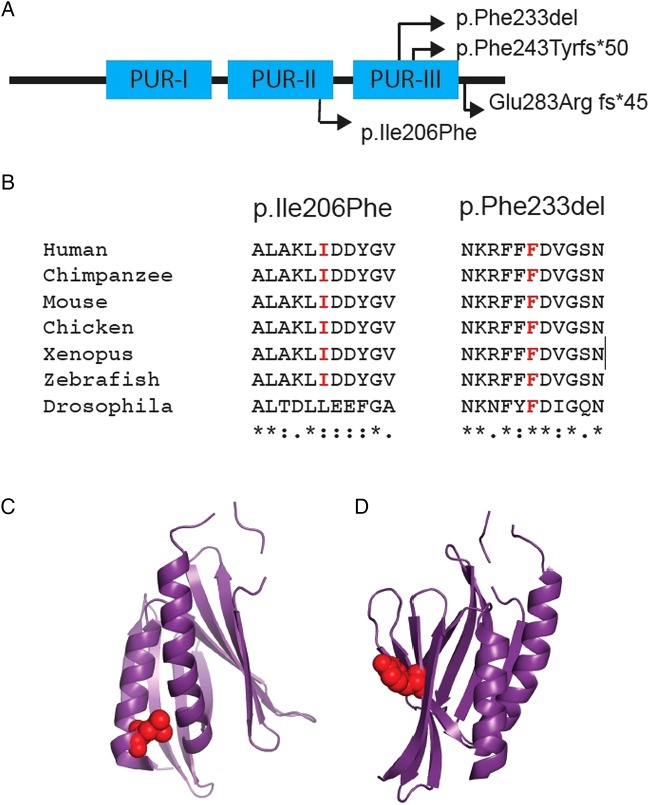
“17 18 Pur α is very highly conserved across the phylogenetic tree ( fi gure 1), with regulatory roles in DNA replication, gene transcription, RNA transport and mRNA translation.”
BackgroundBergemann, A. D., Ma, Z. W., & Johnson, E. M. (1992) · Molecular and Cellular Biology · doi:10.1128/mcb.12.12.5673 · Cited by 146
Wang, X., & Studzinski, G. P. (2001) · Journal of Cellular Biochemistry · doi:10.1002/1097-4644(20010315)80:4<471::aid-jcb1001>3.0.co;2-j · Cited by 145
Schuurs-Hoeijmakers, J. H. M., Oh, E. C. T., Vissers, L. E. L. M., Swinkels, M. E. M., Gilissen, C., Willemsen, M. A. A. P., Holvoet, M., Steehouwer, M., Veltman, J. A., Vries, B. B. A. D., et al. (2012) · The American Journal of Human Genetics · doi:10.1016/j.ajhg.2012.10.013 · Cited by 143
Role of Purα in targeting mRNA to sites of translation in hippocampal neuronal dendrites
Johnson, E. M., Kinoshita, Y., Weinreb, D. B., Wortman, M. J., Simon, R., Khalili, K., Winckler, B., & Gordon, J. (2006) · Journal of Neuroscience Research · doi:10.1002/jnr.20806 · Cited by 124
Ku, C., Polychronakos, C., Tan, E., Naidoo, N., Pawitan, Y., Roukos, D. H., Mort, M. E., & Cooper, D. N. (2012) · Molecular Psychiatry · doi:10.1038/mp.2012.58 · Cited by 105
Haas, S., Thatikunta, P., Steplewski, A., Johnson, E. M., Khalili, K., & Amini, S. (1995) · The Journal of cell biology · doi:10.1083/jcb.130.5.1171 · Cited by 93
Kelm, R. J., Cogan, J. G., Elder, P. K., Strauch, A. R., & Getz, M. J. (1999) · Journal of Biological Chemistry · doi:10.1074/jbc.274.20.14238 · Cited by 86
Barbarisi, A., Petillo, O., Lieto, A. D., Melone, M. A. B., Margarucci, S., Cannas, M. F., & Peluso, G. (2001) · Journal of Cellular Physiology · doi:10.1002/1097-4652(2000)9999:999<000::aid-jcp1042>3.3.co;2-# · Cited by 82
Joint Variant and De Novo Mutation Identification on Pedigrees from High-Throughput Sequencing Data
Cleary, J. G., Braithwaite, R., Gaastra, K., Hilbush, B. S., Inglis, S., Irvine, S. A., Jackson, A., Littin, R., Nohzadeh-Malakshah, S., Rathod, M., et al. (2014) · Journal of Computational Biology · doi:10.1089/cmb.2014.0029 · Cited by 77
Lack of Pur-alpha alters postnatal brain development and causes megalencephaly
Hokkanen, S., Feldmann, H. M., Ding, H., Jung, C. K. E., Bojarski, L., Renner-Muller, I., Schuller, U., Kretzschmar, H., Wolf, E., & Herms, J. (2012) · Human Molecular Genetics · doi:10.1093/hmg/ddr476 · Cited by 75
Haas, S., Gordon, J., & Khalili, K. (1993) · Molecular and Cellular Biology · doi:10.1128/mcb.13.5.3103 · Cited by 69
ZAMBRANO, N., RENZIS, S. D., MINOPOLI, G., FARAONIO, R., DONINI, V., SCALONI, A., CIMINO, F., & RUSSO, T. (1997) · Biochemical Journal · doi:10.1042/bj3280293 · Cited by 68 · cited 1×
“25 Furthermore, proteomics studies suggest that both Pur α and its paralog, Pur β , may have an important regulatory role in control of the gene expression of myelin proteolipid protein (Plp1), which is the most abundant protein in central nervous system myelin and is developmentally regulated.”
BackgroundX-ray structure of Pur-α reveals a Whirly-like fold and an unusual nucleic-acid binding surface
Graebsch, A., Roche, S., & Niessing, D. (2009) · Proceedings of the National Academy of Sciences · doi:10.1073/pnas.0907990106 · Cited by 67 · cited 3×
“PURA encodes a ubiquitously expressed protein, Pur α , which contains an N-terminal glycine-rich region, three Pur repeats (I – III) and a C-terminal glutamine – glutamate rich domain 16 ( fi gure 1).”
BackgroundInfluentialHelix-destabilizing properties of the human single-stranded DNA- and RNA-binding protein Pur?
Darbinian, N., Gallia, G. L., & Khalili, K. (2001) · Journal of Cellular Biochemistry · doi:10.1002/1097-4644(20010315)80:4<589::aid-jcb1013>3.0.co;2-0 · Cited by 60
Shimojima, K., Isidor, B., Le Caignec, C., Kondo, A., Sakata, S., Ohno, K., & Yamamoto, T. (2011) · American Journal of Medical Genetics Part A · doi:10.1002/ajmg.a.33891 · Cited by 52
Wortman, M. J., Johnson, E. M., & Bergemann, A. D. (2004) · Biochimica et Biophysica Acta (BBA) - Molecular Cell Research · doi:10.1016/j.bbamcr.2004.08.010 · Cited by 47
Kobayashi, S., Agui, K., Kamo, S., Li, Y., & Anzai, K. (2000) · Biochemical and Biophysical Research Communications · doi:10.1006/bbrc.2000.3683 · Cited by 41 · cited 2×
“Pur α activates transcription for a large number of cellular genes including those encoding myelin basic protein, 19 tumour necrosis factor α , 23 BC1 24 and the neuron-speci fi c TATA-less gene FE65.”
BackgroundKnapp, A. M., Ramsey, J. E., Wang, S.-X., Godburn, K. E., Strauch, A. R., & Kelm, R. J. (2006) · Journal of Biological Chemistry · doi:10.1074/jbc.m509682200 · Cited by 40
Darbinian, N., Sawaya, B. E., Khalili, K., Jaffe, N., Wortman, B., Giordano, A., & Amini, S. (2001) · Journal of Neuroimmunology · doi:10.1016/s0165-5728(01)00372-1 · Cited by 40
5q31.3 Microdeletion syndrome: Clinical and molecular characterization of two further cases
Brown, N., Burgess, T., Forbes, R., McGillivray, G., Kornberg, A., Mandelstam, S., & Stark, Z. (2013) · American Journal of Medical Genetics Part A · doi:10.1002/ajmg.a.36108 · Cited by 38
Clinical phenotype and candidate genes for the 5q31.3 microdeletion syndrome
Hosoki, K., Ohta, T., Natsume, J., Imai, S., Okumura, A., Matsui, T., Harada, N., Bacino, C. A., Scaglia, F., Jones, J. Y., et al. (2012) · American Journal of Medical Genetics Part A · doi:10.1002/ajmg.a.35439 · Cited by 33
Schoenberg, M. R., Werz, M. A., Block, C., Cruz-Saavedra, L., Rivera-Cruz, A., Benbadis, S. R., & Drane, D. L. (2010) · Springer eBooks · doi:10.1007/978-0-387-76978-3_16 · Cited by 29
Pur alpha and Sp8 as opposing regulators of neural gata2 expression
Penberthy, W. T., Zhao, C., Zhang, Y., Jessen, J. R., Yang, Z., Bricaud, O., Collazo, A., Meng, A., & Lin, S. (2004) · Developmental Biology · doi:10.1016/j.ydbio.2004.08.007 · Cited by 29
Dobretsova, A., Johnson, J. W., Jones, R. C., Edmondson, R. D., & Wight, P. A. (2008) · Journal of Neurochemistry · doi:10.1111/j.1471-4159.2008.05288.x · Cited by 22 · cited 1×
“26 By contrast, Pur α represses expression from a wide range of genes including amyloid-β precursor protein, 27 α -actin 28 and gata2.”
BackgroundNegative Regulation of AβPP Gene Expression by Pur-alpha
Darbinian, N., Cui, J., Basile, A. M., Valle, L. D., Otte, J., Miklossy, J., Sawaya, B. E., Amini, S., Khalili, K., & Gordon, J. (2008) · Journal of Alzheimer s Disease · doi:10.3233/jad-2008-15106 · Cited by 20
Regulation of Pur? gene transcription: Evidence for autoregulation of Pur? promoter
Muralidharan-Chari, V., Sweet, T., Nadraga, Y., Amini, S., & Khalili, K. (2001) · Journal of Cellular Physiology · doi:10.1002/1097-4652(2000)9999:999<000::aid-jcp1039>3.0.co;2-p · Cited by 13
Zhao, S., Kelm, R. J., & Fernald, R. D. (2009) · American Journal of Physiology-Endocrinology and Metabolism · doi:10.1152/ajpendo.00597.2009 · Cited by 10
Cited by
Helbig, K. L., Farwell Hagman, K. D., Shinde, D. N., Mroske, C., Powis, Z., Li, S., Tang, S., & Helbig, I. (2016) · Genetics in Medicine · doi:10.1038/gim.2015.186 · Cited by 363
Advancing epilepsy genetics in the genomic era
Myers, C. T., & Mefford, H. C. (2015) · Genome Medicine · doi:10.1186/s13073-015-0214-7 · Cited by 244
“3 deletions [31, 32].”
Developmental and epileptic encephalopathies
Scheffer, I. E., Zuberi, S., Mefford, H. C., Guerrini, R., & McTague, A. (2024) · Nature Reviews Disease Primers · doi:10.1038/s41572-024-00546-6 · Cited by 158
“PURA , is involved in transcriptional regulation 139 , and pathogenic variants cause severe myoclonic DEE with respiratory insufficiency and hypotonia 140 .”
Ohno, K., Ohkawara, B., Shen, X., Selcen, D., & Engel, A. G. (2023) · International Journal of Molecular Sciences · doi:10.3390/ijms24043730 · Cited by 141
Reijnders, M. R. F., Janowski, R., Alvi, M., Self, J. E., van Essen, T. J., Vreeburg, M., Rouhl, R. P. W., Stevens, S. J. C., Stegmann, A. P. A., Schieving, J., et al. (2018) · Journal of Medical Genetics · doi:10.1136/jmedgenet-2017-104946 · Cited by 102
“It has been suggested that disruption of PUR repeat III possibly results in a more severe phenotype, but additional studies are needed to better understand the genotype-phenotype correlation of PURA mutations.[7]”
BackgroundMethodInfluentialSelf-citation
Metadata
- Authors
- Hunt, D., Leventer, R. J., Simons, C., Taft, R., Swoboda, K. J., Gawne-Cain, M., study, T. D., Magee, A. C., Turnpenny, P. D., & Baralle, D.
- Affiliations
- Princess Anne Hospital (GB)
- Royal Children's Hospital (AU)
- The University of Queensland (AU)
- University of Utah (US)
- Southampton General Hospital (GB)
- Wellcome Sanger Institute (GB)
- Royal Devon and Exeter Hospital (GB)
- Corresponding author
- Hunt, David
- Baralle, Diana
- ORCID
- Venue
- Journal of Medical Genetics
- Publisher
- BMJ
- Published
- 2014-10-23
- Volume
- 51
- Issue
- 12
- Pages
- 806-813
- ISSN
- 0022-2593 (ISSN-L)
- 1468-6244
- PMC
- PMC4251168
- OpenAlex
- W2153803011
- Cited by
- 104
- References
- 41
- Citations by year
- 2026: 7 · 2025: 8 · 2024: 15 · 2023: 8 · 2022: 8 · 2021: 10 · 2020: 14 · 2019: 4 · 2018: 4 · 2017: 10 · 2016: 11 · 2015: 4
- FWCI
- 5.46
- Type
- journal article
- Language
- en
- Open access
- hybrid
- doi.org
- Licence
- cc-by-nc
- Locations
- Journal of Medical Genetics (publishedVersion, cc-by-nc)
- PubMed Central (publishedVersion, cc-by-nc)
- PubMed (publishedVersion)
- ePrints Soton (University of Southampton) (acceptedVersion)
- Minerva Access (University of Melbourne) (submittedVersion, cc-by-nc)
- HighWire Press Open Archive (submittedVersion)
- Royal Devon and Exeter Research Repository (Royal Devon and Exeter) (submittedVersion)
- Funders
- Wellcome Trust (WT 098051)
- National Institute for Health and Care Research (HICF-1009-003)
- University of Queensland
- Topics
- Life Sciences › Biochemistry, Genetics and Molecular Biology › Genetics › Genomics and Rare Diseases
- Life Sciences › Biochemistry, Genetics and Molecular Biology › Genetics › Genetics and Neurodevelopmental Disorders
- Life Sciences › Biochemistry, Genetics and Molecular Biology › Genetics › Genomic variations and chromosomal abnormalities
- Keywords
- PURA, de novo mutations, neurodevelopmental delay, learning disabilities, Purα, case-parent trios, frameshift mutation, missense mutations, neonatal hypotonia, feeding difficulties, seizures, genotype-phenotype correlation, developmental disorders
- MeSH terms
- Amino Acid Sequence, Brain, Child, Developmental Disabilities, Child, Preschool, DNA-Binding Proteins, Female, Humans, Infant, Learning Disabilities, Magnetic Resonance Imaging, Models, Molecular, Mutation, Phenotype, Protein Conformation, Transcription Factors, Facies, Amino Acid Substitution, Gene Order, High-Throughput Nucleotide Sequencing, Exome
About these checks
Registry, retraction, Cites and statistics results are computed, not judged, with one exception: a printed reference that no index lists is read once by a model before it counts as a citation error. Claims are extracted by a model and kept only when their quote appears verbatim in the text; each cited source is then checked, with a model’s help, for whether it says what the claim relies on. Those verdicts can be wrong — read the claim’s quote and the cited source before relying on one.
Statistics and arithmetic are recomputed, not judged.
Confidence bands are shown only for fields calibrated on our annotated test set. None is calibrated yet, so no band is shown.
What counts as a claim ›How we measure confidence ›How we check this ›
Are you an author, or do you see a problem with this page? Request a review
Data sources
Bibliographic data: Semantic Scholar, OpenAlex, Crossref.
Contains information from the Semantic Scholar Academic Graph Datasets, made available under the ODC Attribution License (ODC-BY 1.0).
Semantic Scholar’s data is described in: Kinney, R., et al. (2023). The Semantic Scholar Open Data Platform. arXiv:2301.10140.
