

Real-life survey of pitfalls and successes of precision medicine in genetic epilepsies
Open accessThe DOI matches its Crossref record; 38 of the 40 references it cites were found in a registry or an index.
Abstract
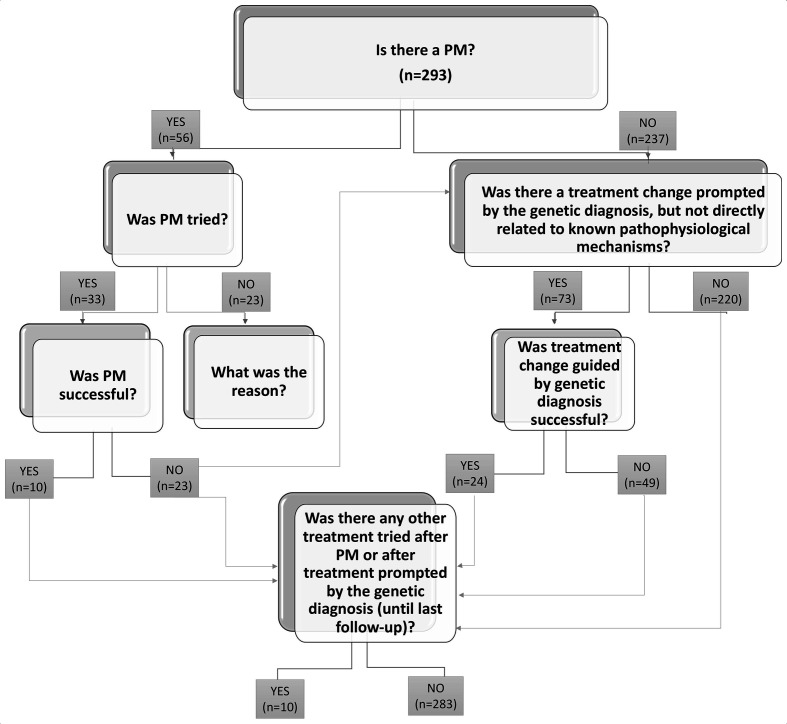
Objective: The term ‘precision medicine’ describes a rational treatment strategy tailored to one person that reverses or modifies the disease pathophysiology. In epilepsy, single case and small cohort reports document nascent precision medicine strategies in specific genetic epilepsies. The aim of this multicentre observational study was to investigate the deeper complexity of precision medicine in epilepsy. Methods: A systematic survey of patients with epilepsy with a molecular genetic diagnosis was conducted in six tertiary epilepsy centres including children and adults. A standardised questionnaire was used for data collection, including genetic findings and impact on clinical and therapeutic management. Results: We included 293 patients with genetic epilepsies, 137 children and 156 adults, 162 females and 131 males. Treatment changes were undertaken because of the genetic findings in 94 patients (32%), including rational precision medicine treatment and/or a treatment change prompted by the genetic diagnosis, but not directly related to known pathophysiological mechanisms. There was a rational precision medicine treatment for 56 patients (19%), and this was tried in 33/56 (59%) and was successful (ie, >50% seizure reduction) in 10/33 (30%) patients. In 73/293 (25%) patients there was a treatment change prompted by the genetic diagnosis, but not directly related to known pathophysiological mechanisms, and this was successful in 24/73 (33%). Significance: Our survey of clinical practice in specialised epilepsy centres shows high variability of clinical outcomes following the identification of a genetic cause for an epilepsy. Meaningful change in the treatment paradigm after genetic testing is not yet possible for many people with epilepsy. This systematic survey provides an overview of the current application of precision medicine in the epilepsies, and suggests the adoption of a more considered approach.
Overview
The claims and statistics of this paper haven’t been checked yet.
Free: it reads the open-access text and checks the first 5 claims that cite a source we can check. Create a free account to check every claim.
Integrity signals
Registry
Cites
Statistics
Figures
Verification
Claims the paper makes
The claims and statistics of this paper haven’t been checked yet.
Free: it reads the open-access text and checks the first 5 claims that cite a source we can check. Create a free account to check every claim.
Claims other papers make about this one
Each is checked against this paper’s own text: does it say what the citing paper says it does?
The source backs part of the claim, not all of it — or backs it for a different population, condition or comparison.
In the citing paper
“Even when an aetiologic genetic diagnosis is made, meaningful change in the treatment paradigm has not yet been possible for most DEEs 183 .”
From Developmental and epileptic encephalopathies (2024) · cites this paper as [183]
Experimental — accuracy not yet measuredThe cited source says what the claim attributes to it.
In the citing paper
“In a 2021 observational study in 293 patients with genetic epilepsies, treatment changes were undertaken because of the genetic findings in 32%, including rational precision medicine treatment or a treatment change prompted by the genetic diagnosis, but not directly related to known pathophysiological mechanisms 183 .”
From Developmental and epileptic encephalopathies (2024) · cites this paper as [183]
Self-check
Percentages, sums and reported differences re-computed from the paper’s own numbers.
The self-check needs the paper’s full text.
Citations
Cites
Richards, S., Aziz, N., Bale, S., Bick, D., Das, S., Gastier-Foster, J., Grody, W. W., Hegde, M., Lyon, E., Spector, E., et al. (2015) · Genetics in Medicine · doi:10.1038/gim.2015.30 · Cited by 32,594
Scheffer, I. E., Berkovic, S., Capovilla, G., Connolly, M. B., French, J., Guilhoto, L., Hirsch, E., Jain, S., Mathern, G. W., Moshé, S. L., et al. (2017) · Epilepsia · doi:10.1111/epi.13709 · Cited by 5,054
French, J. A., Lawson, J. A., Yapici, Z., Ikeda, H., Polster, T., Nabbout, R., Curatolo, P., de Vries, P. J., Dlugos, D. J., Berkowitz, N., et al. (2016) · The Lancet · doi:10.1016/s0140-6736(16)31419-2 · Cited by 764
Genomic and personalized medicine: foundations and applications
Ginsburg, G. S., & Willard, H. F. (2009) · Translational Research · doi:10.1016/j.trsl.2009.09.005 · Cited by 637
Genetic and phenotypic heterogeneity suggest therapeutic implications in SCN2A-related disorders
Wolff, M., Johannesen, K. M., Hedrich, U. B. S., Masnada, S., Rubboli, G., Gardella, E., Lesca, G., Ville, D., Milh, M., Villard, L., et al. (2017) · Brain · doi:10.1093/brain/awx054 · Cited by 600
Self-citationThe spectrum of SCN1A-related infantile epileptic encephalopathies
Harkin, L. A., McMahon, J. M., Iona, X., Dibbens, L., Pelekanos, J. T., Zuberi, S. M., Sadleir, L. G., Andermann, E., Gill, D., Farrell, K., et al. (2007) · Brain · doi:10.1093/brain/awm002 · Cited by 531
Suggested guidelines for the diagnosis and management of urea cycle disorders: First revision
Häberle, J., Burlina, A., Chakrapani, A., Dixon, M., Karall, D., Lindner, M., Mandel, H., Martinelli, D., Pintos‐Morell, G., Santer, R., et al. (2019) · Journal of Inherited Metabolic Disease · doi:10.1002/jimd.12100 · Cited by 506
Baraban, S. C., Dinday, M. T., & Hortopan, G. A. (2013) · Nature Communications · doi:10.1038/ncomms3410 · Cited by 436
GRIN2A mutation and early‐onset epileptic encephalopathy: personalized therapy with memantine
Pierson, T. M., Yuan, H., Marsh, E. D., Fuentes‐Fajardo, K., Adams, D. R., Markello, T., Golas, G., Simeonov, D. R., Holloman, C., Tankovic, A., et al. (2014) · Annals of Clinical and Translational Neurology · doi:10.1002/acn3.39 · Cited by 298
The phenotypic spectrum of SCN8A encephalopathy
Larsen, J., Carvill, G. L., Gardella, E., Kluger, G., Schmiedel, G., Barisic, N., Depienne, C., Brilstra, E., Mang, Y., Nielsen, J. E. K., et al. (2015) · Neurology · doi:10.1212/wnl.0000000000001211 · Cited by 285
Self-citationDe novo loss- or gain-of-function mutations in KCNA2 cause epileptic encephalopathy
EuroEPINOMICS, R. E. S., Syrbe, S., Hedrich, U. B. S., Riesch, E., Djémié, T., Müller, S., Møller, R. S., Maher, B., Hernandez-Hernandez, L., Synofzik, M., et al. (2015) · Nature Genetics · doi:10.1038/ng.3239 · Cited by 276
Self-citationTargeted treatment of migrating partial seizures of infancy with quinidine
Bearden, D., Strong, A., Ehnot, J., DiGiovine, M., Dlugos, D., & Goldberg, E. M. (2014) · Annals of Neurology · doi:10.1002/ana.24229 · Cited by 258
KCNQ2 encephalopathy: Features, mutational hot spots, and ezogabine treatment of 11 patients
Millichap, J. J., Park, K. L., Tsuchida, T., Ben-Zeev, B., Carmant, L., Flamini, R., Joshi, N., Levisohn, P. M., Marsh, E., Nangia, S., et al. (2016) · Neurology Genetics · doi:10.1212/nxg.0000000000000096 · Cited by 241
A roadmap for precision medicine in the epilepsies
(2015) · The Lancet Neurology · doi:10.1016/s1474-4422(15)00199-4 · Cited by 204
Balestrini, S., Arzimanoglou, A. A., Blümcke, I., Scheffer, I. E., Wiebe, S., Zelano, J., & Walker, M. C. (2021) · Epileptic Disorders · doi:10.1684/epd.2021.1255 · Cited by 198
Self-citationMiceli, F., Soldovieri, M. V., Ambrosino, P., De Maria, M., Migliore, M., Migliore, R., & Taglialatela, M. (2015) · The Journal of Neuroscience · doi:10.1523/jneurosci.4423-14.2015 · Cited by 191
Precision medicine and therapies of the future
Sisodiya, S. M. (2020) · Epilepsia · doi:10.1111/epi.16539 · Cited by 185
Self-citationmTOR pathway inhibition as a new therapeutic strategy in epilepsy and epileptogenesis
Citraro, R., Leo, A., Constanti, A., Russo, E., & De Sarro, G. (2016) · Pharmacological Research · doi:10.1016/j.phrs.2016.03.039 · Cited by 164
Balestrini, S., & Sisodiya, S. M. (2018) · Neuroscience Letters · doi:10.1016/j.neulet.2017.01.014 · Cited by 157
Self-citationEpilepsy genetics: clinical impacts and biological insights
Ellis, C. A., Petrovski, S., & Berkovic, S. F. (2019) · The Lancet Neurology · doi:10.1016/s1474-4422(19)30269-8 · Cited by 151
The pharmacologic treatment of Dravet syndrome
Chiron, C., & Dulac, O. (2011) · Epilepsia · doi:10.1111/j.1528-1167.2011.03007.x · Cited by 150
Stockler-Ipsiroglu, S., van Karnebeek, C., Longo, N., Korenke, G. C., Mercimek-Mahmutoglu, S., Marquart, I., Barshop, B., Grolik, C., Schlune, A., Angle, B., et al. (2014) · Molecular Genetics and Metabolism · doi:10.1016/j.ymgme.2013.10.018 · Cited by 145
Epilepsy surgery for patients with genetic refractory epilepsy: a systematic review
Stevelink, R., Sanders, M. W., Tuinman, M. P., Brilstra, E. H., Koeleman, B. P., Jansen, F. E., & Braun, K. P. (2018) · Epileptic Disorders · doi:10.1684/epd.2018.0959 · Cited by 128
TBC1D24 genotype–phenotype correlation: Epilepsies and other neurologic features
Balestrini, S., Milh, M., Castiglioni, C., Lüthy, K., Finelli, M. J., Verstreken, P., Cardon, A., Stražišar, B. G., Holder, J. L., Lesca, G., et al. (2016) · Neurology · doi:10.1212/wnl.0000000000002807 · Cited by 124
Self-citationGNAO1 encephalopathy: Broadening the phenotype and evaluating treatment and outcome
Danti, F. R., Galosi, S., Romani, M., Montomoli, M., Carss, K., Raymond, F. L., Parrini, E., Bianchini, C., McShane, T., Dale, R. C., et al. (2017) · Neurology Genetics · doi:10.1212/nxg.0000000000000143 · Cited by 118
Self-citationDNM1 encephalopathy: A new disease of vesicle fission
von Spiczak, S., Helbig, K. L., Shinde, D. N., Huether, R., Pendziwiat, M., Lourenço, C., Nunes, M. E., Sarco, D. P., Kaplan, R. A., Dlugos, D. J., et al. (2017) · Neurology · doi:10.1212/wnl.0000000000004152 · Cited by 113
Self-citationDiagnostic Yield and Treatment Impact of Targeted Exome Sequencing in Early-Onset Epilepsy
Demos, M. K., Guella, I., DeGuzman, C., McKenzie, M. B., Buerki, S. E., Evans, D. M., Toyota, E. B., Boelman, C. G., Huh, L. L., Datta, A., et al. (2019) · Frontiers in Neurology · doi:10.3389/fneur.2019.00434 · Cited by 108
Glucose transporter 1 deficiency syndrome and other glycolytic defects.
Vivo, D. C. D., Leary, L., & Wang, D. (2002) · PubMed · Cited by 107
Synaptic clustering differences due to different GABRB3 mutations cause variable epilepsy syndromes
Shi, Y.-W., Zhang, Q., Cai, K., Poliquin, S., Shen, W., Winters, N., Yi, Y.-H., Wang, J., Hu, N., Macdonald, R. L., et al. (2019) · Brain · doi:10.1093/brain/awz250 · Cited by 92
Delahaye-Duriez, A., Srivastava, P., Shkura, K., Langley, S. R., Laaniste, L., Moreno-Moral, A., Danis, B., Mazzuferi, M., Foerch, P., Gazina, E. V., et al. (2016) · Genome Biology · doi:10.1186/s13059-016-1097-7 · Cited by 86
Männikkö, R., Wong, L. C. H., Tester, D. J., Thor, M. G., Sud, R., Kullmann, D. M., Sweeney, M. G., Leu, C., Sisodiya, S. M., FitzPatrick, D. R., et al. (2018) · The Lancet · doi:10.1016/s0140-6736(18)30021-7 · Cited by 81
Self-citationPharmacogenetic Principles in the Hippocratic Writings
Sykiotis, G. P., Kalliolias, G. D., & Papavassiliou, A. G. (2005) · The Journal of Clinical Pharmacology · doi:10.1177/0091270005281091 · Cited by 69
Peng, J., Pang, N., Wang, Y., Wang, X., Chen, J., Xiong, J., Peng, P., Zhu, C., Kessi, M. B., He, F., et al. (2019) · CNS Neuroscience & Therapeutics · doi:10.1111/cns.12869 · Cited by 63
DEPDC5 as a potential therapeutic target for epilepsy
Myers, K. A., & Scheffer, I. E. (2017) · Expert Opinion on Therapeutic Targets · doi:10.1080/14728222.2017.1316715 · Cited by 51
Audit of use of stiripentol in adults with Dravet syndrome
Balestrini, S., & Sisodiya, S. M. (2016) · Acta Neurologica Scandinavica · doi:10.1111/ane.12611 · Cited by 48
Self-citationA personalized approach to long QT syndrome
Etheridge, S. P., Asaki, S. Y., & Niu, M. C. (2018) · Current Opinion in Cardiology · doi:10.1097/hco.0000000000000587 · Cited by 23
10.2174/1381612823666170809115827
Balestrini, S., & Sisodiya, S. M. (2017) · Current Pharmaceutical Design · doi:10.2174/1381612823666170809115827 · Cited by 11
Self-citationEpilepsy genetics and the precision medicine matrix
Sisodiya, S. M. (2019) · The Lancet Neurology · doi:10.1016/s1474-4422(19)30331-x · Cited by 10
Self-citation
Research works printed but not linked: 2
- National Research Council (US) Committee on a Framework for Development of a New Taxonomy of Disease. Toward precision medicine: building a knowledge network for biomedical research and a new taxonomy of disease. Washington: National Academies Press, 2011. ISBN: 978-0-309-22222-8. 22536618
- Hedrich UBS, Lauxmann S, Wolff M, et al. Effective precision therapy in KCNA2-related developmental and epileptic encephalopathy with 4-aminopyridine. Science Translational Medicine 2021; In press.
Cited by
Perucca, E., Perucca, P., White, H. S., & Wirrell, E. C. (2023) · The Lancet Neurology · doi:10.1016/s1474-4422(23)00151-5 · Cited by 305
Developmental and epileptic encephalopathies
Scheffer, I. E., Zuberi, S., Mefford, H. C., Guerrini, R., & McTague, A. (2024) · Nature Reviews Disease Primers · doi:10.1038/s41572-024-00546-6 · Cited by 158
“…study in 293 patients with genetic epilepsies, treatment changes were undertaken because of the genetic findings in 32%, including rational precision medicine treatment or a treatment change prompted by the genetic diagnosis, but not directly related to known pathophysiological mechanisms 183 .”
Self-citationGene variant effects across sodium channelopathies predict function and guide precision therapy
Brunklaus, A., Feng, T., Brünger, T., Perez-Palma, E., Heyne, H., Matthews, E., Semsarian, C., Symonds, J. D., Zuberi, S. M., Lal, D., et al. (2022) · Brain · doi:10.1093/brain/awac006 · Cited by 114
“66,67 Knowledge of the functional impact of a SCN -variant can inform clinical management and therapeutic choice.”
The pharmacological treatment of epilepsy: recent advances and future perspectives
Perucca, E. (2021) · Acta Epileptologica · doi:10.1186/s42494-021-00055-z · Cited by 110
“For genetic epilepsies, targeted (precision) treatments have been reported to improve outcomes in a considerable proportion patients with identified gene mutations [54], although a more recent survey gave a more sober assessment of the current impact of these treatments [55].”
BackgroundMonogenic Epilepsies: Disease Mechanisms, Clinical Phenotypes, and Targeted Therapies
Guerrini, R., Balestrini, S., Wirrell, E. C., & Walker, M. C. (2021) · Neurology · doi:10.1212/wnl.0000000000012744 · Cited by 108
Self-citation
Metadata
- Authors
- Balestrini, S., Chiarello, D., Gogou, M., Silvennoinen, K., Puvirajasinghe, C., Jones, W. D., Reif, P., Klein, K. M., Rosenow, F., Weber, Y. G., Lerche, H., Schubert-Bast, S., Borggraefe, I., Coppola, A., Troisi, S., Møller, R. S., Riva, A., Striano, P., Zara, F., Hemingway, C., Marini, C., Rosati, A., Mei, D., Montomoli, M., Guerrini, R., Cross, J. H., & Sisodiya, S. M.
- Affiliations
- Meyer Children's Hospital (IT)
- Great Ormond Street Hospital (GB)
- UCL Queen Square Institute of Neurology (GB)
- Goethe University Frankfurt (DE)
- University of Tübingen (DE)
- Ludwig-Maximilians-Universität München (DE)
- Federico II University Hospital (IT)
- University of Southern Denmark (DK)
- University of Genoa (IT)
- Istituto Giannina Gaslini (IT)
- Corresponding author
- Sisodiya, Sanjay M
- ORCID
- Balestrini, Simona
- Chiarello, Daniela
- Silvennoinen, Katri
- Puvirajasinghe, Clinda
- Jones, Wendy D
- Reif, Philipp
- Klein, Karl Martin
- Rosenow, Felix
- Weber, Yvonne G
- Lerche, Holger
- Schubert-Bast, Susanne
- Borggraefe, Ingo
- Coppola, Antonietta
- Møller, Rikke S
- Riva, Antonella
- Striano, Pasquale
- Zara, Federico
- Hemingway, Cheryl
- Marini, Carla
- Rosati, Anna
- Mei, Davide
- Montomoli, Martino
- Guerrini, Renzo
- Cross, J Helen
- Sisodiya, Sanjay M
- Venue
- Journal of Neurology, Neurosurgery & Psychiatry
- Publisher
- BMJ
- Published
- 2021-04-26
- Volume
- 92
- Issue
- 10
- Pages
- 1044-1052
- ISSN
- 0022-3050 (ISSN-L)
- 1468-330X
- PMC
- PMC8458055
- OpenAlex
- W3158189115
- Cited by
- 49
- References
- 40
- Citations by year
- 2025: 6 · 2024: 16 · 2023: 13 · 2022: 8 · 2021: 6
- FWCI
- 7.71
- Type
- journal article
- Language
- en
- Open access
- hybrid
- doi.org
- Locations
- Journal of Neurology Neurosurgery & Psychiatry (publishedVersion, cc-by)
- Europe PMC (PubMed Central) (publishedVersion, other-oa)
- PubMed Central (publishedVersion, cc-by)
- PubMed (publishedVersion)
- Florence Research (University of Florence) (submittedVersion, other-oa)
- University of Southern Denmark Research Portal (University of Southern Denmark) (submittedVersion, cc-by)
- UCL Discovery (University College London) (submittedVersion)
- Florence Research (University of Florence) (submittedVersion)
- CINECA IRIS Institutial Research Information System (University of Genoa) (submittedVersion)
- RWTH Publications (RWTH Aachen) (submittedVersion, other-oa)
- Publication Server of Goethe University Frankfurt am Main (Goethe University Frankfurt) (submittedVersion, cc-by)
- RWTH Publications (RWTH Aachen)
- Funders
- Wellcome (WT104033AIA)
- Wellcome Trust (WT104033AIA)
- DINOGMI Department of Excellence of MIUR (no award/grant number)
- Topics
- Health Sciences › Medicine › Clinical Neurology › Epilepsy research and treatment
- Life Sciences › Biochemistry, Genetics and Molecular Biology › Genetics › Genomics and Rare Diseases
- Life Sciences › Biochemistry, Genetics and Molecular Biology › Clinical Biochemistry › Metabolism and Genetic Disorders
- Keywords
- precision medicine, genetic epilepsy, molecular genetic diagnosis, epilepsy treatment, seizure reduction, treatment modification, clinical practice variation
- MeSH terms
- Adolescent, Adult, Aged, Child, Child, Preschool, Epilepsy, Female, Humans, Infant, Male, Middle Aged, Retrospective Studies, Molecular Diagnostic Techniques, Young Adult, Precision Medicine
About these checks
Registry, retraction, Cites and statistics results are computed, not judged, with one exception: a printed reference that no index lists is read once by a model before it counts as a citation error. Claims are extracted by a model and kept only when their quote appears verbatim in the text; each cited source is then checked, with a model’s help, for whether it says what the claim relies on. Those verdicts can be wrong — read the claim’s quote and the cited source before relying on one.
Statistics and arithmetic are recomputed, not judged.
Confidence bands are shown only for fields calibrated on our annotated test set. None is calibrated yet, so no band is shown.
What counts as a claim ›How we measure confidence ›How we check this ›
Are you an author, or do you see a problem with this page? Request a review
Data sources
Bibliographic data: Semantic Scholar, OpenAlex, Crossref.
Contains information from the Semantic Scholar Academic Graph Datasets, made available under the ODC Attribution License (ODC-BY 1.0).
Semantic Scholar’s data is described in: Kinney, R., et al. (2023). The Semantic Scholar Open Data Platform. arXiv:2301.10140.
