

Timing of physical activity across adulthood on later-life cognition: 30 years follow-up in the 1946 British birth cohort
Open accessThe DOI matches its Crossref record; 44 of the 44 references it cites were found in a registry or an index.
Abstract
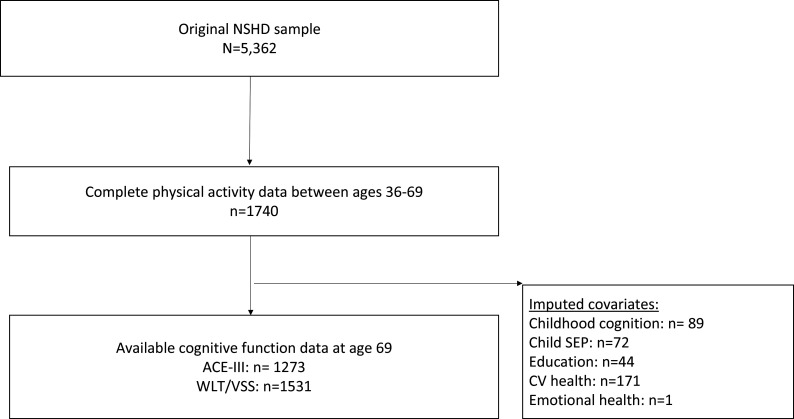
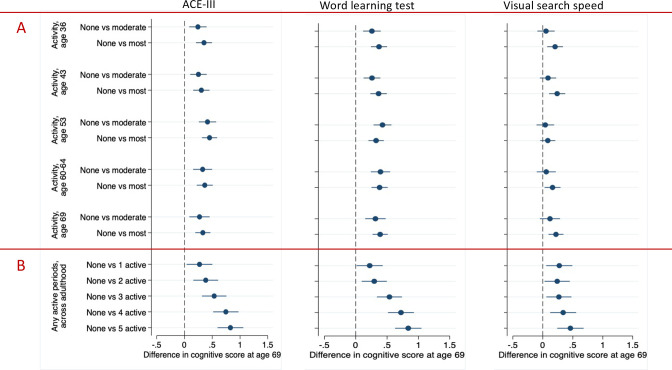
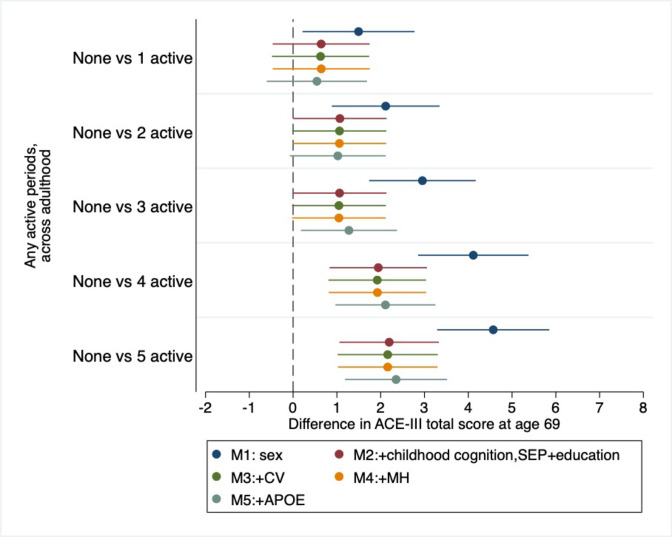
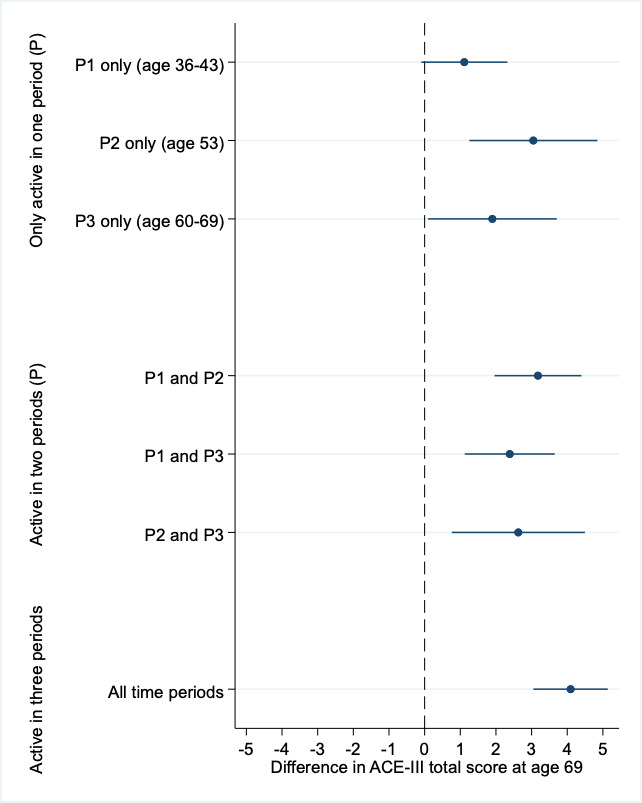
Background: To assess how timing, frequency and maintenance of being physically active, spanning over 30 years in adulthood, is associated with later-life cognitive function. Methods: Participants (n=1417, 53% female) were from the prospective longitudinal cohort study, 1946 British birth cohort. Participation in leisure time physical activity was reported five times between ages 36 and 69, categorised into: not active (no participation in physical activity/month); moderately active (participated 1–4 times/month); most active (participated 5 or more times/month). Cognition at age 69 was assessed by tests of cognitive state (Addenbrooke’s Cognitive Examination-III), verbal memory (word learning test) and processing speed (visual search speed). Results: Being physically active, at all assessments in adulthood, was associated with higher cognition at age 69. For cognitive state and verbal memory, the effect sizes were similar across all adult ages, and between those who were moderately and most physically active. The strongest association was between sustained cumulative physical activity and later-life cognitive state, in a dose-response manner. Adjusting for childhood cognition, childhood socioeconomic position and education largely attenuated these associations but results mainly remained significant at the 5% level. Conclusions: Being physically active at any time in adulthood, and to any extent, is linked with higher later-life cognitive state, but lifelong maintenance of physical activity was most optimal. These relationships were partly explained by childhood cognition and education, but independent of cardiovascular and mental health and APOE-E4, suggestive of the importance of education on the lifelong impacts of physical activity.
Overview
The claims and statistics of this paper haven’t been checked yet.
Free: it reads the open-access text and checks the first 5 claims that cite a source we can check. Create a free account to check every claim.
Integrity signals
Registry
Cites
Statistics
Figures
Verification
Claims the paper makes
The claims and statistics of this paper haven’t been checked yet.
Free: it reads the open-access text and checks the first 5 claims that cite a source we can check. Create a free account to check every claim.
Claims other papers make about this one
Each is checked against this paper’s own text: does it say what the citing paper says it does?
The source backs part of the claim, not all of it — or backs it for a different population, condition or comparison.
In the citing paper
“a cohort study (n=1,417) which recorded physical activity five times between age 36 and 69, found that being physically active at all ages was associated with better cognition at age 69; with the strongest association for sustained physical activity.(166)”
From Dementia prevention, intervention, and care: 2024 report of the Lancet standing Commission (2024) · cites this paper as [166]
Experimental — accuracy not yet measured
Self-check
Percentages, sums and reported differences re-computed from the paper’s own numbers.
The self-check needs the paper’s full text.
Citations
Cites
1 retracted
Dementia prevention, intervention, and care: 2020 report of the Lancet Commission
Livingston, G., Huntley, J., Sommerlad, A., Ames, D., Ballard, C., Banerjee, S., Brayne, C., Burns, A., Cohen-Mansfield, J., Cooper, C., et al. (2020) · The Lancet · doi:10.1016/s0140-6736(20)30367-6 · Cited by 10,430
RetractedGeneral Cardiovascular Risk Profile for Use in Primary Care: The Framingham Heart Study
D’Agostino, R. B., Vasan, R. S., Pencina, M. J., Wolf, P. A., Cobain, M., Massaro, J. M., & Kannel, W. B. (2008) · Circulation · doi:10.1161/circulationaha.107.699579 · Cited by 7,491
Dementia prevention, intervention, and care
Livingston, G., Sommerlad, A., Orgeta, V., Costafreda, S. G., Huntley, J., Ames, D., Ballard, C., Banerjee, S., Burns, A., Cohen-Mansfield, J., et al. (2017) · The Lancet · doi:10.1016/s0140-6736(17)31363-6 · Cited by 6,072
No adjustments are needed for multiple comparisons.
Rothman, K. J. (1990) · Epidemiology · doi:10.1097/00001648-199001000-00010 · Cited by 5,965
A scaled version of the General Health Questionnaire
Goldberg, D. P., & Hillier, V. F. (1979) · Psychological Medicine · doi:10.1017/s0033291700021644 · Cited by 5,459
The Validity of Two Versions of the GHQ in the WHO Study of Mental Illness in General Health Care
GOLDBERG, D. P., GATER, R., SARTORIUS, N., USTUN, T. B., PICCINELLI, M., GUREJE, O., & RUTTER, C. (1997) · Psychological Medicine · doi:10.1017/s0033291796004242 · Cited by 3,657
(2015) · HAL · Cited by 2,238
Baumgart, M., Snyder, H. M., Carrillo, M. C., Fazio, S., Kim, H., & Johns, H. (2015) · Alzheimer's & Dementia · doi:10.1016/j.jalz.2015.05.016 · Cited by 1,660
Northey, J. M., Cherbuin, N., Pumpa, K. L., Smee, D. J., & Rattray, B. (2018) · British Journal of Sports Medicine · doi:10.1136/bjsports-2016-096587 · Cited by 1,380
Hsieh, S., Schubert, S., Hoon, C., Mioshi, E., & Hodges, J. R. (2013) · Dementia and Geriatric Cognitive Disorders · doi:10.1159/000351671 · Cited by 973
Cited by
Dementia prevention, intervention, and care: 2024 report of the Lancet standing Commission
Livingston, G., Huntley, J., Liu, K. Y., Costafreda, S. G., Selbæk, G., Alladi, S., Ames, D., Banerjee, S., Burns, A., Brayne, C., et al. (2024) · The Lancet · doi:10.1016/s0140-6736(24)01296-0 · Cited by 3,860
Firth, J., Torous, J., López‐Gil, J. F., Linardon, J., Milton, A., Lambert, J., Smith, L., Jarić, I., Fabian, H., Vancampfort, D., et al. (2024) · World Psychiatry · doi:10.1002/wps.21188 · Cited by 80
“Engaging in physical activity at any point in adulthood, and to any extent, has been found to be associated with a higher cognitive state in later life 98 .”
BackgroundFactors Affecting Resilience and Prevention of Alzheimer's Disease and Related Dementias
Masurkar, A. V., Marsh, K., Morgan, B. E., Leitner, D., & Wısnıewskı, T. (2024) · Annals of Neurology · doi:10.1002/ana.27055 · Cited by 48
“20 Among recent meta-analyses, most have found a bene fi cial effect of physical exercise in AD, 17,21 but not all.”
Physical exercise regulates microglia in health and disease
Strohm, A. O., & Majewska, A. K. (2024) · Frontiers in Neuroscience · doi:10.3389/fnins.2024.1420322 · Cited by 38
Physical Activity, Alzheimer Plasma Biomarkers, and Cognition
Kim, S. A., Shin, D., Ham, H., Kim, Y., Gu, Y., Kim, H. J., Na, D. L., Zetterberg, H., Blennow, K., Seo, S. W., et al. (2025) · JAMA Network Open · doi:10.1001/jamanetworkopen.2025.0096 · Cited by 34
Physical Activity Over the Adult Life Course and Risk of Dementia in the Framingham Heart Study
Marino, F., Lyu, C., Li, Y., Liu, T., Au, R., & Hwang, P. H. (2025) · JAMA Network Open · doi:10.1001/jamanetworkopen.2025.44439 · Cited by 31
Wang, M., Fan, C., Han, Y., Wang, Y., Cai, H., Zhong, W., Yang, X., Wang, Z., Wang, H., & Han, Y. (2025) · Frontiers in Public Health · doi:10.3389/fpubh.2025.1529969 · Cited by 25
Wei, J., Lohman, M. C., Brown, M. J., Hardin, J. W., Xu, H., Yang, C., Merchant, A. T., Miller, M. C., & Friedman, D. B. (2024) · Journal of the American Geriatrics Society · doi:10.1111/jgs.19109 · Cited by 20
Stéphan, Y., Sutin, A. R., Luchetti, M., Aschwanden, D., & Terracciano, A. (2024) · Aging & Mental Health · doi:10.1080/13607863.2024.2320135 · Cited by 19
“In turn, higher engagement in physical, cognitive, and social activities is associated with better cognitive functioning across adulthood (James et al., 2023, 2011; Wilson et al., 2013).”
Pantiya, P., Thonusin, C., Chunchai, T., Pintana, H., Ongnok, B., Nawara, W., Arunsak, B., Kongkaew, A., Chattipakorn, N., & Chattipakorn, S. C. (2023) · Life Sciences · doi:10.1016/j.lfs.2023.122248 · Cited by 12
Gard, A. J. M., & Lavallee, D. E. (2025) · Healthcare · doi:10.3390/healthcare13080856 · Cited by 9
Eight decades of follow-up link life course exposures to proteomic organ ageing and longevityPreprint
Groves, J. W., Bot, V. A., Ding, D. Y., Nicholas, J. M., Farinas, A., Oh, H. S., James, S., Wong, A., Williams, D. M., King‐Robson, J., et al. (2025) · medRxiv · doi:10.1101/2025.09.07.25335188 · Cited by 8
Self-citationMitchell, J. J., Hamer, M., James, S., Norris, T., Jefferis, B. J. M. H., Wannamethee, S. G., & Blodgett, J. M. (2025) · American Journal of Epidemiology · doi:10.1093/aje/kwaf144 · Cited by 6
“5 Importantly, the use of ARCLP models relies on null hypothesis significance testing in the identification of paths, which may result in the constraint of paths which were tending toward significance at the pre-defined threshold.”
InfluentialSelf-citationAlexander, K. P., Damluji, A. A., Erqou, S. A., Ferrucci, L., Forman, D. E., Galasko, D., & Yaffe, K. S. (2026) · Journal of the American College of Cardiology · doi:10.1016/j.jacc.2026.07.009 · Cited by 7
James, S., Sudre, C. H., Barnes, J., Cash, D. M., Chiou, Y., Coath, W., Keshavan, A., Lu, K., Malone, I. B., Murray‐Smith, H., et al. (2024) · Brain Communications · doi:10.1093/braincomms/fcae431 · Cited by 6
Self-citationDementia and Cognitive Decline: A HEALM Approach
Jaqua, E. E., Tran, M.-L. N., Alvarez, P., Gupta, M., & Yoong, J. (2024) · American Journal of Lifestyle Medicine · doi:10.1177/15598276241291508 · Cited by 5
“33 Additionally, observational studies from Blue Zones — regions known for their high longevity and low incidence of chronic diseases — support these fi ndings.”
InfluentialCognitive reserve counteracts typical neural activity changes related to ageing
Cespón, J., Chupina, I., & Carreiras, M. (2023) · Neuropsychologia · doi:10.1016/j.neuropsychologia.2023.108625 · Cited by 5
Management of patients with chronic cerebrovascular disease
Starchina, Y. A., Kosivtsova, O. V., & Sokolov, E. A. (2023) · Neurology neuropsychiatry Psychosomatics · doi:10.14412/2074-2711-2023-2-91-97 · Cited by 5
Iso‐Markku, P., Buchholz, E. J., Tu, X. M., Gillespie, N. A., Reynolds, C. A., Lyons, M. J., Kremen, W. S., & Franz, C. E. (2025) · Alzheimer s & Dementia Diagnosis Assessment & Disease Monitoring · doi:10.1002/dad2.70169 · Cited by 4
“12 In contrast, a study from the Lothian Birth Cohort made an opposite finding, suggesting a sensitivity period for PA rather than a cumulative model.”
Ren, Z., Nie, L., Sun, Y., Wu, Y., Wang, L., & Liu, J. (2025) · Age and Ageing · doi:10.1093/ageing/afaf317 · Cited by 4
Randolph, J. J., Lacritz, L. H., Colvin, M. K., Espe‐Pfeifer, P., Carter, K. R., Arnett, P. A., Fox‐Fuller, J. T., Aduen, P. A., Cullum, C. M., & Sperling, S. A. (2023) · Archives of Clinical Neuropsychology · doi:10.1093/arclin/acad078 · Cited by 4
Wang, J., Zhang, N., Huang, C., Wu, Q., & Tong, J. (2025) · Frontiers in Aging Neuroscience · doi:10.3389/fnagi.2025.1579874 · Cited by 4
Xu, T., Tao, Y., Chen, R., Strachan, G., Cai, X., & Liu, C. (2023) · BMJ Open · doi:10.1136/bmjopen-2023-076123 · Cited by 4
Navarrete, F. C., Arriagada-Hernández, C., Jara-Tomckowiack, L., Contreras-Díaz, G., Álvarez, C., Hernández-Mosqueira, C., Figueroa-Saavedra, C., Lagos-Hernández, R., Fuentes-Vilugrón, G., & Delgado‐Floody, P. (2026) · Behavioral Sciences · doi:10.3390/bs16060941 · Cited by 3
“Additionally, a further study highlighted that being physically active at any time in adulthood was related to a better later-life cognitive state (James et al., 2023).”
[Factors influencing cognitive function among the older adults in Beijing].
Lin, Y., Wang, H., Tian, Y., Gong, L., & Chang, C. (2024) · PubMed Central · doi:10.19723/j.issn.1671-167x.2024.03.012 · Cited by 3
Zehirlioğlu, L., Demirakça, T., Nkrumah, R. O., Ettingshausen, L., Grauduszus, Y., von Schröder, C., Feichtmair, M., Kleindienst, N., Ende, G., & Schmahl, C. G. (2025) · European Psychiatry · doi:10.1192/j.eurpsy.2025.10116 · Cited by 2
“Given that the existing literature typically assesses physical activity over relatively short periods – such as a week or a year – yet evidence suggests that cumulative PA levels have the most significant impact on brain health in healthy populations [36], our study specifically focuses on LPA.”
Tolea, M. I., Besser, L. M., O’Shea, D. M., Sol, K., Chrisphonte, S., Kleiman, M. J., Baig, M. M., Joshi, M. S., & Galvin, J. E. (2026) · Journal of Alzheimer s Disease · doi:10.1177/13872877261432600 · Cited by 3
“Longitudinal prospective studies such as the British 1946 Birth Cohort Study 4 and the Trondelag Health Study (HUNT, previously Nord-Trondelag Health Study) 5 have indicated that while being physically active at any time in adulthood is linked to better cognition in late-life, maintaining or improving physical activit…”
Burma, J. S., Nel, J. H., Cheung, H., Hofforth, D., Zala, D., Hayden, A., Ronksley, P. E., Carty, C. L., Chang, M., Gross, A. L., et al. (2026) · Frontiers in Neuroendocrinology · doi:10.1016/j.yfrne.2026.101250 · Cited by 2
Self-citationGard, A. J. M., Abdullah, A. S., & Lavallee, D. E. (2025) · Psychology International · doi:10.3390/psycholint7010013 · Cited by 2
“…in women, as being physically active during this period and beyond contributes to the healthy ageing process and those who continue to maintain their PA into older age have been reported as having, for example, higher cognition and less frailty (Angulo et al., 2020; James et al., 2023).”
Antunes, E. P., do Prado, W. L., Canhin, D. D. S., da Silva, C. C. M., Gobbo, L. A., Ferrari, G., Mota, J. A. P. S., Tebar, W. R., & Christófaro, D. G. D. (2025) · Health Science Reports · doi:10.1002/hsr2.71153 · Cited by 2
“Although studies investigating lifelong PA engagement with QoL are still incipient, previous research has shown cumulative PA effects on physical performance, strength, and cognitive function in later life [45, 46].”
Zhong, X., Huang, Z., Huang, B., Cai, H., Yao, Y., Liu, K., & Li, Y. (2026) · The Journals of Gerontology Series A · doi:10.1093/gerona/glaf290 · Cited by 1
Mid‐life cardiorespiratory fitness and risk of late‐onset dementia incidence
Wiklund, C. A., Wang, R., Lindwall, M., Paulsson, S. Å., Ekblom, Ö. B., & Ekblom‐Bak, E. (2026) · Alzheimer s & Dementia Diagnosis Assessment & Disease Monitoring · doi:10.1002/dad2.70239 · Cited by 1
“26,27 However, other studies have found no relationship between physical activity and dementia risk and instead suggest that the previously seen relationship can be attributed to reversed causation.”
Shettigar, D., Sukumar, S., Paramashiva, P. S., Vaishali, K., Panakkal, N. C., Dkhar, W., Pradhan, A., Chandrasekaran, B., Palaniswamy, H. P., Paramashiva, P. S., et al. (2026) · BMC Neurology · doi:10.1186/s12883-026-05055-5 · Cited by 1
“Huang et al. [34] found that higher self-reported leisure-time physical activity was associated with reduced dementia risk (HR = 0.78, 95% CI 0.70–0.93) and with greater volumes in the hippocampus, orbitofrontal cortex, middle temporal gyrus, and thalamus.”
InfluentialAusdauertraining nach Schlaganfall
Mehrholz, J. (2023) · neuroreha · doi:10.1055/a-2039-8705 · Cited by 1
Yamakita, M., Tsuji, T., Kanamori, S., Saito, J., Kai, Y., Tani, Y., Fujiwara, T., Kondo, N., & Kondo, K. (2025) · Public Health · doi:10.1016/j.puhe.2025.03.033 · Cited by 1
FMUPorto - Summaries and comments July 2023
Saúde, A. A. U. C., Felgueiras, A., Maia, B. V., da Estrela, A. C. D. B. U., Cordeiro, D. O., & Pereira, G. M. (2023) · Revista de Medicina Desportiva informa · doi:10.23911/fmup_2023_jul
Norris, T., Mitchell, J. J., Blodgett, J. M., Hamer, M., & Pereira, S. M. P. (2024) · PLoS ONE · doi:10.1371/journal.pone.0295092
(2024) · Elsevier eBooks · doi:10.1016/b978-0-443-23565-8.09996-8
Lifestyle Factors Affecting Biological Processes and Health
Anisman, H., Hayley, S. P., & Kusnecov, A. W. (2024) · Elsevier eBooks · doi:10.1016/b978-0-443-23565-8.00009-0
Examining sex differences in cognitive \nageing and lifetime risk factors for \ndementia
Needham, L. P. (2024) · UCL Discovery (University College London)
Self-citationPhysical Activity Behaviour in Middle-Aged and Older Adults
D’Amore, C. (2024) · MacSphere (McMaster University) · doi:10.71548/23929
Does type or diversity of activities delay aging-related cognitive decline?
Glei, D. A., Lee, C., Brown, C. K., & Weinstein, M. (2026) · Innovation in Aging · doi:10.1093/geroni/igaf133
Redzovic, S. E., Moloudi, M., & Bonsaksen, T. (2026) · BMC Geriatrics · doi:10.1186/s12877-026-07015-7
Cieri, F., Caldwell, J. K., Cordes, D., & Cross, C. L. (2026) · Brain Imaging and Behavior · doi:10.1007/s11682-026-01122-0
Mechanisms and Interventions for Enhancing Cognitive Reserve in Aging Populations
Silva-Pereyra, J., Fernández, T., & Rodríguez, V. (2026) · Frontiers research topics · doi:10.3389/978-2-8325-7954-1
Dominguez, L. J., Veronese, N., Ragusa, F. S., Seminara, F., Baio, S. M., Vernuccio, L., Catanese, G., & Barbagallo, M. (2026) · EXCLI journal · doi:10.17179/excli2026-9298
“…suggest that sustained or increased physical activity across adulthood is associated with better late-life cognition and lower dementia risk (James et al., 2023; Tari et al., 2022), although some associations attenuate after adjustment for cardiometabolic conditions (Greendale et al., 2021).”
The impact of physical activity on health inequality among older adults: evidence from China
Dang, X., Pan, J., Xing, X., & Yi, X. (2026) · BMC Geriatrics · doi:10.1186/s12877-026-08008-2
“For example, studies on cultural engagement and health outcomes have used “atten-dance once a month” as a meaningful threshold [41], and research on cognitive outcomes has found benefits from leisure-time physical activity even at light levels of one to four times per month [42].”
How Life-Course Trajectories of Physical Activity Track With Cognitive Decline
Marino, F., Ding, H., Lin, H., Au, R., & Hwang, P. H. (2026) · Journal of Physical Activity and Health · doi:10.1123/jpah.2026-0133
Korhonen, N. (2026) · Jyväskylä University Digital Archive (University of Jyväskylä)
Exploring the Relationship Between Student Health, Fitness, and Academic Achievement: A Case Study
Chopel, P., & Wangdi, L. (2025) · RABSEL · doi:10.17102/rabsel.25.07.0664728
Rask, A. (2026) · UTUPub (University of Turku)
Longitudinal associations between physical activity and cognition post-stroke: the Nor-COAST study
Luzum, G., Aam, S., Allore, H. G., Saltvedt, I. T., Haberg, A. K., & Askim, T. (2026) · Brain Communications · doi:10.1093/braincomms/fcag367
“10,13 This might imply that a longer follow-up might be necessary to be able to capture clinically relevant changes in cognitive function and trajectories.”
Grajales, A. I. L. (2026) · Tesis Doctorals en Xarxa (Consorci de Serveis Universitaris de Catalunya)
Webber, B. J. (2026) · American Journal of Lifestyle Medicine · doi:10.1177/15598276261497667
Metadata
- Authors
- James, S.-N., Chiou, Y.-J., Fatih, N., Needham, L. P., Schott, J. M., & Richards, M.
- Affiliations
- MRC Unit for Lifelong Health and Ageing (GB)
- University of Oxford (GB)
- Corresponding author
- James, Sarah-Naomi
- Venue
- Journal of Neurology, Neurosurgery & Psychiatry
- Publisher
- BMJ
- Published
- 2023-02-21
- Volume
- 94
- Issue
- 5
- Pages
- 349-356
- ISSN
- 0022-3050 (ISSN-L)
- 1468-330X
- PMC
- PMC10176405
- OpenAlex
- W4321434492
- Cited by
- 46
- References
- 44
- Citations by year
- 2026: 13 · 2025: 13 · 2024: 12 · 2023: 8
- FWCI
- 8.17
- Type
- journal article
- Language
- en
- Open access
- hybrid
- doi.org
- Locations
- Journal of Neurology Neurosurgery & Psychiatry (publishedVersion, cc-by)
- PubMed Central (publishedVersion, cc-by)
- PubMed (publishedVersion)
- UCL Discovery (University College London) (submittedVersion, cc-by)
- Funders
- Alzheimer's Research UK (ARUK-PG2014-1946, PG2017-1946)
- National Institute for Health Research (N/A)
- London Hospitals Biomedical Research Centre (N/A)
- Medical Research Council (MC_UU_12019/1 MC_UU_12019/3)
- Alzheimer’s Association (SG-666374)
- Topics
- Health Sciences › Medicine › Public Health, Environmental and Occupational Health › Physical Activity and Health
- Health Sciences › Medicine › Psychiatry and Mental health › Dementia and Cognitive Impairment Research
- Social Sciences › Psychology › Developmental and Educational Psychology › Aging and Gerontology Research
- Keywords
- physical activity, leisure-time physical activity, later-life cognition, cognitive function, verbal memory, processing speed, cognitive states, exercise timing, children's cognition, 1946 British birth cohort
- MeSH terms
- Birth Cohort, Adult, Aged, Child, Cognition, Female, Follow-Up Studies, Humans, Longitudinal Studies, Male, Middle Aged, Prospective Studies, Exercise
About these checks
Registry, retraction, Cites and statistics results are computed, not judged, with one exception: a printed reference that no index lists is read once by a model before it counts as a citation error. Claims are extracted by a model and kept only when their quote appears verbatim in the text; each cited source is then checked, with a model’s help, for whether it says what the claim relies on. Those verdicts can be wrong — read the claim’s quote and the cited source before relying on one.
Statistics and arithmetic are recomputed, not judged.
Confidence bands are shown only for fields calibrated on our annotated test set. None is calibrated yet, so no band is shown.
What counts as a claim ›How we measure confidence ›How we check this ›
Are you an author, or do you see a problem with this page? Request a review
Data sources
Bibliographic data: Semantic Scholar, OpenAlex, Crossref.
Contains information from the Semantic Scholar Academic Graph Datasets, made available under the ODC Attribution License (ODC-BY 1.0).
Semantic Scholar’s data is described in: Kinney, R., et al. (2023). The Semantic Scholar Open Data Platform. arXiv:2301.10140.
