

Timing of physical activity across adulthood on later-life cognition: 30 years follow-up in the 1946 British birth cohort
Open accessThe DOI matches its Crossref record; 44 of the 44 references it cites were found in a registry or an index.
Abstract
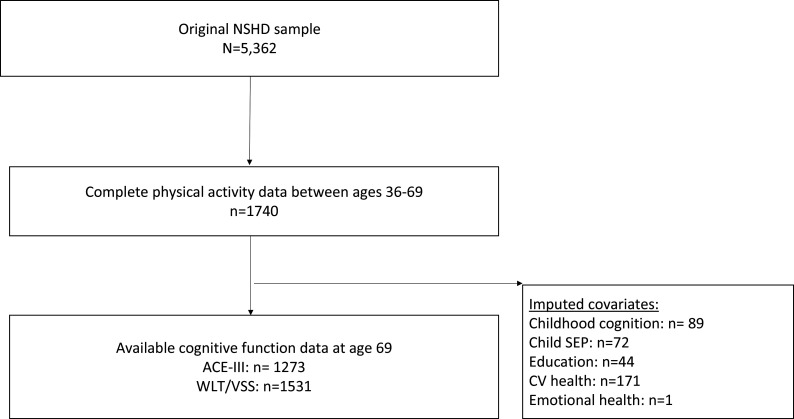
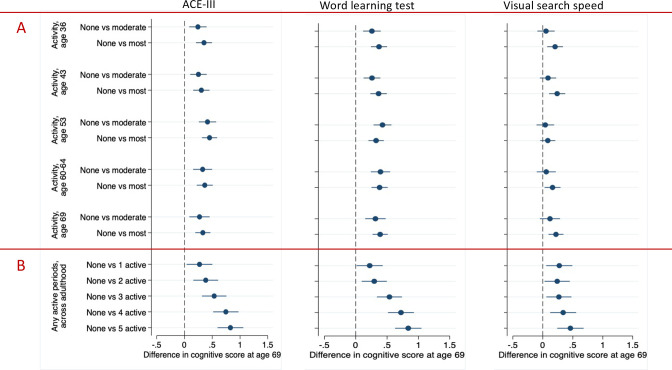
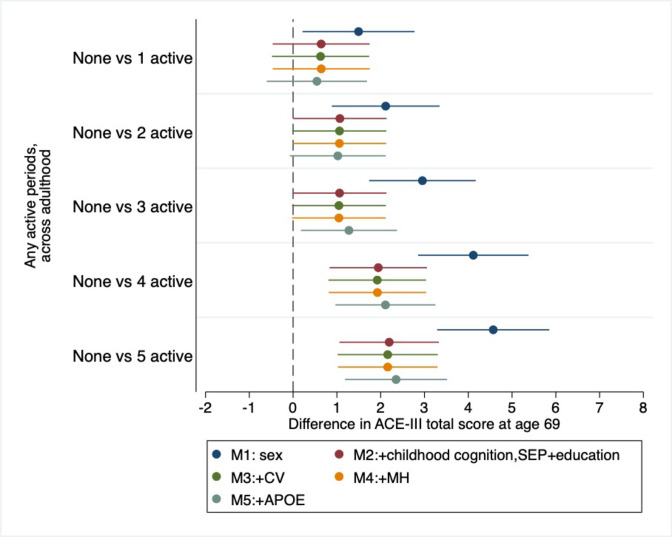
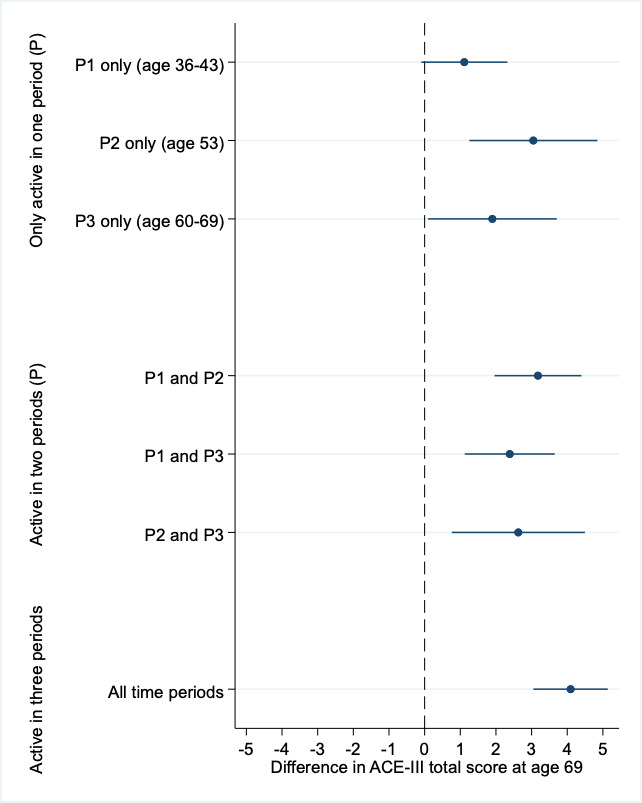
Background: To assess how timing, frequency and maintenance of being physically active, spanning over 30 years in adulthood, is associated with later-life cognitive function. Methods: Participants (n=1417, 53% female) were from the prospective longitudinal cohort study, 1946 British birth cohort. Participation in leisure time physical activity was reported five times between ages 36 and 69, categorised into: not active (no participation in physical activity/month); moderately active (participated 1–4 times/month); most active (participated 5 or more times/month). Cognition at age 69 was assessed by tests of cognitive state (Addenbrooke’s Cognitive Examination-III), verbal memory (word learning test) and processing speed (visual search speed). Results: Being physically active, at all assessments in adulthood, was associated with higher cognition at age 69. For cognitive state and verbal memory, the effect sizes were similar across all adult ages, and between those who were moderately and most physically active. The strongest association was between sustained cumulative physical activity and later-life cognitive state, in a dose-response manner. Adjusting for childhood cognition, childhood socioeconomic position and education largely attenuated these associations but results mainly remained significant at the 5% level. Conclusions: Being physically active at any time in adulthood, and to any extent, is linked with higher later-life cognitive state, but lifelong maintenance of physical activity was most optimal. These relationships were partly explained by childhood cognition and education, but independent of cardiovascular and mental health and APOE-E4, suggestive of the importance of education on the lifelong impacts of physical activity.
Overview
The claims and statistics of this paper haven’t been checked yet.
Free: it reads the open-access text and checks the first 5 claims that cite a source we can check. Create a free account to check every claim.
Integrity signals
Registry
Cites
Statistics
Figures
Verification
Claims the paper makes
The claims and statistics of this paper haven’t been checked yet.
Free: it reads the open-access text and checks the first 5 claims that cite a source we can check. Create a free account to check every claim.
Claims other papers make about this one
Each is checked against this paper’s own text: does it say what the citing paper says it does?
The source backs part of the claim, not all of it — or backs it for a different population, condition or comparison.
In the citing paper
“a cohort study (n=1,417) which recorded physical activity five times between age 36 and 69, found that being physically active at all ages was associated with better cognition at age 69; with the strongest association for sustained physical activity.(166)”
From Dementia prevention, intervention, and care: 2024 report of the Lancet standing Commission (2024) · cites this paper as [166]
Experimental — accuracy not yet measured
Self-check
Percentages, sums and reported differences re-computed from the paper’s own numbers.
The self-check needs the paper’s full text.
Citations
Cites
1 retracted
Dementia prevention, intervention, and care: 2020 report of the Lancet Commission
Livingston, G., Huntley, J., Sommerlad, A., Ames, D., Ballard, C., Banerjee, S., Brayne, C., Burns, A., Cohen-Mansfield, J., Cooper, C., et al. (2020) · The Lancet · doi:10.1016/s0140-6736(20)30367-6 · Cited by 10,430
RetractedGeneral Cardiovascular Risk Profile for Use in Primary Care: The Framingham Heart Study
D’Agostino, R. B., Vasan, R. S., Pencina, M. J., Wolf, P. A., Cobain, M., Massaro, J. M., & Kannel, W. B. (2008) · Circulation · doi:10.1161/circulationaha.107.699579 · Cited by 7,491
Dementia prevention, intervention, and care
Livingston, G., Sommerlad, A., Orgeta, V., Costafreda, S. G., Huntley, J., Ames, D., Ballard, C., Banerjee, S., Burns, A., Cohen-Mansfield, J., et al. (2017) · The Lancet · doi:10.1016/s0140-6736(17)31363-6 · Cited by 6,072
No adjustments are needed for multiple comparisons.
Rothman, K. J. (1990) · Epidemiology · doi:10.1097/00001648-199001000-00010 · Cited by 5,965
A scaled version of the General Health Questionnaire
Goldberg, D. P., & Hillier, V. F. (1979) · Psychological Medicine · doi:10.1017/s0033291700021644 · Cited by 5,459
The Validity of Two Versions of the GHQ in the WHO Study of Mental Illness in General Health Care
GOLDBERG, D. P., GATER, R., SARTORIUS, N., USTUN, T. B., PICCINELLI, M., GUREJE, O., & RUTTER, C. (1997) · Psychological Medicine · doi:10.1017/s0033291796004242 · Cited by 3,657
(2015) · HAL · Cited by 2,238
Baumgart, M., Snyder, H. M., Carrillo, M. C., Fazio, S., Kim, H., & Johns, H. (2015) · Alzheimer's & Dementia · doi:10.1016/j.jalz.2015.05.016 · Cited by 1,660
Northey, J. M., Cherbuin, N., Pumpa, K. L., Smee, D. J., & Rattray, B. (2018) · British Journal of Sports Medicine · doi:10.1136/bjsports-2016-096587 · Cited by 1,380
Hsieh, S., Schubert, S., Hoon, C., Mioshi, E., & Hodges, J. R. (2013) · Dementia and Geriatric Cognitive Disorders · doi:10.1159/000351671 · Cited by 973
Blondell, S. J., Hammersley-Mather, R., & Veerman, J. L. (2014) · BMC Public Health · doi:10.1186/1471-2458-14-510 · Cited by 928
Physical exercise in the prevention and treatment of Alzheimer's disease
De la Rosa, A., Olaso-Gonzalez, G., Arc-Chagnaud, C., Millan, F., Salvador-Pascual, A., García-Lucerga, C., Blasco-Lafarga, C., Garcia-Dominguez, E., Carretero, A., Correas, A. G., et al. (2020) · Journal of Sport and Health Science · doi:10.1016/j.jshs.2020.01.004 · Cited by 595
Yu, J.-T., Xu, W., Tan, C.-C., Andrieu, S., Suckling, J., Evangelou, E., Pan, A., Zhang, C., Jia, J., Feng, L., et al. (2020) · Journal of Neurology, Neurosurgery & Psychiatry · doi:10.1136/jnnp-2019-321913 · Cited by 482
Sabia, S., Dugravot, A., Dartigues, J.-F., Abell, J., Elbaz, A., Kivimäki, M., & Singh-Manoux, A. (2017) · BMJ · doi:10.1136/bmj.j2709 · Cited by 440
Validity and repeatability of the EPIC-Norfolk Physical Activity Questionnaire
Wareham, N. J., Jakes, R. W., Rennie, K. L., Mitchell, J., Hennings, S., & Day, N. E. (2002) · International Journal of Epidemiology · doi:10.1093/ije/31.1.168 · Cited by 435
Lifetime Antecedents of Cognitive Reserve
Richards, M., & Sacker, A. (2003) · Journal of Clinical and Experimental Neuropsychology · doi:10.1076/jcen.25.5.614.14581 · Cited by 365
Self-citationComprehensive evaluation of the Minnesota leisure time physical activity questionnaire
Richardson, M. T., Leon, A. S., Jacobs, D. R., Ainsworth, B. E., & Serfass, R. (1994) · Journal of Clinical Epidemiology · doi:10.1016/0895-4356(94)90008-6 · Cited by 363
Fitness Effects on the Cognitive Function of Older Adults: A Meta-Analytic Study—Revisited
Kramer, A. F., & Colcombe, S. (2018) · Perspectives on Psychological Science · doi:10.1177/1745691617707316 · Cited by 285
Does active leisure protect cognition? Evidence from a national birth cohort.
Richards, M., Hardy, R., & Wadsworth, M. E. J. (2003) · Social Science & Medicine · doi:10.1016/s0277-9536(02)00075-8 · Cited by 264
Self-citationWalsh, J. J., Barnes, J. D., Cameron, J. D., Goldfield, G. S., Chaput, J.-P., Gunnell, K. E., Ledoux, A.-A., Zemek, R. L., & Tremblay, M. S. (2018) · The Lancet Child & Adolescent Health · doi:10.1016/s2352-4642(18)30278-5 · Cited by 264
Lane, C. A., Barnes, J., Nicholas, J. M., Sudre, C. H., Cash, D. M., Parker, T. D., Malone, I. B., Lu, K., James, S.-N., Keshavan, A., et al. (2019) · The Lancet Neurology · doi:10.1016/s1474-4422(19)30228-5 · Cited by 247
Self-citationSnowden, M., Steinman, L., Mochan, K., Grodstein, F., Prohaska, T. R., Thurman, D. J., Brown, D. R., Laditka, J. N., Soares, J., Zweiback, D. J., et al. (2011) · Journal of the American Geriatrics Society · doi:10.1111/j.1532-5415.2011.03323.x · Cited by 227
A structured approach to modelling the effects of binary exposure variables over the life course
Mishra, G., Nitsch, D., Black, S., De Stavola, B., Kuh, D., & Hardy, R. (2009) · International Journal of Epidemiology · doi:10.1093/ije/dyn229 · Cited by 218
Barriers to physical activity and socioeconomic position: implications for health promotion.
Chinn, D. J., White, M., Harland, J., Drinkwater, C., & Raybould, S. (1999) · Journal of Epidemiology and Community Health · doi:10.1136/jech.53.3.191 · Cited by 213
Stafford, M., Black, S., Shah, I., Hardy, R., Pierce, M., Richards, M., Wong, A., & Kuh, D. (2013) · European Journal of Ageing · doi:10.1007/s10433-013-0258-8 · Cited by 192
Self-citationKuh, D., Wong, A., Shah, I., Moore, A., Popham, M., Curran, P., Davis, D., Sharma, N., Richards, M., Stafford, M., et al. (2016) · European Journal of Epidemiology · doi:10.1007/s10654-016-0217-8 · Cited by 159
Self-citationLong term effects of early adversity on cognitive function
Richards, M., & Wadsworth, M. E. J. (2004) · Archives of Disease in Childhood · doi:10.1136/adc.2003.032490 · Cited by 156
Self-citationHiles, S. A., Lamers, F., Milaneschi, Y., & Penninx, B. W. J. H. (2017) · Psychological Medicine · doi:10.1017/s0033291716003548 · Cited by 139
Dodds, R., Kuh, D., Aihie Sayer, A., & Cooper, R. (2013) · Age and Ageing · doi:10.1093/ageing/aft124 · Cited by 115
Lane, C. A., Barnes, J., Nicholas, J. M., Sudre, C. H., Cash, D. M., Malone, I. B., Parker, T. D., Keshavan, A., Buchanan, S. M., Keuss, S. E., et al. (2020) · JAMA Neurology · doi:10.1001/jamaneurol.2019.3774 · Cited by 104
Self-citationCardiovascular Health and Cognitive Function: The Maine-Syracuse Longitudinal Study
Crichton, G. E., Elias, M. F., Davey, A., & Alkerwi, A. (2014) · PLoS ONE · doi:10.1371/journal.pone.0089317 · Cited by 101
Luck, T., Riedel-Heller, S. G., Luppa, M., Wiese, B., Köhler, M., Jessen, F., Bickel, H., Weyerer, S., Pentzek, M., König, H.-H., et al. (2014) · Psychological Medicine · doi:10.1017/s0033291713001918 · Cited by 93
Midlife physical activity, psychological distress, and dementia risk: the HUNT study
Zotcheva, E., Bergh, S., Selbæk, G., Krokstad, S., Håberg, A. K., Strand, B. H., & Ernstsen, L. (2018) · Journal of Alzheimer's Disease · doi:10.3233/jad-180768 · Cited by 87
Childhood socioeconomic position and adult leisure-time physical activity: a systematic review
Elhakeem, A., Cooper, R., Bann, D., & Hardy, R. (2015) · International Journal of Behavioral Nutrition and Physical Activity · doi:10.1186/s12966-015-0250-0 · Cited by 85
James, S., Lane, C., Parker, T. D., Lu, K., Collins, J. D., Murray‐Smith, H., Byford, M., Wong, A., Keshavan, A., Buchanan, S. M., et al. (2018) · BMC Research Notes · doi:10.1186/s13104-018-3995-0 · Cited by 72
Self-citationGolubic, R., Martin, K. R., Ekelund, U., Hardy, R., Kuh, D., Wareham, N., Cooper, R., Brage, S., & teams, O. B. O. T. N. S. A. D. C. (2014) · International Journal of Behavioral Nutrition and Physical Activity · doi:10.1186/1479-5868-11-58 · Cited by 67
Physical Activity and Mental Well-being in a Cohort Aged 60–64 Years
Black, S. V., Cooper, R., Martin, K. R., Brage, S., Kuh, D., & Stafford, M. (2015) · American Journal of Preventive Medicine · doi:10.1016/j.amepre.2015.03.009 · Cited by 64
The Role of Lifestyle Behaviors on 20-Year Cognitive Decline
Cadar, D., Pikhart, H., Mishra, G., Stephen, A., Kuh, D., & Richards, M. (2012) · Journal of Aging Research · doi:10.1155/2012/304014 · Cited by 57
Self-citationRichards, M., James, S.-N., Sizer, A., Sharma, N., Rawle, M., Davis, D. H. J., & Kuh, D. (2019) · BMJ Open · doi:10.1136/bmjopen-2018-024404 · Cited by 54
Self-citationMitáš, J., Cerin, E., Reis, R. S., Conway, T. L., Cain, K. L., Adams, M. A., Schofield, G., Sarmiento, O. L., Christiansen, L. B., Davey, R., et al. (2019) · International Journal of Behavioral Nutrition and Physical Activity · doi:10.1186/s12966-019-0894-2 · Cited by 51
Simmonds, B., Hannam, K. J., Fox, K. R., & Tobias, J. H. (2015) · Osteoporosis International · doi:10.1007/s00198-015-3376-7 · Cited by 45
Pierce, M. B., Silverwood, R. J., Nitsch, D., Adams, J. E., Stephen, A. M., Nip, W., Macfarlane, P. W., Wong, A., Richards, M., Hardy, R., et al. (2012) · PLoS ONE · doi:10.1371/journal.pone.0044857 · Cited by 36
Self-citationJames, S., Davis, D. H. J., O’Hare, C., Sharma, N., John, A., Gaysina, D., Hardy, R., Kuh, D. J., & Richards, M. (2018) · Journal of Affective Disorders · doi:10.1016/j.jad.2018.07.078 · Cited by 34
Self-citationAlmeida‐Meza, P., Richards, M., & Cadar, D. (2022) · Neurology · doi:10.1212/wnl.0000000000200928 · Cited by 10
Self-citation
Cited by
Dementia prevention, intervention, and care: 2024 report of the Lancet standing Commission
Livingston, G., Huntley, J., Liu, K. Y., Costafreda, S. G., Selbæk, G., Alladi, S., Ames, D., Banerjee, S., Burns, A., Brayne, C., et al. (2024) · The Lancet · doi:10.1016/s0140-6736(24)01296-0 · Cited by 3,860
Firth, J., Torous, J., López‐Gil, J. F., Linardon, J., Milton, A., Lambert, J., Smith, L., Jarić, I., Fabian, H., Vancampfort, D., et al. (2024) · World Psychiatry · doi:10.1002/wps.21188 · Cited by 80
“Engaging in physical activity at any point in adulthood, and to any extent, has been found to be associated with a higher cognitive state in later life 98 .”
BackgroundFactors Affecting Resilience and Prevention of Alzheimer's Disease and Related Dementias
Masurkar, A. V., Marsh, K., Morgan, B. E., Leitner, D., & Wısnıewskı, T. (2024) · Annals of Neurology · doi:10.1002/ana.27055 · Cited by 48
“20 Among recent meta-analyses, most have found a bene fi cial effect of physical exercise in AD, 17,21 but not all.”
Physical exercise regulates microglia in health and disease
Strohm, A. O., & Majewska, A. K. (2024) · Frontiers in Neuroscience · doi:10.3389/fnins.2024.1420322 · Cited by 38
Physical Activity, Alzheimer Plasma Biomarkers, and Cognition
Kim, S. A., Shin, D., Ham, H., Kim, Y., Gu, Y., Kim, H. J., Na, D. L., Zetterberg, H., Blennow, K., Seo, S. W., et al. (2025) · JAMA Network Open · doi:10.1001/jamanetworkopen.2025.0096 · Cited by 34
Metadata
- Authors
- James, S.-N., Chiou, Y.-J., Fatih, N., Needham, L. P., Schott, J. M., & Richards, M.
- Affiliations
- MRC Unit for Lifelong Health and Ageing (GB)
- University of Oxford (GB)
- Corresponding author
- James, Sarah-Naomi
- Venue
- Journal of Neurology, Neurosurgery & Psychiatry
- Publisher
- BMJ
- Published
- 2023-02-21
- Volume
- 94
- Issue
- 5
- Pages
- 349-356
- ISSN
- 0022-3050 (ISSN-L)
- 1468-330X
- PMC
- PMC10176405
- OpenAlex
- W4321434492
- Cited by
- 46
- References
- 44
- Citations by year
- 2026: 13 · 2025: 13 · 2024: 12 · 2023: 8
- FWCI
- 8.17
- Type
- journal article
- Language
- en
- Open access
- hybrid
- doi.org
- Locations
- Journal of Neurology Neurosurgery & Psychiatry (publishedVersion, cc-by)
- PubMed Central (publishedVersion, cc-by)
- PubMed (publishedVersion)
- UCL Discovery (University College London) (submittedVersion, cc-by)
- Funders
- Alzheimer's Research UK (ARUK-PG2014-1946, PG2017-1946)
- National Institute for Health Research (N/A)
- London Hospitals Biomedical Research Centre (N/A)
- Medical Research Council (MC_UU_12019/1 MC_UU_12019/3)
- Alzheimer’s Association (SG-666374)
- Topics
- Health Sciences › Medicine › Public Health, Environmental and Occupational Health › Physical Activity and Health
- Health Sciences › Medicine › Psychiatry and Mental health › Dementia and Cognitive Impairment Research
- Social Sciences › Psychology › Developmental and Educational Psychology › Aging and Gerontology Research
- Keywords
- physical activity, leisure-time physical activity, later-life cognition, cognitive function, verbal memory, processing speed, cognitive states, exercise timing, children's cognition, 1946 British birth cohort
- MeSH terms
- Birth Cohort, Adult, Aged, Child, Cognition, Female, Follow-Up Studies, Humans, Longitudinal Studies, Male, Middle Aged, Prospective Studies, Exercise
About these checks
Registry, retraction, Cites and statistics results are computed, not judged, with one exception: a printed reference that no index lists is read once by a model before it counts as a citation error. Claims are extracted by a model and kept only when their quote appears verbatim in the text; each cited source is then checked, with a model’s help, for whether it says what the claim relies on. Those verdicts can be wrong — read the claim’s quote and the cited source before relying on one.
Statistics and arithmetic are recomputed, not judged.
Confidence bands are shown only for fields calibrated on our annotated test set. None is calibrated yet, so no band is shown.
What counts as a claim ›How we measure confidence ›How we check this ›
Are you an author, or do you see a problem with this page? Request a review
Data sources
Bibliographic data: Semantic Scholar, OpenAlex, Crossref.
Contains information from the Semantic Scholar Academic Graph Datasets, made available under the ODC Attribution License (ODC-BY 1.0).
Semantic Scholar’s data is described in: Kinney, R., et al. (2023). The Semantic Scholar Open Data Platform. arXiv:2301.10140.
