

Glucocorticoid-induced osteoporosis
Open accessThe DOI matches its Crossref record; 83 of the 84 references it cites were found in a registry or an index.
Abstract
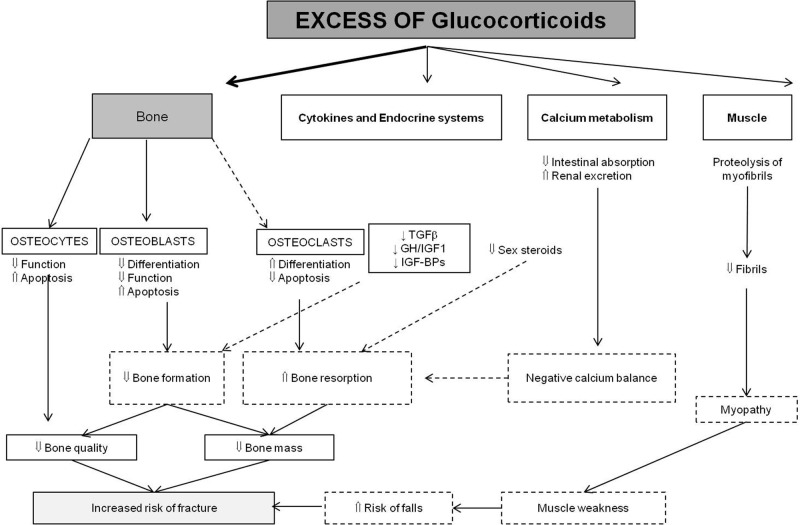
Corticosteroid-induced osteoporosis is the most common form of secondary osteoporosis and the first cause in young people. Bone loss and increased rate of fractures occur early after the initiation of corticosteroid therapy, and are then related to dosage and treatment duration. The increase in fracture risk is not fully assessed by bone mineral density measurements, as it is also related to alteration of bone quality and increased risk of falls. In patients with rheumatoid arthritis, a treat-to-target strategy focusing on low disease activity including through the use of low dose of prednisone, is a key determinant of bone loss prevention. Bone loss magnitude is variable and there is no clearly identified predictor of the individual risk of fracture. Prevention or treatment of osteoporosis should be considered in all patients who receive prednisone. Bisphosphonates and the anabolic agent parathyroid hormone (1-34) have shown their efficacy in the treatment of corticosteroid-induced osteoporosis. Recent international guidelines are available and should guide management of corticosteroid-induced osteoporosis, which remains under-diagnosed and under-treated. Duration of antiosteoporotic treatment should be discussed at the individual level, depending on the subject's characteristics and on the underlying inflammation evolution.
Overview
The claims and statistics of this paper haven’t been checked yet.
Free: it reads the open-access text and checks the first 5 claims that cite a source we can check. Create a free account to check every claim.
Integrity signals
Registry
Cites
Statistics
Figures
Verification
Claims the paper makes
The claims and statistics of this paper haven’t been checked yet.
Free: it reads the open-access text and checks the first 5 claims that cite a source we can check. Create a free account to check every claim.
Claims other papers make about this one
Each is checked against this paper’s own text: does it say what the citing paper says it does?
The source backs part of the claim, not all of it — or backs it for a different population, condition or comparison.
In the citing paper
“These compounds stimulate bone resorption and reduce bone formation by inhibiting osteoblast proliferation and differentiation and by promoting apoptosis of osteoblasts and osteocytes [1,151,152].”
From Bone diseases in patients with chronic liver disease (2019) · cites this paper as [151]
Experimental — accuracy not yet measuredThe source backs part of the claim, not all of it — or backs it for a different population, condition or comparison.
In the citing paper
“Notably, the immunosuppressive drugs used after LT are also an important factor [136,150,151,152].”
From Bone diseases in patients with chronic liver disease (2019) · cites this paper as [151]
Experimental — accuracy not yet measuredIn the citing paper
“Specifically, glucocorticoids play a pivotal role [151,152].”
From Bone diseases in patients with chronic liver disease (2019) · cites this paper as [151]
Self-check
Percentages, sums and reported differences re-computed from the paper’s own numbers.
The self-check needs the paper’s full text.
Citations
Cites
Kong, Y.-Y., Feige, U., Sarosi, I., Bolon, B., Tafuri, A., Morony, S., Capparelli, C., Li, J., Elliott, R., McCabe, S., et al. (1999) · Nature · doi:10.1038/46303 · Cited by 1,856
Weinstein, R. S., Jilka, R. L., Parfitt, A. M., & Manolagas, S. C. (1998) · Journal of Clinical Investigation · doi:10.1172/jci2799 · Cited by 1,753
Sato, K., Suematsu, A., Okamoto, K., Yamaguchi, A., Morishita, Y., Kadono, Y., Tanaka, S., Kodama, T., Akira, S., Iwakura, Y., et al. (2006) · The Journal of Experimental Medicine · doi:10.1084/jem.20061775 · Cited by 1,554
Lam, J., Takeshita, S., Barker, J. E., Kanagawa, O., Ross, F. P., & Teitelbaum, S. L. (2000) · Journal of Clinical Investigation · doi:10.1172/jci11176 · Cited by 1,440
Use of Inhaled Corticosteroids and Risk of Fractures
Van Staa, T. P., Leufkens, H. G. M., & Cooper, C. (2001) · Journal of Bone and Mineral Research · doi:10.1359/jbmr.2001.16.3.581 · Cited by 1,308
The epidemiology of corticosteroid-induced osteoporosis: a meta-analysis
Staa, T. P. V., Staa, T. P. V., Staa, T. P. V., Leufkens, H. G. M., & Cooper, C. (2002) · Osteoporosis International · doi:10.1007/s001980200108 · Cited by 1,294
Use of oral corticosteroids and risk of fractures
Van Staa, T. P., Leufkens, H. G. M., Abenhaim, L., Zhang, B., & Cooper, C. (2000) · Journal of Bone and Mineral Research · doi:10.1359/jbmr.2000.15.6.993 · Cited by 1,263
Alendronate for the Prevention and Treatment of Glucocorticoid-Induced Osteoporosis
Saag, K. G., Emkey, R., Schnitzer, T. J., Brown, J. P., Hawkins, F., Goemaere, S., Thamsborg, G., Liberman, U. A., Delmas, P. D., Malice, M.-P., et al. (1998) · New England Journal of Medicine · doi:10.1056/nejm199807303390502 · Cited by 1,258
Glucocorticoid-induced osteoporosis: pathophysiology and therapy
Canalis, E., Mazziotti, G., Giustina, A., & Bilezikian, J. P. (2007) · Osteoporosis International · doi:10.1007/s00198-007-0394-0 · Cited by 1,114
Teriparatide or Alendronate in Glucocorticoid-Induced Osteoporosis
Saag, K. G., Shane, E., Boonen, S., Marín, F., Donley, D. W., Taylor, K. A., Dalsky, G. P., & Marcus, R. (2007) · New England Journal of Medicine · doi:10.1056/nejmoa071408 · Cited by 914
Cited by
Kenkre, J., & Bassett, J. (2018) · Annals of Clinical Biochemistry: International Journal of Laboratory Medicine · doi:10.1177/0004563218759371 · Cited by 693
Pathogenesis of glucocorticoid-induced osteoporosis and options for treatment
Chotiyarnwong, P., & McCloskey, E. V. (2020) · Nature Reviews Endocrinology · doi:10.1038/s41574-020-0341-0 · Cited by 489
Advances in pathogenesis and therapeutic strategies for osteoporosis
Song, S., Guo, Y., Yang, Y., & Fu, D. (2022) · Pharmacology & Therapeutics · doi:10.1016/j.pharmthera.2022.108168 · Cited by 476
Bisphosphonates for steroid-induced osteoporosis
Allen, C. S., Yeung, J. H., Vandermeer, B., & Homik, J. (2016) · Cochrane Database of Systematic Reviews · doi:10.1002/14651858.cd001347.pub2 · Cited by 248
Treating the Side Effects of Exogenous Glucocorticoids; Can We Separate the Good From the Bad?
Pofi, R., Caratti, G., Ray, D. W., & Tomlinson, J. W. (2023) · Endocrine Reviews · doi:10.1210/endrev/bnad016 · Cited by 209
Metadata
- Authors
- Briot, K., & Roux, C.
- Affiliations
- Inserm (FR)
- Corresponding author
- Roux, Christian
- Venue
- RMD Open
- Publisher
- BMJ
- Published
- 2015-04
- Volume
- 1
- Issue
- 1
- Pages
- e000014
- ISSN
- 2056-5933 (ISSN-L)
- PMC
- PMC4613168
- OpenAlex
- W2093023229
- Cited by
- 300
- References
- 84
- Citations by year
- 2026: 9 · 2025: 21 · 2024: 31 · 2023: 33 · 2022: 35 · 2021: 42 · 2020: 41 · 2019: 33 · 2018: 23 · 2017: 16 · 2016: 12 · 2015: 3
- FWCI
- 2.99
- Type
- journal article
- Language
- en
- Open access
- gold
- doi.org
- Licence
- cc-by-nc
- Locations
- RMD Open (publishedVersion, cc-by-nc)
- PubMed Central (publishedVersion, cc-by-nc)
- PubMed (publishedVersion)
- Topics
- Health Sciences › Medicine › Orthopedics and Sports Medicine › Bone health and osteoporosis research
- Health Sciences › Medicine › Oncology › Bone health and treatments
- Life Sciences › Biochemistry, Genetics and Molecular Biology › Molecular Biology › Bone Metabolism and Diseases
- Keywords
- glucocorticoid-induced osteoporosis, corticosteroid-induced osteoporosis, secondary osteoporosis, bone loss, fracture risk, bone mineral density, bone quality, falls, rheumatoid arthritis, prednisone, treat-to-target, bisphosphonates, parathyroid hormone (1-34), youth
About these checks
Registry, retraction, Cites and statistics results are computed, not judged, with one exception: a printed reference that no index lists is read once by a model before it counts as a citation error. Claims are extracted by a model and kept only when their quote appears verbatim in the text; each cited source is then checked, with a model’s help, for whether it says what the claim relies on. Those verdicts can be wrong — read the claim’s quote and the cited source before relying on one.
Statistics and arithmetic are recomputed, not judged.
Confidence bands are shown only for fields calibrated on our annotated test set. None is calibrated yet, so no band is shown.
What counts as a claim ›How we measure confidence ›How we check this ›
Are you an author, or do you see a problem with this page? Request a review
How to cite
Cite CoChat for the checks on this page, and the paper for its own findings.
- This page
- CoChat. (2026). Citation check: Glucocorticoid-induced osteoporosis. https://app.cochat.ai/papers/10.1136/rmdopen-2014-000014
- The paper
- Briot, K., & Roux, C. (2015). Glucocorticoid-induced osteoporosis. RMD Open. https://doi.org/10.1136/rmdopen-2014-000014
Data sources
Bibliographic data: Semantic Scholar, OpenAlex, Crossref.
Contains information from the Semantic Scholar Academic Graph Datasets, made available under the ODC Attribution License (ODC-BY 1.0).
Semantic Scholar’s data is described in: Kinney, R., et al. (2023). The Semantic Scholar Open Data Platform. arXiv:2301.10140.
