

Do not attempt cardiopulmonary resuscitation decision-making process: scoping review
Open accessThe DOI matches its Crossref record; 90 of the 95 references it cites were found in a registry or an index; 54 of the 106 sources its claims cite were checked for support.
Abstract
OBJECTIVES: To conduct a scoping review to explore the evidence of the process of do not attempt cardiopulmonary resuscitation (DNACPR) decision-making.
Overview
CoChat Summary
## TL;DR
This scoping review mapped evidence on DNACPR decision-making across 58 studies published from 1 January 2013 to 6 April 2023. It found that DNACPR decision-making is shaped by timing, communication, patient/family involvement, documentation, policy, and legal/ethical context, with barriers often outweighing facilitators.
## Key findings
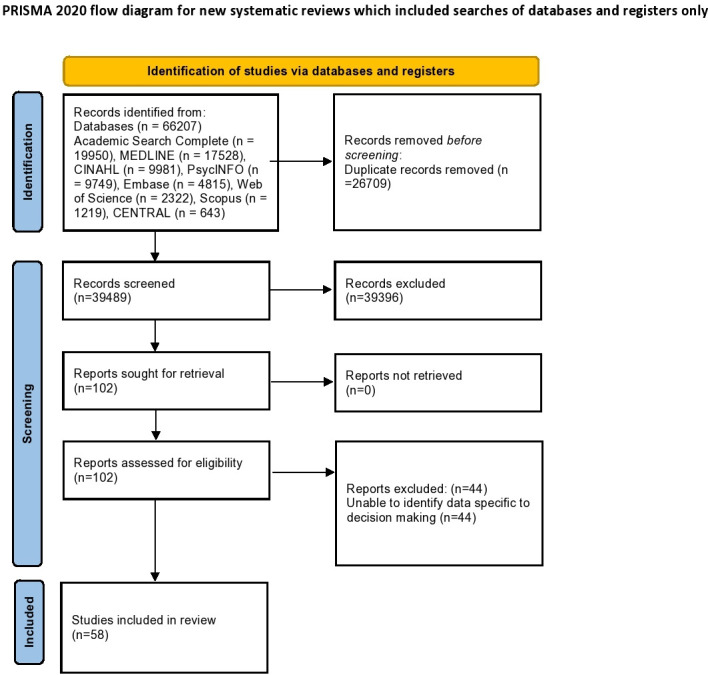
- The review screened 66,207 search results and included 58 papers; these were 36 quantitative, 19 qualitative, and 3 mixed-methods studies across 20 countries.
- Evidence of discussion with the patient or those close to the patient was reported in 68.7% of cases, while patient involvement in decision-making was reported between 33% and 55.8% across studies.
- Documentation of DNACPR decisions varied widely, from 19% to 93.9%; one study reported that 71.9% of patients’ records did not document medically ordered DNACPR decisions, and another found a 23.7% disagreement between preference and documented code status.
- Barriers included timing/time pressure, weak communication, patient/family input problems, conflicts, and ethical uncertainty; facilitators included ongoing conversation, protected time, flexible documentation, clear policy, and communication support.
## Methods
- Scoping review using the Arksey and O’Malley six-step framework, with narrative reporting plus tables; no quality appraisal was conducted.
- Searched eight databases (Academic Search Complete, CINAHL, Cochrane, EMBASE, MEDLINE, PsycINFO, Scopus, Web of Science) for articles from 1 January 2013 to 6 April 2023.
- Search results were screened by paired reviewers in Covidence; data were charted and content-analyzed against six questions: timing, involvement, discussion, documentation, communication/adherence, and recommendations.
## Limitations
- The authors state that no quality appraisal was conducted, so the review offers only a descriptive account of the available information.
- The authors note that greater patient and public involvement “may have strengthened the review” through stakeholder engagement.
- The paper states that searching eight databases is both a strength and a limitation because it may have affected inclusion/exclusion of low-income and middle-income countries and secondary data.
Model-written summary. Check it against the paper before relying on it.
Integrity signals
Registry
Cites
Statistics
Figures
Verification
Claims the paper makes
39 Valid · 5 Not valid · 40 Not checked · 15 Own results and interpretations
The cited sources that could be checked couldn’t confirm or dispute this claim.
In the paper
“Cardiopulmonary resuscitation (CPR) offers the potential to save a person’s life, but in reality, the likelihood of success is generally low for both in-hospital and out-of-hospital cardiac arrest.14”
§ Do not attempt cardiopulmonary resuscitation decision-making process: scoping review > Introduction Cardiopulmonary resuscitation (CPR) offers the potential to save a person’s life, but in reality, the likelihood of success is generally low for both in-hospital and out-of-hospital cardiac arrest.14 Many people tend to overestimate the effectiveness of the practice and may not be aware of the potential for significant injury to the recipient which, in turn, may deprive the person of a dignified death.5 6 Injuries may include rib fractures, sternal fractures, as well as cardiac, pulmonary or intra-abdominal organ injuries.79 Given the potential for serious consequences, it is necessary to ensure that the decision-making process reflects the person’s wishes and is effective and appropriate. The initiation of the do not attempt cardiopulmonary resuscitation (DNACPR) decision-making process may occur when there is clinical evidence that CPR would be futile, that resulting harm would outweigh potential benefits or if a patient refuses CPR treatment. DNACPR decisions do not however involve decisions about acute life-saving treatments.10 In addition to clinical considerations, the decision-making process is underpinned by human rights and respect for decision-making capacity. From a human rights perspective, rights such as the right to life, the right to be free from inhuman and degrading treatment, and the right to autonomy should guide the DNACPR decision-making process. In relation to mental capacity, one must assume that all adults can make their own decisions unless a capacity assessment shows otherwise. Based on this framework, national guidelines and policies have been developed across countries which describe the context, setting and process for informed decision-making for DNACPR decisions. However, evidence on the decision-making process is lacking and variations exist across cultures, countries and health conditions. In this respect, the focus of this paper is to conduct a scoping review to explore the evidence of the process of DNACPR decision-making.
What the sources say
- Could not verifycites [14] Tricco AC Lillie E Zarin W et al PRISMA extension for scoping reviews (PRISMA-SCR): checklist and explanation Ann Intern Med 2018 169 467 73 10.7326/M18-0850 30178033 sourceExperimental — accuracy not yet measured
The Discussion describes dissemination of the PRISMA-ScR reporting guideline, and the checklist addresses scoping-review methods. Searches for CPR, cardiac arrest, and survival rates found no passage in our copy addressing resuscitation success in either in-hospital or out-of-hospital settings. (LLM, conf=0.78)
plain- Asserted: passes — The authors put it forward as true.
- Checkable: passes — It can be checked against evidence.
- Load-bearing: passes — The paper’s conclusions depend on it.
- Based: passes — The paper gives a reason why it holds.
- Could not verify
Every source the paper cites for this claim was checked and supports it.
In the paper
“Only a minority of participants (9.3% of junior paediatricians vs 12.5% of senior paediatrician) reported that they would be comfortable discussing DNACPR with parents.48”
§ Do not attempt cardiopulmonary resuscitation decision-making process: scoping review > Results > Evidence of involvement Patient involvement in the decision-making process was reported between 33% and 55% of the time; 33%,28 48%,22 52.8%44 and 55.8%.45 Almost half of the respondents in one study reported that it was not likely that the patient would be involved in the decision on DNACPR46; while in another study 66% of decisions were made by the medical team without asking the patient or those close to the patient.26 DNACPR decisions were dominated by the belief that patient inclusion is often pointless.19 Patients’ mental or cognitive function was seen as the most important barrier to their involvement in resuscitation decisions.47 Other reasons for lack of involvement were down to physicians’ abilities to communicate with patients/surrogate decision-makers about DNACPR decision-making; 15% of physicians prefer to discuss the topic only if the patients/surrogate decision-makers bring it up.33 Only a minority of participants (9.3% of junior paediatricians vs 12.5% of senior paediatrician) reported that they would be comfortable discussing DNACPR with parents.48 General practitioners felt they should discuss the decision with the patient, but they have anxieties around this.41 Patients who were cared for by a family medical physician prior to death at last hospitalisation and those who had received hospice palliative care were more likely to have signed a DNACPR letter of intent.35 Getting to know the patient and developing a rapport are crucial factors in feeling confident to have the DNACPR conversation.49 Doctors acknowledged the need to involve patients and/or those close to the patient in resuscitation decisions, but there were occasions when this did not occur. Doctors hold varying perspectives about what involvement requires.50 General practitioners vary widely in how much they guide patients and those close to the patient in decision-making41; 69% of resident physicians who were unwilling to offer a DNACPR recommendation stated that the need for patient autonomy prevented them from providing guidance.51 Nonetheless, many CPR/DNACPR conversations are characterised by a nudging communicative approach where the physician pushes patients to their recommendation, despite the belief that conversations should be as neutral as possible.19 Discussions with the patient or those close to the patient from a goal-of-care perspective took place with a focus on comfort care without explicitly mentioning resuscitation.52
What the sources say
- Supportedcites [48] Aljethaily A Al-Mutairi T Al-Harbi K et al Pediatricians’ perceptions toward do not resuscitate: a survey in Saudi Arabia and literature review Adv Med Educ Pract 2020 11 1 8 10.2147/AMEP.S228399 32021536 PMC6954090 source
The Discussion states that only 9.3% of junior pediatricians and 12.5% of senior pediatricians reported being comfortable discussing DNR with parents. The Results table identifies these percentages as those who felt *very* comfortable; the claim otherwise matches the paper’s own summary. (LLM, conf=0.95)
plain- Asserted: passes — The authors put it forward as true.
- Checkable: passes — It can be checked against evidence.
- Load-bearing: unclear — It is unclear whether the paper’s conclusions depend on it.
- Based: passes — The paper gives a reason why it holds.
- Supported
The sources with a verdict support this claim; the rest weren’t checked yet, have no full text we could read, or their verdicts aren’t rated yet.
In the paper
“Patient involvement in the decision-making process was reported between 33% and 55% of the time; 33%,28 48%,22 52.8%44 and 55.8%.45”
§ Do not attempt cardiopulmonary resuscitation decision-making process: scoping review > Results > Evidence of involvement Patient involvement in the decision-making process was reported between 33% and 55% of the time; 33%,28 48%,22 52.8%44 and 55.8%.45 Almost half of the respondents in one study reported that it was not likely that the patient would be involved in the decision on DNACPR46; while in another study 66% of decisions were made by the medical team without asking the patient or those close to the patient.26 DNACPR decisions were dominated by the belief that patient inclusion is often pointless.19 Patients’ mental or cognitive function was seen as the most important barrier to their involvement in resuscitation decisions.47 Other reasons for lack of involvement were down to physicians’ abilities to communicate with patients/surrogate decision-makers about DNACPR decision-making; 15% of physicians prefer to discuss the topic only if the patients/surrogate decision-makers bring it up.33 Only a minority of participants (9.3% of junior paediatricians vs 12.5% of senior paediatrician) reported that they would be comfortable discussing DNACPR with parents.48 General practitioners felt they should discuss the decision with the patient, but they have anxieties around this.41 Patients who were cared for by a family medical physician prior to death at last hospitalisation and those who had received hospice palliative care were more likely to have signed a DNACPR letter of intent.35 Getting to know the patient and developing a rapport are crucial factors in feeling confident to have the DNACPR conversation.49 Doctors acknowledged the need to involve patients and/or those close to the patient in resuscitation decisions, but there were occasions when this did not occur. Doctors hold varying perspectives about what involvement requires.50 General practitioners vary widely in how much they guide patients and those close to the patient in decision-making41; 69% of resident physicians who were unwilling to offer a DNACPR recommendation stated that the need for patient autonomy prevented them from providing guidance.51 Nonetheless, many CPR/DNACPR conversations are characterised by a nudging communicative approach where the physician pushes patients to their recommendation, despite the belief that conversations should be as neutral as possible.19 Discussions with the patient or those close to the patient from a goal-of-care perspective took place with a focus on comfort care without explicitly mentioning resuscitation.52
What the sources say
- Supportedcites [28] Abe A Kobayashi M Kohno T et al Patient participation and associated factors in the discussions on do-not-attempt-resuscitation and end-of-life disclosure: a retrospective chart review study BMC Palliat Care 2021 20 6 10.1186/s12904-020-00698-8 33407388 PMC7789264 source
The Results section (Discussions on CPR/DNAR; page not provided) reports that 112 of 336 patients, or 33.3%, participated in CPR/DNAR discussions. This supports the 33% figure attached to this source; the other percentages in the citing sentence have separate citations. (LLM, conf=0.93)
- Supportedcites [22] Hendriks VJJ Faes MC van der Meer JBL et al Shared decision-making in advance care planning among hospitalized older COVID-19 patients: a multicenter, retrospective cohort study Aging Clin Exp Res 2022 34 3165 9 10.1007/s40520-022-02281-y 36334244 PMC9638468 source
The Results (Table 3) report that patient participation in the code-status decision-making process was documented in 48% of cases. This supports the 48% figure attributed to this source in the citing sentence; the study considered code status broadly, including resuscitation decisions. (LLM, conf=0.92)
- Not checked — no full text of the sourcecites [44] Hurst SA Becerra M Perrier A et al Including patients in resuscitation decisions in Switzerland: from doing more to doing better J Med Ethics 2013 39 158 65 10.1136/medethics-2012-100699 23139391 source
plain- Asserted: passes — The authors put it forward as true.
- Checkable: passes — It can be checked against evidence.
- Load-bearing: unclear — It is unclear whether the paper’s conclusions depend on it.
- Based: passes — The paper gives a reason why it holds.
- Supported
Every source the paper cites for this claim was checked and supports it.
In the paper
“Nonetheless, many CPR/DNACPR conversations are characterised by a nudging communicative approach where the physician pushes patients to their recommendation, despite the belief that conversations should be as neutral as possible.19”
§ Do not attempt cardiopulmonary resuscitation decision-making process: scoping review > Results > Evidence of involvement Patient involvement in the decision-making process was reported between 33% and 55% of the time; 33%,28 48%,22 52.8%44 and 55.8%.45 Almost half of the respondents in one study reported that it was not likely that the patient would be involved in the decision on DNACPR46; while in another study 66% of decisions were made by the medical team without asking the patient or those close to the patient.26 DNACPR decisions were dominated by the belief that patient inclusion is often pointless.19 Patients’ mental or cognitive function was seen as the most important barrier to their involvement in resuscitation decisions.47 Other reasons for lack of involvement were down to physicians’ abilities to communicate with patients/surrogate decision-makers about DNACPR decision-making; 15% of physicians prefer to discuss the topic only if the patients/surrogate decision-makers bring it up.33 Only a minority of participants (9.3% of junior paediatricians vs 12.5% of senior paediatrician) reported that they would be comfortable discussing DNACPR with parents.48 General practitioners felt they should discuss the decision with the patient, but they have anxieties around this.41 Patients who were cared for by a family medical physician prior to death at last hospitalisation and those who had received hospice palliative care were more likely to have signed a DNACPR letter of intent.35 Getting to know the patient and developing a rapport are crucial factors in feeling confident to have the DNACPR conversation.49 Doctors acknowledged the need to involve patients and/or those close to the patient in resuscitation decisions, but there were occasions when this did not occur. Doctors hold varying perspectives about what involvement requires.50 General practitioners vary widely in how much they guide patients and those close to the patient in decision-making41; 69% of resident physicians who were unwilling to offer a DNACPR recommendation stated that the need for patient autonomy prevented them from providing guidance.51 Nonetheless, many CPR/DNACPR conversations are characterised by a nudging communicative approach where the physician pushes patients to their recommendation, despite the belief that conversations should be as neutral as possible.19 Discussions with the patient or those close to the patient from a goal-of-care perspective took place with a focus on comfort care without explicitly mentioning resuscitation.52
What the sources say
- Supportedcites [19] Bedulli M Falvo I Merlani P et al Obstacles to patient inclusion in CPR/DNAR decisions and challenging conversations: a qualitative study with internal medicine physicians in Southern Switzerland PLoS One 2023 18 e0282270 10.1371/journal.pone.0282270 36947569 PMC10032495 source
The Discussion describes a tension between participants’ desired non-manipulative conversation and the leading style they reported using, including nudging patients toward physicians’ preferred decisions. The Results say participants wanted to provide neutral information but reported that CPR/DNAR conversations tend to be leading. (LLM, conf=0.91)
plain- Asserted: passes — The authors put it forward as true.
- Checkable: passes — It can be checked against evidence.
- Load-bearing: unclear — It is unclear whether the paper’s conclusions depend on it.
- Based: passes — The paper gives a reason why it holds.
- Supported
Every source the paper cites for this claim was checked and supports it.
In the paper
“and the ideal timing of a DNACPR discussion may differ between patients.40”
§ Do not attempt cardiopulmonary resuscitation decision-making process: scoping review > Results > Timing of decision-making
What the sources say
- Supportedcites [40] Olver IN Eliott JA Translating into practice cancer patients’ views on do-not-resuscitate decision-making Cancers (Basel) 2016 8 89 10.3390/cancers8100089 27690104 PMC5082379 source
The Conclusions state that patients interviewed about DNR decision-making recognized that the ideal timing of a DNR discussion would differ between patients. The Discussion likewise says patients differed in their readiness for such a discussion. (LLM, conf=0.95)
hedgedstates an association- Asserted: passes — The authors put it forward as true.
- Checkable: passes — It can be checked against evidence.
- Load-bearing: unclear — It is unclear whether the paper’s conclusions depend on it.
- Based: passes — The paper gives a reason why it holds.
- Supported
36 more claims · 18 with their cited sources checked
Create a free account to see all 99 claims and to verify the 10 references still open.
- It may state two separate claims as one. 43
- Probably not a substantial claim. 24
Citations
Cites
The PRISMA 2020 statement: An updated guideline for reporting systematic reviews
Page, M. J., McKenzie, J. E., Bossuyt, P. M., Boutron, I., Hoffmann, T. C., Mulrow, C. D., Shamseer, L., Tetzlaff, J. M., Akl, E. A., Brennan, S. E., et al. (2021) · BMJ · doi:10.1136/bmj.n71 · Cited by 108,283
PRISMA Extension for Scoping Reviews (PRISMA-ScR): Checklist and Explanation
Tricco, A. C., Lillie, E., Zarin, W., O'Brien, K. K., Colquhoun, H., Levac, D., Moher, D., Peters, M. D. J., Horsley, T., Weeks, L., et al. (2018) · Annals of Internal Medicine · doi:10.7326/m18-0850 · Cited by 43,565 · cited 1×
“14 Full-text review resulted in 44 papers being excluded and 58 being included in this review.”
BackgroundScoping studies: towards a methodological framework
Arksey, H., & O'Malley, L. (2005) · International Journal of Social Research Methodology · doi:10.1080/1364557032000119616 · Cited by 36,742
Scoping studies: advancing the methodology
Levac, D., Colquhoun, H., & O'Brien, K. K. (2010) · Implementation Science · doi:10.1186/1748-5908-5-69 · Cited by 15,268
Qualitative descriptive methods in health science research
Colorafi, K. J., & Evans, B. (2016) · HERD: Health Environments Research & Design Journal · doi:10.1177/1937586715614171 · Cited by 1,423
The Royal College of General Practitioners
Fry, J. (1983) · Present State and Future Needs in General Practice · doi:10.1007/978-94-011-7304-9_14 · Cited by 1,317 · cited 1×
“85 A recent development has occurred in Wales where a competency framework is being developed by health boards, trusts and partner organisations to support healthcare professionals in receiving appropriate training and preparation to discuss, complete and sign DNACPR forms.”
BackgroundPrinciples of Clinical Ethics and Their Application to Practice
Varkey, B. (2021) · Medical Principles and Practice · doi:10.1159/000509119 · Cited by 1,171 · cited 1×
“80 Variations can be found across countries and, for some, involving the patient and those close to the patient in decision-making is socially and culturally unacceptable.”
Yan, S., Gan, Y., Jiang, N., Wang, R., Chen, Y., Luo, Z., Zong, Q., Chen, S., & Lv, C. (2020) · Critical Care · doi:10.1186/s13054-020-2773-2 · Cited by 978
European Resuscitation Council Guidelines 2021: Epidemiology of cardiac arrest in Europe
Gräsner, J.-T., Herlitz, J., Tjelmeland, I. B. M., Wnent, J., Masterson, S., Lilja, G., Bein, B., Böttiger, B. W., Rosell-Ortiz, F., Nolan, J. P., et al. (2021) · Resuscitation · doi:10.1016/j.resuscitation.2021.02.007 · Cited by 745
Westphaln, K. K., Regoeczi, W., Masotya, M., Vazquez-Westphaln, B., Lounsbury, K., McDavid, L., Lee, H., Johnson, J., & Ronis, S. D. (2021) · MethodsX · doi:10.1016/j.mex.2021.101375 · Cited by 333
Skeletal chest injuries secondary to cardiopulmonary resuscitation
Hoke, R. S., & Chamberlain, D. (2004) · Resuscitation · doi:10.1016/j.resuscitation.2004.05.019 · Cited by 276
Relational autonomy in end-of-life care ethics: a contextualized approach to real-life complexities
Gómez-Vírseda, C., Maeseneer, Y. D., & Gastmans, C. (2020) · BMC Medical Ethics · doi:10.1186/s12910-020-00495-1 · Cited by 215 · cited 1×
“75 76 This is not a homogeneous concept as the ethical basis for autonomy is varied, and there are a multitude of perspectives on autonomy.”
A systematic review and pooled analysis of CPR-associated cardiovascular and thoracic injuries
Miller, A. C., Rosati, S. F., Suffredini, A. F., & Schrump, D. S. (2014) · Resuscitation · doi:10.1016/j.resuscitation.2014.01.028 · Cited by 168
Mockford, C., Fritz, Z., George, R., Court, R., Grove, A., Clarke, B., Field, R., & Perkins, G. D. (2015) · Resuscitation · doi:10.1016/j.resuscitation.2014.11.016 · Cited by 144
Restorative Design Features for Hospital Staff Break Areas: A Multi-Method Study
Nejati, A., Shepley, M., Rodiek, S., Lee, C., & Varni, J. (2016) · HERD: Health Environments Research & Design Journal · doi:10.1177/1937586715592632 · Cited by 139
Dzeng, E., Colaianni, A., Roland, M., Chander, G., Smith, T. J., Kelly, M. P., Barclay, S., & Levine, D. (2015) · JAMA Internal Medicine · doi:10.1001/jamainternmed.2015.0295 · Cited by 136 · cited 2×
“52”
Increasing use of DNR orders in the elderly worldwide: whose choice is it?
Cherniack, E. P. (2002) · Journal of Medical Ethics · doi:10.1136/jme.28.5.303 · Cited by 103 · cited 1×
“35 83 Such an approach reinforces the move towards personalised medicine, where the care provider–patient relationship has changed from medical paternalism to an autonomy-based relationship, in which patient participation in decision-making is a responsibility.”
El-Jawahri, A., Mitchell, S. L., Paasche-Orlow, M. K., Temel, J. S., Jackson, V. A., Rutledge, R. R., Parikh, M., Davis, A. D., Gillick, M. R., Barry, M. J., et al. (2015) · Journal of General Internal Medicine · doi:10.1007/s11606-015-3200-2 · Cited by 95 · cited 1×
“29 El-Jawahri et al 59 recommended a video decision support tool.”
Do-not-attempt-cardiopulmonary-resuscitation decisions: an evidence synthesis
Perkins, G. D., Griffiths, F., Slowther, A.-M., George, R., Fritz, Z., Satherley, P., Williams, B., Waugh, N., Cooke, M. W., Chambers, S., et al. (2016) · Health Services and Delivery Research · doi:10.3310/hsdr04110 · Cited by 91
Einstein, D. J., Einstein, K. L., & Mathew, P. (2015) · Journal of Palliative Medicine · doi:10.1089/jpm.2014.0373 · Cited by 47 · cited 3×
“Aljohaney and Bawazir 72 recommended an evidence-based curriculum providing instruction for improving discussion and Chen et al, 33 35 Einstein et al , 51 El Sayed et al 67 and Fan and Hsieh 36 all highlight the need for training to enhance communication skills.”
Pettersson, M., Höglund, A. T., & Hedström, M. (2018) · PLOS ONE · doi:10.1371/journal.pone.0206550 · Cited by 43 · cited 2×
“46 Among practitioners, 46.7% of respondents reported they were likely, or very likely, to share prognostic information.”
InfluentialIncluding patients in resuscitation decisions in Switzerland: from doing more to doing better
Hurst, S. A., Becerra, M., Perrier, A., Perron, N. J., Cochet, S., & Elger, B. (2013) · Journal of Medical Ethics · doi:10.1136/medethics-2012-100699 · Cited by 41
Bringing into focus treatment limitation and DNACPR decisions: How COVID-19 has changed practice
Coleman, J. J., Botkai, A., Marson, E. J., Evison, F., Atia, J., Wang, J., Gallier, S., Speakman, J., & Pankhurst, T. (2020) · Resuscitation · doi:10.1016/j.resuscitation.2020.08.006 · Cited by 39 · cited 3×
“24 However, ethical attitudes toward DNACPR decision-making reflect hospital policy regarding prioritisation of autonomy over best interests, 52 and resources such as ethics consultation should be used.”
Liu, S., Lin, H., Lu, F. L., & Lee, T. (2013) · Asian Nursing Research · doi:10.1016/j.anr.2013.12.002 · Cited by 37
Taubert, M., Norris, J., Edwards, S., Snow, V., & Finlay, I. G. (2018) · BMC Palliative Care · doi:10.1186/s12904-018-0370-9 · Cited by 37
Personalized medicine, digital technology and trust: a Kantian account
Myskja, B. K., & Steinsbekk, K. S. (2020) · Medicine, Health Care and Philosophy · doi:10.1007/s11019-020-09974-z · Cited by 37 · cited 1×
“84 What is evident is that variations in understanding, application and process exist and that conversations remain an important part of decision-making.”
Freeman, K., Field, R. A., & Perkins, G. D. (2015) · BMJ Open · doi:10.1136/bmjopen-2014-006517 · Cited by 35
Fan, S.-Y., Wang, Y.-W., & Lin, I.-M. (2018) · BMC Palliative Care · doi:10.1186/s12904-018-0367-4 · Cited by 35 · cited 1×
“36 However, conversations need to be held when the patient is healthy, 34 they need to be ongoing so a process occurs over time rather than as a single event, 43 yet standardising the timing and format of DNACPR discussion to fit hospital culture may distress patients.”
Themes and variations: An exploratory international investigation into resuscitation decision-making
Gibbs, A. J. O., Malyon, A. C., & Fritz, Z. B. M. (2016) · Resuscitation · doi:10.1016/j.resuscitation.2016.01.020 · Cited by 33
Odhiambo, J. F., Pankey, C. L., Ghnenis, A. B., & Ford, S. P. (2020) · International Journal of Environmental Research and Public Health · doi:10.3390/ijerph17186926 · Cited by 32
End-of-life care in Toronto neonatal intensive care units: challenges for physician trainees
Sayed, M. F. E., Chan, M., McAllister, M. A., & Hellmann, J. (2013) · Archives of Disease in Childhood Fetal & Neonatal · doi:10.1136/archdischild-2012-303000 · Cited by 31 · cited 2×
“Aljohaney and Bawazir 72 recommended an evidence-based curriculum providing instruction for improving discussion and Chen et al, 33 35 Einstein et al , 51 El Sayed et al 67 and Fan and Hsieh 36 all highlight the need for training to enhance communication skills.”
BackgroundUr Rahman, M., Abuhasna, S., & Abu-Zidan, F. (2014) · African Health Sciences · doi:10.4314/ahs.v13i4.5 · Cited by 29 · cited 1×
“Typically, end- of-life issues were identified as being discussed prior to becoming severely ill, 31 being informed of a poor prognosis and/or referred for palliative care, 32 having 4–6 months to live, 33 disease progressed to terminal stage, 34 last week of life, 35 health deteriorated, 36–39…”
BackgroundHolland, C. L., Bowker, L. K., & Myint, P. K. (2013) · International Journal of Clinical Practice · doi:10.1111/ijcp.12067 · Cited by 28 · cited 2×
“47 Practitioners may not discuss resuscitation decisions if they believe that it would be distressing or the person lacks capacity 47 ; general practitioners feel they should discuss the decision with patients who have capacity but are fearful of removing hope.”
DNR and COVID-19: the ethical dilemma and suggested solutions
Sultan, H., Mansour, R., Shamieh, O., Al-Tabba', A., & Al-Hussaini, M. (2021) · Frontiers in Public Health · doi:10.3389/fpubh.2021.560405 · Cited by 28 · cited 1×
“81 82 In discussions, practitioners must consider the patient’s knowledge, values and preferences in reaching a consensus.”
Uninformed consent: Do medicine residents lack the proper framework for code status discussions?
Binder, A. F., Huang, G. C., & Buss, M. K. (2015) · Journal of Hospital Medicine · doi:10.1002/jhm.2497 · Cited by 27 · cited 1×
“Binder et al 70 set out that framing these discussions as an example of informed consent may be an effective strategy to educate people and to improve the quality of the discussion.”
Code status discussions in medical inpatients: results of a survey of patients and physicians
Becker, C., Kuenzli, N., Perrig, S., Beck, K., Vincent, A., Widmer, M., Thommen, E., Schaefert, R., Bassetti, S., & Hunziker, S. (2020) · Swiss Medical Weekly · doi:10.4414/smw.2020.20194 · Cited by 26 · cited 3×
“29 El-Jawahri et al 59 recommended a video decision support tool.”
InfluentialBrännström, M., & Jaarsma, T. (2014) · Scandinavian Journal of Caring Sciences · doi:10.1111/scs.12174 · Cited by 25 · cited 2×
“36 However, conversations need to be held when the patient is healthy, 34 they need to be ongoing so a process occurs over time rather than as a single event, 43 yet standardising the timing and format of DNACPR discussion to fit hospital culture may distress patients.”
O’Brien, H., Scarlett, S., Brady, A., Harkin, K., Kenny, R. A., & Moriarty, J. (2018) · Journal of Medical Ethics · doi:10.1136/medethics-2016-103986 · Cited by 24 · cited 1×
“27 More broadly, Abe et al , 28 Becker et al 29 and Choi et al 30 identify DNACPR decisions within the hospitalisation period, while Abe et al 28 identified 9.2% of discussions as occurring during an outpatient visit.”
BackgroundInfluentialCheng, Y.-H., Wang, J.-J., Wu, K.-H., Huang, S., Kuo, M. L., & Su, C.-H. (2016) · Supportive Care in Cancer · doi:10.1007/s00520-015-2971-7 · Cited by 21 · cited 1×
“On the issue of timing, the early initiation of DNACPR discussions was recommended by Abe et al , 28 Cheng et al , 21 Coleman et al 24 and Einstein et al .”
BackgroundThe Experience of Do-Not-Resuscitate Orders and End-of-Life Care Discussions among Physicians
Fan, S., & Hsieh, J. (2020) · International Journal of Environmental Research and Public Health · doi:10.3390/ijerph17186869 · Cited by 21 · cited 5×
“25 However, if patients and those close to the patient would not accept a DNACPR order, CPR was given till the patient’s death based on the applicable law 36 ; where patients expressed their agreement clearly, the DNACPR order was adhered to in order to respect their autonomy.”
InfluentialContemporary European Perspectives on the Ethics of End of Life Care
(2020) · Philosophy and medicine · doi:10.1007/978-3-030-40033-0 · Cited by 20
Jordanian critical care nurses' attitudes toward and experiences of do not resuscitate orders
Khalaileh, M. A. (2014) · International Journal of Palliative Nursing · doi:10.12968/ijpn.2014.20.8.403 · Cited by 19 · cited 3×
“39 81% preferred a coding system to a written statement 60 and it was recommended that the form for recording the instructions on DNACPR should be flexible enough to accommodate a spectrum of possibilities.”
Batten, J. N., Blythe, J. A., Wieten, S., Cotler, M. P., Kayser, J. B., Porter-Williamson, K., Harman, S., Dzeng, E., & Magnus, D. (2021) · BMJ Quality & Safety · doi:10.1136/bmjqs-2020-011222 · Cited by 19 · cited 1×
“…design of hospital code status options which may contribute to known variability in end- of-life care and treatment intensity among USA hospitals 66 and data supports the idea that Qualitative & mixed methods clinicians followed the recommendations to initiate treatment limitation conversations.”
Sterie, A., Jones, L., Jox, R. J., & Rubli Truchard, E. (2021) · Health Expectations · doi:10.1111/hex.13212 · Cited by 19
Chen, R.-Y., Li, Y.-C., Hsueh, K.-C., Wang, F.-W., Chen, H.-J., & Huang, T.-Y. (2022) · BMC Palliative Care · doi:10.1186/s12904-022-01037-9 · Cited by 19 · cited 5×
“Aljohaney and Bawazir 72 recommended an evidence-based curriculum providing instruction for improving discussion and Chen et al, 33 35 Einstein et al , 51 El Sayed et al 67 and Fan and Hsieh 36 all highlight the need for training to enhance communication skills.”
BackgroundInfluentialWagemans, A. M. A., van Schrojenstein Lantman‐de Valk, H. M. J., Proot, I. M., Bressers, A. M., Metsemakers, J., Tuffrey‐Wijne, I., Groot, M., & Curfs, L. M. G. (2017) · Journal of Intellectual Disability Research · doi:10.1111/jir.12333 · Cited by 18 · cited 2×
“…ill, 31 being informed of a poor prognosis and/or referred for palliative care, 32 having 4–6 months to live, 33 disease progressed to terminal stage, 34 last week of life, 35 health deteriorated, 36–39 person moving to a residential setting, 39 at a care plan meeting 39 and inpatient discharge.”
BackgroundAbe, A., Kobayashi, M., Kohno, T., Takeuchi, M., Hashiguchi, S., Mimura, M., & Fujisawa, D. (2021) · BMC Palliative Care · doi:10.1186/s12904-020-00698-8 · Cited by 18 · cited 3×
“When the patient was absent from the DNACPR discussion, decisions were made by those close to the patient based on discussion with the physician 28 or by a senior doctor, with a consultant coun-tersignature.”
InfluentialChevaux, F., Gagliano, M., Waeber, G., Marques-Vidal, P., & Schwab, M. (2015) · European Journal of Internal Medicine · doi:10.1016/j.ejim.2015.04.003 · Cited by 17
Integrating a Question Prompt List on an Inpatient Oncology Unit to Increase Prognostic Awareness
McLawhorn, V., Vess, J., & Dumas, B. P. (2016) · Clinical journal of oncology nursing · doi:10.1188/16.cjon.385-390 · Cited by 16 · cited 1×
“73 Sritharan et al 74 and Chen et al 33 both draw attention to the need for education and training on legal and ethical issues for health-care professionals.”
Resuscitation decisions at the end of life: medical views and the juridification of practice
MacCormick, F. M., Emmett, C., Paes, P., & Hughes, J. C. (2018) · Journal of Medical Ethics · doi:10.1136/medethics-2017-104608 · Cited by 16
Aljohaney, A. A., & Bawazir, Y. M. (2015) · Advances in Medical Education and Practice · doi:10.2147/amep.s82948 · Cited by 15 · cited 1×
“Aljohaney and Bawazir 72 recommended an evidence-based curriculum providing instruction for improving discussion and Chen et al, 33 35 Einstein et al , 51 El Sayed et al 67 and Fan and Hsieh 36 all highlight the need for training to enhance communication skills.”
Miller, S., & Dorman, S. (2014) · Palliative Medicine · doi:10.1177/0269216314531521 · Cited by 15 · cited 2×
“41 Although there is concern about the impact of these discussions on the patient, Low et al 38 demonstrated that most patients deal with these discussions much more positively than staff anticipate.”
Chen, Y.-Y., Su, M., Huang, S.-C., Chu, T.-S., Lin, M.-T., Chiu, Y.-C., & Lin, K.-H. (2019) · BMC Medical Ethics · doi:10.1186/s12910-019-0429-z · Cited by 15 · cited 3×
“Aljohaney and Bawazir 72 recommended an evidence-based curriculum providing instruction for improving discussion and Chen et al, 33 35 Einstein et al , 51 El Sayed et al 67 and Fan and Hsieh 36 all highlight the need for training to enhance communication skills.”
BackgroundChang, H., Lin, M.-H., Chen, C.-K., Chen, T., & Hwang, S. (2020) · International Journal of Environmental Research and Public Health · doi:10.3390/ijerph17020557 · Cited by 15 · cited 1×
“68 54 Ramages and Cheung 57 highlight the importance of educating people as to the potential outcomes of resuscitation, and exploring and documenting their reasoning when discussing resuscitation preferences so that their wishes can be respected.”
BackgroundA cross-sectional investigation of communication in do-not-resuscitate orders in Dutch hospitals
Schluep, M., Hoeks, S. E., Endeman, H., IJmkers, S., Romijn, T. M. M., Alsma, J., Bosch, F. H., Cornet, A. D., Knook, A. H. M., Koopman-van Gemert, A. W. M. M., et al. (2020) · Resuscitation · doi:10.1016/j.resuscitation.2020.04.004 · Cited by 15
Ahmed, N., Lobchuk, M., HUNTER, W. M., Johnston, P., Nugent, Z. J., Sharma, A. M., Ahmed, S., & Sisler, J. (2015) · Cureus · doi:10.7759/cureus.257 · Cited by 15
Palliative care staff's perceptions of do not attempt cardiopulmonary resuscitation discussions
Low, C., Finucane, A., Mason, B., & Spiller, J. (2014) · International Journal of Palliative Nursing · doi:10.12968/ijpn.2014.20.7.327 · Cited by 14 · cited 2×
“41 Although there is concern about the impact of these discussions on the patient, Low et al 38 demonstrated that most patients deal with these discussions much more positively than staff anticipate.”
Doctors’ attitudes regarding not for resuscitation orders
Sritharan, G., Mills, A., Levinson, M., & Gellie, A. L. (2016) · Australian Health Review · doi:10.1071/ah16161 · Cited by 14 · cited 2×
“74 On the issue of administration and procedure, Khalaileh 60 recommended that a standard DNACPR form be kept in the patient’s medical record.”
Choi, J.-Y., Kim, S.-W., Yoon, S.-J., Kang, M.-G., Kim, K.-I., & Kim, C.-H. (2018) · Clinical Interventions in Aging · doi:10.2147/cia.s181400 · Cited by 14 · cited 2×
“51 Proactive discussion 35 can allow the person to fully participate in the decision 30 ; it also ensures that familiar healthcare professionals are involved in the conversation.”
BackgroundInfluentialChiang, C.-C., Chang, S.-C., & Fan, S.-Y. (2021) · American Journal of Hospice and Palliative Medicine® · doi:10.1177/1049909120933535 · Cited by 14 · cited 2×
“58 Healthcare professionals have a significant role in initiating 63 and facilitating discussions between care-givers, patients and those close to the patient.”
Alsaati, B. A., Aljishi, M. N., Alshamakh, S. S., Basharaheel, H. A., Banjar, N. S., Alamri, R., & Alkhayyat, S. S. (2020) · Indian Journal of Palliative Care · doi:10.4103/ijpc.ijpc_228_19 · Cited by 14 · cited 1×
“In addition to providing information to the patient, Alsaati et al , 20 Alwazzeh et al 64 and Ding et al 69 recommend that healthcare professionals also provide an explanation of DNACPR decisions to those close to the patient.”
Clinicians’ Attitudes Towards Do-Not-Resuscitate Directives in a Teaching Hospital in Saudi Arabia
Madadin, M., Alsaffar, G. M., AlEssa, S. M., Khan, A., Badghaish, D. A., Algarni, S. M., & Menezes, R. G. (2019) · Cureus · doi:10.7759/cureus.6510 · Cited by 13
Tseng, Y.-P., Huang, L.-H., Huang, T.-H., Hsu, L.-L., & Hsieh, S.-I. (2017) · International Journal of Gerontology · doi:10.1016/j.ijge.2016.07.004 · Cited by 12
Pediatricians’ Perceptions Toward Do Not Resuscitate: A Survey in Saudi Arabia and Literature Review
Aljethaily, A., Al-Mutairi, T., Al-Harbi, K., Al-Khonezan, S., Aljethaily, A., & Al-Homaidhi, H. S. (2020) · Advances in Medical Education and Practice · doi:10.2147/amep.s228399 · Cited by 12
Saltbæk, L., Michelsen, H. M., Nelausen, K. M., Theile, S., Dehlendorff, C., Dalton, S. O., & Nielsen, D. L. (2020) · Supportive Care in Cancer · doi:10.1007/s00520-020-05460-7 · Cited by 12 · cited 3×
“The need for greater awareness of the roles in DNACPR decision-making and the timing of the decision have been highlighted by Saltbæk et al , 42 while Taubert et al 71 highlight that discussions about CPR and DNACPR need to be more routine and meaningful.”
InfluentialBedulli, M., Falvo, I., Merlani, P., Hurst, S., & Fadda, M. (2023) · PLOS ONE · doi:10.1371/journal.pone.0282270 · Cited by 12 · cited 3×
“It is acknowledged that there is a need to make DNACPR decisions, as soon as possible in a patient’s admission, 18 as part of a timely process 19 and for this to be commenced as early as possible after a diagnosis of an incurable disease.”
BackgroundArrest in hospital: a study of in hospital cardiac arrest outcomes.
Fennelly, N. K., McPhillips, C., & Gilligan, P. (2014) · PubMed · Cited by 11
Managing Do Not Attempt Cardiopulmonary Resuscitation conversations in the community
Hadley, J. M. (2020) · British Journal of Community Nursing · doi:10.12968/bjcn.2020.25.2.58 · Cited by 11 · cited 3×
“The need for patient involvement is further underlined by Hadley 49 ; DNACPR decisions that do not include agreement from patients or those close to the patient and operate instead on multidisciplinary team agreement is likely to be unsuccessful and inappropriate.”
InfluentialSterie, A.-C., Weber, O., Jox, R. J., & Rubli Truchard, E. (2022) · Patient Education and Counseling · doi:10.1016/j.pec.2021.07.042 · Cited by 11 · cited 2×
“19 On this point, Sterie et al 23 highlight that there is a need for communication training regarding the involvement of patients in conversations about goals of care.”
BackgroundShiu, S.-S., Lee, T.-T., Yeh, M.-C., Chen, Y.-C., & Huang, S.-H. (2022) · International Journal of Environmental Research and Public Health · doi:10.3390/ijerph19159521 · Cited by 11 · cited 1×
“81 82 In discussions, practitioners must consider the patient’s knowledge, values and preferences in reaching a consensus.”
BackgroundIntra-Abdominal Hemorrhage following Cardiopulmonary Resuscitation: A Report of Two Cases
Koutserimpas, C., Ioannidis, A., Siaperas, P., Skarpas, A., Tellos, A., Velimezis, G., & Karanikas, I. (2018) · Case Reports in Emergency Medicine · doi:10.1155/2018/5243105 · Cited by 9
Burden, E., Pollock, L., & Paget, C. (2019) · Postgraduate Medical Journal · doi:10.1136/postgradmedj-2019-136565 · Cited by 9
Ahmed, N., Lobchuk, M., Hunter, W., Johnston, P., Nugent, Z., Sharma, A. M., Ahmed, S., & Sisler, J. (2015) · International Journal of Radiation Oncology*Biology*Physics · doi:10.1016/j.ijrobp.2015.07.1749 · Cited by 8
Ding, C., Jin, J., Lan, M., Zhang, Y., Wang, Y., Yang, M., & Wang, S. (2021) · Geriatric Nursing · doi:10.1016/j.gerinurse.2021.04.021 · Cited by 7 · cited 1×
“In addition to providing information to the patient, Alsaati et al , 20 Alwazzeh et al 64 and Ding et al 69 recommend that healthcare professionals also provide an explanation of DNACPR decisions to those close to the patient.”
BackgroundRamages, M., & Cheung, G. (2018) · Psychogeriatrics · doi:10.1111/psyg.12286 · Cited by 6
Moaed, B., Mordechai, O., Ben‐Arush, M. W., Tamir, S., Ofir, R., & Postovsky, S. (2018) · Journal of Pediatric Hematology/Oncology · doi:10.1097/mph.0000000000001360 · Cited by 6 · cited 2×
“58 Healthcare professionals have a significant role in initiating 63 and facilitating discussions between care-givers, patients and those close to the patient.”
Goodarzi, A., Sadeghian, E., Babaei, K., & Khodaveisi, M. (2022) · Ethiopian Journal of Health Sciences · doi:10.4314/ejhs.v32i2.22 · Cited by 6 · cited 2×
“Familiarity with DNACPR decisions may not be consistent across all multidisciplinary team members, 53 but team meetings can build confidence and support difficult end- of-life decisions.”
Misunderstanding of the Term DNR in a Middle - Eastern Teaching Hospital
Ismail, M., Khashaba, S., & Elmusharaf, K. (2015) · Bahrain Medical Bulletin · doi:10.12816/0014417 · Cited by 5 · cited 1×
“47 In contrast, a Bahrain-based study conducted by Ismail et al 65 found that involving those close to the patient in DNACPR decisions was socially and culturally unacceptable from an Islamic perspective.”
Translating into practice cancer patients’ views on do-not-resuscitate decision-making
Olver, I., & Eliott, J. (2016) · Cancers · doi:10.3390/cancers8100089 · Cited by 5 · cited 3×
“40 Timing was influenced by patients’ perceived understanding that they are, or will be, dying.”
Wanted and Unwanted Care: The Double-Edged Sword of Partial Do-Not-Resuscitate Orders
Ariyoshi, N., Nogi, M., Sakai, D., Hiraoka, E., & Fischberg, D. (2018) · Journal of Palliative Medicine · doi:10.1089/jpm.2017.0144 · Cited by 5
Harrington, L., Price, K., & Edmonds, P. (2020) · Clinical Medicine · doi:10.7861/clinmed.2019-0450 · Cited by 5 · cited 3×
“25 For most documented DNACPR conversations, it was unclear however who had initiated the discussion and how the decisional power was shared.”
Nursing facility residents’ cardiopulmonary resuscitation decisions
Myers, A. L., & Matthias, M. S. (2020) · International Journal of Older People Nursing · doi:10.1111/opn.12344 · Cited by 5 · cited 1×
“There is a need for clear direct communication and validation of whether the patient and the caregiver understand the implications of DNACPR 32 62 ; where an awareness video was used people said they did not want intubation.”
Hendriks, V. J. J., Faes, M. C., van der Meer, J. B. L., Janse, E. S., van der Meer, N. J. M., & van der Linden, C. M. J. (2022) · Aging Clinical and Experimental Research · doi:10.1007/s40520-022-02281-y · Cited by 5
How is COVID-19 changing the ways doctors make end-of-life decisions?
Chang, B. K. W., & Matthews, P. (2022) · Journal of Medical Ethics · doi:10.1136/medethics-2022-108268 · Cited by 4
Lombard, J. (2020) · Philosophy and Medicine · doi:10.1007/978-3-030-40033-0_11 · Cited by 3
Self-citationAlwazzeh, M. J., Aljoudi, A. S., Subbarayalu, A. V., Alharbi, A. F., Aldowayan, A. K., Alshahrani, S. F., Alamri, A. M., & Almuhanna, F. A. (2023) · Electronic Journal of General Medicine · doi:10.29333/ejgm/12901 · Cited by 3 · cited 1×
“78 It is this relationship that enables an open conversation and dialogue to occur thereby facilitating the DNACPR decision-making process.”
Cardiac Care: A Practical Guide for Nurses
(2022) · Wiley eBooks · doi:10.1002/9781119117810 · Cited by 3
Do not attempt cardiopulmonary resuscitation decisions (DNACPR) – Policy approaches in Wales
Taubert, M., Rose, B., & Rigby, M. (2023) · Clinics in Integrated Care · doi:10.1016/j.intcar.2023.100149 · Cited by 2 · cited 1×
“86 In addition, a quality improvement project looking at improving DNACPR documentation in Wales showed that the introduction of a new national form resulted in clearer documentation of discussions held with patients and those close to the patient and documented reasons why and when conversations…”
Ethical Issues in Resuscitation and end of Life Care
Kucia, A. M., & Gloster, A. S. (2022) · Wiley eBooks · doi:10.1002/9781119117810.ch22 · Cited by 1
Do not attempt cardiopulmonary resuscitation documentation: a quality improvement project
Haire, E., Bralesford, C., Botting, J., Beasant, E., & Taubert, M. (2024) · BMJ Supportive & Palliative Care · doi:10.1136/spcare-2022-004133 · Cited by 1 · cited 1×
“87”
Research works printed but not linked: 3
- Gardiner R Byrne L Flaherty N et al In-hospital cardiac arrests: a study of incidence and outcomes Ir Med J 2021 114 465
- Alwazzeh MJ Aljoudi AS Subbarayalu AV et al Knowledge gaps, attitudes, and practices regarding end-of-life medical care among physicians in an academic medical center Electron J Gen Med 2023 20 em463 10.29333/ejgm/12901 · DOI · Paper page
- Beauchamp TL Childress JF Principles of biomedical ethics. Eight edition Oxford Oxford University Press 2019
Cited by
European Resuscitation Council Guidelines 2025 Ethics in Resuscitation
Raffay, V. I., Wittig, J., Bossaert, L. L., Djakow, J., Djärv, T., Estella, Á., Lulić, I., Mentzelopoulos, S. D., Monsieurs, K. G., de Voorde, P. V., et al. (2025) · Resuscitation · doi:10.1016/j.resuscitation.2025.110734 · Cited by 80
Lombard, J., Davidson, H., & Doody, O. (2024) · Resuscitation Plus · doi:10.1016/j.resplu.2024.100799 · Cited by 3
“A questionnaire was developed through a literature review, 6 the analysis of DNACPR-related complaints and incidents recorded in sources such as the National Incident Management System, and a review of international practices and policies in jurisdictions such as England, Wales, Ohio (United…”
MethodSelf-citationFelemban, H. B., Merzoug, F., Alshammari, B. S. F., Alshammari, A., & Alruwaili, B. (2026) · Resuscitation Plus · doi:10.1016/j.resplu.2026.101411 · Cited by 1
End-of-life care in a major UK trauma centre
Edwards, S. L., & Ubayasiri, N. (2025) · BMJ Supportive & Palliative Care · doi:10.1136/spcare-2025-005421 · Cited by 1
“Doody et al , 13 in their scoping review, found that there is a perceived need for DNACPR decisions to be done as early as possible by clinicians at admission.”
Resuscitation discussion practices: a survey of European geriatricians
Trabert, J., Trevisan, C., Golüke, N. M. S., Chapelet, G., Sánchez, E., & Lochlainn, M. N. (2025) · European Geriatric Medicine · doi:10.1007/s41999-025-01218-8 · Cited by 2
Metadata
- Authors
- Doody, O., Davidson, H., & Lombard, J.
- Affiliations
- University of Limerick (IE)
- Corresponding author
- Doody, Owen
- Venue
- BMJ Supportive & Palliative Care
- Publisher
- BMJ
- Published
- 2024-03-22
- Volume
- 15
- Issue
- 3
- Pages
- 400-410
- ISSN
- 2045-435X (ISSN-L)
- 2045-4368
- PMC
- PMC12128779
- OpenAlex
- W4393066590
- Cited by
- 10
- References
- 95
- Citations by year
- 2026: 3 · 2025: 6 · 2024: 1
- FWCI
- 0.88
- Type
- journal article
- Language
- en
- Open access
- hybrid
- doi.org
- Licence
- Locations
- BMJ Supportive & Palliative Care (publishedVersion, cc-by-nc)
- PubMed Central (publishedVersion, cc-by)
- PubMed (publishedVersion)
- Figshare (submittedVersion, cc-by-nc-sa)
- University of Limerick Institutional Repository (University of Limerick) (submittedVersion, cc-by-nc-sa)
- University of Limerick Institutional Repository (University of Limerick)
- Funders
- Health Service Executive National Office for Human Rights and Equality Policy
- Topics
- Health Sciences › Medicine › Public Health, Environmental and Occupational Health › Palliative Care and End-of-Life Issues
- Health Sciences › Medicine › Emergency Medicine › Cardiac Arrest and Resuscitation
- Health Sciences › Medicine › Pediatrics, Perinatology and Child Health › Ethics and Legal Issues in Pediatric Healthcare
- Keywords
- DNACPR, end-of-life care, advance care planning, family involvement, communication, barriers and facilitators, ethical uncertainty
- MeSH terms
- Communication, Decision Making, Humans, Resuscitation Orders, Cardiopulmonary Resuscitation
About these checks
Registry, retraction, Cites and statistics results are computed, not judged, with one exception: a printed reference that no index lists is read once by a model before it counts as a citation error. Claims are extracted by a model and kept only when their quote appears verbatim in the text; each cited source is then checked, with a model’s help, for whether it says what the claim relies on. Those verdicts can be wrong — read the claim’s quote and the cited source before relying on one.
The claim verdicts this report counts are experimental: their accuracy is not yet measured.
A language model drew the claims from the paper on 2026-10-10, under version 3 of the claim definition (model deepseek-v4.1-flash, prompt extract-v3).
A second model labelled each claim on 2026-10-10 (model jev-1.13-20260917, definition revision gold-guideline-v0.2).
Cited sources are checked with a language model’s help (gpt-6-sol).
Statistics and arithmetic are recomputed, not judged.
Confidence bands are shown only for fields calibrated on our annotated test set. None is calibrated yet, so no band is shown.
What counts as a claim ›How we measure confidence ›How we check this ›
Are you an author, or do you see a problem with this page? Request a review
Data sources
Bibliographic data: Semantic Scholar, OpenAlex, Crossref.
Contains information from the Semantic Scholar Academic Graph Datasets, made available under the ODC Attribution License (ODC-BY 1.0).
Semantic Scholar’s data is described in: Kinney, R., et al. (2023). The Semantic Scholar Open Data Platform. arXiv:2301.10140.
