

The DOI matches its Crossref record; 29 of the 29 references it cites were found in a registry or an index; none of the 71 sources its claims cite is checked for support yet.
Tobacco industry misappropriation of American Indian culture and traditional tobacco
Open accessAbstract
Objective Describe the extent to which tobacco industry marketing tactics incorporated American Indian culture and traditional tobacco. Methods A keyword search of industry documents was conducted using document archives from the Truth Tobacco Documents Library. Tobacco industry documents (n=76) were analysed for themes. Results Tobacco industry marketing tactics have incorporated American Indian culture and traditional tobacco since at least the 1930s, with these tactics prominently highlighted during the 1990s with Natural American Spirit cigarettes. Documents revealed the use of American Indian imagery such as traditional headdresses and other cultural symbols in product branding and the portrayal of harmful stereotypes of Native people in advertising. The historical and cultural significance of traditional tobacco was used to validate commercially available tobacco. Conclusions The tobacco industry has misappropriated culture and traditional tobacco by misrepresenting American Indian traditions, values and beliefs to market and sell their products for profit. Findings underscore the need for ongoing monitoring of tobacco industry marketing tactics directed at exploiting Native culture and counter-marketing tactics that raise awareness about the distinction between commercial and traditional tobacco use. Such efforts should be embedded within a culturally sensitive framework to reduce the burden of commercial tobacco use.
Overview
AI snapshot
Written from the paper’s full text.
TL;DR
This textual analysis of 76 tobacco industry documents found that companies used American Indian imagery, stereotypes, and references to traditional tobacco to market commercial cigarettes from at least the 1930s through 2002, especially Natural American Spirit in the 1990s. The authors argue this misappropriated Native culture and sacred tobacco, blurring distinctions between traditional and commercial tobacco.
Key findings
- The final collection included 76 documents dating from 1935 to 2002, with the largest number (n=30) from the 1990s; documents came from Philip Morris (28%), the Tobacco Institute (17%), RJR (11%), Lorillard (11%), American Tobacco (11%), Brown & Williamson (9%), Pollay Ads (6%), British American Tobacco (5%) and other collections (2%).
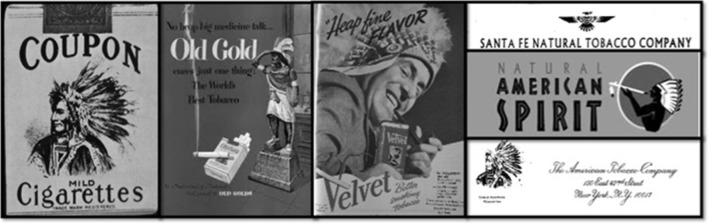
- Forty-nine documents indicated use of American Indian cultural symbols and imagery as a marketing tactic, including traditional headdresses, peace pipes, and stereotypes such as “Heap fine flavor,” “No heap big medicine talk,” and “me dumb Injun.”
- Forty documents referenced the cultural and historical significance of traditional tobacco, often using it to justify commercially available tobacco; examples include a 1951 Lorillard book referring to the “red man” and a 1980 American Tobacco “Indian Country” pitch.
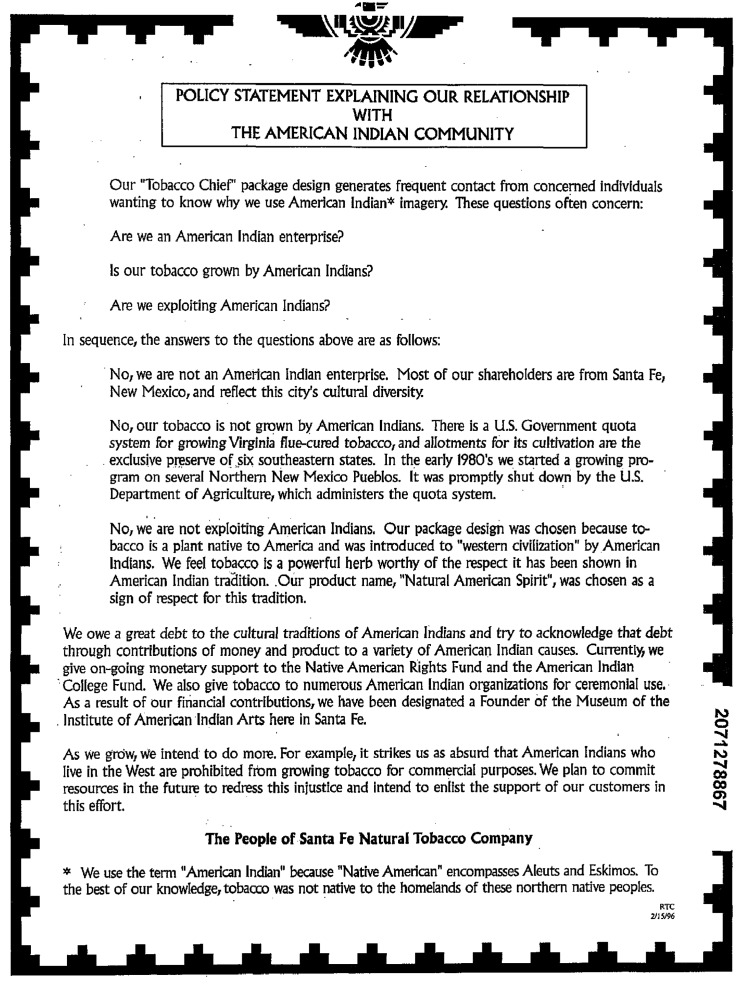
- Twenty-two documents emphasised tobacco as “natural,” with Natural American Spirit using Native imagery alongside “natural,” “additive-free,” and “organic” descriptors; Philip Morris research found the imagery served as a “reminder of tobacco’s original use in its natural state.”
Methods
- A textual analysis was conducted on documents from the Truth Tobacco Industry Documents Library between 1 September 2016 and 1 July 2017, with no date or collection restrictions.
- Searches used iterative “snowball” sampling with broad terms such as “American Indian,” “Native American,” and “traditional tobacco,” plus specific imagery and cultural terms; only the first 200 search results per keyword, sorted by relevance, were carefully examined for inclusion.
- A final collection of 76 documents was analysed for themes, with Native community member input guiding interpretation to ensure cultural competency and sensitivity.
Limitations
- The authors state that restricted documents and the sheer volume of documents meant they could not determine whether all relevant documents were included; they also could not find internal Santa Fe Natural Tobacco Company documents prior to 2002 because it was a small, private company not subject to Master Settlement Agreement disclosure requirements.
- The authors state they excluded documents regarding sovereignty and tribally owned tobacco entities, noting these issues warrant further examination.
- Evident from the text: reliance on industry documents cannot establish actual population exposure or impact, and the authors call for future research on how cultural misrepresentations affect commercial tobacco use among American Indians.
Model-written summary. Check it against the paper before relying on it.
Integrity signals
Registry
Cites
Statistics
Figures
Verification
Claims the paper makes
31 Own result · 30 Not checked yet · 12 No full text of the sources · 8 Own interpretation · 7 Check pending · 7 No basis given · 5 Sources not found · 3 Own method
In the paper
“Despite this, SFNTC included testimonials from customers who reported they were smoking a less harmful product because it was 'natural'. 42”
What the sources say
- Not checked yetcites [42] Anon. Santa Fe Natural Tobacco Company [Mailing Form with Customer Letters]. Philip Morris Records, 1994. http://industrydocuments.library.ucsf.edu/tobacco/docs/lhbg0025
plain- Asserted: passes — The authors put it forward as true.
- Checkable: passes — It can be checked against evidence.
- Load-bearing: passes — The paper’s conclusions depend on it.
- Based: passes — The paper gives a reason why it holds.
A result the paper reports from its own data — it cites no other source for it, so there is none to check. The quote shows it is in the paper.
In the paper
“Documents related to SFNTC poignantly illustrate how Native imagery, culture and beliefs were integral to the company's marketing plan.”
boostedstates an association- Asserted: passes — The authors put it forward as true.
- Checkable: passes — It can be checked against evidence.
- Load-bearing: passes — The paper’s conclusions depend on it.
- Based: passes — The paper gives a reason why it holds.
A result the paper reports from its own data — it cites no other source for it, so there is none to check. The quote shows it is in the paper.
In the paper
“Documents in tobacco company collections did not always reference their own products.”
plain- Asserted: passes — The authors put it forward as true.
- Checkable: passes — It can be checked against evidence.
- Load-bearing: unclear — It is unclear whether the paper’s conclusions depend on it.
- Based: passes — The paper gives a reason why it holds.
In the paper
“Focus groups held by consultants for B&W found that the use of American Indian imagery contributed to consumers' perceptions that SFNTC was a small company creating a healthier, more natural product. 51”
What the sources say
- Not checked yetcites [51] Goldfarb Consultants. Perceptions of American Spirit, Red Kamel & Moonlight Tobacco. Brown & Williamson Records, 1997. https://www.industrydocumentslibrary.ucsf.edu/docs/#id=shmm0078
plainstates a cause- Asserted: passes — The authors put it forward as true.
- Checkable: passes — It can be checked against evidence.
- Load-bearing: passes — The paper’s conclusions depend on it.
- Based: passes — The paper gives a reason why it holds.
A result the paper reports from its own data — it cites no other source for it, so there is none to check. The quote shows it is in the paper.
In the paper
“Documents revealed the use of American Indian imagery such as traditional headdresses and other cultural symbols in product branding and the portrayal of harmful stereotypes of Native people in advertising.”
plainn = 76- Asserted: passes — The authors put it forward as true.
- Checkable: passes — It can be checked against evidence.
- Load-bearing: passes — The paper’s conclusions depend on it.
- Based: passes — The paper gives a reason why it holds.
In the paper
“SFNTC created an image of their brand NAS as a specialty product too exclusive to be sold in the same venues as other commercial tobacco. 50”
What the sources say
- Not checked yetcites [50] Kaplan A . Category Management: Cigarettes New Ways to Carve a Niche. Lorillard Records, 1996. https://www.industrydocumentslibrary.ucsf.edu/docs/#id=mzwj0049
plainstates a cause- Asserted: passes — The authors put it forward as true.
- Checkable: passes — It can be checked against evidence.
- Load-bearing: unclear — It is unclear whether the paper’s conclusions depend on it.
- Based: passes — The paper gives a reason why it holds.
In the paper
“SFNTC saw an opportunity to fill that niche within the cigarette world. 50”
What the sources say
- Not checked yetcites [50] Kaplan A . Category Management: Cigarettes New Ways to Carve a Niche. Lorillard Records, 1996. https://www.industrydocumentslibrary.ucsf.edu/docs/#id=mzwj0049
plain- Asserted: passes — The authors put it forward as true.
- Checkable: passes — It can be checked against evidence.
- Load-bearing: unclear — It is unclear whether the paper’s conclusions depend on it.
- Based: passes — The paper gives a reason why it holds.
A result the paper reports from its own data — it cites no other source for it, so there is none to check. The quote shows it is in the paper.
In the paper
“During the period covered, a general pattern emerged: the earliest documents (1930s-1970s) included the use of Native cultural symbols and imagery.”
plain- Asserted: passes — The authors put it forward as true.
- Checkable: passes — It can be checked against evidence.
- Load-bearing: passes — The paper’s conclusions depend on it.
- Based: passes — The paper gives a reason why it holds.
In the paper
“In one 1994 promotional document, 42 SFNTC referred to the use of 'natural' tobacco as being closer to the way it was intended to be used-as part of American Indian traditions-and completely separate from nicotine addiction.”
What the sources say
- Not checked yetcites [42] Anon. Santa Fe Natural Tobacco Company [Mailing Form with Customer Letters]. Philip Morris Records, 1994. http://industrydocuments.library.ucsf.edu/tobacco/docs/lhbg0025
plain- Asserted: passes — The authors put it forward as true.
- Checkable: passes — It can be checked against evidence.
- Load-bearing: passes — The paper’s conclusions depend on it.
- Based: passes — The paper gives a reason why it holds.
A result the paper reports from its own data — it cites no other source for it, so there is none to check. The quote shows it is in the paper.
In the paper
“Findings demonstrate that the tobacco industry used American Indian imagery and symbols in its branding”
boostedstates a cause- Asserted: passes — The authors put it forward as true.
- Checkable: passes — It can be checked against evidence.
- Load-bearing: passes — The paper’s conclusions depend on it.
- Based: passes — The paper gives a reason why it holds.
A result the paper reports from its own data — it cites no other source for it, so there is none to check. The quote shows it is in the paper.
In the paper
“Forty-nine tobacco industry documents indicated use of American Indian cultural symbols and imagery as a marketing tactic.”
plain- Asserted: passes — The authors put it forward as true.
- Checkable: passes — It can be checked against evidence.
- Load-bearing: passes — The paper’s conclusions depend on it.
- Based: passes — The paper gives a reason why it holds.
A result the paper reports from its own data — it cites no other source for it, so there is none to check. The quote shows it is in the paper.
In the paper
“Later documents (1980s-1990s) made explicit connections to the historical context of traditional tobacco use, whereas the most recent documents (1980s-2001) promoted tobacco as natural.”
plain- Asserted: passes — The authors put it forward as true.
- Checkable: passes — It can be checked against evidence.
- Load-bearing: passes — The paper’s conclusions depend on it.
- Based: passes — The paper gives a reason why it holds.
A result the paper reports from its own data — it cites no other source for it, so there is none to check. The quote shows it is in the paper.
In the paper
“The earliest documents focused primarily on using Native imagery to sell products.”
plain- Asserted: passes — The authors put it forward as true.
- Checkable: passes — It can be checked against evidence.
- Load-bearing: unclear — It is unclear whether the paper’s conclusions depend on it.
- Based: passes — The paper gives a reason why it holds.
A result the paper states — it cites no source for it, so there is none to check. The quote shows it is in the paper.
In the paper
“The cultural and historical significance of tobacco to American Indians appeared in a total of 40 documents.”
hedged- Asserted: passes — The authors put it forward as true.
- Checkable: passes — It can be checked against evidence.
- Load-bearing: unclear — It is unclear whether the paper’s conclusions depend on it.
- Based: passes — The paper gives a reason why it holds.
None of the sources cited for this claim have been checked yet.
In the paper
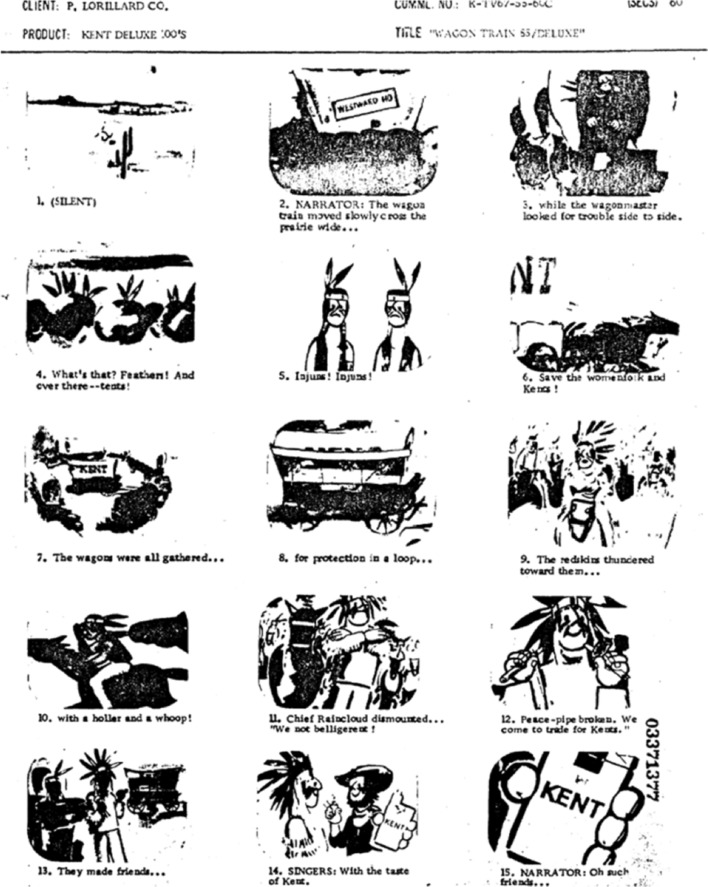
“In addition to the use of headdresses in print ads, fictionalised encounters with Native people in traditional clothing and stereotypical language such as 'me dumb Injun' 27 were used for product promotions on radio and in other media. 28 29”
What the sources say
- Not checked yetcites [27] IKJ National Broadcasting. Uncle Ezra’s Radio Station. #51. RJ Reynolds Records, 1941. https://www.industrydocumentslibrary.ucsf.edu/docs/#id=grdc0079
- Not checked yetcites [28] Anon. Scripts. American Tobacco Records, 1946. https://www.industrydocumentslibrary.ucsf.edu/docs/#id=fqbx0017
- Not checked yetcites [29] Etsy W . The Abbott and Costello Program for Camel Cigarettes. NBC—Studio "A". Program No. 9. Marketing to Minorities, Military, and Gays MSA Collection, 1946. https://www.industrydocumentslibrary.ucsf.edu/docs/#id=fmdb0048
plain- Asserted: passes — The authors put it forward as true.
- Checkable: passes — It can be checked against evidence.
- Load-bearing: unclear — It is unclear whether the paper’s conclusions depend on it.
- Based: passes — The paper gives a reason why it holds.
A result the paper reports from its own data — it cites no other source for it, so there is none to check. The quote shows it is in the paper.
In the paper
“Documents revealed the use of American Indian imagery such as traditional headdresses and other cultural symbols in product branding and the portrayal of harmful stereotypes of Native people in advertising.”
plainn = 76- Asserted: passes — The authors put it forward as true.
- Checkable: passes — It can be checked against evidence.
- Load-bearing: passes — The paper’s conclusions depend on it.
- Based: passes — The paper gives a reason why it holds.
A result the paper reports from its own data — it cites no other source for it, so there is none to check. The quote shows it is in the paper.
In the paper
“One of the most commonly referenced images before the 1950s was the traditional Native headdress.”
plain- Asserted: passes — The authors put it forward as true.
- Checkable: passes — It can be checked against evidence.
- Load-bearing: unclear — It is unclear whether the paper’s conclusions depend on it.
- Based: passes — The paper gives a reason why it holds.
A result the paper reports from its own data — it cites no other source for it, so there is none to check. The quote shows it is in the paper.
In the paper
“Many of these documents used traditional tobacco to justify the use and existence of commercially available tobacco by identifying it as an American tradition pre-dating the tobacco industry by centuries.”
plainstates a cause- Asserted: passes — The authors put it forward as true.
- Checkable: passes — It can be checked against evidence.
- Load-bearing: passes — The paper’s conclusions depend on it.
- Based: passes — The paper gives a reason why it holds.
A result the paper reports from its own data — it cites no other source for it, so there is none to check. The quote shows it is in the paper.
In the paper
“The historical and cultural significance of traditional tobacco was used to validate commercially available tobacco.”
plainstates a causen = 76- Asserted: passes — The authors put it forward as true.
- Checkable: passes — It can be checked against evidence.
- Load-bearing: passes — The paper’s conclusions depend on it.
- Based: passes — The paper gives a reason why it holds.
A result the paper reports from its own data — it cites no other source for it, so there is none to check. The quote shows it is in the paper.
In the paper
“Later documents (1980s-1990s) made explicit connections to the historical context of traditional tobacco use, whereas the most recent documents (1980s-2001) promoted tobacco as natural.”
plainstates an association- Asserted: passes — The authors put it forward as true.
- Checkable: passes — It can be checked against evidence.
- Load-bearing: passes — The paper’s conclusions depend on it.
- Based: passes — The paper gives a reason why it holds.
None of the sources cited for this claim have been checked yet.
In the paper
“An overall shift in the tone occurred during the 1980s and early 1990s. Rather than relying on negative American Indian stereotypes, ads instead began to convey a sense of reverence towards Native people and their use of tobacco.”
plain- Asserted: passes — The authors put it forward as true.
- Checkable: passes — It can be checked against evidence.
- Load-bearing: unclear — It is unclear whether the paper’s conclusions depend on it.
- Based: passes — The paper gives a reason why it holds.
The paper states this without a source or data behind it here, so there is nothing to check it against. The quote shows it is in the paper.
In the paper
“It is notable that SFNTC, more than any other company, explicitly referenced the distinction between sacred and commercial use and tobacco's traditional role in American Indian communities.”
plain- Asserted: passes — The authors put it forward as true.
- Checkable: passes — It can be checked against evidence.
- Load-bearing: unclear — It is unclear whether the paper’s conclusions depend on it.
- Based: unclear — It is unclear why the paper says it holds.
A result the paper reports from its own data — it cites no other source for it, so there is none to check. The quote shows it is in the paper.
In the paper
“exploited relationships with sacred tobacco”
plainstates a cause- Asserted: passes — The authors put it forward as true.
- Checkable: passes — It can be checked against evidence.
- Load-bearing: passes — The paper’s conclusions depend on it.
- Based: passes — The paper gives a reason why it holds.
A result the paper reports from its own data — it cites no other source for it, so there is none to check. The quote shows it is in the paper.
In the paper
“Our results suggest industry marketing incorporated Native imagery and cultural objects for decades.”
hedged- Asserted: passes — The authors put it forward as true.
- Checkable: passes — It can be checked against evidence.
- Load-bearing: passes — The paper’s conclusions depend on it.
- Based: passes — The paper gives a reason why it holds.
A result the paper reports from its own data — it cites no other source for it, so there is none to check. The quote shows it is in the paper.
In the paper
“portrayed harmful stereotypes in its advertising”
plainstates a cause- Asserted: passes — The authors put it forward as true.
- Checkable: passes — It can be checked against evidence.
- Load-bearing: passes — The paper’s conclusions depend on it.
- Based: passes — The paper gives a reason why it holds.
A result the paper reports from its own data — it cites no other source for it, so there is none to check. The quote shows it is in the paper.
In the paper
“Documents revealed that the tobacco industry used Native imagery in their advertising, commodified sacred tobacco and other cultural objects, and misrepresented cultural practices to sell commercial tobacco.”
plainstates a cause- Asserted: passes — The authors put it forward as true.
- Checkable: passes — It can be checked against evidence.
- Load-bearing: passes — The paper’s conclusions depend on it.
- Based: passes — The paper gives a reason why it holds.
A result the paper states — it cites no source for it, so there is none to check. The quote shows it is in the paper.
In the paper
“Earliest depictions commodified cultural symbols such as headdresses and peace pipes.”
plainstates a cause- Asserted: passes — The authors put it forward as true.
- Checkable: passes — It can be checked against evidence.
- Load-bearing: unclear — It is unclear whether the paper’s conclusions depend on it.
- Based: passes — The paper gives a reason why it holds.
A result the paper reports from its own data — it cites no other source for it, so there is none to check. The quote shows it is in the paper.
In the paper
“Documents revealed that the tobacco industry used Native imagery in their advertising, commodified sacred tobacco and other cultural objects, and misrepresented cultural practices to sell commercial tobacco.”
plain- Asserted: passes — The authors put it forward as true.
- Checkable: passes — It can be checked against evidence.
- Load-bearing: passes — The paper’s conclusions depend on it.
- Based: passes — The paper gives a reason why it holds.
A result the paper reports from its own data — it cites no other source for it, so there is none to check. The quote shows it is in the paper.
In the paper
“Documents revealed that the tobacco industry used Native imagery in their advertising, commodified sacred tobacco and other cultural objects, and misrepresented cultural practices to sell commercial tobacco.”
plainstates a cause- Asserted: passes — The authors put it forward as true.
- Checkable: passes — It can be checked against evidence.
- Load-bearing: passes — The paper’s conclusions depend on it.
- Based: passes — The paper gives a reason why it holds.
A result the paper states — it cites no source for it, so there is none to check. The quote shows it is in the paper.
In the paper
“In doing so, the tobacco industry also capitalised on the connection between Native peoples and tobacco in their use of Native imagery as symbols and logos for marketing purposes.”
plainstates a cause- Asserted: passes — The authors put it forward as true.
- Checkable: passes — It can be checked against evidence.
- Load-bearing: passes — The paper’s conclusions depend on it.
- Based: passes — The paper gives a reason why it holds.
The paper states this without a source or data behind it here, so there is nothing to check it against. The quote shows it is in the paper.
In the paper
“In many industry documents, there was acknowledgement of tobacco's connection to Native culture.”
plain- Asserted: passes — The authors put it forward as true.
- Checkable: passes — It can be checked against evidence.
- Load-bearing: passes — The paper’s conclusions depend on it.
- Based: unclear — It is unclear why the paper says it holds.
A result the paper reports from its own data — it cites no other source for it, so there is none to check. The quote shows it is in the paper.
In the paper
“The tobacco industry has used cultural attributes to market its tobacco products.”
plainstates a cause- Asserted: passes — The authors put it forward as true.
- Checkable: passes — It can be checked against evidence.
- Load-bearing: passes — The paper’s conclusions depend on it.
- Based: passes — The paper gives a reason why it holds.
A result the paper states — it cites no source for it, so there is none to check. The quote shows it is in the paper.
In the paper
“The tobacco industry used this knowledge to validate the claim that Native tobacco practices were the foundation for the creation of the tobacco industry.”
plainstates a cause- Asserted: passes — The authors put it forward as true.
- Checkable: passes — It can be checked against evidence.
- Load-bearing: passes — The paper’s conclusions depend on it.
- Based: passes — The paper gives a reason why it holds.
None of the sources cited for this claim have been checked yet.
In the paper
“At the same time, the extermination and assimilation policies of the US federal government during the 19th and 20th centuries further marginalised cultural practices for Native people. 11 12”
What the sources say
- Not checked — no full text of the sourcecites [11] Forster, 2007, Patterns of tobacco use in a sample of American Indians in Minneapolis–St. Paul, Nicotine & Tobacco Research source
- Not matchedcites [12] An act to provide for the allotment of lands in severalty to indians on the various reservations (General Allotment Act or Dawes Act). In: Congress US ed. Statutes at Large 24, 388–91, NADP Document A1887 , 1887.
Couldn’t be matched to a paper in Crossref, so it can’t be checked.
plainstates a cause- Asserted: passes — The authors put it forward as true.
- Checkable: passes — It can be checked against evidence.
- Load-bearing: passes — The paper’s conclusions depend on it.
- Based: passes — The paper gives a reason why it holds.
In the paper
“The tobacco industry's influence in shaping tobacco disparities among racial and ethnic minority populations is well documented. 15”
What the sources say
- Not matchedcites [15] U.S. Department of Health and Human Services. Tobacco Use Among U.S. Racial/Ethnic Minority Groups—African Americans, American Indians and Alaska Natives, Asian Americans and Pacific Islanders, and Hispanics: A Report of the Surgeon General . Atlanta, GA, 1998.
Couldn’t be matched to a paper in Crossref, so it can’t be checked.
boostedstates a cause- Asserted: passes — The authors put it forward as true.
- Checkable: passes — It can be checked against evidence.
- Load-bearing: unclear — It is unclear whether the paper’s conclusions depend on it.
- Based: passes — The paper gives a reason why it holds.
- Not matched
In the paper
“commercial tobacco causes death and disease, whereas traditional or sacred tobacco use is guided by protocols and teachings that honour the Creator. 6”
What the sources say
- Not checked yetcites [6] Blackfeet Nation. Blackfeet tobacco free act. 2005 http://indigenouspeoplestf.org/toolkit/policy/BLACKFEETTRIBALORDINANCE.29092915.pdf (accessed 28 Jun 2017).
plain- Asserted: passes — The authors put it forward as true.
- Checkable: passes — It can be checked against evidence.
- Load-bearing: passes — The paper’s conclusions depend on it.
- Based: passes — The paper gives a reason why it holds.
The paper states this without a source or data behind it here, so there is nothing to check it against. The quote shows it is in the paper.
In the paper
“To our knowledge, this is the first systematic examination of tobacco industry documents focused on how marketing tactics incorporated American Indian culture and traditional tobacco.”
hedged- Asserted: passes — The authors put it forward as true.
- Checkable: passes — It can be checked against evidence.
- Load-bearing: passes — The paper’s conclusions depend on it.
- Based: unclear — It is unclear why the paper says it holds.
In the paper
“Marketing strategically targets consumers' values, attitudes and beliefs, 16 17”
What the sources say
plainstates a cause- Asserted: passes — The authors put it forward as true.
- Checkable: passes — It can be checked against evidence.
- Load-bearing: passes — The paper’s conclusions depend on it.
- Based: passes — The paper gives a reason why it holds.
In the paper
“Recent studies have examined how Natural American Spirit (NAS) cigarettes, which feature Native imagery alongside 'natural' and 'additive-free' text descriptors, may suggest a 'safer' product to consumers. 3 4”
What the sources say
plain- Asserted: passes — The authors put it forward as true.
- Checkable: passes — It can be checked against evidence.
- Load-bearing: passes — The paper’s conclusions depend on it.
- Based: passes — The paper gives a reason why it holds.
In the paper
“For example, tobacco industry documents detail how R.J. Reynolds (RJR) incorporated Spanish language, cultural values and sponsorship of musical and other community festivals as a culturally relevant marketing strategy to target Hispanics. 16”
What the sources say
- Not checked yetcites [16] Iglesias-Rios, 2013, A historical review of R.J. Reynolds' strategies for marketing tobacco to Hispanics in the United States, Am J Public Health source
plain- Asserted: passes — The authors put it forward as true.
- Checkable: passes — It can be checked against evidence.
- Load-bearing: unclear — It is unclear whether the paper’s conclusions depend on it.
- Based: passes — The paper gives a reason why it holds.
In the paper
“The first national company to draw on the 'mystique of Indianness' was Red Man chewing tobacco in 1904. 1”
What the sources say
- Not checked — no full text of the sourcecites [1] Merskin, 2001, Winnebagos, Cherokees, Apaches, and Dakotas: the persistence of stereotyping of American Indians in American advertising brands, How J C source
plain- Asserted: passes — The authors put it forward as true.
- Checkable: passes — It can be checked against evidence.
- Load-bearing: unclear — It is unclear whether the paper’s conclusions depend on it.
- Based: passes — The paper gives a reason why it holds.
In the paper
“Traditional tobacco, used for spiritual, ceremonial and cultural purposes, plays a central role in the life of many, but not all, Native people.”
What the sources say
- Not checked yetcites [6] Blackfeet Nation. Blackfeet tobacco free act. 2005 http://indigenouspeoplestf.org/toolkit/policy/BLACKFEETTRIBALORDINANCE.29092915.pdf (accessed 28 Jun 2017).
plain- Asserted: passes — The authors put it forward as true.
- Checkable: passes — It can be checked against evidence.
- Load-bearing: passes — The paper’s conclusions depend on it.
- Based: passes — The paper gives a reason why it holds.
In the paper
“tobacco advertising and promotions are directly linked to increased tobacco initiation and consumption. 18”
What the sources say
- Not matchedcites [18] National Cancer Institute. The Role of the Media in Promoting and Reducing Tobacco Use. Vol Tobacco Control Monograph No. 19. Bethesda, MD: U.S: Department of Health and Human Services, National Institutes of Health, National Cancer Institute, 2008.
Couldn’t be matched to a paper in Crossref, so it can’t be checked.
plainstates an association- Asserted: passes — The authors put it forward as true.
- Checkable: passes — It can be checked against evidence.
- Load-bearing: unclear — It is unclear whether the paper’s conclusions depend on it.
- Based: passes — The paper gives a reason why it holds.
- Not matched
A conclusion the paper draws from its own results — it cites no other source for it, so there is none to check. The quote shows it is in the paper.
In the paper
“The tobacco industry has misappropriated culture and traditional tobacco by misrepresenting American Indian traditions, values and beliefs to market and sell their products for profit.”
plainstates a causen = 76- Asserted: passes — The authors put it forward as true.
- Checkable: passes — It can be checked against evidence.
- Load-bearing: passes — The paper’s conclusions depend on it.
- Based: passes — The paper gives a reason why it holds.
A claim is checked only against the cited paper’s full text, never its abstract, and none is available for its sources.
In the paper
“and could result in Native people internalising negative perceptions of their culture. 1 54”
What the sources say
hedgedstates a possible cause- Asserted: passes — The authors put it forward as true.
- Checkable: passes — It can be checked against evidence.
- Load-bearing: passes — The paper’s conclusions depend on it.
- Based: passes — The paper gives a reason why it holds.
In the paper
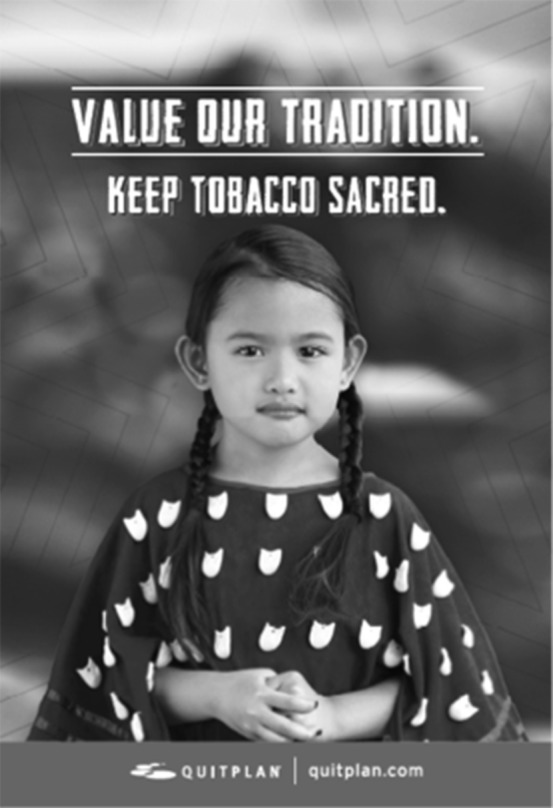
“In Minnesota, the Keep Tobacco Sacred campaign also emphasises the original intention of tobacco among Native people and honouring traditional tobacco as a sacred gift (figure 5). 59”
What the sources say
- Not matchedcites [59] ClearWay Minnesota. Keep tobacco sacred. http://clearwaymn.org/keeptobaccosacred/ (accessed 28 Jun 2017).
Couldn’t be matched to a paper in Crossref, so it can’t be checked.
plain- Asserted: passes — The authors put it forward as true.
- Checkable: passes — It can be checked against evidence.
- Load-bearing: unclear — It is unclear whether the paper’s conclusions depend on it.
- Based: passes — The paper gives a reason why it holds.
- Not matched
A conclusion the paper draws from its own results — it cites no other source for it, so there is none to check. The quote shows it is in the paper.
In the paper
“thereby misappropriating tradition and culture”
plainstates a cause- Asserted: passes — The authors put it forward as true.
- Checkable: passes — It can be checked against evidence.
- Load-bearing: passes — The paper’s conclusions depend on it.
- Based: passes — The paper gives a reason why it holds.
A conclusion the paper draws from its own results — it cites no other source for it, so there is none to check. The quote shows it is in the paper.
In the paper
“The tobacco industry co-opted cultural traditions that are integral to the lives of many American Indians”
plainstates a cause- Asserted: passes — The authors put it forward as true.
- Checkable: passes — It can be checked against evidence.
- Load-bearing: passes — The paper’s conclusions depend on it.
- Based: passes — The paper gives a reason why it holds.
A conclusion the paper draws from its own results — it cites no other source for it, so there is none to check. The quote shows it is in the paper.
In the paper
“These misrepresentations of significant cultural practices outside their traditional context illustrate commodification of culture to market commercial tobacco.”
plainstates a cause- Asserted: passes — The authors put it forward as true.
- Checkable: passes — It can be checked against evidence.
- Load-bearing: passes — The paper’s conclusions depend on it.
- Based: passes — The paper gives a reason why it holds.
None of the sources cited for this claim have been checked yet.
In the paper
“similar to tactics that have been used in other racial/ethnic minority communities, 15 but in this instance, directed at the very core of American Indian values and belief systems. 7”
What the sources say
- Not matchedcites [15] U.S. Department of Health and Human Services. Tobacco Use Among U.S. Racial/Ethnic Minority Groups—African Americans, American Indians and Alaska Natives, Asian Americans and Pacific Islanders, and Hispanics: A Report of the Surgeon General . Atlanta, GA, 1998.
Couldn’t be matched to a paper in Crossref, so it can’t be checked.
- Not checked yetcites [7] source
plainstates a cause- Asserted: passes — The authors put it forward as true.
- Checkable: passes — It can be checked against evidence.
- Load-bearing: passes — The paper’s conclusions depend on it.
- Based: passes — The paper gives a reason why it holds.
- Not matched
In the paper
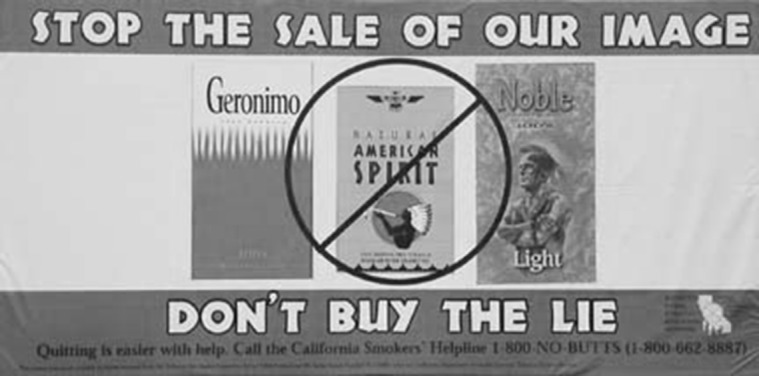
“The Stop the Sale of our Image: Don't Buy the Lie campaign (figure 4) from California offers an example of a community-based campaign to counter pro-tobacco influences. 58”
What the sources say
- Not checked yetcites [58] Billboards decry use of Indian images. NCJ 2003 https://www.northcoastjournal.com/032703/news0327.html#anchor624790 (accessed 28 Jun 2017).
plain- Asserted: passes — The authors put it forward as true.
- Checkable: passes — It can be checked against evidence.
- Load-bearing: unclear — It is unclear whether the paper’s conclusions depend on it.
- Based: passes — The paper gives a reason why it holds.
- It may state two separate claims as one. 28
- Probably not a substantial claim. 34
In the paper
“NAS was sold directly to a small number of retailers, focusing on 'health food stores, smoke shops… coffee bars, independent grocers, and gift stores' 50 to further reinforce the 'natural' aspect of tobacco and join the broader health-conscious movement of the 1980s and 1990s. 50”
What the sources say
- Not checked yetcites [50] Kaplan A . Category Management: Cigarettes New Ways to Carve a Niche. Lorillard Records, 1996. https://www.industrydocumentslibrary.ucsf.edu/docs/#id=mzwj0049
plainstates a cause- Asserted: passes — The authors put it forward as true.
- Checkable: passes — It can be checked against evidence.
- Load-bearing: unclear — It is unclear whether the paper’s conclusions depend on it.
- Based: passes — The paper gives a reason why it holds.
It may state two separate claims as one.
In the paper
“Research conducted by industry competitors found that the use of American Indian imagery by SFNTC served to 'bond people with America's origins'. 35”
What the sources say
- Not checked yetcites [35] Anon. Natural American Spirit [Brand and Product Overview]. Philip Morris Records, 1995. hhttps://www.industrydocumentslibrary.ucsf.edu/docs/#id=lpbn0154
plainstates a cause- Asserted: passes — The authors put it forward as true.
- Checkable: passes — It can be checked against evidence.
- Load-bearing: fails — The paper’s conclusions may not depend on it.
- Based: passes — The paper gives a reason why it holds.
Probably not a substantial claim. The paper’s conclusions may not depend on it.
The paper states this without a source or data behind it here, so there is nothing to check it against. The quote shows it is in the paper.
In the paper
“Reverence towards Native culture culminated with the emergence of SFNTC in 1982.”
plainstates a cause- Asserted: passes — The authors put it forward as true.
- Checkable: passes — It can be checked against evidence.
- Load-bearing: fails — The paper’s conclusions may not depend on it.
- Based: fails — The paper may give no reason why it holds.
Probably not a substantial claim. The paper’s conclusions may not depend on it. The paper may give no reason why it holds.
A result the paper reports from its own data — it cites no other source for it, so there is none to check. The quote shows it is in the paper.
In the paper
“Tobacco industry marketing tactics have incorporated American Indian culture and traditional tobacco since at least the 1930s, with these tactics prominently highlighted during the 1990s with Natural American Spirit cigarettes.”
plainstates an associationn = 76- Asserted: passes — The authors put it forward as true.
- Checkable: passes — It can be checked against evidence.
- Load-bearing: passes — The paper’s conclusions depend on it.
- Based: passes — The paper gives a reason why it holds.
It may state two separate claims as one.
In the paper
“Part of this image was carefully cultivated by marketing products as 'additive-free' and using only certified organic tobacco. 36”
What the sources say
- Not checked yetcites [36] Crellin R . Organic Tobacco. British American Tobacco Records, 2000. https://www.industrydocumentslibrary.ucsf.edu/docs/#id=thnm0197
plainstates a cause- Asserted: passes — The authors put it forward as true.
- Checkable: passes — It can be checked against evidence.
- Load-bearing: unclear — It is unclear whether the paper’s conclusions depend on it.
- Based: passes — The paper gives a reason why it holds.
It may state two separate claims as one.
The paper states this without a source or data behind it here, so there is nothing to check it against. The quote shows it is in the paper.
In the paper
“In 1996, SFNTC management recognised that consumers were becoming more interested in what they were putting into their bodies and started showing preference for organic and chemical-free options.”
plain- Asserted: passes — The authors put it forward as true.
- Checkable: passes — It can be checked against evidence.
- Load-bearing: fails — The paper’s conclusions may not depend on it.
- Based: fails — The paper may give no reason why it holds.
Probably not a substantial claim. The paper’s conclusions may not depend on it. The paper may give no reason why it holds. It may state two separate claims as one.
A result the paper reports from its own data — it cites no other source for it, so there is none to check. The quote shows it is in the paper.
In the paper
“The final theme identified in the analysis was emphasising tobacco as 'natural' and providing smokers a spiritual or sacred connection to the world, which appeared 22 times.”
plain- Asserted: passes — The authors put it forward as true.
- Checkable: passes — It can be checked against evidence.
- Load-bearing: fails — The paper’s conclusions may not depend on it.
- Based: passes — The paper gives a reason why it holds.
Probably not a substantial claim. The paper’s conclusions may not depend on it.
A result the paper states — it cites no source for it, so there is none to check. The quote shows it is in the paper.
In the paper
“Native imagery featured prominently in all NAS marketing materials and on the SFNTC logo and product packaging.”
plain- Asserted: passes — The authors put it forward as true.
- Checkable: passes — It can be checked against evidence.
- Load-bearing: passes — The paper’s conclusions depend on it.
- Based: passes — The paper gives a reason why it holds.
It may state two separate claims as one.
A result the paper reports from its own data — it cites no other source for it, so there is none to check. The quote shows it is in the paper.
In the paper
“Documents in this theme mentioned the use of traditional tobacco as central to the lives of many American Indians.”
plain- Asserted: passes — The authors put it forward as true.
- Checkable: passes — It can be checked against evidence.
- Load-bearing: fails — The paper’s conclusions may not depend on it.
- Based: passes — The paper gives a reason why it holds.
Probably not a substantial claim. The paper’s conclusions may not depend on it.
In the paper
“PM concluded that the images used by SFNTC contributed significantly to smokers' emotional connection and loyalty with these products. 35”
What the sources say
- Not checked yetcites [35] Anon. Natural American Spirit [Brand and Product Overview]. Philip Morris Records, 1995. hhttps://www.industrydocumentslibrary.ucsf.edu/docs/#id=lpbn0154
boostedstates a cause- Asserted: passes — The authors put it forward as true.
- Checkable: passes — It can be checked against evidence.
- Load-bearing: passes — The paper’s conclusions depend on it.
- Based: passes — The paper gives a reason why it holds.
Probably not a substantial claim.
None of the sources cited for this claim have been checked yet.
In the paper
“SFNTC also sold and distributed other products associated with American Indian culture, such as Vignette Fact Cards containing stories of tribal leaders 44 and a 'Book of Elders' collection of interviews with elders across the USA and Canada, 45 and distributed at least one mailing including a Pueblo tale of sacred tobacco. 46”
What the sources say
- Not checked yetcites [44] Anon. RJR Websites, Santa Fe Natural Tobacco Company. RJ Reynolds Records, 2001. https://www.industrydocumentslibrary.ucsf.edu/docs/#id=jqgk0023
- Not checked yetcites [45] Santa Fe Natural Tobacco Company [Direct Mailing with Free Sample and Order Form]. Philip Morris Records, 1995. https://www.industrydocumentslibrary.ucsf.edu/docs/#id=kpyv0044
- Not checked yetcites [46] Santa Fe Natural Tobacco Company. Natural American Spirit Tobacco Products. American Tobacco Records, 1993. https://www. industrydocumentslibrary. ucsf. edu/ doc s/# id= njkw0020
plain- Asserted: passes — The authors put it forward as true.
- Checkable: passes — It can be checked against evidence.
- Load-bearing: passes — The paper’s conclusions depend on it.
- Based: passes — The paper gives a reason why it holds.
It may state two separate claims as one.
In the paper
“PM found that the logos and graphics on NAS packaging led consumers to believe that smoking cigarettes was a normal human activity and that they were supporting a worthy Native cause (assuming that the brand was under American Indian ownership). 35”
What the sources say
- Not checked yetcites [35] Anon. Natural American Spirit [Brand and Product Overview]. Philip Morris Records, 1995. hhttps://www.industrydocumentslibrary.ucsf.edu/docs/#id=lpbn0154
plainstates a cause- Asserted: passes — The authors put it forward as true.
- Checkable: passes — It can be checked against evidence.
- Load-bearing: passes — The paper’s conclusions depend on it.
- Based: passes — The paper gives a reason why it holds.
It may state two separate claims as one.
None of the sources cited for this claim have been checked yet.
In the paper
“Among other references to the sacred uses of tobacco were NAS sage smudge sticks, 42 and 'pow-wow blend', which SFNTC said was used in Native ceremonies 36 and contained amounts of sage, mint, bearberry and red willow 42 43”
What the sources say
- Not checked yetcites [42] Anon. Santa Fe Natural Tobacco Company [Mailing Form with Customer Letters]. Philip Morris Records, 1994. http://industrydocuments.library.ucsf.edu/tobacco/docs/lhbg0025
- Not checked yetcites [36] Crellin R . Organic Tobacco. British American Tobacco Records, 2000. https://www.industrydocumentslibrary.ucsf.edu/docs/#id=thnm0197
- Not checked yetcites [43] Bordeaux N . American Spirit Pouch Blends. Philip Morris Records, 1995. https://www.industrydocumentslibrary.ucsf.edu/docs/#id=tklw0028
plain- Asserted: passes — The authors put it forward as true.
- Checkable: passes — It can be checked against evidence.
- Load-bearing: passes — The paper’s conclusions depend on it.
- Based: passes — The paper gives a reason why it holds.
It may state two separate claims as one.
None of the sources cited for this claim have been checked yet.
In the paper
“Both AT 34 and SFNTC 35 packaging displayed a man in traditional headdress, and in the case of SFNTC smoking a 'peace pipe' (figure 1).”
What the sources say
- Not checked yetcites [34] Anon. Circular Book, November 2, 1965 to December 24, 1965. American Tobacco Records:1965. https://www.industrydocumentslibrary.ucsf.edu/docs/#id=fnnn0174
- Not checked yetcites [35] Anon. Natural American Spirit [Brand and Product Overview]. Philip Morris Records, 1995. hhttps://www.industrydocumentslibrary.ucsf.edu/docs/#id=lpbn0154
plain- Asserted: passes — The authors put it forward as true.
- Checkable: passes — It can be checked against evidence.
- Load-bearing: passes — The paper’s conclusions depend on it.
- Based: passes — The paper gives a reason why it holds.
It may state two separate claims as one.
A result the paper reports from its own data — it cites no other source for it, so there is none to check. The quote shows it is in the paper.
In the paper
“A final collection of 76 documents dating from 1935 to 2002 were included for analysis, with the largest number of documents (n=30) dating from the 1990s.”
plain- Asserted: passes — The authors put it forward as true.
- Checkable: passes — It can be checked against evidence.
- Load-bearing: fails — The paper’s conclusions may not depend on it.
- Based: passes — The paper gives a reason why it holds.
Probably not a substantial claim. The paper’s conclusions may not depend on it. It may state two separate claims as one.
In the paper
“SFNTC paired Native imagery with descriptors such as 'natural' and 'organic', but also included statements that additive-free products were not safer than other forms of commercial tobacco. 52”
What the sources say
- Not checked yetcites [52] Natural American Spirit. Introducing Natural American Spirit Account Representatives. Brown & Williamson Records, 1990. https://www.industrydocumentslibrary.ucsf.edu/docs/#id=phmm0078
plain- Asserted: passes — The authors put it forward as true.
- Checkable: passes — It can be checked against evidence.
- Load-bearing: passes — The paper’s conclusions depend on it.
- Based: passes — The paper gives a reason why it holds.
It may state two separate claims as one.
A result the paper reports from its own data — it cites no other source for it, so there is none to check. The quote shows it is in the paper.
In the paper
“Documents came from Philip Morris (PM) (28%), the Tobacco Institute (17%), RJR (11%), Lorillard (11%), American Tobacco (AT) (11%), Brown & Williamson (B&W) (9%), Pollay Ads (6%), British American Tobacco (5%) and other collections (2%).”
plain- Asserted: passes — The authors put it forward as true.
- Checkable: passes — It can be checked against evidence.
- Load-bearing: fails — The paper’s conclusions may not depend on it.
- Based: passes — The paper gives a reason why it holds.
Probably not a substantial claim. The paper’s conclusions may not depend on it. It may state two separate claims as one.
The paper states this without a source or data behind it here, so there is nothing to check it against. The quote shows it is in the paper.
In the paper
“SFNTC sold products such as smudge sticks and pow-wow blend tobacco and prominently featuring ceremonial regalia and pipes in branding.”
plain- Asserted: passes — The authors put it forward as true.
- Checkable: passes — It can be checked against evidence.
- Load-bearing: passes — The paper’s conclusions depend on it.
- Based: unclear — It is unclear why the paper says it holds.
It may state two separate claims as one.
A result the paper states — it cites no source for it, so there is none to check. The quote shows it is in the paper.
In the paper
“Native culture was featured in packaging and advertising, and also woven into the company's positioning as a natural, additive-free product.”
plainstates an association- Asserted: passes — The authors put it forward as true.
- Checkable: passes — It can be checked against evidence.
- Load-bearing: passes — The paper’s conclusions depend on it.
- Based: passes — The paper gives a reason why it holds.
It may state two separate claims as one.
In the paper
“Using traditional tobacco was forbidden by the US government until 1978 when the American Indian Religious Freedom Act extended protections to 'preserve for American Indians their inherent right to freedom to believe, express, and exercise the traditional religions'. 13”
What the sources say
- Not matchedcites [13] American Indian Religious Freedom Act. In: 95th Congress, ed. Vol 92 STAT. 469, 1987. Public Law No. 95-341.
Couldn’t be matched to a paper in Crossref, so it can’t be checked.
plainstates a cause- Asserted: passes — The authors put it forward as true.
- Checkable: passes — It can be checked against evidence.
- Load-bearing: unclear — It is unclear whether the paper’s conclusions depend on it.
- Based: passes — The paper gives a reason why it holds.
It may state two separate claims as one.
- Not matched
In the paper
“We used widely accepted iterative 'snowball' sampling techniques, which have been detailed in previous tobacco industry document research. 21 22”
plain- Asserted: passes — The authors put it forward as true.
- Checkable: passes — It can be checked against evidence.
- Load-bearing: fails — The paper’s conclusions may not depend on it.
- Based: passes — The paper gives a reason why it holds.
Probably not a substantial claim. The paper’s conclusions may not depend on it.
In the paper
“T raditional tobacco currently and historically has been used to honour and welcome guests, to communicate with the Creator, as a prayer offering or to share wisdom. 7”
What the sources say
- Not checked yetcites [7] source
plain- Asserted: passes — The authors put it forward as true.
- Checkable: passes — It can be checked against evidence.
- Load-bearing: passes — The paper’s conclusions depend on it.
- Based: passes — The paper gives a reason why it holds.
It may state two separate claims as one.
In the paper
“Since then, American Indian imagery has appeared on other tobacco products, such as Geronimo cigarettes, with colourful and attractive packaging designed to appeal to ethnic pride. 2”
What the sources say
- Check pendingcites [2] source
plainstates a cause- Asserted: passes — The authors put it forward as true.
- Checkable: passes — It can be checked against evidence.
- Load-bearing: unclear — It is unclear whether the paper’s conclusions depend on it.
- Based: passes — The paper gives a reason why it holds.
It may state two separate claims as one.
In the paper
“Traditional tobacco can be placed on the ground in offerings, burned for cleansing purposes or smoked in a pipe during rituals. 8”
What the sources say
- Not checked — no full text of the sourcecites [8] source
plain- Asserted: passes — The authors put it forward as true.
- Checkable: passes — It can be checked against evidence.
- Load-bearing: fails — The paper’s conclusions may not depend on it.
- Based: passes — The paper gives a reason why it holds.
Probably not a substantial claim. The paper’s conclusions may not depend on it. It may state two separate claims as one.
In the paper
“Co-opting culture, including images, ethnic symbols and traditional objects, has been employed to target population subgroups and to increase the appeal of products to a broad range of consumers. 19”
What the sources say
- Not checked — no full text of the sourcecites [19] source
plainstates a cause- Asserted: passes — The authors put it forward as true.
- Checkable: passes — It can be checked against evidence.
- Load-bearing: passes — The paper’s conclusions depend on it.
- Based: passes — The paper gives a reason why it holds.
It may state two separate claims as one.
In the paper
“Each tribe has its own language for tobacco 11 and additional search terms were generated from conversations with diverse tribal members.”
What the sources say
- Not checked — no full text of the sourcecites [11] Forster, 2007, Patterns of tobacco use in a sample of American Indians in Minneapolis–St. Paul, Nicotine & Tobacco Research source
plain- Asserted: passes — The authors put it forward as true.
- Checkable: passes — It can be checked against evidence.
- Load-bearing: fails — The paper’s conclusions may not depend on it.
- Based: passes — The paper gives a reason why it holds.
Probably not a substantial claim. The paper’s conclusions may not depend on it.
In the paper
“Prior research has also documented the use of cultural attributes and ethnic identities to market tobacco products and create brand identity. 19”
What the sources say
- Not checked — no full text of the sourcecites [19] source
plainstates an association- Asserted: passes — The authors put it forward as true.
- Checkable: passes — It can be checked against evidence.
- Load-bearing: fails — The paper’s conclusions may not depend on it.
- Based: passes — The paper gives a reason why it holds.
Probably not a substantial claim. The paper’s conclusions may not depend on it.
In the paper
“Recent studies have examined how Natural American Spirit (NAS) cigarettes, which feature Native imagery alongside 'natural' and 'additive-free' text descriptors, may suggest a 'safer' product to consumers. 3 4”
What the sources say
hedgedstates a possible cause- Asserted: passes — The authors put it forward as true.
- Checkable: passes — It can be checked against evidence.
- Load-bearing: passes — The paper’s conclusions depend on it.
- Based: passes — The paper gives a reason why it holds.
Probably not a substantial claim.
In the paper
“For centuries, strict protocols have guided practices for cultivating and harvesting tobacco plants. 9”
What the sources say
- Not checked — no full text of the sourcecites [9] Hodge, 2006, Persistent smoking among Northern Plains Indians: lenient attitudes, low harm value, and partiality toward cigarette smoking, J Cult Divers
plain- Asserted: passes — The authors put it forward as true.
- Checkable: passes — It can be checked against evidence.
- Load-bearing: fails — The paper’s conclusions may not depend on it.
- Based: passes — The paper gives a reason why it holds.
Probably not a substantial claim. The paper’s conclusions may not depend on it.
What the paper did — it cites no source for this, so there is none to check. The quote shows it is in the paper.
In the paper
“As part of the iterative process, authors reviewed related and relevant documents (using adjacent Bates numbers, project names and brand names) and verified information on company websites to better contextualise results.”
plain- Asserted: passes — The authors put it forward as true.
- Checkable: passes — It can be checked against evidence.
- Load-bearing: fails — The paper’s conclusions may not depend on it.
- Based: passes — The paper gives a reason why it holds.
Probably not a substantial claim. The paper’s conclusions may not depend on it.
In the paper
“Cultivation of a commercialised tobacco crop paved the way for the proliferation of manufactured tobacco. 10”
What the sources say
- Not checked — no full text of the sourcecites [10] BlueEye, 2004, Use of Native American imagery to sell tobacco, J Okla State Med Assoc
plainstates a cause- Asserted: passes — The authors put it forward as true.
- Checkable: passes — It can be checked against evidence.
- Load-bearing: fails — The paper’s conclusions may not depend on it.
- Based: passes — The paper gives a reason why it holds.
Probably not a substantial claim. The paper’s conclusions may not depend on it.
In the paper
“Unger et al 5 suggest that the use of Native imagery is used to portray commercial tobacco as natural and convey a spiritual experience to consumers by blurring the distinction between commercial and traditional tobacco.”
What the sources say
- Not checked — no full text of the sourcecites [5] source
hedgedstates a cause- Asserted: passes — The authors put it forward as true.
- Checkable: passes — It can be checked against evidence.
- Load-bearing: passes — The paper’s conclusions depend on it.
- Based: passes — The paper gives a reason why it holds.
Probably not a substantial claim. It may state two separate claims as one.
In the paper
“Native community member (NV) input guided the interpretation of results 23 to ensure findings were interpreted with cultural competency and sensitivity.”
What the sources say
- Not checked — no full text of the sourcecites [23] source
plainstates a causeSingle case- Asserted: passes — The authors put it forward as true.
- Checkable: passes — It can be checked against evidence.
- Load-bearing: fails — The paper’s conclusions may not depend on it.
- Based: passes — The paper gives a reason why it holds.
Probably not a substantial claim. The paper’s conclusions may not depend on it.
In the paper
“commercial tobacco causes death and disease, whereas traditional or sacred tobacco use is guided by protocols and teachings that honour the Creator. 6”
What the sources say
- Not checked yetcites [6] Blackfeet Nation. Blackfeet tobacco free act. 2005 http://indigenouspeoplestf.org/toolkit/policy/BLACKFEETTRIBALORDINANCE.29092915.pdf (accessed 28 Jun 2017).
plainstates a cause- Asserted: passes — The authors put it forward as true.
- Checkable: passes — It can be checked against evidence.
- Load-bearing: fails — The paper’s conclusions may not depend on it.
- Based: passes — The paper gives a reason why it holds.
Probably not a substantial claim. The paper’s conclusions may not depend on it. It may state two separate claims as one.
In the paper
“Following similar techniques to those identified by other industry document researchers, 21 only the first 200 search results for each keyword, sorted by relevance, were carefully examined for inclusion.”
What the sources say
- Check pendingcites [21] source
plain- Asserted: passes — The authors put it forward as true.
- Checkable: passes — It can be checked against evidence.
- Load-bearing: fails — The paper’s conclusions may not depend on it.
- Based: passes — The paper gives a reason why it holds.
Probably not a substantial claim. The paper’s conclusions may not depend on it.
In the paper
“This relationship with traditional tobacco dates back to the beginning of time and is embedded within many creation stories. 7”
What the sources say
- Not checked yetcites [7] source
plain- Asserted: passes — The authors put it forward as true.
- Checkable: passes — It can be checked against evidence.
- Load-bearing: fails — The paper’s conclusions may not depend on it.
- Based: passes — The paper gives a reason why it holds.
Probably not a substantial claim. The paper’s conclusions may not depend on it. It may state two separate claims as one.
What the paper did — it cites no source for this, so there is none to check. The quote shows it is in the paper.
In the paper
“Given the scope of our research question, we excluded documents regarding the complex issues of sovereignty and tribally owned tobacco entities.”
plain- Asserted: passes — The authors put it forward as true.
- Checkable: passes — It can be checked against evidence.
- Load-bearing: fails — The paper’s conclusions may not depend on it.
- Based: passes — The paper gives a reason why it holds.
Probably not a substantial claim. The paper’s conclusions may not depend on it.
In the paper
“Community-based strategies, framed within an assets-based context, can promote health and healing in Native communities and contribute to a broader movement to restore traditional tobacco and reclaim Native culture. 7”
What the sources say
- Not checked yetcites [7] source
plainstates a cause- Asserted: passes — The authors put it forward as true.
- Checkable: fails — It may be too vague to check against evidence.
- Load-bearing: passes — The paper’s conclusions depend on it.
- Based: passes — The paper gives a reason why it holds.
Probably not a substantial claim. It may be too vague to check against evidence. It may state two separate claims as one.
A conclusion the paper draws from its own results — it cites no other source for it, so there is none to check. The quote shows it is in the paper.
In the paper
“Such efforts, embedded within a culturally sensitive, community-driven approach, may help reduce the burden of commercial tobacco use.”
hedgedstates a possible cause- Asserted: passes — The authors put it forward as true.
- Checkable: fails — It may be too vague to check against evidence.
- Load-bearing: passes — The paper’s conclusions depend on it.
- Based: fails — The paper may give no reason why it holds.
Probably not a substantial claim. It may be too vague to check against evidence. The paper may give no reason why it holds.
None of the sources cited for this claim have been checked yet.
In the paper
“Descriptors such as 'noble, brave, and free', 33 as well as offensive portrayals of colloquial language such as Lorillard's 'no heap big medicine talk' 25 (figure 1) may reinforce public misconceptions of Native people”
What the sources say
- Not checked yetcites [33] Anon. American Indian. Brown & Williamson Records, 1990. https://www.industrydocumentslibrary.ucsf.edu/docs/#id=xtxk0102
- Not checked yetcites [25] Lorillard. No Heap Big Medicine Talk. Richard W. Pollay Cigarette Ads Collection, 1949. https://www.industrydocumentslibrary.ucsf.edu/tobacco/docs/#id=sgwg0026
hedgedstates a possible cause- Asserted: passes — The authors put it forward as true.
- Checkable: passes — It can be checked against evidence.
- Load-bearing: unclear — It is unclear whether the paper’s conclusions depend on it.
- Based: passes — The paper gives a reason why it holds.
It may state two separate claims as one.
A conclusion the paper draws from its own results — it cites no other source for it, so there is none to check. The quote shows it is in the paper.
In the paper
“However, these types of representations dehumanise diverse peoples and cultures”
plainstates a cause- Asserted: passes — The authors put it forward as true.
- Checkable: fails — It may be too vague to check against evidence.
- Load-bearing: passes — The paper’s conclusions depend on it.
- Based: passes — The paper gives a reason why it holds.
Probably not a substantial claim. It may be too vague to check against evidence.
In the paper
“These depictions do not consider the cultural significance of these sacred objects, but are solely focused on the sale of a commodity. 10”
What the sources say
- Not checked — no full text of the sourcecites [10] BlueEye, 2004, Use of Native American imagery to sell tobacco, J Okla State Med Assoc
plain- Asserted: passes — The authors put it forward as true.
- Checkable: passes — It can be checked against evidence.
- Load-bearing: passes — The paper’s conclusions depend on it.
- Based: passes — The paper gives a reason why it holds.
It may state two separate claims as one.
In the paper
“The tobacco industry utilised American Indian history, culture and images for marketing and commodified a culture and people deeply connected to traditional tobacco, but also disproportionately impacted by the harms of commercial tobacco use. 14”
What the sources say
- Check pendingcites [14] source
plainstates a cause- Asserted: passes — The authors put it forward as true.
- Checkable: passes — It can be checked against evidence.
- Load-bearing: passes — The paper’s conclusions depend on it.
- Based: passes — The paper gives a reason why it holds.
It may state two separate claims as one.
A conclusion the paper draws from its own results — it cites no other source for it, so there is none to check. The quote shows it is in the paper.
In the paper
“A fascination with the romanticised ideal of Native culture prompted the marketing concept for NAS.”
plainstates a cause- Asserted: passes — The authors put it forward as true.
- Checkable: passes — It can be checked against evidence.
- Load-bearing: passes — The paper’s conclusions depend on it.
- Based: fails — The paper may give no reason why it holds.
Probably not a substantial claim. The paper may give no reason why it holds.
In the paper
“For example, we were unable to find any internal documents from SFNTC prior to 2002 (when SFNTC was acquired by RJR) because they were a small, private company and not subject to the disclosure requirements of the Master Settlement Agreement. 60”
What the sources say
- Not checked yetcites [60] Tobacco Control Legal Consortium. The master settlement agreement: an overview. 2015 http://www.publichealthlawcenter.org/sites/default/files/resources/tclc-fs-msa-overview-2015.pdf (accessed 28 Jun 2017).
plainstates a cause- Asserted: passes — The authors put it forward as true.
- Checkable: passes — It can be checked against evidence.
- Load-bearing: fails — The paper’s conclusions may not depend on it.
- Based: passes — The paper gives a reason why it holds.
Probably not a substantial claim. The paper’s conclusions may not depend on it. It may state two separate claims as one.
In the paper
“while ignoring the rich history that traditions and words have for many Native cultures. 53”
What the sources say
- Not checked — no full text of the sourcecites [53] McIvor, 2009, Language and culture as protective factors for at-risk communities, Int J Indig Health source
plainstates a cause- Asserted: passes — The authors put it forward as true.
- Checkable: passes — It can be checked against evidence.
- Load-bearing: fails — The paper’s conclusions may not depend on it.
- Based: passes — The paper gives a reason why it holds.
Probably not a substantial claim. The paper’s conclusions may not depend on it.
What the paper did — it cites no source for this, so there is none to check. The quote shows it is in the paper.
In the paper
“Because some of the industry documents are restricted (due to confidential information) and of the sheer volume of documents, we were unable to determine whether all documents relevant to our research question were included.”
plainstates a cause- Asserted: passes — The authors put it forward as true.
- Checkable: passes — It can be checked against evidence.
- Load-bearing: fails — The paper’s conclusions may not depend on it.
- Based: passes — The paper gives a reason why it holds.
Probably not a substantial claim. The paper’s conclusions may not depend on it.
The paper states this without a source or data behind it here, so there is nothing to check it against. The quote shows it is in the paper.
In the paper
“No previous literature has examined the extent to which the tobacco industry incorporated American Indian culture and traditional tobacco in their marketing tactics.”
plain- Asserted: passes — The authors put it forward as true.
- Checkable: passes — It can be checked against evidence.
- Load-bearing: passes — The paper’s conclusions depend on it.
- Based: fails — The paper may give no reason why it holds.
Probably not a substantial claim. The paper may give no reason why it holds.
None of the sources cited for this claim have been checked yet.
In the paper
“previous research has identified commodification of American Indian images on products like Crazy Horse Malt Liquor 56 and Big Chief Sugar, 54 as well as sports teams' mascots”
What the sources say
- Not checked — no full text of the sourcecites [56] Moore, 1996, Target marketing of tobacco and alcohol-related products to ethnic minority groups in the United States, Ethn Dis
- Not checked — no full text of the sourcecites [54] source
- Not checked yetcites [57] National Congress of American Indians. Ending the Legacy of Racism in Sports & The Era of Harmful "Indian" Sports Mascots. 2013 http://www.ncai.org/attachments/PolicyPaper_mijApMoUWDbjqFtjAYzQWlqLdrwZvsYfakBwTHpMATcOroYolpN_NCAI_Harmful_Mascots_Report_Ending_the_Legacy_of_Racism_10_2013.pdf
plain- Asserted: passes — The authors put it forward as true.
- Checkable: passes — It can be checked against evidence.
- Load-bearing: fails — The paper’s conclusions may not depend on it.
- Based: passes — The paper gives a reason why it holds.
Probably not a substantial claim. The paper’s conclusions may not depend on it.
In the paper
“Misappropriation and misuse of American Indian names, signs and symbols are not limited to tobacco products 55”
What the sources say
- Not matchedcites [55] Johnsson D . The branding of traditional cultural expressions: to whose benefit? Indigenous Peoples' Innovation: Intellectual Property Pathways to Development. Canberra ACT: Australian National University E-Press, 2012.
Couldn’t be matched to a paper in Crossref, so it can’t be checked.
plain- Asserted: passes — The authors put it forward as true.
- Checkable: passes — It can be checked against evidence.
- Load-bearing: fails — The paper’s conclusions may not depend on it.
- Based: passes — The paper gives a reason why it holds.
Probably not a substantial claim. The paper’s conclusions may not depend on it.
- Not matched
A conclusion the paper draws from its own results — it cites no other source for it, so there is none to check. The quote shows it is in the paper.
In the paper
“contributing to ignorance among non-Natives”
plainstates a cause- Asserted: passes — The authors put it forward as true.
- Checkable: passes — It can be checked against evidence.
- Load-bearing: passes — The paper’s conclusions depend on it.
- Based: passes — The paper gives a reason why it holds.
Probably not a substantial claim.
None of the sources cited for this claim have been checked yet.
In the paper
“discriminatory and degrading use of Native imagery that takes a toll on health and undermines the intellectual property rights of Indigenous communities. 55 57”
What the sources say
- Not matchedcites [55] Johnsson D . The branding of traditional cultural expressions: to whose benefit? Indigenous Peoples' Innovation: Intellectual Property Pathways to Development. Canberra ACT: Australian National University E-Press, 2012.
Couldn’t be matched to a paper in Crossref, so it can’t be checked.
- Not checked yetcites [57] National Congress of American Indians. Ending the Legacy of Racism in Sports & The Era of Harmful "Indian" Sports Mascots. 2013 http://www.ncai.org/attachments/PolicyPaper_mijApMoUWDbjqFtjAYzQWlqLdrwZvsYfakBwTHpMATcOroYolpN_NCAI_Harmful_Mascots_Report_Ending_the_Legacy_of_Racism_10_2013.pdf
plainstates a cause- Asserted: passes — The authors put it forward as true.
- Checkable: passes — It can be checked against evidence.
- Load-bearing: passes — The paper’s conclusions depend on it.
- Based: passes — The paper gives a reason why it holds.
Probably not a substantial claim. It may state two separate claims as one.
- Not matched
The paper relies on this without support.
No studies to date have specifically explored the use of Native cultural attributes in industry document archives.
“Despite evidence of the industry's marketing tactics to associate tobacco products with valued cultural attributes 20 as well as the long history of using Native imagery on packaging, we are unaware of any studies to date that have specifically explored the use of Native cultural attributes in industry document archives.”
The paper relies on this without support.
For Native communities, there are strict protocols for wearing a traditional headdress or being gifted a pipe.
“However, for Native communities, there are strict protocols for wearing a traditional headdress or being gifted a pipe.”
The paper relies on this without support.
There are specific instructions around growing and harvesting traditional tobacco, which can only be done by certain community members under protocols.
“There are also specific instructions around growing and harvesting traditional tobacco, which can only be done by certain community members under protocols.”
The paper relies on this without support.
Headdresses, peace pipes, and other cultural objects are sacred and have cultural significance for Native communities.
“These depictions do not consider the cultural significance of these sacred objects”
Claims other papers make about this one
Each is checked against this paper’s own text: does it say what the citing paper says it does?
In the citing paper
“Colonization is not a historical artifact or mere moment in history; it continues to harm contemporaneously. 6,7”
From Decolonization of Tobacco in Indigenous Communities of Turtle Island (North America) (2022) · cites this paper as [6]
In the citing paper
“Indigenous knowledge values, behaviors, and protocols have been suppressed (oftentimes appropriated for financial gain) through colonization processes implemented by governments, churches, and other institutions. 6-8”
From Decolonization of Tobacco in Indigenous Communities of Turtle Island (North America) (2022) · cites this paper as [6]
Self-check
Percentages, sums and reported differences re-computed from the paper’s own numbers.
Each contradiction between two passages listed here was confirmed by an independent check.
Rated minor: it would not touch a result — a value no result rests on, a p-value that stays on the same side of the significance level, or a conflict that is clerical, resolved elsewhere in the paper, or outside its own findings.
In the paper
§ Introduction · p. 1
“Using traditional tobacco was forbidden by the US government until 1978 when the American Indian Religious Freedom Act extended protections”
§ References · p. 7
“13 American Indian Religious Freedom Act. In: 95th Congress, ed. Vol 92 STAT. 469, 1987. Public Law No. 95-341.”
Rated minor: it would not touch a result — a value no result rests on, a p-value that stays on the same side of the significance level, or a conflict that is clerical, resolved elsewhere in the paper, or outside its own findings.
In the paper
§ Cultural and historical significance of traditional tobacco · p. 4
“Figure 3 SantaFe Natural Tobacco Company. Answers to your questions about Natural Americancigarettes. Philip Morris Records. February 1996. 37”
§ References · p. 7
“37 Santa Fe Natural Tobacco Company. Natural American Spirit Tobacco Products. American Tobacco Records, 1993.”
Citations
Cites
REVIEW OF COMMUNITY-BASED RESEARCH: Assessing Partnership Approaches to Improve Public Health
Israel, B. A., Schulz, A. J., Parker, E. A., & Becker, A. B. (1998) · Annual Review of Public Health · doi:10.1146/annurev.publhealth.19.1.173 · Cited by 5,893
Current Cigarette Smoking Among Adults — United States, 2005–2015
Jamal, A., King, B. A., Neff, L. J., Whitmill, J., Babb, S. D., & Graffunder, C. M. (2016) · MMWR. Morbidity and Mortality Weekly Report · doi:10.15585/mmwr.mm6544a2 · Cited by 742
Current Cigarette Smoking Among Adults — United States, 2016
Jamal, A., Phillips, E., Gentzke, A. S., Homa, D. M., Babb, S. D., King, B. A., & Neff, L. J. (2018) · MMWR. Morbidity and Mortality Weekly Report · doi:10.15585/mmwr.mm6702a1 · Cited by 737
Benowitz, N., Blum, A., Braithwaite, R., & Castro, F. (1998) · Cited by 658
Current cigarette smoking among adults — United States, 2005–2014
Jamal, A., Homa, D. M., O’Connor, E., Babb, S. D., Caraballo, R. S., Singh, T., Hu, S. S., & King, B. A. (2015) · MMWR. Morbidity and Mortality Weekly Report · doi:10.15585/mmwr.mm6444a2 · Cited by 528
Tobacco industry documents: treasure trove or quagmire?
Malone, R. E. (2000) · Tobacco Control · doi:10.1136/tc.9.3.334 · Cited by 235
Yerger, V. B., Przewoznik, J., & Malone, R. E. (2007) · Journal of Health Care for the Poor and Underserved · doi:10.1353/hpu.2007.0120 · Cited by 179
National Congress of American Indians
Clink, K. (2017) · Reference Reviews · doi:10.1108/rr-10-2016-0256 · Cited by 152
Exploring the cultural context of tobacco use: A transdisciplinary framework
Unger, J. B., Cruz, T. B., Baezconde-Garbanati, L. A., Shakib, S., Palmer, P. H., Johnson, C., Shields, A. E., Cruz, J. D., Mock, J., Kromm, E. E., et al. (2003) · Nicotine & Tobacco Research · doi:10.1080/14622200310001625546 · Cited by 100
Cited by
Sorted by citations
Michos, E. D., Reddy, T. K., Gulati, M., Brewer, L. C., Bond, R. M., Velarde, G., Bailey, A. L., Echols, M. R., Nasser, S. A., Bays, H. E., et al. (2021) · American Journal of Preventive Cardiology · doi:10.1016/j.ajpc.2021.100250 · Cited by 130
Cruz, T. B., Rose, S. W., Lienemann, B. A., Byron, M., Meissner, H. I., Baezconde-Garbanati, L. A., Huang, L., Carroll, D. M., Soto, C., & Unger, J. B. (2019) · Tobacco Induced Diseases · doi:10.18332/tid/111397 · Cited by 122
Tobacco-Related Disparities Viewed Through the Lens of Intersectionality
Sheffer, C. E., Williams, J. M., Erwin, D. O., Smith, P. H., Carl, E. M., & Ostroff, J. S. (2021) · Nicotine & Tobacco Research · doi:10.1093/ntr/ntab193 · Cited by 52
Moran, M. B., Heley, K. M., Czaplicki, L., Weiger, C. V., Strong, D. R., & Pierce, J. P. (2020) · Nicotine & Tobacco Research · doi:10.1093/ntr/ntaa275 · Cited by 52
Decolonization of Tobacco in Indigenous Communities of Turtle Island (North America)
Nez Henderson, P., Lee, J. P., Soto, C., O′Leary, R., Rutan, E., D′Silva, J., Waa, A., Henderson, Z. P., Nez, S. S., & Maddox, R. (2022) · Nicotine & Tobacco Research · doi:10.1093/ntr/ntab180 · Cited by 49
Self-citation
Metadata
- Authors
- D’Silva, J., O’Gara, E., & Villaluz, N. T.
- Affiliations
- University of Maryland, Baltimore (US)
- ClearWay Minnesota (US)
- Corresponding author
- D’Silva, Joanne
- Venue
- Tobacco Control
- Publisher
- BMJ
- Published
- 2018-02-19
- Volume
- 27
- Issue
- e1
- Pages
- e57-e64
- ISSN
- 0964-4563 (ISSN-L)
- 1468-3318
- PMC
- PMC6073916
- OpenAlex
- W2788410863
- Semantic Scholar
- 81320fcf5bd3b1d4b5814869e8404cc47123e5ea
- Cited by
- 54
- References
- 29
- Citations by year
- 2026: 7 · 2025: 7 · 2024: 6 · 2023: 5 · 2022: 12 · 2021: 5 · 2020: 5 · 2019: 6 · 2018: 1
- FWCI
- 3.97
- Type
- journal article
- Language
- en
- Open access
- hybrid
- doi.org
- Licence
- cc-by-nc
- Locations
- Tobacco Control (publishedVersion, cc-by-nc)
- Europe PMC (PubMed Central) (publishedVersion, cc-by-nc)
- PubMed (publishedVersion)
- PubMed Central (publishedVersion, cc-by-nc)
- HighWire Press Open Archive (submittedVersion)
- Topics
- Health Sciences › Medicine › Public Health, Environmental and Occupational Health › Smoking Behavior and Cessation
- Health Sciences › Medicine › Public Health, Environmental and Occupational Health › Global Public Health Policies and Epidemiology
- Social Sciences › Health › Indigenous Health, Education, and Rights
- Keywords
- tobacco industry, Native American culture, cultural appropriation, tobacco marketing, Native American stereotypes, counter-marketing, cultural sensitivity
- MeSH terms
- Culture, Humans, Indians, North American, Tobacco Industry, Marketing, Tobacco Products
About these checks
Registry, retraction, Cites and statistics results are computed, not judged, with one exception: a printed reference that no index lists is read once by a model before it counts as a citation error. Claims are extracted by a model and kept only when their quote appears verbatim in the text; each cited source is then checked, with a model’s help, for whether it says what the claim relies on. Those verdicts can be wrong — read the claim’s quote and the cited source before relying on one.
A language model drew the claims from the paper on 2026-11-11, under version 3 of the claim definition (model deepseek-v4.1-flash, prompt extract-v3).
A second model labelled each claim on 2026-11-11 (model jev-1.13-20260917, definition revision gold-guideline-v0.2).
Statistics and arithmetic are recomputed, not judged.
Confidence bands are shown only for fields calibrated on our annotated test set. None is calibrated yet, so no band is shown.
What counts as a claim ›How we measure confidence ›How we check this ›
Are you an author, or do you see a problem with this page? Request a review
