

Quantum lattice Boltzmann is a quantum walk
Open accessThe DOI matches its Crossref record; 44 of the 46 references it cites were found in a registry or an index; 3 of the 15 sources its claims cite were checked for support.
Abstract
Numerical methods for the 1-D Dirac equation based on operator splitting and on the quantum lattice Boltzmann (QLB) schemes are reviewed. It is shown that these discretizations fall within the class of quantum walks, i.e. discrete maps for complex fields, whose continuum limit delivers Dirac-like relativistic quantum wave equations.
Overview
CoChat Summary
## TL;DR
The paper reviews 1-D Dirac-equation discretizations based on operator splitting and quantum lattice Boltzmann (QLB) and shows that they can be written exactly as quantum walks (QW). It extends the correspondence to curved space-time and argues the link could support quantum-computer simulation of relativistic quantum dynamics.
## Key findings
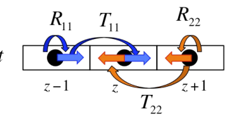
- A general 1-D QW with a unitary 2×2 coin matrix \(B_{j,n}\in U(2)\) is shown to correspond one-to-one with discretizations of the Dirac equation with a space-time dependent mass matrix.
- For the split-operator discretization, the paper derives an exact mapping from the Dirac mass terms \(M_{j,n}\) to QW parameters \(\xi_{j,n}, \alpha_{j,n}, \beta_{j,n}, \theta_{j,n}\); when \(M_0=0\), the QW reduces to \(SU(2)\).
- For the free massive Dirac case, the QLB transfer matrix is given explicitly, and the mapping to QW is exact for any mass \(m\).
- In curved space-time, the QLB-like discretization preserves a QW structure, but a residency matrix \(R\) appears; this matrix vanishes on a uniform mesh (no gravity).
## Methods
- Review-and-derivation paper: it develops formal correspondences between continuous Dirac dynamics, operator-splitting schemes, QLB schemes, and QW formulations.
- The main analysis uses operator splitting, Crank-Nicolson time marching, and finite-volume discretization to rewrite the Dirac equation as a stream-collide update with unitary matrices.
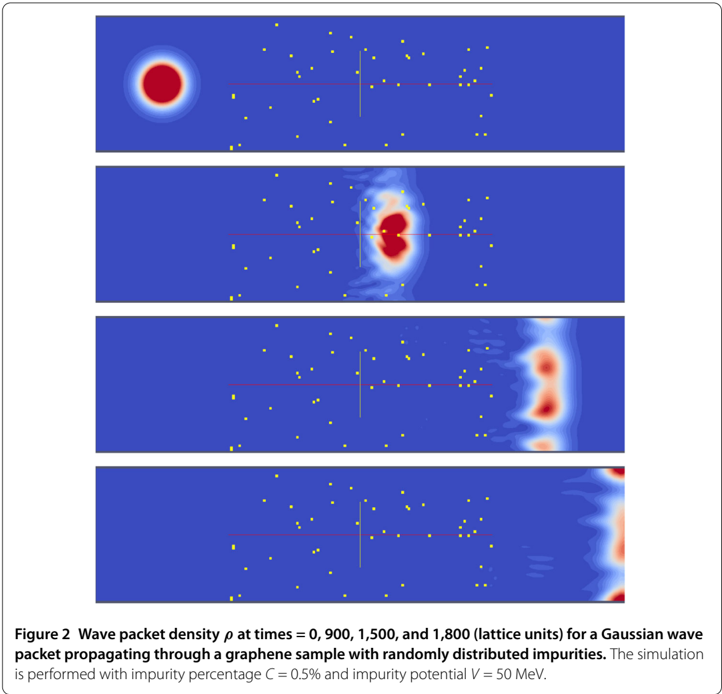
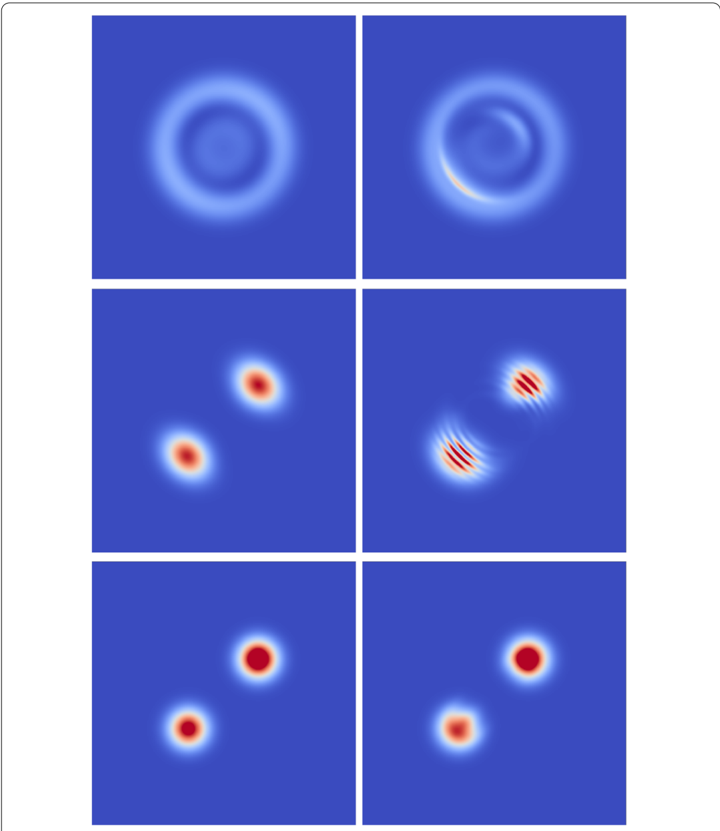
- The paper also presents numerical illustrations in 2+1 and 3+1 space-time dimensions, including graphene with random impurities and a Dirac equation with Nambu–Jona-Lasinio interactions.
## Limitations
- The paper itself says the curved-space construction focuses on mathematical structure rather than numerical properties; convergence and stability are explicitly deferred to future work.
- It says the multi-dimensional QLB-QW equivalence “will be discussed in a future publication,” and that a similar analysis in two spatial dimensions for the NJL case “remains to be developed.”
- Evident from the text: several displayed equations and parameter values are mangled in the provided full text, so some formulas/numbers are not fully legible in this copy.
Model-written summary. Check it against the paper before relying on it.
Integrity signals
Registry
Cites
Statistics
Figures

Verification
Claims the paper makes
2 Valid · 1 Not valid · 9 Not checked · 59 Own results and interpretations
The cited sources support only part of this claim — read each source’s verdict below.
In the paper
“The Dirac equation with a NJL interaction term driven by the coupling parameter g, reads as follows”
§ Quantum lattice Boltzmann is a quantum walk > .. Nambu-Jona-Lasinio interaction
What the sources say
- Partly supportedcites [42] 42. Nambu Y, Jona-Lasinio G. Dynamical model of elementary particles based on an analogy with superconductivity. I. Phys Rev. 1961;122:345-58. sourceExperimental — accuracy not yet measured
Our copy does establish the NJL content attributed to this source: Sec. II 'The Primary Interaction' assumes the γ5-invariant nonlinear fermion Lagrangian with coupling g0 (positive, dimensions [mass]^-1 per the OCR) and its Fierz-equivalent form, Eqs. (2.6)-(2.7), and Sec. III introduces the coupling constant g in the fermion's equation, 'zy p+mp+Z(p m gA)=0' with Z = 2g0[Tr S(0) - γ5 Tr S(0)γ5 - ...] (Eqs. 3.1, 3.4). However, the paper never writes the equation of motion in the nonlinear Dirac form quoted by the citing sentence, (iγ∂ - m)ψ + g[(ψ̄ψ)ψ + (ψ̄γ5ψ)γ5ψ] = 0; its Dirac equation (3.11a) is linear, (γ∂ + m)ψ_m(x) = 0, with the scalar and pseudoscalar four-fermion terms entering only through the cutoff-regularised lowest-order self-energy. So the interaction structure and coupling are supported, but the specific closed nonlinear equation is not stated in our copy. (LLM, conf=0.72)
plain- Asserted: passes — The authors put it forward as true.
- Checkable: passes — It can be checked against evidence.
- Load-bearing: unclear — It is unclear whether the paper’s conclusions depend on it.
- Based: passes — The paper gives a reason why it holds.
- Partly supported
A result the paper states — it cites no source for it, so there is none to check. The quote shows it is in the paper.
In the paper
“It is possible, however, to recover a stable and norm-preserving method.Instead of using the 'naive' LB equation discretization given in Eq. (), the mass term on the right-hand side of Eq. () is discretized by using an implicit Crank-Nicolson average:”
§ Quantum lattice Boltzmann is a quantum walk > 4 Quantum lattice Boltzmann, operator splitting and quantum walks
hedgedstates a cause- Asserted: passes — The authors put it forward as true.
- Checkable: passes — It can be checked against evidence.
- Load-bearing: passes — The paper’s conclusions depend on it.
- Based: passes — The paper gives a reason why it holds.
A result the paper states — it cites no source for it, so there is none to check. The quote shows it is in the paper.
In the paper
“These relations give a correspondence between the QLB technique and the QW.”
§ Quantum lattice Boltzmann is a quantum walk > 4 Quantum lattice Boltzmann, operator splitting and quantum walks
plainstates an association- Asserted: passes — The authors put it forward as true.
- Checkable: passes — It can be checked against evidence.
- Load-bearing: passes — The paper’s conclusions depend on it.
- Based: passes — The paper gives a reason why it holds.
A result the paper states — it cites no source for it, so there is none to check. The quote shows it is in the paper.
In the paper
“When M = , one recovers the SU() QW because then, B := B | M = ∈ SU().”
§ Quantum lattice Boltzmann is a quantum walk > 3 Split-operator and quantum walks
plainstates a cause- Asserted: passes — The authors put it forward as true.
- Checkable: passes — It can be checked against evidence.
- Load-bearing: passes — The paper’s conclusions depend on it.
- Based: passes — The paper gives a reason why it holds.
None of the sources cited for this claim have been checked yet.
In the paper
“The discretization presented in this work extends to the D+ dimensional case by applying the notion of operator splitting.”
§ Quantum lattice Boltzmann is a quantum walk > 8 Multi-dimensions
plainstates a cause- Asserted: passes — The authors put it forward as true.
- Checkable: passes — It can be checked against evidence.
- Load-bearing: unclear — It is unclear whether the paper’s conclusions depend on it.
- Based: passes — The paper gives a reason why it holds.
47 more claims
Create a free account to see all 71 claims and to verify the 4 references still open.
- It may state two separate claims as one. 12
- Probably not a substantial claim. 8
Claims other papers make about this one
Each is checked against this paper’s own text: does it say what the citing paper says it does?
The cited source says what the claim attributes to it.
In the citing paper
“In this direction, one of the recent result shows that the discretization of DE on the quantum lattice Boltzmann falls within the class of QW52.”
From Dirac Cellular Automaton from Split-step Quantum Walk (2016) · cites this paper as [52]
Citations
Cites
Geim, A. K., & Novoselov, K. S. (2007) · Nature Materials · doi:10.1038/nmat1849 · Cited by 39,979
Quantum Mechanics and Path Integrals
(1966) · Students Quarterly Journal · doi:10.1049/sqj.1966.0063 · Cited by 9,537
LATTICE BOLTZMANN METHOD FOR FLUID FLOWS
Chen, S., & Doolen, G. D. (1998) · Annual Review of Fluid Mechanics · doi:10.1146/annurev.fluid.30.1.329 · Cited by 7,314
Finite Volume Methods for Hyperbolic Problems
LeVeque, R. J. (2002) · Cambridge University Press eBooks · doi:10.1017/cbo9780511791253 · Cited by 6,313
Dynamical Model of Elementary Particles Based on an Analogy with Superconductivity. I
Nambu, Y., & Jona-Lasinio, G. (1961) · Physical Review · doi:10.1103/physrev.122.345 · Cited by 5,501
Lattice BGK Models for Navier-Stokes Equation
Qian, Y. H., D'Humières, D., & Lallemand, P. (1992) · Europhysics Letters (EPL) · doi:10.1209/0295-5075/17/6/001 · Cited by 5,303
Evidence for wavelike energy transfer through quantum coherence in photosynthetic systems
Engel, G. S., Calhoun, T. R., Read, E. L., Ahn, T.-K., Mančal, T., Cheng, Y.-C., Blankenship, R. E., & Fleming, G. R. (2007) · Nature · doi:10.1038/nature05678 · Cited by 3,315 · cited 1×
“Moreover, QW’s are amenable to a number of experimental realizations, such as ion traps [3, 4, 5], liquid-state nuclear-magnetic-resonance quantum-information processor [6], photonic devices [7] and other types of optical devices [8].”
BackgroundDynamical Model of Elementary Particles Based on an Analogy with Superconductivity. II
Nambu, Y., & Jona-Lasinio, G. (1961) · Physical Review · doi:10.1103/physrev.124.246 · Cited by 2,412
Decoherence and the Appearance of a Classical World in Quantum Theory
Joos, E., Zeh, H. D., Kiefer, C., Giulini, D., Kupsch, J., & Stamatescu, I.-O. (2003) · doi:10.1007/978-3-662-05328-7 · Cited by 2,121
He, X., & Luo, L.-S. (1997) · Physical Review E · doi:10.1103/physreve.56.6811 · Cited by 1,744
Extremely high-intensity laser interactions with fundamental quantum systems
Di Piazza, A., Müller, C., Hatsagortsyan, K. Z., & Keitel, C. H. (2012) · Reviews of Modern Physics · doi:10.1103/revmodphys.84.1177 · Cited by 1,725
Aharonov, Y., Davidovich, L., & Zagury, N. (1993) · Physical Review A · doi:10.1103/physreva.48.1687 · Cited by 1,622
Decoherence and the Appearance of a Classical World in Quantum Theory
Giulini, D., Joos, E., Kiefer, C., Kupsch, J., Stamatescu, I.-O., & Zeh, H. D. (1996) · Springer eBooks · doi:10.1007/978-3-662-03263-3 · Cited by 1,089
Aspuru-Guzik, A., & Walther, P. (2012) · Nature Physics · doi:10.1038/nphys2253 · Cited by 952 · cited 1×
“Moreover, QW’s are amenable to a number of experimental realizations, such as ion traps [3, 4, 5], liquid-state nuclear-magnetic-resonance quantum-information processor [6], photonic devices [7] and other types of optical devices [8].”
BackgroundExponential algorithmic speedup by a quantum walk
Childs, A. M., Cleve, R., Deotto, E., Farhi, E., Gutmann, S., & Spielman, D. A. (2003) · Proceedings of the thirty-fifth annual ACM symposium on Theory of computing · doi:10.1145/780542.780552 · Cited by 825 · cited 1×
“using exponentially less operations than classical computations [2].”
MethodQuantum simulation of the Dirac equation
Gerritsma, R., Kirchmair, G., Zähringer, F., Solano, E., Blatt, R., & Roos, C. F. (2010) · Nature · doi:10.1038/nature08688 · Cited by 725 · cited 1×
“Moreover, QW’s are amenable to a number of experimental realizations, such as ion traps [3, 4, 5], liquid-state nuclear-magnetic-resonance quantum-information processor [6], photonic devices [7] and other types of optical devices [8].”
BackgroundAn Introduction to Quantum Computing
Kaye, P., Laflamme, R., & Mosca, M. (2006) · Oxford University Press eBooks · doi:10.1093/oso/9780198570004.001.0001 · Cited by 714
From quantum cellular automata to quantum lattice gases
Meyer, D. A. (1996) · Journal of Statistical Physics · doi:10.1007/bf02199356 · Cited by 556 · cited 1×
“Both operations are unitary and can be encoded in logical gates for quantum computing purposes [34, 35].”
BackgroundRealization of a Quantum Walk with One and Two Trapped Ions
Zähringer, F., Kirchmair, G., Gerritsma, R., Solano, E., Blatt, R., & Roos, C. F. (2010) · Physical Review Letters · doi:10.1103/physrevlett.104.100503 · Cited by 531
Quantum Walk of a Trapped Ion in Phase Space
Schmitz, H., Matjeschk, R., Schneider, C., Glueckert, J., Enderlein, M., Huber, T., & Schaetz, T. (2009) · Physical Review Letters · doi:10.1103/physrevlett.103.090504 · Cited by 462
Ryan, C. A., Laforest, M., Boileau, J. C., & Laflamme, R. (2005) · Physical Review A · doi:10.1103/physreva.72.062317 · Cited by 280 · cited 2×
“Moreover, QW’s are amenable to a number of experimental realizations, such as ion traps [3, 4, 5], liquid-state nuclear-magnetic-resonance quantum-information processor [6], photonic devices [7] and other types of optical devices [8].”
BackgroundLattice Boltzmann equation for quantum mechanics
Succi, S., & Benzi, R. (1993) · Physica D: Nonlinear Phenomena · doi:10.1016/0167-2789(93)90096-j · Cited by 217 · cited 4×
“These numerical methods have been developed and employed as efficient numerical tools to solve relativistic quantum mechanics problems on classical computers [17, 18, 19].”
MethodInfluentialThe lattice Boltzmann equation on irregular lattices
Nannelli, F., & Succi, S. (1992) · Journal of Statistical Physics · doi:10.1007/bf01341755 · Cited by 206
Self-citationWeyl, Dirac, and Maxwell equations on a lattice as unitary cellular automata
Bialynicki-Birula, I. (1994) · Physical Review D · doi:10.1103/physrevd.49.6920 · Cited by 195
Exponential algorithmic speedup by a quantum walk
Childs, A. M., Cleve, R., Deotto, E., Farhi, E., Gutmann, S., & Spielman, D. A. (2003) · Proceedings of the thirty-fifth ACM symposium on Theory of computing - STOC '03 · doi:10.1145/780551.780552 · Cited by 134
Lattice Boltzmann method on unstructured grids: Further developments
Ubertini, S., Bella, G., & Succi, S. (2003) · Physical Review E · doi:10.1103/physreve.68.016701 · Cited by 128 · cited 1×
“For this purpose, several finite-volume LB (FVLB) schemes have been formulated, whose main outcome is that the streaming operator is no longer a diagonal matrix with eigenvalues ±1, as required by the formal QLB structure [37, 38].”
MethodSelf-citationOptimizing the discrete time quantum walk using a SU(2) coin
Chandrashekar, C. M., Srikanth, R., & Laflamme, R. (2008) · Physical Review A · doi:10.1103/physreva.77.032326 · Cited by 122
Simulating quantum mechanics on a quantum computer
Boghosian, B. M., & Taylor, W. (1998) · Physica D: Nonlinear Phenomena · doi:10.1016/s0167-2789(98)00042-6 · Cited by 120 · cited 1×
“Both operations are unitary and can be encoded in logical gates for quantum computing purposes [34, 35].”
BackgroundThe Dirac equation as a quantum walk: higher dimensions, observational convergence
Arrighi, P., Nesme, V., & Forets, M. (2014) · Journal of Physics A: Mathematical and Theoretical · doi:10.1088/1751-8113/47/46/465302 · Cited by 114
Numerical solution of the time-dependent Dirac equation in coordinate space without fermion-doubling
Fillion-Gourdeau, F., Lorin, E., & Bandrauk, A. D. (2012) · Computer Physics Communications · doi:10.1016/j.cpc.2012.02.012 · Cited by 97
Self-citationQuantum walks as massless Dirac fermions in curved space-time
Di Molfetta, G., Brachet, M., & Debbasch, F. (2013) · Physical Review A · doi:10.1103/physreva.88.042301 · Cited by 94
Quantum walks in artificial electric and gravitational fields
Di Molfetta, G., Brachet, M., & Debbasch, F. (2014) · Physica A: Statistical Mechanics and its Applications · doi:10.1016/j.physa.2013.11.036 · Cited by 93 · cited 19×
“2 Quantum walks Let us consider a (1 + 1) quantum walk on the line for a pair of complex wave functions (bi-spinor ψ), obeying a discrete space-time evolution equations described by the following discrete map [10, 11, 12, 20]: [ ψ 1,j ψ 2,j ] = Bj,n [ ψ 1,j−1 ψ 2,j+1 ]”
BackgroundMethodResultInfluentialFeynman's relativistic chessboard as an ising model
Gersch, H. A. (1981) · International Journal of Theoretical Physics · doi:10.1007/bf00669436 · Cited by 67
Quantum Simulator for Transport Phenomena in Fluid Flows
Mezzacapo, A., Sanz, M., Lamata, L., Egusquiza, I. L., Succi, S., & Solano, E. (2015) · Scientific Reports · doi:10.1038/srep13153 · Cited by 60
Self-citationDiscrete-time quantum walks: Continuous limit and symmetries
di Molfetta, G., & Debbasch, F. (2012) · Journal of Mathematical Physics · doi:10.1063/1.4764876 · Cited by 60 · cited 6×
“2 Quantum walks Let us consider a (1 + 1) quantum walk on the line for a pair of complex wave functions (bi-spinor ψ), obeying a discrete space-time evolution equations described by the following discrete map [10, 11, 12, 20]: [ ψ 1,j ψ 2,j ] = Bj,n [ ψ 1,j−1 ψ 2,j+1 ]”
BackgroundMethodInfluentialQuantum Mechanics and Path Integrals
Feynman, R. P., Hibbs, A. R., & Weiss, G. H. (1966) · Physics Today · doi:10.1063/1.3048320 · Cited by 48
Fillion-Gourdeau, F., Herrmann, H. J., Mendoza, M., Palpacelli, S., & Succi, S. (2013) · Physical Review Letters · doi:10.1103/physrevlett.111.160602 · Cited by 31 · cited 5×
“Details on the numerical methods used to obtain these results are given in [18, 19, 40].”
MethodResultInfluentialSelf-citationA simple and accurate mixed solver for the Maxwell–Dirac equations
Lorin, E., & Bandrauk, A. D. (2010) · Nonlinear Analysis Real World Applications · doi:10.1016/j.nonrwa.2010.06.007 · Cited by 29
Kinetic Formulation of the Kohn-Sham Equations forab initioElectronic Structure Calculations
Mendoza, M., Sauro Succi, A., & Herrmann, H. J. (2014) · Physical Review Letters · doi:10.1103/physrevlett.113.096402 · Cited by 20
Self-citationKLEIN TUNNELING IN THE PRESENCE OF RANDOM IMPURITIES
PALPACELLI, S., Mendoza, M., Herrmann, H. J., & Succi, S. (2012) · International Journal of Modern Physics C · doi:10.1142/s0129183112500805 · Cited by 19
Self-citationLattice Boltzmann method for quantum field theory
Succi, S. (2007) · Journal of Physics A Mathematical and Theoretical · doi:10.1088/1751-8113/40/26/f07 · Cited by 8
Self-citationONE-DIMENSIONAL QUANTUM LATTICE BOLTZMANN SCHEME FOR THE NONLINEAR DIRAC EQUATION
Palpacelli, S., Romatschke, P., & Succi, S. (2013) · International Journal of Modern Physics C · doi:10.1142/s0129183113400019 · Cited by 5
Self-citationKinetic Approach to Lattice Quantum Mechanics
Succi, S. (2002) · Lecture notes in computer science · doi:10.1007/3-540-45830-1_11 · Cited by 3
Self-citationThe rise of graphenePreprint
Geim, A. K., & Novoselov, K. S. (2007) · arXiv (Cornell University) · doi:10.48550/arxiv.cond-mat/0702595 · Cited by 2
Quantum Simulator for Transport Phenomena in Fluid Flows
Mezzacapo, A., Sanz, M., Lamata, L., et al. (2015) · arXiv · doi:10.48550/arxiv.1502.00515
Hamiltonian Formulation of Quantum Mechanics
Giulini, D. (2003) · Decoherence and the Appearance of a Classical World in Quantum Theory · doi:10.1007/978-3-662-05328-7_14
Research works printed but not linked: 3
- 22. Gilmore R. Lie groups, Lie algebras, and some of their applications. New York: Dover; 2012.
- 25. Succi S. The Lattice-Boltzmann equation. Oxford: Oxford University Press; 2001.
- 34. Meyer D. From quantum cellular automata to quantum lattice gases. J Stat Phys. 1996;85(5-6):551-74. · DOI · Paper page
Cited by
Quantum walks as simulators of neutrino oscillations in a vacuum and matter
Molfetta, G. D., & Pérez, A. (2016) · New Journal of Physics · doi:10.1088/1367-2630/18/10/103038 · Cited by 70
Quantum walking in curved spacetime
Arrighi, P., Facchini, S., & Forets, M. (2016) · Quantum Information Processing · doi:10.1007/s11128-016-1335-7 · Cited by 63
“[22], is within the framework of lattice discretization of the relativistic quantum wave equation (quantum lattice Boltzmann [25]).”
Quantum walks and discrete gauge theories
Arnault, P., & Debbasch, F. (2016) · Physical Review A · doi:10.1103/physreva.93.052301 · Cited by 69
Quantum walks and non-Abelian discrete gauge theory
Arnault, P., Molfetta, G. D., Brächet, M., & Debbasch, F. (2016) · Physical Review A · doi:10.1103/physreva.94.012335 · Cited by 74
Dirac Cellular Automaton from Split-step Quantum Walk
Mallick, A., & Chandrashekar, C. M. (2016) · Scientific Reports · doi:10.1038/srep25779 · Cited by 45
“φ φ φ φ = = = + = = + − + − ˆ ˆ ⁎ ⁎ R I c c t A t c c t A t 2 [ ( ( 0) ( 0) )] [ ( ( 0) ( 0) )] , (52) SQW k k k k 1 2 2 1 2 2 where,”
Metadata
- Authors
- Succi, S., Fillion-Gourdeau, F., & Palpacelli, S.
- Venue
- EPJ Quantum Technology
- Published
- 2015-05-16
- Volume
- 2
- Issue
- 1
- ISSN
- 2196-0763 (ISSN-L)
- OpenAlex
- W1534322248
- Semantic Scholar
- 869383e9528d5eec31f08290904a31ed74637f56
- Cited by
- 45
- References
- 36
- Citations by year
- 2026: 2 · 2025: 3 · 2024: 5 · 2023: 6 · 2022: 4 · 2021: 2 · 2020: 2 · 2019: 5 · 2018: 4 · 2017: 4 · 2016: 6 · 2015: 1
- FWCI
- 4.90
- Type
- journal article
- Language
- en
- Open access
- gold
- doi.org
- Locations
- EPJ Quantum Technology (publishedVersion, cc-by)
- arXiv (Cornell University) (submittedVersion)
- arXiv (Cornell University)
- Topics
- Physical Sciences › Computer Science › Artificial Intelligence › Quantum Computing Algorithms and Architecture
- Physical Sciences › Engineering › Computational Mechanics › Lattice Boltzmann Simulation Studies
- Physical Sciences › Mathematics › Numerical Analysis › Numerical Solvers for Ordinary Differential Equations
- Keywords
- quantum walks, Dirac equation, operator splitting, curved space, relativistic quantum dynamics, quantum simulation, lattice Boltzmann method
About these checks
Registry, retraction, Cites and statistics results are computed, not judged, with one exception: a printed reference that no index lists is read once by a model before it counts as a citation error. Claims are extracted by a model and kept only when their quote appears verbatim in the text; each cited source is then checked, with a model’s help, for whether it says what the claim relies on. Those verdicts can be wrong — read the claim’s quote and the cited source before relying on one.
The claim verdicts this report counts are experimental: their accuracy is not yet measured.
A language model drew the claims from the paper on 2026-10-10, under version 3 of the claim definition (model deepseek-v4.1-flash, prompt extract-v3).
A second model labelled each claim on 2026-10-10 (model jev-1.13-20260917, definition revision gold-guideline-v0.2).
Cited sources are checked with a language model’s help (qwen3.8-omni-flash).
Statistics and arithmetic are recomputed, not judged.
Confidence bands are shown only for fields calibrated on our annotated test set. None is calibrated yet, so no band is shown.
What counts as a claim ›How we measure confidence ›How we check this ›
Are you an author, or do you see a problem with this page? Request a review
Data sources
Bibliographic data: Semantic Scholar, OpenAlex, Crossref.
Contains information from the Semantic Scholar Academic Graph Datasets, made available under the ODC Attribution License (ODC-BY 1.0).
Semantic Scholar’s data is described in: Kinney, R., et al. (2023). The Semantic Scholar Open Data Platform. arXiv:2301.10140.
