

Jurassic evolution of the Arabian carbonate platform edge in the central Oman Mountains
Open accessThe DOI matches its Crossref record; 41 of the 46 references it cites were found in a registry or an index.
Abstract
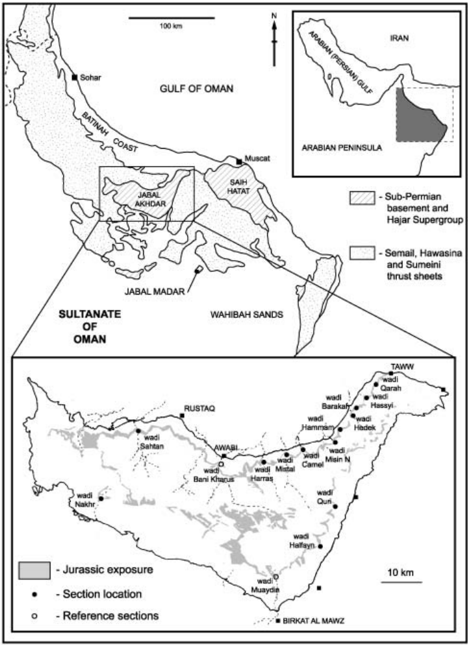
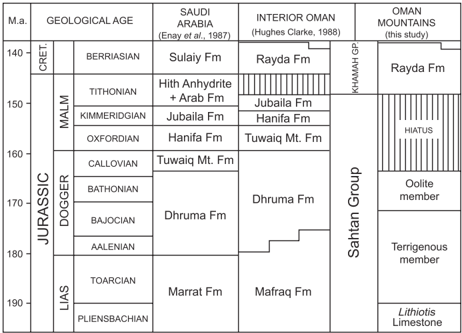
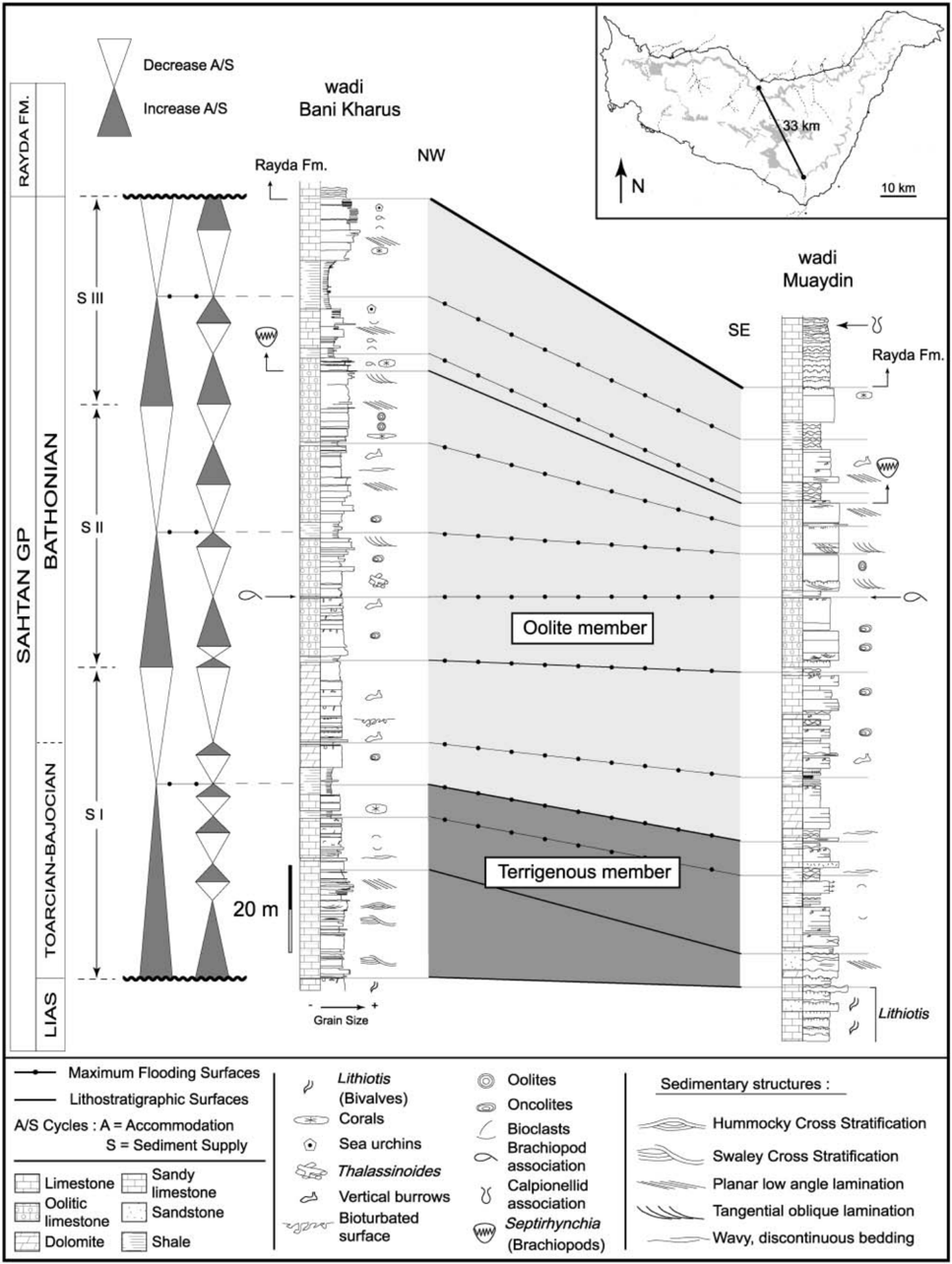
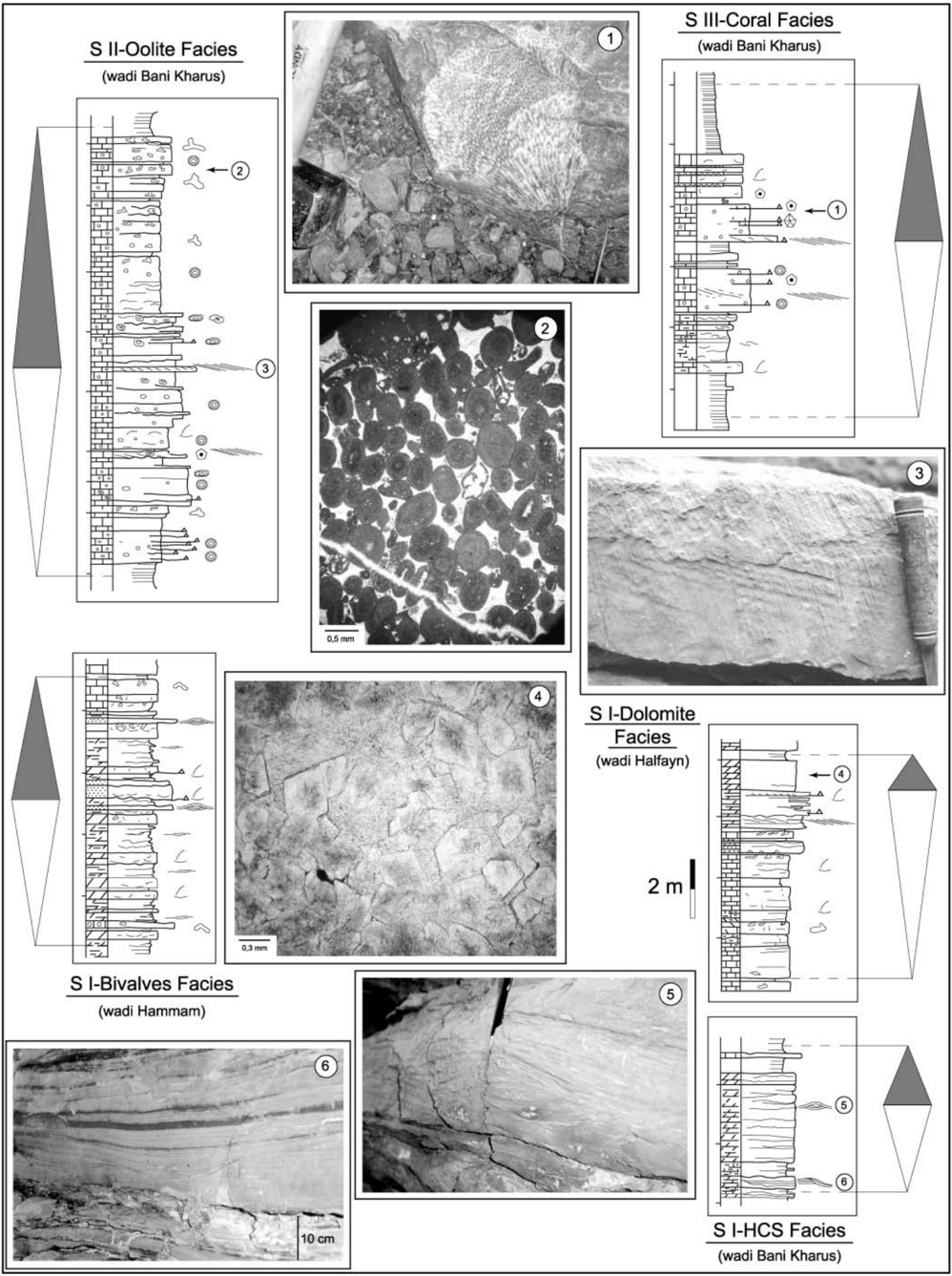
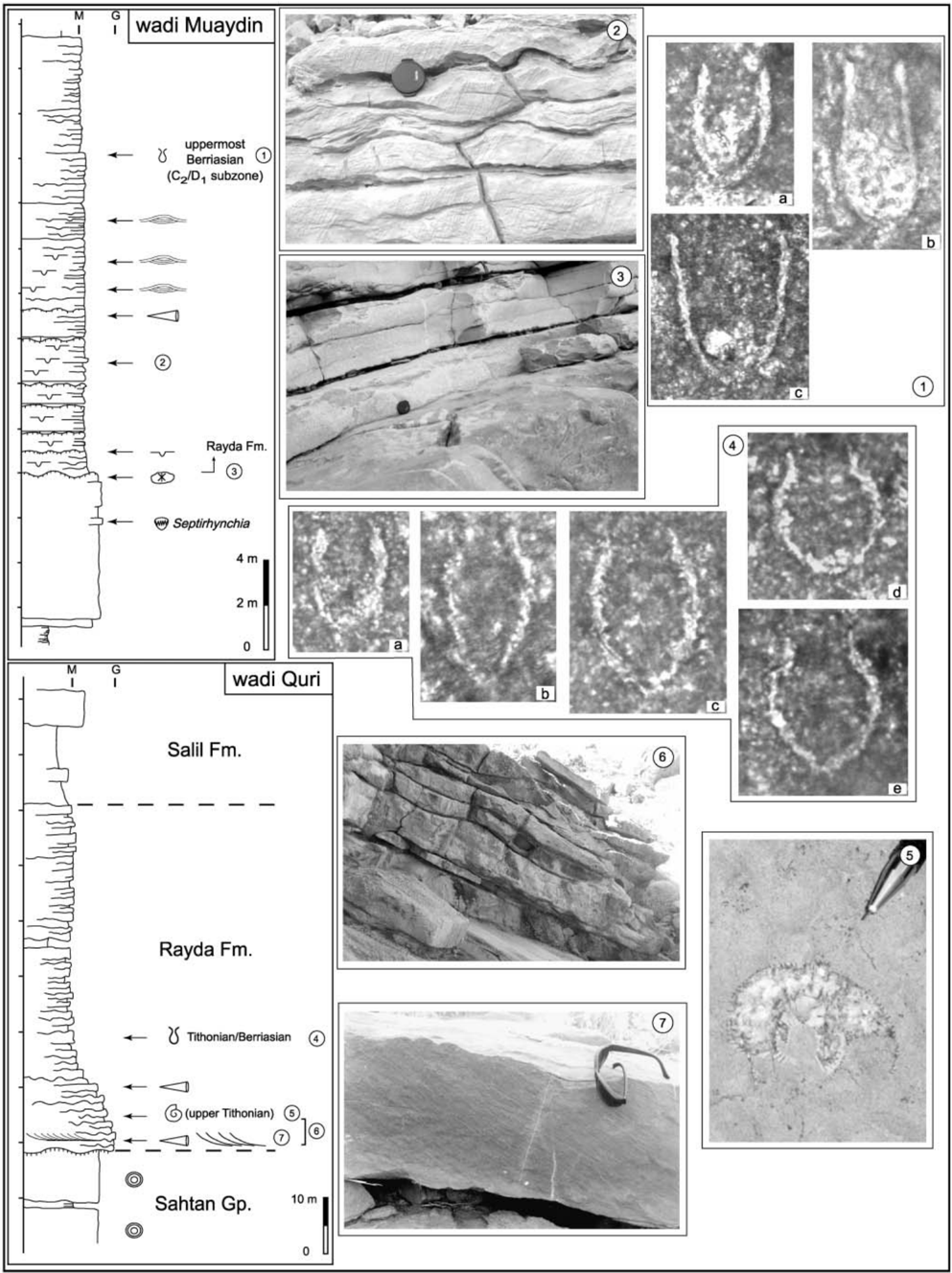
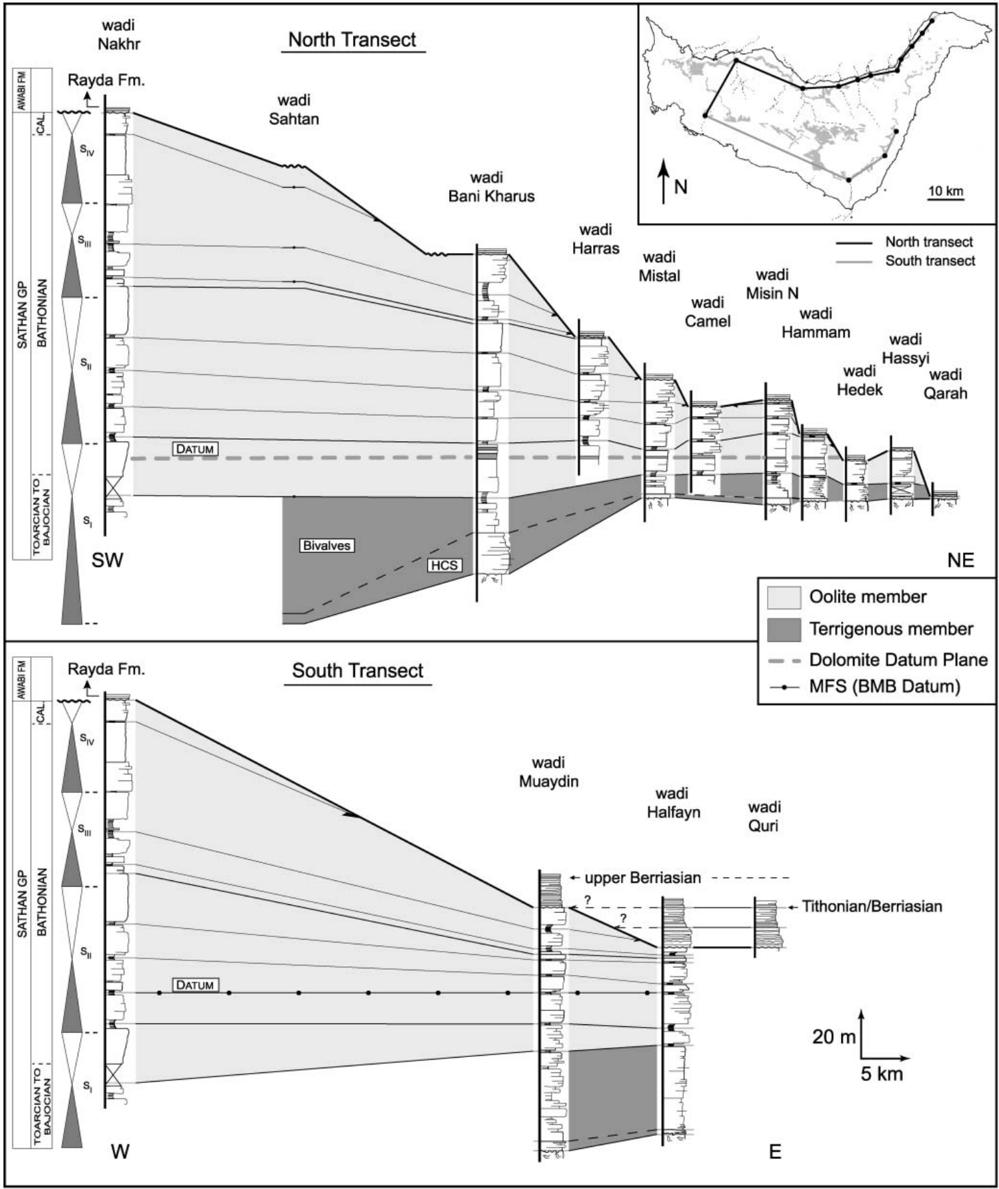
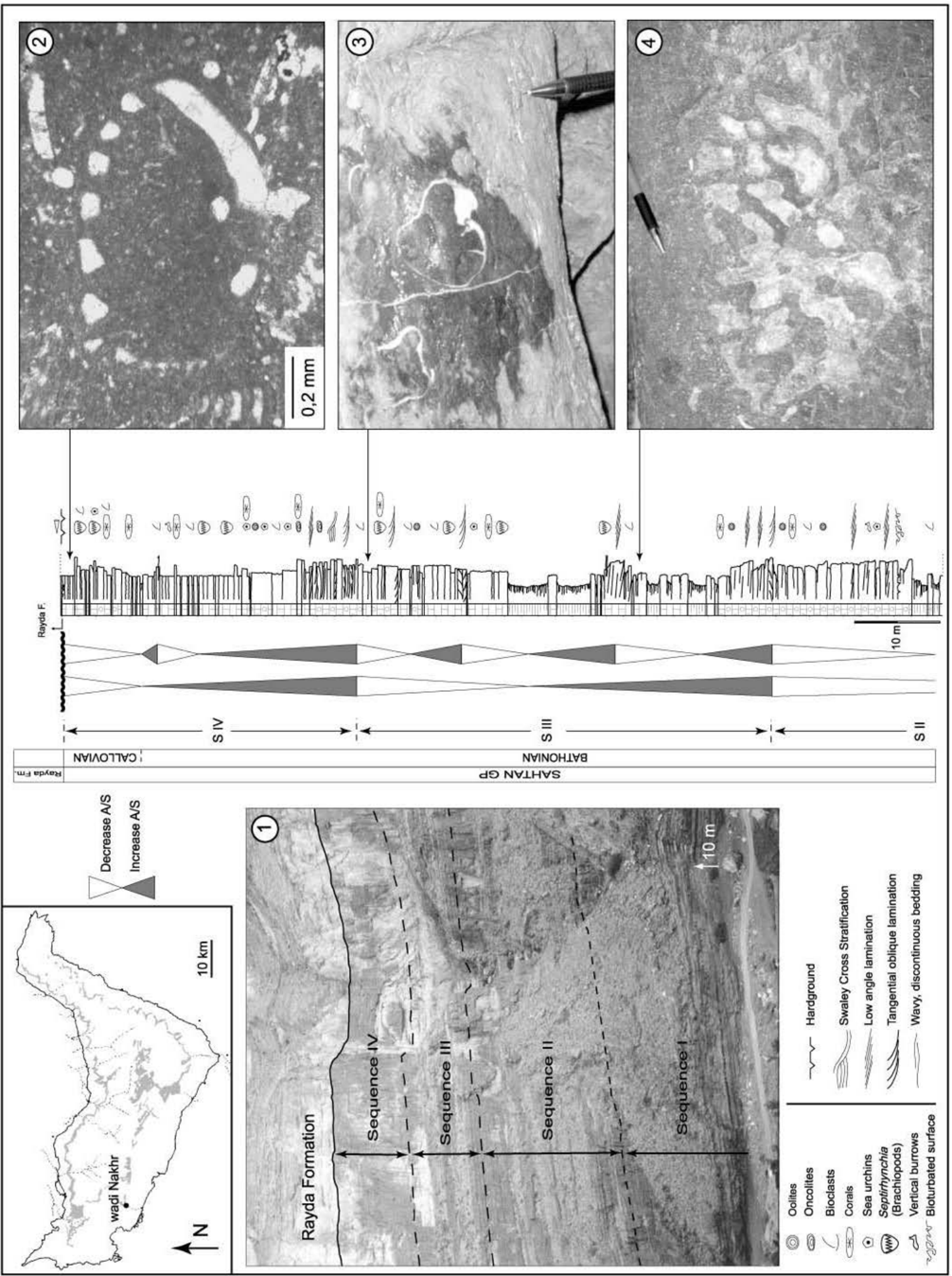
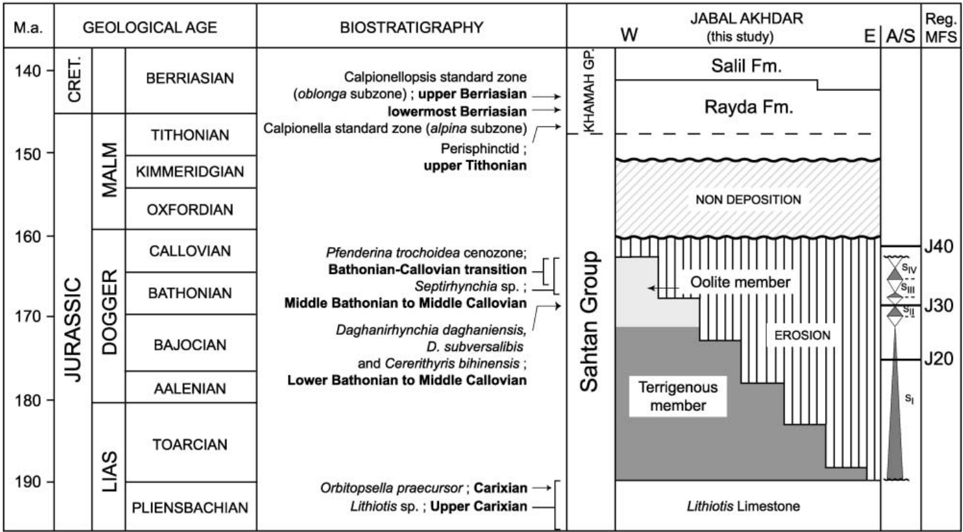
The Jurassic Sahtan Group exposed in northern Oman was deposited in shallow marine environments at the edge of the Arabian Platform facing the Neo-Tethys (Hamrat Duru Basin). The upper Sahtan Group is made up of a mixed siliciclastic–carbonate unit overlain by pure carbonate deposits, assigned to a Bathonian and Early Callovian age on the basis of brachiopods and foraminifers. These carbonate depositional systems were composed of outer oolitic shoals that underwent subaerial exposure, and a deeper, somewhat restricted, gently dipping shelf interior. Oolitic material was shed off the platform edge into the deep-sea depositional complex of the Guweyza Formation. The Sahtan Group is affected by an important thickness reduction towards northeastern Jabal Akhdar. The angular unconformity (0.2%) at the top of the Sahtan Group is shown to result from tilting and top truncation of genetic sequences. This unconformity is overlain by the Rayda Formation, a veneer that shows an onlap pattern including a gradual deepening upwards facies evolution. The minimal time span of the stratigraphic hiatus is Mid-Callovian–Kimmeridgian. Oxfordian and Kimmeridgian sequences were probably never deposited in this area because of lack of accommodation space and/or because of subaerial exposure. It is proposed herein that the unconformity was shaped by subaerial carbonate dissolution during a steady, tectonically driven exhumation of the platform edge. During the Tithonian, a major eustatic sea-level rise caused transgression of the Rayda Formation upon the platform edge and normal shelf marine conditions resumed in the eastern Arabian Peninsula.
Overview
The claims and statistics of this paper haven’t been checked yet.
Free: it reads the open-access text and checks the first 5 claims that cite a source we can check. Create a free account to check every claim.
Integrity signals
Registry
Cites
Statistics
Figures
Verification
Claims the paper makes
The claims and statistics of this paper haven’t been checked yet.
Free: it reads the open-access text and checks the first 5 claims that cite a source we can check. Create a free account to check every claim.
Claims other papers make about this one
Each is checked against this paper’s own text: does it say what the citing paper says it does?
The source backs part of the claim, not all of it — or backs it for a different population, condition or comparison.
In the citing paper
“Meanwhile, the Middle to Upper Jurassic Sahtan Group in this area is composed of ~30 to 400 m thick carbonate units [42].”
From Clumped Isotope Reordering and Kinetic Differences in Co-Hosted Calcite and Dolomite Minerals throughout Burial Diagenesis and Exhumation (2023) · cites this paper as [42]
Experimental — accuracy not yet measured
Self-check
Percentages, sums and reported differences re-computed from the paper’s own numbers.
The self-check needs the paper’s full text.
Citations
Cites
CRUST 5.1: A global crustal model at 5° × 5°
Mooney, W. D., Laske, G., & Masters, T. G. (1998) · Journal of Geophysical Research: Solid Earth · doi:10.1029/97jb02122 · Cited by 1,029 · cited 1×
“…in some isostatic re-equilibrium as a result of a former regional thickening of the crust, which is still detectable beneath the Oman Mountains: 42–55 km according to Al-Lazki et al. (2002) against a typical value of 30–40 km for Palaeozoic and Mesozoic regions (Tanimoto 1995; Mooney et al. 1998).”
BackgroundGradstein, F. M., Agterberg, F. P., Ogg, J. G., Hardenbol, J., van Veen, P., Thierry, J., & Huang, Z. (1994) · Journal of Geophysical Research: Solid Earth · doi:10.1029/94jb01889 · Cited by 821
Middle East: Stratigraphic Evolution and Oil Habitat
(2), R. J. M. (1980) · AAPG Bulletin · doi:10.1306/2f918a8b-16ce-11d7-8645000102c1865d · Cited by 782 · cited 2×
“A possible mechanism for the uplift of the platform edge could be some salt mobilization in the Infracambrian to Cambrian Ara Formation of the Huqf Group, because of the relative proximity of the Fayud salt basin (Murris 1980).”
BackgroundThe stratigraphic signatures of tectonics, eustacy and sedimentology - an overview
Vail, P. R. (1991) · Medical Entomology and Zoology · Cited by 757
THE GEOLOGY OF THE OMAN MOUNTAINS
Glennie, K. W. (1996) · Journal of Petroleum Geology · doi:10.1111/j.1747-5457.1996.tb00520.x · Cited by 590 · cited 2×
“Stratigraphic setting The first stratigraphic synthesis and nomenclature of the Mesozoic autochthonous terrain in Oman was produced by Glennie et al. (1974) (Fig.”
BackgroundDonovan, D. T., & Arkell, W. J. (1957) · The Geographical Journal · doi:10.2307/1790757 · Cited by 508 · cited 2×
“Toarcian) with a regional Middle East transgression (Arkell 1956; Enay et al. 1987).”
BackgroundSTRATIGRAPHY AND ROCK UNIT NOMENCLATURE IN THE OIL‐PRODUCING AREA OF INTERIOR OMAN
Clarke, M. W. H. (1988) · Journal of Petroleum Geology · doi:10.1111/j.1747-5457.1988.tb00800.x · Cited by 346
A REEVALUATION OF JURASSIC EUSTASY IN THE LIGHT OF NEW DATA AND THE REVISED EXXON CURVE
HALLAM, A. (1988) · Sea-Level Changes · doi:10.2110/pec.88.01.0261 · Cited by 301 · cited 1×
“Necessarily, this relative high elevation would have been tectonically created because the Late Jurassic was a time of high global sea level (Hallam 1988).”
BackgroundIce age at the Middle–Late Jurassic transition?
Dromart, G., Garcia, J.-P., Picard, S., Atrops, F., Lécuyer, C., & Sheppard, S. M. F. (2003) · Earth and Planetary Science Letters · doi:10.1016/s0012-821x(03)00287-5 · Cited by 235 · cited 1×
“This major hiatus has been recently related to a general sea-level lowstand in association with the formation of high-latitude continental ice sheets (Dromart et al. 2003).”
BackgroundSelf-citationOoids in Purbeck limestones (lowermost Cretaceous) of the Swiss and French Jura
STRASSER, A. (1986) · Sedimentology · doi:10.1111/j.1365-3091.1986.tb01971.x · Cited by 184 · cited 4×
“These ooids belong to type 1 of Strasser (1986).”
BackgroundInfluential
Research works printed but not linked: 8
- Alme ´ras, Y. 1987. Les brachiopodes du Lias-Dogger: pale ´ontologie et biostrati- graphie. in: Le Jurassique d'Arabie Saoudite Centrale. Geobios, Me ´moire Spe ´cial, 9, 161-219.
- Benzaggagh, M. & Atrops, F. 1995. Donne ´es nouvelles sur la succession des calpionelles du Berriasien dans le Prerif et le Mesorif (Rif, Maroc). Comptes Rendus de l'Acade ´mie des Sciences, Se ´rie II, 321, 681-688.
- Cattaneo, G. 1991. Evolution se ´dimentaire et pale ´oge ´ographie du Jurassique supe ´rieur et du Cre ´tace ´basal de l'avant-pays rifain oriental (Maroc). Bulletin de la Socie ´te ´Ge ´ologique de France, 8, 69-78.
- Garcia, J.-P., Laurin, B. & Sambet, G. 1996. Les associations de brachiopodes du Jurassique moyen du bassin de Paris; une e ´chelle biochronologique ponctue ´e de niveaux-repe `res pour la contrainte des corre ´lations se ´quentielles a `haute re ´solution. Bulletin de la Socie ´te ´Ge ´ologique de France, 167, 435-451.
- Nazer, N. M. 1970. Rhynchonellid brachiopods of the Middle and Upper Jurassic of the Tuwaiq Mountains, Saudi Arabia. MSc thesis, Kansas University, Lawrence.
- Rabu, D. 1987. Ge ´ologie de l'autochtone des Montagnes d'Oman, la fene ˆtre du Djebel Akhdar. PhD thesis, Universite ´Pierre et Marie Curie, Paris.
- Remane, J., Bakalova, D. & Ivanova, D. et al. 1986. Agreement on the subdivision of the standard calpionellid zones defined at the IInd Planktonic Conference, Rome 1970. Acta Geologica Hungaria, 29, 5-14.
- Simmons, M.D. & Hart, M.B. 1987. The biostratigraphy and microfacies of the Early to mid-Cretaceous carbonates of Wadi Mi'aidin, central Oman Mountains. In: Hart, M.B. (ed.) Micropalaeontology of Carbonate Environ- ments. Ellis Horwood, Chichester, 176-207.
Cited by
Razin, P., Taati, F., & van Buchem, F. S. P. (2010) · Geological Society London Special Publications · doi:10.1144/sp329.9 · Cited by 137
“…in Oman (van Buchem et al. 2002a), the Barremian–Aptian Kharaib and Shuaiba Formations in Oman (e.g. Pittet et al. 2002; van Buchem et al. 2002b; Granier et al. 2004), the Jurassic Sahtan Group in Oman (Rousseau et al. 2005), and the lower Jurassic Calcaires d’Amelago in Morocco (Pierre 2006).”
BackgroundCalciclastic submarine fans: An integrated overview
Payros, A., & Pujalte, V. (2007) · Earth-Science Reviews · doi:10.1016/j.earscirev.2007.09.001 · Cited by 107
A mechanism for brief glacial episodes in the Mesozoic greenhouse
Donnadieu, Y., Dromart, G., Goddéris, Y., Pucéat, E., Brigaud, B., Dera, G., Dumas, C., & Olivier, N. (2011) · Paleoceanography · doi:10.1029/2010pa002100 · Cited by 92
Self-citationVahrenkamp, V., Laer, P. V., Franco, B. J., Celentano, M. A., Grélaud, C., & Razin, P. (2015) · International Petroleum Technology Conference · doi:10.2523/iptc-18470-ms · Cited by 54
Abdel-Fattah, Z. A., Gingras, M. K., Caldwell, M. W., Pemberton, S. G., & MacEachern, J. A. (2016) · Ichnos/Ichnos : an international journal for plant and animal traces · doi:10.1080/10420940.2016.1185010 · Cited by 43
“- Fitzsimmons & Johnson, 2000 Jurassic - Sahtan Group - Kap Stewart / Neill Klinter Fm contact - Oman, Middle East - East Greenland - Rousseau et al., 2005 - Dam, 1990 Triassic - German Muschelkalk - East Germany, Europe - Bertling, 1999 Permian - Parana intracratonic basin.”
BackgroundTectono‐Stratigraphic Evolution of the Foreland Fold‐and‐Thrust Belt of the United Arab Emirates
Abdelmaksoud, A. J., Ali, M. Y., & Searle, M. P. (2022) · Tectonics · doi:10.1029/2022tc007470 · Cited by 34
“A terrigenous system remained until the late Bajocian, after which carbonate sedimentation dominated over the platform margin throughout the Bathonian-early Callovian (Rousseau et al., 2005).”
BackgroundGerdes, K. D., Winefield, P., Simmons, M. D., & van Oosterhout, C. (2010) · Geological Society London Special Publications · doi:10.1144/sp329.2 · Cited by 33
“Deposition on the Arabian Shelf was characterized by relatively low accommodation space and sediment volumes.”
BackgroundInfluentialWadood, B., Khan, S., Li, H., Liu, Y., Ahmad, S., & Jiao, X. (2020) · Arabian Journal for Science and Engineering · doi:10.1007/s13369-020-04654-9 · Cited by 32
Holostratigraphy of the Kahmah regional Series in Oman, Qatar, and the United Arab Emirates
Granier, B. (2008) · Carnets de géologie (Notebooks on geology) · doi:10.4267/2042/19112 · Cited by 32
Stratigraphic organisation of the Jurassic sequence in Interior Oman, Arabian Peninsula
Rousseau, M., Dromart, G., Droste, H., & Homewood, P. W. (2006) · GeoArabia · doi:10.2113/geoarabia110117 · Cited by 32
Self-citationDujoncquoy, E., Grélaud, C., Razin, P., Imbert, P., van Buchem, F., Dupont, G., & Lebec, A. (2018) · AAPG Bulletin · doi:10.1306/04201715239 · Cited by 30
Al-Husseini, M. I., Matthews, R. K., & Mattner, J. (2006) · GeoArabia · doi:10.2113/geoarabia1101145 · Cited by 30
Late Jurassic to Cretaceous evolution of the eastern Tethyan Hawasina Basin (Oman Mountains)
Wohlwend, S., Celestino, R., Reháková, D., Huck, S., & Weissert, H. (2016) · Sedimentology · doi:10.1111/sed.12326 · Cited by 31
“Sedimentology © 2016 International Association of Sedimentologists, Sedimentology, 64, 87–110 platform during Bathonian–Oxfordian time (e.g. Rousseau et al., 2005) and represent reworked platform material formed during the erosional phase on the platform top.”
BackgroundThe Wadi ad Dawasir “delta”, central Saudi Arabia: A relative sea-level fall of Early Bathonian age
Énay, R., Mangold, C., Alméras, Y., & Hughes, G. W. (2009) · GeoArabia · doi:10.2113/geoarabia140117 · Cited by 29
Hosseini, S., Conrad, M. A., Clavel, B., & Carras, N. (2015) · Cretaceous Research · doi:10.1016/j.cretres.2015.09.007 · Cited by 27
Hughes, G. W., & Naji, N. (2008) · Volumina Jurassica · Cited by 30
Bendias, D., & Aigner, T. (2015) · GeoArabia · doi:10.2113/geoarabia200317 · Cited by 27
“Rousseau et al. (2005, 2006) studied the Sahtan Group in several outcrops (Wadi Bani Awf, Wadi Bani Kharuz, Jabal Madar, Al Huqf) and in the subsurface of Oman, and was the fi rst to publish sedimentological outcrop descriptions and outcrop/subsurface correlations.”
BackgroundRing, U., Glodny, J., Hansman, R. J., Scharf, A., Mattern, F., Callegari, I., van Hinsbergen, D. J. J., Willner, A. P., & Hong, Y. (2024) · Earth-Science Reviews · doi:10.1016/j.earscirev.2024.104711 · Cited by 24
Chapter 5 Tectonic evolution of the Oman Mountains
Scharf, A., Mattern, F., Al-Wardi, M., Frijia, G., Moraetis, D., Pracejus, B., Bauer, W., & Callegari, I. (2021) · Geological Society London Memoirs · doi:10.1144/m54.5 · Cited by 23
“Moreover, an unconformity related to tilting and erosion had formed between the Upper Jurassic and relatively deep-marine Upper Tithonian–Berriasian sedimentary rocks (Kahmah 1 & 2 Formation; Béchennec et al. 1992; Rousseau et al. 2005).”
BackgroundInfluentialWadood, B., Khan, S., Liu, Y., Li, H., & Rahman, A. (2020) · Geological Journal · doi:10.1002/gj.3968 · Cited by 22
Woor, S., Thomas, D. S. G., Durcan, J. A., Burrough, S. L., & Parton, A. (2023) · Quaternary Science Reviews · doi:10.1016/j.quascirev.2023.108384 · Cited by 23
Chapter 2 Tectonostratigraphy of the eastern part of the Oman Mountains
Scharf, A., Mattern, F., Al-Wardi, M., Frijia, G., Moraetis, D., Pracejus, B., Bauer, W., & Callegari, I. (2021) · Geological Society London Memoirs · doi:10.1144/m54.2 · Cited by 19
“The erosion of the Sahtan Group is more intense in the eastern JAD with respect to the western JAD (Rousseau et al. 2005, fig.”
BackgroundMethodInfluentialStratigraphic Note: Orbital calibration of the Arabian Jurassic second-order sequence stratigraphy
Al-Husseini, M. I., & Matthews, R. K. (2006) · GeoArabia · doi:10.2113/geoarabia1103161 · Cited by 17
Hönig, M., John, C. M., & Manning, C. (2016) · Gondwana Research · doi:10.1016/j.gr.2016.11.007 · Cited by 18
Calcimicrobe tubules in uppermost Jurassic Arab-A carbonates of Saudi Arabia
Hughes, G. W. A. G. (2010) · GeoArabia · doi:10.2113/geoarabia150117 · Cited by 15
Cooper, D. J. W., Toland, C., Ali, M. Y., & Green, O. (2016) · Journal of Asian Earth Sciences · doi:10.1016/j.jseaes.2016.08.021 · Cited by 13
Adefris, D., Nton, M. E., Boboye, O. A., & Atnafu, B. (2022) · Journal of Sedimentary Environments · doi:10.1007/s43217-022-00110-w · Cited by 11
Phillips, E. R., Waters, C. N., & Ellison, R. A. (2012) · Frontiers in earth sciences · doi:10.1007/978-3-642-30609-9_4 · Cited by 12
“2) is transgressive, overlapping this erosional surface towards the west, with the oldest deposits in the east being Tithonian in age, and late Berriasian at Wadi Mi’aidin further to the west (Rousseau et al. 2005).”
BackgroundInfluentialWilson, A. O. (2020) · Geological Society London Memoirs · doi:10.1144/m53.5 · Cited by 14
“The gradient of the angular unconformity was low (0.2%, Rousseau et al. 2005, c. 2 m km−1).”
BackgroundInfluentialChapter 6 Jubaila–Arab–Hith sequences
Wilson, A. O. (2020) · Geological Society London Memoirs · doi:10.1144/m53.6 · Cited by 10
Ehrenberg, S. N., Neilson, J., Gómez-Rivas, E., Oxtoby, N. H., Jayachandran, I. S. A. J., Adlan, Q., & Vahrenkamp, V. (2024) · Journal of Petroleum Geology · doi:10.1111/jpg.12871 · Cited by 10
Facies associations of the Bathonian Hamam Formation from Northwestern Jordan
Ahmad, F., Farouk, S., & Ziko, A. (2013) · Arabian Journal of Geosciences · doi:10.1007/s12517-013-1137-5 · Cited by 7
“The Jurassic successions are widely distributed and have economic importance for hydrocarbon reservoirs in the Middle East region (Rousseau et al. 2005).”
BackgroundAli, F., Zhang, S., Hanif, M., Mohibullah, M., Zhang, Y., Usman, M., Wang, S., Liu, X., Ma, P., & Huang, D. (2022) · Frontiers of Earth Science · doi:10.1007/s11707-021-0943-4 · Cited by 7
“…al., 2002; Yang et al., 2003; Chen et al., 2013; Srivastave and Ranawat, 2015; Ali et al., 2018; Ali et al., 2019), Central Tethys (Moshrif, 1987; Rousseau et al., 2005; Abdula et al., 2015), and Western Tethys (Nielsen et al., 2003; Løseth et al., 2009) with current study in the Indus Basin,…”
BackgroundKhan, E., Naseem, A. A., Khan, S., Wadood, B., Rehman, F., Saleem, M., Mehmood, M., Ahmad, W., Ahmed, Z., & Azeem, T. (2022) · Acta Geologica Sinica - English Edition · doi:10.1111/1755-6724.14938 · Cited by 7
“The Middle Jurassic carbonates are widely distributed in the adjacent continents e.g. India, Southern UAE, Central Oman, Central Saud Arabia and the Central High Atlas of Morocco (Rousseau et al., 2005; Addi and Chafiki, 2013; Hollis et al., 2017; Yousif et al., 2018; Ahmad et al., 2020).”
BackgroundInfluentialCooper, D. J. W., Ali, M. Y., & Searle, M. P. (2017) · Journal of Asian Earth Sciences · doi:10.1016/j.jseaes.2017.12.018 · Cited by 7
Adlan, Q., Kaczmarek, S., & John, C. (2023) · Minerals · doi:10.3390/min13121466 · Cited by 6
Chapter 4 Depositional geometry at selected locations around the basin
Wilson, A. O. (2020) · Geological Society London Memoirs · doi:10.1144/m53.4 · Cited by 6
“The Lekhwair 319 well is used in both of the traverses as the northwestern anchor point in Rousseau et al. (2005).”
BackgroundMethodInfluentialWu, C., Cheng, C., Zhang, L., Yu, B., & Wang, H. (2022) · Energy Geoscience · doi:10.1016/j.engeos.2022.09.006 · Cited by 6
Origin of Drusy Dolomite Cement in Permo-Triassic Dolostones, Northern United Arab Emirates
Mansurbeg, H., Alsuwaidi, M., Dong, S., Shahrokhi, S., & Morad, S. (2021) · Water · doi:10.3390/w13141908 · Cited by 7
Granier, B., Peebles, R., & Sander, N. J. (2006) · Journal of the Geological Society · doi:10.1144/0016-76492005-151 · Cited by 4
“Rousseau et al. (2005) confirm that the pre-Kahmah unconformity in the Jabal Akhdar area represents a geologically substantial hiatus.”
BackgroundMethodInfluentialAitken, J. F., Chitrao, A., Xie, A., Fadipe, O. A., Shamsi, J. A., Vantala, A., & Tameemi, K. A. (2022) · Abu Dhabi International Petroleum Exhibition & Conference (ADIPEC) · doi:10.2118/211635-ms · Cited by 4
Jiménez-López, J. C., López‐Martínez, R., Barragán, R., & Buitrón-Sánchez, B. E. (2021) · Revista Mexicana de Biodiversidad · doi:10.22201/ib.20078706e.2021.92.3376 · Cited by 2
“…(2019); Atasoy et al. (2018); Borza et al. (1984); Dragastan (2011); Reháková et al. (2009) 1 1 1 1 Asia Occidental Benzaggagh et al. (2012); Rousseau et al. (2005) 1 1 2 1 C. coronatus, Remaniella gr. murgeanui Para el Valanginiano sigue existiendo un número importante de taxones…”
BackgroundInfluentialScharf, A., Mattern, F., Al-Sayigh, A. R., Galluccio, L., & Frijia, G. (2026) · Journal of African Earth Sciences · doi:10.1016/j.jafrearsci.2026.106014 · Cited by 1
Cross, N. E., Aitken, J. F., Elila, A. K., & Tameemi, K. A. (2026) · Petroleum Geoscience · doi:10.1144/petgeo2025-093 · Cited by 1
4. Cycles and Events in Earth History
Föllmi, K. B., Schaltegger, U., & Adatte, T. (2013)
Al-Ansi, H. A., Al-Wehaibi, M., & Stanley, R. (2013) · GeoArabia · doi:10.2113/geoarabia1802179
Li, Y., Chen, D., Xu, Z., Wang, W., Wei, M., Zhang, Y., Qin, J., Yang, R., & Zhou, Z. (2025) · SSRN Electronic Journal · doi:10.2139/ssrn.5494727
Al-Manthari, K., El‐Ghali, M. A. K., Hersi, O. S., Rajendran, S., Ahmed, I., Moustafa, M. S. H., Farfour, M., & Al-Awah, H. (2025) · Advances in Science, Technology & Innovation/Advances in science, technology & innovation · doi:10.1007/978-3-031-87558-8_63
Shahzad, A., Qamar, S., Ahmed, K. S., & Sirfraz, Y. (2026) · Journal of Asian Earth Sciences · doi:10.1016/j.jseaes.2026.107053
Bordenave, A. (2019) · theses.fr (ABES) · doi:10.70675/640e446az204az4338z9718z0049c96026b4
“I-III.4.1 Le Flysch de Bourail Dénommé autrefois Flysch Éocène (Gonord 1977), Flysch de Bourail (Paris 1981) ou encore Flysch Paléogène (Cluzel et al. 1998) (Figure I-16), cette unité porte aujourd’hui le nom de Bourail Group (Maurizot & Cluzel 2014).”
BackgroundInfluential
Metadata
- Authors
- Rousseau, M., Dromart, G., Garcia, J.-P., Atrops, F., & Guillocheau, F.
- Affiliations
- Lyon 1 Université (FR)
- Centre National de la Recherche Scientifique (FR)
- 3Université Lyon 1, UMR CNRS 5125, Domaine Scientifique de La Doua, 69622 Villeurbanne Cedex, France
- 4Université de Rennes, Géosciences Rennes, UMR CNRS 6118, Campus de Beaulieu, 35042 Rennes Cedex, France
- ORCID
- Garcia, Jean-Pierre
- Venue
- Journal of the Geological Society
- Publisher
- Geological Society of London
- Published
- 2005-03
- Volume
- 162
- Issue
- 2
- Pages
- 349-362
- ISSN
- 0016-7649 (ISSN-L)
- 2041-479X
- OpenAlex
- W2037061354
- Cited by
- 52
- References
- 46
- Citations by year
- 2026: 3 · 2025: 2 · 2024: 2 · 2023: 2 · 2022: 6 · 2021: 4 · 2020: 5 · 2019: 1 · 2018: 1 · 2017: 1 · 2016: 4 · 2015: 3 · 2013: 3 · 2012: 1
- FWCI
- 4.32
- Type
- journal article
- Language
- en
- Open access
- green
- hal.science
- Licence
- Locations
- Journal of the Geological Society (publishedVersion)
- HAL (submittedVersion, cc-by-nc)
- HAL (submittedVersion)
- Topics
- Physical Sciences › Earth and Planetary Sciences › Earth-Surface Processes › Geological formations and processes
- Physical Sciences › Earth and Planetary Sciences › Paleontology › Paleontology and Stratigraphy of Fossils
- Physical Sciences › Earth and Planetary Sciences › Geology › Geological Studies and Exploration
- Keywords
- Neo-Tethys, angular unconformity, subaerial exposure, exhumation, eustatic sea-level rise, oolitic shoals, Jabal Akhdar, Jurassic stratigraphy, Oman Mountains
About these checks
Registry, retraction, Cites and statistics results are computed, not judged, with one exception: a printed reference that no index lists is read once by a model before it counts as a citation error. Claims are extracted by a model and kept only when their quote appears verbatim in the text; each cited source is then checked, with a model’s help, for whether it says what the claim relies on. Those verdicts can be wrong — read the claim’s quote and the cited source before relying on one.
Statistics and arithmetic are recomputed, not judged.
Confidence bands are shown only for fields calibrated on our annotated test set. None is calibrated yet, so no band is shown.
What counts as a claim ›How we measure confidence ›How we check this ›
Are you an author, or do you see a problem with this page? Request a review
Data sources
Bibliographic data: Semantic Scholar, OpenAlex, Crossref.
Contains information from the Semantic Scholar Academic Graph Datasets, made available under the ODC Attribution License (ODC-BY 1.0).
Semantic Scholar’s data is described in: Kinney, R., et al. (2023). The Semantic Scholar Open Data Platform. arXiv:2301.10140.
