

The DOI matches its Crossref record; 58 of the 58 references it cites were found in a registry or an index; 1 of the 33 sources its claims cite were checked for support.
Robust and accurate skeletal rigging from mesh sequences
Abstract
We introduce an example-based rigging approach to automatically generate linear blend skinning models with skeletal structure. Based on a set of example poses, our approach can output its skeleton, joint positions, linear blend skinning weights, and corresponding bone transformations. The output can be directly used to set up skeleton-based animation in various 3D modeling and animation software as well as game engines. Specifically, we formulate the solving of a linear blend skinning model with a skeleton as an optimization with joint constraints and weight smoothness regularization, and solve it using an iterative rigging algorithm that (i) alternatively updates skinning weights, joint locations, and bone transformations, and (ii) automatically prunes redundant bones that can be generated by an over-estimated bone initialization. Due to the automatic redundant bone pruning, our approach is more robust than existing example-based rigging approaches. Furthermore, in terms of rigging accuracy, even with a single set of parameters, our approach can soundly outperform state of the art methods on various types of experimental datasets including humans, quadrupled animals, and highly deformable models.
Overview
CoChat Summary
## TL;DR
The paper presents an example-based rigging method that automatically produces a skeleton-based linear blend skinning (LBS) model from a sequence of example poses. It improves robustness by over-initializing bones and pruning redundancies, and improves accuracy by iteratively updating weights, joint locations, and bone transformations with soft joint constraints.
## Key findings
- The method outputs the skeleton, joint positions, skinning weights, and bone transformations directly from example poses.
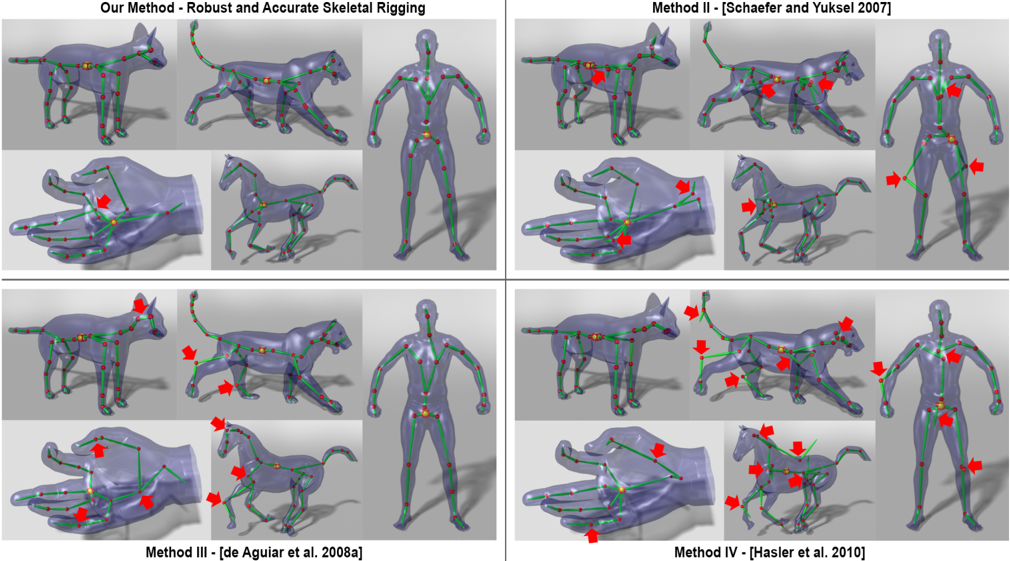
- On 9 test datasets, the paper reports that using a single parameter set, the method outperformed three state-of-the-art methods in robustness and accuracy.
- In Table 1, the reported RMSEs for the authors’ method are lower than the comparators across all listed datasets, e.g.:
- cat-poses: 0.25 vs. 0.68 / 1.04 / 0.63
- horse-poses: 0.21 vs. 0.54 / 1.24 / 0.75
- hand: 0.18 vs. 0.23 / 0.42 / 0.18
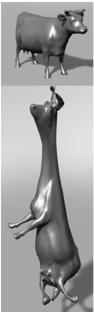
- cow: 1.52 vs. 5.41 / 5.61 / 5.58
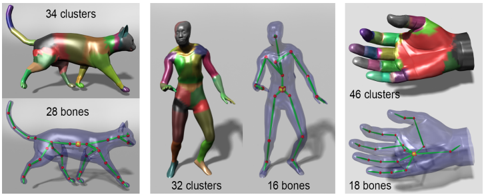
- The paper reports that the method can rig difficult models with few frames, e.g. 9 frames produced a 28-bone skeleton for the cat model.
## Methods
- Example-based rigging pipeline with three main stages: initialization from motion-driven clustering, topology reconstruction via skinning decomposition and a minimum spanning tree, and iterative rigging with block coordinate descent.
- Input: a temporally coherent set of example poses (mesh sequence) plus a rest pose; output: skeletal structure, joint locations, skinning weights, and bone transformations.
- Main analysis: optimization of an LBS model with data fitting, weight smoothness regularization, and soft joint constraints; redundant bones are pruned during iterative updates.
## Limitations
- The paper states that the method has low computational efficiency and is suitable only for offline applications.
- The paper states that results depend on the quality of the input example poses; noise, limited motion range, and asymmetry can affect output.
- The paper states that the LBS model has limited approximation power and cannot capture some complicated nonlinear deformations.
Model-written summary. Check it against the paper before relying on it.
Integrity signals
Registry
Cites
Statistics
Figures








Verification
Claims the paper makes
0 Valid · 1 Not valid · 21 Not checked · 72 Own results and interpretations
The cited sources that could be checked couldn’t confirm or dispute this claim.
In the paper
“As a tradeoff, [Anguelov et al. 2004] gives a slightly larger approximation error than [Schaefer and Yuksel 2007].”
What the sources say
- Could not verifycites Anguelov et al. 2004 doi:10.5555/1036843.1036846Experimental — accuracy not yet measured
The Experimental Results (p. 7) describe the paper’s puppet and arm datasets but do not compare approximation errors with Schaefer and Yuksel 2007. A search for that comparison and for approximation error found no supporting passage in our copy. (LLM, conf=0.78)
- Not matchedcites Schaefer and Yuksel 2007
Couldn’t be matched to a paper in Crossref, so it can’t be checked.
plain- Asserted: passes — The authors put it forward as true.
- Checkable: passes — It can be checked against evidence.
- Load-bearing: unclear — It is unclear whether the paper’s conclusions depend on it.
- Based: passes — The paper gives a reason why it holds.
- Could not verify
A result the paper states — it cites no source for it, so there is none to check. The quote shows it is in the paper.
In the paper
“We introduce an example-based rigging approach to automatically generate linear blend skinning models with skeletal structure.”
plainstates a cause- Asserted: passes — The authors put it forward as true.
- Checkable: passes — It can be checked against evidence.
- Load-bearing: passes — The paper’s conclusions depend on it.
- Based: passes — The paper gives a reason why it holds.
A result the paper states — it cites no source for it, so there is none to check. The quote shows it is in the paper.
In the paper
“Furthermore, in terms of rigging accuracy, even with a single set of parameters, our approach can soundly outperform state of the art methods on various types of experimental datasets including humans, quadrupled animals, and highly deformable models.”
plainstates a cause- Asserted: passes — The authors put it forward as true.
- Checkable: passes — It can be checked against evidence.
- Load-bearing: passes — The paper’s conclusions depend on it.
- Based: passes — The paper gives a reason why it holds.
A result the paper states — it cites no source for it, so there is none to check. The quote shows it is in the paper.
In the paper
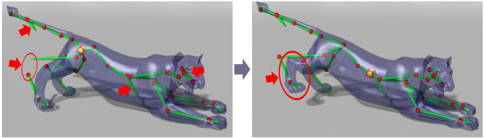
“As shown in Fig. 1, our method can robustly generate high-quality rigging models from a small set of example poses.”
plainstates a cause- Asserted: passes — The authors put it forward as true.
- Checkable: passes — It can be checked against evidence.
- Load-bearing: passes — The paper’s conclusions depend on it.
- Based: passes — The paper gives a reason why it holds.
A result the paper states — it cites no source for it, so there is none to check. The quote shows it is in the paper.
In the paper
“By formulating the solving of a LBS model with skeleton as a constrained optimization, our iterative approach can obtain more accurate joint locations, bone lengths, corresponding joint rotations, as well as the reconstruction of the example poses without accumulation of fitting errors.”
plainstates a cause- Asserted: passes — The authors put it forward as true.
- Checkable: passes — It can be checked against evidence.
- Load-bearing: passes — The paper’s conclusions depend on it.
- Based: unclear — It is unclear why the paper says it holds.
49 more claims
Create a free account to see all 94 claims and every source verdict.
- It may state two separate claims as one. 25
- Probably not a substantial claim. 19
Citations
Cites
An Algorithm for Vector Quantizer Design
Linde, Y., Buzo, A., & Gray, R. (1980) · IEEE Transactions on Communications · doi:10.1109/tcom.1980.1094577 · Cited by 7,201
On the shortest spanning subtree of a graph and the traveling salesman problem
Kruskal, J. B. (1956) · Proceedings of the American Mathematical Society · doi:10.1090/s0002-9939-1956-0078686-7 · Cited by 5,088
SCAPE: shape completion and animation of people
Anguelov, D., Srinivasan, P., Koller, D., Thrun, S., Rodgers, J., & Davis, J. (2005) · ACM Transactions on Graphics · doi:10.1145/1073204.1073207 · Cited by 1,489
A discussion of the solution for the best rotation to relate two sets of vectors
Kabsch, W. (1978) · Acta Crystallographica Section A · doi:10.1107/s0567739478001680 · Cited by 1,151 · cited 1×
“(6a) is to combine the solution proposed by Le and Deng [2012] with the solution to the Weighted Absolute Orientation problem [Kabsch 1978].”
MethodOn the Shortest Spanning Subtree of a Graph and the Traveling Salesman Problem
Kruskal, J. B. (1956) · Proceedings of the American Mathematical Society · doi:10.2307/2033241 · Cited by 1,117
Deformation transfer for triangle meshes
Sumner, R. W., & Popović, J. (2004) · ACM Transactions on Graphics · doi:10.1145/1015706.1015736 · Cited by 1,052
Articulated mesh animation from multi-view silhouettes
Vlasic, D., Baran, I., Matusik, W., & Popović, J. (2008) · ACM Transactions on Graphics · doi:10.1145/1360612.1360696 · Cited by 610
Performance capture from sparse multi-view video
de Aguiar, E., Stoll, C., Theobalt, C., Ahmed, N., Seidel, H.-P., & Thrun, S. (2008) · ACM Transactions on Graphics · doi:10.1145/1360612.1360697 · Cited by 535
Skeleton extraction by mesh contraction
Au, O. K.-C., Tai, C.-L., Chu, H.-K., Cohen-Or, D., & Lee, T.-Y. (2008) · ACM Transactions on Graphics · doi:10.1145/1360612.1360643 · Cited by 521
Automatic rigging and animation of 3D characters
Baran, I., & Popović, J. (2007) · ACM SIGGRAPH 2007 papers · doi:10.1145/1275808.1276467 · Cited by 495 · cited 2×
“Many automatic methods have been proposed to generate the skinning weights from a static 3D model [Baran and Popovi´c 2007; Jacobson et al. 2011].”
Method
Cited by
Loper, M., Mahmood, N., Romero, J., Pons-Moll, G., & J, B. M. (2015) · ACM Transactions on Graphics · doi:10.1145/2816795.2818013 · Cited by 3,734
SMPL: A Skinned Multi-Person Linear Model
Loper, M., Mahmood, N., Romero, J., Pons-Moll, G., & Black, M. J. (2023) · Seminal Graphics Papers: Pushing the Boundaries, Volume 2 · doi:10.1145/3596711.3596800 · Cited by 768
Xu, Z., Zhou, Y., Kalogerakis, E., Landreth, C., & Singh, K. (2020) · ACM Transactions on Graphics · doi:10.1145/3386569.3392379 · Cited by 126
“…2013; Dionne and de Lasa 2014; Jacobson et al. 2011; Kavan et al. 2007; Kavan and Sorkine 2012; Kavan and Žára 2005; Wareham and Lasenby 2008], to data-driven methods that produce skinning from a sequence of examples [James and Twigg 2005; Le and Deng 2014; Loper et al. 2015; Qiao et al. 2018].”
MethodLearning skeletal articulations with neural blend shapes
Li, P., Aberman, K., Hanocka, R., Liu, L., Sorkine‐Hornung, O., & Chen, B. (2021) · ACM Transactions on Graphics · doi:10.1145/3450626.3459852 · Cited by 118
Avatar reshaping and automatic rigging using a deformable model
Feng, A., Casas, D., & Shapiro, A. (2015) · Motion in Games · doi:10.1145/2822013.2822017 · Cited by 76
Metadata
- Authors
- Le, B. H., & Deng, Z.
- Affiliations
- University of Houston (US)
- ORCID
- Deng, Zhigang
- Venue
- ACM Transactions on Graphics
- Published
- 2014-07-27
- Volume
- 33
- Issue
- 4
- Pages
- 1-10
- ISSN
- 0730-0301 (ISSN-L)
- 1557-7368
- OpenAlex
- W2152005648
- Cited by
- 111
- References
- 46
- Citations by year
- 2026: 2 · 2025: 8 · 2024: 7 · 2023: 9 · 2022: 2 · 2021: 15 · 2020: 11 · 2019: 12 · 2018: 12 · 2017: 2 · 2016: 19 · 2015: 10 · 2014: 2
- FWCI
- 9.98
- Type
- journal article
- Language
- en
- Open access
- closed
- Locations
- ACM Transactions on Graphics (publishedVersion)
- Funders
- National Institutes of Health
- National Natural Science Foundation of China (61328204)
- Division of Information and Intelligent Systems
- Topics
- Physical Sciences › Computer Science › Computer Graphics and Computer-Aided Design › 3D Shape Modeling and Analysis
- Physical Sciences › Computer Science › Computer Graphics and Computer-Aided Design › Human Motion and Animation
- Physical Sciences › Computer Science › Computer Graphics and Computer-Aided Design › Computer Graphics and Visualization Techniques
- Keywords
- linear blend skinning, skeleton estimation, joint position estimation, skeleton-based animation, 3D character animation
About these checks
Registry, retraction, Cites and statistics results are computed, not judged, with one exception: a printed reference that no index lists is read once by a model before it counts as a citation error. Claims are extracted by a model and kept only when their quote appears verbatim in the text; each cited source is then checked, with a model’s help, for whether it says what the claim relies on. Those verdicts can be wrong — read the claim’s quote and the cited source before relying on one.
The claim verdicts this report counts are experimental: their accuracy is not yet measured.
A language model drew the claims from the paper on 2026-10-10, under version 3 of the claim definition (model deepseek-v4.1-flash, prompt extract-v3).
A second model labelled each claim on 2026-10-10 (model jev-1.13-20260917, definition revision gold-guideline-v0.2).
Cited sources are checked with a language model’s help (gpt-6-sol).
Statistics and arithmetic are recomputed, not judged.
Confidence bands are shown only for fields calibrated on our annotated test set. None is calibrated yet, so no band is shown.
What counts as a claim ›How we measure confidence ›How we check this ›
Are you an author, or do you see a problem with this page? Request a review
How to cite
Cite CoChat for the checks on this page, and the paper for its own findings.
- This page
- CoChat. (2026). Citation check: Robust and accurate skeletal rigging from mesh sequences. https://app.cochat.ai/papers/10.1145/2601097.2601161
- The paper
- Le, B. H., & Deng, Z. (2014). Robust and accurate skeletal rigging from mesh sequences. ACM Transactions on Graphics. https://doi.org/10.1145/2601097.2601161
Data sources
Bibliographic data: Semantic Scholar, OpenAlex, Crossref.
Contains information from the Semantic Scholar Academic Graph Datasets, made available under the ODC Attribution License (ODC-BY 1.0).
Semantic Scholar’s data is described in: Kinney, R., et al. (2023). The Semantic Scholar Open Data Platform. arXiv:2301.10140.
