

Black Lives Matter in Wikipedia: Collective Memory and Collaboration around Online Social Movements
Open accessThe DOI matches its Crossref record; 47 of the 47 references it cites were found in a registry or an index; none of the 16 sources its claims cite is checked for support yet.
Abstract
Social movements use social computing systems to complement offline mobilizations, but prior literature has focused almost exclusively on movement actors' use of social media. In this paper, we analyze participation and attention to topics connected with the Black Lives Matter movement in the English language version of Wikipedia between 2014 and 2016. Our results point to the use of Wikipedia to (1) intensively document and connect historical and contemporary events, (2) collaboratively migrate activity to support coverage of new events, and (3) dynamically re-appraise pre-existing knowledge in the aftermath of new events. These findings reveal patterns of behavior that complement theories of collective memory and collective action and help explain how social computing systems can encode and retrieve knowledge about social movements as they unfold.
Overview
CoChat Summary
TL;DR
Analyzing English Wikipedia revision histories and pageviews around Black Lives Matter (BLM) from 2014–2016, this paper identifies three mechanisms: intensified documentation, collaborative migration, and dynamic re-appraisal. It argues these patterns show how a peer-production system encodes collective memory and knowledge about an unfolding social movement without direct movement control.
Key findings
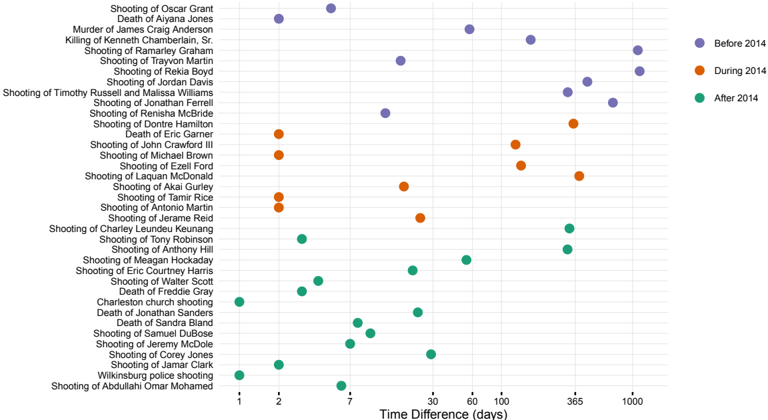
- Intensified documentation: average article-creation lag for BLM-related deaths fell from 361 days before 2014 to 107 days during 2014 to 51 days after 2014, an 86% reduction. Only 2 of 37 deaths had articles created within 24 hours, and 12 events had lags of at least 100 days.
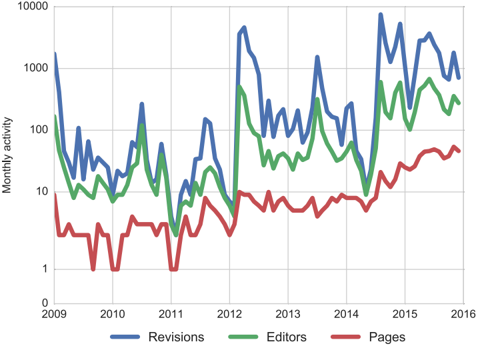
- Activity was highly concentrated: 141 articles/talk pages had 86,940 revisions by 6,795 editors; the Top 10 pages and talk pages accounted for 76,194 (87.6%) revisions and 5,449 (80.2%) editors. The “Shooting of Michael Brown” and “Shooting of Trayvon Martin” articles alone contributed 52,941 (60.9%) revisions.
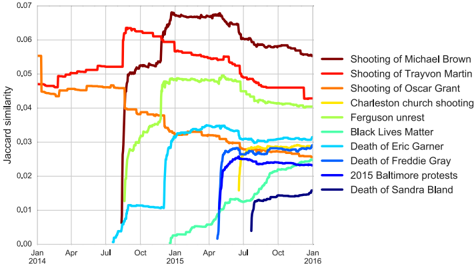
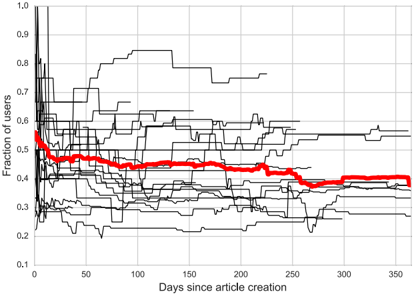
- Collaborative migration: daily editor similarity was low; the “Shooting of Michael Brown” article had the greatest similarity but never rose above 7%, while the “Black Lives Matter” article showed an increasing similarity trajectory. On the BLM talk page, 74 editors made 534 revisions, and 41 also edited the article itself, meaning only 10% of article editors participated in talk discussions.
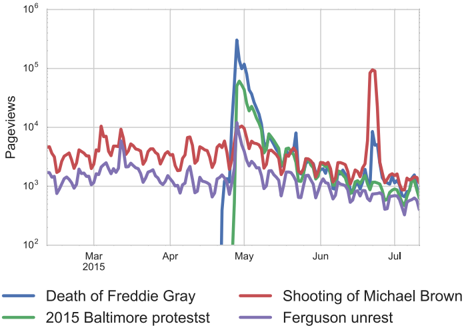
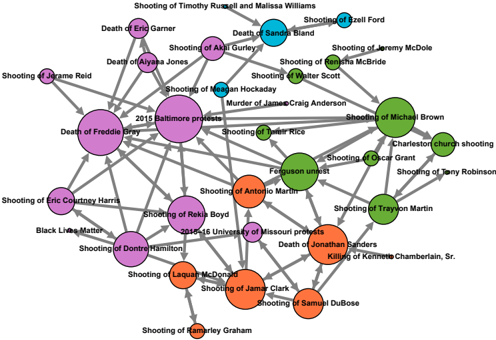
- Dynamic re-appraisal: revision correlations were consistently lower than pageview or revision-pageview correlations; the strongest revision pair was Freddie Gray–Baltimore protests at 0.672, while pageview/revision-pageview pairs included Michael Brown–Ferguson unrest at 0.918 and Freddie Gray–Baltimore protests at 0.942. The “Black Lives Matter” article was peripheral in the correlation network, with a single connection to the shooting of Dontre Hamilton.
Methods
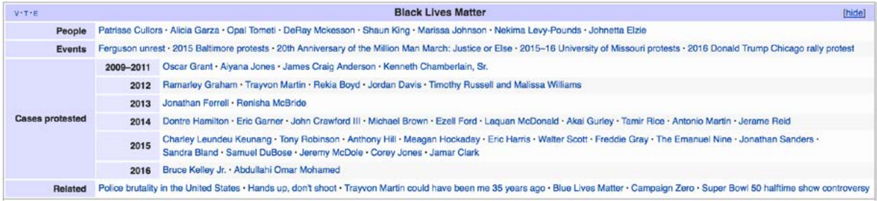
- Trace data from English Wikipedia revision histories collected April 21, 2016 using a custom Python script with Wikitools and the MediaWiki API. The sample was built from the union of 59 articles in the Black Lives Matter template and 74 in the Black Lives Matter category, excluding pages not focused on the movement, a death, or a protest, yielding 42 main articles (1 movement, 37 deaths, 4 protests); redirects and talk pages were included, totaling 141 articles/talk pages, 86,940 revisions by 6,795 editors from January 6, 2009 to April 21, 2016.
- Pageviews from January 1, 2014 to January 1, 2016 were extracted from a third-party daily pageviews database. The study is exploratory and descriptive, using temporal dynamics, Jaccard similarity, correlations, hierarchical clustering with Ward variance minimization, network visualization, and qualitative review of the BLM talk page.
Limitations
- Stated: the analysis covers only a single prominent contemporary U.S. social movement on the largest Wikipedia language edition, limiting generalizability; revision data are a convenient sample that censors contributions during page protections and overlooks source choices and automated agents; there are no demographic data on editors or readers; the authors cannot claim whether editors support the movement; and the descriptive quantitative analyses could be extended with regression, network, time-series, text, sequence, or causal-inference methods.
- Evident: the pageview time range truncates some information for some articles, as the paper notes, and data collection ends April 21, 2016, so later BLM-related activity is not captured.
Model-written summary. Check it against the paper before relying on it.
Integrity signals
Registry
Cites
Statistics
Figures
Verification
Claims the paper makes
0 Valid · 1 Not valid · 12 Not checked · 103 Own results and interpretations
A result the paper states — it cites no source for it, so there is none to check. The quote shows it is in the paper.
In the paper
“This indicates that only 10% of editors to the article participated in discussions on the talk page.”
§ Black Lives Matter in Wikipedia: Collaboration and Collective Memory around Online Social Movements > Black Lives Matter talk page discussion
hedged- Asserted: passes — The authors put it forward as true.
- Checkable: passes — It can be checked against evidence.
- Load-bearing: unclear — It is unclear whether the paper’s conclusions depend on it.
- Based: passes — The paper gives a reason why it holds.
A result the paper reports from its own data — it cites no other source for it, so there is none to check. The quote shows it is in the paper.
In the paper
“During 2014, when the BLM movement gained attention, the 10 pages about deaths took on average 107 days to be created.”
§ Black Lives Matter in Wikipedia: Collaboration and Collective Memory around Online Social Movements > Temporal dynamics of article creation
plain- Asserted: passes — The authors put it forward as true.
- Checkable: passes — It can be checked against evidence.
- Load-bearing: passes — The paper’s conclusions depend on it.
- Based: passes — The paper gives a reason why it holds.
A result the paper states — it cites no source for it, so there is none to check. The quote shows it is in the paper.
In the paper
“faster coverage of new movement topics”
§ Black Lives Matter in Wikipedia: Collaboration and Collective Memory around Online Social Movements > INTRODUCTION
plainstates a cause- Asserted: passes — The authors put it forward as true.
- Checkable: passes — It can be checked against evidence.
- Load-bearing: passes — The paper’s conclusions depend on it.
- Based: passes — The paper gives a reason why it holds.
A result the paper states — it cites no source for it, so there is none to check. The quote shows it is in the paper.
In the paper
“In the case of BLM, many of these structures were not created until mid-2015.”
§ Black Lives Matter in Wikipedia: Collaboration and Collective Memory around Online Social Movements > RQ2: Collaborative migration
plainSingle case- Asserted: passes — The authors put it forward as true.
- Checkable: passes — It can be checked against evidence.
- Load-bearing: passes — The paper’s conclusions depend on it.
- Based: passes — The paper gives a reason why it holds.
A result the paper states — it cites no source for it, so there is none to check. The quote shows it is in the paper.
In the paper
“expanded discussion”
§ Black Lives Matter in Wikipedia: Collaboration and Collective Memory around Online Social Movements > INTRODUCTION
plainstates an association- Asserted: passes — The authors put it forward as true.
- Checkable: passes — It can be checked against evidence.
- Load-bearing: passes — The paper’s conclusions depend on it.
- Based: passes — The paper gives a reason why it holds.
66 more claims
Create a free account to see all 116 claims and to verify the 16 references still open.
- It may state two separate claims as one. 23
- Probably not a substantial claim. 27
- The quote only partly states this claim. 1
Claims other papers make about this one
Each is checked against this paper’s own text: does it say what the citing paper says it does?
In the citing paper
“Using computational techniques to study social movements and the emergence of non-dominant narratives situated within particular cultures is becoming increasingly common (e.g., [67,72]).”
From Addressing age-related bias in sentiment analysis, (2018) · cites this paper as [72]
Self-check
Percentages, sums and reported differences re-computed from the paper’s own numbers.
Each contradiction between two passages listed here was confirmed by an independent check.
Rated minor: it would not touch a result — a value no result rests on, a p-value that stays on the same side of the significance level, or a conflict that is clerical, resolved elsewhere in the paper, or outside its own findings.
In the paper
§ Black Lives Matter in Wikipedia: Collaboration and Collective Memory around Online Social Movements > Temporal dynamics of article creation
“The "Shooting of Rekia Boyd" (1,133 days) and the "Shooting of Ramarley Grant" (1,097 days) had the longest article creation lag.”
§ Black Lives Matter in Wikipedia: Collaboration and Collective Memory around Online Social Movements > Acknowledgements
“Shooting of Ramarley Graham”
Rated minor: it would not touch a result — a value no result rests on, a p-value that stays on the same side of the significance level, or a conflict that is clerical, resolved elsewhere in the paper, or outside its own findings.
In the paper
§ Black Lives Matter in Wikipedia: Collaboration and Collective Memory around Online Social Movements > Editor similarities over time
“Substantively, this metric describes what fraction of users on an article in a given day had edited any other article in the corpus at any time leading up to and including that day.”
§ Black Lives Matter in Wikipedia: Collaboration and Collective Memory around Online Social Movements > Editor similarities over time
“The Jaccard coefficient captures the similarity between two sets of entities by computing the size of the intersection between entities in both sets, divided by the union of the sets.”
Citations
Cites
Halbwachs, M., & Coser, L. A. (1992) · doi:10.7208/chicago/9780226774497.001.0001 · Cited by 4,939
Recruitment to High-Risk Activism: The Case of Freedom Summer
McAdam, D. (1986) · American Journal of Sociology · doi:10.1086/228463 · Cited by 2,203 · cited 1×
“A groups’ shared sense of the past contributes to collective action by providing common frames to articulate grievances, develop shared identity, regenerate networks and resources, and increase incentives for cooperation [12, 34].”
BackgroundSocial Media and the Decision to Participate in Political Protest: Observations From Tahrir Square
Tufekci, Z., & Wilson, C. (2012) · Journal of Communication · doi:10.1111/j.1460-2466.2012.01629.x · Cited by 1,532 · cited 1×
“These platforms are designed to reduce coordination costs as well as enhance information sharing, potentially encouraging more people to engage in protest politics than would have otherwise [41].”
BackgroundGenerations and Collective Memories
Schuman, H., & Scott, J. (1989) · American Sociological Review · doi:10.2307/2095611 · Cited by 1,071
Harnessing the wisdom of crowds in wikipedia: quality through coordination
Kittur, A., & Kraut, R. E. (2008) · Proceedings of the 2008 ACM conference on Computer supported cooperative work · doi:10.1145/1460563.1460572 · Cited by 680
Networked Gatekeeping and Networked Framing on #Egypt
Meraz, S., & Papacharissi, Z. (2013) · The International Journal of Press/Politics · doi:10.1177/1940161212474472 · Cited by 580 · cited 1×
“Contemporary social movements use social computing and social media platforms to mobilize supporters, negotiate meaning, alter their relationship to media gatekeepers, and reframe issues [3, 35].”
BackgroundHe says, she says: conflict and coordination in Wikipedia
Kittur, A., Suh, B., Pendleton, B. A., & Chi, E. H. (2007) · Proceedings of the SIGCHI Conference on Human Factors in Computing Systems · doi:10.1145/1240624.1240698 · Cited by 574 · cited 1×
“A broader literature has shown that editors act interdependently assuming nuanced social roles [1, 43], managing conflict dynamics [30, 44], and coordinating their actions to produce high quality content [29].”
BackgroundBeyond the Hashtags: #Ferguson, #Blacklivesmatter, and the Online Struggle for Offline Justice
Freelon, D., McIlwain, C. D., & Clark, M. D. (2016) · SSRN Electronic Journal · doi:10.2139/ssrn.2747066 · Cited by 566 · cited 4×
“As it became clear that the events in Ferguson had provoked nationwide concern, the phrase spread on social media and in the press [10].”
BackgroundInfluentialHijacking #myNYPD: Social Media Dissent and Networked Counterpublics
Jackson, S. J., & Foucault Welles, B. (2015) · Journal of Communication · doi:10.1111/jcom.12185 · Cited by 416
Benford, R. D. (1993) · The Sociological Quarterly · doi:10.1111/j.1533-8525.1993.tb00387.x · Cited by 316 · cited 1×
“Typically, a movement’s framing describes the grievances at stake, determines how the movement is understood, and specifies the scope of issues to be addressed by fostering a “sense of severity, urgency, efficacy, and propriety” [2].”
Background
Cited by
On the Dangers of Stochastic Parrots: Can Language Models Be Too Big? 🦜
Bender, E. M., Gebru, T., McMillan-Major, A., & Shmitchell, S. (2021) · Proceedings of the 2021 ACM Conference on Fairness, Accountability, and Transparency · doi:10.1145/3442188.3445922 · Cited by 6,988
“For instance, the Black Lives Matter movement (BLM) influenced Wikipedia article generation and editing such that, as the BLM movement grew, articles covering shootings of Black people increased in coverage and were generated with reduced latency [135].”
BackgroundAddressing age-related bias in sentiment analysis,
Diaz, M., Johnson, I., Lazar, A., Piper, A. M., & Gergle, D. (2018) · Proceedings of the 2018 CHI Conference on Human Factors in Computing Systems · doi:10.1145/3173574.3173986 · Cited by 138
Drawing the Lines of Contention: Networked Frame Contests Within #BlackLivesMatter Discourse
Stewart, L. G., Arif, A., Nied, A. C., Spiro, E. S., & Starbird, K. (2017) · Proceedings of the ACM on Human-Computer Interaction · doi:10.1145/3134920 · Cited by 82
Ma, Z., Mei, Y., Long, Y., Su, Z., & Gajos, K. Z. (2024) · Proceedings of the CHI Conference on Human Factors in Computing Systems · doi:10.1145/3613904.3642482 · Cited by 68
“Even when the filtered versions are used, they may inadvertently offend and silence the voices of marginalized communities such as LGBTQ+ due to inherent limitations in the filtering algorithms [104].”
BackgroundToward a Grassroots Culture of Technology Practice
Ghoshal, S., Mendhekar, R., & Bruckman, A. (2020) · Proceedings of the ACM on Human-Computer Interaction · doi:10.1145/3392862 · Cited by 60
“Today in the western world, grassroots organizing has a distinctly technological character [48, 82].”
BackgroundMueller, A., Wood-Doughty, Z., Amir, S., Dredze, M. H., & Nobles, A. L. (2021) · Proceedings of the ACM on Human-Computer Interaction · doi:10.1145/3449181 · Cited by 76
“of collaborative communication technologies in digital activism including how the collaborative nature of Wikipedia functions as a knowledge building tool and collective memory of a collective action [98], how singular mentions of a hashtag on social media do indeed contribute to collective storytelling (as opposed to…”
BackgroundGrowing Tiny Publics: Small Farmers' Social Movement Strategies
Steup, R., Santhanam, A., Logan, M., Dombrowski, L. S., & Su, N. M. (2018) · Proceedings of the ACM on Human-Computer Interaction · doi:10.1145/3274434 · Cited by 56
“Much attention focuses on social media usage within more prominent “in-person” protests and marches, including studies of the Arab Spring [79], Black Lives Matter [16, 68, 72], and the Occupy Movement [15], and for many different topics including sustainability, racial inequality, economic inequality, gender inequalit…”
BackgroundConversations About Crime: Re-Enforcing and Fighting Against Platformed Racism on Reddit
Wu, Q., Williams, L. K., Simpson, E., & Semaan, B. (2022) · Proceedings of the ACM on Human-Computer Interaction · doi:10.1145/3512901 · Cited by 35
Understanding the Security and Privacy Advice Given to Black Lives Matter Protesters
Boyd, M. J., Sullivan, J., Chetty, M., & Ur, B. (2021) · CHI Conference on Human Factors in Computing Systems · doi:10.1145/3411764.3445061 · Cited by 38
“Moreover, most HCI research on the BLM movement has focused on discourse online [2, 59, 76, 78, 81], rather than the role of technology in demonstrations and protests.”
BackgroundBehind the scenes of K-pop fandom: unveiling K-pop fandom collaboration network
Kang, J., Kim, J., Yang, M., Park, E., Ko, M., Lee, M., & Han, J. (2021) · Quality & Quantity · doi:10.1007/s11135-021-01189-5 · Cited by 39
Ren, Y., Zhang, H., & Kraut, R. E. (2023) · ACM Transactions on Computer-Human Interaction · doi:10.1145/3617369 · Cited by 35
A Forensic Qualitative Analysis of Contributions to Wikipedia from Anonymity Seeking Users
Champion, K., McDonald, N., Bankes, S., Zhang, J., Greenstadt, R., Forte, A., & Hill, B. M. (2019) · Proceedings of the ACM on Human-Computer Interaction · doi:10.1145/3359155 · Cited by 20
“[48], who combined quantitative analysis with careful qualitative reading of discussion pages and historical events to understand interactions of the Wikipedia community with the Black Lives Matter movement.”
Tong, X., Li, Y., Li, J., Bei, R., & Zhang, L. (2022) · Proceedings of the AAAI/ACM Conference on AI Ethics and Society · doi:10.1145/3514094.3534202 · Cited by 29
"This is why we play": Characterizing Online Fan Communities of the NBA Teams
Zhang, J. S., Tan, C., & Lv, Q. (2018) · Proceedings of the ACM on Human-Computer Interaction · doi:10.1145/3274466 · Cited by 28
“Other offline events studies include the dynamics of breaking news [26, 27, 31], celebrity death [15, 28], and Black Lives Matter [52, 59].”
BackgroundBetween news and history: identifying networked topics of collective attention on Wikipedia
Gildersleve, P., Lambiotte, R., & Yasseri, T. (2023) · Journal of Computational Social Science · doi:10.1007/s42001-023-00215-w · Cited by 20
An Analysis of Content Gaps Versus User Needs in the Wikidata Knowledge Graph
Abián, D., Meroño-Peñuela, A., & Simperl, E. P. B. (2022) · Lecture notes in computer science · doi:10.1007/978-3-031-19433-7_21 · Cited by 25
Ladange, Adange, Jeetange: The Farmers' Movement and Its Virtual Spaces
Gupta, P., Petterson, A., Motla, D., & Chandra, P. (2022) · Proceedings of the ACM on Human-Computer Interaction · doi:10.1145/3555547 · Cited by 14
Dismantling Gender Blindness in Online Discussion of a Crime/Gender Dichotomy
Qin, Y., Duan, W., Wu, Q., & Lu, Z. (2024) · Proceedings of the ACM on Human-Computer Interaction · doi:10.1145/3653686 · Cited by 23
“Bonilla-Silva argued that color blindness is the primary mechanism to frame subtle and covert racism in the contemporary U.S. Bonilla-Silva articulated four color-blind racial frames [16].”
BackgroundRacial Capitalism Online: Navigating Race Among Creative Professionals of Color
Turner, J. R., & Hui, J. S. (2023) · Proceedings of the ACM on Human-Computer Interaction · doi:10.1145/3579518 · Cited by 13
Social remembering in the digital age: Implications for virtual study, work, and social engagement
Greeley, G. D., Peña, T., & Rajaram, S. (2022) · Memory Mind & Media · doi:10.1017/mem.2022.3 · Cited by 11
“At the same time, a political scientist might be interested in how online groups translate virtual engagement into real-world mobilisation (eg, Twyman et al 2017).”
BackgroundEvent-Driven Analysis of Crowd Dynamics in the Black Lives Matter Online Social Movement
Peng, H., Budak, C., & Romero, D. M. (2019) · International World Wide Web Conference (WWW) · doi:10.1145/3308558.3313673 · Cited by 12
“A recent work [53] studied the collective response of editors of Chinese Wikipedia to the government censorship in mainland China.”
MethodRen, R., & Xu, J. (2023) · New Media & Society · doi:10.1177/14614448221149641 · Cited by 11
“Wikipedia readers are also trying to make sense of new events by connecting with prior events, with the help of the hyperlinking function (Twyman et al., 2017).”
InfluentialSupporting Social Movements Through HCI and Design
Petterson, A., Thuppilikkat, A. A., Gupta, P., Klassen, S., Jack, M., Liu, J., & Chandra, P. (2023) · CHI Conference Extended Abstracts on Human Factors in Computing Systems (CHI EA) · doi:10.1145/3544549.3573812 · Cited by 10
“Our workshop will build on existing HCI and CSCW literature that explores the relationship between ICTs with social movements [22, 23, 32, 40] along with how designers can support social movements [11, 12, 35] and community-led activism [3, 19, 25, 30, 36].”
BackgroundCHInclusion: Working Toward a More Inclusive HCI Community
Strohmayer, A., MacArthur, C., Spors, V., Muller, M. J., Vigil-Hayes, M., & Alabdulqader, E. A. (2019) · CHI Conference Extended Abstracts on Human Factors in Computing Systems (CHI EA) · doi:10.1145/3290607.3299012 · Cited by 15
Bridging Action Frames: Instagram Infographics in U.S. Ethnic Movements
Kaviani, D., & Salehi, N. (2022) · Proceedings of the ACM on Human-Computer Interaction · doi:10.1145/3512926 · Cited by 27
Covid-19 and Collective Memory Among Malaysians: Does Generation Matter?
Mustafa, H., Mukhiar, S. N. S., Jamaludin, S. S. S., & Jais, N. M. (2021) · Pertanika journal of social science & humanities · doi:10.47836/pjssh.29.4.15 · Cited by 11
Wu, Q., Romero, T., & Semaan, B. (2024) · CHI Conference on Human Factors in Computing Systems · doi:10.1145/3613904.3642688 · Cited by 14
“Identity construction is a highly nuanced process for members of diferent groups [15, 68, 73].”
BackgroundThe Dynamics of Peer-Produced Political Information During the 2016 U.S. Presidential Campaign
Keegan, B. (2019) · Proceedings of the ACM on Human-Computer Interaction · doi:10.1145/3359135 · Cited by 10
“The hightempo online knowledge collaborations generating content about current and breaking news events are accomplished through a variety of practices: regenerating organizational structures from previous crises [40], adapting specific expertise to fill to emergent social roles [37], developing routines to handle reg…”
BackgroundSelf-citationBeadle, K., Warner, M., & Vasek, M. (2025) · Proceedings of the ACM on Human-Computer Interaction · doi:10.1145/3710900 · Cited by 10
"Self-Quaranteens" Process COVID-19: Understanding Information Visualization Language in Memes
Perovich, L. J., Alper, M., & Cleveland, C. (2022) · Proceedings of the ACM on Human-Computer Interaction · doi:10.1145/3512894 · Cited by 5
GitHub as a collaborative curation platform for memory projects of COVID-19 in China
Han, E. L. (2023) · Information Communication & Society · doi:10.1080/1369118x.2022.2161828 · Cited by 6
“With collaborative editing on Wiki-pedia, new events are getting supported through convergence with the past events, and at the same time pre-existing knowledge is getting reassessed through the editing activities of the present (Twyman et al., 2017).”
BackgroundKeeping up on Current Events! A Case Study of Newcomers to Wikipedia
Li, A., & Farzan, R. (2018) · Lecture notes in computer science · doi:10.1007/978-3-030-01129-1_22 · Cited by 5
Porter, E., Krafft, P. M., & Keegan, B. (2020) · ACM Transactions on Social Computing · doi:10.1145/3373147 · Cited by 10
“Culturally shared recollections or “collective memories” play a significant role in shaping the perception and interpretation of current events [17, 71], and images are powerful tools in this process [1].”
BackgroundSelf-citationBhattacharjee, A., Rifat, M. R., Das, D., Haque, S. M. T., & Ahmed, S. I. (2025) · Proceedings of the ACM on Human-Computer Interaction · doi:10.1145/3711057 · Cited by 5
Dissent, Distance, Dilemmas: ICTs and the Belarusian Diasporic Social Movement Community
Thuppilikkat, A. A., Akimova, J., & Chandra, P. (2025) · Proceedings of the ACM on Human-Computer Interaction · doi:10.1145/3757469 · Cited by 4
Media Network and Citizen Journalism: The Transition from Agenda Setting to Agenda Loop
Zhang, S. (2024) · Communication Studies · doi:10.1080/10510974.2024.2383342 · Cited by 3
“Twyman et al. (2017) observed a strong correlation between the speed of collaboration on “Black Lives Matter” movement pages and the event’s significance.”
Exploring the impact of ChatGPT on Wikipedia engagement
Reeves, N., Yin, W., & Simperl, E. P. B. (2025) · Collective Intelligence · doi:10.1177/26339137251372599 · Cited by 20
“…even stretch beyond pages specific to those topics, with evidence of increased cooperation and engagement in various pages covering historical events during the Black Lives Matter social movement even where there was little to no new information around those events (Twyman, Keegan & Shaw, 2017).”
KDAP: An Open Source Toolkit to Accelerate Knowledge Building Research
Verma, A. A., Iyengar, S. R. S., Setia, S., & Dubey, N. (2020) · International Symposium on Open Collaboration · doi:10.1145/3412569.3412575 · Cited by 5
Lessons from AR Memorialization: Artists' and Activists' Approaches to Responsible AR Development
Gasca, A. M. C., Croskey, P., Höllerer, T., Thaler, K. M., Yang, E., & Jacobs, J. (2025) · Designing Interactive Systems Conference · doi:10.1145/3715336.3735815 · Cited by 4
Karthikeyan, V., Kirubakaran, G., Prakash, R. V., & Visu, Y. P. (2024) · Advances in computational intelligence and robotics book series · doi:10.4018/979-8-3693-6824-4.ch002 · Cited by 3
Collaboration of Open Content News in Wikipedia: The Role and Impact of Gatekeepers
Li, A., & Farzan, R. (2020) · International World Wide Web Conference (WWW) · doi:10.1145/3366424.3383568 · Cited by 2
“For example, researchers have investigated the memory-building processes for the Egyptian revolution across languages[6], the deaths of notable people[14], the Vietnam War[17], and the Black Lives Matter social movements[31].”
BackgroundO’Mara, S. M. (2022) · doi:10.31234/osf.io/ugeh8 · Cited by 2
Challenges in Restructuring Community-based Moderation
Tran, C., Take, K., Champion, K., Hill, B. M., & Greenstadt, R. (2024) · Proceedings of the ACM on Human-Computer Interaction · doi:10.1145/3686954 · Cited by 5
“Furthermore, QFA seeks to give researchers an understanding of the measures, tools, and strategies employed by subjects who seek to gain an understanding of the phenomenon themselves.”
Kelly-Thompson, K., Weldon, S. L., Wright, J. M., Goldwasser, D., Einwohner, R. L., Sinclair‐Chapman, V., & Tormos‐Aponte, F. (2025) · Politics Groups and Identities · doi:10.1080/21565503.2025.2453167 · Cited by 4
“Social media provides a vital platform particularly for solidarity and framing among contemporary activists (Anderson 2016; DeChoudhury et al. 2016; Papacharissi 2015; Stewart et al. 2017; Twyman, Keegan, and Shaw 2017; van Haperen, Uitermark, and van der Zeeuw 2020).”
Black Older Adults' Perception of Using Voice Assistants to Enact a Medical Recovery Curriculum
Green, A., Polite, G., Hung, I., Fessele, K. L., Billington, S. L., Landay, J. A., & Cuadra, A. (2025) · Proceedings of the ACM on Human-Computer Interaction · doi:10.1145/3710937 · Cited by 3
Scalable Methods for Storing and Retrieving Wikipedia Revision Histories for Large-Scale Analysis
Verma, A. A., Setia, S., & Demartini, G. (2026) · ACM Transactions on the Web · doi:10.1145/3787449 · Cited by 1
Tracing the History and Evolution of Dark Patterns on Twitter from 2010-2021
Obi, I., Gray, C. M., Chivukula, S. S., Duane, J.-N., Johns, J., Will, M., Li, Z., & Carlock, T. V. (2025) · ACM Transactions on Social Computing · doi:10.1145/3716306 · Cited by 20
External-Facing Communication on Social Media During the Russia-Ukraine Conflict of 2014
Ahmed, K. M., Choe, S., de Freitas, C., Patil, S., & Kogan, M. (2026) · CHI Conference on Human Factors in Computing Systems · doi:10.1145/3772318.3791595 · Cited by 1
“Recent research on online social movements focuses more on the online coordination, self-organization, and contestation that take place around hashtags central to many recent movements, such as #MeToo [86, 96, 113, 134] and #BlackLivesMatter [59, 178].”
An Efficient Approach to Store and Access Wikipedia's Revision History for Large-Scale Analysis
Verma, A. A., & Setia, S. (2024) · ACM Conference on Hypertext and Social Media (HT) · doi:10.1145/3648188.3675150
Nostalgia on Twitter: Detection and Analysis of a Large‐Scale Dataset
Jothiraj, F. V. S., Hong, L., & Mashhadi, A. (2024) · Proceedings of the Association for Information Science and Technology · doi:10.1002/pra2.1033 · Cited by 1
“Studies often use keywords of crisis (Zhang et al., 2020) or social movements (Twyman et al., 2017) associated with time references but the data can only be used to understand collective memories about certain events.”
The Persistence of Retracted Papers on Wikipedia
Shi, H., Yu, Y., Romero, D. M., & Horvát, E.-Á. (2026) · Proceedings of the ACM on Human-Computer Interaction · doi:10.1145/3817014 · Cited by 2
Metadata
- Authors
- Twyman, M., Keegan, B. C., & Shaw, A.
- Affiliations
- Northwestern University (US)
- University of Colorado Boulder (US)
- Venue
- Proceedings of the 2017 ACM Conference on Computer Supported Cooperative Work and Social Computing
- Publisher
- ACM
- Published
- 2017-02-25
- Pages
- 1400-1412
- OpenAlex
- W4299397191
- Cited by
- 51
- References
- 47
- Citations by year
- 2026: 3 · 2025: 8 · 2024: 8 · 2023: 6 · 2022: 8 · 2021: 5 · 2020: 4 · 2019: 4 · 2018: 4 · 2017: 1
- FWCI
- 9.77
- Type
- conference paper
- Language
- en
- Open access
- hybrid
- doi.org
- Licence
- Locations
- ACM Conference on Computer Supported Cooperative Work (CSCW) (publishedVersion, cc-by-sa)
- CU Scholar (University of Colorado Boulder) (submittedVersion)
- OSF Preprints (OSF Preprints) (submittedVersion)
- Funders
- Northwestern University
- University of Missouri
- Topics
- Social Sciences › Communication › Wikis in Education and Collaboration
- Social Sciences › Communication › Social Media and Politics
- Social Sciences › Sociology and Political Science › Social Movements and Cultural Identity
- Keywords
- Black Lives Matter, Wikipedia, social movements, social computing, collective memory, collective action, online mobilization, knowledge co-production, event coverage, social media
About these checks
Registry, retraction, Cites and statistics results are computed, not judged, with one exception: a printed reference that no index lists is read once by a model before it counts as a citation error. Claims are extracted by a model and kept only when their quote appears verbatim in the text; each cited source is then checked, with a model’s help, for whether it says what the claim relies on. Those verdicts can be wrong — read the claim’s quote and the cited source before relying on one.
A language model drew the claims from the paper on 2026-10-10, under version 3 of the claim definition (model deepseek-v4.1-flash, prompt extract-v3).
A second model labelled each claim on 2026-10-10 (model jev-1.13-20260917, definition revision gold-guideline-v0.2).
Statistics and arithmetic are recomputed, not judged.
Confidence bands are shown only for fields calibrated on our annotated test set. None is calibrated yet, so no band is shown.
What counts as a claim ›How we measure confidence ›How we check this ›
Are you an author, or do you see a problem with this page? Request a review
Data sources
Bibliographic data: Semantic Scholar, OpenAlex, Crossref.
Contains information from the Semantic Scholar Academic Graph Datasets, made available under the ODC Attribution License (ODC-BY 1.0).
Semantic Scholar’s data is described in: Kinney, R., et al. (2023). The Semantic Scholar Open Data Platform. arXiv:2301.10140.
