

The DOI matches its Crossref record; 12 of the 12 references it cites were found in a registry or an index.
On attention models for human activity recognition
Open accessAbstract
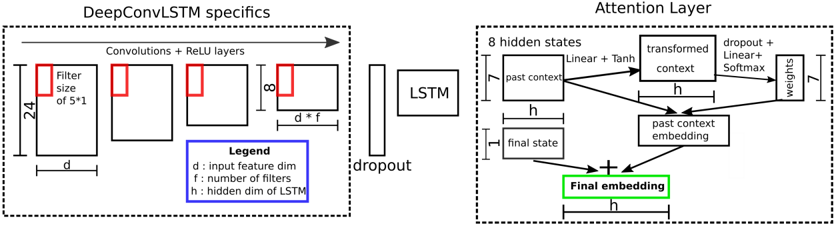
Deep Learning methods have become very attractive in the wider, wearables-based human activity recognition (HAR) research community. The majority of models are based on either convolutional or explicitly temporal models, or combinations of both. In this paper we introduce attention models into HAR research as a data driven approach for exploring relevant temporal context. Attention models learn a set of weights over input data, which we leverage to weight the temporal context being considered to model each sensor reading. We construct attention models for HAR by adding attention layers to a state-of-the-art deep learning HAR model (DeepConvLSTM) and evaluate our approach on benchmark datasets achieving significant increase in performance. Finally, we visualize the learned weights to better understand what constitutes relevant temporal context.
Overview
The claims and statistics of this paper haven’t been checked yet.
Free: it reads the open-access text and checks the first 5 claims that cite a source we can check. Create a free account to check every claim.
Integrity signals
Registry
Cites
Statistics
Figures


Verification
Claims the paper makes
The claims and statistics of this paper haven’t been checked yet.
Free: it reads the open-access text and checks the first 5 claims that cite a source we can check. Create a free account to check every claim.
Claims other papers make about this one
Each is checked against this paper’s own text: does it say what the citing paper says it does?
The cited source says what the claim attributes to it.
In the citing paper
“Temporal attention was applied by Murahari et al. [138] whereas continuous sensor and temporal attention were evaluated by Zeng et al. [214], both leading to increased performance.”
From Past, Present, and Future of Sensor-based Human Activity Recognition Using Wearables: A Surveying Tutorial on a Still Challenging Task (2025) · cites this paper as [138]
Self-check
Percentages, sums and reported differences re-computed from the paper’s own numbers.
The self-check needs the paper’s full text.
Citations
Cites
Hochreiter, S., & Schmidhuber, J. (1997) · Neural Computation · doi:10.1162/neco.1997.9.8.1735 · Cited by 102,318 · cited 2×
“For example, Long Short Term Memory (LSTM [7] models can learn infinite temporal contexts.”
Background(2014) · Cited by 33,419
Deep Convolutional and LSTM Recurrent Neural Networks for Multimodal Wearable Activity Recognition
Ordóñez, F., & Roggen, D. (2016) · Sensors · doi:10.3390/s16010115 · Cited by 2,761 · cited 6×
“For example, Convolutional Neural Networks (CNNs) in HAR employ a sliding window procedure to map the timeseries data to a fixed 2D representation that is fed into the convolution layers [9].”
BackgroundMethodInfluentialA tutorial on human activity recognition using body-worn inertial sensors
Bulling, A., Blanke, U., & Schiele, B. (2014) · ACM Computing Surveys · doi:10.1145/2499621 · Cited by 1,668 · cited 2×
“This is even more pertinent for HAR problems as there is typically only little, if any, relation between current and distant past activities [2].”
BackgroundMethodIntroducing a New Benchmarked Dataset for Activity Monitoring
Reiss, A., & Stricker, D. (2012) · 2012 16th International Symposium on Wearable Computers · doi:10.1109/iswc.2012.13 · Cited by 1,456 · cited 1×
“RIMENTS Our explorations of the benefits that attention models may bring to human activity recognition are based on experimental evaluations on standard datasets from the field: Opportunity [3], PAMAP2 [11], and Skoda [13]. These datasets are very diverse in terms of the nature of activities and the relative distributio…”
MethodAsk Me Anything: Dynamic Memory Networks for Natural Language Processing
Kumar, A., Irsoy, O., Ondruska, P., Iyyer, M., Bradbury, J., Gulrajani, I., Zhong, V., Paulus, R., & Socher, R. (2015) · arXiv · doi:10.48550/arxiv.1506.07285 · Cited by 1,020 · cited 1×
“es. In essence, such an approach would adapt the analysis windows in a data-driven manner. Attention models have been introduced for natural language processing tasks for part of speech (POS) tagging [8]. The formal idea is that a set of linear layers and non-linearities are used to learn weights over kvectors each of…”
BackgroundConvolutional Neural Networks for Human Activity Recognition using Mobile Sensors
Zeng, M., Nguyen, L. T., Yu, B., Mengshoel, O. J., Zhu, J., Wu, P., & Zhang, J. (2014) · Proceedings of the 6th International Conference on Mobile Computing, Applications and Services · doi:10.4108/icst.mobicase.2014.257786 · Cited by 876 · cited 1×
“Combined with clever combinations of pooling, that is, subsampling, and linear layers, very powerful recognition systems have been realized [1, 16, 15].”
BackgroundThe Opportunity challenge: A benchmark database for on-body sensor-based activity recognition
Chavarriaga, R., Sagha, H., Calatroni, A., Digumarti, S. T., Tröster, G., Millán, J. D. R., & Roggen, D. (2013) · Pattern Recognition Letters · doi:10.1016/j.patrec.2012.12.014 · Cited by 742 · cited 3×
“Arguably, this approach works very well as such models currently dominate the most challenging HAR benchmarks (such as Opportunity [3]).”
BackgroundMethodInfluentialDeep, Convolutional, and Recurrent Models for Human Activity Recognition Using Wearables
Hammerla, N. Y., Halloran, S., & Ploetz, T. (2016) · arXiv · doi:10.48550/arxiv.1604.08880 · Cited by 606 · cited 2×
“recognition results. Significant improvements over non-attention baselines are highlighted in bold (Wilson). Modeling Datasets Variant Opportunity PAMAP2 Skoda DeepConvLSTM [9] 67.2 74.8 91.2 b-LSTM-S [5] 68.4 83.8 92.1 Att. Model 70.7 87.5 91.3 Confidence Interval .003 .002 .004 each, with an overlap of 50% between con…”
BackgroundInfluentialEnsembles of Deep LSTM Learners for Activity Recognition using Wearables
Guan, Y., & Plötz, T. (2017) · Proceedings of the ACM on Interactive, Mobile, Wearable and Ubiquitous Technologies · doi:10.1145/3090076 · Cited by 511 · cited 4×
“We employ standard training and evaluation protocols based on hold out datasets as they have been defined in the original publications (and summarized, e.g., in [4]).”
BackgroundMethodInfluentialSelf-citation
Research works printed but not linked: 3
- 10.5555/2627435.2670313 · doi:10.5555/2627435.2670313
- T. Tieleman and G. Hinton . 2012 . Lecture 6.5-rmsprop: Divide the gradient by a running average of its recent magnitude. COURSERA: Neural networks for machine learning 4, 2 (2012), 26--31. T. Tieleman and G. Hinton. 2012. Lecture 6.5-rmsprop: Divide the gradient by a running average of its recent magnitude. COURSERA: Neural networks for machine learning 4, 2 (2012), 26--31.
- J. Yang , Minh Nhut Nguyen , Phyo Phyo San , Xiaoli Li , and Shonali Krishnaswamy . 2015 . Deep Convolutional Neural Networks on Multichannel Time Series for Human Activity Recognition .. In Proc. IJCAI. J. Yang, Minh Nhut Nguyen, Phyo Phyo San, Xiaoli Li, and Shonali Krishnaswamy. 2015. Deep Convolutional Neural Networks on Multichannel Time Series for Human Activity Recognition.. In Proc. IJCAI.
Cited by
Deep Learning for Sensor-based Human Activity Recognition: Overview, Challenges and Opportunities
Chen, K., Zhang, D., Yao, L., Guo, B., Yu, Z., & Liu, Y. (2020) · arXiv · doi:10.48550/arxiv.2001.07416 · Cited by 314
“tworkswithone overall optimization function, which makes allowance for miscellaneous deep learning techniques including deep transfer learning [2], deep active learning [50], deep attention mechanism [101] J. ACM, Vol. 37, No. 4, Article 111. Publication date: August 2018. 111:4 K. Chen et al. and other not systematic…”
BackgroundInfluentialComputer vision applications in construction safety assurance
Fang, W., Ding, L., Love, P. E. D., Luo, H., Li, H., Peña-Mora, F., Zhong, B., & Zhou, C. (2020) · Automation in Construction · doi:10.1016/j.autcon.2019.103013 · Cited by 288
Attention induced multi-head convolutional neural network for human activity recognition
Khan, Z. N., & Ahmad, J. (2021) · Applied Soft Computing · doi:10.1016/j.asoc.2021.107671 · Cited by 187
Contrastive Predictive Coding for Human Activity Recognition
Haresamudram, H., Essa, I., & Plötz, T. (2021) · Proceedings of the ACM on Interactive, Mobile, Wearable and Ubiquitous Technologies · doi:10.1145/3463506 · Cited by 150
“Subsequent work on this architecture to improve performance includes temporal attention [55].”
BackgroundSelf-citationA review of machine learning-based human activity recognition for diverse applications
Kulsoom, F., Narejo, S., Mehmood, Z., Chaudhry, H. N., Butt, A., & Bashir, A. K. (2022) · Neural Computing and Applications · doi:10.1007/s00521-022-07665-9 · Cited by 167
“Some research worked used attention models to extract feature-based spatiotemporal context [116, 130, 114].”
Method
Metadata
- Authors
- Murahari, V. S., & Plötz, T.
- Affiliations
- Georgia Institute of Technology (US)
- ORCID
- Murahari, Vishvak S.
- Venue
- Proceedings of the 2018 ACM International Symposium on Wearable Computers
- Publisher
- ACM
- Published
- 2018-10-08
- Pages
- 100-103
- OpenAlex
- W2803458625
- Cited by
- 157
- References
- 12
- Citations by year
- 2026: 10 · 2025: 17 · 2024: 31 · 2023: 24 · 2022: 27 · 2021: 22 · 2020: 16 · 2019: 10
- FWCI
- 3.62
- Type
- conference paper
- Language
- en
- Open access
- green
- arxiv.org
- Licence
- Locations
- ACM International Symposium on Wearable Computers (ISWC) (publishedVersion)
- arXiv (Cornell University) (submittedVersion, cc-by-nc-sa)
- arXiv (Cornell University) (submittedVersion)
- arXiv (Cornell University)
- Topics
- Physical Sciences › Computer Science › Computer Vision and Pattern Recognition › Context-Aware Activity Recognition Systems
- Physical Sciences › Computer Science › Computer Vision and Pattern Recognition › Human Pose and Action Recognition
- Physical Sciences › Computer Science › Signal Processing › Time Series Analysis and Forecasting
- Keywords
- human activity recognition, attention-based models, temporal context, wearable sensors, attention layers, sensor data
About these checks
Registry, retraction, Cites and statistics results are computed, not judged, with one exception: a printed reference that no index lists is read once by a model before it counts as a citation error. Claims are extracted by a model and kept only when their quote appears verbatim in the text; each cited source is then checked, with a model’s help, for whether it says what the claim relies on. Those verdicts can be wrong — read the claim’s quote and the cited source before relying on one.
Statistics and arithmetic are recomputed, not judged.
Confidence bands are shown only for fields calibrated on our annotated test set. None is calibrated yet, so no band is shown.
What counts as a claim ›How we measure confidence ›How we check this ›
Are you an author, or do you see a problem with this page? Request a review
How to cite
Cite CoChat for the checks on this page, and the paper for its own findings.
- This page
- CoChat. (2026). Citation check: On attention models for human activity recognition. https://app.cochat.ai/papers/10.1145/3267242.3267287
- The paper
- Murahari, V. S., & Plötz, T. (2018). On attention models for human activity recognition. Proceedings of the 2018 ACM International Symposium on Wearable Computers. https://doi.org/10.1145/3267242.3267287
Data sources
Bibliographic data: Semantic Scholar, OpenAlex, Crossref.
Contains information from the Semantic Scholar Academic Graph Datasets, made available under the ODC Attribution License (ODC-BY 1.0).
Semantic Scholar’s data is described in: Kinney, R., et al. (2023). The Semantic Scholar Open Data Platform. arXiv:2301.10140.
