

LaMPost: Design and Evaluation of an AI-assisted Email Writing Prototype for Adults with Dyslexia
Open accessThe DOI matches its Crossref record; 71 of the 72 references it cites were found in a registry or an index, and 1 are not checked yet.
Abstract
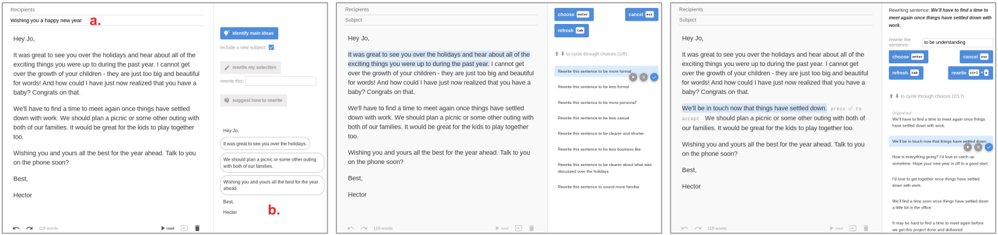
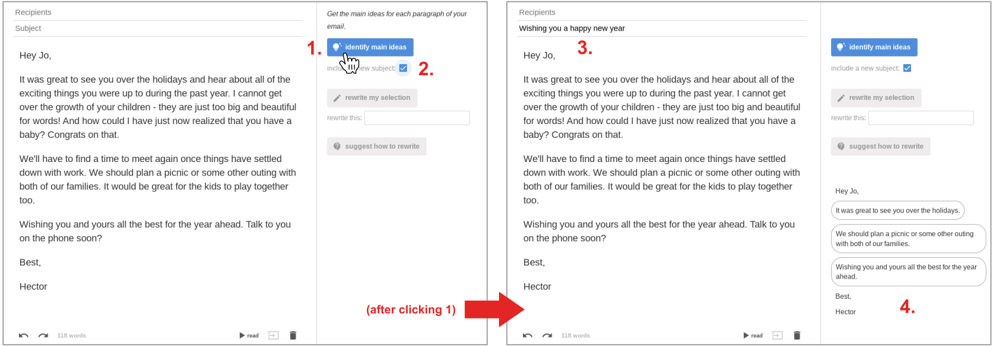
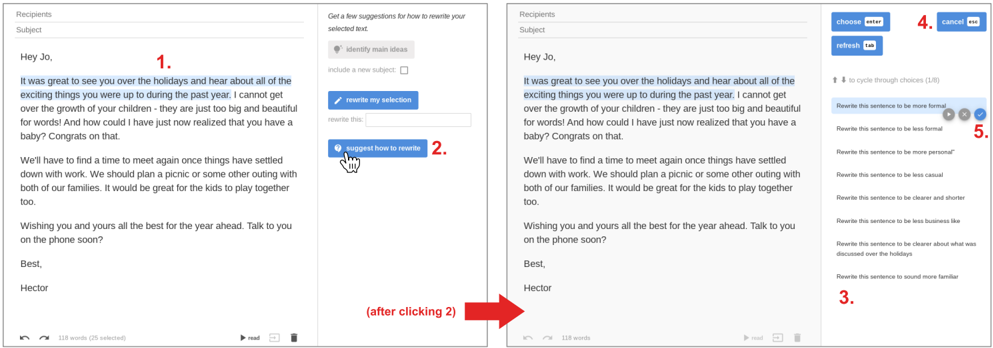
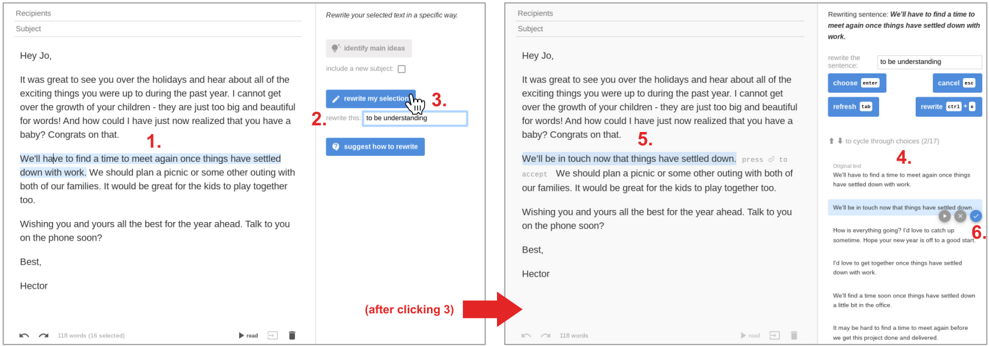
Prior work has explored the writing challenges experienced by people with dyslexia, and the potential for new spelling, grammar, and word retrieval technologies to address these challenges. However, the capabilities for natural language generation demonstrated by the latest class of large language models (LLMs) highlight an opportunity to explore new forms of human-AI writing support tools. In this paper, we introduce LaMPost, a prototype email-writing interface that explores the potential for LLMs to power writing support tools that address the varied needs of people with dyslexia. LaMPost draws from our understanding of these needs and introduces novel AI-powered features for email-writing, including: outlining main ideas, generating a subject line, suggesting changes, rewriting a selection. We evaluated LaMPost with 19 adults with dyslexia, identifying many promising routes for further exploration (including the popularity of the “rewrite” and “subject line” features), but also finding that the current generation of LLMs may not surpass the accuracy and quality thresholds required to meet the needs of writers with dyslexia. Surprisingly, we found that participants’ awareness of the AI had no effect on their perception of the system, nor on their feelings of autonomy, expression, and self-efficacy when writing emails. Our findings yield further insight into the benefits and drawbacks of using LLMs as writing support for adults with dyslexia and provide a foundation to build upon in future research.
Overview
The claims and statistics of this paper haven’t been checked yet.
Free: it reads the open-access text and checks the first 5 claims that cite a source we can check. Create a free account to check every claim.
Integrity signals
Registry
Cites
Statistics
Figures
Verification
Claims the paper makes
The claims and statistics of this paper haven’t been checked yet.
Free: it reads the open-access text and checks the first 5 claims that cite a source we can check. Create a free account to check every claim.
Self-check
Percentages, sums and reported differences re-computed from the paper’s own numbers.
The self-check needs the paper’s full text.
Citations
Cites
Using thematic analysis in psychology
Braun, V., & Clarke, V. (2006) · Qualitative Research in Psychology · doi:10.1191/1478088706qp063oa · Cited by 194,414
Vaswani, A., Shazeer, N., Parmar, N., Uszkoreit, J., Jones, L., Gomez, A. N., Kaiser, L., & Polosukhin, I. (2017) · arXiv · doi:10.48550/arxiv.1706.03762 · Cited by 120,404
Exploiting Generative AI to Scale up Intelligent Tutoring Systems
Jakubův, J., Chvalovský, K., Goertzel, Z., Kaliszyk, C., Olšák, M., Piotrowski, B., Schulz, S., Suda, M., & Urban, J. (2023) · DROPS (Schloss Dagstuhl – Leibniz Center for Informatics) · doi:10.4230/lipics.itp.2023.19 · Cited by 76,658
BERT: Pre-training of Deep Bidirectional Transformers for Language Understanding
Devlin, J., Chang, M.-W., Lee, K., & Toutanova, K. (2018) · arXiv · doi:10.48550/arxiv.1810.04805 · Cited by 73,173
Language Models are Few-Shot Learners
Brown, T. B., Mann, B., Ryder, N., Subbiah, M., Kaplan, J., Dhariwal, P., Neelakantan, A., Shyam, P., Sastry, G., Askell, A., et al. (2020) · arXiv · doi:10.48550/arxiv.2005.14165 · Cited by 23,372
Kaugeranna, R., Kaugeranna, E., & Aion, (. S. 4. 6. (2023) · DROPS (Schloss Dagstuhl – Leibniz Center for Informatics) · doi:10.4230/lipics.giscience.2023.43 · Cited by 13,690
On the Dangers of Stochastic Parrots: Can Language Models Be Too Big? 🦜
Bender, E. M., Gebru, T., McMillan-Major, A., & Shmitchell, S. (2021) · Proceedings of the 2021 ACM Conference on Fairness, Accountability, and Transparency · doi:10.1145/3442188.3445922 · Cited by 6,988 · cited 1×
“Of particular note is that such models risk generating factually incorrect, ofensive, or stereotyped text since they are trained on content from the internet [5, 65].”
BackgroundThe Paradox of Choice: Why More Is Less
Schwartz, B. N. (2004) · Works - Scholarship, Research, & Creative Expression (Swarthmore College) · Cited by 2,512
Schwarzer, R., & Jerusalem, M. (2012) · PsycTESTS Dataset · doi:10.1037/t00393-000 · Cited by 1,572
Evaluating Large Language Models Trained on Code
Chen, M., Tworek, J., Jun, H., Yuan, Q., Pinto, H. P. D. O., Kaplan, J., Edwards, H., Burda, Y., Joseph, N., Brockman, G., et al. (2021) · arXiv · doi:10.48550/arxiv.2107.03374 · Cited by 1,436
Research works printed but not linked: 5
- 4. Thomas Armstrong. 2011. The Power of Neurodiversity: Unleashing the Advan- tages of Your Diferently Wired Brain (published in Hardcover as Neurodiversity). Hachette Books.
- 32. IDA Editorial Contributors. 2020. Dyslexia Basics. https://dyslexiaida.org/ dyslexia-basics/.
- 45. Jennifer Pedler. 2007. Computer Correction of Real-word Spelling Errors in Dyslexic Text. Ph. D. Dissertation. Birkbeck College, London University.
- 48. Alec Radford, Jefrey Wu, Rewon Child, David Luan, Dario Amodei, Ilya Sutskever, and Others. 2019. Language models are unsupervised multitask learners. OpenAI blog 1, 8 (2019), 9.
- 63. Monica van Schaik. 2021. "ACCEPT THE IDEA THAT NEURODIVERSE KIDS EXIST": DYSLEXIC NARRATIVES AND NEURODIVERSITY PARADIGM VISIONS. Ph. D. Dissertation. Wilfrid Laurier University.
Cited by
AI Hallucinations: A Misnomer Worth Clarifying
Maleki, N., Padmanabhan, B., & Dutta, K. (2024) · 2024 IEEE Conference on Artificial Intelligence (CAI) · doi:10.1109/cai59869.2024.00033 · Cited by 194
Supporting Sensemaking of Large Language Model Outputs at Scale
Gero, K. I., Swoopes, C., Gu, Z., Kummerfeld, J. K., & Glassman, E. L. (2024) · Proceedings of the CHI Conference on Human Factors in Computing Systems · doi:10.1145/3613904.3642139 · Cited by 52
Valencia, S., Cave, R., Kallarackal, K., Seaver, K., Terry, M., & Kane, S. K. (2023) · Proceedings of the 2023 CHI Conference on Human Factors in Computing Systems · doi:10.1145/3544548.3581560 · Cited by 97
“LLMs have previously been used to support accessibility use cases including generating speech for AAC users [7, 31], and providing writing support for people with dyslexia [14].”
MethodDang, H., Goller, S., Lehmann, F., & Buschek, D. (2023) · Proceedings of the 2023 CHI Conference on Human Factors in Computing Systems · doi:10.1145/3544548.3580969 · Cited by 83
"I look at it as the king of knowledge": How Blind People Use and Understand Generative AI Tools
Adnin, R., & Das, M. (2024) · The 26th International ACM SIGACCESS Conference on Computers and Accessibility · doi:10.1145/3663548.3675631 · Cited by 73
Jang, J., Moharana, S., Carrington, P., & Begel, A. (2024) · Proceedings of the CHI Conference on Human Factors in Computing Systems · doi:10.1145/3613904.3642894 · Cited by 64
Carik, B., Ping, K., Ding, X., & Rho, E. H. R. (2025) · Proceedings of the ACM on Human-Computer Interaction · doi:10.1145/3701194 · Cited by 64
Introduction to large language models (LLMs) for dementia care and research
Treder, M. S., Lee, S., & Tsvetanov, K. A. (2024) · Frontiers in Dementia · doi:10.3389/frdem.2024.1385303 · Cited by 63
Kim, J., Suh, S., Chilton, L. B., & Xia, H. (2023) · Proceedings of the 2023 ACM Designing Interactive Systems Conference · doi:10.1145/3563657.3595996 · Cited by 61
“Goodman et al. [39] developed a mail writing system for adults with dyslexia that facilitated the process of writing emails by outlining the email’s content and subject line, suggesting phrases, and ofer-ing rewriting features.”
BackgroundSupermind Ideator: How Scaffolding Human-AI Collaboration Can Increase Creativity
Heyman, J. L., Rick, S., Giacomelli, G., Wen, H., Laubacher, R., Taubenslag, N., Knicker, M. S., Jeddi, Y., Ragupathy, P., Curhan, J. R., et al. (2024) · ACM Collective Intelligence Conference (CI) · doi:10.1145/3643562.3672611 · Cited by 58
Saha, K., Jain, Y., Liu, C., Kaliappan, S., & Karkar, R. (2026) · ACM Transactions on Computing for Healthcare · doi:10.1145/3709366 · Cited by 53
Reza, M., Laundry, N. M., Musabirov, I., Dushniku, P., Yu, Z. Y. “., Mittal, K., Grossman, T., Liut, M., Kuzminykh, A., & Williams, J. J. (2024) · Proceedings of the CHI Conference on Human Factors in Computing Systems · doi:10.1145/3613904.3641899 · Cited by 52
“…for each participant. timing constraints of our study and served as realistic use-cases for LLMs, in alignment with recent HCI studies on human-AI co-writing [9, 31, 47], and commonly advertised applications of commercial AI-assisted writing tools, such as Grammarly Go, Respond-able, and Copy.ai.”
Exploring the Use of Large Language Models for Improving the Awareness of Mindfulness
Kumar, H., Wang, Y., Shi, J., Musabirov, I., Farb, N. A. S., & Williams, J. J. (2023) · Extended Abstracts of the 2023 CHI Conference on Human Factors in Computing Systems · doi:10.1145/3544549.3585614 · Cited by 50
Storyfier: Exploring Vocabulary Learning Support with Text Generation Models
Peng, Z., Wang, X., Han, Q., Zhu, J., Ma, X., & Qu, H. (2023) · Proceedings of the 36th Annual ACM Symposium on User Interface Software and Technology · doi:10.1145/3586183.3606786 · Cited by 27
Generative AI in User-Generated Content
Hua, Y., Niu, S., Cai, J., Chilton, L. B., Heuer, H., & Wohn, D. Y. (2024) · CHI Conference Extended Abstracts on Human Factors in Computing Systems (CHI EA) · doi:10.1145/3613905.3636315 · Cited by 51
Siddiqui, M. N., Pea, R. D., & Subramonyam, H. (2025) · CHI Conference on Human Factors in Computing Systems · doi:10.1145/3706598.3714119 · Cited by 45
A Map of Exploring Human Interaction Patterns with LLM: Insights into Collaboration and Creativity
Li, J., Li, J., & Su, Y. (2024) · Lecture notes in computer science · doi:10.1007/978-3-031-60615-1_5 · Cited by 44
Collage is the New Writing: Exploring the Fragmentation of Text and User Interfaces in AI Tools
Buschek, D. (2024) · Designing Interactive Systems Conference · doi:10.1145/3643834.3660681 · Cited by 44
The Design Space of Generative ModelsPreprint
Morris, M. R., Cai, C. J., Holbrook, J., Kulkarni, C. E., & Terry, M. (2023) · arXiv (Cornell University) · doi:10.48550/arxiv.2304.10547 · Cited by 43
Self-citationCo-Writing with AI, on Human Terms: Aligning Research with User Demands Across the Writing Process
Reza, M., Thomas-Mitchell, J., Dushniku, P., Laundry, N., Williams, J. J., & Kuzminykh, A. (2025) · Proceedings of the ACM on Human-Computer Interaction · doi:10.1145/3757566 · Cited by 37
“Proposal Integration (S2) presents AI-generated content as suggestions within an exploration framework.”
InfluentialUnderstanding Digital Content Creation Needs of Blind and Low Vision People
Zhang, L., Sun, S., & Findlater, L. (2023) · International ACM SIGACCESS Conference on Computers and Accessibility (ASSETS) · doi:10.1145/3597638.3608387 · Cited by 36
Habibi, F., Sedaghatshoar, S., Attar, T., Shokoohi, M., Kiani, A., & Malek, A. N. (2025) · AI and Ethics · doi:10.1007/s43681-024-00608-1 · Cited by 37
Zhao, S., Xiong, S. C., Pang, B. C., Tang, X., & He, P. (2025) · CHI Conference Extended Abstracts on Human Factors in Computing Systems (CHI EA) · doi:10.1145/3706599.3720113 · Cited by 31
Survey on User Interface Design and Interactions for Generative AI Applications
Luera, R., Rossi, R., Siu, A. F., Dernoncourt, F., Yu, T., Kim, S., Zhang, R., Chen, X., Salehy, H., Lipka, N., et al. (2025) · Foundations and Trends® in Human–Computer Interaction · doi:10.1561/1100000106 · Cited by 33
Bastola, A., Wang, H., Hembree, J., Yadav, P., Gong, Z., Dixon, E., Razi, A., & McNeese, N. J. (2023) · arXiv (Cornell University) · doi:10.48550/arxiv.2306.11980 · Cited by 28
Haroon, R., & Dogar, F. R. (2024) · International ACM SIGACCESS Conference on Computers and Accessibility (ASSETS) · doi:10.1145/3663548.3675633 · Cited by 28
A Review of LLM-Assisted IdeationPreprint
Li, S., Padilla, S., Bras, P. L., Dong, J., & Chantler, M. J. (2025) · arXiv (Cornell University) · doi:10.48550/arxiv.2503.00946 · Cited by 25
GlassMail: Towards Personalised Wearable Assistant for On-the-Go Email Creation on Smart Glasses
Zhou, C., Yan, Z., Ram, A., Gu, Y. S., Xiang, Y., Liu, C., Huang, Y., Ooi, W. T., & Zhao, S. (2024) · Designing Interactive Systems Conference · doi:10.1145/3643834.3660683 · Cited by 25
The potential of Large Language Models for social robots in special education
Voultsiou, E., Vrochidou, Ε., Moussiades, L., & Papakostas, G. A. (2025) · Progress in Artificial Intelligence · doi:10.1007/s13748-025-00363-2 · Cited by 24
TutoAI: a cross-domain framework for AI-assisted mixed-media tutorial creation on physical tasks
Chen, Y., Morariu, V. I., Truong, A., & Liu, Z. (2024) · CHI Conference on Human Factors in Computing Systems · doi:10.1145/3613904.3642443 · Cited by 23
de Wynter, A. (2024) · IEEE Transactions on Games · doi:10.1109/tg.2024.3497601 · Cited by 22
Why So Serious? Exploring Timely Humorous Comments in AAC Through AI-Powered Interfaces
Weinberg, T. M., Kadoma, K., Penuela, R. E. G., Valencia, S., & Roumen, T. J. (2025) · CHI Conference on Human Factors in Computing Systems · doi:10.1145/3706598.3714102 · Cited by 22
Language Models as Critical Thinking Tools: A Case Study of PhilosophersPreprint
Ye, A., Moore, J., Novick, R., & Zhang, A. X. (2024) · arXiv (Cornell University) · doi:10.48550/arxiv.2404.04516 · Cited by 22
LaMPost: AI Writing Assistance for Adults with Dyslexia Using Large Language Models
Goodman, S. M., Buehler, E., Clary, P., Coenen, A., Donsbach, A., Horne, T. N., Lahav, M., MacDonald, R., Michaels, R. B., Narayanan, A., et al. (2024) · Communications of the ACM · doi:10.1145/3626952 · Cited by 20
Self-citationEmails by LLMs: A Comparison of Language in AI-Generated and Human-Written Emails
Li, W., Lai, Y., Soni, S., & Saha, K. (2025) · ACM Web Science Conference (WebSci) · doi:10.1145/3717867.3717872 · Cited by 19
Do LLMs Meet the Needs of Software Tutorial Writers? Opportunities and Design Implications
Bhat, A., Shrivastava, D., & Guo, J. (2024) · Designing Interactive Systems Conference · doi:10.1145/3643834.3660692 · Cited by 19
Liu, Y., Wen, Z., Weng, L., Woodman, O., Yang, Y., & Chen, W. (2024) · IEEE Transactions on Visualization and Computer Graphics · doi:10.1109/tvcg.2024.3410523 · Cited by 18
Understanding and Supporting Formal Email Exchange by Answering AI-Generated Questions
Miura, Y., Yang, C.-L., Kuribayashi, M., Matsumoto, K., Kuzuoka, H., & Morishima, S. (2025) · CHI Conference on Human Factors in Computing Systems · doi:10.1145/3706598.3714016 · Cited by 17
An HCI-Centric Survey and Taxonomy of Human-Generative-AI Interactions
Shi, J., Jain, R., Doh, H., Suzuki, R., & Ramani, K. (2023) · arXiv · doi:10.48550/arxiv.2310.07127 · Cited by 15
Kaliappan, S., Liu, C., Jain, Y., Karkar, R., & Saha, K. (2025) · JMIR Aging · doi:10.2196/68890 · Cited by 15
On the relevance of Maslow's need theory in the age of artificial intelligence
Montag, C., Riazi, A. M., Mikros, G. K., Becker, B., & Ali, R. (2025) · Technological Forecasting and Social Change · doi:10.1016/j.techfore.2025.124222 · Cited by 15
Li, Q., & Wu, S. (2024) · Proceedings of the ACM on Human-Computer Interaction · doi:10.1145/3687014 · Cited by 7
Supermind Ideator: How scaffolding Human-AI collaboration can increase creativity
Heyman, J. L., Rick, S., Giacomelli, G., Wen, H., Laubacher, R., Taubenslag, N., Knicker, M. S., Jeddi, Y., Ragupathy, P., Curhan, J. R., et al. (2024) · Collective Intelligence · doi:10.1177/26339137241305117 · Cited by 14
Supermind Ideator: Exploring generative AI to support creative problem-solving
Rick, S. R., Giacomelli, G., Wen, H., Laubacher, R. J., Taubenslag, N., Heyman, J. L., Knicker, M. S., Jeddi, Y., Maier, H., Dwyer, S., et al. (2023) · arXiv · doi:10.48550/arxiv.2311.01937 · Cited by 12
A Literature Review of Personalized Large Language Models for Email Generation and Automation
Novelo, R., Silva, R. R., & Bernardino, J. (2025) · Future Internet · doi:10.3390/fi17120536 · Cited by 12
Haroon, R., Wigdor, K., Yang, K., Toumanios, N., Crehan, E. T., & Dogar, F. R. (2025) · International ACM SIGACCESS Conference on Computers and Accessibility (ASSETS) · doi:10.1145/3663547.3746337 · Cited by 11
Johnson, J., Lewis, A., Mankoff, J. C., & Banner, O. (2026) · CHI Conference on Human Factors in Computing Systems · doi:10.1145/3772318.3790652 · Cited by 12
MenuCraft: Interactive Menu System Design with Large Language ModelsPreprint
Kargaran, A. H., Nikeghbal, N., Heydarnoori, A., & Schütze, H. (2023) · arXiv (Cornell University) · doi:10.48550/arxiv.2303.04496 · Cited by 12
Pinto, A., Quilter, E. E. V., Vasikaran, J., Koerner, S., Chimonas, T., Nielsen, E. E., Marshall, P., & O'Hara, K. P. (2025) · Australian Conference on Human-Computer Interaction (OzCHI) · doi:10.1145/3764687.3764713 · Cited by 9
StepWrite: Adaptive Planning for Speech-Driven Text Generation
Alaoui, H. E., Taheri, A., Peng, Y.-H., & Bigham, J. P. (2025) · ACM Symposium on User Interface Software and Technology (UIST) · doi:10.1145/3746059.3747610 · Cited by 9
Roxas, R. E., & Recario, R. N. C. (2024) · Indonesian Journal of Electrical Engineering and Computer Science · doi:10.11591/ijeecs.v36.i1.pp252-263 · Cited by 10
QuickTA : Exploring the Design Space of Using Large Language Models to Provide Support to Students
Kumar, H., Леонидович, М. И., Williams, J. J., & Liut, M. (2023) · TSpace (University of Toronto) · Cited by 8
Approach Intelligent Writing Assistants Usability with Seven Stages of ActionPreprint
Bhat, A., Shrivastava, D., & Guo, J. (2023) · arXiv (Cornell University) · doi:10.48550/arxiv.2304.02822 · Cited by 8
Design Probes for AI-Driven AAC: Addressing Complex Communication Needs in Aphasia
Mao, L., Lee, J. H., Faroqi‐Shah, Y., & Valencia, S. (2025) · Designing Interactive Systems Conference · doi:10.1145/3715336.3735736 · Cited by 7
Moharana, S., Bennett, C. L., Buehler, E., Madaio, M., Tibdewal, V., & Kane, S. K. (2025) · Proceedings of the AAAI/ACM Conference on AI Ethics and Society · doi:10.1609/aies.v8i2.36669 · Cited by 6
Self-citationUnderstanding Conversational AI: Philosophy, Ethics, and Social Impact of Large Language Models
Poibeau, T. (2025) · Ubiquity Press eBooks · doi:10.5334/bde · Cited by 6
Chen, Y., & Liu, Z. (2024) · Workshop on Intelligent and Interactive Writing Assistants (In2Writing) · doi:10.1145/3690712.3690715 · Cited by 6
Zindulka, T., Goller, S., Lehmann, F., & Buschek, D. (2025) · CHI Conference on Human Factors in Computing Systems · doi:10.1145/3706598.3713890 · Cited by 6
Bringing Context-Aware Completion Suggestions to Arbitrary Text Entry Interfaces
Aveni, T. J., Fox, A., & Hartmann, B. (2023) · ACM Symposium on User Interface Software and Technology (UIST) · doi:10.1145/3586182.3615825 · Cited by 6
Rethinking Productivity with GenAI: A Neurodivergent Students' Perspective
Jamshed, H., Naseem, M., Potluri, V., & Brewer, R. N. (2025) · Proceedings of the 27th International ACM SIGACCESS Conference on Computers and Accessibility · doi:10.1145/3663547.3746329 · Cited by 5
“This dilemma echoes findings in prior work where people with invisible disabilities want to be authentically represented, whether in writing [35] or virtual spaces [36].”
CNReader: a reading practice tool designed for Chinese children with developmental dyslexia
Liu, L., Fang, T., Liu, E., Shi, S. M., Zhai, S., Chen, Y., Zhang, L., Shi, Y., & Yao, C. (2025) · Humanities and Social Sciences Communications · doi:10.1057/s41599-025-05079-1 · Cited by 5
Ledoyen, F., Dias, G. H., Pantin, J., Lechervy, A., Maurel, F., & Chahir, Y. (2025) · Conference on Empirical Methods in Natural Language Processing (EMNLP) · doi:10.18653/v1/2025.emnlp-main.596 · Cited by 5
Understanding User Experience with AI-Assisted Writing Service
Kim, G., Kim, J., & Kim, H. K. (2023) · Lecture notes in computer science · doi:10.1007/978-3-031-35894-4_19 · Cited by 5
Design Probes for AI-Driven AAC: Addressing Complex Communication Needs in AphasiaPreprint
Mao, L., Lee, J. H., Shah, Y. F., & Valencia, S. (2025) · arXiv (Cornell University) · doi:10.48550/arxiv.2504.09435 · Cited by 5
Morgan, D. (2026) · Disability & Society · doi:10.1080/09687599.2026.2667528 · Cited by 4
“Goodman et al. (2022) found that dyslexic adults valued features such as automated outlining and rewriting assistance.”
From Use to Oversight: How Mental Models Influence User Behavior and Output in AI Writing Assistants
Rismani, S., Blodgett, S. L., Liao, Q. V., Olteanu, A., & Moon, A. (2026) · CHI Conference on Human Factors in Computing Systems · doi:10.1145/3772318.3791670 · Cited by 4
Semantic Prompting: Agentic Incremental Narrative Refinement through Spatial Semantic Interaction
Tang, X., Tahmid, I. A., Krokos, E., Whitley, K. N., Wang, X., & North, C. L. (2026) · International Conference on Advanced Visual Interfaces (AVI) · doi:10.1145/3811427.3811444 · Cited by 4
Designing Accessible Content Creation Support with Blind and Low Vision Creators
Zhang, L. (2024) · ACM SIGACCESS Accessibility and Computing · doi:10.1145/3654768.3654775 · Cited by 6
Large Language Models and Inclusivity in Bioethics Scholarship
Varma, S. (2023) · The American Journal of Bioethics · doi:10.1080/15265161.2023.2250286 · Cited by 4
LexiEase AI : An AI Powered Dyslexic Support System
Phatangare, S., Jain, S., Chakrabarty, S., Chougule, S., & Bisen, S. (2025) · International Conference Trends Material Science and Inventive Materials · doi:10.1109/ictmim65579.2025.10987997 · Cited by 4
OmniFill: Domain-Agnostic Form Filling Suggestions Using Multi-Faceted ContextPreprint
Aveni, T. J., Fox, A., & Hartmann, B. (2023) · arXiv (Cornell University) · doi:10.48550/arxiv.2310.17826 · Cited by 4
Where Do I 'Add the Egg'?: Exploring Agency and Ownership in AI Creative Co-Writing Systems
Carrera, D., Thomas-Mitchell, J., & Wigdor, D. (2026) · Proceedings of the 2026 CHI Conference on Human Factors in Computing Systems · doi:10.1145/3772318.3791952 · Cited by 3
“Many interfaces resembled commercial instantiations of this archetype, utilizing buttons, dropdown menus, and keywords (in creative writing [51, 58, 70, 80] and other writing contexts [28, 38, 63]).”
Pimenova, V., Sechayk, Y., Murai, F., Hundt, A., & Dori-Hacohen, S. (2025) · International ACM SIGACCESS Conference on Computers and Accessibility (ASSETS) · doi:10.1145/3663547.3759764 · Cited by 3
Recent Advances in Artificial Intelligence for Dyslexia Detection: A Systematic Review
Pamungkas, Y., Rangkuti, R. Y., Karim, A., & Sangsawang, T. (2025) · International Journal of Robotics and Control Systems · doi:10.31763/ijrcs.v5i3.2057 · Cited by 3
Lost in Translation: Benchmarking Commercial Machine Translation Models for Dyslexic-Style Text
Price, G., & Wu, S. (2025) · Findings of the Association for Computational Linguistics: ACL (Findings of ACL) · doi:10.18653/v1/2025.findings-acl.708 · Cited by 3
Song, F. (2023) · Journal of Information Systems Engineering & Management · doi:10.55267/iadt.07.14076 · Cited by 3
Prototype of Riding Accident Detection System Using R3 SMD Microcontroller Based on GPS and IoT
Setiadi, T., & Wijayanti, A. (2023) · Jurnal E-Komtek (Elektro-Komputer-Teknik) · doi:10.37339/e-komtek.v7i2.1526 · Cited by 3
AI Chatbots for Mental Health: Values and Harms from Lived Experiences of Depression
Yoo, D. W., Shi, J. M., Rodriguez, V. J., & Saha, K. (2025) · arXiv · doi:10.48550/arxiv.2504.18932 · Cited by 2
Fitzsimons, A., Gerber, E. M., & Long, D. (2024) · Workshop on Intelligent and Interactive Writing Assistants (In2Writing) · doi:10.1145/3690712.3690719 · Cited by 2
Infrastructuring for Access: Co-Designing Writing Tools with a Dyslexic Academic
Wang, E. Q., & Marie, A. S. (2026) · CHI Conference on Human Factors in Computing Systems · doi:10.1145/3772318.3791104 · Cited by 2
Mohana, M., da Silveira, A. C., Subashini, P., Ghinea, G., & Santos, C. A. S. (2024) · Lecture notes in educational technology · doi:10.1007/978-981-97-0076-9_10 · Cited by 2
Ochiai, Y., Kondo, N., & Fushimi, T. (2023) · arXiv (Cornell University) · doi:10.48550/arxiv.2304.04498 · Cited by 2
ICX360: In-Context eXplainability 360 ToolkitPreprint
Wei, D., Luss, R., Hu, X., Paes, L. M., Chen, P., Ramamurthy, K. N., Miehling, E., Vejsbjerg, I., & Strobelt, H. (2025) · arXiv (Cornell University) · doi:10.48550/arxiv.2511.10879 · Cited by 2
Inclusive Easy-to-Read Generation for Individuals with Cognitive ImpairmentsPreprint
Ledoyen, F., Dias, G. H., Lechervy, A., Pantin, J., Maurel, F., Chahir, Y., Gouzonnat, E., Berthelot, M., Moravac, S., Altinier, A., et al. (2025) · arXiv (Cornell University) · doi:10.48550/arxiv.2510.00691 · Cited by 2
When Disability Disclosure Travels: Memory, Privacy, and Contextual Integrity in Conversational AIPreprint
Taheri, A., Tazike, M., Carrington, P., & Bigham, J. P. (2026) · arXiv (Cornell University) · doi:10.48550/arxiv.2609.22720 · Cited by 3
SnapSound: Empowering everyone to customize sound experience with Generative AI
Oh, J., & Jeong, J.-W. (2025) · International Journal of Human-Computer Studies · doi:10.1016/j.ijhcs.2025.103673 · Cited by 1
Augmenting Human Cognition Through Generative AI
Rogers, Y., Reicherts, L., Zhang, Z. T., & Hassib, M. (2026) · Springer eBooks · doi:10.1007/978-3-031-61050-9_10-1 · Cited by 1
Automating Personalized Email Outreach: A LangChain–LLaMA Framework with ChromaDB and Groq Cloud
Vijay Ganesh, M., Bhavana, T., Pranavi, C., Sethu, N. H., & Prashsanth, K. (2025) · International Conference on Ubiquitous Computing and Intelligent Information Systems (ICUIS) · doi:10.1109/icuis67429.2025.11380266 · Cited by 1
Teaching Spell Checkers to Teach: Pedagogical Program Synthesis for Interactive Learning
Siddiqui, M. N., Cavez, V., Rangasrinivasan, S., Olszewski, A., Setlur, S., Agrawala, M., & Subramonyam, H. (2026) · ACM International Conference on Intelligent User Interfaces (IUI) · doi:10.1145/3742413.3789137 · Cited by 1
Enhancing digital reading for dyslexic learners: an AI-based approach to cognitive load reduction
Amjad, A., Amirhosseini, M. H., & Kalabi, F. (2026) · Journal of Enabling Technologies · doi:10.1108/jet-08-2025-0060 · Cited by 1
Oliveira, R., & Palhanos, L. R. (2023) · Simpósio Brasileiro de Fatores Humanos em Sistemas Computacionais (IHC) · doi:10.5753/ihc_estendido.2023.233798 · Cited by 1
How different mental models of AI-based writing assistants impact writers’ interactions with them
Rismani, S., Blodgett, S. L., Olteanu, A., Liao, Q. V., & Moon, A. (2024) · Workshop on Intelligent and Interactive Writing Assistants (In2Writing) · doi:10.1145/3690712.3690722 · Cited by 1
Khanom, N. N., Gershkovich, A., Alonzo, O., & Hassan, S. (2025) · International ACM SIGACCESS Conference on Computers and Accessibility (ASSETS) · doi:10.1145/3663547.3759713 · Cited by 1
A Low-Resource Speech-Driven NLP Pipeline for Sinhala Dyslexia Assistance
Perera, P., & Sumanathilaka, D. K. (2025) · International conference Recent advances in natural language processing · doi:10.26615/978-954-452-098-4-106 · Cited by 1
Gupta, I., & Buryi, P. (2026) · arXiv (Cornell University) · doi:10.48550/arxiv.2605.00113 · Cited by 1
Bak, M. (2023) · The American Journal of Bioethics · doi:10.1080/15265161.2023.2250312
A Visualization System for LLM-based Fault Entity Extraction of Power Equipment
You, L., Guo, X., Wang, D., Zhang, Z., Zhong, K., Chen, N., & Wang, H. (2025) · doi:10.1109/icbdse65491.2025.11220034
Large language models and the future of writing
Poibeau, T. (2025) · Ubiquity Press eBooks · doi:10.5334/bde.d
Interacting with Assistive Technology (IAT) Workshop
Whittington, P., Doğan, H., Wang, R., Porter, C., Waller, A., AI-Thani, D., & Öndünç, S. E. (2024) · Bournemouth University Research Online (Bournemouth University)
Metadata
- Authors
- Goodman, S. M., Buehler, E., Clary, P., Coenen, A., Donsbach, A., Horne, T. N., Lahav, M., MacDonald, R., Michaels, R. B., Narayanan, A., Pushkarna, M., Riley, J., Santana, A., Shi, L., Sweeney, R., Weaver, P., Yuan, A., & Morris, M. R.
- Affiliations
- Google (United States) (US)
- Google (United Kingdom) (GB)
- ORCID
- Venue
- Proceedings of the 24th International ACM SIGACCESS Conference on Computers and Accessibility
- Publisher
- ACM
- Published
- 2022-10-22
- Pages
- 1-18
- OpenAlex
- W4284880452
- Cited by
- 71
- References
- 68
- Citations by year
- 2026: 12 · 2025: 26 · 2024: 23 · 2023: 10
- FWCI
- 31.92
- Type
- conference paper
- Language
- en
- Open access
- hybrid
- doi.org
- Licence
- Locations
- International ACM SIGACCESS Conference on Computers and Accessibility (ASSETS) (publishedVersion, cc-by)
- arXiv (Cornell University) (submittedVersion)
- arXiv (Cornell University)
- Topics
- Health Sciences › Health Professions › Occupational Therapy › Assistive Technology in Communication and Mobility
- Social Sciences › Human Factors and Ergonomics › Digital Accessibility for Disabilities
- Physical Sciences › Computer Science › Artificial Intelligence › Natural Language Processing Techniques
- Keywords
- dyslexia, email writing, large language models, assistive technology, natural language generation, text rewriting, outlining, user autonomy, self-efficacy, adults with dyslexia
About these checks
Registry, retraction, Cites and statistics results are computed, not judged, with one exception: a printed reference that no index lists is read once by a model before it counts as a citation error. Claims are extracted by a model and kept only when their quote appears verbatim in the text; each cited source is then checked, with a model’s help, for whether it says what the claim relies on. Those verdicts can be wrong — read the claim’s quote and the cited source before relying on one.
Statistics and arithmetic are recomputed, not judged.
Confidence bands are shown only for fields calibrated on our annotated test set. None is calibrated yet, so no band is shown.
What counts as a claim ›How we measure confidence ›How we check this ›
Are you an author, or do you see a problem with this page? Request a review
Data sources
Bibliographic data: Semantic Scholar, OpenAlex, Crossref.
Contains information from the Semantic Scholar Academic Graph Datasets, made available under the ODC Attribution License (ODC-BY 1.0).
Semantic Scholar’s data is described in: Kinney, R., et al. (2023). The Semantic Scholar Open Data Platform. arXiv:2301.10140.
