

LaMPost: Design and Evaluation of an AI-assisted Email Writing Prototype for Adults with Dyslexia
Open accessThe DOI matches its Crossref record; 71 of the 72 references it cites were found in a registry or an index, and 1 are not checked yet.
Abstract
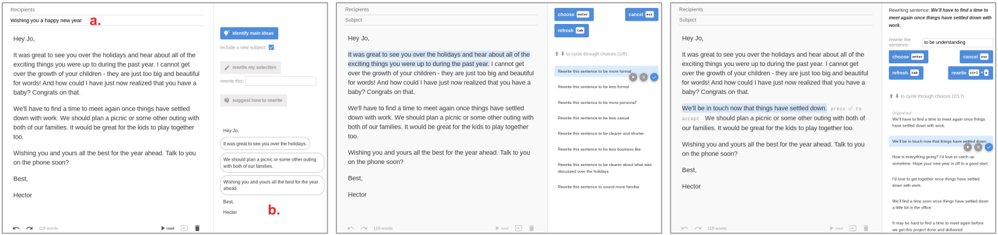
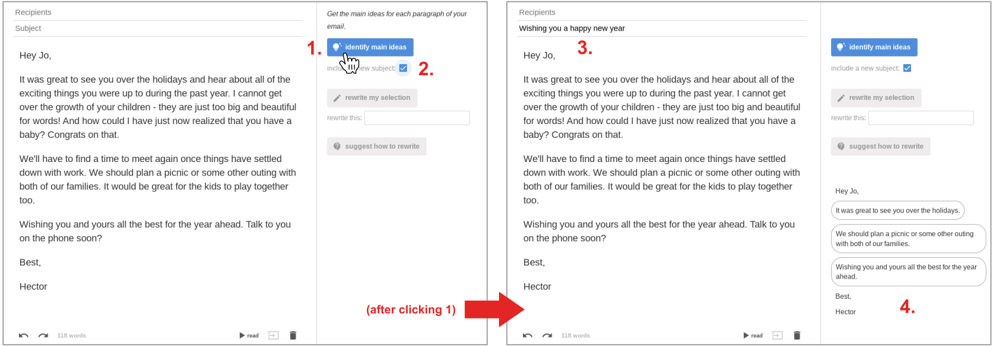
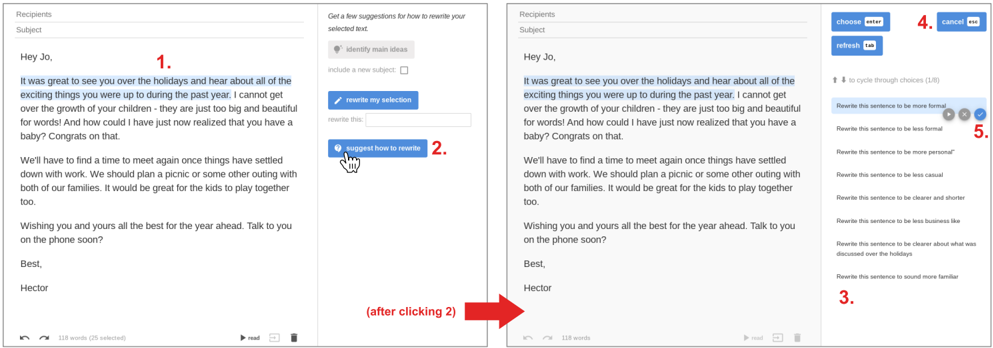
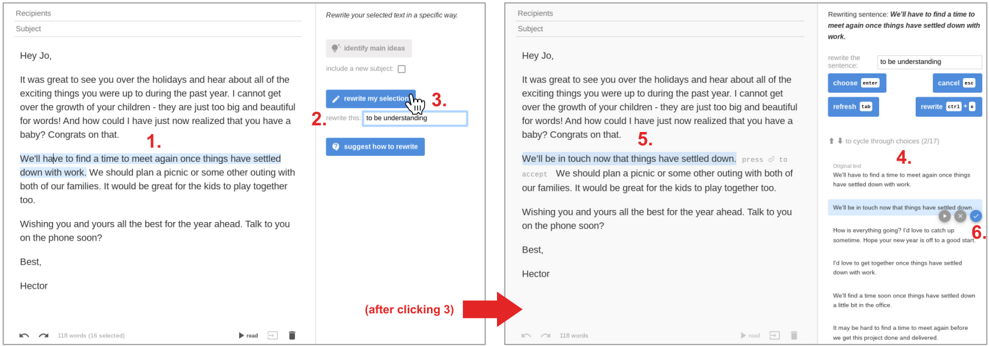
Prior work has explored the writing challenges experienced by people with dyslexia, and the potential for new spelling, grammar, and word retrieval technologies to address these challenges. However, the capabilities for natural language generation demonstrated by the latest class of large language models (LLMs) highlight an opportunity to explore new forms of human-AI writing support tools. In this paper, we introduce LaMPost, a prototype email-writing interface that explores the potential for LLMs to power writing support tools that address the varied needs of people with dyslexia. LaMPost draws from our understanding of these needs and introduces novel AI-powered features for email-writing, including: outlining main ideas, generating a subject line, suggesting changes, rewriting a selection. We evaluated LaMPost with 19 adults with dyslexia, identifying many promising routes for further exploration (including the popularity of the “rewrite” and “subject line” features), but also finding that the current generation of LLMs may not surpass the accuracy and quality thresholds required to meet the needs of writers with dyslexia. Surprisingly, we found that participants’ awareness of the AI had no effect on their perception of the system, nor on their feelings of autonomy, expression, and self-efficacy when writing emails. Our findings yield further insight into the benefits and drawbacks of using LLMs as writing support for adults with dyslexia and provide a foundation to build upon in future research.
Overview
The claims and statistics of this paper haven’t been checked yet.
Free: it reads the open-access text and checks the first 5 claims that cite a source we can check. Create a free account to check every claim.
Integrity signals
Registry
Cites
Statistics
Figures
Verification
Claims the paper makes
The claims and statistics of this paper haven’t been checked yet.
Free: it reads the open-access text and checks the first 5 claims that cite a source we can check. Create a free account to check every claim.
Self-check
Percentages, sums and reported differences re-computed from the paper’s own numbers.
The self-check needs the paper’s full text.
Citations
Cites
Using thematic analysis in psychology
Braun, V., & Clarke, V. (2006) · Qualitative Research in Psychology · doi:10.1191/1478088706qp063oa · Cited by 194,414
Vaswani, A., Shazeer, N., Parmar, N., Uszkoreit, J., Jones, L., Gomez, A. N., Kaiser, L., & Polosukhin, I. (2017) · arXiv · doi:10.48550/arxiv.1706.03762 · Cited by 120,404
Exploiting Generative AI to Scale up Intelligent Tutoring Systems
Jakubův, J., Chvalovský, K., Goertzel, Z., Kaliszyk, C., Olšák, M., Piotrowski, B., Schulz, S., Suda, M., & Urban, J. (2023) · DROPS (Schloss Dagstuhl – Leibniz Center for Informatics) · doi:10.4230/lipics.itp.2023.19 · Cited by 76,658
BERT: Pre-training of Deep Bidirectional Transformers for Language Understanding
Devlin, J., Chang, M.-W., Lee, K., & Toutanova, K. (2018) · arXiv · doi:10.48550/arxiv.1810.04805 · Cited by 73,173
Language Models are Few-Shot Learners
Brown, T. B., Mann, B., Ryder, N., Subbiah, M., Kaplan, J., Dhariwal, P., Neelakantan, A., Shyam, P., Sastry, G., Askell, A., et al. (2020) · arXiv · doi:10.48550/arxiv.2005.14165 · Cited by 23,372
Kaugeranna, R., Kaugeranna, E., & Aion, (. S. 4. 6. (2023) · DROPS (Schloss Dagstuhl – Leibniz Center for Informatics) · doi:10.4230/lipics.giscience.2023.43 · Cited by 13,690
On the Dangers of Stochastic Parrots: Can Language Models Be Too Big? 🦜
Bender, E. M., Gebru, T., McMillan-Major, A., & Shmitchell, S. (2021) · Proceedings of the 2021 ACM Conference on Fairness, Accountability, and Transparency · doi:10.1145/3442188.3445922 · Cited by 6,988 · cited 1×
“Of particular note is that such models risk generating factually incorrect, ofensive, or stereotyped text since they are trained on content from the internet [5, 65].”
BackgroundThe Paradox of Choice: Why More Is Less
Schwartz, B. N. (2004) · Works - Scholarship, Research, & Creative Expression (Swarthmore College) · Cited by 2,512
Schwarzer, R., & Jerusalem, M. (2012) · PsycTESTS Dataset · doi:10.1037/t00393-000 · Cited by 1,572
Evaluating Large Language Models Trained on Code
Chen, M., Tworek, J., Jun, H., Yuan, Q., Pinto, H. P. D. O., Kaplan, J., Edwards, H., Burda, Y., Joseph, N., Brockman, G., et al. (2021) · arXiv · doi:10.48550/arxiv.2107.03374 · Cited by 1,436
Research works printed but not linked: 5
- 4. Thomas Armstrong. 2011. The Power of Neurodiversity: Unleashing the Advan- tages of Your Diferently Wired Brain (published in Hardcover as Neurodiversity). Hachette Books.
- 32. IDA Editorial Contributors. 2020. Dyslexia Basics. https://dyslexiaida.org/ dyslexia-basics/.
- 45. Jennifer Pedler. 2007. Computer Correction of Real-word Spelling Errors in Dyslexic Text. Ph. D. Dissertation. Birkbeck College, London University.
- 48. Alec Radford, Jefrey Wu, Rewon Child, David Luan, Dario Amodei, Ilya Sutskever, and Others. 2019. Language models are unsupervised multitask learners. OpenAI blog 1, 8 (2019), 9.
- 63. Monica van Schaik. 2021. "ACCEPT THE IDEA THAT NEURODIVERSE KIDS EXIST": DYSLEXIC NARRATIVES AND NEURODIVERSITY PARADIGM VISIONS. Ph. D. Dissertation. Wilfrid Laurier University.
Cited by
Items 101–114 of 114
DESIGN PROBES FOR AI−DRIVEN AAC: ADDRESSING COMPLEX COMMUNICATION NEEDS IN APHASIA
Mao, L. (2025) · University Libraries (University of Maryland) · doi:10.13016/utqj-vqev
Navigating AI system implementation
Berretta, S. (2025) · Dokumentenrepositorium der RUB (Ruhr University Bochum) · doi:10.13154/294-13591
Heuer, H., Goller, S., & Buschek, D. (2026) · i-com · doi:10.1515/icom-2025-0024
Iterative Prompt Refinement for Dyslexia-Friendly Text Summarization Using GPT-4oPreprint
Bhojwani, S., Kain, S., & Xu, L. (2026) · arXiv (Cornell University) · doi:10.48550/arxiv.2602.22524
DyslexiaMate - a Multisensory Learning Platform for Neurodivergent Students
Faiza, I., A, M. S. N. V. L. K., Vijaya Anandhan, P., Vikasita, M., Sanmuga Priya, M., & Babu, P. (2025) · IEEE International Conference on Innovations in Engineering and Next-Generation Technologies for Sustainability (ICINVENTS) · doi:10.1109/icinvents64613.2025.11401866
Towards AI-Mediated Bidirectional Communication Support for Cross-Neurotype Interactions
Haroon, R. (2026) · ACM SIGACCESS Accessibility and Computing · doi:10.1145/3803767.3803779
Erreurs d’orthographe chez les personnes dyslexiques : analyses et pistes de remédiation
Bodard, J. (2024) · theses.fr (ABES) · doi:10.70675/eb2c604czac70z4b15zb649zd1ceeca2b79c
How Neurodivergent Students Conceptualize the Risks and Benefits of AI Chatbots
Underwood, K. (2026) · Carolina Digital Repository (University of North Carolina at Chapel Hill) · doi:10.17615/kb8b-xy58
Psikologi Idiolek: Erosi Kepemilikan Linguistik dalam Praktik Menulis dengan AI
Samosir, Z. C., Marpaung, Y. D. M., Syafira, M. D., Azzahra, M. A., & Adi, P. (2026) · Jurnal Pustaka Cendekia Hukum dan Ilmu Sosial · doi:10.70292/pchukumsosial.v4i1.289
Sridharan K, A. D., Aravindh, D., Arvind Prasad, H., & Abinicks, B., V (2026) · International Journal of Advanced Research in Science Communication and Technology · doi:10.48175/ijarsct-36720
Adults with Dyslexia & Duolingo: Experiences with Gamified Language Learning and Redesign Ideas
Kusuma, A., Dalvi, T., Niklaus, A. G., & Alonzo, O. (2026) · Lecture notes in computer science · doi:10.1007/978-3-032-29656-6_3
Soe, M. M. M., & Batovski, D. A. (2026) · International STEM Education Conference (iSTEM-Ed) · doi:10.1109/istem-ed69857.2026.11734330
Liang, Q. (., Adnin, R., & Das, M. (2026) · International ACM SIGACCESS Conference on Computers and Accessibility (ASSETS) · doi:10.1145/3797867.3829052
Metadata
- Authors
- Goodman, S. M., Buehler, E., Clary, P., Coenen, A., Donsbach, A., Horne, T. N., Lahav, M., MacDonald, R., Michaels, R. B., Narayanan, A., Pushkarna, M., Riley, J., Santana, A., Shi, L., Sweeney, R., Weaver, P., Yuan, A., & Morris, M. R.
- Affiliations
- Google (United States) (US)
- Google (United Kingdom) (GB)
- ORCID
- Venue
- Proceedings of the 24th International ACM SIGACCESS Conference on Computers and Accessibility
- Publisher
- ACM
- Published
- 2022-10-22
- Pages
- 1-18
- OpenAlex
- W4284880452
- Cited by
- 71
- References
- 68
- Citations by year
- 2026: 12 · 2025: 26 · 2024: 23 · 2023: 10
- FWCI
- 31.92
- Type
- conference paper
- Language
- en
- Open access
- hybrid
- doi.org
- Licence
- Locations
- International ACM SIGACCESS Conference on Computers and Accessibility (ASSETS) (publishedVersion, cc-by)
- arXiv (Cornell University) (submittedVersion)
- arXiv (Cornell University)
- Topics
- Health Sciences › Health Professions › Occupational Therapy › Assistive Technology in Communication and Mobility
- Social Sciences › Human Factors and Ergonomics › Digital Accessibility for Disabilities
- Physical Sciences › Computer Science › Artificial Intelligence › Natural Language Processing Techniques
- Keywords
- dyslexia, email writing, large language models, assistive technology, natural language generation, text rewriting, outlining, user autonomy, self-efficacy, adults with dyslexia
About these checks
Registry, retraction, Cites and statistics results are computed, not judged, with one exception: a printed reference that no index lists is read once by a model before it counts as a citation error. Claims are extracted by a model and kept only when their quote appears verbatim in the text; each cited source is then checked, with a model’s help, for whether it says what the claim relies on. Those verdicts can be wrong — read the claim’s quote and the cited source before relying on one.
Statistics and arithmetic are recomputed, not judged.
Confidence bands are shown only for fields calibrated on our annotated test set. None is calibrated yet, so no band is shown.
What counts as a claim ›How we measure confidence ›How we check this ›
Are you an author, or do you see a problem with this page? Request a review
Data sources
Bibliographic data: Semantic Scholar, OpenAlex, Crossref.
Contains information from the Semantic Scholar Academic Graph Datasets, made available under the ODC Attribution License (ODC-BY 1.0).
Semantic Scholar’s data is described in: Kinney, R., et al. (2023). The Semantic Scholar Open Data Platform. arXiv:2301.10140.
