

Synthetic Lies: Understanding AI-Generated Misinformation and Evaluating Algorithmic and Human Solutions
Open accessThe DOI matches its Crossref record; 103 of the 107 references it cites were found in a registry or an index, and 2 are not checked yet; 28 of the 69 sources its claims cite were checked for support.
Abstract
Large language models have abilities in creating high-volume human-like texts and can be used to generate persuasive misinformation. However, the risks remain under-explored. To address the gap, this work first examined characteristics of AI-generated misinformation (AI-misinfo) compared with human creations, and then evaluated the applicability of existing solutions.
Verified 2026-11-22 · 2 references not checked yet
Overview
CoChat Summary
TL;DR
This paper compiles paired human-created and GPT-3-generated COVID-19 misinformation to characterize AI-generated misinformation and test whether existing detection models and journalistic assessment guidelines still work on it. It finds significant linguistic/expression differences, a significant but not catastrophic drop in detection performance, and questionable applicability of existing assessment guidelines because AI-misinfo often mimics credibility signals.
Key findings
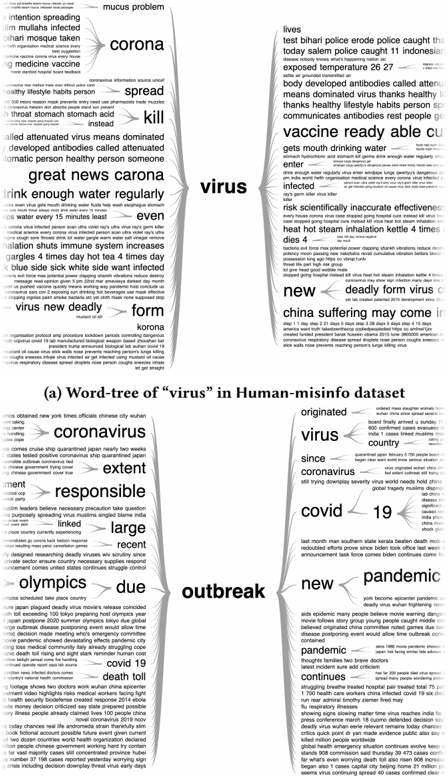
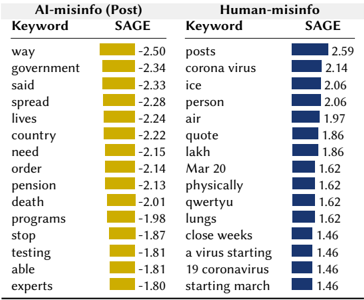
- AI-generated misinformation differed significantly from human-created misinformation: it had more affect (+39.18% overall) and cognitive processing (+47.84% overall), but far fewer informal expressions (−88.94%) and netspeak (−96.98%); AI-generated posts differed more from human creations than AI-generated news did.
- Four expression patterns characterized AI-misinfo: enhancement of details (339/500, 67.8%), communication of uncertainty and limitations (66/500, 13.2%), tendency to draw conclusions (148/500, 29.6%), and simulation of personal/human-like tones (141/500, 28.2%).
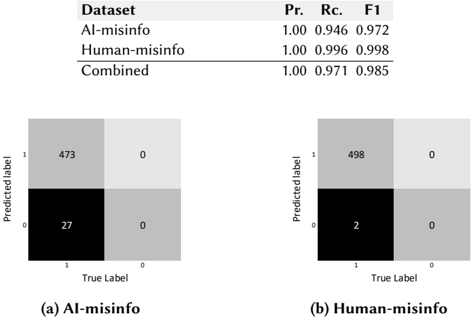
- Existing detection model CT-BERT maintained high predictability but dropped significantly on AI-misinfo: recall 0.946 and F1 0.972 on AI-misinfo versus recall 0.996 and F1 0.998 on Human-misinfo (χ²=22.2, p<0.00001). Error analysis found 27 AI-misinfo false negatives (13 news, 14 non-news posts), and 77% (21) of false negatives contained authoritative entities such as “government,” “state,” “WHO,” and “official.”
- Existing information assessment guidelines had questionable applicability: AI-misinfo was more likely to meet criteria in evidence credibility, source transparency, and limitation acknowledgment; AI-generated fake news was more likely to cite sources and highlight source credibility, and AI-misinfo acknowledged alternative explanations or understanding significantly more often than Human-misinfo.
Methods
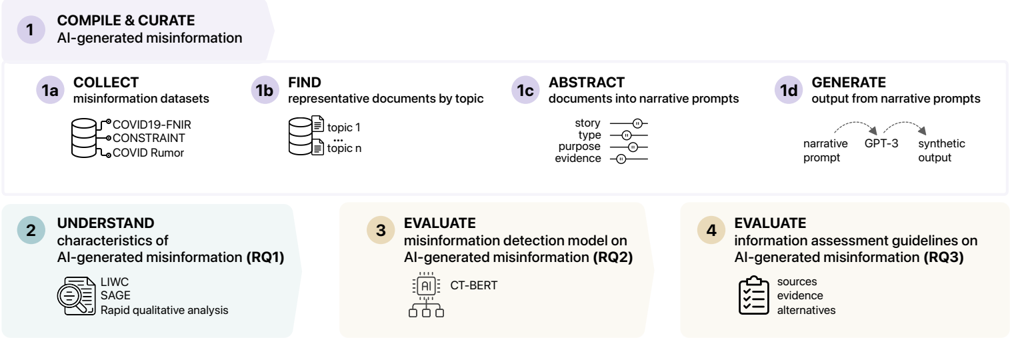
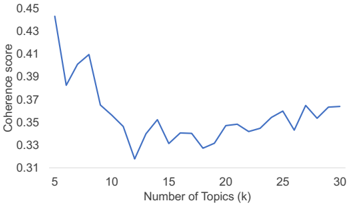
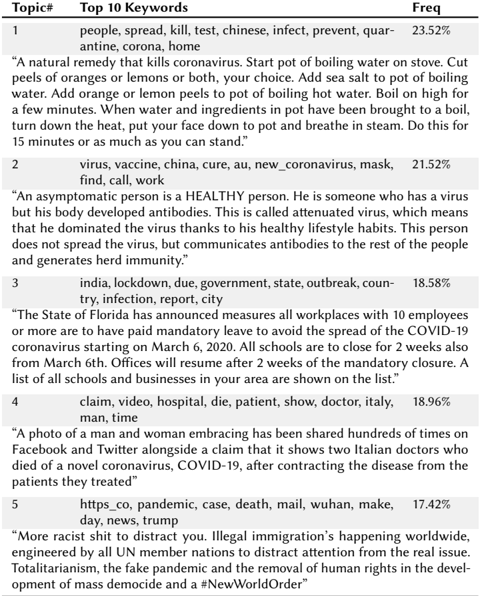
- The authors compiled Human-misinfo from three peer-reviewed COVID-19 misinformation datasets: COVID19-FNIR (3,727), CONSTRAINT (5,100), and COVID Rumor (3,581), totaling 12,408 documents. LDA topic modeling identified five topics and selected 50 representative documents per topic (250 total; 97 news, 153 social media posts), which were abstracted via Narrative Theory-guided content analysis into 500 narrative prompts (250 news, 250 non-news; average Cohen’s κ=0.87).
- GPT-3 davinci-002 generated 500 AI-misinfo outputs from those prompts at temperature 70%, keeping one best result; average token size was 119.12 (SD 69.25, Max 472, Min 32).
- RQ1 used LIWC, SAGE, and rapid qualitative analysis on 250 human-AI pairs. RQ2 evaluated the AAAI 2021 COVID-19 fake news detection winner CT-BERT on 1,000 unseen documents (500 AI-misinfo, 500 Human-misinfo) using precision, recall, and F1, plus recall-centric error analysis. RQ3 used deductive coding of 120 human-AI pairs against Kovach and Rosenstiel’s “way of skeptical knowing” guidelines, with inter-rater Cohen’s κ of 0.83 then 0.96.
Limitations
- Stated: the work is situated in the COVID-19 context and can be reasonably generalized to similar topics such as crisis communication and public health, but not all findings apply directly to other contexts; AI-misinfo was created only by GPT-3, and future work should comparatively study other LLMs and themes.
- Stated: the authors assume datasets without noted AI-generated or synthetic text are human-created, though this may not be true; narrative prompts may leave out nuanced attributes, so the approach is a demonstration of balancing generative and specific attributes rather than a comprehensive capture of all COVID-19 misinformation; evaluated solutions were pre-existing and designed for human-created misinformation, so results are exploratory evaluations of risk and applicability.
- Evident from text: AI-misinfo came from a single generation setup (GPT-3 davinci-002, temperature 70%, one best result), and the human-misinfo datasets were collected mostly before June 2020 and no later than December 2020; RQ3’s guideline evaluation coded only 120 pairs rather than the full dataset.
Model-written summary. Check it against the paper before relying on it.
Integrity signals
Registry
Cites
Statistics
Figures
Verification
Claims the paper makes
23 Valid · 7 Not valid · 28 Not checked · 114 Own results and interpretations
Every source the paper cites for this claim was checked and supports it.
In the paper
“Buchanan et al. [14] demonstrated LLM's ability to create moderate-to-high quality misinformation messages with little human involvement.”
§ Synthetic Lies: Understanding AI-Generated Misinformation and Evaluating Algorithmic and Human Solutions > 2.1 Generative AI and Its Role in the Age of Misinformation
What the sources say
- Supportedcites [14] 14. Ben Buchanan, Andrew Lohn, Micah Musser, and Katerina Sedova. 2021. Truth, Lies, and Automation: How Language Models Could Change Disinformation. Tech- nical Report. Center for Security and Emerging Technology, Georgetown Uni- versity. 1-54 pages. https://doi.org/10.51593/2021CA003 source
In “Narrative Wedging” (page unavailable), the paper reports that most GPT-3 messages were well targeted and that 85% were rated credible by at least three of four evaluators. The same section describes a brief human prompting and selection process that took minutes, supporting the claim of little human involvement. The demonstrated results concern GPT-3 in the tested disinformation tasks, not every LLM or task. (LLM, conf=0.90)
states a cause- Asserted: passes — The authors put it forward as true.
- Checkable: passes — It can be checked against evidence.
- Load-bearing: passes — The paper’s conclusions depend on it.
- Based: passes — The paper gives a reason why it holds.
- Supported
Every source the paper cites for this claim was checked and supports it.
In the paper
“Unfortunately, AI techniques are far from being a savior in the battle against misinformation, but instead, can be used to generate misinformation [14].”
§ Synthetic Lies: Understanding AI-Generated Misinformation and Evaluating Algorithmic and Human Solutions > 1 INTRODUCTION
What the sources say
- Supportedcites [14] 14. Ben Buchanan, Andrew Lohn, Micah Musser, and Katerina Sedova. 2021. Truth, Lies, and Automation: How Language Models Could Change Disinformation. Tech- nical Report. Center for Security and Emerging Technology, Georgetown Uni- versity. 1-54 pages. https://doi.org/10.51593/2021CA003 source
The report states that its study shows a real prospect of automated tools generating content for disinformation campaigns (Center for Security and Emerging Technology, p. v). Its Narrative Elaboration section also describes using GPT-3 to produce stories that spread false claims. (LLM, conf=0.94)
plainstates a cause- Asserted: passes — The authors put it forward as true.
- Checkable: passes — It can be checked against evidence.
- Load-bearing: passes — The paper’s conclusions depend on it.
- Based: passes — The paper gives a reason why it holds.
- Supported
The cited sources support only part of this claim — read each source’s verdict below.
In the paper
“Prior work has shown that health professionals, academic institutions, and government agencies are considered more trusted sources than social media, family, and friends [28,70].”
§ Synthetic Lies: Understanding AI-Generated Misinformation and Evaluating Algorithmic and Human Solutions > 7.2.2 Evidence.
What the sources say
- Partly supportedcites [28] 28. Mohan Dutta-Bergman. 2003. Trusted Online Sources of Health Information: Diferences in Demographics, Health Beliefs, and Health-Information Orien- tation. J Med Internet Res 2003;5(3):e21 https://www.jmir.org/2003/3/e21 5, 3 (9 2003), e893. https://doi.org/10.2196/JMIR.5.3.E21 sourceExperimental — accuracy not yet measured
The Results and Discussion identify the personal doctor, medical university, and federal government website as the most trusted online health-information sources among those studied. But the Methods list neither social media nor family and friends as options, so this paper does not support the claimed comparison with them. (LLM, conf=0.90)
- Supportedcites [70] 70. Linqi Lu, Jiawei Liu, Y. Connie Yuan, Kelli S. Burns, Enze Lu, and Dongxiao Li. 2021. Source Trust and COVID-19 Information Sharing: The Mediating Roles of Emotions and Beliefs About Sharing. Health Education and Behavior 48, 2 (4 2021), 132-139. https://doi.org/10.1177/1090198120984760 source
The Discussion states that health professionals, government agencies, and academic institutions were rated as more trusted COVID-19 information sources than family and friends, with social media rated least trusted. The Results report the same ranking. The finding concerns COVID-19 information sources, which is the context measured by this paper. (LLM, conf=0.94)
plain- Asserted: passes — The authors put it forward as true.
- Checkable: passes — It can be checked against evidence.
- Load-bearing: unclear — It is unclear whether the paper’s conclusions depend on it.
- Based: passes — The paper gives a reason why it holds.
- Partly supported
Every source the paper cites for this claim was checked and supports it.
In the paper
“They were more likely to possess fewer signal words discovered in prior work on misinformation [51], such as strong sentimental expressions (e.g., 'kill' and 'die').”
§ Synthetic Lies: Understanding AI-Generated Misinformation and Evaluating Algorithmic and Human Solutions > 6.2 RQ2 Results
What the sources say
- Supportedcites [51] 51. Shan Jiang and Christo Wilson. 2018. Linguistic Signals under Misinformation and Fact-Checking: Evidence from User Comments on Social Media. Proc. ACM Hum.-Comput. Interact. 2, CSCW (11 2018). https://doi.org/10.1145/3274351 source
Section 5.1, Figure 10 identifies a word cluster containing “kill” and “die” and associates its use in user comments with lower post veracity. This supports the citation’s role in identifying previously studied misinformation-related signal words; the false-negative comparison is the citing authors’ own finding, not a result attributed to this source. No page number is available in our copy. (LLM, conf=0.88)
hedgedstates an association- Asserted: passes — The authors put it forward as true.
- Checkable: passes — It can be checked against evidence.
- Load-bearing: unclear — It is unclear whether the paper’s conclusions depend on it.
- Based: passes — The paper gives a reason why it holds.
- Rests on 2 assumptions not shown here.
- Supported
The cited sources support only part of this claim — read each source’s verdict below.
In the paper
“Compared with discussions about deep fake videos and potential harms that have been highlighted in media in recent years, people are less aware of the persuasiveness and fuency of AI-generated text [32].”
§ Synthetic Lies: Understanding AI-Generated Misinformation and Evaluating Algorithmic and Human Solutions > 8.2.4
What the sources say
- Partly supportedcites [32] 32. Dilrukshi Gamage, Piyush Ghasiya, Vamshi Bonagiri, Mark E Whiting, and Kazutoshi Sasahara. 2022. Are Deepfakes Concerning? Analyzing Conversations of Deepfakes on Reddit and Exploring Societal Implications. In CHI Conference on Human Factors in Computing Systems. 1-19. sourceExperimental — accuracy not yet measured
Section 4.3 finds that Reddit communities paid substantially more attention to deepfake videos than to the deceptive potential of AI-generated text, and says AI can generate news with apparent legitimacy. That supports the comparison, but the finding concerns Reddit discussions, not people's awareness generally; the passage also does not establish that media coverage caused the difference. (LLM, conf=0.84)
plain- Asserted: passes — The authors put it forward as true.
- Checkable: passes — It can be checked against evidence.
- Load-bearing: passes — The paper’s conclusions depend on it.
- Based: passes — The paper gives a reason why it holds.
- Partly supported
69 more claims · 1 with their cited sources checked
Create a free account to see all 172 claims and to verify the 4 references still open.
- Probably not a substantial claim. 56
- It may state two separate claims as one. 63
- Borderline: one of the tests for a substantial claim is unclear. 1
- The quote only partly states this claim. 3
Claims other papers make about this one
Each is checked against this paper’s own text: does it say what the citing paper says it does?
The source backs part of the claim, not all of it — or backs it for a different population, condition or comparison.
In the citing paper
“However, they often struggle with accuracy and robustness, leading to false positives or undetected deepfakes (Almars 2021; Feuerriegel et al. 2023; Zhou et al. 2023).”
From Characterizing AI-Generated Misinformation on Social Media (2025) · cites this paper as Zhou et al. 2023
Experimental — accuracy not yet measuredThe source backs part of the claim, not all of it — or backs it for a different population, condition or comparison.
In the citing paper
“Finally, Zhou et al. show that GPT-3 can easily produce misinformation about COVID-19 that can escape detection by most social media platforms (8).”
From Can Generative AI improve social science? (2024) · cites this paper as [8]
Experimental — accuracy not yet measuredThe source backs part of the claim, not all of it — or backs it for a different population, condition or comparison.
In the citing paper
“As described in Section 3.1, a multiplicity of AI systems could lead to an increase in the quantity and quality of misinformation (Kay et al., 2024; Zhou et al., 2023).”
From Multi-Agent Risks from Advanced AI (2025) · cites this paper as Zhou et al., 2023
Experimental — accuracy not yet measuredThe cited source says what the claim attributes to it.
In the citing paper
“Detecting such content poses challenges for existing automated detection models (Zhou et al., 2023).”
From Anatomy of an AI-powered malicious social botnet (2024) · cites this paper as Zhou et al., 2023
Citations
Cites
BERT: Pre-training of Deep Bidirectional Transformers for Language Understanding
Devlin, J., Chang, M.-W., Lee, K., & Toutanova, K. (2018) · arXiv · doi:10.48550/arxiv.1810.04805 · Cited by 73,173
(2003) · Journal of Machine Learning Research · doi:10.5555/944919.944937 · Cited by 32,337
Language Models are Few-Shot Learners
Brown, T. B., Mann, B., Ryder, N., Subbiah, M., Kaplan, J., Dhariwal, P., Neelakantan, A., Shyam, P., Sastry, G., Askell, A., et al. (2020) · arXiv · doi:10.48550/arxiv.2005.14165 · Cited by 23,372
Blei, D. M., Ng, A. Y., & Jordan, M. I. (2002) · Advances in Neural Information Processing Systems 14 · doi:10.7551/mitpress/1120.003.0082 · Cited by 12,223
The spread of true and false news online
Vosoughi, S., Roy, D., & Aral, S. (2018) · Science · doi:10.1126/science.aap9559 · Cited by 8,847 · cited 1×
“” This prevalence of risk expressions echoes prior work that shows false rumors inspire fear in the replies compared with true information [108].”
BackgroundThe Psychological Meaning of Words: LIWC and Computerized Text Analysis Methods
Tausczik, Y. R., & Pennebaker, J. W. (2010) · Journal of Language and Social Psychology · doi:10.1177/0261927x09351676 · Cited by 5,774 · cited 4×
“We utilized the Linguistic Inquiry and Word Count (LIWC) [104] as the text analysis tool to examine linguistic styles that are content-driven but focus on stylistic and tonal features.”
MethodInfluentialMisinformation and Its Correction: Continued Influence and Successful Debiasing
Lewandowsky, S., Ecker, U. K. H., Seifert, C. M., Schwarz, N., & Cook, J. (2012) · Psychological Science in the Public Interest · doi:10.1177/1529100612451018 · Cited by 2,920
On the Opportunities and Risks of Foundation Models
Bommasani, R., Hudson, D. A., Adeli, E., Altman, R., Arora, S., von Arx, S., Bernstein, M. S., Bohg, J., Bosselut, A., Brunskill, E., et al. (2021) · arXiv · doi:10.48550/arxiv.2108.07258 · Cited by 2,676 · cited 3×
“Researchers and journalists have tried to rein back the technology-centric complacency by calling out the issues of biases [11, 100], stereotypes [11, 52, 77], and malicious use [11, 34] in AI-generated content.”
BackgroundSelf-citationGuidelines for Human-AI Interaction
Amershi, S., Weld, D., Vorvoreanu, M., Fourney, A., Nushi, B., Collisson, P., Suh, J., Iqbal, S., Bennett, P. N., Inkpen, K., et al. (2019) · Proceedings of the 2019 CHI Conference on Human Factors in Computing Systems · doi:10.1145/3290605.3300233 · Cited by 2,439 · cited 1×
“, [1, 4]) and encouraged clear explanations of AI limits and capabilities.”
BackgroundProceedings of the 29th International Conference on Machine Learning (ICML-12)
Langford, J. C., & Pineau, J. (2012) · arXiv (Cornell University) · doi:10.48550/arxiv.1207.4676 · Cited by 1,618
Research works printed but not linked: 8
- 40. Alison Hamilton. 2013. Qualitative methods in rapid turn-around health services research. Health services research & development cyberseminar (2013).
- 10.18653/v1 · DOI
- 57. Bill Kovach and Tom Rosenstiel. 2021. The Elements of Journalism, Revised and Updated 4th Edition: What Newspeople Should Know and the Public Should Expect. Crown Publishing Group (NY).
- 63. Bruno Latour and Steve Woolgar. 2013. An anthropologist visits the laboratory. In Laboratory Life. Princeton University Press, 43-104.
- 10.1093/JAMIA · doi:10.1093/jamia
- 73. David Mimno, Hanna M Wallach, Edmund Talley, Miriam Leenders, and Andrew McCallum. 2011. Optimizing semantic coherence in topic models. In EMNLP 2011 -Conference on Empirical Methods in Natural Language Processing, Proceedings of the Conference. Association for Computational Linguistics, 262-272.
- 95. Juan Carlos Medina Serrano, Orestis Papakyriakopoulos, and Simon Hegelich. 2020. NLP-based feature extraction for the detection of COVID-19 misinforma- tion videos on YouTube. In Proceedings of the 1st Workshop on NLP for COVID-19 at ACL 2020.
- 10.1093/EURPUB · doi:10.1093/eurpub
Cited by
Shen, X., Chen, Z., Backes, M., Shen, Y., & Zhang, Y. (2023) · arXiv · doi:10.48550/arxiv.2308.03825 · Cited by 861
Self-citationGenerative artificial intelligence
Banh, L., & Strobel, G. (2023) · Electronic Markets · doi:10.1007/s12525-023-00680-1 · Cited by 579
Shen, X., Chen, Z., Backes, M., Shen, Y., & Zhang, Y. (2024) · Proceedings of the 2024 on ACM SIGSAC Conference on Computer and Communications Security · doi:10.1145/3658644.3670388 · Cited by 441
“Recent incidents have highlighted the risks that LLMs can generate misinformation [93], promote conspiracy theories [40], scale spear phishing attacks [34], and facilitate hate cam-paigns [69].”
Self-citationCan Generative AI Improve Social Science?
Bail, C. A. (2023) · doi:10.31235/osf.io/rwtzs · Cited by 369
Can Generative AI improve social science?
Bail, C. A. (2024) · Proceedings of the National Academy of Sciences · doi:10.1073/pnas.2314021121 · Cited by 369
Lai, C. Y., Cheung, K. Y., & Chan, C. S. (2023) · Computers and Education: Artificial Intelligence · doi:10.1016/j.caeai.2023.100178 · Cited by 230
Shoaib, M. R., Wang, Z., Ahvanooey, M. T., & Zhao, J. (2023) · 2023 International Conference on Computer and Applications (ICCA) · doi:10.1109/icca59364.2023.10401723 · Cited by 202
AI Chatbots in Digital Mental Health
Balcombe, L. (2023) · Informatics · doi:10.3390/informatics10040082 · Cited by 174
Kabir, S., Udo-Imeh, D. N., Kou, B., & Zhang, T. (2024) · Proceedings of the CHI Conference on Human Factors in Computing Systems · doi:10.1145/3613904.3642596 · Cited by 160
“Zhou et al. [89] further highlight the risks by showing how traditional misinformation detection and mitigation methods often fail to identify misinformation generated by state-of-the-art LLM s.”
BackgroundMethodInfluentialEnhancing AI-Assisted Group Decision Making through LLM-Powered Devil's Advocate
Chiang, C.-W., Lu, Z., Li, Z., & Yin, M. (2024) · Proceedings of the 29th International Conference on Intelligent User Interfaces · doi:10.1145/3640543.3645199 · Cited by 142
Li, Z., Zhu, H., Lu, Z., & Yin, M. (2023) · Proceedings of the 2023 Conference on Empirical Methods in Natural Language Processing · doi:10.18653/v1/2023.emnlp-main.647 · Cited by 139
Generative Echo Chamber? Effect of LLM-Powered Search Systems on Diverse Information Seeking
Sharma, N., Liao, Q. V., & Xiao, Z. (2024) · Proceedings of the CHI Conference on Human Factors in Computing Systems · doi:10.1145/3613904.3642459 · Cited by 132
Lyu, W., Wang, Y., Chung, T. (., Sun, Y., & Zhang, Y. (2024) · Proceedings of the Eleventh ACM Conference on Learning @ Scale · doi:10.1145/3657604.3662036 · Cited by 131
Self-citationZhang, R., Li, H., Meng, H., Zhan, J., Gan, H., & Lee, Y.-C. (2025) · Proceedings of the 2025 CHI Conference on Human Factors in Computing Systems · doi:10.1145/3706598.3713429 · Cited by 123
“These systems can cause a variety of harms, from emotional distress to privacy violations to the spread of misinformation and reinforcement of harmful stereotypes [86, 108].”
Lai, C. Y., Cheung, K. Y., Chan, C. S., & Law, K. K. (2024) · Computers and Education: Artificial Intelligence · doi:10.1016/j.caeai.2024.100246 · Cited by 122
Typology of Risks of Generative Text-to-Image Models
Bird, C., Ungless, E., & Kasirzadeh, A. (2023) · Proceedings of the 2023 AAAI/ACM Conference on AI, Ethics, and Society · doi:10.1145/3600211.3604722 · Cited by 121
Contrasting Linguistic Patterns in Human and LLM-Generated News Text
Muñoz-Ortiz, A., Gómez-Rodríguez, C., & Vilares, D. (2024) · Artificial Intelligence Review · doi:10.1007/s10462-024-10903-2 · Cited by 94
“Zhou et al. (2023) conducted a thorough comparison between AI-created and human-created misinformation.”
BackgroundPark, H., & Ahn, D. (2024) · Proceedings of the CHI Conference on Human Factors in Computing Systems · doi:10.1145/3613904.3642785 · Cited by 84
“Moreover, the HCI community has long designed and studied fact-checking algorithms [4, 26, 35, 39, 89, 103] to identify fake news, false information, and rumors [47, 56–58].”
BackgroundPellas, N. (2023) · Smart Learning Environments · doi:10.1186/s40561-023-00276-4 · Cited by 83
The Value, Benefits, and Concerns of Generative AI-Powered Assistance in Writing
Li, Z., Liang, C., Peng, J., & Yin, M. (2024) · Proceedings of the CHI Conference on Human Factors in Computing Systems · doi:10.1145/3613904.3642625 · Cited by 81
Knowledge Editing for Large Language Models: A Survey
Wang, S., Zhu, Y., Liu, H., Zheng, Z., Chen, C., & Li, J. (2025) · ACM Computing Surveys · doi:10.1145/3698590 · Cited by 79
“In KME, the update of a specific piece of knowledge in LLMs is typically formulated as an edit , such as rectifying the answer to “ Who is the president of the USA?”
Benefits and Harms of Large Language Models in Digital Mental Health
De Choudhury, M., Pendse, S. R., & Kumar, N. (2023) · doi:10.31234/osf.io/y8ax9 · Cited by 78
Benefits and Harms of Large Language Models in Digital Mental Health
De Choudhury, M., Pendse, S. R., & Kumar, N. (2023) · arXiv · doi:10.48550/arxiv.2311.14693 · Cited by 78
Saeidnia, H. R., Hosseini, E., Lund, B. D., Tehrani, M. A., Zaker, S., & Molaei, S. (2025) · Knowledge and Information Systems · doi:10.1007/s10115-024-02337-7 · Cited by 116
"I look at it as the king of knowledge": How Blind People Use and Understand Generative AI Tools
Adnin, R., & Das, M. (2024) · The 26th International ACM SIGACCESS Conference on Computers and Accessibility · doi:10.1145/3663548.3675631 · Cited by 73
“Further research is needed to explore how blind people interact with multi-modal GenAI tools, e.g., image and music generation to develop a holistic understanding of GenAI accessibility.”
BackgroundAnatomy of an AI-powered malicious social botnet
Yang, K., & Menczer, F. (2024) · Journal of Quantitative Description: Digital Media · doi:10.51685/jqd.2024.icwsm.7 · Cited by 71
Brohi, S., Mastoi, Q.-U.-A., Jhanjhi, N. Z., & Pillai, T. R. (2025) · Algorithms · doi:10.3390/a18080499 · Cited by 69
Generative AI in the Wild: Prospects, Challenges, and Strategies
Sun, Y., Jang, E., Ma, F., & Wang, T. (2024) · Proceedings of the CHI Conference on Human Factors in Computing Systems · doi:10.1145/3613904.3642160 · Cited by 64
“Other participants developed more systematic strategies such as ‘role assignment, task contextualization, task decomposition, and task specification’ [P3] and ‘summarizing complex ideas into one-line prompts’ [P9].”
BackgroundA Survey of Text Watermarking in the Era of Large Language Models
Liu, A., Pan, L.-Y., Lu, Y., Li, J., Hu, X., Zhang, X., Wen, L.-J., King, I., Xiong, H., & Yu, P. S. (2023) · ACM Computing Surveys · doi:10.1145/3691626 · Cited by 221
The Persuasive Power of Large Language Models
Breum, S. M., Egdal, D. V., Mortensen, V. G., Møller, A. G., & Aiello, L. M. (2023) · arXiv · doi:10.48550/arxiv.2312.15523 · Cited by 57
Detecting AI-Generated Text: Factors Influencing Detectability with Current Methods
Fraser, K., Dawkins, H., & Kiritchenko, S. (2025) · Journal of Artificial Intelligence Research · doi:10.1613/jair.1.16665 · Cited by 139
Multimodality of AI for Education: Toward Artificial General Intelligence
Lee, G., Shi, L., Latif, E., Gao, Y., Bewersdorff, A., Nyaaba, M., Guo, S., Liu, Z., Mai, G., Liu, T., et al. (2025) · IEEE Transactions on Learning Technologies · doi:10.1109/tlt.2025.3574466 · Cited by 55
Pang, R. Y., Schroeder, H., Smith, K. S., Barocas, S., Xiao, Z., Tseng, E., & Bragg, D. (2025) · CHI Conference on Human Factors in Computing Systems · doi:10.1145/3706598.3713726 · Cited by 146
Sociotechnical Safety Evaluation of Generative AI Systems
Weidinger, L., Rauh, M., Marchal, N., Manzini, A., Hendricks, L. A., Mateos-Garcia, J., Bergman, S., Kay, J., Griffin, C., Bariach, B., et al. (2023) · arXiv · doi:10.48550/arxiv.2310.11986 · Cited by 49
Fake News Detection with Large Language Models on the LIAR DatasetPreprint
Boissonneault, D., & Hensen, E. (2024) · Research Square · doi:10.21203/rs.3.rs-4465815/v1 · Cited by 59
The Persuasive Power of Large Language Models
Breum, S. M., Egdal, D. V., Gram Mortensen, V., Møller, A. G., & Aiello, L. M. (2024) · Proceedings of the International AAAI Conference on Web and Social Media · doi:10.1609/icwsm.v18i1.31304 · Cited by 57
Towards Understanding Jailbreak Attacks in LLMs: A Representation Space Analysis
Lin, Y., He, P., Xu, H., Xing, Y., Yamada, M., Liu, H., & Tang, J. (2024) · Proceedings of the 2024 Conference on Empirical Methods in Natural Language Processing · doi:10.18653/v1/2024.emnlp-main.401 · Cited by 46
Chandra, M., Naik, S., Ford, D., Okoli, E., De Choudhury, M., Ershadi, M., Ramos, G., Hernandez, J., Bhattacharjee, A., Warreth, S., et al. (2025) · Proceedings of the 2025 ACM Conference on Fairness, Accountability, and Transparency · doi:10.1145/3715275.3732063 · Cited by 44
“Understanding the reliability of information has been a prominent theme among the past works particularly evaluating the presence of misinfor-mation [1, 85, 119], inconsistency [38, 69] and toxicity [29, 70] in content generated by AI conversational agents.”
ConDA: Contrastive Domain Adaptation for AI-generated Text Detection
Bhattacharjee, A., Kumarage, T., Moraffah, R., & Liu, H. (2023) · Proceedings of the 13th International Joint Conference on Natural Language Processing and the 3rd Conference of the Asia-Pacific Chapter of the Association for Computational Linguistics (Volume 1: Long Papers) · doi:10.18653/v1/2023.ijcnlp-main.40 · Cited by 43
Gupta, N., Khatri, K., Malik, Y., Lakhani, A., Kanwal, A., Aggarwal, S., & Dahuja, A. (2024) · BMC Medical Education · doi:10.1186/s12909-024-06592-8 · Cited by 58
Shah, S. B., Thapa, S., Acharya, A., Rauniyar, K., Poudel, S., Jain, S., Masood, A., & Naseem, U. (2025) · IEEE Access · doi:10.1109/access.2024.3406644 · Cited by 39
Fighting Fire with Fire: The Dual Role of LLMs in Crafting and Detecting Elusive Disinformation
Lucas, J., Uchendu, A., Yamashita, M., Lee, J., Rohatgi, S., & Lee, D. (2023) · Proceedings of the 2023 Conference on Empirical Methods in Natural Language Processing · doi:10.18653/v1/2023.emnlp-main.883 · Cited by 37
Chow, J. C. L., & Li, K. (2025) · JMIR Cancer · doi:10.2196/66633 · Cited by 46
'It was 80% me, 20% AI': Seeking Authenticity in Co-Writing with Large Language Models
Hwang, A. H.-C., Liao, Q. V., Blodgett, S. L., Olteanu, A., & Trischler, A. (2025) · Proceedings of the ACM on Human-Computer Interaction · doi:10.1145/3711020 · Cited by 42
Towards Reliable Misinformation Mitigation: Generalization, Uncertainty, and GPT-4
Pelrine, K., Imouza, A., Thibault, C., Reksoprodjo, M., Gupta, C., Christoph, J. N., Godbout, J., & Rabbany, R. (2023) · Conference on Empirical Methods in Natural Language Processing (EMNLP) · doi:10.18653/v1/2023.emnlp-main.395 · Cited by 134
Danry, V., Pataranutaporn, P., Groh, M., & Epstein, Z. (2025) · Proceedings of the 2025 CHI Conference on Human Factors in Computing Systems · doi:10.1145/3706598.3713408 · Cited by 35
AI Through a CSR Lens: Consumer Issues and Public Policy
Du, S., & Sen, S. (2023) · Journal of Public Policy & Marketing · doi:10.1177/07439156231186573 · Cited by 36
Silver Lining in the Fake News Cloud: Can Large Language Models Help Detect Misinformation?
Kumar, R., Goddu, B., Saha, S., & Jatowt, A. (2025) · IEEE Transactions on Artificial Intelligence · doi:10.1109/tai.2024.3440248 · Cited by 32
Cai, Z., Park, S., Nixon, N., & Doroudi, S. (2024) · CHI Conference Extended Abstracts on Human Factors in Computing Systems (CHI EA) · doi:10.1145/3613905.3650868 · Cited by 56
Ethical Considerations in Using AI in Educational Research
Balta, N. (2023) · Journal of research in didactical sciences. · doi:10.51853/jorids/14205 · Cited by 44
Riedmann-Streitz, C., Streitz, N., Antona, M., Marcus, A., Margetis, G., Ntoa, S., Rau, P. P., & Rosenzweig, E. (2024) · International Journal of Human-Computer Interaction · doi:10.1080/10447318.2024.2325175 · Cited by 47
Yu, T., Tian, Y., Chen, Y., Huang, Y., Pan, Y., & Jang, W. (2025) · Systems · doi:10.3390/systems13060461 · Cited by 65
Comparing the Willingness to Share for Human-generated vs. AI-generated Fake News
Bashardoust, A., Feuerriegel, S., & Shrestha, Y. R. (2024) · Proceedings of the ACM on Human-Computer Interaction · doi:10.1145/3687028 · Cited by 33
Truth-O-Meter: Collaborating with LLM in Fighting its HallucinationsPreprint
Galitsky, B. A. (2023) · Preprints.org · doi:10.20944/preprints202307.1723.v1 · Cited by 27
AI’s Epistemic Harm: Reinforcement Learning, Collective Bias, and the New AI Culture War
Humphreys, D. (2025) · Philosophy & Technology · doi:10.1007/s13347-025-00928-y · Cited by 26
“Put in the wrong hands, however, language models could potentially increase the spread of misinformation (Monte - ith et al., 2024 ; Zhou et al., 2023 ) though some have argued that fears over AI-driven misinformation are overblown (Simon et al., 2023 ).”
More Than Data Stories: Broadening the Role of Visualization in Contemporary Journalism
Fu, Y., & Stasko, J. (2023) · IEEE Transactions on Visualization and Computer Graphics · doi:10.1109/tvcg.2023.3287585 · Cited by 43
Exploring the application of LLM-based AI in UX design: an empirical case study of ChatGPT
Zhou, Z., Li, Y., & Yu, J. (2024) · Human-Computer Interaction · doi:10.1080/07370024.2024.2420991 · Cited by 45
Generative AI in User-Generated Content
Hua, Y., Niu, S., Cai, J., Chilton, L. B., Heuer, H., & Wohn, D. Y. (2024) · CHI Conference Extended Abstracts on Human Factors in Computing Systems (CHI EA) · doi:10.1145/3613905.3636315 · Cited by 51
Understanding Attitudes and Trust of Generative AI Chatbots for Social Anxiety Support
Wang, Y., Wang, Y., Crace, K., & Zhang, Y. (2025) · CHI Conference on Human Factors in Computing Systems · doi:10.1145/3706598.3714286 · Cited by 62
Self-citationGenAICHI 2024: Generative AI and HCI at CHI 2024
Muller, M. J., Kantosalo, A., Maher, M. L., Martin, C. P., & Walsh, G. (2024) · CHI Conference Extended Abstracts on Human Factors in Computing Systems (CHI EA) · doi:10.1145/3613905.3636294 · Cited by 33
Hwang, A. H., Siy, J. O., Shelby, R. M., & Lentz, A. (2024) · Designing Interactive Systems Conference · doi:10.1145/3643834.3661555 · Cited by 43
Preventing and Detecting Misinformation Generated by Large Language Models
Liu, A., Sheng, Q., & Hu, X. (2024) · International ACM SIGIR Conference on Research and Development in Information Retrieval (SIGIR) · doi:10.1145/3626772.3661377 · Cited by 68
Generative artificial intelligence can have a role in combating vaccine hesitancy
Larson, H. J., & Lin, L. K. (2024) · BMJ · doi:10.1136/bmj.q69 · Cited by 31
Kaate, I., Salminen, J. O., Jung, S., Xuan, T. T. T., Häyhänen, E., Azem, J. Y., & Jansen, B. J. J. (2025) · ACM International Conference on Intelligent User Interfaces (IUI) · doi:10.1145/3708359.3712160 · Cited by 55
盖振华, Tong, L., & Ge, Q. (2024) · OSF Preprints (OSF Preprints) · doi:10.31219/osf.io/ctw8v · Cited by 21
Decoding persuasion: a survey on ML and NLP methods for the study of online persuasion
Bassi, D., Fomsgaard, S. K., & Pereira-Fariña, M. (2024) · Frontiers in Communication · doi:10.3389/fcomm.2024.1457433 · Cited by 40
Mapping the individual, social and biospheric impacts of Foundation Models
Hernández, A. D., Krishna, S., Perini, A., Katell, M. A., Bennett, S., Borda, A., Hashem, Y., Hadjiloizou, S., Mahomed, S., Jayadeva, S., et al. (2024) · ACM Conference on Fairness, Accountability, and Transparency (FAccT) · doi:10.1145/3630106.3658939 · Cited by 48
ChatGPT across Arabic Twitter: A Study of Topics, Sentiments, and Sarcasm
Al-Khalifa, S., Alhumaidhi, F., Alotaibi, H. M., & Al-Khalifa, H. S. (2023) · Data · doi:10.3390/data8110171 · Cited by 22
The Dual Nature of AI in Information Dissemination: Ethical Considerations
Germani, F., Spitale, G., & Biller‐Andorno, N. (2024) · JMIR AI · doi:10.2196/53505 · Cited by 41
How to Detect AI-Generated Texts?
Nguyen, T. T., Hatua, A., & Sung, A. H. (2023) · IEEE Annual Ubiquitous Computing, Electronics & Mobile Communication Conference (UEMCON) · doi:10.1109/uemcon59035.2023.10316132 · Cited by 33
GenAICHI 2025: Generative AI and HCI at CHI 2025
Muller, M. J., Chilton, L. B., Maher, M. L., Martin, C. P., Choi, M., Walsh, G., & Kantosalo, A. (2025) · CHI Conference Extended Abstracts on Human Factors in Computing Systems (CHI EA) · doi:10.1145/3706599.3707213 · Cited by 23
A Survey of Reasoning with Foundation ModelsPreprint
Sun, J., Zheng, C., Xie, E., Liu, Z., Chu, R., Liu, J., Xu, J., Ding, M., Li, H., Geng, M., et al. (2023) · OSF Preprints (OSF Preprints) · doi:10.31219/osf.io/ac4sp · Cited by 157
Generative Artificial Intelligence in Marketing: The Invisible Danger of AI Hallucinations
Yaprak, B. (2024) · Journal of Economy Business and Management · doi:10.7596/jebm.1588897 · Cited by 24
Be Friendly, Not Friends: How LLM Sycophancy Shapes User Trust
Sun, Y., & Wang, T. (2026) · Proceedings of the 2026 CHI Conference on Human Factors in Computing Systems · doi:10.1145/3772318.3791079 · Cited by 16
Generative AI and health misinformation: production, propagation, and mitigation—a systematic review
Saeidnia, H. R., Jahani, S., Ghiasi, N., & Keshavarz, H. (2026) · BMC Public Health · doi:10.1186/s12889-025-26148-9 · Cited by 43
Garbarino, S., & Bragazzi, N. L. (2024) · Journal of Sleep Research · doi:10.1111/jsr.14210 · Cited by 15
Contrasting Linguistic Patterns in Human and LLM-Generated News Text
(2024) · doi:10.21203/rs.3.rs-4077382/v1 · Cited by 94
Challenges and Opportunities of LLM-Based Synthetic Personae and Data in HCI
Prpa, M., Troiano, G. M., Wood, M., & Coady, Y. (2024) · CHI Conference Extended Abstracts on Human Factors in Computing Systems (CHI EA) · doi:10.1145/3613905.3636293 · Cited by 33
ACCURACY AND DETECTION OF STUDENT USE OF CHATGPT IN BUSINESS ANALYTICS COURSES
(2023) · Issues in Information Systems · doi:10.48009/2_iis_2023_113 · Cited by 19
Bora, B. Y., & Kölemen, C. Ş. (2025) · Contemporary Educational Technology · doi:10.30935/cedtech/16433 · Cited by 35
Pataranutaporn, P., Archiwaranguprok, C., Chan, S., Loftus, E. F., & Maes, P. (2025) · CHI Conference on Human Factors in Computing Systems · doi:10.1145/3706598.3713697 · Cited by 50
Model of ethical analysis of digital technologies: towards true digital humanism
de la Cruz, C. D., Fernández, J. L. F., & Villegas-Galaviz, C. (2025) · AI & Society · doi:10.1007/s00146-025-02330-w · Cited by 30
Farooq, A., & de Vreese, C. H. (2025) · AI & Society · doi:10.1007/s00146-025-02416-5 · Cited by 38
Artificial intelligence and graduate employability: What should we teach Generation AI?
Waring, P. (2024) · Journal of Applied Learning & Teaching · doi:10.37074/jalt.2024.7.1.42 · Cited by 38
The Impact of ChatGPT for Enhancing Knowledge Management in University Libraries
Rahman, M. H., & Islam, M. N. (2024) · Journal of Web Librarianship · doi:10.1080/19322909.2024.2391907 · Cited by 25
A Psychometric Validation of the PAILQ-6: Perceived Artificial Intelligence Literacy Questionnaire
Grassini, S. (2024) · Nordic Conference on Human-Computer Interaction · doi:10.1145/3679318.3685359 · Cited by 31
Malla: Demystifying Real-world Large Language Model Integrated Malicious Services
Lin, Z., Cui, J., Liao, X., & Wang, X. (2024) · arXiv · doi:10.48550/arxiv.2401.03315 · Cited by 13
“Past research showcased how LLMs can be weaponized across diverse domains, such as misinformation propagation [91,102,125], deepfake user profile creation [109], spear phishing campaigns [97, 98], attack and malware generation [97] and the generation of hateful memes [119].”
BackgroundPerception of AI Use in Youth Mental Health Services: Qualitative Study
Ding, X., & Barbic, S. P. (2025) · Journal of Participatory Medicine · doi:10.2196/69449 · Cited by 22
Towards AI-Assisted Mapmaking: Assessing the Capabilities of GPT-4o in Cartographic Design
Memduhoğlu, A. (2025) · ISPRS International Journal of Geo-Information · doi:10.3390/ijgi14010035 · Cited by 16
Cazzamatta, R., & Sarısakaloğlu, A. (2025) · Emerging Media · doi:10.1177/27523543251344971 · Cited by 37
Don’t Be Fooled: The Misinformation Effect of Explanations in Human–AI Collaboration
Spitzer, P., Holstein, J., Morrison, K., Holstein, K., Satzger, G., & Kühl, N. (2026) · International Journal of Human–Computer Interaction · doi:10.1080/10447318.2025.2574511 · Cited by 12
“Therefore, we advise designers to incorporate not only mechanisms to detect incorrect explanations post-hoc [38, 99, 105] but also in the design of the AI.”
Peng, W., Meng, J., & Issaka, B. (2024) · PLoS ONE · doi:10.1371/journal.pone.0307771 · Cited by 22
Large Language Models and Biorisk
D’Alessandro, W., Lloyd, H. R., & Sharadin, N. (2023) · The American Journal of Bioethics · doi:10.1080/15265161.2023.2250333 · Cited by 13
Generative AI in the Era of 'Alternative Facts'
Gabriel, S., Lyu, L., Siderius, J., Ghassemi, M., Andreas, J., & Ozdaglar, A. (2024) · An MIT Exploration of Generative AI · doi:10.21428/e4baedd9.82175d26 · Cited by 11
Towards Relatable Climate Change Data: Untangling Tensions in Engaging with a Hyperobject
Ferreira, M. G., Nunes, N., & Nisi, V. (2024) · Designing Interactive Systems Conference · doi:10.1145/3643834.3661606 · Cited by 12
Enabling Multi-modal Conversational Interface for Clinical Imaging
Dayanandan, K., & Lall, B. (2024) · CHI Conference Extended Abstracts on Human Factors in Computing Systems (CHI EA) · doi:10.1145/3613905.3650805 · Cited by 15
Fang, A., Chhabria, H., Maram, A., & Zhu, H. (2025) · CHI Conference on Human Factors in Computing Systems · doi:10.1145/3706598.3713115 · Cited by 25
Assessing Susceptibility Factors of Confirmation Bias in News Feed Reading
Boonprakong, N., Pareek, S., Tag, B., Gonçalves, J., & Dingler, T. (2025) · CHI Conference on Human Factors in Computing Systems · doi:10.1145/3706598.3713873 · Cited by 17
Multi-Agent Risks from Advanced AI
Hammond, L., Chan, A., Clifton, J., Hoelscher-Obermaier, J., Khan, A., McLean, E., Smith, C., Barfuss, W., Foerster, J., Gavenčiak, T., et al. (2025) · arXiv · doi:10.48550/arxiv.2502.14143 · Cited by 305
Breaking Bad: Unraveling Influences and Risks of User Inputs to ChatGPT for Game Story Generation
Taveekitworachai, P., Abdullah, F., Gursesli, M. C., Dewantoro, M. F., Chen, S., Lanatà, A., Guazzini, A., & Thawonmas, R. (2023) · Lecture notes in computer science · doi:10.1007/978-3-031-47658-7_27 · Cited by 17
Metadata
- Authors
- Zhou, J., Zhang, Y., Luo, Q., Parker, A. G., & De Choudhury, M.
- Affiliations
- Georgia Institute of Technology (US)
- Ohio University (US)
- School of Interactive Computing, Georgia Institute of Technology, United States
- Venue
- Proceedings of the 2023 CHI Conference on Human Factors in Computing Systems
- Publisher
- ACM
- Published
- 2023-04-19
- Pages
- 1-20
- OpenAlex
- W4366588626
- Cited by
- 288
- References
- 74
- Citations by year
- 2026: 56 · 2025: 119 · 2024: 89 · 2023: 24
- FWCI
- 268.06
- Type
- conference paper
- Language
- en
- Open access
- hybrid
- doi.org
- Licence
- Locations
- CHI Conference on Human Factors in Computing Systems (publishedVersion, cc-by-nc-nd)
- Funders
- National Science Foundation (2137724)
- Topics
- Social Sciences › Sociology and Political Science › Misinformation and Its Impacts
- Physical Sciences › Computer Science › Information Systems › Spam and Phishing Detection
- Physical Sciences › Computer Science › Artificial Intelligence › Ethics and Social Impacts of AI
- Keywords
- AI-generated misinformation, large language models, misinformation detection, COVID-19 misinformation, human-AI comparison, source credibility, source transparency, uncertainty communication
About these checks
Registry, retraction, Cites and statistics results are computed, not judged, with one exception: a printed reference that no index lists is read once by a model before it counts as a citation error. Claims are extracted by a model and kept only when their quote appears verbatim in the text; each cited source is then checked, with a model’s help, for whether it says what the claim relies on. Those verdicts can be wrong — read the claim’s quote and the cited source before relying on one.
The claim verdicts this report counts are experimental: their accuracy is not yet measured.
A language model drew the claims from the paper on 2026-09-28, under version 3 of the claim definition (model deepseek-v4.1-flash, prompt extract-v3).
A second model labelled each claim on 2026-09-28 (model jev-1.13-20260917, definition revision gold-guideline-v0.2).
Cited sources are checked with a language model’s help (gpt-6-sol).
Statistics and arithmetic are recomputed, not judged.
Confidence bands are shown only for fields calibrated on our annotated test set. None is calibrated yet, so no band is shown.
What counts as a claim ›How we measure confidence ›How we check this ›
Are you an author, or do you see a problem with this page? Request a review
Data sources
Bibliographic data: Semantic Scholar, OpenAlex, Crossref.
Contains information from the Semantic Scholar Academic Graph Datasets, made available under the ODC Attribution License (ODC-BY 1.0).
Semantic Scholar’s data is described in: Kinney, R., et al. (2023). The Semantic Scholar Open Data Platform. arXiv:2301.10140.
