

The DOI matches its Crossref record; 82 of the 82 references it cites were found in a registry or an index.
A Taxonomy for Human-LLM Interaction Modes: An Initial Exploration
Open accessAbstract
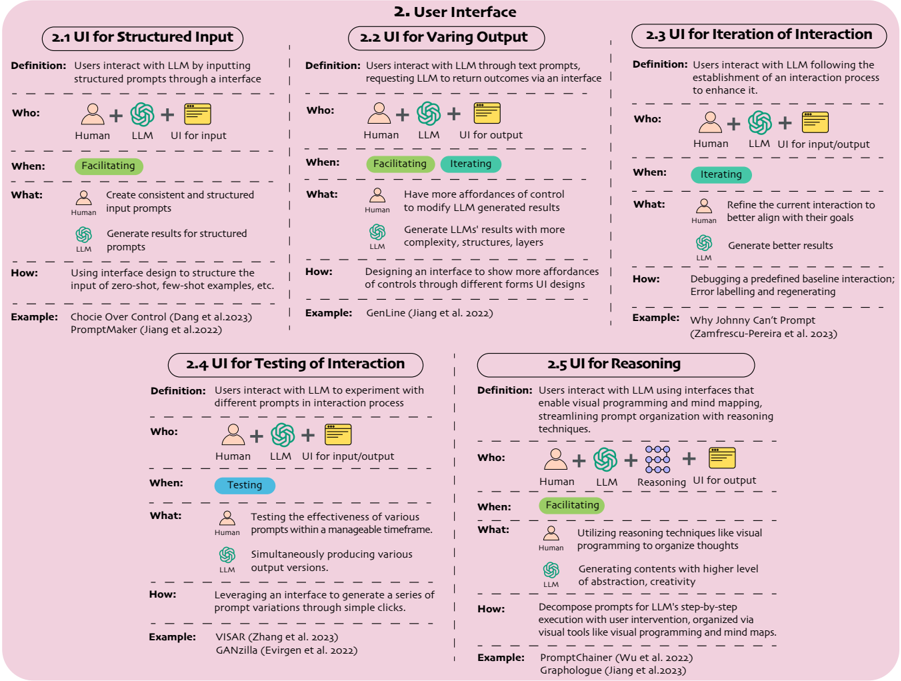
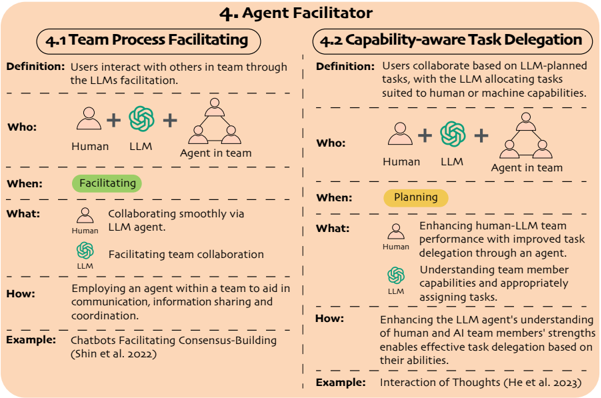
With ChatGPT’s release, conversational prompting has become the most popular form of human-LLM interaction. However, its effectiveness is limited for more complex tasks involving reasoning, creativity, and iteration. Through a systematic analysis of HCI papers published since 2021, we identified four key phases in the human-LLM interaction flow—planning, facilitating, iterating, and testing—to precisely understand the dynamics of this process. Additionally, we have developed a taxonomy of four primary interaction modes: Mode 1: Standard Prompting, Mode 2: User Interface, Mode 3: Context-based, and Mode 4: Agent Facilitator. This taxonomy was further enriched using the “5W1H” guideline method, which involved a detailed examination of definitions, participant roles (Who), the phases that happened (When), human objectives and LLM abilities (What), and the mechanics of each interaction mode (How). We anticipate this taxonomy will contribute to the future design and evaluation of human-LLM interaction.
Overview
The claims and statistics of this paper haven’t been checked yet.
Free: it reads the open-access text and checks the first 5 claims that cite a source we can check. Create a free account to check every claim.
Integrity signals
Registry
Cites
Statistics
Figures


Verification
Claims the paper makes
The claims and statistics of this paper haven’t been checked yet.
Free: it reads the open-access text and checks the first 5 claims that cite a source we can check. Create a free account to check every claim.
Claims other papers make about this one
Each is checked against this paper’s own text: does it say what the citing paper says it does?
The source backs part of the claim, not all of it — or backs it for a different population, condition or comparison.
In the citing paper
“Although other valuable frameworks detail collaborative workflows [58, 124] or communication patterns [139], they often underexplored AI's proactive capabilities.”
From Exploring Collaboration Patterns and Strategies in Human-AI Co-creation through the Lens of Agency: A Scoping Review of the Top-tier HCI Literature (2025) · cites this paper as [58]
Experimental — accuracy not yet measuredThe source backs part of the claim, not all of it — or backs it for a different population, condition or comparison.
In the citing paper
“Although empirical studies [58, 63, 65] offer valuable situated insights, their focus on individual contexts limits the cross-context synthesis required to identify overarching patterns and design principles applicable across the co-creative landscape.”
From Exploring Collaboration Patterns and Strategies in Human-AI Co-creation through the Lens of Agency: A Scoping Review of the Top-tier HCI Literature (2025) · cites this paper as [58]
Experimental — accuracy not yet measuredThe cited source says what the claim attributes to it.
In the citing paper
“Gao et al. [58] for instance, emphasized interaction patterns, leaving agency dynamics and control mechanisms less examined.”
From Exploring Collaboration Patterns and Strategies in Human-AI Co-creation through the Lens of Agency: A Scoping Review of the Top-tier HCI Literature (2025) · cites this paper as [58]
The check wasn’t confident either way, so it gives no verdict — never disputed.
In the citing paper
“Furthermore, empirical studies, while offering valuable insights [58, 63, 65], are often limited to a specific context, limiting generalizability between settings.”
From Exploring Collaboration Patterns and Strategies in Human-AI Co-creation through the Lens of Agency: A Scoping Review of the Top-tier HCI Literature (2025) · cites this paper as [58]
Experimental — accuracy not yet measured
Self-check
Percentages, sums and reported differences re-computed from the paper’s own numbers.
The self-check needs the paper’s full text.
Citations
Cites
(1994) · Cited by 21,711
Chain-Of-Thought Prompting Elicits Reasoning in Large Language Models
Wei, J., Wang, X., Schuurmans, D., Bosma, M., Ichter, B., Xia, F., Chi, E., Le, Q. V., & Zhou, D. (2022) · Advances in Neural Information Processing Systems 35 · doi:10.52202/068431-1800 · Cited by 4,505
Chain-of-Thought Prompting Elicits Reasoning in Large Language Models
Wei, J., Wang, X., Schuurmans, D., Bosma, M., Ichter, B., Xia, F., Chi, E., Le, Q., & Zhou, D. (2022) · arXiv · doi:10.48550/arxiv.2201.11903 · Cited by 4,263
Why Johnny Can’t Prompt: How Non-AI Experts Try (and Fail) to Design LLM Prompts
Zamfirescu-Pereira, J. D., Wong, R. Y., Hartmann, B., & Yang, Q. (2023) · Proceedings of the 2023 CHI Conference on Human Factors in Computing Systems · doi:10.1145/3544548.3581388 · Cited by 1,274 · cited 1×
“For instance, BotDesigner [78] aids users in refning human-LLM interactions, such as recipe conversations.”
Pattern-Oriented Software Architecture, Patterns for Concurrent and Networked Objects
Schmidt, D. C., Stal, M., Rohnert, H., & Buschmann, F. (2000) · Cited by 982
Prompt Programming for Large Language Models: Beyond the Few-Shot Paradigm
Reynolds, L., & McDonell, K. (2021) · Extended Abstracts of the 2021 CHI Conference on Human Factors in Computing Systems · doi:10.1145/3411763.3451760 · Cited by 952
A Prompt Pattern Catalog to Enhance Prompt Engineering with ChatGPT
White, J., Fu, Q., Hays, S., Sandborn, M., Olea, C., Gilbert, H., Elnashar, A., Spencer-Smith, J., & Schmidt, D. C. (2023) · arXiv · doi:10.48550/arxiv.2302.11382 · Cited by 838 · cited 3×
“Similar to other software taxonomies, such as software design patterns [19, 57] and catalogs for prompt engineering [69], our taxonomy aims to assist software designers in at least two important ways.”
Designing the user interface: Strategies for effective human-computer interaction
Sriram, D. (1987) · Artificial Intelligence in Engineering · doi:10.1016/0954-1810(87)90189-0 · Cited by 756
Wu, T., Terry, M., & Cai, C. J. (2022) · CHI Conference on Human Factors in Computing Systems · doi:10.1145/3491102.3517582 · Cited by 483 · cited 1×
“This is facilitated by employing visual programming techniques, such as chain designs [3, 71, 72] and mind maps [27, 63, 80], enabling a more interactive and user-defned reasoning framework.”
Wordcraft: Story Writing With Large Language Models
Yuan, A., Coenen, A., Reif, E., & Ippolito, D. (2022) · 27th International Conference on Intelligent User Interfaces · doi:10.1145/3490099.3511105 · Cited by 374
Research works printed but not linked: 4
- Hai Dang Lukas Mecke Florian Lehmann Sven Goller and Daniel Buschek. 2022. How to Prompt? Opportunities and Challenges of Zero- and Few-Shot Learning for Human-AI Interaction in Creative Applications of Generative Models. http://arxiv.org/abs/2209.01390 arXiv:2209.01390 [cs]. · arXiv
- Peiling Jiang, Jude Rayan, Steven P Dow, and Haijun Xia. 2023. Graphologue: Exploring Large Language Model Responses with Interactive Diagrams. arXiv preprint arXiv:2305.11473 (2023). · arXiv
- Takeshi Kojima, Shixiang Shane Gu, Machel Reid, Yutaka Matsuo, and Yusuke Iwasawa. 2022. Large language models are zero-shot reasoners. Advances in neural information processing systems 35 (2022), 22199–22213.
- Zheng Zhang, Jie Gao, Ranjodh Singh Dhaliwal, and Toby Jia-Jun Li. 2023. VISAR: A Human-AI Argumentative Writing Assistant with Visual Programming and Rapid Draft Prototyping. arXiv preprint arXiv:2304.07810 (2023). · arXiv
Cited by
Herrera-Poyatos, D., Peláez-González, C., Zuheros, C., Herrera-Poyatos, A., Tejedor, V., Herrera, F., & Montes, R. (2025) · Frontiers in Artificial Intelligence · doi:10.3389/frai.2025.1609097 · Cited by 95
“The taxonomy presented in Gao et al. (2024) categorizes the interaction modes that structure human-LLM exchanges, providing insights into how structured prompting, UI-enhanced reasoning, and agent-facilitated collaboration affect model transparency.”
Using Large Language Models to Generate, Validate, and Apply User Intent Taxonomies
Shah, C., White, R. W., Andersen, R., Buscher, G., Counts, S., Das, S. S. S., Montazer, A., Manivannan, S., Neville, J., Ni, X., et al. (2023) · arXiv · doi:10.48550/arxiv.2309.13063 · Cited by 33
Designing Interactions with Generative AI for Art and Creativity: A Systematic Review and Taxonomy
Hu, X., Xing, Y., Cai, X., Zhao, Y., Cook, M., Borgo, R., & Neate, T. (2025) · Designing Interactive Systems Conference · doi:10.1145/3715336.3735843 · Cited by 60
“Gao et al. [65] identify four distinct phases in the human–LLM interaction—planning, facilitating, iterating, and testing—and introduce a taxonomy of interaction modes that reflect how users engage with LLMs throughout language-based workflows.”
Zhang, S., Wang, H., & Yi, X. (2025) · Proceedings of the ACM on Human-Computer Interaction · doi:10.1145/3757594 · Cited by 36
A hybrid framework for creating artificial intelligence-augmented systematic literature reviews
Malik, F. S., & Terzidis, O. (2026) · Management Review Quarterly · doi:10.1007/s11301-025-00522-8 · Cited by 28
“Addi - tionally, fine-tuning pre-trained models with domain-specific datasets enhances their relevance and applicability (Anthony et al. 2023; Bolaños et al. 2024; Choudhary et al. 2023; Gao et al. 2024; Gatrell et al. 2024).”
Metadata
- Authors
- Gao, J., Gebreegziabher, S. A., Choo, K. T. W., Li, T. J.-J., Perrault, S. T., & Malone, T. W.
- Affiliations
- Singapore-MIT Alliance for Research and Technology (SG)
- University of Notre Dame (US)
- Singapore University of Technology and Design (SG)
- Massachusetts Institute of Technology (US)
- ORCID
- Venue
- Extended Abstracts of the CHI Conference on Human Factors in Computing Systems
- Publisher
- ACM
- Published
- 2024-05-11
- Pages
- 1-11
- OpenAlex
- W4393904462
- Semantic Scholar
- e9d7b6a0d8e1160a1b557bff9bd86d94d3c38bc0
- Cited by
- 57
- References
- 71
- Citations by year
- 2026: 28 · 2025: 26 · 2024: 3
- FWCI
- 18.37
- Type
- conference paper
- Language
- en
- Open access
- green
- arxiv.org
- Licence
- Locations
- CHI Conference Extended Abstracts on Human Factors in Computing Systems (CHI EA) (publishedVersion)
- arXiv (Cornell University) (submittedVersion, cc-by-nc-sa)
- arXiv (Cornell University)
- Funders
- National Research Foundation
- Topics
- Physical Sciences › Computer Science › Human-Computer Interaction › Usability and User Interface Design
- Physical Sciences › Computer Science › Artificial Intelligence › Speech and dialogue systems
- Physical Sciences › Computer Science › Human-Computer Interaction › Innovative Human-Technology Interaction
- Keywords
- human-LLM interaction, interaction modes, taxonomy (general classification scheme), user interface design
About these checks
Registry, retraction, Cites and statistics results are computed, not judged, with one exception: a printed reference that no index lists is read once by a model before it counts as a citation error. Claims are extracted by a model and kept only when their quote appears verbatim in the text; each cited source is then checked, with a model’s help, for whether it says what the claim relies on. Those verdicts can be wrong — read the claim’s quote and the cited source before relying on one.
Statistics and arithmetic are recomputed, not judged.
Confidence bands are shown only for fields calibrated on our annotated test set. None is calibrated yet, so no band is shown.
What counts as a claim ›How we measure confidence ›How we check this ›
Are you an author, or do you see a problem with this page? Request a review
How to cite
Cite CoChat for the checks on this page, and the paper for its own findings.
- This page
- CoChat. (2026). Citation check: A Taxonomy for Human-LLM Interaction Modes: An Initial Exploration. https://app.cochat.ai/papers/10.1145/3613905.3650786
- The paper
- Gao, J., Gebreegziabher, S. A., Choo, K. T. W., Li, T. J.-J., Perrault, S. T., & Malone, T. W. (2024). A Taxonomy for Human-LLM Interaction Modes: An Initial Exploration. Extended Abstracts of the CHI Conference on Human Factors in Computing Systems. https://doi.org/10.1145/3613905.3650786
Data sources
Bibliographic data: Semantic Scholar, OpenAlex, Crossref.
Contains information from the Semantic Scholar Academic Graph Datasets, made available under the ODC Attribution License (ODC-BY 1.0).
Semantic Scholar’s data is described in: Kinney, R., et al. (2023). The Semantic Scholar Open Data Platform. arXiv:2301.10140.
