

Prompt Problems: A New Programming Exercise for the Generative AI Era
Open accessThe DOI matches its Crossref record; 35 of the 35 references it cites were found in a registry or an index.
Abstract
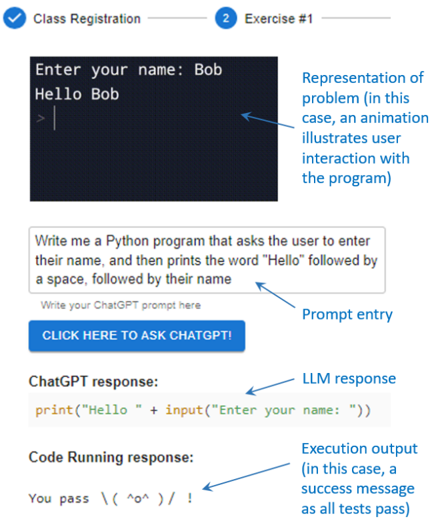
Large language models (LLMs) are revolutionizing the field of computing education with their powerful code-generating capabilities. Traditional pedagogical practices have focused on code writing tasks, but there is now a shift in importance towards reading, comprehending and evaluating LLM-generated code. Alongside this shift, an important new skill is emerging -- the ability to solve programming tasks by constructing good prompts for code-generating models. In this work we introduce a new type of programming exercise to hone this nascent skill: 'Prompt Problems'. Prompt Problems are designed to help students learn how to write effective prompts for AI code generators. A student solves a Prompt Problem by crafting a natural language prompt which, when provided as input to an LLM, outputs code that successfully solves a specified programming task. We also present a new web-based tool called Promptly which hosts a repository of Prompt Problems and supports the automated evaluation of prompt-generated code. We deploy Promptly in one CS1 and one CS2 course and describe our experiences, which include student perceptions of this new type of activity and their interactions with the tool. We find that students are enthusiastic about Prompt Problems, and appreciate how the problems engage their computational thinking skills and expose them to new programming constructs. We discuss ideas for the future development of new variations of Prompt Problems, and the need to carefully study their integration into classroom practice.
Overview
The claims and statistics of this paper haven’t been checked yet.
Free: it reads the open-access text and checks the first 5 claims that cite a source we can check. Create a free account to check every claim.
Integrity signals
Registry
Cites
Statistics
Figures

Verification
Claims the paper makes
The claims and statistics of this paper haven’t been checked yet.
Free: it reads the open-access text and checks the first 5 claims that cite a source we can check. Create a free account to check every claim.
Claims other papers make about this one
Each is checked against this paper’s own text: does it say what the citing paper says it does?
The source backs part of the claim, not all of it — or backs it for a different population, condition or comparison.
In the citing paper
“Further, novice learners of programming may become overwhelmed and confused by generated code, which could add to the high levels of frustration that are common in introductory programming courses [71,188].”
From The Robots Are Here: Navigating the Generative AI Revolution in Computing Education (2023) · cites this paper as [71]
Experimental — accuracy not yet measuredThe source backs part of the claim, not all of it — or backs it for a different population, condition or comparison.
In the citing paper
“Although LLMs can automate routine programming tasks, their limitations become apparent when addressing nuanced or ill-structured problems (Zhang et al., 2023;Denny et al. 2024).”
From Integrating Generative AI into Programming Education: Student Perceptions and the Challenge of Correcting AI Errors (2025) · cites this paper as Denny et al. 2024
Experimental — accuracy not yet measuredThe source backs part of the claim, not all of it — or backs it for a different population, condition or comparison.
In the citing paper
“Explicit instruction on how to critically assess, refine, and debug AI-generated code fosters the development of essential competencies -ranging from algorithmic reasoning to software testing (Denny et al., 2024;Kendon et al., 2023).”
From Integrating Generative AI into Programming Education: Student Perceptions and the Challenge of Correcting AI Errors (2025) · cites this paper as Denny et al., 2024
Experimental — accuracy not yet measuredThe check wasn’t confident either way, so it gives no verdict — never disputed.
In the citing paper
“Although generative systems are stateless in that they do not retain context across interactions unless explicitly prompted [107,108]”
From AI Agents vs. Agentic AI: A Conceptual taxonomy, applications and challenges (2026) · cites this paper as [107]
Experimental — accuracy not yet measuredIn the citing paper
“Indeed, some recent papers found in the second phase snowballing focused on introducing tools around LLMs, such as CodeHelp [127] and Promptly [71].”
From The Robots Are Here: Navigating the Generative AI Revolution in Computing Education (2023) · cites this paper as [71]
1 more claim about this paper
Create a free account to see every claim other papers make about this one.
Self-check
Percentages, sums and reported differences re-computed from the paper’s own numbers.
The self-check needs the paper’s full text.
Citations
Cites
A Prompt Pattern Catalog to Enhance Prompt Engineering with ChatGPT
White, J., Fu, Q., Hays, S., Sandborn, M., Olea, C., Gilbert, H., Elnashar, A., Spencer-Smith, J., & Schmidt, D. C. (2023) · arXiv · doi:10.48550/arxiv.2302.11382 · Cited by 838 · cited 1×
“White et al. present a prompt structuring framework for constructing prompts that can be applied across problem domains, and demonstrate how prompts can be constructed from patterns [30].”
BackgroundAutomatic Generation of Programming Exercises and Code Explanations Using Large Language Models
Sarsa, S., Denny, P., Hellas, A., & Leinonen, J. (2022) · Proceedings of the 2022 ACM Conference on International Computing Education Research - Volume 1 · doi:10.1145/3501385.3543957 · Cited by 497
Self-citationThe Robots Are Coming: Exploring the Implications of OpenAI Codex on Introductory Programming
Finnie-Ansley, J., Denny, P., Becker, B. A., Luxton-Reilly, A., & Prather, J. (2022) · Proceedings of the 24th Australasian Computing Education Conference · doi:10.1145/3511861.3511863 · Cited by 463
Self-citationBecker, B. A., Denny, P., Finnie-Ansley, J., Luxton-Reilly, A., Prather, J., & Santos, E. A. (2023) · Proceedings of the 54th ACM Technical Symposium on Computer Science Education V. 1 · doi:10.1145/3545945.3569759 · Cited by 401 · cited 1×
“In addition to the opportunities they present, educators have voiced concerns around the potential misuse of these models for plagiarism, and over-reliance on AI-generated code by beginners [3], leading to a possible erosion of traditional coding skills [9].”
BackgroundSelf-citationThe Robots Are Here: Navigating the Generative AI Revolution in Computing Education
Prather, J., Denny, P., Leinonen, J., Becker, B. A., Albluwi, I., Craig, M., Keuning, H., Kiesler, N., Kohn, T., Luxton-Reilly, A., et al. (2023) · Proceedings of the 2023 Working Group Reports on Innovation and Technology in Computer Science Education · doi:10.1145/3623762.3633499 · Cited by 396 · cited 1×
“The advent of large language models (LLMs) that can generate code is having a rapid and significant impact on computing education practice, particularly at the introductory level [24].”
BackgroundSelf-citationStudying the effect of AI Code Generators on Supporting Novice Learners in Introductory Programming
Kazemitabaar, M., Chow, J., Ma, C. K. T., Ericson, B. J., Weintrop, D., & Grossman, T. (2023) · Proceedings of the 2023 CHI Conference on Human Factors in Computing Systems · doi:10.1145/3544548.3580919 · Cited by 366
Denny, P., Kumar, V., & Giacaman, N. (2023) · Proceedings of the 54th ACM Technical Symposium on Computer Science Education V. 1 · doi:10.1145/3545945.3569823 · Cited by 287
Self-citationMalinka, K., Peresíni, M., Firc, A., Hujnák, O., & Janus, F. (2023) · Proceedings of the 2023 Conference on Innovation and Technology in Computer Science Education V. 1 · doi:10.1145/3587102.3588827 · Cited by 287
Prather, J., Reeves, B. N., Denny, P., Becker, B. A., Leinonen, J., Luxton-Reilly, A., Powell, G., Finnie-Ansley, J., & Santos, E. A. (2024) · ACM Transactions on Computer-Human Interaction · doi:10.1145/3617367 · Cited by 256
Self-citationLau, S., & Guo, P. (2023) · Proceedings of the 2023 ACM Conference on International Computing Education Research V.1 · doi:10.1145/3568813.3600138 · Cited by 241
Research works printed but not linked: 2
- Leo Porter and Daniel Zingaro. 2023. Learn AI-Assisted Python Programming: With Github Copilot and ChatGPT. Manning, Shelter Island, NY.
- 10.1007/978--3-031--11647--6_127 · doi:10.1007/978--3-031--11647--6_127
Cited by
Items 101–195 of 195
ReDefining Code Comprehension: Function Naming as a Mechanism for Evaluating Code Comprehension
Smith, D. H., Fowler, M., Denny, P. C., & Zilles, C. B. (2025) · ACM Conference on Innovation and Technology in Computer Science Education (ITiCSE) · doi:10.1145/3724363.3729097 · Cited by 4
Self-citationWhat Computing Faculty Want: Designing AI Tools for High-Enrollment Courses Beyond CS1
Borela, R., Soylu, M. Y., Lee, J., & Roy, N. (2025) · ACM Conference on International Computing Education Research (ICER) · doi:10.1145/3702653.3744327 · Cited by 2
Exploring Prompt Engineering for Generating G-Code to Program CNC Milling Machines
Okuno, H. R. M. (2025) · Lecture notes in networks and systems · doi:10.1007/978-981-96-6432-0_9 · Cited by 1
GDD Generation for Hyper-Casual Games Using Large Language Models: A Comparative Evaluation
Aydinalp, M. E., Doğan, B., & Bal, A. (2025) · Bitlis Eren Üniversitesi Fen Bilimleri Dergisi · doi:10.17798/bitlisfen.1664312 · Cited by 1
Porpoise: An LLM-Based Sandbox for Novices to Practice Writing Purpose Statements
Krishnamurthi, S., Thießen, T., & Vahrenhold, J. (2025) · ACM SIGPLAN International Symposium on SPLASH-E (SPLASH-E) · doi:10.1145/3758317.3759683 · Cited by 5
Gardella, N., Shelton, J., Graßl, I., & Riggs, S. L. (2025) · Koli Calling International Conference on Computing Education Research · doi:10.1145/3769994.3770015 · Cited by 2
“Despite limited empirical evidence about how to best balance AI-inclusive and AI-exclusive instruction, new pedagogical approaches are already embracing code-generating AI [21, 52].”
Online Platform to Inform GenAI Misuse in Programming Through Code Differences
Karnalim, O. (2025) · International Journal of Distance Education Technologies · doi:10.4018/ijdet.397045 · Cited by 5
Utilizing Large Language Model for Programming Course Exercise Generation
Kaila, E., Rytilahti, J., Lempinen, W., & Lindgren, L. (2026) · Communications in computer and information science · doi:10.1007/978-3-032-12313-8_15 · Cited by 2
Exploring Student Choice and the Use of Multimodal Generative AI in Programming Learning
Hou, X., Xiao, R., Ye, R., Liut, M., & Stamper, J. C. (2026) · ACM Technical Symposium on Computer Science Education (SIGCSE) · doi:10.1145/3770762.3772548 · Cited by 3
“More ways to teach prompt crafting have also appeared, developing students’ prompting skills via new exercises [12] and through dedicated interactive instruction [41].”
ACM Generative AI Task Force Special Session: Teaching with Generative AI: Tools You Can Use Today
Denny, P. C., Leinonen, J., Kumar, V., & Gordon, S. I. (2026) · ACM Technical Symposium on Computer Science Education (SIGCSE) · doi:10.1145/3770761.3777140 · Cited by 1
“…developed, evaluated, and appearing in the literature: Prompt Problems (for crafting effective natural language prompts for computational tasks) [1], Explain in Plain Language tasks (for scalable feedback of code comprehension tasks) [2], Auto-completion Quizzes (for scaffolding the use of code…”
Self-citationOne Line at a Time: Scaffolding Reflective Code Evaluation through Structured AI Assistance
Qiu, V., Parker, L., Riegel, K., Giacaman, N., Denny, P. C., MacNeil, S., & Prather, J. E. (2026) · Australasian Computing Education Conference · doi:10.1145/3786228.3786243 · Cited by 4
Self-citationDesign Implications for Student and Educator Needs in AI-Supported Programming Learning Tools
Ma, B., Xie, Y., Li, H., Li, G., Chen, L. Y. E., Shimada, A., & Konomi, S. (2026) · International Journal of Human-Computer Interaction · doi:10.1080/10447318.2026.2730083 · Cited by 3
Nathaniel, J., Oyelere, S. S., Suhonen, J. T., & Tedre, M. (2026) · Frontiers in Computer Science · doi:10.3389/fcomp.2026.1789829 · Cited by 4
A Reference Framework for the Use of Generative AI in Higher Education
González-Eras, A., Pérez, J., Puerto, E., González, W. E. P., & Aguilar, J. (2025) · Latin American Computer Conference (CLEI) · doi:10.1109/clei67442.2025.11420309 · Cited by 1
“Learning to code has traditionally focused on code writing tasks, but, given the powerful code-generating capabilities of GenAI, there is now a shift in importance towards reading, comprehending, and evaluating AI-generated code [23].”
Integration of a neural network assistant on programming into a digital educational platform
Кушниренко, А. Г., Leonov, A. G., Мащенко, К. А., Martynov, N. S., Пчелин, К. К., & Shlyakhov, A. V. (2026) · Informatics and Education · doi:10.32517/0234-0453-2026-41-1-23-36 · Cited by 2
How do college students weigh the reliability of AI in academic writing?
Murshidi, G. H. A., Alfahid, M. F., & Zaabi, A. A. (2026) · Cogent Education · doi:10.1080/2331186x.2026.2670040 · Cited by 3
Shallari, I., Gallo, V., Carratù, M., Hussain, M., Krapohl, D., & Mousavirad, S. J. (2026) · Education Sciences · doi:10.3390/educsci16050803 · Cited by 2
“At the same time, the findings add a domain-specific perspective to engineering and computing education research (Denny et al., 2024; Filippi & Motyl, 2024; Prather et al., 2023).”
InfluentialBrender, J., El‐Hamamsy, L., Uittenhove, K. L., Pérez, A., Jermann, P., Francesco Mondada, C., & Bumbacher, E. W. (2026) · Lecture notes in computer science · doi:10.1007/978-3-032-29763-1_37 · Cited by 4
“In response, numerous prompting guidelines have been proposed [8,21,28]; however, many lack empirical validation and rarely examine whether learned strategies transfer to unconstrained LLM use [5,32].”
Using Generative AI in Software Design Education
Jackson, V., Liu, S.-S., & van der Hoek, A. (2026) · International Workshop on Designing Software (Designing) · doi:10.1145/3786152.3788589 · Cited by 2
LLM-Enabled Educational Artefacts in Computer Science Education: A Systematic Mapping Study
Sanchez, F. L., Alario‐Hoyos, C., Guamán, D. S., & Caiza, J. C. (2026) · Applied Sciences · doi:10.3390/app16199778
Machine Learning Models to Detect AI-Assisted Code Anomaly in Introductory Programming Course
Toba, H., & Karnalim, O. (2024) · Lecture notes in networks and systems · doi:10.1007/978-3-031-71530-3_11 · Cited by 4
Twisted Games: A First Experience of Inclusion of AI tools in First Year Programming Classes
Wightman, P. M. (2024) · IEEE Latin American Conference on Computational Intelligence (LA-CCI) · doi:10.1109/la-cci62337.2024.10814750 · Cited by 6
CodeContrast: A Contrastive Learning Approach for Generating Coherent Programming Exercises
Torres, N. (2025) · Education Sciences · doi:10.3390/educsci15010080 · Cited by 3
Fostering Creativity: Student-Generative AI Teaming in an Open-Ended CS0 Assignment
Filcik, D., Sobiesk, E., & Matthews, S. J. (2025) · ACM Technical Symposium on Computer Science Education (SIGCSE) · doi:10.1145/3641554.3701853 · Cited by 7
Tadi, S. R. C. C. T. (2025) · International Journal of Advanced Research in Science Communication and Technology · doi:10.48175/ijarsct-26358 · Cited by 1
Research on Multidimensional Evaluation Technology of Teachers’ Digital Literacy for LLM as a Judge
范, 迪., Zhang, T., Li, F., Wu, W., Yu, Y., & Yu, G. (2025) · Communications in computer and information science · doi:10.1007/978-981-96-6310-1_7 · Cited by 1
Optimizing Generative AI Applications: A Comparative Study of Effective Prompting Techniques
Jyoti, S., Tejpal, M., & Jothi, K. R. (2025) · International Conference on Pervasive Computing and Social Networking (ICPCSN) · doi:10.1109/icpcsn65854.2025.11035207 · Cited by 3
“• Educational Integration : Bozkurt and Sharma [4], and Denny et al. [19] call for integrating prompt engineering into curricula to prepare students for AI-driven environments.”
Building Proficiency in GAI: Key Competencies for SuccessPreprint
Grimberg, E., & Mason, C. (2025) · Qeios · doi:10.32388/infmmj · Cited by 2
Ethical Considerations and Challenges
(2024) · Advances in knowledge acquisition, transfer, and management book series/Advances in knowledge acquisition, transfer and management book series · doi:10.4018/979-8-3693-6905-0.ch007 · Cited by 3
Towards Integrating Behavior-Driven Development in Mobile Development: An Experience Report
Hao, Q., & Liu, R. (2025) · ACM Technical Symposium on Computer Science Education (SIGCSE) · doi:10.1145/3641554.3701875
“However, instructors should anticipate for the issue of students overusing generative AI, and the challenge of ensuring fairness in grading [39, 42].”
Building Proficiency in Generative AI: Key Competencies for SuccessPreprint
Grimberg, E., & Mason, C. (2025) · Qeios · doi:10.32388/infmmj.2
Introducing AI Code Generators in Agile Software Testing
Nidagundi, P., Jurenoks, A., Bevinamarad, P., & Bulla, C. M. (2025) · Springer eBooks · doi:10.1007/978-981-97-9132-3_1
Unlocking Proficiency: Experts’ Views on the Use of Generative AIPreprint
Grimberg, E., & Mason, C. (2025) · Qeios · doi:10.32388/infmmj.3
Rafique, Z., Wasim, M., & Ali, A. (2025) · International Conference on Advancements in Computational Sciences (ICACS) · doi:10.1109/icacs64902.2025.10937828
“Instead, LLMs are useful, but a clear and precise prompt is required for optimal performance, which poses a challenge in the work done by Deny et al. [31] in improving AIhuman interaction through prompt design.”
Fostering Qualified Software Engineers via Software Engineering Conversion Programmes
Li, Z. (2025) · IEEE International Conference on Software Engineering Education and Training (CSEE&T) · doi:10.1109/cseet66350.2025.00039
“…as an example, given the fast growing trend in low-code development [24], “a programmer nowadays is unnecessary to program from scratch” [25]; and within the booming era of AI-assisted development, dealing with programming tasks is gradually being turned into crafting natural language prompts [26].”
Beyond Code: Leveraging ChatGPT to Enhance (Not Replace) Traditional Programming Education
Adeniran, A., & Alhathli, M. A. E. (2025) · Lecture notes in computer science · doi:10.1007/978-3-031-98462-4_7 · Cited by 1
Rossi, V., Scantamburlo, T., & Melonio, A. (2025) · Lecture notes in computer science · doi:10.1007/978-3-031-98459-4_12 · Cited by 2
Alvi, A. K., Azad, R. I., Uddin, M. E., & Reno, S. (2025) · International Conference on Next-Generation Computing, IoT and Machine Learning (NCIM) · doi:10.1109/ncim65934.2025.11160076
“This demands decentralized solutions that can meet these limitations with efficiency [3].”
Prompts Engineering Challenges in Software Code Generation
Gutierrez, Y., Camacho, E., Pardo, C., & Villarreal, V. (2025) · IEEE Congreso Internacional en Inteligencia Ambiental, Ingeniería de Software y Salud Electrónica y Móvil (AmITIC) · doi:10.1109/amitic68284.2025.11214606
“…which are based on the use of sequential questions, feedback and educational examples to foster a progressive interaction with the model [1], [6], [20], [30], [31], [32]; (3) Accuracy, robustness and variability in code generation , focused on generating correct, adaptive and reliable code,…”
Asking Novices to Evaluate Code Quality: Understandability and Efficiency
Mirolo, C., & Izu, C. (2025) · ACM Global Computing Education Conference (CompEd) · doi:10.1145/3736181.3747149
Bridging the AI Gap: Developing AI Literacy in Programming Education
Kohen-Vacs, D., Usher, M., & Jansen, M. (2025) · Lecture notes in networks and systems · doi:10.1007/978-3-032-05070-0_18
Feitosa, Y. R. G., Castilho, M. A., & Kutzke, A. R. (2025) · Anais ... Workshops do Congresso Brasileiro de Informática na Educação · doi:10.5753/cbie_estendido.2025.16080
A Field Study of Prompt Programming with LLM
Deguchi, D., SENDA, T., & Kajiwara, Y. (2025) · International Conference on Intelligent Informatics and Biomedical Sciences (ICIIBMS) · doi:10.1109/iciibms66230.2025.11316775
“In higher education, “Prompt Problems,” i.e., exercises for acquiring prompts suitable for automatic code generation, have been proposed [13].”
AI Chatbots vs. Traditional Search: A Comparative Study on Student Information Retrieval
Pasquarelli, L., Koutcheme, C., & Hellas, A. (2025) · IEEE Frontiers in Education Conference (FIE) · doi:10.1109/fie63693.2025.11328491 · Cited by 2
“As an example, LLMs have been integrated into code explanation tasks [8], and students have been asked to write prompts that create code to solve a given problem with the intent to learn prompting [6].”
Decoding AI Impact: Longitudinal Analysis of Code Submissions in Programming MOOCs
Leppänen, L., Leinonen, J., Hellas, A., Kaila, E., & Mannila, L. (2025) · IEEE Frontiers in Education Conference (FIE) · doi:10.1109/fie63693.2025.11328633
“Opinions on how to view student usage of the increasingly available and capable LLM-based tools have varied from calls to reconfigure teaching around said tools [2], [3], to calls of their bans from education context [4].”
Self-citationUse of Generative AI Tools in Software Quality Assurance Work
Maxim, B. R., Song, Z., de Hurtado, B. G., Hassan, F., & Shijo, S. (2025) · IEEE Frontiers in Education Conference (FIE) · doi:10.1109/fie63693.2025.11328290
“Generative Artificial Intelligence (GenAI) represents a cutting edge field within artificial intelligence that focuses on developing algorithms capable of producing content that mirrors human-like outputs, such as text, images, audio and video [1], [2].”
How Students Use Generative AI: Insights from Conversation Log Analysis
Li, Z., Koloutsou‐Vakakis, S., Kozłowski, T., Kindratenko, V., & Alawini, A. (2025) · IEEE Frontiers in Education Conference (FIE) · doi:10.1109/fie63693.2025.11328645 · Cited by 2
“Beyond personalized learning, other frequently noted benefits include the provision of timely, specific, and constructive feedback [7], [20], support for writing and brain-storming [6], and the potential to foster critical thinking skills [21], [22].”
A Scientometric Analysis of Generative AI in the Educational Context
Vázquez, J. P. G., Astorga-Vargas, M. A., Corral, L. E. V., Zatarain-Aceves, H., & Vega, J. E. S. (2026) · Springer eBooks · doi:10.1007/978-981-95-4871-2_18
Cultural Psychology for a Technologically Transformed Society: A Neo-Structuration Perspective
Сергеевич, С. П. (2026) · Integrative Psychological and Behavioral Science · doi:10.1007/s12124-025-09969-6 · Cited by 1
“…linguistic engagement with AI which can serve as a means to an “external” utilitarian practical goal (e.g., searching for information) or as a tool for psychological relief and leisure — with the AI acting as an interlocutor, therapist, or even a friend (Denny et al., 2024; Filienko et al., 2025).”
Yin, W. (2026) · Creative Education · doi:10.4236/ce.2026.171007 · Cited by 2
Computer Science Education in the GenAI Era
Hazzan, O., Ragonis, N., & Lapidot, T. (2026) · Springer eBooks · doi:10.1007/978-3-032-00953-1_3
Introduction: What Is this Guide About?
Hazzan, O., Ragonis, N., & Lapidot, T. (2026) · Springer eBooks · doi:10.1007/978-3-032-00953-1_1
Laaksonen, A. (2026) · Undergraduate topics in computer science · doi:10.1007/978-3-032-07453-9_11
Describing Functionality in Natural Language May Improve Decomposition Behaviors
Burns, M., Edwards, W., & Edwards, J. (2026) · ACM Technical Symposium on Computer Science Education (SIGCSE) · doi:10.1145/3770762.3772513
“The emergence of Large Language Models (LLMs) has enabled tools like NLFs to introduce new methods to study how students approach problem decomposition [9, 30].”
Modelling Prompting Behaviours in LLM-Mediated Task Solving
Ammar, A. E. C. (2026) · ACM International Conference on Intelligent User Interfaces (IUI) · doi:10.1145/3742414.3789230
Tang, K., Tong-Ho, H. N. H., Riegel, K., Denny, P. C., Giacaman, N., & Leinonen, J. (2026) · Australasian Computing Education Conference · doi:10.1145/3786228.3786249 · Cited by 2
“This allows students to practice writing clear, unambigious problem specifications, in a similar fashion to prior work on prompt problems [10].”
Self-citationKavuri, S., Delgado-Diaz, D., Ortiz, K., Chao, A., Molina, I. V., Ochoa, B., & Porter, L. (2026) · Australasian Computing Education Conference · doi:10.1145/3786228.3786250 · Cited by 1
Prasad, P., Sane, A., & Chitkulwar, S. (2026) · CHI Conference Extended Abstracts on Human Factors in Computing Systems (CHI EA) · doi:10.1145/3772363.3798522
“Researchers have also explored the use of LLMs in programming exercises and assessment settings [3, 13, 21].”
Ouh, E. L., Tan, K. W., Lo, S. L., & Zhang, Y. (2026) · International Conference on Learning Analytics and Knowledge (LAK) · doi:10.1145/3785022.3785037 · Cited by 1
AI-Driven Hyper-Personalization in Omnichannel Marketing Automation: A Conceptual Framework
de Oliveira, D. A., Costa, A. P. O., Coelho, D., Pereira, I., & Júnior, J. G. D. C. (2026) · Smart innovation, systems and technologies · doi:10.1007/978-3-032-16284-7_15 · Cited by 1
Teaching bioinformatics with generative AI: judgment, uncertainty, and responsibility
Teufel, A., & Liberles, D. A. (2026) · Journal of Microbiology and Biology Education · doi:10.1128/jmbe.00331-25 · Cited by 2
Large language models in software development learning
Hernández, S. C., Cruz, M. P. T., Sánchez, J. M. E., Luna-Gómez, A. A., Orozco, A. M. P., & Medina, R. H. (2026) · Discover Education · doi:10.1007/s44217-026-01750-0 · Cited by 3
“…strategies to solve problems arise, such as the case of “Prompt problems,” which consists of assigning a series of programming problems to the student, who must solve them by writing prompts so that the LLM generates the code with the exact requirements established in the practice instrument [31].”
Chen, E., Chen, W., Tang, X., Wang, Y., Yuan, M., Judicke, S., & Beigh, K. (2026) · ACM Conference on Learning @ Scale (L@S) · doi:10.1145/3774398.3811579
Martinenghi, A., Guidotti, S., Donabauer, G., Koyutürk, C., Ortiz-Beltrán, A., Theophilou, E., Chimisso, R., Bink, M., Garzotto, F., Taibi, D., et al. (2026) · Lecture notes in computer science · doi:10.1007/978-3-032-29763-1_29 · Cited by 1
On Using Programming-RAG to Improve Learning Outcomes in Programming Education
Klefstad, B., Sandstrak, G., Styve, A. G., & Raja, K. (2026) · IEEE Global Engineering Education Conference (EDUCON) · doi:10.1109/educon67543.2026.11574292
Huesca, G., Flores, T. D. C. R., Echeverria, G., Pérez-Fuertes, L., Constantino-González, M. D. L. Á., Martínez-Treviño, Y., Navarrete, C., Felix-Herran, L. C., Cedillo-Hernández, A., Ayala, A. G., et al. (2026) · Education Sciences · doi:10.3390/educsci16071037 · Cited by 1
Niemann, S., & Schmid, U. (2026) · International Conference on Information Technology Based Higher Education and Training (ITHET) · doi:10.1109/ithet69978.2026.11585137
“While LLMs are able to achieve consistently good results on coding some tasks [23], their performance drops in settings where the prompts are unspecific and no checks of the output are performed by a user with some degree of expertise [16; 24].”
Huesca, G., Martínez-Treviño, Y., González, C. G. J., Delgado, D. A. C., Navarrete, C., Cedillo-Hernández, A., & Meza, R. R. Q. (2026) · AI · doi:10.3390/ai7070248 · Cited by 1
“This strategy is an extension of the Prompt Problems strategy proposed by Denny et al. in [37,38].”
Riegel, K., Hua, Y. C., Denny, P. C., Pădurean, V.-A., Leinonen, J., Prather, J. E., & Singla, A. K. (2026) · ACM Conference on Innovation and Technology in Computer Science Education (ITiCSE) · doi:10.1145/3803400.3809397
Self-citationPurplex: An Integrated Platform for Natural Language Programming and Code Comprehension Activities
Smith, D. H., Denny, P. C., & Riegel, K. (2026) · ACM Conference on Innovation and Technology in Computer Science Education (ITiCSE) · doi:10.1145/3803401.3811973
“This problem type develops prompt construction skills and encourages students to reason about program behaviour and specifications [2].”
Self-citationDoan, A. B.-H., Midtlien, K. S., Hussain, S. S., Moalagh, M., & Farshchian, B. A. (2026) · International Workshop on Cooperative and Human Aspects of Software Engineering (CHASE) · doi:10.1145/3794860.3794889
“GenAI also facilitates learning by offloading routine syntax, allowing students to focus on higher-order thinking such as logic, functionality, and design [15, 41, 56].”
InfluentialWang, T., & Brown, C. (2026) · ACM/IEEE International Conference on Software Engineering: Companion Proceedings (ICSE-Companion) · doi:10.1145/3786580.3786986
Teaching Programming in the Age of AI: Pedagogical Strategies for Computational Sociology
Ramos, M. C., & Liang, F. (2026) · Teaching Sociology · doi:10.1177/0092055x261469125
Aydemir, M. (2026) · Sakarya University Journal of Education · doi:10.19126/suje.1931440
Barlog, B., Craig, H., & Peng, Z. (2026) · IEEE International Conference on Information Reuse and Integration (IRI) · doi:10.1109/iri69576.2026.00027
“Student prompts frequently exhibit deficiencies including missing context and incorrect terminology [12].”
Pădurean, V.-A., Riegel, K., Barbre, G., Blake, M., Denny, P. C., Gotovos, A., Leinonen, J., MacNeil, S., Prather, J. E., & Singla, A. K. (2026) · ACM Conference on International Computing Education Research (ICER) · doi:10.1145/3765964.3811639 · Cited by 1
Self-citationScaffolding Autocomplete: Improving Guidance for Learners using Generative Code Suggestions
Prather, J. E., MacNeil, S., Luxton-Reilly, A., Margulieux, L. E., Reeves, B. N., Denny, P. C., Leinonen, J., Homer, J., Nabid, R. A., & Rossetti, R. L. (2026) · ACM Conference on International Computing Education Research (ICER) · doi:10.1145/3765964.3811654
Self-citationGardella, N., Prather, J. E., Leinonen, J., Denny, P. C., Pettit, R., & Riggs, S. L. (2026) · ACM Conference on International Computing Education Research (ICER) · doi:10.1145/3765964.3811664
Self-citationWhen AI Is Wrong on Purpose: How Students Respond to Buggy GenAI Code
Pădurean, V.-A., Riegel, K., Gotovos, A., Mahapatra, J., Ghosh, A., Denny, P. C., Leinonen, J., Prather, J. E., & Singla, A. K. (2026) · ACM Conference on International Computing Education Research (ICER) · doi:10.1145/3765964.3811667 · Cited by 5
Self-citationA Validated Scale Measuring Student Self-Efficacy for Programming with Generative AI
Prather, J. E., Margulieux, L. E., Kharitonova, Y., Yang, Y., Reeves, B. N., Denny, P. C., Benario, J. G., Holmes, E., Spaulding, E., Barbre, G., et al. (2026) · ACM Conference on International Computing Education Research (ICER) · doi:10.1145/3765964.3811645 · Cited by 2
Self-citationPrompt Writing and Program Quality: An Investigation from a Programming Education Perspective
Nakamura, Y., Ito, W., Nishigata, Y., & Kuramitsu, K. (2026) · Journal of Information Processing · doi:10.2197/ipsjjip.34.648
Assessment in CS Education: A Way Forward with AI
Ternikov, A. (2026) · IT Professional · doi:10.1109/mitp.2026.3706589
“15 This approach inverts the traditional coding task, requiring students to demonstrate their comprehension of the task and their ability to communicate computational intent precisely.”
Maxim, B. R., Ghammam, A., Roy, M., Gandi, S., & Gujarathi, A. (2026) · ASEE Annual Conference & Exposition · doi:10.18260/1-2--60806
Ling, W.-S., & Chu, C.-M. (2026) · IEEE International Conference on Consumer Electronics - Taiwan (ICCE-Taiwan) · doi:10.1109/icce-taiwan71481.2026.11652537
“Consequently, the "Prompt Problems" model has emerged, allowing students to engage in logical decomposition and abstraction via natural language prompts without being hindered by syntactical barriers [3].”
Yang, J., Wang, H., Chen, M., Chen, X., Wang, J., & Wang, C. (2026) · Interactive Learning Environments · doi:10.1080/10494820.2026.2713873
Rücker, M. T. (2026) · ACM Transactions on Computing Education · doi:10.1145/3844731 · Cited by 1
Hey, ChatGPT, Look at My Work: Using Conversational AI in Requirements Engineering Education
Badihi, S., Tegegn, M., Riddell, E., Czarnecki, K., & Rubin, J. (2026) · ACM/IEEE International Conference on Software Engineering: Companion Proceedings (ICSE-Companion) · doi:10.1145/3744916.3773112 · Cited by 1
“For example, Denny et al. [19] suggest teaching prompt problems , i.e., to have students devise prompts that would guide an AI tool to generate the code required to solve a given problem.”
InfluentialCipriano, B. P., & Ferreira, L. S. (2026) · Communications in computer and information science · doi:10.1007/978-3-032-39106-3_17
Explanation First Prompting for Reviewing AI Programming Answers in Undergraduate Courses
Raiter, O. К. (2026) · International Conference on Advanced Computer Information Technologies (ACIT) · doi:10.1109/acit69831.2026.11700007
“Their later work on “prompt problems” reframed prompting as an assessable educational activity rather than a hidden shortcut [13].”
Alam, A. (2026) · Advances in computational intelligence and robotics book series · doi:10.4018/979-8-3373-8332-3.ch004
إعادة هندسة مناهج علوم الحاسب في المرحلة الثانوية في عصر الذكاء الاصطناعي التوليدي
الشمري, أ. (2026) · Academic Journal of Research and Scientific Publishing · doi:10.52132/ajrsp/v8.90.8
Bedin, H. A. T., Mariotti, M. B., & Jaques, P. A. (2026) · Anais do ... Simpósio Brasileiro de Informática na Educação/Anais do Simpósio Brasileiro de Informática na Educação · doi:10.5753/sbie.2026.27338
“O artefato é executado com sucesso, e o estudante pode confundir esse resultado com a compreensão conceitual [Prather et al. 2024], risco detalhado na subseção seguinte.”
InfluentialUso Mediado de IA Generativa no Ensino de Lógica de Programação: Um Estudo de Caso Exploratório
Filho, E. D., Neto, A. S., Albuquerque, D. W., Lucas, F. A., Freire, K. S., & dos Santos, I. R. (2026) · Anais do ... Simpósio Brasileiro de Informática na Educação/Anais do Simpósio Brasileiro de Informática na Educação · doi:10.5753/sbie.2026.27348
“…˜ ao dos prompts e reforc¸a que a ferramenta deve explicar, questionar ou sugerir caminhos, mas n ˜ ao substituir a construc¸ ˜ ao da soluc¸ ˜ ao, em linha com abordagens que tratam a formulac¸ ˜ ao de prompts como uma habilidade relevante na programac¸ ˜ ao mediada por IA [Denny et al. 2024].”
Generative AI in C Programming Education: Pedagogical Strategies and Educational Risks
SECAF, M. V., & Arimoto, M. M. (2026) · Anais do ... Simpósio Brasileiro de Informática na Educação/Anais do Simpósio Brasileiro de Informática na Educação · doi:10.5753/sbie.2026.28228
Liu, M., Wang, M., Wang, J., Guo, S., Yang, J., Liu, Y., Wang, Y., & 伊浩 (2026) · International Conference on Intelligent Education and Computer Technology (IECT) · doi:10.1145/3845354.3845458
Metadata
- Authors
- Denny, P., Leinonen, J., Prather, J., Luxton-Reilly, A., Amarouche, T., Becker, B. A., & Reeves, B. N.
- Affiliations
- University of Auckland (NZ)
- Abilene Christian University (US)
- University of Toronto (CA)
- University College Dublin (IE)
- ORCID
- Venue
- Proceedings of the 55th ACM Technical Symposium on Computer Science Education V. 1
- Publisher
- ACM
- Published
- 2024-03-07
- Pages
- 296-302
- OpenAlex
- W4392564669
- Cited by
- 187
- References
- 27
- Citations by year
- 2026: 63 · 2025: 83 · 2024: 41
- FWCI
- 81.96
- Type
- conference paper
- Language
- en
- Open access
- hybrid
- doi.org
- Licence
- Locations
- ACM Technical Symposium on Computer Science Education (SIGCSE) (publishedVersion, cc-by)
- arXiv (Cornell University) (submittedVersion)
- arXiv (Cornell University)
- Funders
- Ulla Tuominen Foundation
- Topics
- Physical Sciences › Computer Science › Computer Science Applications › Teaching and Learning Programming
- Social Sciences › Education › Problem and Project Based Learning
- Social Sciences › Education › Artificial Intelligence in Education
- Keywords
- prompt engineering, large language models, AI-assisted code generation, programming education, computational thinking, student perceptions
About these checks
Registry, retraction, Cites and statistics results are computed, not judged, with one exception: a printed reference that no index lists is read once by a model before it counts as a citation error. Claims are extracted by a model and kept only when their quote appears verbatim in the text; each cited source is then checked, with a model’s help, for whether it says what the claim relies on. Those verdicts can be wrong — read the claim’s quote and the cited source before relying on one.
Statistics and arithmetic are recomputed, not judged.
Confidence bands are shown only for fields calibrated on our annotated test set. None is calibrated yet, so no band is shown.
What counts as a claim ›How we measure confidence ›How we check this ›
Are you an author, or do you see a problem with this page? Request a review
Data sources
Bibliographic data: Semantic Scholar, OpenAlex, Crossref.
Contains information from the Semantic Scholar Academic Graph Datasets, made available under the ODC Attribution License (ODC-BY 1.0).
Semantic Scholar’s data is described in: Kinney, R., et al. (2023). The Semantic Scholar Open Data Platform. arXiv:2301.10140.
