

The DOI matches its Crossref record; 52 of the 52 references it cites were found in a registry or an index; 11 of the 32 sources its claims cite were checked for support.
The Evolution of Information Seeking in Software Development: Understanding the Role and Impact of AI Assistants
Open accessAbstract
About 32% of a software practitioners' day involves seeking and using information to support task completion. Although the information needs of software practitioners have been studied extensively, the impact of AI-assisted tools on their needs and information-seeking behaviors remains largely unexplored. To addresses this gap, we conducted a mixed-method study to understand AI-assisted information seeking behavior of practitioners and its impact on their perceived productivity and skill development. We found that developers are increasingly using AI tools to support their information seeking, citing increased efficiency as a key benefit. Our findings also amplify caveats that come with effectively using AI tools for information seeking, especially for learning and skill development, such as the importance of foundational developer knowledge that can guide and inform the information provided by AI tools. Our efforts have implications for the effective integration of AI tools into developer workflows as information retrieval systems and learning aids.
Overview
CoChat Summary
TL;DR
This mixed-method study (survey n=128; 17 interviews) examines how developers use AI assistants for information seeking and how this affects perceived productivity and skill development. It finds efficiency gains and widespread AI use, but also validation burdens, overreliance risks, and trade-offs between short-term productivity and long-term learning.
Key findings
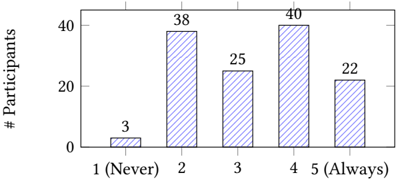
- AI-assisted information seeking is common: 83.6% of survey respondents actively use AI tools, and the majority report using AI at least half the time in their work. Tools used include ChatGPT (118), GitHub Copilot (62), Gemini (51), Microsoft Copilot (38), Tabnine (8), Claude (4), and Other (8). Developers use AI to understand best practices, discover libraries or solutions, explore trade-offs, identify keywords, recall or explain code, and synthesize documentation.
- For productivity, 109 respondents said their workflow was about the same when using AI tools, while 78—mostly those with fewer years of development experience—said AI improved their flow. Time savings was the most common productivity metric, followed by output quantity and solution quality; one participant reported getting a ticket scoped for several days or a week done in half an hour.
- For skill development, 119 respondents reported using AI for learning new technologies; 114 used AI for learning about and 113 for integrating new technologies. Concerns included knowledge gaps (88), overreliance (94), and poor problem-solving skills (87). Some participants reported decreased confidence, reduced independent coding, and diminished creative problem-solving, while others reported improved creative and critical thinking.
- AI-generated information lacks community vetting, creating validation burdens: participants described incomplete or fragmented answers, cross-referencing multiple AI systems, non-prescriptive language, inconsistent adaptive responses, and inappropriate information density. Traditional sources remain important, especially Stack Overflow, official documentation for GUI tasks, Reddit, and colleagues or mentors for niche or context-specific problems.
Methods
- Survey: a 20-minute Qualtrics survey with four sections, piloted with 3 respondents whose data were excluded. Recruitment used LinkedIn, X, internal mailing lists, Washington D.C. developer communities, and snowball sampling. From 310 responses and 173 interview-interest responses, filtering under-three-minute or incomplete responses left 168; excluding irrelevant open-ended answers left 128 valid responses. Respondents’ median age was 25–34; experience was 0–2 years (36), 2–5 years (53), 5–7 years (21), 7–10 years (10), and more than 10 years (8).
- Interviews: 17 participants interviewed over Zoom until theoretical saturation, with a protocol piloted with one author and two participants. Analysis used qualitative coding and thematic analysis: an initial codebook, independent labeling of one transcript by all four authors, an external auditor review of a subset of coded segments, and application of the final codebook to remaining transcripts.
- Analysis: survey questions were mapped to research questions; experience levels were grouped into five categories. Closed-ended questions used descriptive statistics and Fisher’s exact test with Bonferroni correction; open-ended responses used thematic summaries; only significant findings were reported.
Limitations
- Stated internal threat: self-reported survey and interview data may be subject to memory bias; the authors asked participants to ground responses in past experiences to mitigate this.
- Stated external threats: recruitment through LinkedIn, X, and internal mailing lists may not represent the broader developer community; the authors also engaged local developer communities and used snowball sampling. They note generalizability concerns due to sample size but state the goal is transferability rather than generalizability, supported by the mixed-method design and external auditor.
- Stated construct threat: participants may misinterpret questions; the authors piloted survey and interview protocols and provided definitions for key terms. Evident from the text: the sample skews early-career (median age 25–34; most survey respondents had 0–5 years of experience; interview participants mostly had 0–6 years except P17 with 18 years), and self-selection may limit perspectives.
Model-written summary. Check it against the paper before relying on it.
Integrity signals
Registry
Cites
Statistics
Figures

Verification
Claims the paper makes
7 Valid · 3 Not valid · 9 Not checked · 86 Own results and interpretations
The cited sources support only part of this claim — read each source’s verdict below.
In the paper
“However, most of these studies focus on AI-assisted tool use in the context of understanding, generating, or modifying source code, providing little insight into the role AI plays in developer information seeking and its impact.”
§ The Evolution of Information Seeking in Software Development: Understanding the Role and Impact of AI Assistants Ebtesam > 1 Introduction
What the sources say
- Partly supportedcites [12] 12. Ruijia Cheng, Ruotong Wang, Thomas Zimmermann, and Denae Ford. 2024. "It would work for me too": How Online Communities Shape Software Developers' Trust in AI-Powered Code Generation Tools. ACM Transactions on Interactive Intelligent Systems 14, 2 (2024), 1-39. sourceExperimental — accuracy not yet measured
Section 2.3, “AI-powered Code Generation Tools” (page unavailable), reviews studies of code generation, code quality, readability, and developers’ use of generated code, supporting the claim that the cited literature emphasizes code-related tasks. It does not establish that most AI-assisted-tool studies have that focus or assess a gap concerning AI’s role in developer information seeking and its impact. Section 2.2 discusses developers turning to AI for programming questions, but does not establish that broader research gap. (LLM, conf=0.82)
- Not matchedcites [13] 13. Saikrishna Chinthapatla. 2024. Unleashing the Future: A Deep Dive into AI- Enhanced Productivity for Developers. Journal Homepage: http://www. ijmra. us 13, 03 (2024).
Couldn’t be matched to a paper in Crossref, so it can’t be checked.
- Not checked — no full text of the sourcecites [37] 37. Margaret-Anne Storey and Alexey Zagalsky. 2016. Disrupting developer produc- tivity one bot at a time. In Proceedings of the 2016 24th ACM SIGSOFT international symposium on foundations of software engineering. 928-931. source
- Partly supportedcites [40] 40. Albert Ziegler, Eirini Kalliamvakou, X Alice Li, Andrew Rice, Devon Rifkin, Shawn Simister, Ganesh Sittampalam, and Edward Aftandilian. 2022. Productivity assessment of neural code completion. In Proceedings of the 6th ACM SIGPLAN International Symposium on Machine Programming. 21-29. sourceExperimental — accuracy not yet measured
The Introduction and Background (pages not available in our copy) discuss research on code completion and generation, supporting that part of the characterization. They do not establish that most AI-assisted-tool studies have this focus or assess how much insight those studies provide into developer information seeking; a search for information seeking found no such discussion. (LLM, conf=0.80)
plain- Asserted: passes — The authors put it forward as true.
- Checkable: passes — It can be checked against evidence.
- Load-bearing: passes — The paper’s conclusions depend on it.
- Based: passes — The paper gives a reason why it holds.
- Partly supported
The cited sources support only part of this claim — read each source’s verdict below.
In the paper
“A significant contributor to, or deterrent from, developer productivity is the time they spend seeking information to support the completion of their tasks [19,31].”
§ The Evolution of Information Seeking in Software Development: Understanding the Role and Impact of AI Assistants Ebtesam > 1 Introduction
What the sources say
- Partly supportedcites [19] 19. Márcio Kuroki Gonçalves, Cleidson RB de Souza, and Víctor M González. 2011. Collaboration, Information Seeking and Communication: An Observational Study of Software Developers' Work Practices. J. Univers. Comput. Sci. 17, 14 (2011), 1913-1930. sourceExperimental — accuracy not yet measured
The Discussion (Figure 5; page not provided) reports substantial time spent seeking information to coordinate work, and the Introduction links communication and coordination generally to productivity. The paper does not establish that time spent seeking information is itself a significant contributor to, or deterrent from, developer productivity. (LLM, conf=0.83)
- Not checked — no full text of the sourcecites [31] 31. André N Meyer, Earl T Barr, Christian Bird, and Thomas Zimmermann. 2019. Today was a good day: The daily life of software developers. IEEE Transactions on Software Engineering 47, 5 (2019), 863-880. source
plainstates a cause- Asserted: passes — The authors put it forward as true.
- Checkable: passes — It can be checked against evidence.
- Load-bearing: passes — The paper’s conclusions depend on it.
- Based: passes — The paper gives a reason why it holds.
- Partly supported
The cited sources support only part of this claim — read each source’s verdict below.
In the paper
“Developers traditionally build expertise through deliberate practice, pattern recognition, and incremental learning -all of which are well established principles from educational psychology [3,8,11,15,35].”
§ The Evolution of Information Seeking in Software Development: Understanding the Role and Impact of AI Assistants Ebtesam > 5.2 Developer Productivity and Learning Trade-offs
What the sources say
- Not checked — no full text of the sourcecites [3] 3. Richard C Atkinson and Richard M Shiffrin. 1968. Human memory. A proposed system and its control processes (1968). source
- Partly supportedcites [8] 8. Daniel Bor and Anil K Seth. 2012. Consciousness and the prefrontal parietal network: insights from attention, working memory, and chunking. Frontiers in psychology 3 (2012), 63. sourceExperimental — accuracy not yet measured
The section “What is the Functional Role of the Prefrontal Parietal Network?” (page unavailable) describes practice reducing cognitive demands and chunking as a way to discover useful patterns. The Conclusion calls chunking a learning mechanism. The paper does not specifically address developers, deliberate practice as a method of building expertise, or incremental learning. (LLM, conf=0.84)
- Not checked — no full text of the sourcecites [11] 11. Guillermo Campitelli and Fernand Gobet. 2011. Deliberate practice: Necessary but not sufficient. Current directions in psychological science 20, 5 (2011), 280-285. source
- Not checked — no full text of the sourcecites [15] 15. Nelson Cowan, Zhijian Chen, and Jeffrey N Rouder. 2004. Constant capacity in an immediate serial-recall task: A logical sequel to Miller (1956). Psychological science 15, 9 (2004), 634-640. source
- Not checked — no full text of the sourcecites [35] 35. Henry L Roediger and Kathleen B McDermott. 1995. Creating false memories: Remembering words not presented in lists. Journal of experimental psychology: Learning, Memory, and Cognition 21, 4 (1995), 803. source
boostedstates a cause- Asserted: passes — The authors put it forward as true.
- Checkable: passes — It can be checked against evidence.
- Load-bearing: passes — The paper’s conclusions depend on it.
- Based: passes — The paper gives a reason why it holds.
The cited sources support only part of this claim — read each source’s verdict below.
In the paper
“This represents a significant shift from established patterns where developers built expertise through reading documentation and social learning (such as peer interactions and collaborative forums) before implementation [9,39].”
§ The Evolution of Information Seeking in Software Development: Understanding the Role and Impact of AI Assistants Ebtesam > 5.1 The Evolution of Developer Information Seeking
What the sources say
- Not checked — no full text of the sourcecites [9] 9. Joel Brandt, Philip J Guo, Joel Lewenstein, Mira Dontcheva, and Scott R Klemmer. 2009. Two studies of opportunistic programming: interleaving web foraging, learning, and writing code. In Proceedings of the SIGCHI Conference on Human Factors in Computing Systems. 1589-1598. source
- Partly supportedcites [39] 39. Majid Zamiri and Ali Esmaeili. 2024. Methods and technologies for supporting knowledge sharing within learning communities: A systematic literature review. Administrative Sciences 14, 1 (2024), 17. sourceExperimental — accuracy not yet measured
The paper describes documentation and manuals as resources for learners and, in Section 4 (Discussion), describes forums and collaborative platforms as ways to share knowledge. It does not establish that developers traditionally built expertise through those methods before implementation; its discussion concerns learning communities more broadly. (LLM, conf=0.85)
plain- Asserted: passes — The authors put it forward as true.
- Checkable: passes — It can be checked against evidence.
- Load-bearing: passes — The paper’s conclusions depend on it.
- Based: passes — The paper gives a reason why it holds.
A result the paper reports from its own data — it cites no other source for it, so there is none to check. The quote shows it is in the paper.
In the paper
“Another common use case among participants when information seeking is to use AI tools to recall previous knowledge or explain code.”
§ The Evolution of Information Seeking in Software Development: Understanding the Role and Impact of AI Assistants Ebtesam > 4.1 Information Seeking with AI tools (RQ1) AI-Assisted Information Seeking
plain- Asserted: passes — The authors put it forward as true.
- Checkable: passes — It can be checked against evidence.
- Load-bearing: unclear — It is unclear whether the paper’s conclusions depend on it.
- Based: passes — The paper gives a reason why it holds.
37 more claims
Create a free account to see all 105 claims and to verify the 3 references still open.
- It may state two separate claims as one. 36
- Probably not a substantial claim. 34
- Borderline: one of the tests for a substantial claim is unclear. 1
- The quote only partly states this claim. 1
Citations
Cites
How Many Interviews Are Enough?: An Experiment with Data Saturation and Variability
Guest, G., Bunce, A., & Johnson, L. (2006) · Field Methods · doi:10.1177/1525822x05279903 · Cited by 20,808
Human Memory: A Proposed System and its Control Processes
Atkinson, R. C., & Shiffrin, R. M. (1968) · Psychology of Learning and Motivation · doi:10.1016/s0079-7421(08)60422-3 · Cited by 7,216 · cited 1×
“…felt that while AI can expedite problem solving, it can also lead to a superficial understanding of new technologies if used for integration , which may be the reason why some participants reported feeling less confident and comfortable in using these technologies independently for learning.”
Creating false memories: Remembering words not presented in lists.
Roediger, H. L., & McDermott, K. B. (1995) · Journal of Experimental Psychology: Learning, Memory, and Cognition · doi:10.1037/0278-7393.21.4.803 · Cited by 3,792
Retrieval-Augmented Generation for Knowledge-Intensive NLP Tasks
Lewis, P., Perez, E., Piktus, A., Petroni, F., Karpukhin, V., Goyal, N., Küttler, H., Lewis, M., Yih, W.-T., Rocktäschel, T., et al. (2020) · arXiv · doi:10.48550/arxiv.2005.11401 · Cited by 3,101
Using Numbers in Qualitative Research
Maxwell, J. A. (2010) · Qualitative Inquiry · doi:10.1177/1077800410364740 · Cited by 985 · cited 1×
“While this new approach accelerates immediate task completion, it introduces additional challenges.”
Proceedings of the SIGCHI Conference on Human Factors in Computing Systems
(2008) · doi:10.1145/1357054 · Cited by 547
(2009) · doi:10.1145/1518701.1518944 · Cited by 447
Grounded Copilot: How Programmers Interact with Code-Generating Models
Barke, S., James, M. B., & Polikarpova, N. (2023) · Proceedings of the ACM on Programming Languages · doi:10.1145/3586030 · Cited by 436
Ensuring survey research data integrity in the era of internet bots
Griffin, M., Martino, R. J., LoSchiavo, C., Comer-Carruthers, C., Krause, K. D., Stults, C. B., & Halkitis, P. N. (2022) · Quality & Quantity · doi:10.1007/s11135-021-01252-1 · Cited by 314
The Impact of AI on Developer Productivity: Evidence from GitHub Copilot
Peng, S., Kalliamvakou, E., Cihon, P., & Demirer, M. (2023) · arXiv · doi:10.48550/arxiv.2302.06590 · Cited by 287
Zamiri, M., & Esmaeili, A. (2024) · Administrative Sciences · doi:10.3390/admsci14010017 · Cited by 267
Novice software developers, all over again
Begel, A., & Simon, B. (2008) · Proceedings of the Fourth international Workshop on Computing Education Research · doi:10.1145/1404520.1404522 · Cited by 266
29th International Conference on Software Engineering (ICSE'07)
(2007) · doi:10.1109/icse10853.2007 · Cited by 259
Proceedings of the ACM 2011 conference on Computer supported cooperative work
(2011) · doi:10.1145/1958824 · Cited by 244
Navigating the Complexity of Generative AI Adoption in Software Engineering
Russo, D. (2024) · ACM Transactions on Software Engineering and Methodology · doi:10.1145/3652154 · Cited by 217
Information needs in bug reports: improving cooperation between developers and users
Breu, S., Premraj, R., Sillito, J., & Zimmermann, T. (2010) · Proceedings of the 2010 ACM conference on Computer supported cooperative work · doi:10.1145/1718918.1718973 · Cited by 204
A Large-Scale Survey on the Usability of AI Programming Assistants: Successes and Challenges
Liang, J. T., Yang, C., & Myers, B. A. (2024) · Proceedings of the IEEE/ACM 46th International Conference on Software Engineering · doi:10.1145/3597503.3608128 · Cited by 203
Productivity Assessment of Neural Code Completion
Ziegler, A., Kalliamvakou, E., Li, X. A., Rice, A., Rifkin, D., Simister, S., Sittampalam, G., & Aftandilian, E. (2022) · Proceedings of the 6th ACM SIGPLAN International Symposium on Machine Programming · doi:10.1145/3520312.3534864 · Cited by 200
Cognition in Close Relationships
(2013) · Psychology Press eBooks · doi:10.4324/9780203772027 · Cited by 186
Using information fragments to answer the questions developers ask
Fritz, T., & Murphy, G. C. (2010) · Proceedings of the 32nd ACM/IEEE International Conference on Software Engineering - Volume 1 · doi:10.1145/1806799.1806828 · Cited by 163
(2011) · doi:10.1177/0963721411421922 · Cited by 162
Taking Flight with Copilot: Early insights and opportunities of AI-powered pair-programming tools
Bird, C., Ford, D., Zimmermann, T., Forsgren, N., Kalliamvakou, E., Lowdermilk, T., & Gazit, I. (2022) · Queue · doi:10.1145/3582083 · Cited by 158
(2016) · doi:10.1145/2950290.2983989 · Cited by 153
Bor, D., & Seth, A. K. (2012) · Frontiers in Psychology · doi:10.3389/fpsyg.2012.00063 · Cited by 143 · cited 1×
“…felt that while AI can expedite problem solving, it can also lead to a superficial understanding of new technologies if used for integration , which may be the reason why some participants reported feeling less confident and comfortable in using these technologies independently for learning.”
Hard-to-answer questions about code
LaToza, T. D., & Myers, B. A. (2010) · Evaluation and Usability of Programming Languages and Tools · doi:10.1145/1937117.1937125 · Cited by 141 · cited 2×
“On the flip side, LaToza et al. [25] surveyed 179 professional developers regarding hard-to-answer questions about code to better understand information needs developers encounter challenges trying to fulfill.”
Self-citationConstant Capacity in an Immediate Serial-Recall Task: A Logical Sequel to Miller (1956)
Cowan, N., Chen, Z., & Rouder, J. N. (2004) · Psychological Science · doi:10.1111/j.0956-7976.2004.00732.x · Cited by 129
Today was a good day: The daily life of software developers
Meyer, A. N., Barr, E. T., Bird, C., & Zimmermann, T. (2021) · IEEE Transactions on Software Engineering · doi:10.1109/tse.2019.2904957 · Cited by 123
(2024) · doi:10.1145/3664646.3664773 · Cited by 67
Boguslawski, S., Deer, R., & Dawson, M. G. (2025) · Information and Learning Sciences · doi:10.1108/ils-10-2023-0163 · Cited by 66
Bird, C., Ford, D., Zimmermann, T., Forsgren, N., Kalliamvakou, E., Lowdermilk, T., & Gazit, I. (2023) · Communications of the ACM · doi:10.1145/3589996 · Cited by 55
(2013) · doi:10.4324/9780203772027-8 · Cited by 53
What distinguishes great software engineers
Li, P. L., Ko, A. J., & Begel, A. (2020) · Empirical Software Engineering · doi:10.1007/s10664-019-09773-y · Cited by 48
Cheng, R., Wang, R., Zimmermann, T., & Ford, D. (2024) · ACM Transactions on Interactive Intelligent Systems · doi:10.1145/3651990 · Cited by 47
Characterizing Software Engineering Work with Personas Based on Knowledge Worker Actions
Ford, D., Zimmermann, T., Bird, C., & Nagappan, N. (2017) · 2017 ACM/IEEE International Symposium on Empirical Software Engineering and Measurement (ESEM) · doi:10.1109/esem.2017.54 · Cited by 37
(2019) · doi:10.34190/rm.19.113 · Cited by 33
API-Related Developer Information Needs in Stack Overflow
Liu, M., Peng, X., Marcus, A., Xing, S., Treude, C., & Zhao, C. (2021) · IEEE Transactions on Software Engineering · doi:10.1109/tse.2021.3120203 · Cited by 28
Navigating the Complexity of Generative AI Adoption in Software Engineering—RCR Report
Russo, D. (2024) · ACM Transactions on Software Engineering and Methodology · doi:10.1145/3680471 · Cited by 27
Make Your Tools Sparkle with Trust: The PICSE Framework for Trust in Software Tools
Johnson, B., Bird, C., Ford, D., Forsgren, N., & Zimmermann, T. (2023) · 2023 IEEE/ACM 45th International Conference on Software Engineering: Software Engineering in Practice (ICSE-SEIP) · doi:10.1109/icse-seip58684.2023.00043 · Cited by 27
Self-citationPhillips, S., Ruhe, G., & Sillito, J. (2012) · ACM Conference on Computer Supported Cooperative Work (CSCW) · doi:10.1145/2145204.2145408 · Cited by 27
Grounded Copilot: How Programmers Interact with Code-Generating Models
Barke, S., James, M. B., & Polikarpova, N. (2022) · arXiv · doi:10.48550/arxiv.2206.15000 · Cited by 23 · cited 1×
“Barke et al. [4] investigated how developers interact with AI programming assistants like GitHub Copilot.”
Gonçalves, M. K., González, V. M., & de Souza, L. R. B. (2011) · Verlag der Technischen Universität Graz · doi:10.3217/jucs-017-14-1913 · Cited by 22
Navigating the Complexity of Generative AI Adoption in Software EngineeringPreprint
Russo, D. (2023) · arXiv (Cornell University) · doi:10.48550/arxiv.2307.06081 · Cited by 18
(2015) · doi:10.1145/2786805.2803197 · Cited by 11
Cheng, R., Wang, R., Zimmermann, T., et al. (2022) · arXiv (Cornell University) · doi:10.48550/arxiv.2212.03491 · Cited by 7
Appendix to Information Needs in Bug Reports: Improving Cooperation Between Developers and Users
Breu, S., Premraj, R., Sillito, J., et al. (2009) · doi:10.11575/prism/31257 · Cited by 1
(2025) · Science · doi:10.1126/science.adw2589
Research works printed but not linked: 2
- Saikrishna Chinthapatla. 2024. Unleashing the Future: A Deep Dive into AI-Enhanced Productivity for Developers. Journal Homepage: http://www.ijmra.us 13, 03 (2024).
- Tran Minh Tung. 2024. Opening Up The Workplace: The Way Ai Tools Are Changing Productivity. Educational Administration: Theory and Practice 30, 3 (2024), 480–491.
Cited by
Alami, A., & Ernst, N. (2025) · 2025 IEEE/ACM 18th International Conference on Cooperative and Human Aspects of Software Engineering (CHASE) · doi:10.1109/chase66643.2025.00016 · Cited by 15
Reducing Development Time with AI Tools: Enhancing Human-AI Collaboration in Software Development
Anumakonda, R. C. (2025) · European Modern Studies Journal · doi:10.59573/emsj.9(3).2025.45 · Cited by 1
Salomon, M., Chin, K. D., Holmes, R., Fritz, T., & Murphy, G. C. (2025) · ACM SIGPLAN International Symposium on SPLASH-E (SPLASH-E) · doi:10.1145/3758317.3759680 · Cited by 4
From Disruptions to Discussions: How GenAI Impacts Human Interactions in Software Development
Salomon, M., Koshchenko, E., Sergeyuk, A., Holmes, R., Murphy, G. C., & Fritz, T. (2026) · IEEE Transactions on Software Engineering · doi:10.1109/tse.2026.3655626 · Cited by 1
“…et al. and Vaz Pereira et al. studies present conflicting perspectives on how GenAI affects collaboration: Haque et al. report decreases in face-to-face interaction and organic knowledge sharing, whereas Vaz Pereira et al. found no significant changes to how developers collab-orated as a team.”
InfluentialPaz-Chen, M., Lanir, J., & Ayalon, O. (2026) · Behaviour and Information Technology · doi:10.1080/0144929x.2026.2654495 · Cited by 1
Metadata
- Authors
- Al Haque, E., Brown, C., LaToza, T. D., & Johnson, B.
- Affiliations
- George Mason University, Fairfax, Virginia, USA
- Virginia Tech (US)
- George Mason University (US)
- Venue
- Proceedings of the 33rd ACM International Conference on the Foundations of Software Engineering
- Publisher
- ACM
- Published
- 2025-06-23
- Pages
- 1494-1502
- OpenAlex
- W4413268010
- Cited by
- 9
- References
- 26
- Citations by year
- 2026: 4 · 2025: 5
- FWCI
- 10.29
- Type
- conference paper
- Language
- en
- Open access
- hybrid
- doi.org
- Licence
- cc-by
- Locations
- ACM Joint European Software Engineering Conference and Symposium on the Foundations of Software Engineering (ESEC/FSE) (publishedVersion, cc-by)
- VTechWorks (Virginia Tech) (publishedVersion, cc-by)
- arXiv (Cornell University) (submittedVersion, cc-by)
- arXiv (Cornell University) (cc-by)
- Topics
- Physical Sciences › Computer Science › Information Systems › Software Engineering Research
- Physical Sciences › Computer Science › Information Systems › Information Retrieval and Search Behavior
- Physical Sciences › Computer Science › Information Systems › Software Engineering Techniques and Practices
- Keywords
- information seeking, AI assistants, software developers, developer productivity, developer workflows, developer knowledge
About these checks
Registry, retraction, Cites and statistics results are computed, not judged, with one exception: a printed reference that no index lists is read once by a model before it counts as a citation error. Claims are extracted by a model and kept only when their quote appears verbatim in the text; each cited source is then checked, with a model’s help, for whether it says what the claim relies on. Those verdicts can be wrong — read the claim’s quote and the cited source before relying on one.
The claim verdicts this report counts are experimental: their accuracy is not yet measured.
A language model drew the claims from the paper on 2026-09-29, under version 3 of the claim definition (model deepseek-v4.1-flash, prompt extract-v3).
A second model labelled each claim on 2026-09-29 (model jev-1.13-20260917, definition revision gold-guideline-v0.2).
Cited sources are checked with a language model’s help (gpt-6-sol).
Statistics and arithmetic are recomputed, not judged.
Confidence bands are shown only for fields calibrated on our annotated test set. None is calibrated yet, so no band is shown.
What counts as a claim ›How we measure confidence ›How we check this ›
Are you an author, or do you see a problem with this page? Request a review
Data sources
Bibliographic data: Semantic Scholar, OpenAlex, Crossref.
Contains information from the Semantic Scholar Academic Graph Datasets, made available under the ODC Attribution License (ODC-BY 1.0).
Semantic Scholar’s data is described in: Kinney, R., et al. (2023). The Semantic Scholar Open Data Platform. arXiv:2301.10140.
