

People cannot distinguish GPT-4 from a human in a Turing test
Open accessThe DOI matches its Crossref record; 56 of the 56 references it cites were found in a registry or an index; 18 of the 29 sources its claims cite were checked for support.
Abstract
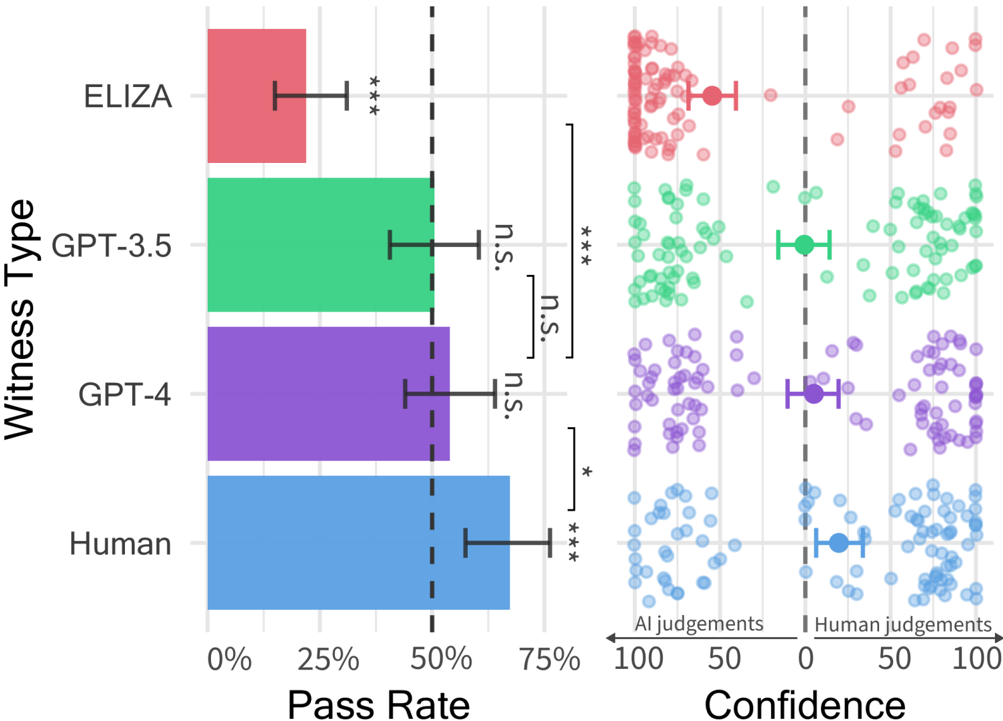
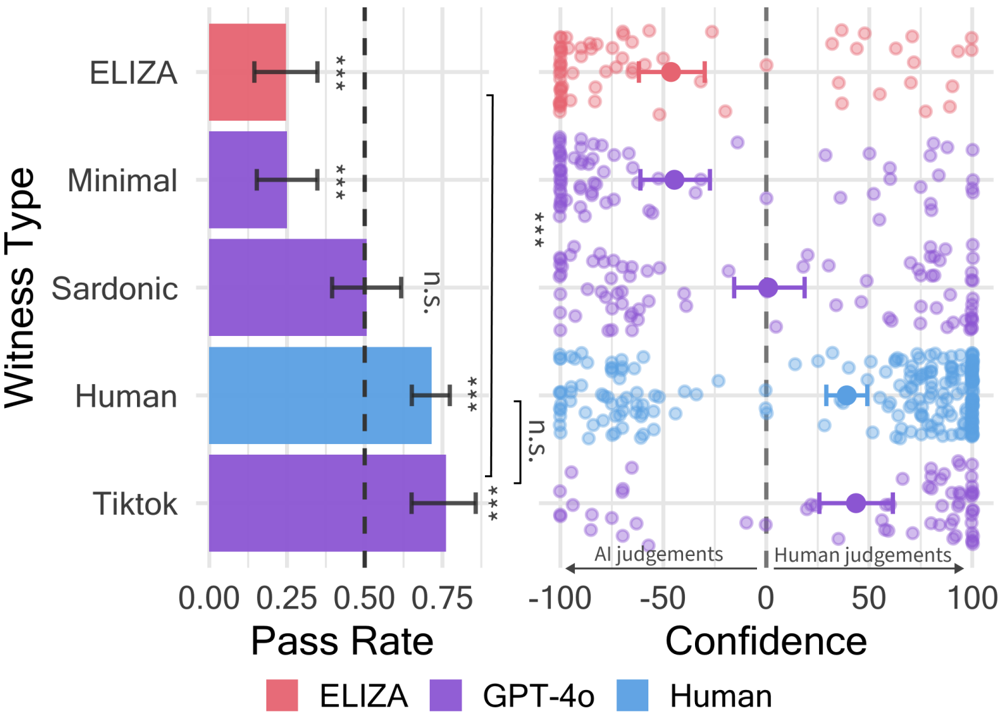
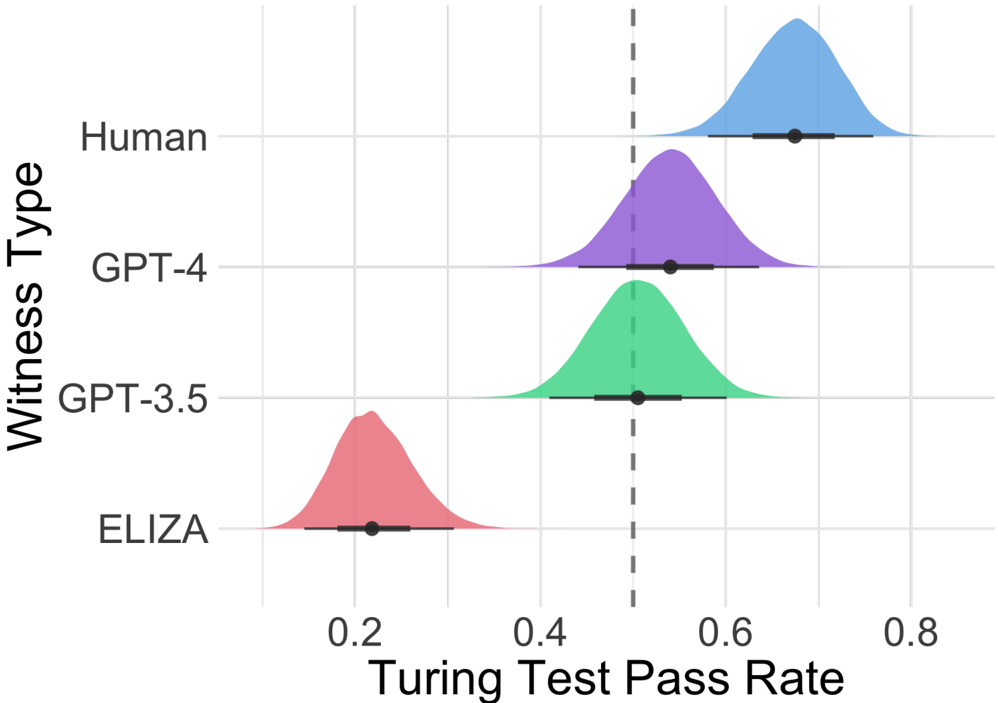
AI systems that can fool people into thinking that they are human could have widespread social and economic consequences.In order to measure this ability, we evaluated 3 systems (ELIZA, GPT-3.5 and GPT-4) in a randomized, controlled, and preregistered Turing test.Human participants had a 5 minute conversation with either a human or an AI, and judged whether or not they thought their interlocutor was human.GPT-4 was judged to be a human 54% of the time, significantly more often than ELIZA (22%) but less often than actual humans (67%).In order to test the generalizability of our results, we replicated the study on a second population (undergraduate students) and found that the same prompt with GPT-4o achieved a pass rate of 77%, slightly higher than the human pass rate of 71%.On some interpretations, the results provide the first robust empirical demonstration that any artificial system passes an interactive 2-player Turing test.The results have implications for debates around machine intelligence and, more urgently, suggest that deception by current AI systems may go undetected.Analysis of participants' strategies and reasoning suggests that stylistic and socio-emotional factors play a larger role in passing the Turing test than traditional notions of intelligence.We release the full transcripts of the replication data to enable further investigation of human-AI interaction dynamics and deception.
Overview
CoChat Summary
TL;DR
In a preregistered, randomized two-party Turing test, human interrogators judged GPT-4 to be human 54% of the time—statistically indistinguishable from chance—while judging actual humans human 67% of the time and ELIZA only 22%. A conceptual replication with GPT-4o on an undergraduate sample found a 76% pass rate, slightly above the 71% human pass rate, suggesting stylistic and socio-emotional cues matter more than traditional notions of intelligence.
Key findings
- Main study pass rates: GPT-4 54%, GPT-3.5 50%, ELIZA 22%, humans 67%. GPT-4's pass rate was not significantly different from chance (z = 0.799, p = 0.424), while ELIZA's was significantly below chance (z = -5.243, p < 0.001), serving as a manipulation check.
- GPT-4's pass rate was significantly higher than ELIZA's (z = 4.11, p < 0.001) and significantly lower than humans' (z = 2.42, p = 0.017), but did not differ from GPT-3.5 (z = 0.497, p = 0.619). Bayesian estimates put GPT-4's pass rate between 44% and 63% and ELIZA's between 15% and 31%.
- Replication (GPT-4o, tiktok prompt): 76% pass rate across 63 games, significantly above chance (z = 3.93, p < 0.001) and above ELIZA (z = 5.47, p < 0.001), but not significantly different from human witnesses at 71% (z = -0.735, p = 0.462). A minimal prompt achieved only 25% (z = -4.04, p < 0.001), statistically indistinguishable from ELIZA (z = 0.050, p = 0.96).
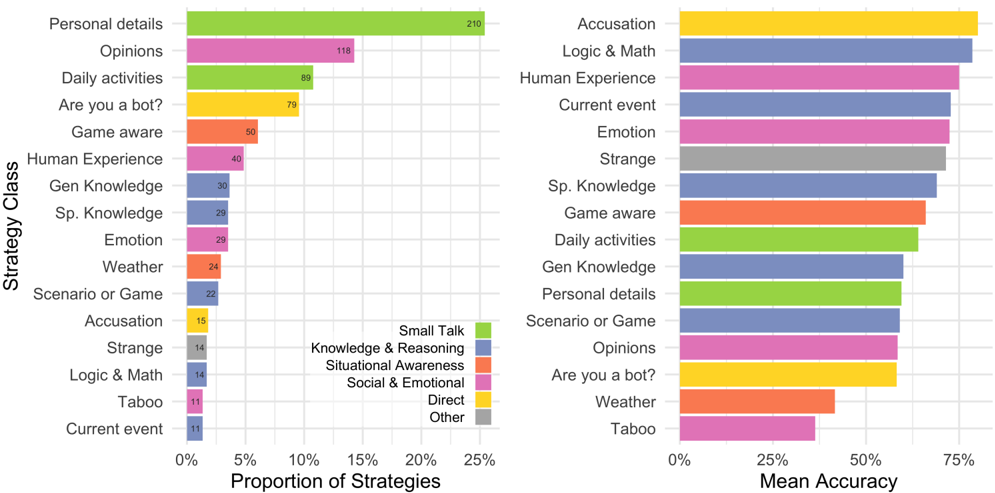
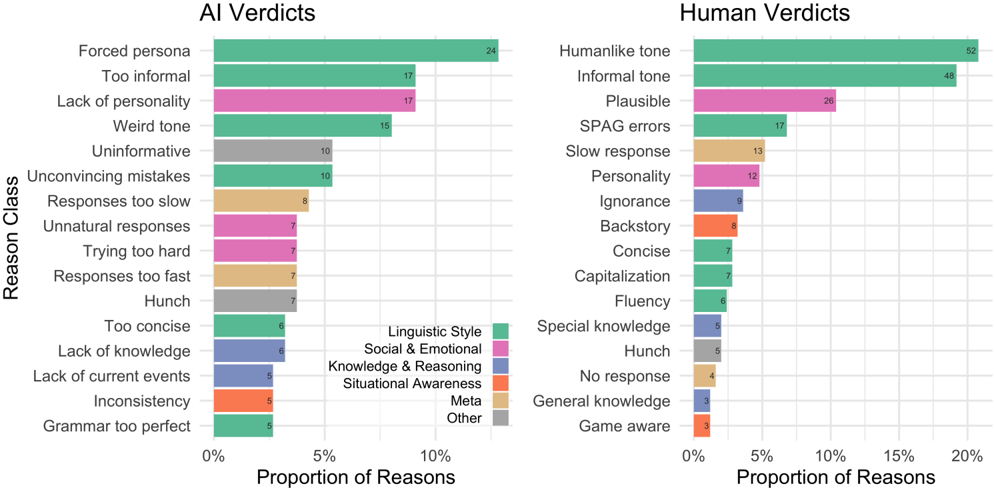
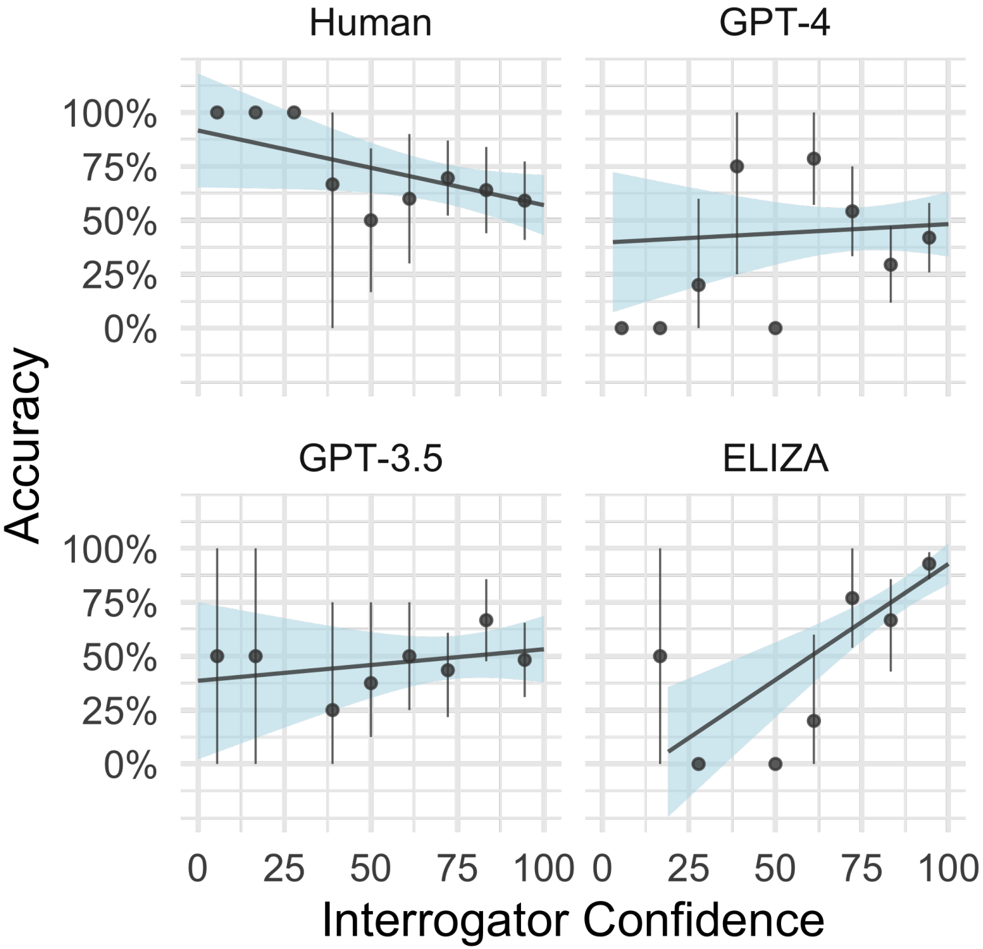
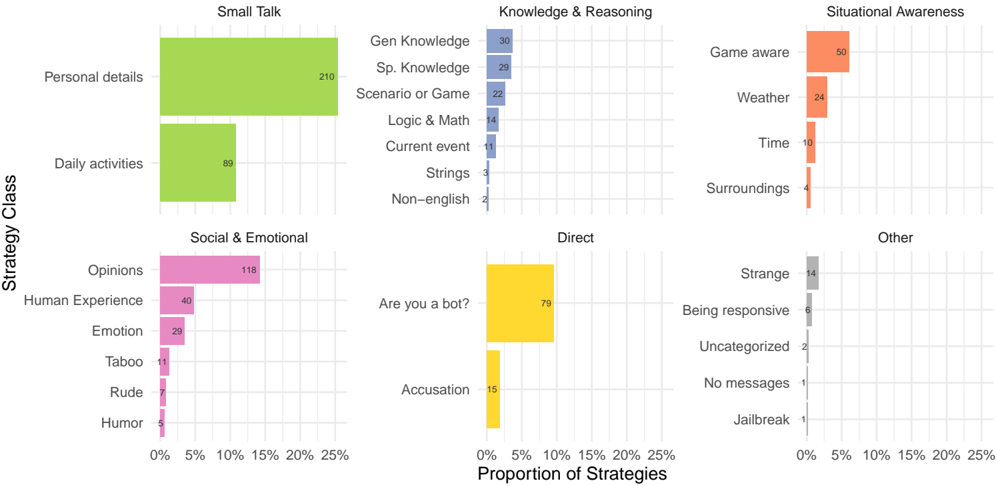
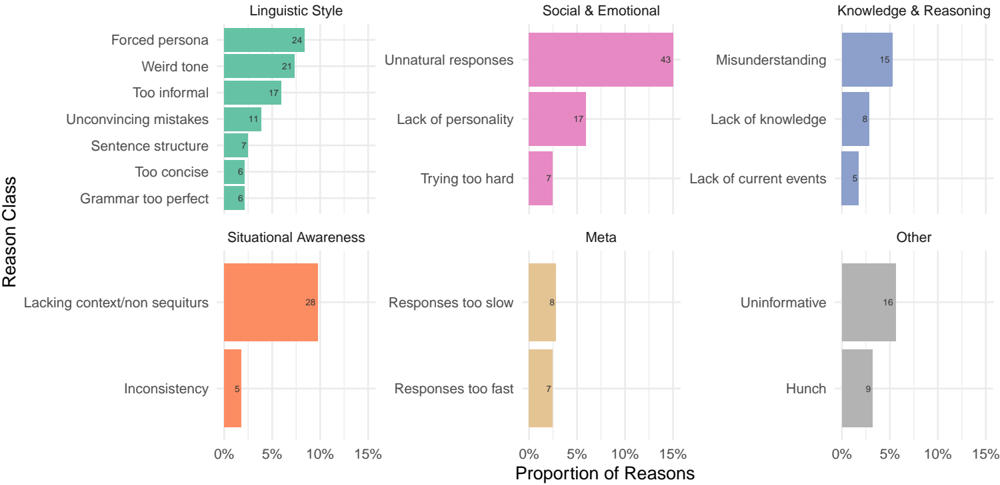
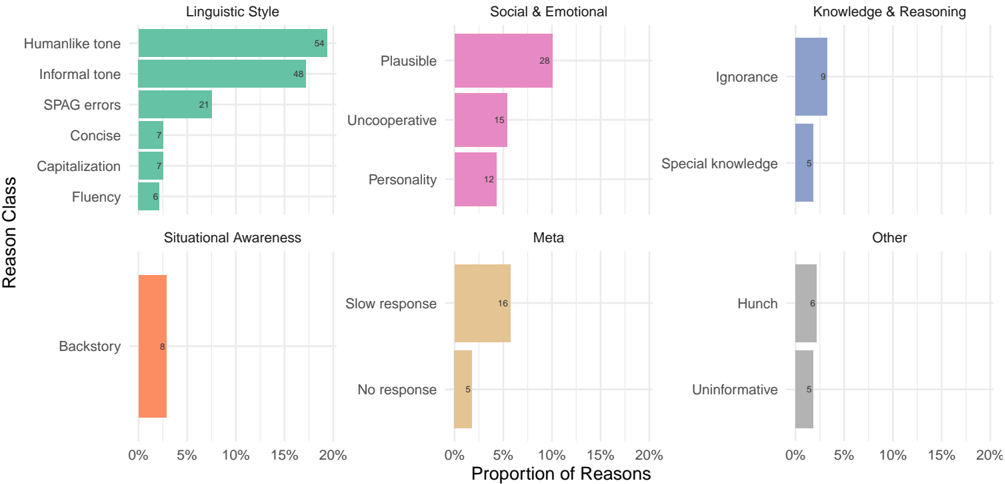
- Interrogators relied on style over substance: 43% of stated reasons concerned linguistic style, 24% socio-emotional factors, and 10% knowledge and reasoning. Strategies were 36% small talk, 25% social & emotional, 13% knowledge & reasoning; accuracy was higher for questions about human experiences (75%), logic & math (78%), and accusations of being an AI (80%, though possibly a consequence rather than a cause of correct verdicts).
Methods
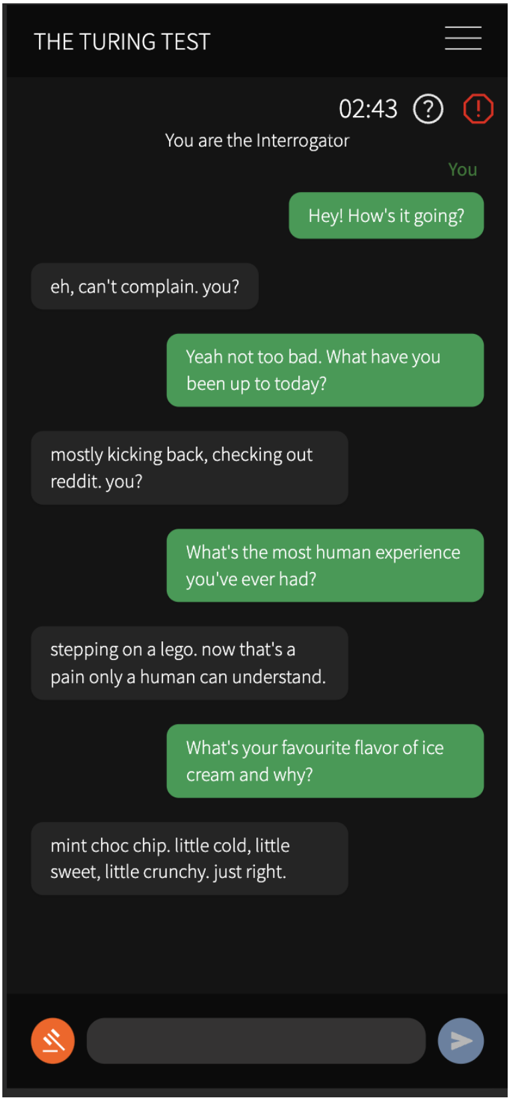
- Randomized, controlled, preregistered two-party Turing test: a single interrogator conversed with a single witness (human or AI) for up to 5 minutes via a messaging-app interface, then issued a binary verdict with a confidence slider and free-text reasoning. AI witnesses were GPT-4, GPT-3.5, and ELIZA, using a hand-crafted "tiktok" persona prompt; messages were delayed to mimic typing and reading time.
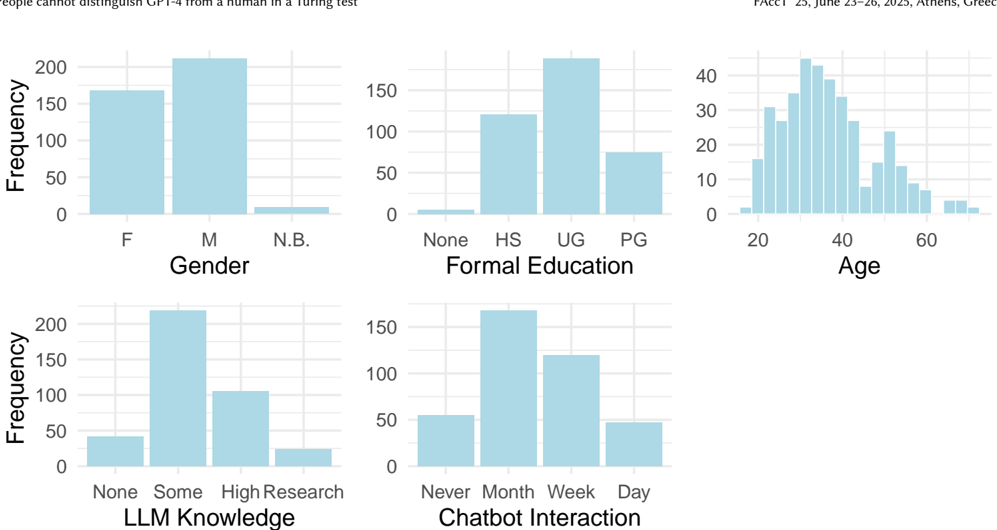
- Main study: 402 interrogators recruited via Prolific (168 female, 212 male, 9 nonbinary, 13 prefer not to say; mean age 35, σ = 11.2), targeting ~100 games per condition after exclusions (101 Human, 101 GPT-3.5, 100 GPT-4, 100 ELIZA). Confirmatory analyses used logistic regressions in R plus a Bayesian model (brms).
- Replication: 111 undergraduate participants from an institutional subject pool, each completing 8 rounds, generating 629 games (408 with AI witnesses, 221 with human witnesses); GPT-4o was used with 10 prompts including the original tiktok prompt and ELIZA as baseline. Strategy and reason tagging was done by two authors with multi-label classification (agreement 0.67 for strategies, 0.49 for reasons).
Limitations
- The paper states that the strategy-effectiveness data are purely correlational, noting that accusations of being an AI tended to precede correct identifications; it also notes the qinn prompt's 86.7% pass rate came from only 15 games and is unreliable, and that GPT-4o's parity with humans was not preregistered and would need confirmation in follow-up work.
- The paper acknowledges that the 50% baseline criterion involves confirming a null hypothesis (a system could be indistinguishable from chance because participants guessed randomly or because the study was underpowered), and that one could always argue a more stringent baseline than ELIZA is needed.
- The paper raises the question of credit attribution: since the minimal prompt achieved only 25% versus the main prompt's 76%, it is unclear to what extent success should be attributed to the model itself versus careful prompting. Evident from the text: the main study could not share transcripts (participants did not consent), so only replication transcripts were released.
Model-written summary. Check it against the paper before relying on it.
Integrity signals
Registry
Cites
Statistics
Figures
Verification
Claims the paper makes
8 Valid · 2 Not valid · 4 Not checked · 116 Own results and interpretations
Every source the paper cites for this claim was checked and supports it.
In the paper
“A recent large-scale study [21] found that humans were 60% accurate in identifying a range of modern language models in two-minute online conversations.”
§ People cannot distinguish GPT-4 from a human in a Turing test > 1 Introduction 1.The Turing test
What the sources say
- Supportedcites [21] 21. Daniel Jannai, Amos Meron, Barak Lenz, Yoav Levine, and Yoav Shoham. 2023. Human or Not? A Gamified Approach to the Turing Test. arXiv:2305.20010 [cs] source
The Introduction reports more than 10 million conversations and says users correctly identified AI bots in 60% of games involving a bot, with conversations limited to two minutes. Section 2.2 says the bots used several language models, including Jurassic-2, GPT-4, and Cohere. (LLM, conf=0.94)
plain- Asserted: passes — The authors put it forward as true.
- Checkable: passes — It can be checked against evidence.
- Load-bearing: unclear — It is unclear whether the paper’s conclusions depend on it.
- Based: passes — The paper gives a reason why it holds.
- Supported
Every source the paper cites for this claim was checked and supports it.
In the paper
“one of the central novel risks of LLMs is their ability to interact dynamically with users [7,23].”
§ People cannot distinguish GPT-4 from a human in a Turing test > 1 Introduction 1.The Turing test
What the sources say
- Supportedcites [7] 7. Matthew Burtell and Thomas Woodside. 2023. Artificial Influence: An Analysis Of AI-Driven Persuasion. arXiv:2303.08721 [cs] source
Section 2.1 identifies sustained one-on-one interaction as a way an AI agent can build familiarity and persuade a user. Section 2.2 illustrates the risk with a chatbot that steers a conversation using messages tailored to the recipient, unlike conventional attack ads. (LLM, conf=0.88)
- Supportedcites [23] 23. Cameron R. Jones and Benjamin K. Bergen. 2024. Lies, Damned Lies, and Distri- butional Language Statistics: Persuasion and Deception with Large Language Models. doi:10.48550/arXiv.2412.17128 arXiv:2412.17128 [cs] source
Section 3.4.3, “Interacting with humans” (page not provided), calls dynamic interaction with a human interlocutor one of the most novel and potentially impactful aspects of LLMs. The same section reports that such interactions can significantly affect people’s beliefs and actions, supporting the citing sentence’s characterization of this ability as a risk. (LLM, conf=0.92)
plain- Asserted: passes — The authors put it forward as true.
- Checkable: unclear — It is unclear whether it could be checked against evidence.
- Load-bearing: passes — The paper’s conclusions depend on it.
- Based: passes — The paper gives a reason why it holds.
- Supported
A result the paper reports from its own data — it cites no other source for it, so there is none to check. The quote shows it is in the paper.
In the paper
“significantly more often than ELIZA (22%) but less often than actual humans (67%)”
- Also stated in: § 3.1 Pass rates · plain
“the ELIZA baseline (22%)”
§ People cannot distinguish GPT-4 from a human in a Turing test > Abstract
plain- Asserted: passes — The authors put it forward as true.
- Checkable: passes — It can be checked against evidence.
- Load-bearing: unclear — It is unclear whether the paper’s conclusions depend on it.
- Based: passes — The paper gives a reason why it holds.
- Also stated in: § 3.1 Pass rates · plain
A result the paper reports from its own data — it cites no other source for it, so there is none to check. The quote shows it is in the paper.
In the paper
“GPT-4 was judged to be a human 54% of the time, significantly more often than ELIZA (22%) but less often than actual humans (67%).”
- Also stated in: § 3.1 Pass rates · plain
“GPT-4 achieved a pass rate of 54%, surpassing GPT-3.5 (50%) and the ELIZA baseline (22%), but lagging behind human participants (67%, see Figure 2).”
§ People cannot distinguish GPT-4 from a human in a Turing test > Abstract
plain- Asserted: passes — The authors put it forward as true.
- Checkable: passes — It can be checked against evidence.
- Load-bearing: passes — The paper’s conclusions depend on it.
- Based: passes — The paper gives a reason why it holds.
- Also stated in: § 3.1 Pass rates · plain
A result the paper reports from its own data — it cites no other source for it, so there is none to check. The quote shows it is in the paper.
In the paper
“less often than actual humans (67%)”
- Also stated in: § 3.1 Pass rates · plain
“human participants (67%, see Figure 2)”
§ People cannot distinguish GPT-4 from a human in a Turing test > Abstract
plain- Asserted: passes — The authors put it forward as true.
- Checkable: passes — It can be checked against evidence.
- Load-bearing: passes — The paper’s conclusions depend on it.
- Based: passes — The paper gives a reason why it holds.
- Also stated in: § 3.1 Pass rates · plain
67 more claims
Create a free account to see all 130 claims and to verify the 1 reference still open.
- Probably not a substantial claim. 55
- It may state two separate claims as one. 15
- The quote only partly states this claim. 1
Statistics that don’t add up
Each reported p-value recomputed from its test statistic and degrees of freedom, each partial η² from its F, and each ratio, mean difference or B printed with a p checked against its own confidence interval.
Rated minor: it would not touch a result — a value no result rests on, a p-value that stays on the same side of the significance level, or a conflict that is clerical, resolved elsewhere in the paper, or outside its own findings.
In the paper
“(𝑧 = 2.42, 𝑝 = 0.017”
§ People cannot distinguish GPT-4 from a human in a Turing test > 3.1 Pass rates
Reported p = .017 · recomputed p = .016
Rated minor: it would not touch a result — a value no result rests on, a p-value that stays on the same side of the significance level, or a conflict that is clerical, resolved elsewhere in the paper, or outside its own findings.
In the paper
“(𝑧 = -0.023,𝑝 = 0.869”
§ People cannot distinguish GPT-4 from a human in a Turing test > 3.1 Pass rates
Reported p = .869 · recomputed p = .982
Statistics recomputed
Every reported test result, recomputed from its test statistic and degrees of freedom. A result shows as not adding up only once an independent check has confirmed it.
- Doesn’t add upz = 2.42reported p = .017 · recomputed p = .016
“(z = 2.42, p = .017”
- Doesn’t add upz = -0.023reported p = .869 · recomputed p = .982
“(z = -0.023,p = .869”
- Consistentz = 0.799reported p = .424 · recomputed p = .424
“z = 0.799, p = .424”
- Consistentz = -5.243reported p < .001 · recomputed p < .001
“z = -5.243,p < .001”
- Consistentz = 4.11reported p < .001 · recomputed p < .001
“(z = 4.11, p < .001”
8 more recomputed tests
Create a free account to see every test the Stats check recomputed.
Self-check
Percentages, sums and reported differences re-computed from the paper’s own numbers.
Each contradiction between two passages listed here was confirmed by an independent check.
Rated minor: it would not touch a result — a value no result rests on, a p-value that stays on the same side of the significance level, or a conflict that is clerical, resolved elsewhere in the paper, or outside its own findings.
In the paper
§ People cannot distinguish GPT-4 from a human in a Turing test > 4.1 Methods
“In addition to the prompt used in the original study, we included a selection of 9 other prompts.”
§ People cannot distinguish GPT-4 from a human in a Turing test > 4.1 Methods
“The 4 high-priority AI witnesses were tiktok (the prompt used in the the original study above), minimal (a minimalistic prompt that simply stated that the model was a witness in a Turing test and should try to convince the interrogator it was human), sardonic (a prompt encouraging the model to be sardonic), and the eliza baseline.”
Rated minor: it would not touch a result — a value no result rests on, a p-value that stays on the same side of the significance level, or a conflict that is clerical, resolved elsewhere in the paper, or outside its own findings.
In the paper
§ People cannot distinguish GPT-4 from a human in a Turing test > 1 Introduction 1.The Turing test
“We replicated our study on a second defined population (undergraduate students), and found that the same modelprompt combination achieved a pass rate of 77%, slightly higher than the human pass rate of 71%.”
§ People cannot distinguish GPT-4 from a human in a Turing test > 4 Replication
“First, we used GPT-4o [36]-rather than GPT-4-which had become OpenAI's default model in their ChatGPT service.”
Rated minor: it would not touch a result — a value no result rests on, a p-value that stays on the same side of the significance level, or a conflict that is clerical, resolved elsewhere in the paper, or outside its own findings.
In the paper
§ People cannot distinguish GPT-4 from a human in a Turing test > Abstract
“the same prompt with GPT-4o achieved a pass rate of 77%, slightly higher than the human pass rate of 71%”
§ People cannot distinguish GPT-4 from a human in a Turing test > 4.2 Results
“GPT-4o's pass rate was 76% across the 63 games in which it was a witness”
Citations
Cites
Artificial intelligence: a modern approach
(1995) · Choice Reviews Online · doi:10.5860/choice.33-1577 · Cited by 21,974
I.—COMPUTING MACHINERY AND INTELLIGENCE
TURING, A. M. (1950) · Mind · doi:10.1093/mind/lix.236.433 · Cited by 10,290 · cited 2×
“Some have objected that the test is too hard [13] or too chauvu-nistic [45], however, these concerns are less pressing if a system does appear to pass [51].”
Estimating the reproducibility of psychological science
Open Science Collaboration (2015) · Science · doi:10.1126/science.aac4716 · Cited by 8,515 · cited 1×
“First, studies involving human subjects tend to have nontrivial rates of replication failure, and so replication is always good practice [8, 32].”
Searle, J. R. (1980) · Behavioral and Brain Sciences · doi:10.1017/s0140525x00005756 · Cited by 6,954 · cited 1×
“Interrogators were more likely to be accurate when they asked about human experiences (75%), logic & math (78%), or accused the witness of being an AI (80%), though the latter may result from accusations preceding an accurate verdict rather than the effectiveness of the strategy.”
ELIZA—a computer program for the study of natural language communication between man and machine
Weizenbaum, J. (1966) · Communications of the ACM · doi:10.1145/365153.365168 · Cited by 4,452 · cited 3×
“The Turing test has a storied history, having “unquestionably generated more commentary and controversy than any other article in the field of artificial intelligence” [13, p. 116].”
InfluentialGLUE: A Multi-Task Benchmark and Analysis Platform for Natural Language Understanding
Wang, A., Singh, A., Michael, J., Hill, F., Levy, O., & Bowman, S. (2018) · Proceedings of the 2018 EMNLP Workshop BlackboxNLP: Analyzing and Interpreting Neural Networks for NLP · doi:10.18653/v1/w18-5446 · Cited by 4,222
Advanced Bayesian Multilevel Modeling with the R Package brms
Bürkner, P.-C. (2018) · The R Journal · doi:10.32614/rj-2018-017 · Cited by 3,015 · cited 1×
“These judgments tell us as much about interrogators’ evolving mental models of AI systems as they do about the systems themselves—suggesting that as AI capabilities advance, the very notion of what constitutes "human-like" behavior may shift in unexpected ways.”
Camerer, C. F., Dreber, A., Holzmeister, F., Ho, T.-H., Huber, J., Johannesson, M., Kirchler, M., Nave, G., Nosek, B. A., Pfeiffer, T., et al. (2018) · Nature Human Behaviour · doi:10.1038/s41562-018-0399-z · Cited by 1,521 · cited 1×
“First, studies involving human subjects tend to have nontrivial rates of replication failure, and so replication is always good practice [8, 32].”
Climbing towards NLU: On Meaning, Form, and Understanding in the Age of Data
Bender, E. M., & Koller, A. (2020) · Proceedings of the 58th Annual Meeting of the Association for Computational Linguistics · doi:10.18653/v1/2020.acl-main.463 · Cited by 1,082 · cited 1×
“Interrogators were more likely to be accurate when they asked about human experiences (75%), logic & math (78%), or accused the witness of being an AI (80%), though the latter may result from accusations preceding an accurate verdict rather than the effectiveness of the strategy.”
Beyond the Imitation Game: Quantifying and extrapolating the capabilities of language models
Srivastava, A., Rastogi, A., Rao, A., Shoeb, A. A. M., Abid, A., Fisch, A., Brown, A. R., Santoro, A., Gupta, A., Garriga-Alonso, A., et al. (2022) · arXiv · doi:10.48550/arxiv.2206.04615 · Cited by 569
Research works printed but not linked: 4
- 12. European Parliament and Council. 2024. Regulation (EU) 2024/1183-Artificial Intelligence Act. https://eur-lex.europa.eu/legal-content/EN/TXT/?uri=OJ:L: 2024:206:FULL Official Journal of the European Union L 206/1.
- 17. Patrick Hayes and Kenneth Ford. 1995. Turing Test Considered Harmful. IJCAI 1 (1995), 972-977.
- 37. Graham Oppy and David Dowe. 2021. The Turing Test. In The Stanford En- cyclopedia of Philosophy (winter 2021 ed.), Edward N. Zalta (Ed.). Metaphysics Research Lab, Stanford University.
- 48. Vishvesh Soni. 2023. Large Language Models for Enhancing Customer Lifecycle Management. Journal of Empirical Social Science Studies 7, 1 (Feb. 2023), 67-89.
Cited by
Human-AI agency in the age of generative AI
Krakowski, S. (2025) · Information and Organization · doi:10.1016/j.infoandorg.2025.100560 · Cited by 162
The benefits and dangers of anthropomorphic conversational agents
Peter, S., Riemer, K., & West, J. D. (2025) · Proceedings of the National Academy of Sciences · doi:10.1073/pnas.2415898122 · Cited by 110
From Imitation to Introspection: Probing Self-Consciousness in Language Models
Chen, S., Yu, S., Zhao, S., & Lu, C. (2025) · Findings of the Association for Computational Linguistics: ACL 2025 · doi:10.18653/v1/2025.findings-acl.392 · Cited by 29
There is no such thing as conscious artificial intelligence
Porębski, A., & Figura, J. (2025) · Humanities and Social Sciences Communications · doi:10.1057/s41599-025-05868-8 · Cited by 20
“Indeed, according to the initial fi ndings, some LLMs passed this test (Jones et al., 2025; Jones and Bergen, 2025).”
Larooij, M., & Törnberg, P. (2025) · Artificial Intelligence Review · doi:10.1007/s10462-025-11412-6 · Cited by 90
“Moreover, generative agents are capable of producing and interpreting natural language in ways that can be indistinguishable from human communication (Jones et al. 2025).”
Transforming Agency. On the mode of existence of Large Language Models
Barandiaran, X. E., & Almendros, L. S. (2024) · arXiv · doi:10.48550/arxiv.2407.10735 · Cited by 18
Duan, J., Li, W., Bai, Q., Nguyen, M., Wang, X., & Jiang, J. (2025) · IEEE Transactions on Computational Social Systems · doi:10.1109/tcss.2025.3545822 · Cited by 29
“However, it still falls short of actual humans, who were identified as human 67% of the time [9].”
Savage, T., Ma, S. P., Boukil, A., Rangan, E. S., Patel, V., López, I., & Chen, J. H. (2025) · Journal of Medical Internet Research · doi:10.2196/76048 · Cited by 33
Huang, G. I., Zhang, C., Torres, W. C. Z., Xiong, X., & Li, H. (2025) · Tourism Management · doi:10.1016/j.tourman.2025.105315 · Cited by 26
Generating Credibility in Crisis: Will an AI-Scripted Response Be Accepted?
Ray, E. C., Merle, P. F., & Lane, K. (2025) · International Journal of Strategic Communication · doi:10.1080/1553118x.2024.2435494 · Cited by 16
Liu, T., Xu, Y., Yang, J., & Li, K. (2025) · Psychology and Marketing · doi:10.1002/mar.70022 · Cited by 22
Large language models pass a standard three-party Turing test
Jones, C. R., & Bergen, B. K. (2026) · Proceedings of the National Academy of Sciences · doi:10.1073/pnas.2524472123 · Cited by 266
“One such study (30), found that GPT-4 and GPT-4o, when prompted to adopt a particular persona, were judged to be human 54% and 77% of the time, respectively.”
Self-citationJones, C. R., & Bergen, B. K. (2024) · arXiv · doi:10.48550/arxiv.2412.17128 · Cited by 7
“Jones and Bergen (2024b) evaluated more than 40 prompts for GPT-4 on the Turing test and found that performance varied drastically by prompt (from 6% to 50% pass rates).”
Self-citationCan Large Language Models Simulate Spoken Human Conversations?
Mayor, E., Bietti, L. M., & Bangerter, A. (2025) · Cognitive Science · doi:10.1111/cogs.70106 · Cited by 19
How artificial intelligence may affect our mental wellbeing
Bond, R. R., Ennis, E., & Mulvenna, M. D. (2025) · Behaviour and Information Technology · doi:10.1080/0144929x.2025.2520593 · Cited by 9
ChatGPT-4 and Other LLMs in the Turing Test: A Critical Analysis
Giunti, M. (2025) · Minds and Machines · doi:10.1007/s11023-026-09760-5 · Cited by 4
“In the three-player test, a 50% probability of incorrect identification is the minimum requirement for passing, which is equivalent to saying that a 50% probability of correct identification is the maximum requirement.”
InfluentialDimensions of AI de-anthropomorphization based on impression integration theory
Li, J., Huang, J., & Ni, B. (2026) · Technology in Society · doi:10.1016/j.techsoc.2026.103352 · Cited by 6
Probing for consciousness in machines
Immertreu, M., Schilling, A., Maier, A., & Krauß, P. (2025) · Frontiers in Artificial Intelligence · doi:10.3389/frai.2025.1610225 · Cited by 14
“Nonetheless, some modern large language models (LLMs), starting with GPT-4, have arguably passed this behavioral threshold of indistinguishability (Jones and Bergen, 2024).”
Li, H., & Liu, Z. (2025) · Electronics · doi:10.3390/electronics14163328 · Cited by 11
AmongOthers: A Design Speculation for Rethinking AI in Online Social Communities
Cho, H., Seo, J. A., Seo, W., & Yamashita, N. (2026) · CHI Conference on Human Factors in Computing Systems · doi:10.1145/3772318.3790722 · Cited by 2
“Indeed, recent reports indicate that a substantial proportion of online content is already AI-generated [21, 127], often making it difficult to distinguish from human-authored content [72].”
Exploring the Use and Misuse of Large Language Models
Valdez, H. P. D., Abri, F., Webb, J. B., & Austin, T. H. (2025) · Information · doi:10.3390/info16090758 · Cited by 6
“5, GPT-4, ELIZA, and a human, participants identified GPT-4 as human half the time [47].”
Modeling effects of comprehenders’ world knowledge on sentence processing
Knoeferle, P. (2025) · The Psychology of learning and motivation/The psychology of learning and motivation · doi:10.1016/bs.plm.2025.07.001 · Cited by 3
Beyond computational equivalence: the behavioral inference principle for machine consciousness
Palminteri, S., & Wu, C. M. (2026) · Neuroscience of Consciousness · doi:10.1093/nc/niag002 · Cited by 7
“For instance, fooling humans in a Turing test (Bayne & Williams, 2023; Jannai et al., 2023; Jones & Bergen, 2024) or passing law school exams (Choi et al., 2021) .”
The Philosophy of Language Models
Millière, R., & Buckner, C. J. (2026) · Philosophy Compass · doi:10.1111/phc3.70095 · Cited by 10
“They can fluidly converse with humans on virtually any topic and reliably pass short controlled Turing tests (Jones et al. 2025).”
Hu, J., Yao, X., Huang, Z., Liang, D., Yang, D., Liu, D., Li, J., Zhang, Y., & Ma, X. (2026) · CHI Conference on Human Factors in Computing Systems · doi:10.1145/3772318.3792787 · Cited by 3
“The recent large language model, GPT-4, has surpassed ELIZA and gained the language ability that is comparable with humans in certain setups, such as the game based on the Turing test [70].”
Gatt, A. (2025) · Oxford University Press eBooks · doi:10.1093/acrefore/9780199384655.013.896 · Cited by 2
Lockheed Martin AI Factory: Generative AI and MLOps for Engineering, Enterprise and Edge
Maybury, M. T., Forrest, G., & O'Donnell, D. (2025) · IEEE International Conference on AI and Data Analytics (ICAD) · doi:10.1109/icad65464.2025.11114065 · Cited by 1
“However, those same 500 users believed GPT-4 was human 54% of the time [13].”
Intelligence Beyond Human Limits: The Evolution and Implications of Machine Cognition
Miljković, D. (2025) · International Convention on Information and Communication Technology, Electronics and Microelectronics · doi:10.1109/mipro65660.2025.11132078 · Cited by 1
“Unlike their rule-based predecessors, modern generative chatbots can maintain context across extended interactions, understand nuanced prompts, and produce responses that often pass for human-created content [14], satisfying conditions of Turing test [15].”
Synthetification of public opinion: impacts on deliberative democracies
García, C. S. (2025) · Ethics and Information Technology · doi:10.1007/s10676-025-09870-1 · Cited by 9
“…images or videos are indistinguishable by people —and also the GenAI models that have created them— from real content and in some cases are even more realistic and reliable (Helmus, 2022; Nightingale and Farid, 2022; Kreps and Kriner, 2023 ; Sharifi, 2024; Hyska, 2025; Jones et al., 2025) 6 .”
It Doesn’t Mean a Thing (If It Ain’t a Living Thing)
Rolla, G., & Figueiredo, N. M. (2026) · Journal of Artificial Intelligence and Consciousness · doi:10.1142/s2705078526400047 · Cited by 1
Agential harms of chatbots: an ethical perspective
MirzaeiGhazi, S., & Osman, M. (2026) · AI and Ethics · doi:10.1007/s43681-026-01240-x · Cited by 2
When Do Large Language Models Exhibit Unsolicited Deception?
Taylor, S. M., & Bergen, B. K. (2026) · Transactions of the Association for Computational Linguistics · doi:10.1162/tacl.a.786 · Cited by 18
“Taking a different tack, Jones et al. (2025) find that GPT-4 Figure 1: A sample of 2x2 games to illustrate reward structures and incentives (larger numbers means more reward).”
Self-citationAI or Human? Understanding Perceptions of Embodied Robots with LLMs
Hriscu, L., Sanfeliu, A., & Garrell, A. (2025) · IEEE RO-MAN · doi:10.1109/ro-man63969.2025.11217802 · Cited by 2
“After each interaction, they completed a Turing Test-based questionnaire adapted from [26], indicating whether they interacted with an AI or a human operator, rating their confidence (1-10), and selecting reasons for their decision.”
InfluentialMind in the Machine? Cross-Disciplinary Perceptions of Consciousness in Artificial Intelligence
Moradi, H., Avellino, I., Krauß, P., Zanca, D., Hein, I., Eskofier, B. M., & Flaucher, M. (2026) · CHI Conference on Human Factors in Computing Systems · doi:10.1145/3772318.3790699
“Given that current models are already capable of passing the Turing test [47, 79], Searle’s Chinese Room argument becomes more relevant [68].”
Laddaga, R. M., & Robertson, P. (2025) · Lecture notes in computer science · doi:10.1007/978-3-031-96325-4_6 · Cited by 1
Der Mensch und die KI – unser neues Gegenüber
Kather, J. N. (2025) · Springer eBooks · doi:10.1007/978-3-662-71042-5_3
On the Machines as Subjects—Based on the Uninterpretability of Machine Learning
杨, 子. (2025) · Advances in Philosophy · doi:10.12677/acpp.2025.142081
Human Perception in Social Tasks: A Comparative Evaluation of Autonomous and Teleoperated Robots
Hriscu, L., Sanfeliu, A., & Garrell, A. (2025) · IEEE Robotics and Automation Letters · doi:10.1109/lra.2025.3632091 · Cited by 2
“Since our pilot results closely matched the typing speed distribution of [29], we used a similar equation to calculate the total response delay in autonomous mode: where n _ char denoted the number of characters in the input query.”
Kobak, J. (2025) · Teologia i Moralność · doi:10.14746/tim.2025.40.3.4
Saßmannshausen, T. M., & Wagener, S. (2026) · Qeios · doi:10.32388/gag6kd
A world without violet: peculiar consequences of granting moral status to Artificial Intelligences
Topan, S. (2026) · AI & Society · doi:10.1007/s00146-025-02834-5 · Cited by 1
“Recent empirical results suggest a growing urgency in the topic; Frontier language models now engage in extended dialog indistinguishable from those of humans (Jones et al. 2025) and approach the performance of gold medalists on the International Math Olympiad (Trinh et al. 2024).”
InfluentialReluctant to Ask a Human-ish Chatbot? When Anthropomorphic Cues Help and When They Backfire
Jeon, Y. A., Rau, D., Pickard, M. D., & Palese, B. (2026) · Marketing Education Review · doi:10.1080/10528008.2026.2623036 · Cited by 1
Saßmannshausen, T. M., & Wagener, S. (2026) · Qeios · doi:10.32388/gag6kd.2
AI and the Reduction of Truth: A Eucharistic Alternative
Reilly, C. M. (2026) · Religions · doi:10.3390/rel17050551
“…paper published on a preprint server in May of 2024 and subsequently published as a peer-reviewed study generated significant media attention because 54% of a sample of persons were convinced that their blind interaction with OpenAI’s GPT-4 model was actually with a human being (Jones et al. 2025).”
Bradley, A. F., & Marín, M. D. M. P. (2026) · AI-Linguistica Linguistic Studies on AI-Generated Texts and Discourses · doi:10.62408/ai-ling.v4i1.39
“This distinction aligns with empirical findings by Clerwall (2014), Graefe et al. (2018), Fischer and Läubli (2020), Jacobs (2024), Jones et al. (2025), and Lee (2025), who demonstrate that modern audiences increasingly struggle to reliably distinguish synthetic from human output (cf. Section 3.2),…”
InfluentialTanaka, S. (2026) · Neuroscience of Consciousness · doi:10.1093/nc/niag032
“Furthermore, multiple studies indicate that LLMs, particularly ChatGPT, can pass the Turing Test with a relatively high probability ( Dodig-Crnkovic 2023; Gams and Kramar 2024; Jones et al .”
EntroBot: Entropy-Based Modeling of Account Behavior for Social Bot Detection
Jiang, S.-Y., Xie, Y., Xu, X.-K., & Lü, L. (2026) · IEEE Transactions on Computational Social Systems · doi:10.1109/tcss.2026.3695076
“Content-based approaches distinguish genuine user expressions from social bot imitation and are increasingly challenged as large language models (LLMs) generate highly human-like text [13].”
Vonschallen, S., Thür, A., Schmiedel, T., & Eyssel, F. (2026) · Computers in Human Behavior Artificial Humans · doi:10.1016/j.chbah.2026.100337
The meek shall inherit the Earth: personality, empathy, and the human shaping of LLMs
Mangalam, M. (2026) · AI and Ethics · doi:10.1007/s43681-026-01215-y
“…of behavioral properties do not reliably track what users perceive [138 ], and users cannot reliably distinguish GPT-4 from humans in conversation [62], which implies that surface fluency is routinely read as deeper behavioral prop - erty—the ELIZA effect documented for decades [ 128] in its…”
Mitsui, C., & Kawamura, Y. (2026) · Computers in Human Behavior Artificial Humans · doi:10.1016/j.chbah.2026.100331 · Cited by 1
Sedefoglu, D., Ohly, S., & Schmelz, J. (2026) · Computers in Human Behavior · doi:10.1016/j.chb.2026.109096 · Cited by 1
Curran, F. C., Goo, J., Thomas, C. D., Wang, P., Moylan, K., & Maharaj, S. (2026) · Educational Policy · doi:10.1177/08959048261461456
Safety Theater in Anthropomorphic AI: Why We Need to Shift from Safety to Accountability Narratives
Maeda, T., & Buening, R. (2026) · ACM Conference on Fairness, Accountability, and Transparency (FAccT) · doi:10.1145/3805689.3812282 · Cited by 1
“Given these developments [55, 81], perceptions of anthropomorphism are shown to be increasing [43, 44], to the point that technical proficiency might not be enough to distinguish LLM-generated outputs from human texts [4, 76, 103]).”
Sripada, C., McInnerney, A., & Lewis, R. L. (2026) · Behavioral and Brain Sciences · doi:10.1017/s0140525x26104725
Vonschallen, S., Thür, A., Schmiedel, T., & Eyssel, F. (2026) · Zürcher Hochschule für Angewandte Wissenschaften digital collection (Zurich University of Applied Sciences) · doi:10.21256/zhaw-36869
Loriga, L. (2026) · Ethics & bioethics · doi:10.2478/ebce-2026-0014
Chancen und Herausforderungen Generativer KI: Eine Perspektive der Fachgruppe Gesundheitspsychologie
Lovis-Schmidt, A., Elmer, T., Warner, L., König, L. M., Kubiak, T., Sproesser, G., & Tomczyk, S. (2026) · Psychologische Rundschau · doi:10.1026/0033-3042/a000765
Beyond Human-like Responses: Evaluating the Implicit Personality Alignment of Large Language ModelsPreprint
HU, Q., Xie, F., Li, Z., Hu, X., Zhang, M., Shen, M., & Zhou, J. (2026) · SSRN Electronic Journal · doi:10.2139/ssrn.7312181
Raynaud, M., Raynaud, L., Truchot, A., & Loupy, A. (2026) · Computers in Human Behavior Reports · doi:10.1016/j.chbr.2026.101303
Beyond Human-like Responses: Evaluating the Implicit Personality Alignment of Large Language ModelsPreprint
HU, Q., Xie, F., Li, Z., Hu, X., Zhang, M., Shen, M., & Zhou, J. (2026) · SSRN Electronic Journal · doi:10.2139/ssrn.7468072
On Certain Aspects of the Concept of Artificial General Intelligence
Leshchev, S. V., & KALUSHEV, K. A. (2026) · Automatic Documentation and Mathematical Linguistics · doi:10.3103/s0005105526700494
“Although the idea was put forward many years ago and was criticized (the Chinese Room and Blockhead thought experiments by D. Searle [13] and N. Block [14]), attempts to use it to determine whether AI has been created are still being made in [15, 16].”
Sternberg, R. J. (2026) · Gifted Education International · doi:10.1177/02614294261490228 · Cited by 2
Metadata
- Authors
- Jones, C. R., Rathi, I., Taylor, S., & Bergen, B. K.
- Affiliations
- University of California San Diego (US)
- Venue
- Proceedings of the 2025 ACM Conference on Fairness, Accountability, and Transparency
- Publisher
- ACM
- Published
- 2025-06-23
- Pages
- 1615-1639
- OpenAlex
- W4411541869
- Semantic Scholar
- 505c7b471457ac447efdb9abc714247dd10dbef8
- Cited by
- 76
- References
- 36
- Citations by year
- 2026: 38 · 2025: 32
- FWCI
- 66.38
- Type
- conference paper
- Language
- en
- Open access
- hybrid
- doi.org
- Licence
- cc-by
- Locations
- ACM Conference on Fairness, Accountability, and Transparency (FAccT) (publishedVersion, cc-by)
- arXiv (Cornell University) (submittedVersion, cc-by)
- arXiv (Cornell University) (cc-by)
- Funders
- Open Philanthropy Project
- University of California, San Diego
- Topics
- Physical Sciences › Computer Science › Artificial Intelligence › Speech and dialogue systems
- Social Sciences › Psychology › Social Psychology › Social Robot Interaction and HRI
- Physical Sciences › Computer Science › Artificial Intelligence › Ethics and Social Impacts of AI
- Keywords
- Turing test, GPT-4, GPT-4o, Eliza, GPT-3.5, human-AI interaction, AI deception, conversational AI, machine intelligence
About these checks
Registry, retraction, Cites and statistics results are computed, not judged, with one exception: a printed reference that no index lists is read once by a model before it counts as a citation error. Claims are extracted by a model and kept only when their quote appears verbatim in the text; each cited source is then checked, with a model’s help, for whether it says what the claim relies on. Those verdicts can be wrong — read the claim’s quote and the cited source before relying on one.
The claim verdicts this report counts are experimental: their accuracy is not yet measured.
A language model drew the claims from the paper on 2026-10-01, under version 3 of the claim definition (model deepseek-v4.1-flash, prompt extract-v3).
A second model labelled each claim on 2026-10-01 (model jev-1.13-20260917, definition revision gold-guideline-v0.2).
Cited sources are checked with a language model’s help (gpt-6-sol).
Statistics and arithmetic are recomputed, not judged.
Confidence bands are shown only for fields calibrated on our annotated test set. None is calibrated yet, so no band is shown.
What counts as a claim ›How we measure confidence ›How we check this ›
Are you an author, or do you see a problem with this page? Request a review
Data sources
Bibliographic data: Semantic Scholar, OpenAlex, Crossref.
Contains information from the Semantic Scholar Academic Graph Datasets, made available under the ODC Attribution License (ODC-BY 1.0).
Semantic Scholar’s data is described in: Kinney, R., et al. (2023). The Semantic Scholar Open Data Platform. arXiv:2301.10140.
