

MeshAgent: Enabling Reliable Network Management with Large Language Models
Open accessThe DOI matches its Crossref record; 63 of the 63 references it cites were found in a registry or an index.
Abstract
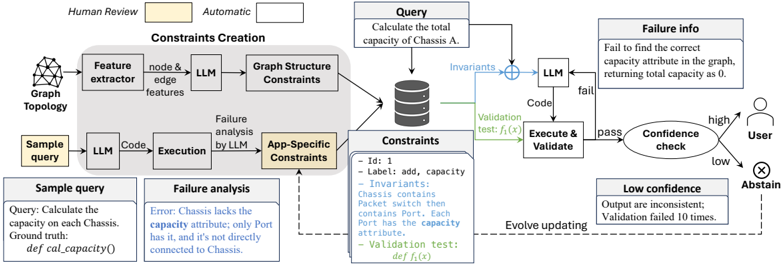
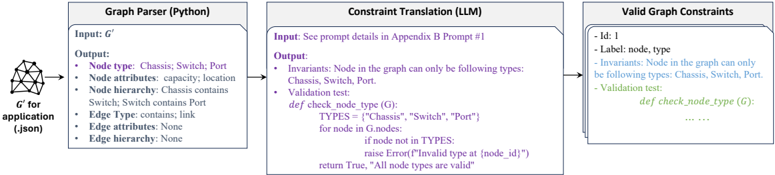
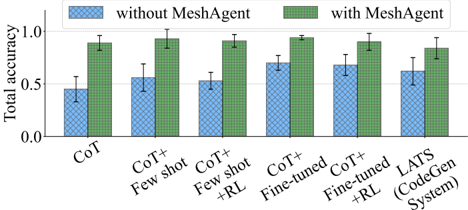
The emergence of large language models (LLMs) offers great promise for building domain-specific agents, but adapting them for network management remains challenging. To understand why, we conduct a case study on network management tasks and find that state-of-the-art specialization techniques rely heavily on extensive, high-quality task-specific data to produce precise solutions. However, real-world network queries are often diverse and unpredictable, making such techniques difficult to scale. Motivated by this gap, we propose MeshAgent, a new workflow that improves precision by extracting domain-specific invariants from sample queries and encoding them as constraints. These constraints guide LLM's generation and validation process, narrowing the search space and enabling low-effort adaptation. We evaluate our method across three network management applications and a user study involving industrial network professionals, showing that it complements existing techniques and consistently improves accuracy. We also introduce reliability metrics and demonstrate that our system is more dependable, with the ability to abstain when confidence is low. Overall, our results show that MeshAgent achieves over 95% accuracy, reaching 100% when paired with fine-tuned agents, and improves accuracy by up to 26% compared to baseline methods. The extraction of reusable invariants provides a practical and scalable alternative to traditional LLM specialization, enabling the development of more reliable agents for real-world network management.
Overview
The claims and statistics of this paper haven’t been checked yet.
Free: it reads the open-access text and checks the first 5 claims that cite a source we can check. Create a free account to check every claim.
Integrity signals
Registry
Cites
Statistics
Figures




Verification
Claims the paper makes
The claims and statistics of this paper haven’t been checked yet.
Free: it reads the open-access text and checks the first 5 claims that cite a source we can check. Create a free account to check every claim.
Claims other papers make about this one
Each is checked against this paper’s own text: does it say what the citing paper says it does?
The source backs part of the claim, not all of it — or backs it for a different population, condition or comparison.
In the citing paper
“This is useful only when the system constrains the output format and preserves provenance [92], [31].”
From Large language models for agentic NetOps and AIOps: Architectures, evaluation, and safety (2027) · cites this paper as [92]
Experimental — accuracy not yet measuredThe source backs part of the claim, not all of it — or backs it for a different population, condition or comparison.
In the citing paper
“An explanation only becomes useful when it includes a record of what was checked and the reasons for those checks [10], [92], [74].”
From Large language models for agentic NetOps and AIOps: Architectures, evaluation, and safety (2027) · cites this paper as [92]
Experimental — accuracy not yet measuredThe check wasn’t confident either way, so it gives no verdict — never disputed.
In the citing paper
“Recent RCA systems that use LLM tend to require that explanations are based on actual diagnostic evidence.”
From Large language models for agentic NetOps and AIOps: Architectures, evaluation, and safety (2027) · cites this paper as [92]
Experimental — accuracy not yet measured
Self-check
Percentages, sums and reported differences re-computed from the paper’s own numbers.
The self-check needs the paper’s full text.
Citations
Cites
LLaMA: Open and Efficient Foundation Language Models
Touvron, H., Lavril, T., Izacard, G., Martinet, X., Lachaux, M.-A., Lacroix, T., Rozière, B., Goyal, N., Hambro, E., Azhar, F., et al. (2023) · arXiv · doi:10.48550/arxiv.2302.13971 · Cited by 4,602
Large Language Models Encode Clinical Knowledge
Singhal, K., Azizi, S., Tu, T., Mahdavi, S. S., Wei, J., Chung, H. W., Scales, N., Tanwani, A., Cole-Lewis, H., Pfohl, S., et al. (2022) · arXiv · doi:10.48550/arxiv.2212.13138 · Cited by 4,083
Large language models encode clinical knowledge
Singhal, K., Azizi, S., Tu, T., Mahdavi, S. S., Wei, J., Chung, H. W., Scales, N., Tanwani, A., Cole-Lewis, H., Pfohl, S., et al. (2023) · Nature · doi:10.1038/s41586-023-06291-2 · Cited by 4,083
PaLM: Scaling Language Modeling with Pathways
Chowdhery, A., Narang, S., Devlin, J., Bosma, M., Mishra, G., Roberts, A., Barham, P., Chung, H. W., Sutton, C., Gehrmann, S., et al. (2022) · arXiv · doi:10.48550/arxiv.2204.02311 · Cited by 2,590
Lost in the Middle: How Language Models Use Long Contexts
Liu, N. F., Lin, K., Hewitt, J., Paranjape, A., Bevilacqua, M., Petroni, F., & Liang, P. (2023) · arXiv · doi:10.48550/arxiv.2307.03172 · Cited by 1,599
Sparks of Artificial General Intelligence: Early experiments with GPT-4
Bubeck, S., Chandrasekaran, V., Eldan, R., Gehrke, J., Horvitz, E., Kamar, E., Lee, P., Lee, Y. T., Li, Y., Lundberg, S., et al. (2023) · arXiv · doi:10.48550/arxiv.2303.12712 · Cited by 1,526
On Faithfulness and Factuality in Abstractive Summarization
Maynez, J., Narayan, S., Bohnet, B., & McDonald, R. (2020) · Proceedings of the 58th Annual Meeting of the Association for Computational Linguistics · doi:10.18653/v1/2020.acl-main.173 · Cited by 1,185
On Faithfulness and Factuality in Abstractive Summarization
Maynez, J., Narayan, S., Bohnet, B., & McDonald, R. (2020) · arXiv · doi:10.48550/arxiv.2005.00661 · Cited by 1,185
Reflexion: Language Agents with Verbal Reinforcement Learning
Shinn, N., Cassano, F., Berman, E., Gopinath, A., Narasimhan, K., & Yao, S. (2023) · arXiv · doi:10.48550/arxiv.2303.11366 · Cited by 1,087
Competition-level code generation with AlphaCode
Li, Y., Choi, D., Chung, J., Kushman, N., Schrittwieser, J., Leblond, R., Eccles, T., Keeling, J., Gimeno, F., Dal Lago, A., et al. (2022) · Science · doi:10.1126/science.abq1158 · Cited by 1,043
Competition-Level Code Generation with AlphaCode
Li, Y., Choi, D., Chung, J., Kushman, N., Schrittwieser, J., Leblond, R., Eccles, T., Keeling, J., Gimeno, F., Lago, A. D., et al. (2022) · arXiv · doi:10.48550/arxiv.2203.07814 · Cited by 1,043
Gemini: A Family of Highly Capable Multimodal Models
Gemini Team, Anil, R., Borgeaud, S., Alayrac, J.-B., Yu, J., Soricut, R., Schalkwyk, J., Dai, A. M., Hauth, A., Millican, K., et al. (2023) · arXiv · doi:10.48550/arxiv.2312.11805 · Cited by 990
Self-citationRetrieval-Augmented Generation for Large Language Models: A Survey
Gao, Y., Xiong, Y., Gao, X., Jia, K., Pan, J., Bi, Y., Dai, Y., Sun, J., Wang, M., & Wang, H. (2023) · arXiv · doi:10.48550/arxiv.2312.10997 · Cited by 876
Anil, R., Dai, A. M., Firat, O., Johnson, M., Lepikhin, D., Passos, A., Shakeri, S., Taropa, E., Bailey, P., Chen, Z., et al. (2023) · arXiv · doi:10.48550/arxiv.2305.10403 · Cited by 834
Self-citationTeaching Large Language Models to Self-Debug
Chen, X., Lin, M., Schärli, N., & Zhou, D. (2023) · arXiv · doi:10.48550/arxiv.2304.05128 · Cited by 812 · cited 1×
“Even advanced prompting fails on networking queries that require precise multi-step reasoning.”
Reciprocal rank fusion outperforms condorcet and individual rank learning methods
Cormack, G. V., Clarke, C. L. A., & Buettcher, S. (2009) · Proceedings of the 32nd international ACM SIGIR conference on Research and development in information retrieval · doi:10.1145/1571941.1572114 · Cited by 797
Can LLMs Express Their Uncertainty? An Empirical Evaluation of Confidence Elicitation in LLMs
Xiong, M., Hu, Z., Lu, X., Li, Y., Fu, J., He, J., & Hooi, B. (2023) · arXiv · doi:10.48550/arxiv.2306.13063 · Cited by 618
ReAct: Synergizing Reasoning and Acting in Language Models
Yao, S., Zhao, J., Yu, D., Du, N., Shafran, I., Narasimhan, K., & Cao, Y. (2022) · arXiv · doi:10.48550/arxiv.2210.03629 · Cited by 608
Training Verifiers to Solve Math Word Problems
Cobbe, K., Kosaraju, V., Bavarian, M., Chen, M., Jun, H., Kaiser, L., Plappert, M., Tworek, J., Hilton, J., Nakano, R., et al. (2021) · arXiv · doi:10.48550/arxiv.2110.14168 · Cited by 575
Learning from Few Examples: A Summary of Approaches to Few-Shot LearningPreprint
Parnami, A., & Lee, M. (2022) · arXiv (Cornell University) · doi:10.48550/arxiv.2203.04291 · Cited by 486
Program Synthesis with Large Language Models
Austin, J., Odena, A., Nye, M., Bosma, M., Michalewski, H., Dohan, D., Jiang, E., Cai, C., Terry, M., Le, Q., et al. (2021) · arXiv · doi:10.48550/arxiv.2108.07732 · Cited by 388
A survey on intent-based networking
Leivadeas, A., & Falkner, M. (2023) · IEEE Communications Surveys & Tutorials · doi:10.1109/comst.2022.3215919 · Cited by 326
Bai, Y., Kadavath, S., Kundu, S., Askell, A., Kernion, J., Jones, A., Chen, A., Goldie, A., Mirhoseini, A., & Kaplan, J. (2022) · arXiv (Cornell University) · doi:10.48550/arxiv.2212.08073 · Cited by 326
RAG vs Fine-tuning: Pipelines, Tradeoffs, and a Case Study on AgriculturePreprint
Balaguer, A. D. L., Benara, V., Cunha, R. L. F., Filho, R. D. M. E., Hendry, T., Holstein, D., Marsman, J., Mecklenburg, N., Malvar, S., Nunes, L. O., et al. (2024) · arXiv (Cornell University) · doi:10.48550/arxiv.2401.08406 · Cited by 307
Gemini 1.5: Unlocking multimodal understanding across millions of tokens of context
Gemini Team, Georgiev, P., Lei, V. I., Burnell, R., Bai, L., Gulati, A., Tanzer, G., Vincent, D., Pan, Z., Wang, S., et al. (2024) · arXiv · doi:10.48550/arxiv.2403.05530 · Cited by 306 · cited 1×
“Even advanced prompting fails on networking queries that require precise multi-step reasoning.”
DeepSeek-AI, Liu, A., Feng, B., Xue, B., Wang, B., Wu, B., Lu, C., Zhao, C., Deng, C., Zhang, C., et al. (2024) · arXiv · doi:10.48550/arxiv.2412.19437 · Cited by 294
Self-citationThe rise of traffic classification in IoT networks: A survey
Tahaei, H., Afifi, F., Asemi, A., Zaki, F., & Anuar, N. B. (2020) · Journal of Network and Computer Applications · doi:10.1016/j.jnca.2020.102538 · Cited by 275
Sonata: query-driven streaming network telemetry
Gupta, A., Harrison, R., Canini, M., Feamster, N., Rexford, J., & Willinger, W. (2018) · Proceedings of the 2018 Conference of the ACM Special Interest Group on Data Communication · doi:10.1145/3230543.3230555 · Cited by 273 · cited 1×
“• Constraint Guided Optimization for Reliable Code Generation. encode application-specific invariants (e.g., safety conditions, dependency rules) as constraints .”
Don't Hallucinate, Abstain: Identifying LLM Knowledge Gaps via Multi-LLM CollaborationPreprint
Feng, S., Shi, W., Wang, Y., et al. (2024) · Annual Meeting of the Association for Computational Linguistics · doi:10.48550/arxiv.2402.00367 · Cited by 250
Building Guardrails for Large Language ModelsPreprint
Dong, Y., Mu, R., Jin, G., Qi, Y., Hu, J., Zhao, X., Meng, J., Ruan, W., & Huang, X. (2024) · arXiv (Cornell University) · doi:10.48550/arxiv.2402.01822 · Cited by 214
NetConfEval: Can LLMs Facilitate Network Configuration?
Wang, C., Scazzariello, M., Farshin, A., Ferlin, S., Kostić, D., & Chiesa, M. (2024) · Proceedings of the ACM on Networking · doi:10.1145/3656296 · Cited by 206
Automatic Root Cause Analysis via Large Language Models for Cloud Incidents
Chen, Y., Xie, H., Ma, M., Kang, Y., Gao, X., Shi, L., Cao, Y., Gao, X., Fan, H., Wen, M., et al. (2024) · Proceedings of the Nineteenth European Conference on Computer Systems · doi:10.1145/3627703.3629553 · Cited by 190
Network monitoring using traffic dispersion graphs (tdgs)
Iliofotou, M., Pappu, P., Faloutsos, M., Mitzenmacher, M., Singh, S., & Varghese, G. (2007) · Proceedings of the 7th ACM SIGCOMM conference on Internet measurement · doi:10.1145/1298306.1298349 · Cited by 185 · cited 2×
“See Appendix A, Table 7 for more.”
Hallucination is Inevitable: An Innate Limitation of Large Language Models
Xu, Z., Jain, S., & Kankanhalli, M. (2024) · arXiv · doi:10.48550/arxiv.2401.11817 · Cited by 180
Flow Event Telemetry on Programmable Data Plane
Zhou, Y., Sun, C., Liu, H. H., Miao, R., Bai, S., Li, B., Zheng, Z., Zhu, L., Shen, Z., Xi, Y., et al. (2020) · ACM SIGCOMM Conference (SIGCOMM) · doi:10.1145/3387514.3406214 · Cited by 177 · cited 1×
“• Constraint Guided Optimization for Reliable Code Generation. encode application-specific invariants (e.g., safety conditions, dependency rules) as constraints .”
Self-citationNetLLM: adapting large language models for networking
Wu, D., Wang, X., Qiao, Y., Wang, Z., Jiang, J., Cui, S., & Wang, F. (2024) · Proceedings of the ACM SIGCOMM 2024 Conference · doi:10.1145/3651890.3672268 · Cited by 167
Long, S., Tan, J., Mao, B., Tang, F., Li, Y., Zhao, M., & Kato, N. (2025) · IEEE Communications Surveys & Tutorials · doi:10.1109/comst.2025.3526606 · Cited by 165
Data-efficient Fine-tuning for LLM-based Recommendation
Lin, X., Wang, W., Li, Y., Yang, S., Feng, F., Wei, Y., & Chua, T.-S. (2024) · arXiv · doi:10.48550/arxiv.2401.17197 · Cited by 165
Network monitoring: Present and future
Lee, S., Levanti, K., & Kim, H. S. (2014) · Computer Networks · doi:10.1016/j.comnet.2014.03.007 · Cited by 154 · cited 1×
“See Appendix A, Table 7 for more.”
Retrieval Augmented Code Generation and Summarization
Parvez, M. R., Ahmad, W., Chakraborty, S., Ray, B., & Chang, K.-W. (2021) · Findings of the Association for Computational Linguistics: EMNLP 2021 · doi:10.18653/v1/2021.findings-emnlp.232 · Cited by 141
A Survey of Hallucination in Large Foundation Models
Rawte, V., Sheth, A., & Das, A. (2023) · arXiv · doi:10.48550/arxiv.2309.05922 · Cited by 133
Prompting Is Programming: A Query Language for Large Language Models
Beurer-Kellner, L., Fischer, M., & Vechev, M. (2023) · Proceedings of the ACM on Programming Languages · doi:10.1145/3591300 · Cited by 117
Improving Code Generation by Training with Natural Language FeedbackPreprint
Chen, A. (2023) · arXiv.org · doi:10.48550/arxiv.2303.16749 · Cited by 100 · cited 1×
“Even advanced prompting fails on networking queries that require precise multi-step reasoning.”
CodeT: Code Generation with Generated Tests
Chen, B., Zhang, F., Nguyen, A., Zan, D., Lin, Z., Lou, J.-G., & Chen, W. (2022) · arXiv · doi:10.48550/arxiv.2207.10397 · Cited by 92
PROSPER: Extracting Protocol Specifications Using Large Language Models
Sharma, P., & Yegneswaran, V. (2023) · ACM Workshop on Hot Topics in Networks (HotNets) · doi:10.1145/3626111.3628205 · Cited by 79
"We Need Structured Output": Towards User-centered Constraints on Large Language Model Output
Liu, M. X., Liu, F., Fiannaca, A. J., Koo, T., Dixon, L., Terry, M., & Cai, C. J. (2024) · Extended Abstracts of the CHI Conference on Human Factors in Computing Systems · doi:10.1145/3613905.3650756 · Cited by 73
A Holistic View of AI-driven Network Incident Management
Hamadanian, P., Arzani, B., Fouladi, S., Kakarla, S. K. R., Fonseca, R., Billor, D., Cheema, A., Nkposong, E., & Chandra, R. (2023) · ACM Workshop on Hot Topics in Networks (HotNets) · doi:10.1145/3626111.3628176 · Cited by 67
CodexDB: synthesizing code for query processing from natural language instructions using GPT-3 codex
Trummer, I. (2022) · Proceedings of the VLDB Endowment · doi:10.14778/3551793.3551841 · Cited by 65
Visualizing big network traffic data using frequent pattern mining and hypergraphs
Glatz, E., Mavromatidis, S., Ager, B., & Dimitropoulos, X. A. (2013) · Computing · doi:10.1007/s00607-013-0282-8 · Cited by 60 · cited 1×
“See Appendix A, Table 7 for more.”
Enhancing Network Management Using Code Generated by Large Language Models
Mani, S. K., Zhou, Y., Hsieh, K., Segarra, S., Eberl, T., Azulai, E., Frizler, I., Chandra, R., & Kandula, S. (2023) · Proceedings of the 22nd ACM Workshop on Hot Topics in Networks · doi:10.1145/3626111.3628183 · Cited by 54
Self-citationNatural Language to Code Translation with Execution
Shi, F., Fried, D., Ghazvininejad, M., Zettlemoyer, L., & Wang, S. I. (2022) · arXiv · doi:10.48550/arxiv.2204.11454 · Cited by 49
Don’t Hallucinate, Abstain: Identifying LLM Knowledge Gaps via Multi-LLM Collaboration
Feng, S., Shi, W., Wang, Y., Ding, W., Balachandran, V., & Tsvetkov, Y. (2024) · Proceedings of the 62nd Annual Meeting of the Association for Computational Linguistics (Volume 1: Long Papers) · doi:10.18653/v1/2024.acl-long.786 · Cited by 40
Traffic dispersion graph based anomaly detection
Le, D. Q., Jeong, T., Roman, H. E., & Hong, J. W. (2011) · International Symposium on Information and Communication Technology · doi:10.1145/2069216.2069227 · Cited by 37
Adapting Foundation Models for Operator Data Analytics
Kotaru, M. (2023) · ACM Workshop on Hot Topics in Networks (HotNets) · doi:10.1145/3626111.3628191 · Cited by 32
Toward Reproducing Network Research Results Using Large Language Models
Xiang, Q., Lin, Y., Fang, M., Huang, B., Huang, S., Wen, R., Le, F., Kong, L., & Shu, J. (2023) · ACM Workshop on Hot Topics in Networks (HotNets) · doi:10.1145/3626111.3628189 · Cited by 22
Language Agent Tree Search Unifies Reasoning Acting and Planning in Language Models
Zhou, A., Yan, K., Shlapentokh-Rothman, M., Wang, H., & Wang, Y.-X. (2023) · arXiv · doi:10.48550/arxiv.2310.04406 · Cited by 18
Towards Interactive Research Agents for Internet Incident Investigation
Zhou, Y., Yu, N., & Liu, Z. (2023) · ACM Workshop on Hot Topics in Networks (HotNets) · doi:10.1145/3626111.3628212 · Cited by 16
Self-citationEnhancing Trust in LLMs: Algorithms for Comparing and Interpreting LLMs
Brown, N. B. (2024) · arXiv · doi:10.48550/arxiv.2406.01943 · Cited by 14
LLM Post-Training: A Deep Dive into Reasoning Large Language Models
Kumar, K., Ashraf, T., Thawakar, O., Anwer, R. M., Cholakkal, H., Shah, M., Yang, M.-H., Torr, P. H. S., Khan, F. S., & Khan, S. (2025) · arXiv · doi:10.48550/arxiv.2502.21321 · Cited by 10
Securing Public Clouds using Dynamic Communication Graphs
Mani, S. K., Hsieh, K., Segarra, S., Eberl, T., Chandra, R., Azulai, E., Annamalai, N., Bansal, D., & Kandula, S. (2023) · ACM Workshop on Hot Topics in Networks (HotNets) · doi:10.1145/3626111.3628198 · Cited by 1 · cited 1×
“Injecting network domain knowledge via prompting can degrade LLM performance when structural and latent dependencies are not explicitly modeled.”
Self-citationUnveiling the Landscape of LLM Deployment in the Wild: An Empirical StudyPreprint
Hou, X., Han, J., Zhao, Y., et al. (2025) · arXiv (Cornell University) · doi:10.48550/arxiv.2505.02502 · Cited by 1
Exploring LLM-based Agents for Root Cause AnalysisPreprint
Roy, D., Zhang, X., Bhave, R., et al. (2024) · arXiv (Cornell University) · doi:10.48550/arxiv.2403.04123
OpenAI, Achiam, J., Adler, S., Agarwal, S., Ahmad, L., Akkaya, I., Aleman, F. L., Almeida, D., Altenschmidt, J., Altman, S., et al. (2023) · arXiv · doi:10.48550/arxiv.2303.08774
Research works printed but not linked: 14
- Tom B. Brown Benjamin Mann Nick Ryder Melanie Subbiah Jared Kaplan Prafulla Dhariwal Arvind Neelakantan Pranav Shyam Girish Sastry Amanda Askell Sandhini Agarwal Ariel Herbert-Voss Gretchen Krueger Tom Henighan Rewon Child Aditya Ramesh Daniel M. Ziegler Jeffrey Wu Clemens Winter Christopher Hesse Mark Chen Eric Sigler Mateusz Litwin Scott Gray Benjamin Chess Jack Clark Christopher Berner Sam McCandlish Alec Radford Ilya Sutskever and Dario Amodei. 2020. Language Models are Few-Shot Learners. In Advances in Neural Information Processing Systems (NeurIPS).
- Edward J. Hu, Yelong Shen, Phillip Wallis, Zeyuan Allen-Zhu, Yuanzhi Li, Shean Wang, Lu Wang, and Weizhu Chen. 2022. LoRA: Low-Rank Adaptation of Large Language Models. In The Tenth International Conference on Learning Representations (ICLR).
- Yudong Huang, Hongyang Du, Xinyuan Zhang, Dusit Niyato, Jiawen Kang, Zehui Xiong, Shuo Wang, and Tao Huang. 2024. Large language models for networking: Applications, enabling techniques, and challenges. IEEE Network (2024).
- Arthur S Jacobs, Ricardo J Pfitscher, Rafael H Ribeiro, Ronaldo A Ferreira, Lisandro Z Granville, Walter Willinger, and Sanjay G Rao. 2021. Hey, lumi! using natural language for {intent-based} network management. In 2021 USENIX Annual Technical Conference (USENIX ATC 21). 625-639.
- Patrick Lewis, Ethan Perez, Aleksandra Piktus, Fabio Petroni, Vladimir Karpukhin, Naman Goyal, Heinrich Küttler, Mike Lewis, Wen-tau Yih, Tim Rocktäschel, et al., 2020. Retrieval-augmented generation for knowledge-intensive nlp tasks. Advances in Neural Information Processing Systems, Vol. 33 (2020), 9459-9474.
- Jeffrey C. Mogul, Drago Goricanec, Martin Pool, Anees Shaikh, Douglas Turk, Bikash Koley, and Xiaoxue Zhao. 2020. Experiences with Modeling Network Topologies at Multiple Levels of Abstraction. In USENIX Symposium on Networked Systems Design and Implementation (NSDI). https://www.usenix.org/conference/nsdi20/presentation/mogul
- Long Ouyang, Jeffrey Wu, Xu Jiang, Diogo Almeida, Carroll L. Wainwright, Pamela Mishkin, Chong Zhang, Sandhini Agarwal, Katarina Slama, Alex Ray, John Schulman, Jacob Hilton, Fraser Kelton, Luke Miller, Maddie Simens, Amanda Askell, Peter Welinder, Paul F. Christiano, Jan Leike, and Ryan Lowe. 2022. Training language models to follow instructions with human feedback. In Annual Conference on Neural Information Processing Systems (NeurIPS).
- Gartner Research. 2017. Innovation Insight: Intent-Based Networking Systems. https://www.gartner.com/en/documents/3599617.
- Haopei Wang, Anubhavnidhi Abhashkumar, Changyu Lin, Tianrong Zhang, Xiaoming Gu, Ning Ma, Chang Wu, Songlin Liu, Wei Zhou, Yongbin Dong, et al., 2024a. {NetAssistant}: Dialogue Based Network Diagnosis in Data Center Networks. In 21st USENIX Symposium on Networked Systems Design and Implementation (NSDI 24). 2011-2024.
- Jason Wei, Maarten Bosma, Vincent Y. Zhao, Kelvin Guu, Adams Wei Yu, Brian Lester, Nan Du, Andrew M. Dai, and Quoc V. Le. 2022a. Finetuned Language Models are Zero-Shot Learners. In The Tenth International Conference on Learning Representations (ICLR).
- Jason Wei, Xuezhi Wang, Dale Schuurmans, Maarten Bosma, Brian Ichter, Fei Xia, Ed H. Chi, Quoc V. Le, and Denny Zhou. 2022b. Chain-of-Thought Prompting Elicits Reasoning in Large Language Models. In Advances in Neural Information Processing Systems (NeurIPS). http://papers.nips.cc/paper_files/paper/2022/hash/9d5609613524ecf4f15af0f7b31abca4-Abstract-Conference.html
- Zihao Xu, Yi Liu, Gelei Deng, Yuekang Li, and Stjepan Picek. 2024b. LLM Jailbreak Attack versus Defense Techniques-A Comprehensive Study. arXiv preprint arXiv:2402.13457 (2024). · arXiv
- Shunyu Yao, Dian Yu, Jeffrey Zhao, Izhak Shafran, Tom Griffiths, Yuan Cao, and Karthik Narasimhan. 2024. Tree of thoughts: Deliberate problem solving with large language models. Advances in Neural Information Processing Systems, Vol. 36 (2024).
- Yajie Zhou, Jiajun Ruan, Eric S Wang, Sadjad Fouladi, Francis Y Yan, Kevin Hsieh, and Zaoxing Liu. 2025. NetPress: Dynamically Generated LLM Benchmarks for Network Applications. arXiv preprint arXiv:2506.03231 (2025). · arXiv
Cited by
Large language models for agentic NetOps and AIOps: Architectures, evaluation, and safety
Bilal, M., Crowcroft, J., Wang, R., Xu, X., & Dustdar, S. (2027) · Computer Science Review · doi:10.1016/j.cosrev.2026.101075 · Cited by 10
“Agentic NetOps and AIOps systems differ mainly in their permitted authority [55], [67], [76].”
InfluentialTowards fully autonomous network management: A survey on LLM-based Multi-Agent Systems
Kim, K.-H., Park, C., Lee, H., Park, C., Kim, T., Choi, M.-J., & Kim, E. (2026) · ICT Express · doi:10.1016/j.icte.2026.07.003 · Cited by 6
Toward Forecast-Aware LLM Agents for Network Management
Choi, J., Jung, T., Kim, K. S., Na, J., & Hong, E. (2026) · International Conference on Artificial Intelligence in Information and Communication (ICAIIC) · doi:10.1109/icaiic68212.2026.11454207
“…delineates a clear limitation: certain operational tasks, such as flow-level performance monitoring that requires statistical analysis over time-series measurements (e.g., latency, jitter, and loss), are better handled by signal-processing or time-series models than by graph-oriented reasoning [7].”
de Freitas, J. P., & Vieira, F. H. T. (2026) · Anais do Workshop de Testes e Tolerância a Falhas (WTF) · doi:10.5753/wtf.2026.24133
“Zhou et al. (2025) propuseram o MeshAgent para datacenter, cuja variabilidade de enlace é ordens de magnitude menor que a observada em LoRa.”
Framework para Verificação e Validação Experimental de Configurações de Rede Geradas por LLMs
Colombo, C. D. S., & Martinello, M. (2026) · doi:10.5753/sbrc.2026.19857
Metadata
- Authors
- Zhou, Y., Hsieh, K., Mani, S. K., Kandula, S., & Liu, Z.
- Affiliations
- University of Maryland, College Park (US)
- Microsoft (United States) (US)
- Amazon (United States) (US)
- Venue
- Proceedings of the ACM on Measurement and Analysis of Computing Systems
- Published
- 2025-12
- Volume
- 9
- Issue
- 3
- Pages
- 1-36
- ISSN
- 2476-1249 (ISSN-L)
- OpenAlex
- W4416927413
- Cited by
- 7
- References
- 32
- Citations by year
- 2026: 7
- FWCI
- 2.94
- Type
- journal article
- Language
- en
- Open access
- hybrid
- doi.org
- Licence
- cc-by
- Locations
- Proceedings of the ACM on Measurement and Analysis of Computing Systems (publishedVersion, cc-by)
- ACM SIGMETRICS International Conference on Measurement and Modeling of Computer Systems (SIGMETRICS) (publishedVersion, cc-by)
- ACM SIGMETRICS Performance Evaluation Review (publishedVersion, cc-by)
- Funders
- National Science Foundation (2431093, 2415754, 2415758)
- Topics
- Physical Sciences › Computer Science › Computer Networks and Communications › Mobile Agent-Based Network Management
- Physical Sciences › Computer Science › Computer Networks and Communications › Software-Defined Networks and 5G
- Physical Sciences › Computer Science › Artificial Intelligence › Topic Modeling
- Keywords
- large language models, network management, LLM agents, query validation, abstention
About these checks
Registry, retraction, Cites and statistics results are computed, not judged, with one exception: a printed reference that no index lists is read once by a model before it counts as a citation error. Claims are extracted by a model and kept only when their quote appears verbatim in the text; each cited source is then checked, with a model’s help, for whether it says what the claim relies on. Those verdicts can be wrong — read the claim’s quote and the cited source before relying on one.
Statistics and arithmetic are recomputed, not judged.
Confidence bands are shown only for fields calibrated on our annotated test set. None is calibrated yet, so no band is shown.
What counts as a claim ›How we measure confidence ›How we check this ›
Are you an author, or do you see a problem with this page? Request a review
Data sources
Bibliographic data: Semantic Scholar, OpenAlex, Crossref.
Contains information from the Semantic Scholar Academic Graph Datasets, made available under the ODC Attribution License (ODC-BY 1.0).
Semantic Scholar’s data is described in: Kinney, R., et al. (2023). The Semantic Scholar Open Data Platform. arXiv:2301.10140.
