

Frontiers of Carbonate Clumped Isotope Thermometry
Open accessThe DOI matches its Crossref record; 193 of the 193 references it cites were found in a registry or an index; 43 of the 142 sources its claims cite were checked for support.
Abstract
Carbonate minerals contain stable isotopes of carbon and oxygen with different masses whose abundances and bond arrangement are governed by thermodynamics. The clumped isotopic value Δi is a measure of the temperature-dependent preference of heavy C and O isotopes to clump, or bond with or near each other, rather than with light isotopes in the carbonate phase. Carbonate clumped isotope thermometry uses Δi values measured by mass spectrometry (Δ47, Δ48) or laser spectroscopy (Δ638) to reconstruct mineral growth temperature in surface and subsurface environments independent of parent water isotopic composition. Two decades of analytical and theoretical development have produced a mature temperature proxy that can estimate carbonate formation temperatures from 0.5 to 1,100°C, with up to 1–2°C external precision (2 standard error of the mean). Alteration of primary environmental temperatures by fluid-mediated and solid-state reactions and/or Δi values that reflect nonequilibrium isotopic fractionations reveal diagenetic history and/or mineralization processes. Carbonate clumped isotope thermometry has contributed significantly to geological and biological sciences, and it is poised to advance understanding of Earth's climate system, crustal processes, and growth environments of carbonate minerals. ▪Clumped heavy isotopes in carbonate minerals record robust temperatures and fluid compositions of ancient Earth surface and subsurface environments.▪Mature analytical methods enable carbonate clumped Δ47, Δ48, and Δ638 measurements to address diverse questions in geological and biological sciences.▪These methods are poised to advance marine and terrestrial paleoenvironment and paleoclimate, tectonics, deformation, hydrothermal, and mineralization studies.
Overview
CoChat Summary
TL;DR
This review synthesizes two decades of carbonate clumped isotope thermometry, now a mature proxy that reconstructs carbonate formation temperatures independent of parent water δ¹⁸O from 0.5 to 1,100°C with up to 1–2°C external precision (2 standard error of the mean) under extensive replication. It covers analytical methods, standardization, controls on isotopic clumping, and applications across paleoclimate, tectonics, diagenesis, and CaCO₃–DIC–H₂O system studies.
Key findings
- Carbonate clumped isotope thermometry can estimate carbonate formation temperatures from 0.5 to 1,100°C, with up to 1–2°C external precision (2 standard error of the mean) for Earth surface temperatures (<40°C) given sufficient replication or averaging.
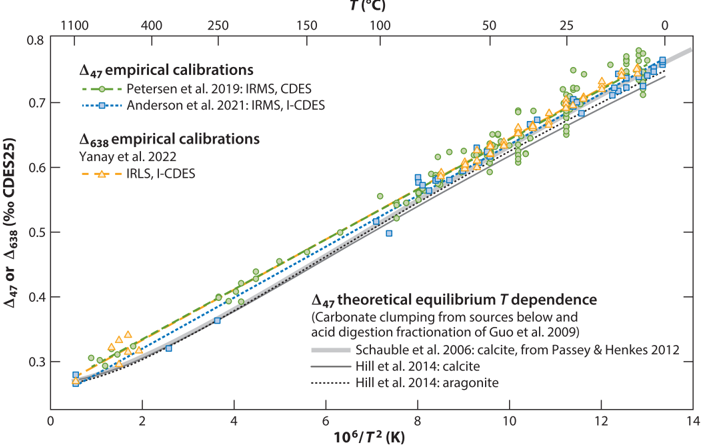
- Two composite T–Δ₄₇ calibrations are highlighted: Petersen et al. (2019), CDES-referenced, n = 132 samples (>1,200 replicate analyses) from 11 laboratories spanning 4–800°C; and Anderson et al. (2021), I-CDES-referenced, n = 91 samples (>1,400 replicates) from 5 laboratories spanning 0.5–1,100°C. These calibrations are offset by 3°C near 25°C and 7°C near 100°C.
- Δ₄₇ varies ∼0.005‰/°C near 25°C, compared to ∼0.22‰/°C for δ¹⁸O; typical single-analysis uncertainties of 0.010‰ and 0.05‰, respectively, mean Δ₄₇ thermometry requires routine replication (at least three times, sometimes >20 times for microsample methods).
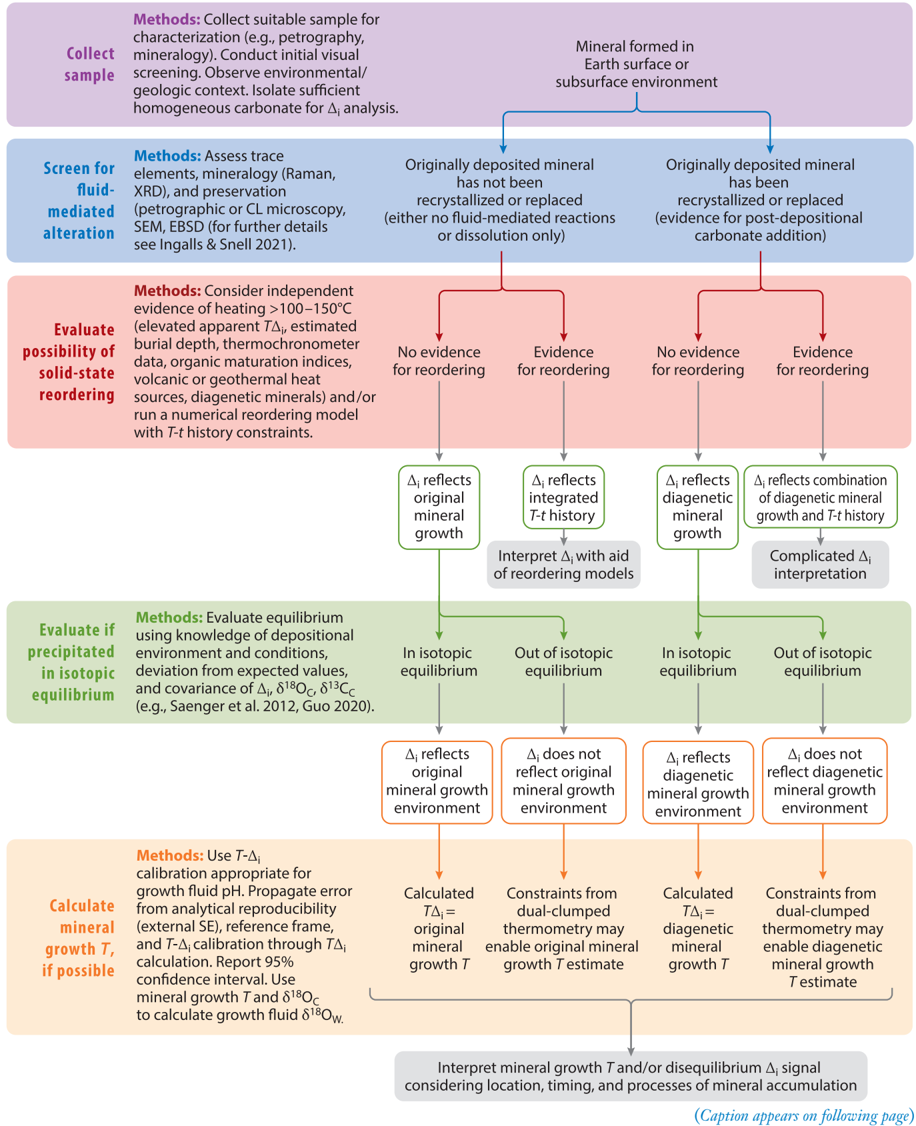
- Alteration by fluid-mediated and solid-state reactions, disequilibrium precipitation, and pH effects can overprint or shift Δ₄₇; solid-state bond reordering becomes important above 100–150°C, and pH >9.5 causes Δ₄₇ to deviate from known T–Δ₄₇ relationships. Paired Δ₄₇–Δ₄₈ measurements can reveal disequilibrium and, in some cases, allow correction.
Methods
- This is a review and synthesis, not a primary research study; it builds on previous reviews and the clumped isotope literature, with a Supplemental Companion providing historical context, calculations, and sources.
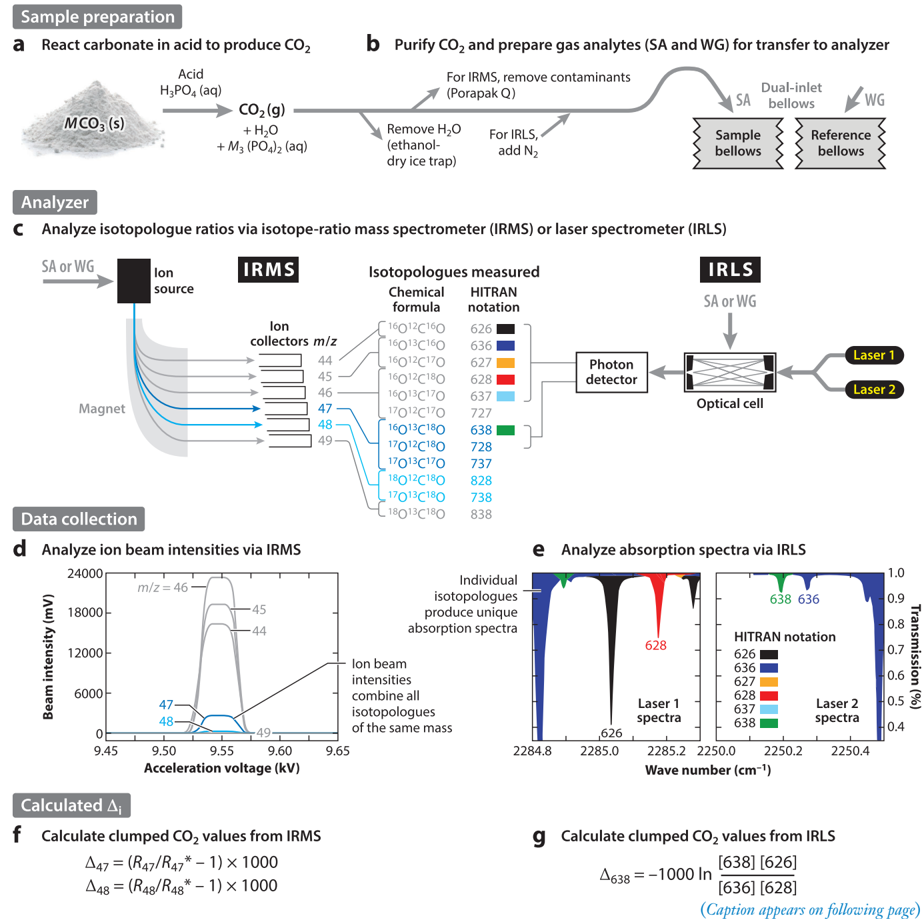
- It describes and compares analytical techniques—isotope-ratio mass spectrometry (IRMS) and isotope-ratio laser spectroscopy (IRLS)—along with sample preparation, purification, standardization to CDES and I-CDES reference frames, and conversion of Δᵢ values to temperature.
- It compares theoretical equilibrium calculations with empirical T–Δ₄₇ and T–Δ₆₃₈ calibrations and discusses applications, controls, and future opportunities; no new primary sample collection or measurements are reported.
Limitations
- The paper states that Δ₄₇ is relatively insensitive to temperature, so single-sample temperature uncertainty is higher than for δ¹⁸O thermometry despite lower Δ₄₇ analytical uncertainty; extensive replication is needed, and sample size requirements are orders of magnitude larger than for traditional carbon and oxygen isotope measurement.
- The paper notes that the two leading T–Δ₄₇ calibrations are offset by 3°C near 25°C and 7°C near 100°C, and that the I-CDES carbonate-based reference frame currently spans a smaller range of bulk compositions and Δᵢ values than equilibrated gases, which can lead to larger propagated errors.
- Evident from the text: as a review, it does not provide new empirical validation; conclusions depend on cited literature and community calibration choices, and some areas—such as paired Δ₄₇–Δ₄₈ disequilibrium correction and laser-based Δ₆₃₈ analysis—are described as having only a few papers to date or being in early stages of development.
Model-written summary. Check it against the paper before relying on it.
Integrity signals
Registry
Cites
Statistics
Figures
Verification
Claims the paper makes
33 Valid · 9 Not valid · 43 Not checked · 83 Own results and interpretations
Some cited sources support this claim and some don’t — read each source’s verdict below.
In the paper
“This means that in extreme pH environments (such as where [CO 3 2-] is dominant, pH > 9.5), shifts in the chemical and isotopic equilibrium of the H 2 O-DIC-CaCO 3 system cause carbonates to follow a different equilibrium Ti relationship (Tripati et al. 2015, Watkins & Hunt 2015).”
§ Frontiers of Carbonate Clumped Isotope Thermometry > 4.1. (Dis)equilibrium Carbonate Precipitation and pH Effects
What the sources say
- Partly supportedcites Tripati et al. 2015 matched to “Beyond temperature: clumped isotope signatures in dissolved inorganic carbon species and the influence of solution chemistry on carbonate mineral composition” (2015) sourceExperimental — accuracy not yet measured
Section 3.2 says pH changes the equilibrium isotopic composition of the DIC pool, and the Abstract says rapidly growing carbonates may record a DIC species’ signature. But section 3.2 explicitly says equilibrium mineral compositions depend on temperature, not pH. The claim omits the rapid-growth qualification and incorrectly presents the resulting carbonate signature as a different mineral equilibrium temperature relationship; section 2.2.1 also places roughly equal bicarbonate and carbonate concentrations at pH 10.2, rather than carbonate dominance throughout pH > 9.5. (LLM, conf=0.86)
- Disputedcites Watkins & Hunt 2015 matched to “A process-based model for non-equilibrium clumped isotope effects in carbonates” (2015) sourceExperimental — accuracy not yet measured
The Figure 5 caption (section 7 Summary; page unavailable) describes pH-dependent clumped-isotope compositions as a model of non-equilibrium calcite, with apparent temperatures calculated using an equilibrium calcite calibration. Section 6.4.1 likewise describes pH and growth-rate effects as possible offsets from the true equilibrium value. The paper does not say that high pH gives carbonates a different equilibrium temperature–clumped-isotope relationship; it distinguishes such offsets from equilibrium. (LLM, conf=0.85)
Checked by a reasoning model — may be wrong.
plainstates a cause- Asserted: passes — The authors put it forward as true.
- Checkable: passes — It can be checked against evidence.
- Load-bearing: passes — The paper’s conclusions depend on it.
- Based: passes — The paper gives a reason why it holds.
- Partly supported
The cited sources support only part of this claim — read each source’s verdict below.
In the paper
“Up to 1-2°C external precision (2 standard error of the mean) can be achieved with extensive replication (e.g., Petersen et al. 2019).”
§ Frontiers of Carbonate Clumped Isotope Thermometry > 3.6. Uncertainty in a T 47 Estimate
What the sources say
- Partly supportedcites Petersen et al. 2019 matched to “Effects of Improved 17 O Correction on Interlaboratory Agreement in Clumped Isotope Calibrations, Estimates of Mineral‐Specific Offsets, and Temperature Dependence of Acid Digestion Fractionation” (2019) sourceExperimental — accuracy not yet measured
Section 2.3 (p. 10) states that external standard error decreases with the square root of the number of replicates, and section 3.9 (pp. 20–21) discusses how replication affects reconstructed-temperature error. But the paper does not establish the claimed 1–2°C precision at 2 standard errors; it says temperature error varies with formation temperature and also discusses calibration uncertainty. (LLM, conf=0.84)
plainstates a cause- Asserted: passes — The authors put it forward as true.
- Checkable: passes — It can be checked against evidence.
- Load-bearing: unclear — It is unclear whether the paper’s conclusions depend on it.
- Based: passes — The paper gives a reason why it holds.
- Partly supported
Every source the paper cites for this claim was checked and supports it.
In the paper
“With sufficient reference frame measurements, i and temperature differences between sample unknowns with similar bulk isotopic compositions that were analyzed together may be more precisely constrained than their absolute i and temperature values (Daëron 2021).”
§ Frontiers of Carbonate Clumped Isotope Thermometry > 3.6. Uncertainty in a T 47 Estimate
What the sources say
- Supportedcites Daëron 2021 matched to “Full propagation of analytical uncertainties in Δ47 measurements” (2021) source
Section 3.3 (page not given) says standardization errors are correlated between samples and that errors on Δ47 differences between samples of similar compositions are largely unaffected by standardization errors when the samples are analyzed in the same session. Section 1 (page not given) explains that carbonate Δ47 constrains temperature, supporting the temperature implication of the paraphrase. (LLM, conf=0.90)
hedgedstates a possible cause- Asserted: passes — The authors put it forward as true.
- Checkable: passes — It can be checked against evidence.
- Load-bearing: unclear — It is unclear whether the paper’s conclusions depend on it.
- Based: passes — The paper gives a reason why it holds.
- Supported
The sources with a verdict support this claim; the rest weren’t checked yet, have no full text we could read, or their verdicts aren’t rated yet.
In the paper
“Recently, IRLS systems have been used to analyze the abundance of clumped isotopologues in CO 2 (Prokhorov et al. 2019, Wang et al. 2020), including CO 2 derived from MCO 3 (Yanay et al. 2022).”
§ Frontiers of Carbonate Clumped Isotope Thermometry > 3.3. Clumped Isotope Analysis by Isotope-Ratio Laser Spectroscopy
What the sources say
- Not checked — no full text of the sourcecites Prokhorov et al. 2019 matched to “Laser Absorption Spectroscopy of Rare and Doubly Substituted Carbon Dioxide Isotopologues” (2019) source
- Could not verifycites Wang et al. 2020 matched to “Clumped isotope thermometry of modern and fossil snail shells from the Himalayan-Tibetan Plateau: Implications for paleoclimate and paleoelevation reconstructions” (2021) sourceExperimental — accuracy not yet measured
Our copy of Wang et al. (2021, GSA Bulletin) never mentions IRLS or any laser-based system for measuring clumped isotopologue abundances in CO2; the only analytical discussion is of standard gas-source isotope ratio mass spectrometry (METHODS: carbonate reacted with H3PO4 at 90 °C, CO2 purified, 'Mass 44-49 isotopologue ratios were measured using a Thermo MAT 253 mass spectrometer', with re-analyses at UM and UCLA on the same style of system). The Introduction and Limitations and Future Direction sections treat clumped isotope thermometry and note only that 'Efforts are also needed to improve the precision and accuracy of clumped isotope analysis', without attributing that to a spectroscopic technique. Searches for IRLS, laser absorption/infrared spectroscopy, and alternative isotopologue measurement techniques returned only these mass-spectrometry passages, so the paper neither supports nor contradicts the attributed point. (LLM, conf=0.68)
- Supportedcites Yanay et al. 2022 matched to “Rapid and precise measurement of carbonate clumped isotopes using laser spectroscopy” (2022) source
The Introduction describes TILDAS as an infrared laser spectrometer that measures clumped CO2 isotopologues and explicitly distinguishes this study’s carbonate-derived CO2 from earlier cylinder-gas work. The Results (“Sample size and analytical throughput”) report 1,245 carbonate analyses, including acid digestion. These passages support the portion of the sentence attributed to Yanay et al.; the copy does not use the notation MCO3, but it describes carbonate-derived CO2. (LLM, conf=0.93)
plain- Asserted: passes — The authors put it forward as true.
- Checkable: passes — It can be checked against evidence.
- Load-bearing: unclear — It is unclear whether the paper’s conclusions depend on it.
- Based: passes — The paper gives a reason why it holds.
The cited sources support only part of this claim — read each source’s verdict below.
In the paper
“Clumped isotope data are increasingly normalized to carbonate reference materials for which community-accepted 47 values are defined and ultimately referenced back to the gas-based CDES reference frame”
§ Frontiers of Carbonate Clumped Isotope Thermometry > 3.4. Standardization of Bulk Isotope and Clumped Isotope i Values
What the sources say
- Partly supportedcites Bernasconi et al. 2018 matched to “Reducing uncertainties in carbonate clumped isotope analysis through consistent carbonate-based standardization” (2018) sourceExperimental — accuracy not yet measured
The Absolute Reference Frame section identifies CDES as a gas-based reference frame, and the paper describes using carbonate standards to normalize data to it. But the Outlook says community-accepted Δ47 values for the ETH standards were still a goal of an interlaboratory effort, not values already established. The paper therefore does not fully support that part of the claim. (LLM, conf=0.88)
- Partly supportedcites Bernasconi et al. 2021 matched to “InterCarb: A Community Effort to Improve Interlaboratory Standardization of the Carbonate Clumped Isotope Thermometer Using Carbonate Standards” (2021) sourceExperimental — accuracy not yet measured
The Conclusions propose carbonate reference materials with community-accepted Δ47 values, and “Reporting Data Normalized to Carbonates” says those values are anchored to the gas-based CDES scale through heated- and equilibrated-gas measurements. The Introduction says carbonate standards were already used in many laboratories, but the paper does not establish that normalization to the newly defined consensus values was increasingly common. (LLM, conf=0.84)
plainstates an association- Asserted: passes — The authors put it forward as true.
- Checkable: passes — It can be checked against evidence.
- Load-bearing: unclear — It is unclear whether the paper’s conclusions depend on it.
- Based: passes — The paper gives a reason why it holds.
- Partly supported
84 more claims · 19 with their cited sources checked
Create a free account to see all 168 claims and to verify the 8 references still open.
- It may state two separate claims as one. 51
- Probably not a substantial claim. 34
Self-check
Percentages, sums and reported differences re-computed from the paper’s own numbers.
Each contradiction between two passages listed here was confirmed by an independent check.
Rated major: it would touch a result — a value a result rests on, reported and recomputed p-values on opposite sides of the significance level, two passages that conflict with no sign which is right, or a cited work retracted before this paper was published.
In the paper
§ Frontiers of Carbonate Clumped Isotope Thermometry > 3.1. Converting MCO 3 to Pure CO 2
“This acid digestion fractionation produces CO 2 with δ 18 O and clumped isotope values that are isotopically lighter than, but proportional to, those in the reactant carbonate”
§ Frontiers of Carbonate Clumped Isotope Thermometry > 3.4. Standardization of Bulk Isotope and Clumped Isotope i Values
“Similar to δ 18 O, CO 2 produced by acid digestion of MCO 3 has a higher clumped isotopic composition than the carbonate reactant because bonds containing 18 O are stronger and less likely to be broken.”
Rated minor: it would not touch a result — a value no result rests on, a p-value that stays on the same side of the significance level, or a conflict that is clerical, resolved elsewhere in the paper, or outside its own findings.
In the paper
§ Frontiers of Carbonate Clumped Isotope Thermometry > 2.2. Carbonate Clumped Isotope Geothermometry
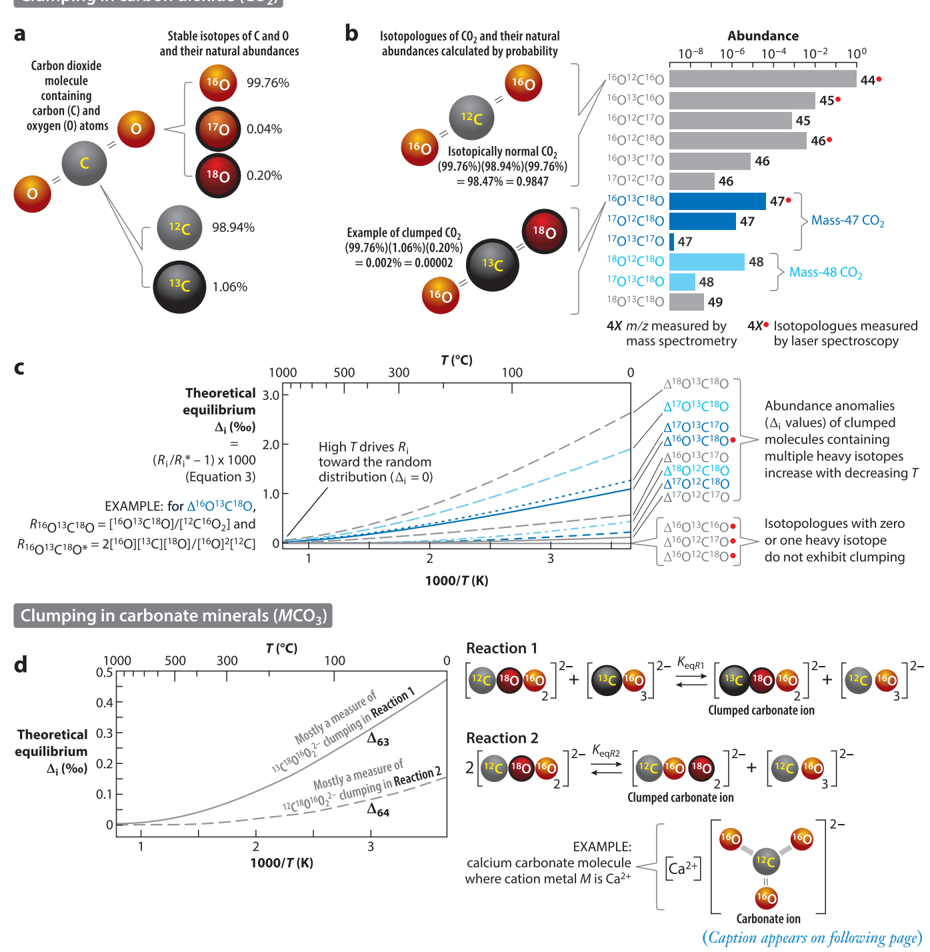
“Stated another way, the equilibrium constants, K eq (defined as follows), of these reactions are proportional to temperature”
§ Frontiers of Carbonate Clumped Isotope Thermometry > 2.2. Carbonate Clumped Isotope Geothermometry
“At thermodynamic equilibrium, decreasing temperature drives these reactions to the right, increasing the abundance of clumped ions relative to singly substituted ions (Figure 1c,d).”
Citations
Cites
Trends, Rhythms, and Aberrations in Global Climate 65 Ma to Present
Zachos, J., Pagani, M., Sloan, L., Thomas, E., & Billups, K. (2001) · Science · doi:10.1126/science.1059412 · Cited by 10,458
On the Isotopic Chemistry of Carbonates and a Paleotemperature Scale
McCrea, J. M. (1950) · The Journal of Chemical Physics · doi:10.1063/1.1747785 · Cited by 3,742
Oxygen and carbon isotope fractionation in biogenic aragonite: Temperature effects
Grossman, E. L., & Ku, T.-L. (1986) · Chemical Geology: Isotope Geoscience section · doi:10.1016/0168-9622(86)90057-6 · Cited by 1,176
Bemis, B. E., Spero, H. J., Bijma, J., & Lea, D. W. (1998) · Paleoceanography · doi:10.1029/98pa00070 · Cited by 1,108
13C–18O bonds in carbonate minerals: a new kind of paleothermometer
Ghosh, P., Adkins, J., Affek, H., Balta, B., Guo, W., Schauble, E. A., Schrag, D., & Eiler, J. M. (2006) · Geochimica et Cosmochimica Acta · doi:10.1016/j.gca.2005.11.014 · Cited by 914
“Clumped-isotope” geochemistry—The study of naturally-occurring, multiply-substituted isotopologues
Eiler, J. M. (2007) · Earth and Planetary Science Letters · doi:10.1016/j.epsl.2007.08.020 · Cited by 774
Past climates inform our future
Tierney, J. E., Poulsen, C. J., Montañez, I. P., Bhattacharya, T., Feng, R., Ford, H. L., Hönisch, B., Inglis, G. N., Petersen, S. V., Sagoo, N., et al. (2020) · Science · doi:10.1126/science.aay3701 · Cited by 662
Self-citationDefining an absolute reference frame for ‘clumped’ isotope studies of CO2
Dennis, K. J., Affek, H. P., Passey, B. H., Schrag, D. P., & Eiler, J. M. (2011) · Geochimica et Cosmochimica Acta · doi:10.1016/j.gca.2011.09.025 · Cited by 627
CARBONATE-WATER ISOTOPIC TEMPERATURE SCALE
EPSTEIN, S., BUCHSBAUM, R., LOWENSTAM, H., & UREY, H. C. (1951) · Geological Society of America Bulletin · doi:10.1130/0016-7606(1951)62[417:cits]2.0.co;2 · Cited by 626
The Magnitude and Duration of Late Ordovician–Early Silurian Glaciation
Finnegan, S., Bergmann, K., Eiler, J. M., Jones, D. S., Fike, D. A., Eisenman, I., Hughes, N. C., Tripati, A. K., & Fischer, W. W. (2011) · Science · doi:10.1126/science.1200803 · Cited by 573
Research works printed but not linked: 4
- 93. Kim ST, O'Neil JR. 1997. Temperature dependence of 18 O. Geochim. Cosmochim. Acta 61:34613475
- 175. Yeung LY, Young ED, Schauble EA. 2012. Measurements of 18 O 18 O and 17 O 18 O in the atmosphere and the role of isotope-exchange reactions. J. Geophys. Res. 117(D18):D18306
- 178. Zeebe RE, Wolf-Gladrow D. 2001. CO 2 in Seawater: Equilibrium, Kinetics, Isotopes. Amsterdam: Elsevier
- 191. Related Articles From the Annual Review of Astronomy and Astrophysics, Volume 60 (2022) Atmospheres of Rocky Exoplanets Robin Wordsworth and Laura Kreidberg From the Annual Review of Chemical and Biomolecular Engineering, Volume 13 (2022) Direct Air Capture of CO 2 Using Solvents Radu Custelcean Technological Options for Direct Air Capture: A Comparative Process Engineering Review Xiaowei Wu, Ramanan Krishnamoorti, and Praveen Bollini From the Annual Review of Ecology, Evolution, and Systematics, Volume 53 (2022) Evolutionary Ecology of Fire Jon E. Keeley and Juli G. Pausas Integrating Fossil Observations Into Phylogenetics Using the Fossilized Birth-Death Model April M. Wright, David W. Bapst, Joëlle Barido-Sottani, and Rachel C.M. Warnock The Macroevolutionary History of Bony Fishes: A Paleontological View Matt Friedman From the Annual Review of Environment and Resources, Volume 47 (2022) The Ocean Carbon Cycle Tim DeVries Permafrost and Climate Change: Carbon Cycle Feedbacks From the Warming Arctic Edward A.G. Schuur, Benjamin W. Abbott, Roisin Commane, Jessica Ernakovich, Eugenie Euskirchen, Gustaf Hugelius, Guido Grosse, Miriam Jones, Charlie Koven, Victor Leshyk, David Lawrence, Michael M. Loranty, Marguerite Mauritz, David Olefeldt, Susan Natali, Heidi Rodenhizer, Verity Salmon, Christina Schädel, Jens Strauss, Claire Treat, and Merritt Turetsky xii Remote Sensing the Ocean Biosphere Sam Purkis and Ved Chirayath From the Annual Review of Fluid Mechanics, Volume 55 (2023) Submesoscale Dynamics in the Upper Ocean John R. Taylor and Andrew F. Thompson Fluid Dynamics of Polar Vortices on Earth, Mars, and Titan Darryn W. Waugh Icebergs Melting Claudia Cenedese and Fiamma Straneo The Fluid Mechanics of Deep-Sea Mining Thomas Peacock and Raphael Ouillon Turbulent Rotating Rayleigh-Bénard Convection Robert E. Ecke and Olga Shishkina From the Annual Review of Marine Science, Volume 15 (2023) From Stamps to Parabolas S. George Philander Sociotechnical Considerations About Ocean Carbon Dioxide Removal Sarah R. Cooley, Sonja Klinsky, David R. Morrow, and Terre Satterfield Nuclear Reprocessing Tracers Illuminate Flow Features and Connectivity Between the Arctic and Subpolar North Atlantic Oceans Núria Casacuberta and John N. Smith The Arctic Ocean's Beaufort Gyre Mary-Louise Timmermans and John M. Toole Global Quaternary Carbonate Burial: Proxy-and Model-Based Reconstructions and Persisting Uncertainties Madison Wood, Christopher T. Hayes, and Adina Paytan Quantifying the Ocean's Biological Pump and Its Carbon Cycle Impacts on Global Scales David A. Siegel, Timothy DeVries, Ivona Cetinić, and Kelsey M. Bisson Novel Insights into Marine Iron Biogeochemistry from Iron Isotopes Jessica N. Fitzsimmons and Tim M. Conway Insights from Fossil-Bound Nitrogen Isotopes in Diatoms, Foraminifera, and Corals Rebecca S. Robinson, Sandi M. Smart, Jonathan D. Cybulski, Kelton W. McMahon, Basia Marcks, and Catherine Nowakowski Prokaryotic Life in the Deep Ocean's Water Column Gerhard J. Herndl, Barbara Bayer, Federico Baltar, and Thomas Reinthaler Lipid Biogeochemistry and Modern Lipidomic Techniques Bethanie R. Edwards From the Annual Review of Materials Research, Volume 52 (2022) Biomineralized Materials for Sustainable and Durable Construction Danielle N. Beatty, Sarah L. Williams, and Wil V. Srubar III Brittle Solids: From Physics and Chemistry to Materials Applications Brian R. Lawn and David B. Marshall Material Flows and Efficiency Jonathan M. Cullen and Daniel R. Cooper Architectural Glass Sheldon M. Wiederhorn and David R. Clarke
Cited by
Kelson, J. R., Huth, T. E., Passey, B. H., Levin, N. E., Petersen, S., Ballato, P., Beverly, E. J., Breecker, D. O., Hoke, G. D., Hudson, A. M., et al. (2023) · Geochimica et Cosmochimica Acta · doi:10.1016/j.gca.2023.06.034 · Cited by 45
Self-citationRobust land surface temperature record for north China over the past 21,000 years
Guo, J., Ziegler, M., Wanders, N., Vreeken, M., Yin, Q., Lu, H., Fuchs, L., Dong, J., Sun, Y., & Peterse, F. (2024) · Science Advances · doi:10.1126/sciadv.adj4800 · Cited by 39
“The ∆ 47 yields the absolute temperature at which the carbonate was formed, independent of the δ 18 O composition of the source water ( 49 ).”
BackgroundHoldsworth, C. M., John, C. M., Snæbjörnsdóttir, S. Ó., Johnson, G., Sigfússon, B., Leslie, R., Haszeldine, R. S., & Gilfillan, S. M. V. (2024) · Applied Geochemistry · doi:10.1016/j.apgeochem.2024.105925 · Cited by 32
A robust methodology for triple (∆47, ∆48, ∆49) clumped isotope analysis of carbonates
Bernecker, M., Hofmann, S., Staudigel, P. T., Davies, A., Tagliavento, M., Meijer, N., Ballian, A., & Fiebig, J. (2023) · Chemical Geology · doi:10.1016/j.chemgeo.2023.121803 · Cited by 25
Absolute age and temperature of belemnite rostra: Constraints on the Early Cretaceous cooling event
Wang, T., Yang, P., He, S., Hoffmann, R., Zhang, Q., Farnsworth, A., Feng, Y., Randrianaly, H. N., Xie, J., Yue, Y., et al. (2024) · Global and Planetary Change · doi:10.1016/j.gloplacha.2023.104353 · Cited by 23
Aminov, J., Dupont‐Nivet, G., Ruiz, D., & Gailleton, B. (2023) · Earth-Science Reviews · doi:10.1016/j.earscirev.2023.104401 · Cited by 20
Writ in water—Unwritten histories obtained from carbonate deposits in ancient water systems
Sürmelihindi, G., & Passchier, C. W. (2023) · Geoarchaeology · doi:10.1002/gea.21980 · Cited by 13
“Clumped isotope thermometry can be used to determine the temperature of carbonate deposition independent of water composition (Eiler, 2011; Huntington & Petersen, 2023) and is promising for application on aqueduct carbonates but has so far only been applied to natural deposits (e.g., Kele et al.,…”
MethodPedogenic carbonate as a transient soil component in a humid, temperate forest (Michigan, USA)
Kelson, J. R., Huth, T. E., Andrews, K., Bartleson, M., Cerling, T. E., Jin, L., Salinas, M., & Levin, N. E. (2025) · Quaternary Research · doi:10.1017/qua.2024.41 · Cited by 12
“Typical standard deviations of known values are <0.1 ‰ for δ 13 C and δ 18 O. Clumped isotope ( Δ 47 ) geochemistry refers to the temperature-dependent clumping between 13 C and 18 O in a carbonate mineral (Eiler, 2007; Huntington and Petersen, 2023).”
InfluentialSynthetic Witherite for Standardisation of Clumped Isotope ( Δ47 ) Measurements
Kong, K., Guo, Y., Deng, W., & Wei, G. (2023) · Geostandards and Geoanalytical Research · doi:10.1111/ggr.12520 · Cited by 10
Clark, A. J., Torres-Romero, I., Jaggi, M., Bernasconi, S. M., & Stoll, H. M. (2024) · Climate of the Past · doi:10.5194/cp-20-2081-2024 · Cited by 10
Jin, T., Huntington, K. W., Wen, Y., Gu, X., Schauer, A. J., & Zhang, L. (2024) · Palaeogeography Palaeoclimatology Palaeoecology · doi:10.1016/j.palaeo.2024.112014 · Cited by 10
Self-citationWostbrock, J. A. G., Witts, J. D., Gao, Y., Peshek, C., Myers, C., Henkes, G. A., & Sharp, Z. D. (2024) · Geological Society of America Bulletin · doi:10.1130/b37543.1 · Cited by 11
Hudson, A. M., Kelson, J. R., Paces, J. B., Ruleman, C. A., Huntington, K. W., & Schauer, A. J. (2024) · Geochemistry Geophysics Geosystems · doi:10.1029/2023gc011221 · Cited by 8
“Clumped isotope ( ∆ 47 ) thermometry has recently provided an additional novel paleotemperature indicator (Ghosh et al., 2006; Huntington & Petersen, 2023; Huntington et al., 2009), and has increasingly been applied to reconstructing late Pleistocene‐Holocene climate change from carbonate archives…”
BackgroundSelf-citationHodgin, E. B., Swanson‐Hysell, N. L., Kylander-Clark, A. R. C., Turner, A. C., Stolper, D. A., Ibarra, D. E., Schmitz, M. D., Zhang, Y., Fairchild, L. M., & Fuentes, A. J. (2024) · Tectonics · doi:10.1029/2024tc008415 · Cited by 11
Coccoliths as Recorders of Paleoceanography and Paleoclimate over the Past 66 Million Years
Bolton, C. T., & Stoll, H. M. (2024) · Annual Review of Earth and Planetary Sciences · doi:10.1146/annurev-earth-040623-103211 · Cited by 11
Scholz, S. R., Petersen, S., & Anderson, B. M. (2024) · Palaeogeography Palaeoclimatology Palaeoecology · doi:10.1016/j.palaeo.2024.112553 · Cited by 9
Self-citationMolluscan isotope sclerochronology in marine palaeoclimatology: Taxa, technique and timespan issues
Johnson, A. L. A., Schöne, B. R., Petersen, S., de Winter, N. J., Dowsett, H. J., Cudennec, J.-F., Harper, E. M., & Winkelstern, I. Z. (2025) · Quaternary Science Reviews · doi:10.1016/j.quascirev.2024.109068 · Cited by 8
Self-citationCalibration of the carbonate clumped isotope thermometer of land snail shells
Bao, R., Sheng, X., Li, C., Cui, C., Yan, H., Ji, J., & Chen, J. (2023) · Chemical Geology · doi:10.1016/j.chemgeo.2023.121773 · Cited by 9
Curley, A. N., Petersen, S., Fricke, H., & Gleason, J. D. (2024) · Earth and Planetary Science Letters · doi:10.1016/j.epsl.2024.119180 · Cited by 6
Self-citationGuo, Y., Kong, K., Liu, X., Deng, W., & Wei, G. (2024) · Chemical Geology · doi:10.1016/j.chemgeo.2024.122036 · Cited by 8
Arriga, G., Marchegiano, M., Peral, M., Hu, H., Cosentino, D., Shen, C., Dalton, H. B., Brilli, M., Aldega, L., Claeys, P., et al. (2024) · Tectonics · doi:10.1029/2024tc008548 · Cited by 7
“…rocks (governed by comminution) makes it challenging to interpret the meaning of these temperature estimates, which may reflect a combination of pre‐tectonic events, such us diagenetic mineral growths and complex T‐t history (e.g., Huntington & Petersen, 2023; Nooitgedacht et al., 2021).”
Clumped isotopes reveal relationship between mussel growth and river discharge
Brewer, M. A., Grossman, E. L., & Randklev, C. R. (2024) · Scientific Reports · doi:10.1038/s41598-024-58246-w · Cited by 6
Wang, T., He, S., Chen, Y., Aitchison, J. C., Zhang, Q., Li, G., Xi, D., Wu, C., Wang, L., Xie, J., et al. (2024) · Geological Society of America Bulletin · doi:10.1130/b37313.1 · Cited by 5
Rohling, E. J., Gernon, T., Heslop, D., Reichart, G., Roberts, A. P., & Yu, J. (2024) · Paleoceanography and Paleoclimatology · doi:10.1029/2024pa004872 · Cited by 8
“Oxygen isotope exchange changes between the ocean and lithosphere could also introduce long‐term δ 18 O w shifts (e.g., Huntington & Petersen, 2023; Meckler et al., 2022; Rohling et al., 2022), but seafloor spreading and production rate changes were relatively small, notably over the last 40 Myr…”
An introduction to ‘Carbonate Reservoirs: Applying Current Knowledge to Future Energy Needs’
Garland, J., Barnett, A. J., Burchette, T. P., et al. (2025) · Geological Society London Special Publications · doi:10.1144/sp548-2024-117 · Cited by 3
Gasparrini, M., Mangenot, X., Bonifacie, M., Deschamps, P., & Ceriani, A. (2025) · Terra Nova · doi:10.1111/ter.70004 · Cited by 5
Sassarini, N. A. V., Gasparrini, M., Bernasconi, S. M., & Corrado, S. (2023) · Basin Research · doi:10.1111/bre.12814 · Cited by 9
“Therefore, it is possible to make meaningful predictions about carbonate ∆ 47 reordering if a well-constrained thermal history is available, even when fluid composition and pressure are unknown (Brenner et al., 2018; Huntington & Petersen, 2023).”
BackgroundArtetxe-Arrate, I., Brophy, D., Dettman, D. L., Luque, P. L., Varela, J. L., Oray, I. K., Arrizabalaga, H., & Fraile, I. (2023) · Marine Environmental Research · doi:10.1016/j.marenvres.2023.106283 · Cited by 4
Recent Efforts to Improve the Accuracy and Precision of Carbonate Clumped‐Isotope Analysis
Oikawa, K., Abe, O., & Iryu, Y. (2024) · Island Arc · doi:10.1111/iar.12537 · Cited by 4
Wise, E. K., & Jurkowski, C. (2024) · Physical Geography · doi:10.1080/02723646.2024.2313781 · Cited by 3
“The use of this technique continues to develop, and researchers have shown the potential for seasonal temperature estimates (Affek, 2012) and the utility of an expanding field of different isotopologues (Huntington & Petersen, 2023).”
McIntosh, J. A., Tabor, N. J., & Montañez, I. P. (2025) · Chemical Geology · doi:10.1016/j.chemgeo.2025.122941 · Cited by 4
Caxito, F. D. A., LANA, C. D. C., de Carvalho, D. F., Uhlein, G. J., Reis, C., Dias, P. H. A., Canabrava, D., Okubo, J., Luvizotto, G. L., Warren, L. V., et al. (2025) · Geoscience Frontiers · doi:10.1016/j.gsf.2025.102218 · Cited by 2
Self-citationLi, R., Jones, B., Lu, C., Chang, B., & Shao, L. (2026) · Sedimentary Geology · doi:10.1016/j.sedgeo.2026.107059 · Cited by 2
Murata, A., Mori, T., Katō, H., Hu, H., Shen, C., Senda, R., Kashiwagi, K., & Kano, A. (2024) · Island Arc · doi:10.1111/iar.70002 · Cited by 3
“This might be ascribed to the kinetic effect, as suggested by previous studies of carbonate clumped isotope thermometry (e.g., Guo and Zhou 2019; Dreybrodt 2019; Bajnai et al. 2020; Huntington and Petersen 2023).”
Hoffman, J. J., Petersen, S. V., & Jones, M. M. (2025) · Palaeogeography Palaeoclimatology Palaeoecology · doi:10.1016/j.palaeo.2025.112778 · Cited by 3
Self-citationA Terrestrial Thermometer Using Carbonate Clumped Isotopes From Gar Scales
Gray, K. E., & Brandon, M. T. (2025) · Geochemistry Geophysics Geosystems · doi:10.1029/2024gc011714 · Cited by 4
“Carbonate clumped isotopes, Δ 47 , refers to the abundance of two doubly substituted rare isotopes, 13 C– 18 O, in the carbonate lattice compared to a randomized isotopic composition (Huntington & Petersen, 2023).”
Yanay, N., Quade, J., Wang, Z., Waseem, M. T., & Dettman, D. L. (2025) · Geochimica et Cosmochimica Acta · doi:10.1016/j.gca.2025.02.023 · Cited by 3
Aljinović, D., Richoz, S., Smirčić, D., Chen, Y., Nestell, G. P., Jazvac, I., & Petrash, D. A. (2025) · Sedimentology · doi:10.1111/sed.13257 · Cited by 2
Liu, X., Liu, Y., Rao, Y., Guo, Y., Guo, X., Huang, X., Li, H., Ding, L., & Gao, R. (2025) · Tectonophysics · doi:10.1016/j.tecto.2025.230986 · Cited by 5
Water-Isotope Proxies in Lake Sediments: Calibrations, Uncertainties, and New Directions
McFarlin, J. M., Axford, Y., Bowen, G. J., Leavitt, W. D., Rhim, J. H., & Shuman, B. N. (2026) · Annual Review of Earth and Planetary Sciences · doi:10.1146/annurev-earth-032524-014745 · Cited by 3
Stiles, E., Huntington, K. W., Wang, Z., Schauer, A., Yanay, N., Garzione, C. N., Montes, C., Góngora, D. E., Vanegas, A., Perdomo, C. A., et al. (2026) · Palaeogeography Palaeoclimatology Palaeoecology · doi:10.1016/j.palaeo.2026.113805 · Cited by 1
Self-citationChoi, S., Paik, I., Kim, H., Kim, Y., Zhang, S., Park, Y., & Lee, S. K. (2026) · Papers in Palaeontology · doi:10.1002/spp2.70084 · Cited by 2
Liu, X., Liu, Y., Ballian, A., Bernecker, M., Fiebig, J., Rao, Y., Ding, L., & Mulch, A. (2026) · Global and Planetary Change · doi:10.1016/j.gloplacha.2026.105547 · Cited by 2
Extreme warming and pulsed volcanism during the Paleocene-Eocene Thermal Maximum
Salman, A. M., Wang, X.-T., Chen, Z., Cui, L., Li, H., & Wang, X. (2026) · Science China Earth Sciences · doi:10.1007/s11430-025-1944-y · Cited by 4
“By integrating bulk carbonate and foraminiferal shells, this method provides absolute temperature estimates (Eagle et al., 2013; Tripati et al., 2010; Zhai et al., 2019; Meinicke et al., 2020; Yue et al., 2021; Huntington and Petersen, 2023).”
New evidence for normal seawater dolomitization in the middle Permian
Gao, H., Hou, J., Chen, M., Li, X., Li, S., Wang, J., & Zhu, G. (2026) · Chemical Geology · doi:10.1016/j.chemgeo.2026.123599 · Cited by 1
Anomalously cool clumped isotope temperatures in tropical lagoon carbonates
Wyman, D. A., Ingalls, M., Conroy, J. L., He, R., & Lusk, S. (2025) · The Depositional Record · doi:10.1002/dep2.70024 · Cited by 1
“Studies of marine carbonates have found clumped isotope values in foraminifera, coccolithophorids and molluscs have the same T-Δ 47 relationship as synthetic carbonates (Huntington & Petersen, 2023 and references therein).”
Cooling climate across last interglacial high stands on San Salvador and Great Inagua, The Bahamas
Winkelstern, I. Z., Petersen, S., Curran, H. A., Phillips, C., Quizon, A. A., Glumac, B., & Griffing, D. H. (2025) · The Depositional Record · doi:10.1002/dep2.70038 · Cited by 1
“Clumped isotope palaeothermometry allows for the quantification of both temperature and water chemistry (e.g. δ 18 O water ) at the time of shell calcification (Huntington & Petersen, 2023).”
Self-citationFreeman, K. H., & Jeanloz, R. (2023) · Annual Review of Earth and Planetary Sciences · doi:10.1146/annurev-ea-51-041223-100001
Katz, S. A., Levin, N. E., Rodbell, D. T., Abbott, M. B., Passey, B. H., & Katz, S. A. (2025) · Geophysical Research Letters · doi:10.1029/2025gl116249 · Cited by 1
Determination of pressure baseline corrections for clumped-isotope signals with complex peak shapes
Räss, S., Nyfeler, P., Wheeler, P., Price, W., & Leuenberger, M. (2025) · Atmospheric measurement techniques · doi:10.5194/amt-18-3691-2025
Reconstruction of South China Sea Deep Water Salinity During the Last Glacial Maximum (LGM)
Wang, H., Chen, Y., & Haeckel, M. (2025) · Journal of Marine Science and Engineering · doi:10.3390/jmse13091773
Ortega, T. D., Woods, A. D., Tripati, A., Westrick-Snapp, B., & Loyd, S. J. (2025) · Journal of Sedimentary Research · doi:10.2110/jsr.2025.042
Hatton, K., Rasbury, E. T., Henkes, G. A., Kirk, J., Russo, C. J., Sousa, F. J., Wooton, K. M., Jaret, S. J., Northrup, P. A., Piccione, G. G., et al. (2025) · SEPM (Society for Sedimentary Geology) eBooks · doi:10.2110/sepmscn.058.19
Clumped isotope measurements on nanomoles of CO 2 using a hollow core fiber-based spectrometer
Wieman, S. T., Kapit, J., Guo, W., & Michel, A. P. M. (2025) · Optics Express · doi:10.1364/oe.582189
He, Y. (2025) · Applied Geochemistry · doi:10.1016/j.apgeochem.2025.106668 · Cited by 1
Liu, X., Liu, Y., Guo, X., Fan, S., Guo, X., Hao, W., Huang, X., Shen, X., Ren, Q., Rao, Y., et al. (2026) · Palaeogeography Palaeoclimatology Palaeoecology · doi:10.1016/j.palaeo.2026.113813 · Cited by 1
Hydrothermal perturbation controls clumped isotope heterogeneity in deep-buried carbonates
Guo, Y., Guo, Y., Hu, J., Deng, W., & Wei, G. (2026) · Chemical Geology · doi:10.1016/j.chemgeo.2026.123552 · Cited by 1
Salman, A. M., 王, 学., 陈, 祚., 崔, 琳., 李, 鸿., & 王, 旭. (2026) · SCIENTIA SINICA Terrae · doi:10.1360/n072025-0853
McCaffrey, O. F., Winkelstern, I. Z., Kneeshaw, T. A., & Higley, M. C. (2026) · Geosphere · doi:10.1130/ges02933.1
Cai, Y., Yang, Q., Guo, A., et al. (2026) · Minerals · doi:10.3390/min16080850
Wu, J., Wu, J., Wu, J., et al. (2026) · Quaternary · doi:10.3390/quat9050061
Wang, T., Zhang, J., He, S., Aitchison, J. C., Wang, L., Mulch, A., Li, G., Xie, J., Xi, D., & Ding, L. (2026) · Earth and Planetary Science Letters · doi:10.1016/j.epsl.2026.120318
Beeler, S. R., Keenan, S. W., Pagnac, D., & Kortenbusch, R. (2026) · Sedimentary Geology · doi:10.1016/j.sedgeo.2026.107200
Gomes, L. D., Petersen, S., Portell, R. W., Waters, E., & Fang, Y. (2026) · American Journal of Science · doi:10.2475/001c.167511
Self-citationGhosh, P., Banerjee, S., Banerjee, Y., Pérez-Rivarés, F. J., Sanz, L. F. A., Osácar, C., & Arenas, C. (2026) · Sedimentary Geology · doi:10.1016/j.sedgeo.2026.107202
Metadata
- Authors
- Huntington, K. W., & Petersen, S. V.
- Affiliations
- University of Washington (US)
- University of Michigan (US)
- Venue
- Annual Review of Earth and Planetary Sciences
- Publisher
- Annual Reviews
- Published
- 2023-05-31
- Volume
- 51
- Issue
- 1
- Pages
- 611-641
- ISSN
- 0084-6597 (ISSN-L)
- 1545-4495
- OpenAlex
- W4322724646
- Semantic Scholar
- 47779cd26f3c33958a060715e00f4957fcbf8205
- Cited by
- 66
- References
- 174
- Citations by year
- 2026: 17 · 2025: 20 · 2024: 19 · 2023: 9
- FWCI
- 2.50
- Type
- journal article
- Language
- en
- Open access
- hybrid
- doi.org
- Locations
- Annual Review of Earth and Planetary Sciences (publishedVersion, cc-by)
- Topics
- Physical Sciences › Earth and Planetary Sciences › Atmospheric Science › Geology and Paleoclimatology Research
- Physical Sciences › Earth and Planetary Sciences › Geology › Hydrocarbon exploration and reservoir analysis
- Physical Sciences › Earth and Planetary Sciences › Paleontology › Paleontology and Stratigraphy of Fossils
- Keywords
- carbonate clumped isotope thermometry, clumped isotopes, carbonate minerals, paleoclimate, paleoenvironment, diagenesis, hydrothermal mineralization, tectonics
About these checks
Registry, retraction, Cites and statistics results are computed, not judged, with one exception: a printed reference that no index lists is read once by a model before it counts as a citation error. Claims are extracted by a model and kept only when their quote appears verbatim in the text; each cited source is then checked, with a model’s help, for whether it says what the claim relies on. Those verdicts can be wrong — read the claim’s quote and the cited source before relying on one.
The claim verdicts this report counts are experimental: their accuracy is not yet measured.
A language model drew the claims from the paper on 2026-09-28, under version 3 of the claim definition (prompt extract-v3).
A second model labelled each claim on 2026-09-28 (model jev-1.13-20260917, definition revision gold-guideline-v0.2).
Cited sources are checked with a language model’s help (gpt-6-sol and qwen3.8-omni-flash).
Statistics and arithmetic are recomputed, not judged.
Confidence bands are shown only for fields calibrated on our annotated test set. None is calibrated yet, so no band is shown.
What counts as a claim ›How we measure confidence ›How we check this ›
Are you an author, or do you see a problem with this page? Request a review
Data sources
Bibliographic data: Semantic Scholar, OpenAlex, Crossref.
Contains information from the Semantic Scholar Academic Graph Datasets, made available under the ODC Attribution License (ODC-BY 1.0).
Semantic Scholar’s data is described in: Kinney, R., et al. (2023). The Semantic Scholar Open Data Platform. arXiv:2301.10140.
